


How Much Should You Spend on Commercial Refrigeration?
There's no sensible rule that says 10%, 20%, or any other fixed slice of a kitchen budget should be spent on refrigeration. The right answer starts with the business's refrigeration functions, then works through usable capacity, operating environment, equipment choice, installation, and whole-of-life cost. That approach gives operators a budget that fits the way they trade, instead of forcing a fridge spend that looks neat on paper but fails in service.
Why There Is No Fixed Percentage for Refrigeration Budgets
A percentage-based budget sounds tidy, but it usually produces the wrong result. A café, bar, hotel kitchen, marae kitchen, or aged-care servery can all have very different refrigeration needs even when the overall fit-out budget is similar. What matters is whether the business can store, access, display, and protect food at the volumes and temperatures it needs.
The strongest budgeting method starts with required refrigeration functions, then moves to usable capacity, then to the operating environment, then to the right equipment, then to installation costs, and finally to whole-of-life considerations. That sequence keeps the decision grounded in the operation, not in an arbitrary ratio.
Practical rule: if the menu, delivery pattern, and service style change, the refrigeration budget should change too.
A fixed percentage also hides the difference between a unit that merely fits the budget and one that can handle the job under load. New Zealand food businesses must keep potentially hazardous chilled food at 5°C or below, frozen food at -18°C or below, and hot food at 60°C or above. That means the budget needs to buy reliable performance, not just a cabinet shape.
It also helps to remember that refrigeration is one of the main operating costs in hospitality. EECA says refrigeration accounted for 22% of all energy consumed in New Zealand's accommodation and food services sector in 2022 EECA food and beverage service pathway. In that context, the spend can't be treated as a simple one-off purchase.
Why 20 Covers Tells You Very Little About What You Need
A 20-cover café sounds small, but it tells you surprisingly little. Two venues with the same seat count can have completely different refrigeration loads depending on how much is made on site, how often deliveries arrive, how much is held for service, and whether drinks or display sales matter.
Café A
Café A has a simple menu, frequent deliveries, limited fresh production, and a modest chilled drinks list. In that setup, refrigeration is mainly about short-term holding, easy access, and enough room to keep delivery stock organised without crowding.
Café B
Café B has the same 20 seats, but it prepares more food, receives larger deliveries, holds ingredients through service, needs display refrigeration, carries a larger beverage range, and stores frozen product. That business needs a very different mix of storage and working cold space, even though the customer count is identical.
A common mistake is to size refrigeration by front-of-house capacity alone. That can understate the actual load because refrigeration is driven by menu complexity, delivery rhythm, prep method, and where stock is stored elsewhere. A 20-cover café with chilled desserts, house-made fillings, and bottled drinks can need more cold space than a bigger venue with a simpler offer.
One useful way to think about it is peak inventory. Refrigeration needs to work for the moment after a delivery arrives, not just for the quietest hour of the day. If the fridge is fine on Monday morning but falls over after a Thursday delivery, it's undersized for the business.
Covers are a headcount, not a refrigeration schedule.
For operators comparing equipment ranges, the first product choice is usually about function, not size alone. A compact venue might only need a basic upright and a small underbench unit, while a more complex café could need several cabinets working together. The same logic is why a trade-focused underbench unit such as the SKOPE ProSpec 3 Door Underbench Fridge - PG11.UBR.3.SD.RH can make sense in one kitchen and be unnecessary in another.
Build Your Budget by Refrigeration Function
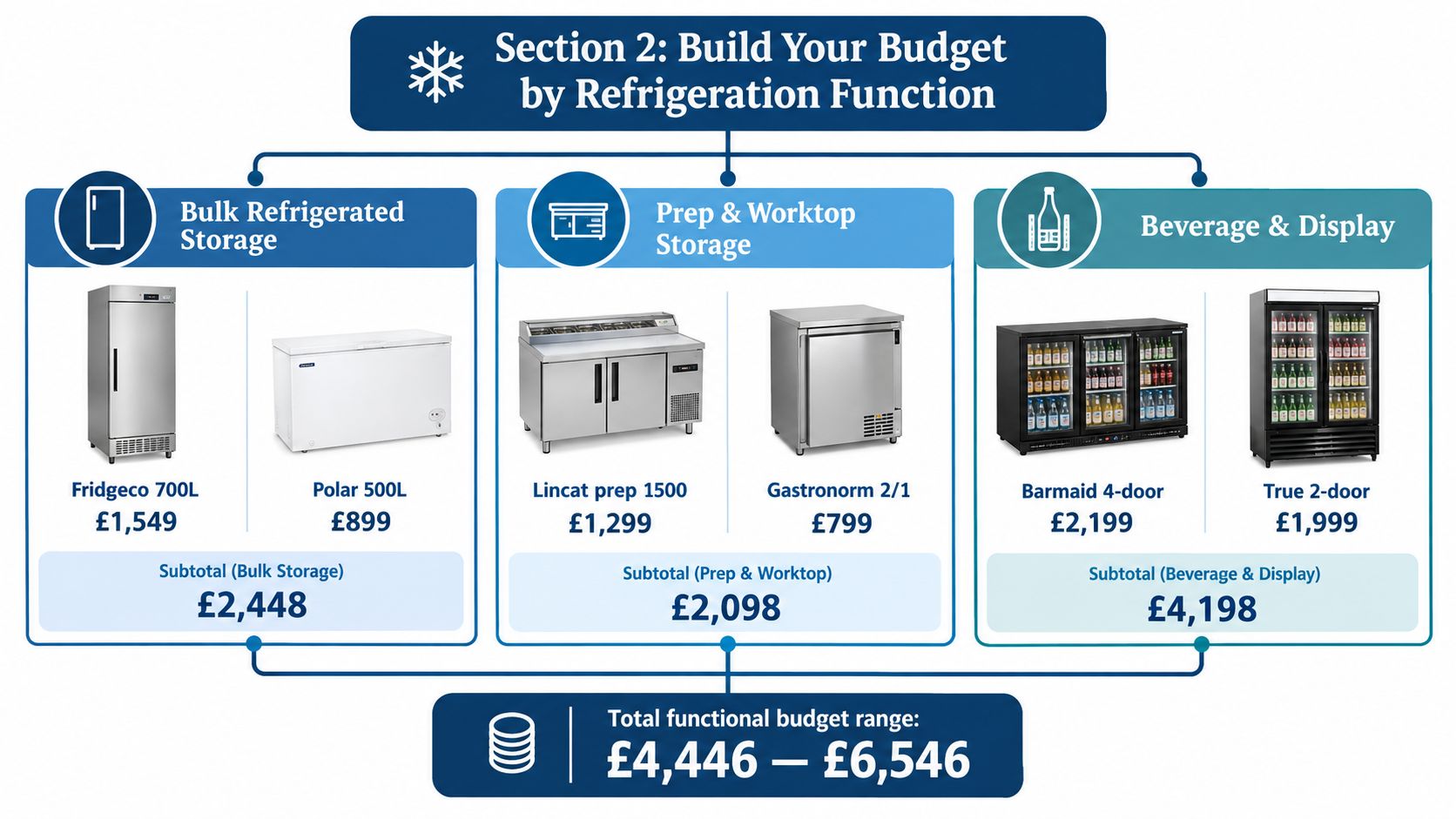
The cleanest way to answer how much should you spend on commercial refrigeration? is to price the job by function. That creates a refrigeration schedule the business can work from, instead of a vague lump sum.
Start with bulk storage
Bulk refrigerated storage is the backbone of the system. Upright fridges and, where needed, cool-room capacity come in. If the business receives regular produce, dairy, meat, or prepared goods, this category usually carries the most pressure because it needs to absorb deliveries without turning every shelf into a puzzle.
Add working refrigeration
Working refrigeration sits near prep and cook stations, where staff need fast access. Underbench units are often the right answer here because they reduce steps, keep ingredients close, and support line efficiency. When the cookline is busy, accessibility matters as much as raw litres.
Price preparation refrigeration separately
Preparation refrigeration is different again. Prep counters and prep fridges support mise en place, portioning, and quicker service, especially where salads, sandwiches, toppings, or cold assembly are part of the menu. The workflow question matters as much as the temperature question here.
Include display refrigeration only if it sells or stores product
Display units are easy to overbuy because they look impressive. They only earn their keep if the business needs food or beverage merchandising, visibility, or front-of-house holding. If display isn't doing a job, it can become expensive floor space.
Don't forget frozen storage
Frozen storage should be added where the menu requires it, not by default. Some operations need a freezer for stock buffering, others barely use one. The point is to match the freezer to the actual menu and delivery pattern.
For operators who like to compare frameworks, a simple way to cross-check the refrigeration schedule is against which commercial kitchen investments should you make first, because refrigeration often sits near the top of the priority list when a venue is opening or upgrading. When more detailed planning is needed, Exayard HVAC estimating software is the kind of tool some project teams use to keep equipment and service allowances structured, especially on larger fit-outs.
Illustrative Café Refrigeration Budget Using Current Pricing
An illustrative budget works better than a blanket rule because it shows how the numbers stack up in real equipment terms. This is not a recommendation for every 20-cover café, it's a simple example of how to cost a refrigeration schedule.
| Function | Example Equipment Type | Current Advertised Price |
|---|---|---|
| Bulk refrigerated storage | Commercial upright fridge | NZ$995 |
| Working refrigeration | Commercial underbench fridge | NZ$1,795 |
| Display refrigeration | Commercial display chiller | NZ$995 |
Using that kind of schedule, the illustrative equipment total comes to NZ$3,785. That number is useful because it links spend to function, not to a seat count.
A café with a simpler menu might need less than this. A café with heavier prep, more beverage holding, or frozen stock might need more. The right question isn't, “What should refrigeration cost for a café?” It's, “What refrigeration functions does this café need, and what does the required equipment add up to?”
That's also why different product families can be relevant at different points in the schedule. A basic upright fridge may cover bulk storage, while a unit from the SKOPE underbench fridges collection or an Atosa underbench model can be more suitable for working stock, depending on the kitchen layout and duty level. If frozen storage is part of the offer, Atosa upright freezers may belong in the schedule as well.
The budget should follow the schedule, not the other way around.
A second snapshot from the NZ market shows commercial refrigeration listings ranging from about NZ$2,000 up to NZ$175,000. That spread is a good reminder that once a business moves beyond a single cabinet, the refrigeration budget can change very quickly with scale and specification.
Purchase Price Versus Whole of Life Cost
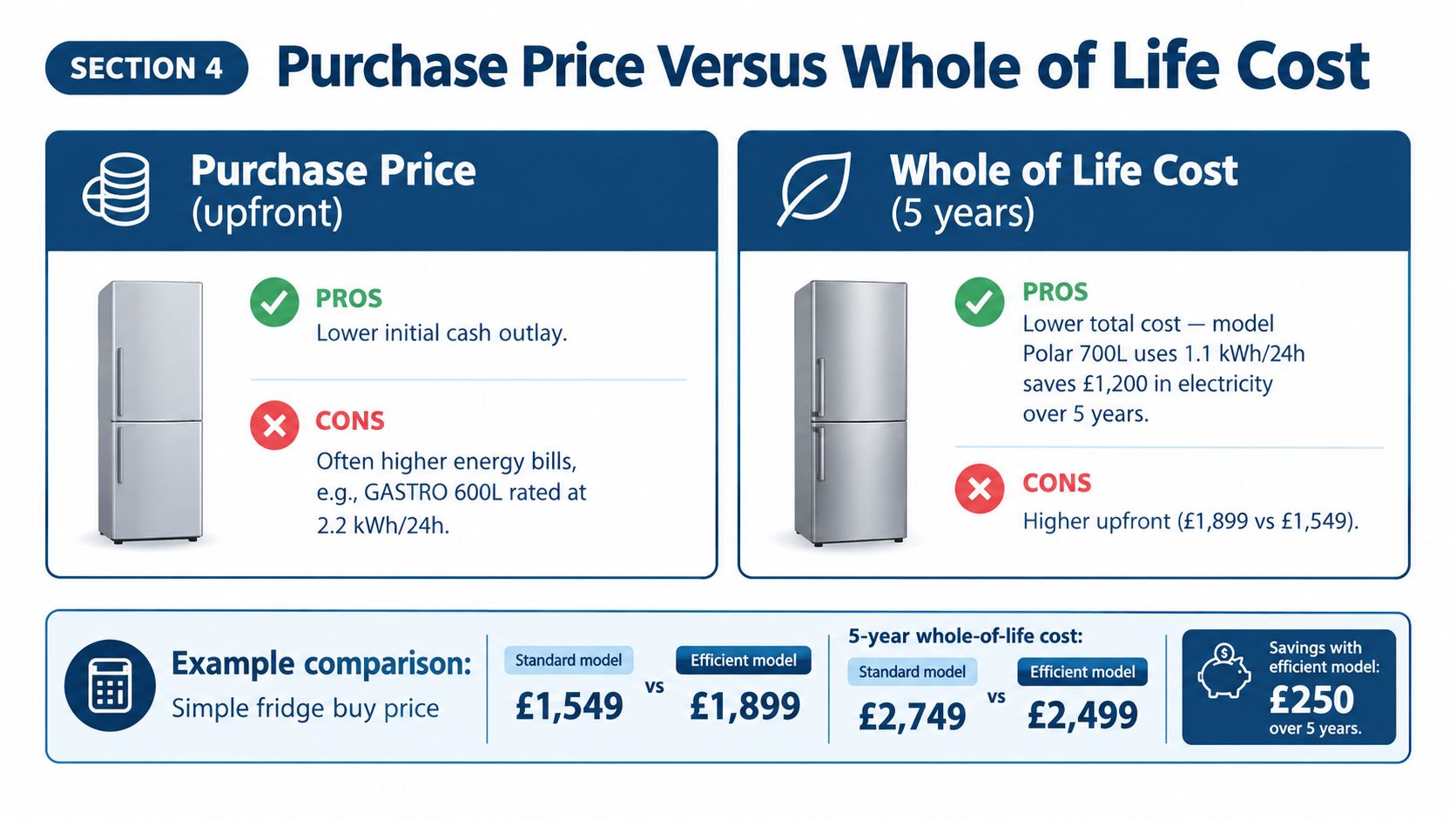
A fridge's sticker price is only part of the story. The bigger question is what it costs to own, operate, and keep reliable across the life of the business.
Energy is the obvious place to start. EECA's business energy data notes that more than half of businesses spend less than NZ$500 a month on electricity, and refrigeration systems are one of the main energy expenditures, so even a modest efficiency decision can matter in daily operating cost EECA business energy data. That does not mean the most expensive fridge is always the smartest buy. It does mean the cheapest cabinet on the floor might not be the cheapest to run.
The same caution applies to controls, warranty, parts availability, construction, and suitability for the operating environment. A unit that looks fine in a showroom can struggle in a hot kitchen, a cramped bar, or a site with weak airflow. A fridge that is cheap to buy but awkward to service can also become expensive every time it goes down.
The real cost of downtime is often the stock inside the cabinet, not the repair invoice.
Stock at risk matters because a failed fridge can interrupt service long before the cabinet is repaired. That risk is higher in critical applications where chilled product, prep stock, or display stock is tied directly to the day's trading. In those situations, construction quality and workflow suitability can matter as much as headline price.
SKOPE and Atosa both have places in a sensible buying conversation. They suit different budgets and operating requirements, and the right choice depends on actual duty, kitchen temperature, and the level of control the venue needs. A premium-spec unit can be justified in one operation and unnecessary in another.
For a deeper look at that trade-off, the article on whether premium refrigeration always makes sense is worth reading alongside the product specification sheets, because the best option is rarely chosen by price alone.
Hidden Costs and Design Integration to Budget For
The sticker price is only part of the job. Freight, access, positioning, services, and layout can all change what a refrigeration purchase really costs on site.
A practical checklist helps before the order goes in.
- Freight and delivery: long carry distances or awkward loading areas can affect the job.
- Site access: narrow doors, stairs, or tight corridors can make positioning harder than expected.
- Electrical requirements: the outlet has to suit the cabinet and the site.
- Ventilation and clearances: heat rejection has to work in the space the cabinet sits in.
- Plumbing or drainage: only relevant where the specific equipment needs it.
- Shelving and accessories: useful additions can change both function and cost.
- Removal of existing equipment: old cabinets still need to come out.
- Energy, routine maintenance, and cleaning: these are ongoing, not optional.
Commissioning only needs to be budgeted where the equipment requires it. A plug-in commercial refrigerator does not automatically need specialist commissioning, but the site still needs to be prepared properly.
Temperature compliance still shapes the install. If the cabinet can't hold temperature in the space it has been given, it is the wrong spec even if the brochure dimensions fit.
For new kitchens or major refurbishments, SACH Design is relevant because refrigeration should sit around workflow, not just against a wall. Delivery, storage, preparation, cooking, and service all need room to work. In many kitchens, several correctly placed units do more than one oversized upright, because staff spend less time walking, bending, and rearranging stock.
Routine care matters too. Pair the purchase plan with commercial refrigeration maintenance guidance so the budget covers what the cabinet needs every day, not only what it cost on invoice day.
Choosing the Right Refrigeration Spend for Your Venue
The safest way to budget is to forget the percentage question. Work out what needs to be refrigerated, specify enough usable capacity for peak inventory, then cost the equipment that can do the job properly. That approach protects against both undersizing, where stock becomes crowded and access gets awkward, and oversizing, where capital and kitchen space sit half empty.
A fridge that is too small creates its own bill later, because the business ends up rearranging stock, pushing product into unsuitable spaces, or buying another cabinet sooner than planned. A fridge that is too large can be just as wasteful if it steals valuable floor area and drives unnecessary energy use.
The strongest budgets start with the business stage, the menu, the delivery pattern, and the workflow around service. For a useful compare-and-contrast read, choosing refrigeration based on your business stage fits well with the function-first approach.
If the refrigeration schedule feels unclear, Hospitality can help map bulk storage, working stock, prep refrigeration, display, and frozen requirements into a practical equipment list. That makes it much easier to choose between SKOPE, Atosa, and other suitable options without guessing at a percentage first.
If you're planning a new kitchen or replacing ageing cabinets, Simply Hospitality can help size the refrigeration around your menu, workflow, and site conditions. Visit Simply Hospitality to compare suitable refrigeration options and get practical advice before you buy.