


What Does One Hour of Kitchen Downtime Really Cost?
A busy Friday service can lose its rhythm in seconds. A range stops heating, the dishwasher throws an error, or the only working fridge starts climbing out of its safe temperature range. Front-of-house staff slow bookings, the kitchen narrows the menu, and customers wait while the team decides whether to keep trading or shut a station.
So, what does one hour of kitchen downtime really cost? The answer isn't just the sales recorded during that hour. A useful estimate combines lost gross profit, wasted stock, idle labour, emergency costs, and recovery costs, while recognising that rent, fixed wages, insurance, finance, and other overheads keep running. The right figure depends on the venue, the trading period, and the equipment that failed.
The True Impact of a Sudden Kitchen Stoppage
At 7pm, a restaurant may have prep complete, reservations arriving, delivery orders queued, and a team positioned around a familiar cookline. At 7.05pm, the primary oven fails. The chef moves dishes to smaller appliances, the pass starts prioritising orders, front-of-house delays new tables, and the manager decides which menu items can still be produced.
The clock might show one hour. The disruption can reach much further. A reduced menu may lead to refunds or cancelled orders, unused prep may become waste, and staff may spend the rest of the shift working around a bottleneck. Customers who leave disappointed may not return, although that future effect is difficult to measure and shouldn't be presented as a guaranteed financial outcome.
Auckland's January 2020 power outage demonstrates why timing matters. RNZ reported that the cuts arrived around lunchtime, forcing some businesses to shut or cancel orders. One affected restaurant manager said a three-hour outage would create a hefty loss, while Heart of the City said businesses would have lost thousands of dollars. The report also described a broad CBD impact, rather than an isolated inconvenience. RNZ's account of the Auckland CBD power outage shows how a short interruption during peak trading can affect meals, bookings, table turns, prep, and same-day takings.
Practical rule: Measure the trading period affected, not just the number of minutes the appliance was unavailable.
A kitchen doesn't need to close completely for downtime to become expensive. A failed fryer can remove the core products from a takeaway menu. A dishwasher that stops during a busy service can leave clean plates, glasses, and utensils unavailable while dirty ware accumulates. A refrigeration problem can turn a trading interruption into a stock and food-safety decision.
Operators reviewing resilience can also use how reliable equipment protects your busiest trading days alongside practical electrical-outage guidance such as this resource for commercial electrician palm beach county. The point isn't to copy another business's loss figure. Verified customer revenue data varies too widely between venues to provide a universal benchmark.
The more useful question is operational: which failed appliance would stop the rest of the business from making money? That appliance deserves the clearest contingency plan.
Breaking Down the Three Cost Categories
Lost revenue and lost profit aren't interchangeable. If a restaurant normally takes NZ$2,000 between 7pm and 8pm, losing its only critical cooking appliance doesn't automatically mean NZ$2,000 of profit has disappeared. Some ingredients, utilities, and consumables linked to those sales may not be used, and the kitchen may recover part of the demand later.
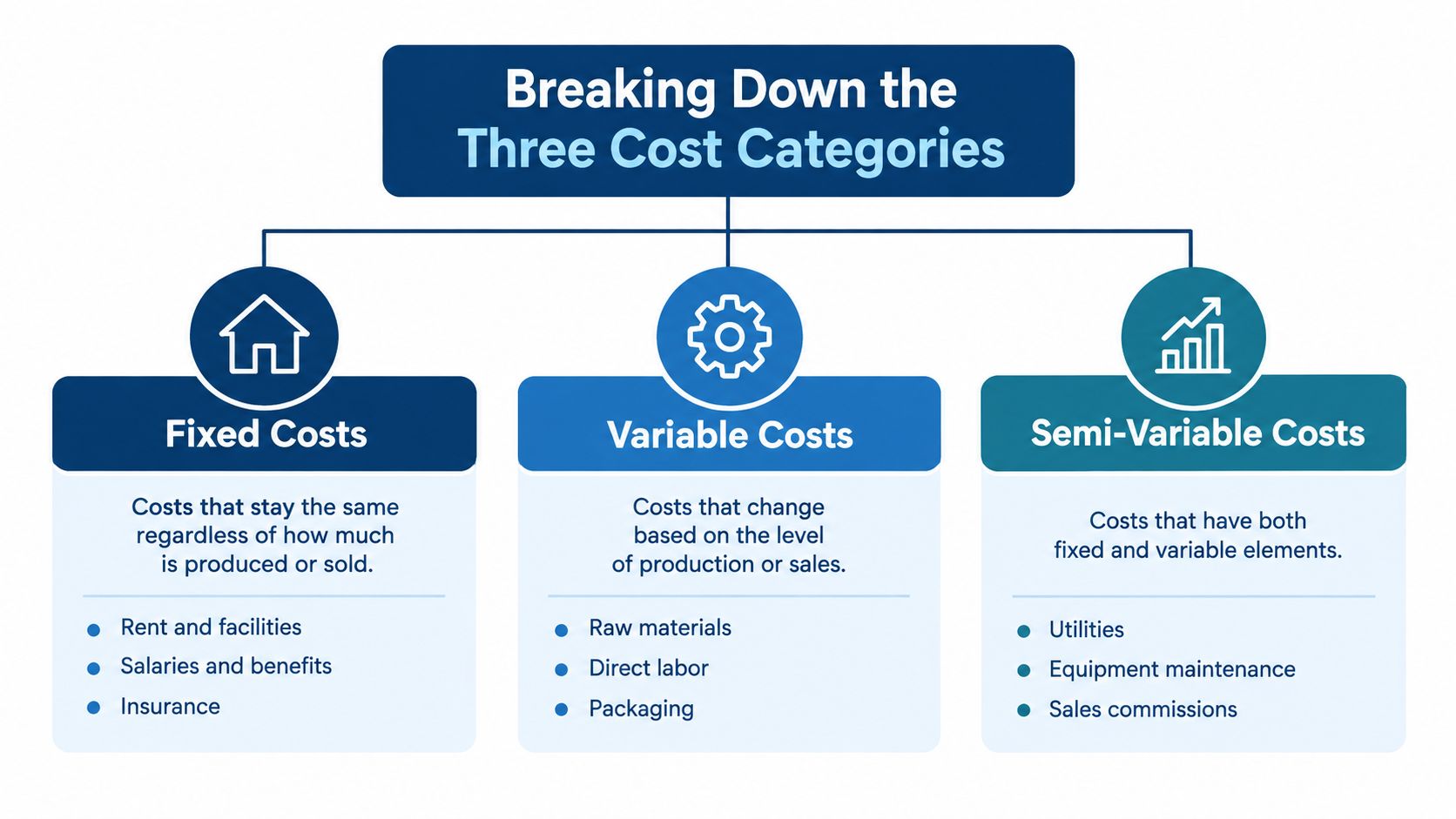
A practical downtime review separates the impact into three groups.
Costs that continue regardless
These costs keep running while the kitchen is idle or restricted:
- Rent: The premises still cost the business money, whether the kitchen is producing or not.
- Fixed labour: Salaried staff and other committed labour costs don't disappear because a station has stopped.
- Insurance: Cover continues through the interruption.
- Finance: Equipment and business finance repayments remain due.
- Other overheads: Software, administration, contracted services, and similar commitments may continue.
This category explains why an outage can damage margin quickly. A venue may avoid some production costs while still carrying much of its normal cost base.
Costs that may stop or reduce
Some expenses fall when production falls. The reduction won't be identical for every venue, because menus, supplier arrangements, and service style differ.
- Ingredients: Unused ingredients may avoid immediate replacement costs, although prepared or temperature-sensitive stock can become waste.
- Utilities: Cooking, refrigeration, extraction, and washing loads may change, but the premises won't necessarily use no power or water.
- Consumables: Packaging, cleaning products, napkins, and other service items may be used less during a restricted service.
These reductions should be deducted carefully. They reduce the cost attached to sales that never happened, but they don't make the interruption harmless.
Costs created by the failure
The breakdown can create a separate expense layer:
- Lost gross profit: The contribution that would have remained after variable costs on sales that could not be completed.
- Wasted stock: Ingredients, prep, and chilled or frozen products that can't be safely used.
- Idle labour: Staff may remain paid while waiting, cleaning around the failure, or working at a slower station.
- Emergency servicing: Urgent attendance, diagnosis, or parts may cost more than planned maintenance.
- Temporary equipment: Short-term hire or alternative production arrangements may add expense.
- Refunds and cancelled orders: The venue may need to return payments or absorb failed delivery orders.
- Recovery overtime: Staff may need extra time to complete prep, cleaning, or service after production resumes.
The rewashing cost in a commercial kitchen offers a useful reminder that small operational inefficiencies can become commercial costs when a process is disrupted.
The working formula is:
Approximate downtime cost = lost gross profit + wasted stock + idle labour + emergency costs + recovery costs
This method avoids two common errors. It doesn't treat every lost dollar of sales as profit, and it doesn't pretend that avoided ingredient costs offset rent, wages, disruption, and waste.
Calculating Your Venue's Hourly Exposure
A venue can turn downtime into a useful planning number without pretending the result applies everywhere. The calculation should use the affected service period, the equipment involved, and the sales that could realistically have been saved through a reduced menu or alternate production method.
A practical calculation method
- Identify normal sales for the affected period. Use the venue's own till or booking records for comparable trading periods.
- Estimate sales lost. Separate cancelled sales from orders delayed, transferred to another service period, or completed through a reduced menu.
- Remove variable costs that weren't incurred. Include only relevant food, packaging, energy, and consumable costs.
- Add continuing costs exposed during the interruption. Consider fixed labour and the portion of overheads that remains payable.
- Record new costs caused by the failure. Include waste, urgent servicing, temporary equipment, refunds, overtime, and recovery work.
- Review the wider consequence. Note food-safety disposal, missed bookings, reduced capacity, and any operational backlog.
The result is an estimate, not an accounting entry. It becomes more useful when the same method is applied to the appliances the business depends on most.
Consider a venue assessing a primary cooking module such as the Waldorf 800 Series INL8410ECF - 900mm Induction Range Convection Oven Low Back Version. Its configuration combines four induction cooking zones with a GN 2/1 convection oven, so the exposure depends on how many menu items rely on that combined capacity and whether other appliances can absorb production.
The example below uses illustrative figures only, not customer data. Operators should replace every amount with their own records.
| Cost Category | Hourly Impact (NZD) | Notes |
|---|---|---|
| Lost gross profit | NZ$1,200 | Estimated contribution from sales that couldn't be completed after variable costs |
| Wasted stock | NZ$250 | Prep and ingredients that couldn't be safely reused |
| Idle labour | NZ$300 | Paid labour with reduced productive output |
| Emergency costs | NZ$450 | Urgent attendance, temporary arrangements, or related charges |
| Recovery costs | NZ$200 | Extra cleaning, prep, refunds, or overtime |
| Approximate downtime cost | NZ$2,400 | Combined estimate for the affected event |
The table isn't a promise that a venue will lose this amount. It demonstrates how the total can exceed the directly visible sales shortfall, while still avoiding the mistake of calling all lost sales profit. A venue that retains partial production may have a lower lost-gross-profit figure. One that loses its only critical station may face higher waste and recovery exposure.
Electrical load also matters. New Zealand's Electricity Industry Participation Code 2010 sets the Value of Lost Load at $20,000/MWh, which equates to about $20 per kW of electrical load for a one-hour outage. A kitchen with 30 kW of critical load therefore has a direct lost-load value of roughly NZ$600 before spoilage, labour inefficiency, or lost sales are added, as outlined in the Transpower VoLL study.
For a related operational comparison, manual dishwashing versus commercial dishwashers helps operators assess whether a fallback process can maintain service or just move the bottleneck elsewhere.
Assessing Equipment Criticality and Vulnerability
The most expensive appliance failure isn't necessarily the failure of the most expensive machine. It's the appliance the venue has no practical way to operate without.
Each operator should identify three pieces of equipment that would most seriously affect the business if they stopped working tomorrow. That list should reflect menu dependency, replacement options, food-safety exposure, service speed, and the ability of other equipment to absorb the work.
Refrigeration protects more than stock
Commercial fridges, freezers, display units, and blast chillers protect ingredients and prep as well as trading capacity. When refrigeration fails, the manager must control access, monitor temperatures, protect the door seals from unnecessary opening, and decide what can remain safely stored. A refrigeration fault can therefore create stock waste, food-safety risk, and a difficult reopening process at the same time.
Operators should record what each cabinet holds, which products are most vulnerable, and how temperature checks are documented. A refrigeration monitoring systems guide can support that planning without replacing the venue's own food-control procedures.
Cooking equipment sets menu capacity
A combi or convection oven often supports several menu sections, including roasting, baking, finishing, and batch production. If the only major oven fails, a venue may still have a functioning cooktop, fryer, or microwave, but the menu can become too narrow to deliver at normal speed.
Fryers present a different exposure. A failed fryer can be decisive for a takeaway built around fried products, while another restaurant may have enough alternative menu capacity to continue with limited disruption. The appliance's price doesn't determine its criticality. The menu and the fallback options do.
Washing and preparation create bottlenecks
A commercial dishwasher can overwhelm an operation progressively rather than immediately. Dirty plates, pans, glasses, and utensils continue accumulating, and staff may be diverted from prep or service to wash by hand. The commercial dishwasher collection should be assessed alongside water, drainage, ventilation, access, and throughput requirements, rather than as a standalone purchase.
Ice machines can be mission-critical for bars, hotels, events, and beverage-led venues. Food-preparation equipment, including slicers, mixers, processors, and vacuum systems, can also remove a substantial amount of prep capacity when one unit fails.
Criticality test: If the machine stopped during the next peak service, could another appliance produce the same output without creating an unsafe or unsustainable bottleneck?
That answer should guide maintenance priority, spare-part planning, staff training, and replacement timing. It shouldn't be based only on purchase price.
Navigating Food Safety and Insurance Implications
An interruption becomes more serious when the business can't demonstrate control over food, cleaning, and reopening decisions. Refrigeration deserves particular attention because official Auckland guidance says fridges are typically safe for only a few hours after a power outage, with food potentially requiring disposal after longer interruptions. The guidance creates a practical decision window, although it doesn't assign a separate economic value to the first hour compared with later hours. Auckland's food-business reopening guidance should be kept with the venue's emergency procedures.
The financial impact can also reach hygiene operations. New Zealand food hygiene regulations require knives, cutting boards, and slicing machines used on premises to be thoroughly washed and rendered hygienic at least once each working day, as set out in the Food Hygiene Regulations. If an equipment failure prevents normal cleaning or safe production, management needs a documented alternative, not an improvised assumption.
Insurance needs careful reading
Business interruption insurance generally responds to loss of income after insured damage, rather than every form of utility interruption. Official New Zealand business insurance guidance says cover can help with wages, rent, utilities, and some profit over an agreed period when an interruption follows events covered under commercial property material damage cover.
Machinery breakdown cover addresses a different risk. A New Zealand policy briefing describes the purpose of breakdown cover as funding repair or replacement of essential machinery and helping the business survive resultant interruptions without adversely affecting expected profits. It also explains that business interruption calculations can include reduced turnover and increased costs of working over an indemnity period normally between 12 and 36 months, according to the QBE machinery breakdown briefing.
Policy wording, exclusions, waiting periods, evidence requirements, and the insured cause all matter. Operators considering how to file a business interruption claim should also preserve sales records, waste records, staff timesheets, service invoices, temperature logs, and communications with customers.
Food-safety obligations still apply during an insurance discussion. The New Zealand food safety regulations overview gives operators a useful reference point, but it doesn't replace advice from the relevant council, verifier, insurer, or qualified adviser.
Building Resilience Through Strategic Procurement
Resilience starts before the breakdown. A venue that knows the make, model, serial number, dimensions, services, and critical parts for every essential appliance can make decisions faster than a venue searching for those details during Friday service.
Commercial equipment should be selected for total ownership conditions, not just the purchase specification. An operator should ask:
- Parts support: Can the required parts be sourced through an established New Zealand support network?
- Service access: Is there a realistic path to qualified technical assistance when the appliance fails?
- Workflow fit: Can staff clean, load, unload, and maintain the unit without creating avoidable bottlenecks?
- Installation: Are electrical, gas, ventilation, drainage, access, and floor requirements understood before ordering?
- Fallback capacity: Can another appliance temporarily absorb part of the output?
- Replacement compatibility: Are the dimensions and services recorded so a replacement can be identified quickly?
Established commercial brands with strong New Zealand parts and service support can reduce uncertainty around mission-critical equipment. That doesn't guarantee immediate repair or eliminate failure. It can, however, make diagnosis, parts identification, temporary planning, and replacement decisions more organised.
Hospitality places value on this support question when discussing equipment choices with operators, while recognising that it doesn't provide repair services. Its catalogue covers commercial refrigeration, cooking, food preparation, dishwashing, and related hospitality supplies, so operators can compare equipment categories and plan a coordinated working environment rather than selecting each appliance in isolation.
Cheap equipment can create expensive exposure
A lower purchase price may look attractive until the venue considers cleaning access, installation changes, parts availability, staff training, and the cost of an unsuitable replacement. A buying cheap versus buying once comparison can help operators test whether the apparent saving survives normal ownership conditions.
Finance can also affect the decision. Flexible finance arrangements may allow a business to acquire suitable commercial equipment without carrying the entire upfront cost, but the repayment commitment still needs to fit the venue's cash flow. Insurance, warranty terms, planned maintenance, and emergency contact arrangements should sit beside the finance decision.
A broader guide to restaurant insurance can help operators frame equipment failure within wider risk planning. The strongest procurement decision isn't automatically the most expensive or the newest. It's the one that protects menu capacity, has workable support, fits the site, and gives the business a credible recovery path.
Your Pre-Service Contingency Checklist
A contingency plan should be visible, current, and usable by the duty manager. It shouldn't depend on one owner remembering which contractor installed the dishwasher or where the refrigeration paperwork was filed.
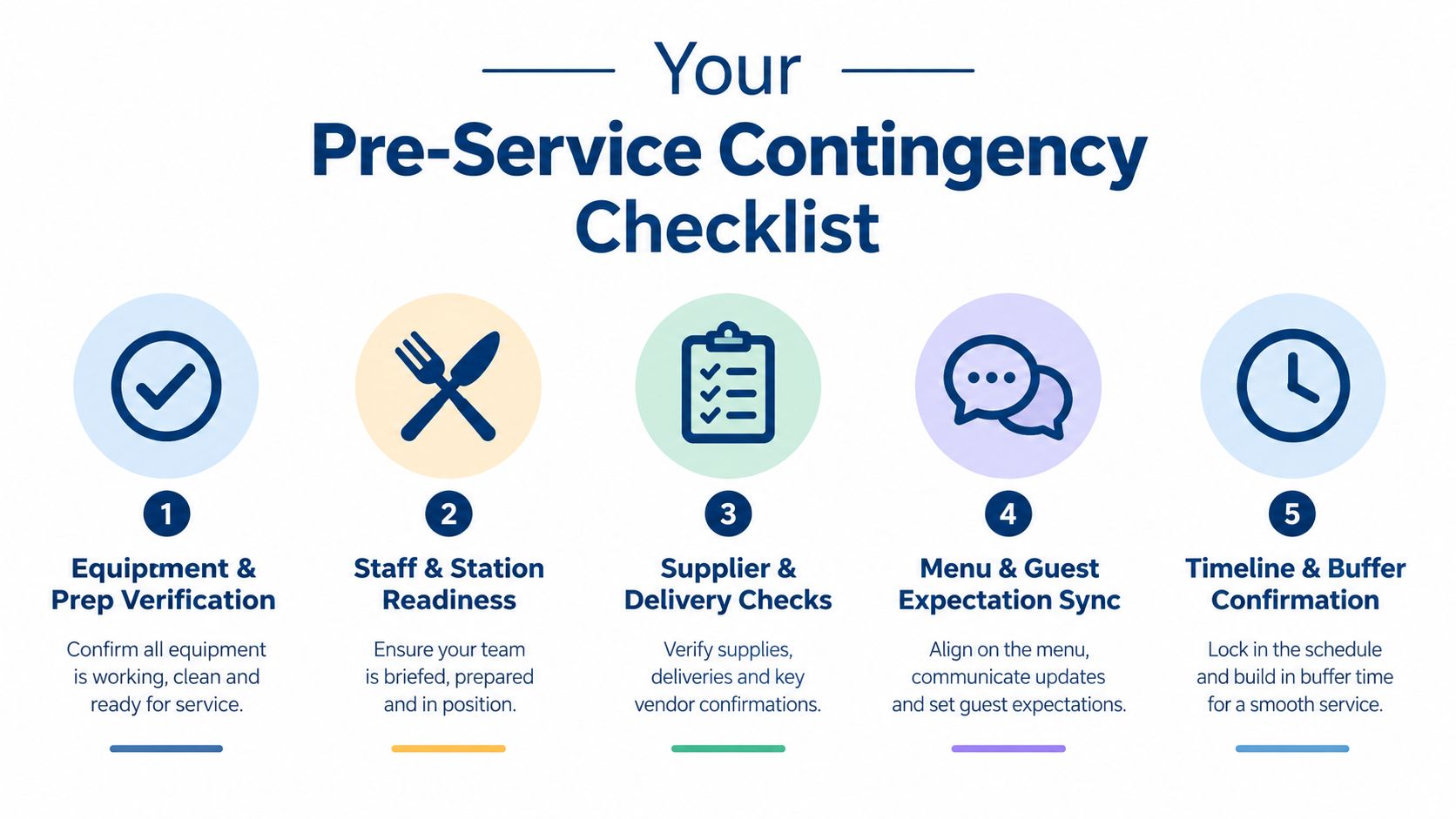
Before a high-volume service, operators should confirm:
- Equipment records: Model and serial information is recorded for the three most critical appliances, with photographs of rating plates where useful.
- Service contacts: The approved service contact, after-hours contact, warranty details, and escalation process are available to the duty manager.
- Fallback production: Staff know which menu items can continue if the oven, fryer, dishwasher, ice machine, refrigeration, or preparation equipment fails.
- Stock protection: The team knows what happens to chilled and frozen stock, who records temperatures, and who authorises disposal.
- People and communication: Kitchen and front-of-house staff know who can reduce the menu, pause orders, contact customers, and document refunds.
- Replacement information: Required dimensions, electrical or gas services, access constraints, and alternative specifications are kept together.
One simple training exercise is to ask the team to name the first three actions after each critical appliance stops. Training should also cover cleaning and safe workarounds, not just production. A kitchen staff training resource can support that conversation.
The middle of a busy service isn't the time to discover who manufactured the dishwasher. Prepared operators can make a controlled decision, protect stock, keep a reduced menu moving, and start recovery with the right information.
Hospitality supplies commercial refrigeration, cooking, food-preparation, dishwashing equipment, tableware, and related hospitality essentials for New Zealand businesses. Visit Simply Hospitality to review equipment options and contact the team for help matching a mission-critical appliance to the venue's workflow, site services, and contingency needs.