


What Is Reverse Osmosis and Why Does It Matter in Warewashing?
Reverse osmosis uses pressure and a semi-permeable membrane to reduce dissolved substances in water. In warewashing, its value is controlling what remains on glassware and crockery after the final rinse evaporates, not making the machine run faster.
That distinction matters because “better washing” can mean several different things. A dishwasher must remove food soil, rinse away chemistry and deliver hygienically clean ware, but the last water touching a glass also affects how that glass looks when it dries. If dissolved minerals remain in the rinse water, they can become visible as spots, streaks or film.
The right question isn't whether every commercial dishwasher needs RO. It's whether the incoming water, the equipment and the required finished result justify a membrane treatment system. New Zealand supplies vary widely, and many are already soft, so a measured diagnosis is more useful than an automatic upgrade.
What Reverse Osmosis Actually Does in a Commercial Kitchen
Reverse osmosis, or RO, pushes water under pressure through a semi-permeable membrane. Water molecules pass through, while the membrane rejects a substantial proportion of dissolved salts, minerals and other small substances. The process isn't the same as using a simple sieve. It's a molecular-scale separation that produces a treated-water stream and a reject, or concentrate, stream.
In warewashing, RO is usually relevant to the final-rinse water. The sequence is straightforward:
- Water reaches the glass or dish.
- The water evaporates during drying.
- Dissolved material that didn't leave with the water can remain on the surface.
That residue is what the customer may see under bar lighting or across a white plate. RO therefore controls the composition of the rinse water, rather than making the warewasher's programmed cycle shorter or removing food soil more effectively.
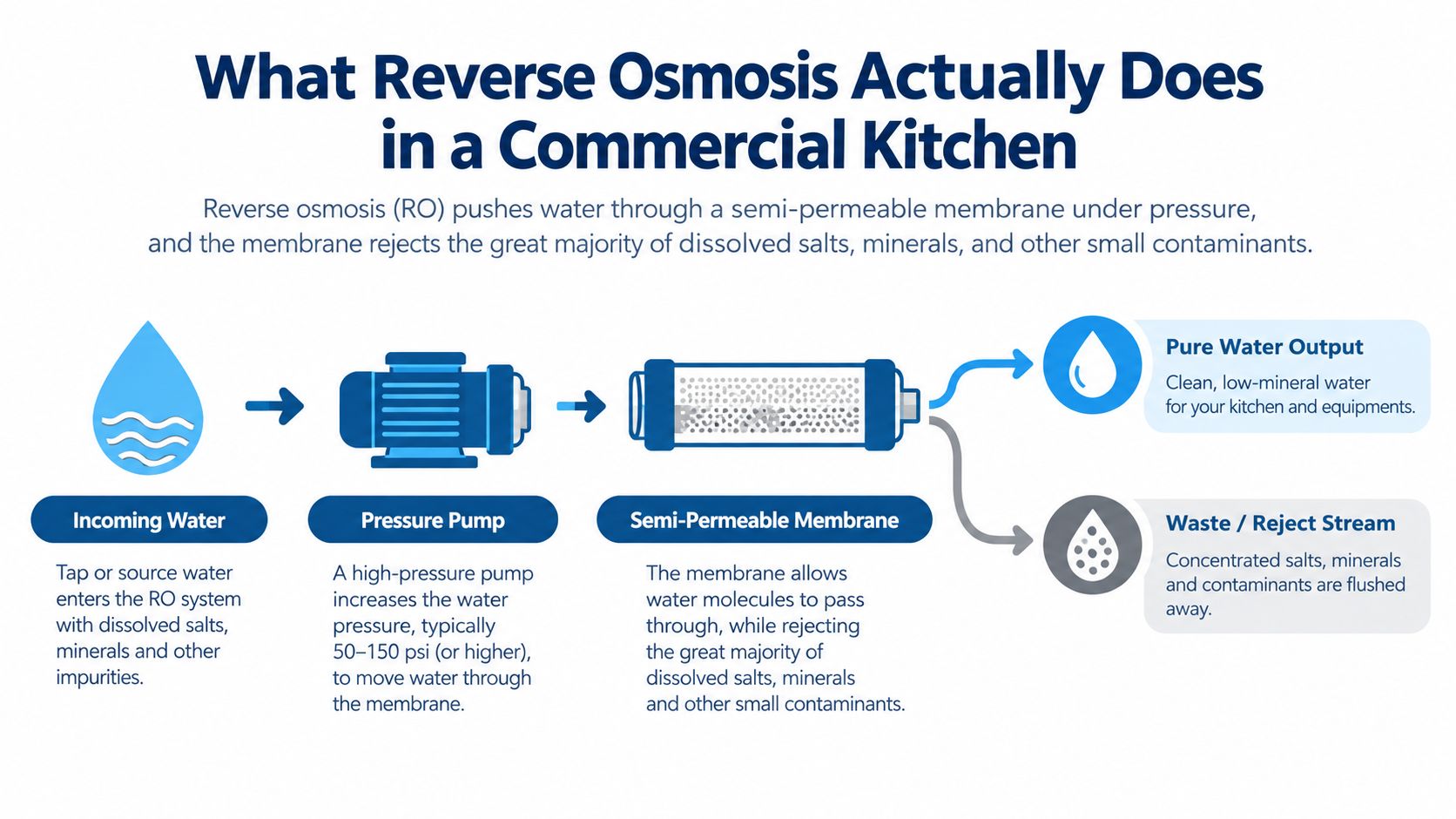
The membrane addresses invisible residue
A final rinse with lower-mineral water can help reduce spotting, filming and repeated polishing where dissolved material is contributing to the problem. That's particularly relevant for wine glasses, cocktail glassware and other clear items where a small mark is easy to notice.
New Zealand water data shows why the decision can't be based on a single national assumption. Tauranga City Council classifies water below 17 mg/L of calcium carbonate as soft, while water between 120 and 180 mg/L is hard and water above 180 mg/L is very hard. Tauranga's own supply is reported at 10 mg/L, firmly within the soft range (Tauranga City Council water information).
A plain-language overview of the membrane process can also help operators distinguish RO from ordinary cartridge filtration. The SouthRay Kitchen & Bath RO guide provides useful background on how pressure and membrane separation work.
Practical rule: RO controls dissolved material in the water. It doesn't correct a blocked spray arm, an empty rinse-aid container, a dirty wash tank or a scratched glass.
Minerals aren't responsible for every mark. Poor dosing, machine condition, loading, food residue, incorrect operating conditions and the condition of the glass itself can all produce disappointing results. RO should be considered after the whole washing process has been checked.
Why a Wash Result Can Disappoint (And Why It Is Not Always the Water)
A glass can look cloudy even when the incoming water isn't the main problem. Operators should investigate the process before requesting additional treatment, because a dosing adjustment or service visit may address the cause more directly than an RO system.
Start with the chemical programme. Too little detergent can leave soil behind, while too much can contribute to film, foam or residue. Rinse aid also needs to be delivered at the level specified for the machine and product. A pump that has drifted out of calibration may under-dose or over-dose for many cycles before anyone connects the result with the equipment.
The machine itself deserves a close inspection:
- Wash arms and jets: Blocked openings reduce spray coverage and mechanical action.
- Rinse nozzles: Mineral or food deposits can affect final-rinse distribution.
- Filters and scrap screens: Poor cleaning allows soil to circulate rather than leave the machine.
- Racks and baskets: Bent supports can tilt glasses, allowing water to pool instead of draining.
- Tank and internal surfaces: Poor cleaning can create carry-over that resembles water spotting.
Loading creates another set of variables. Overloaded racks prevent water and chemistry from reaching every surface, while glasses placed too closely together can trap residue. Food and beverage carry-over, especially oils, milk proteins and sticky drink residues, can also create a film that looks like a mineral mark after drying.
Check the ware before changing the water
Glass condition often gets overlooked. Scratched or permanently etched glass may stay hazy even after the washing process has been corrected. Previous exposure to aggressive chemistry, unsuitable temperatures or repeated abrasive handling can change the surface permanently.
Wooden boards, utensils and other porous items can retain oils and food residue. If they share a rack or washing sequence with presentation ware, they can add contamination to the process. Pre-scraping and suitable separation may solve that issue without any water treatment.
The machine's rinse temperature and pressure should be compared with the equipment maker's specifications. An operator shouldn't assume that hotter or stronger is always better, because the correct operating window depends on the particular warewasher, chemical programme and load.
A useful diagnostic sequence is:
- Inspect and clean the machine, arms, jets, filters and racks.
- Check detergent and rinse-aid delivery.
- Review loading, pre-scraping and ware separation.
- Examine glass condition and recurring residue types.
- Verify temperature and pressure against manufacturer guidance.
- Test the incoming water if spotting, scale or filming remains.
The guide to what causes spotty glassware gives operators a practical way to separate mineral-related marks from process and glass-condition problems.
Filtration, Softening, and Reverse Osmosis Compared
These three treatments are often discussed as though they're interchangeable. They aren't. Each one targets a different part of the water, and the correct choice depends on incoming water, equipment requirements, required finished result and operating volume.
| Treatment | What it removes | Solves in warewashing | Does not solve |
|---|---|---|---|
| Filtration | Particles and selected substances, depending on filter technology | Sediment or specific water constituents targeted by the cartridge | Dissolved hardness minerals unless the filter is designed for that purpose |
| Softening | Primarily calcium and magnesium hardness ions through an ion-exchange process | Scale risk associated with hardness | All dissolved solids, and it won't automatically guarantee spot-free glassware |
| Reverse osmosis | A broad proportion of dissolved minerals and other substances through membrane separation | Lower-mineral final-rinse water, reduced spotting potential and lower mineral deposition where the setup suits the machine | Poor loading, incorrect chemistry, blocked components or damaged glass |
Filtration is targeted
A filter can remove particular particles or contaminants, depending on the media and cartridge design. It may improve water entering the equipment, but “filtered” doesn't automatically mean “low in dissolved minerals”. Operators need to identify what the cartridge is designed to remove and how long it remains effective.
Basic filter upkeep also matters. Guidance on maintaining home water filters is written for domestic applications, but it reinforces a general point that applies to commercial systems too: a treatment device requires an organised replacement and inspection routine.
Softening focuses on hardness
A softener primarily addresses calcium and magnesium through a resin process. It can be valuable where hardness is contributing to scale on heating elements, spray arms, hot water cylinders or internal water paths. The treated water may still contain other dissolved substances, so softened water isn't the same as demineralised or RO water.
RO takes a broader approach. It reduces a substantial proportion of dissolved material from a controlled water stream, which is why it's often selected for demanding glasswashing and high-presentation service. Hobart describes osmosis as producing “almost 100% desalted water” for applications where dishwasher use is high and a spotless result is required (Hobart water quality and treatment guidance).
The best treatment isn't the most advanced treatment. It's the one that addresses the measured problem without creating an unnecessary operating burden.
Some sites need a combination. A pre-filter may protect the RO membrane, a softener may address upstream hardness, and RO may supply the final rinse. Other sites may need only a filter or softener. The equipment maker's inlet specifications should guide the final decision.
Operators can also read more about how water quality affects dishwasher performance before selecting a treatment category.
Reading Your Water in NZ Without Overplaying Hardness
Hardness matters, but it is an easy culprit to blame too quickly. A spot on a glass can come from dissolved minerals, yet chemistry, loading, temperature, pressure, equipment condition and drying can produce a similar result. Start with the site's water and the finished wash, rather than assuming hardness explains everything.
Auckland groundwater sources fall into soft or moderately hard categories. Watercare notes that the New Zealand Drinking Water Standards guideline value for total hardness is below 200 mg/L (Watercare information on water hardness). Hamilton describes most New Zealand waters as soft, at under 75 g/m³ as calcium carbonate, and identifies water around 40 g/m³ as calcium carbonate in its local context. These figures provide regional context, not a substitute for testing at the equipment connection.
TDS is an indicator, not a diagnosis
Total dissolved solids, or TDS, is a measurement that indicates dissolved ionic material in water. A TDS meter can compare incoming water with RO-treated water and show whether the system is producing a materially different output.
TDS does not identify each substance, explain why a glass is marked or replace a complete water-quality analysis. Read it alongside hardness, the machine's specifications, chemical settings, temperature, pressure and the actual finished result. The practical question is what remains on the ware after rinse water evaporates, and whether that residue is causing a visible or operational problem.
| Supply type | Typical TDS | Typical hardness as CaCO3 | Common warewashing issue |
|---|---|---|---|
| Soft municipal supply | Varies by location | Often low, but not uniform | Spotting may still come from chemistry, loading or glass condition |
| Moderately hard or groundwater supply | Varies by location | Can be higher at the site connection | Greater potential for scale or mineral residue |
| RO-treated stream | Lower than the incoming supply when the system is operating correctly | Reduced mineral content | Requires correct sizing, maintenance and compatible equipment |
The table avoids universal TDS or hardness thresholds because supplies and machines differ. The manufacturer's inlet requirement takes priority over a generic recommendation.
For example, the Electrolux Professional rack-type dishwashing specification calls for 2 to 6 bar inlet pressure, hardness no higher than 50°fH/28°dH and conductivity at or below 10 µS/cm. It recommends an upstream softener when hardness exceeds that specification (Electrolux Professional New Zealand water-treatment specification).
Record the water baseline, define the visible or operational problem, and compare the findings with the exact warewasher or glasswasher documentation. If scale is the issue, a commercial dishwasher descaler may form part of the maintenance response, subject to the equipment and chemical manufacturer's instructions.
Premium Glassware, Polishing Labour, and an Honest Look at ROI
Clear glassware exposes water-quality issues more readily than many other items. A wine glass, cocktail glass or premium beer glass can be hygienically clean and still look unacceptable if it dries with visible spotting. That's why venues using collections such as Zwiesel, Pasabahce, Stölzle, Luigi Bormioli or Ocean often assess the final appearance as carefully as the cleaning result.
RO isn't universally required for premium glassware. The correct decision depends on incoming water, the glasswasher, the chemical programme, the condition of the glass and the venue's presentation standard. However, where operators are manually polishing glasses mainly to remove avoidable water marks, final-rinse quality becomes a sensible operational measure.
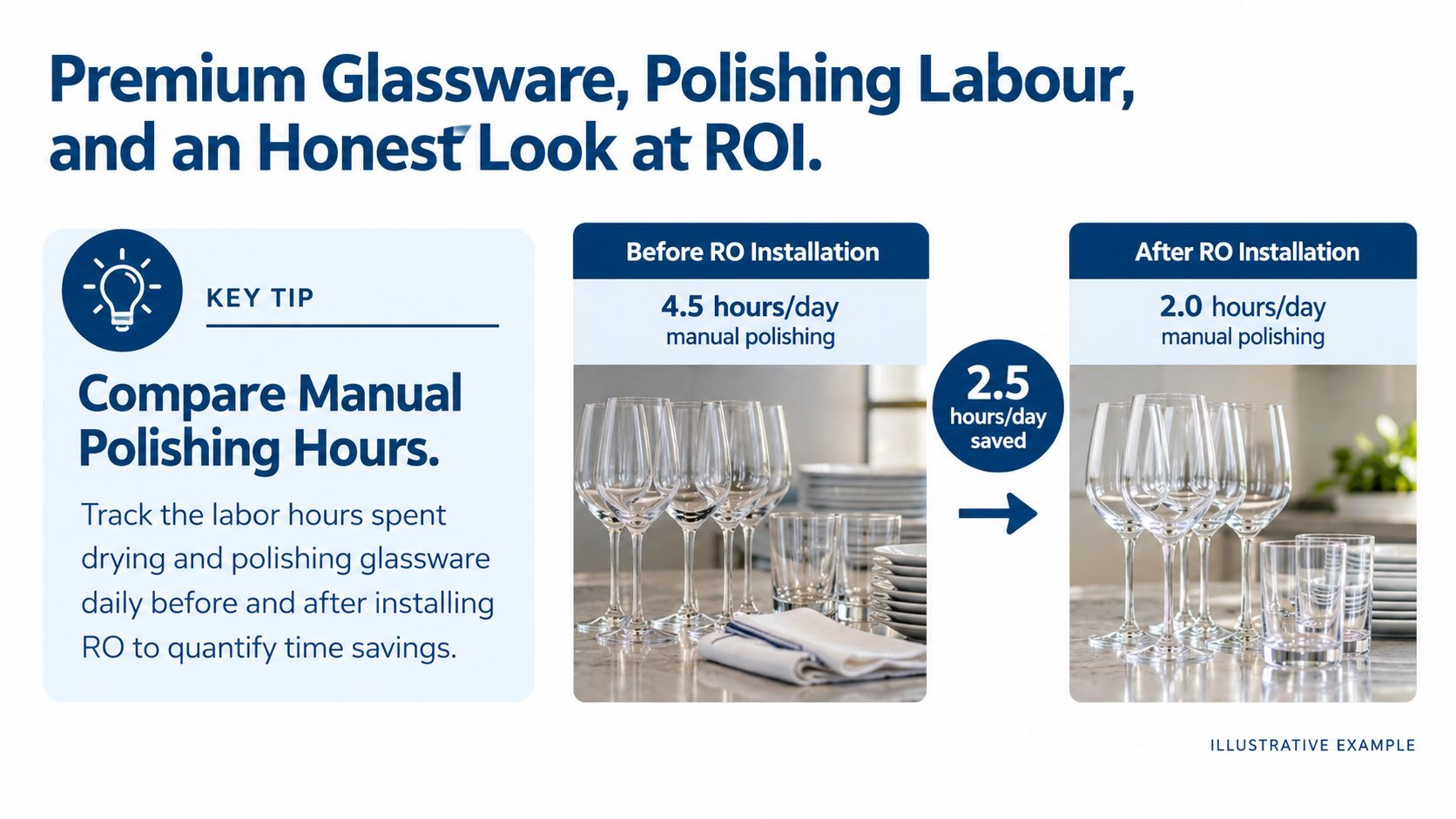
An illustrative labour calculation
The following example is illustrative only, not a customer result or a promise of RO performance.
Suppose a venue spends 30 minutes per day polishing avoidable water marks, using an illustrative loaded labour cost of $35 per hour. The daily labour time is half an hour, so the calculation is:
0.5 × $35 = $17.50 per day
Across 300 trading days, the illustrative annual labour time becomes:
$17.50 × 300 = $5,250 per year
That figure doesn't prove that RO will save the venue $5,250. It shows why the labour deserves measurement before and after any change. If polishing continues for reasons unrelated to dissolved minerals, the treatment won't remove that work.
The cost of hand-polishing glassware can help operators structure that measurement around actual roster time rather than assumptions.
What RO won't promise
RO water doesn't naturally shorten a warewasher's programmed cycle. Cycle duration is determined by the machine's programme and operating requirements, not only by the mineral content of the rinse water.
Operators also shouldn't assume automatic detergent or rinse-aid savings. Chemical use depends on incoming water, dosing equipment, machine settings, soil load and the chemical programme. Any change should be measured rather than promised.
Potential benefits may include:
- Presentation: Less mineral residue where water quality is contributing to spotting.
- Polishing time: A possible reduction in manual finishing work, if marks are avoidable and mineral-related.
- Scale control: Lower mineral deposition where the system and equipment guidance support it.
- Process consistency: A more controlled final-rinse input for demanding glasswashing.
The sensible ROI review compares the treatment's purchase, installation, water use, servicing and consumables with measured changes in polishing time, rewash frequency, appearance complaints and scale-related maintenance.
Capacity, Reject Water, and the Cost of Running an RO System
An RO system can produce excellent water and still be a poor fit if it cannot keep up with the busiest service. Capacity planning starts with the relationship between RO production capacity, storage where applicable and peak warewasher demand.
A glasswasher usually draws water in bursts, not at a steady average rate. Check the manufacturer's production rate, storage arrangement and recovery information, then compare them with the machine's actual demand during peak service. An undersized system may leave operators waiting, blending with untreated water or using RO inconsistently.
RO also creates a reject stream. The membrane separates treated water from concentrate, so the installation needs suitable drainage and a clear view of water consumption. One commercial equipment specification lists osmotised-water recovery at 35/65% and approximately 99% mineral removal before the dishwasher feed. Those figures show why equipment-specific documentation matters when assessing output and reject water (commercial equipment water-treatment guidance).
Recovery and reject-water characteristics vary between systems. Ask for:
- Treated-water production: Usable output under the site's pressure and temperature conditions.
- Storage capacity: The buffer available when demand arrives in short bursts.
- Reject-water volume: Concentrate flow and drain requirements.
- Operating pressure: The inlet range required for reliable performance.
- Consumables: Prefilters, membranes and post-treatment components.
- Service access: Space for inspection and replacement work.
Calculate whole-of-life cost as:
Purchase + installation + replacement filters + membrane replacement + servicing + water + energy where applicable = whole-of-life treatment cost
Inlet pressure also affects operation. One New Zealand RO technical guide specifies 275 to 520 kPa for proper operation and says a pressure-limiting device is required when line pressure exceeds 500 kPa under Australian and New Zealand plumbing standards (Puretec RO system technical guidance).
The Winterhalter reverse osmosis water-treatment range provides a useful reference when comparing commercial options. Final selection still depends on the particular warewasher, site plumbing and peak demand. A system that matches those conditions can support consistent use, while one chosen only for its treatment performance may create avoidable waiting, drainage and running costs.
Selecting, Maintaining, and Getting Help With the Right Setup
A practical RO decision has four hand-off points. Each one reduces the risk of buying a system that is technically impressive but unsuitable for the kitchen.
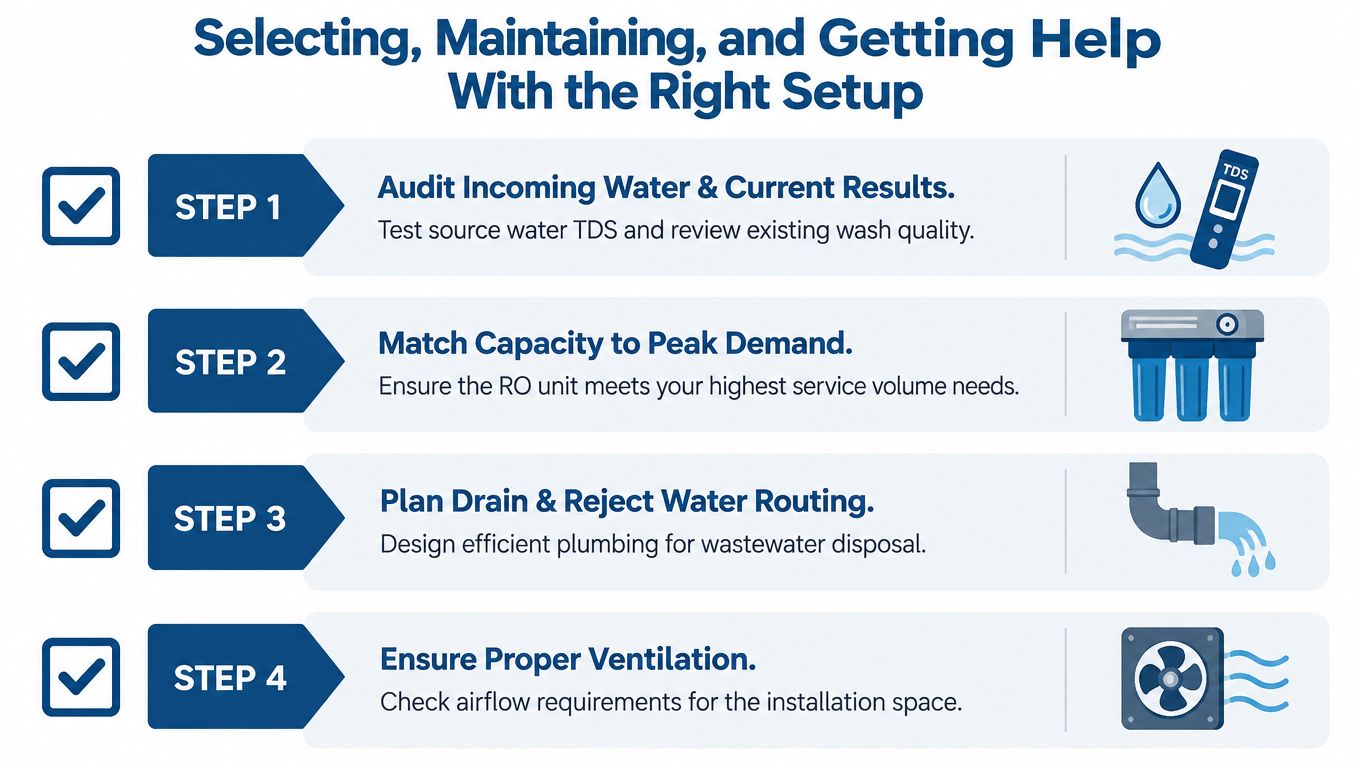
1. Establish the starting point
Record the current wash result, visible marks, polishing time, machine settings and recurring scale. Test the incoming water at or near the equipment connection where possible. A qualified laboratory, water-treatment provider or suitably trained technician can help interpret the result.
2. Match the system to peak demand
Count the likely glass and rack demand during the busiest service, not just the daily average. The equipment maker should confirm the required inlet pressure, conductivity, hardness, flow and any approved integrated or external RO options.
3. Plan the installation environment
Reject water needs a compliant drain route. The site also needs access to filters, membranes, valves and storage components, along with suitable ventilation where the equipment documentation calls for it. A licensed plumber or appropriately qualified installer should handle connection work where required.
4. Organise ongoing care
Maintenance must follow the RO manufacturer's instructions rather than a universal replacement calendar. Operators should monitor treated-water quality, output changes and system warnings, then arrange filter or membrane replacement according to the stated requirements and actual operating conditions.
A treatment system becomes another part of the warewashing system. It needs capacity, maintenance and service access just like the machine it supports.
Before requesting quotations, an operator should have four details ready:
- Water baseline: Available hardness, conductivity or TDS information.
- Peak glass demand: The busiest period's rack or glass volume.
- Drain location: A practical route for reject water.
- Service access: Space for inspection, consumable replacement and technical work.
Hospitality supplies commercial warewashing equipment and related kitchen products, but it doesn't operate a general dishwasher servicing, RO installation or water-treatment servicing business. Its role is to help operators compare compatible equipment and identify the questions that should go to the machine manufacturer, licensed plumber or qualified water-treatment technician.
Simply Hospitality can help assess commercial dishwashers, glasswashers and compatible water-treatment options against a venue's workflow, equipment requirements and presentation goals. Visit Simply Hospitality to discuss the right starting point before committing to an RO system.