

What Is the Cost of Manual Food Preparation in a Commercial Kitchen?
Manual food preparation in a commercial kitchen costs far more than most operators think because labour alone now starts at NZ$23.95/hour from 1 April 2026, while average kitchen wages have been reported much higher at NZ$29.77/hour and average hospitality wages at NZ$27.84/hour. The actual cost isn't the knife and board. It's the labour minutes each task consumes, repeated through every prep shift, every service, and every week of the year.
The popular advice on this topic is too soft. It treats manual prep as a simple wage-rate issue, or jumps straight to “buy equipment and save labour”. That misses the actual decision. What is the cost of manual food preparation in a commercial kitchen? It's this:
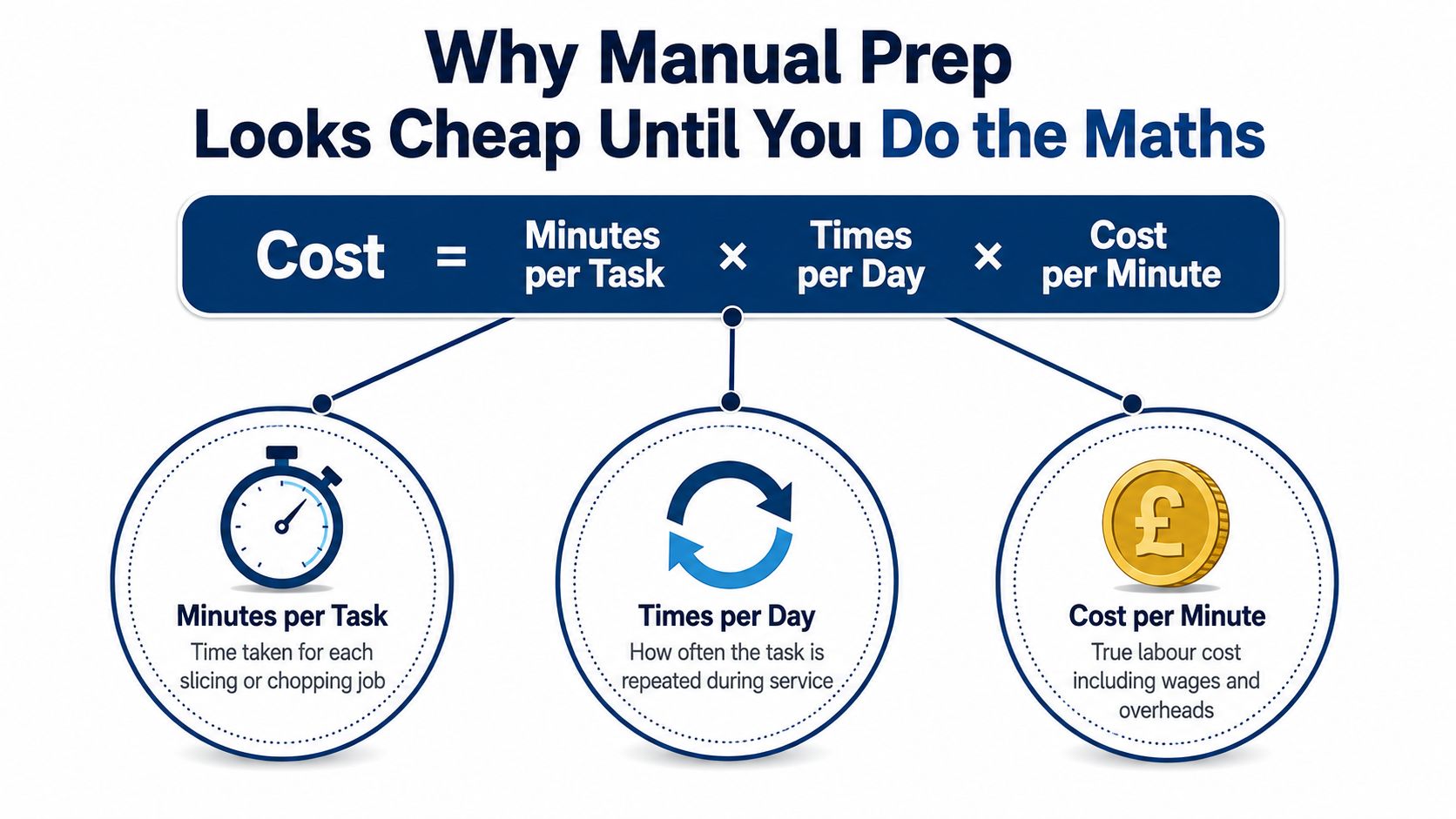
Time per task × frequency × true hourly labour cost = annual manual preparation cost
That's the only framework that matters. A few minutes of chopping doesn't look expensive when someone's standing at the bench doing it. It starts looking expensive when those same few minutes happen over and over again across prep-heavy menus.
In New Zealand, that matters because kitchen labour isn't cheap and productivity improvement in accommodation and food services has been modest. Stats NZ reported labour productivity in accommodation and food services rose 2.4% in the year to March 2023, while output rose 11.1% and labour inputs rose 8.5%, which points to businesses increasing production mainly by adding labour rather than getting dramatically more output per worker (Stats NZ productivity statistics). For operators, that means small prep inefficiencies stay expensive.
Why Manual Prep Looks Cheap Until You Do the Maths
Manual prep usually hides in plain sight. Staff peel onions, grate cheese, chop herbs, slice tomatoes, portion slaw, blend sauces, and move on. None of those jobs feels costly in isolation, so kitchens often undercount them.
That's the mistake.
The cost sits in repetition
A knife, chopping board, and prep bench feel “free” because they're already there. The labour isn't free. In New Zealand hospitality, labour is a major cost driver. The Restaurant Association's 2025 remuneration survey reported an average hospitality wage of NZ$27.84/hour, with kitchen roles averaging NZ$29.77/hour and kitchen hands averaging NZ$25.03/hour (RNZ coverage of the 2025 remuneration survey).
A common issue seen across hospitality businesses is that prep time becomes invisible because it happens before the rush. Service gets the attention. Prep burns wage dollars in the background. That's one reason slow prep creates wider operating drag, which is worth comparing with the hidden cost of slow prep and how the right approach fixes it.
Practical rule: Manual prep rarely looks expensive when someone chops for five minutes. The cost becomes obvious when those five minutes are repeated several times a day, hundreds of days a year.
The formula operators should use
The useful calculation isn't complicated:
- Time per task: How many minutes the task takes
- Frequency: How many times the kitchen repeats that task
- True labour cost: What that staff time costs per hour, not just the base wage
That's the commercial lens. Not whether hand prep “feels manageable”.
For prep-heavy venues, this matters even more because labour share can swallow margin. Industry commentary highlighted hospitality wages averaging NZ$27.84/hour in 2025, kitchen roles at NZ$29.77/hour, and labour costs reported at around 40% of revenue, with some commentary placing the median café or restaurant near 34% (Restaurant NZ wage cost commentary).
Operators don't need another generic claim about efficiency. They need their own minutes, their own frequency, and their own hourly cost.
Turning a Wage Rate Into True Prep Labour Cost
Most labour calculations are wrong because they stop at the award or wage line. That's not what prep costs the business.
Start with the legal floor, then load it properly
From 1 April 2026, New Zealand's adult minimum wage rises to NZ$23.95/hour, with starting-out and training rates at NZ$19.16/hour (minimum wage rates and types). That means a standard 40-hour week costs at least NZ$958 before tax for an adult worker in wage terms alone from that date.
Many operators pay above that floor. For some tourism and hospitality AEWV roles in 2026, the required pay can be at least 95% of the median wage, or at least NZ$28.18/hour depending on the role and visa settings (Immigration New Zealand wage update for tourism and hospitality roles).
Use an illustrative loaded rate, not just the headline wage
The cleanest way to price prep is to convert the wage into a true loaded labour cost. That includes the base pay and the employment costs operators usually forget when they estimate bench work.
| Cost Component | Illustrative NZ$ |
|---|---|
| Base hourly wage | Varies by venue |
| KiwiSaver employer contribution | Add venue-specific amount |
| ACC levies | Add venue-specific amount |
| Holiday pay accrual | Add venue-specific amount |
| Paid breaks | Add venue-specific amount |
| Payroll overhead | Add venue-specific amount |
| Illustrative loaded labour cost | 35.00/hour |
NZ$35/hour is purely an illustrative assumption. It is not a market quote, not a customer result, and not a claim about what any specific kitchen pays. Operators should replace it with their own loaded figure.
At that illustrative rate:
- NZ$35/hour = approximately NZ$0.58/minute
- Each 10 minutes of prep = approximately NZ$5.83
- Each second has a cost too, which is why repetitive hand work matters more than people think
That's the multiplier every other prep calculation depends on. The same logic shows up in other overlooked labour tasks, including how much hand polishing glassware is costing a restaurant.
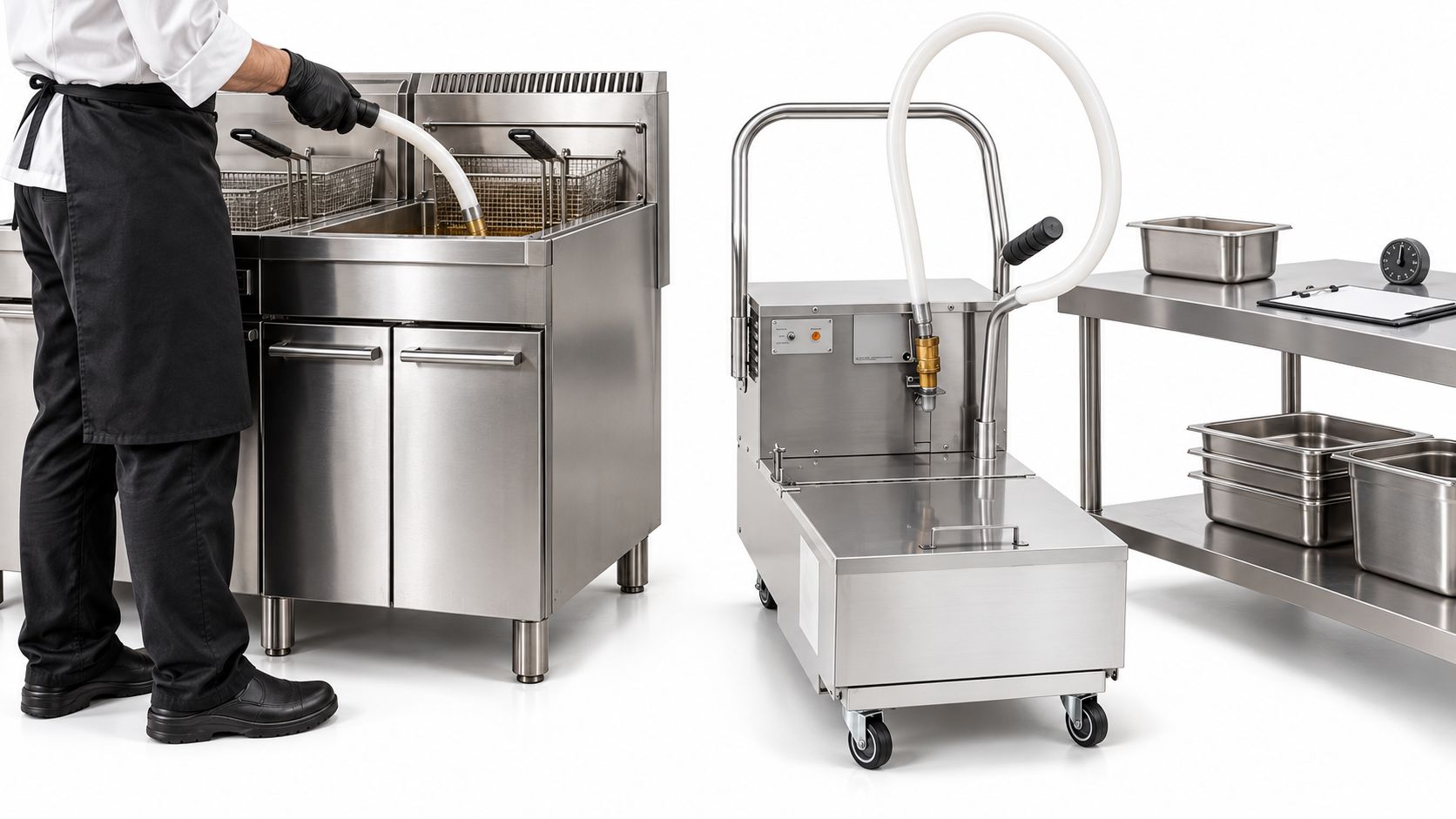
One consideration regularly discussed with customers is that the same labour logic applies beyond chopping and mixing. For example, the Frymax EOF-25 25L Electric Oil Filter Machine moves fryer-oil filtration from an improvised manual task to a dedicated workflow. It's a mobile 25L electric oil-filtering machine with an electric filtration pump, flexible return hose, replaceable filter media, and a stainless-steel format for commercial fryer-oil maintenance. It's not “food prep” in the narrow sense, but it's the same operational principle. Repetitive manual work has a labour cost whether the kitchen measures it or not.
Calculating Manual Prep Cost Per Dish
Per-dish labour cost is where hand prep stops being abstract and starts affecting menu pricing.
A simple worked example
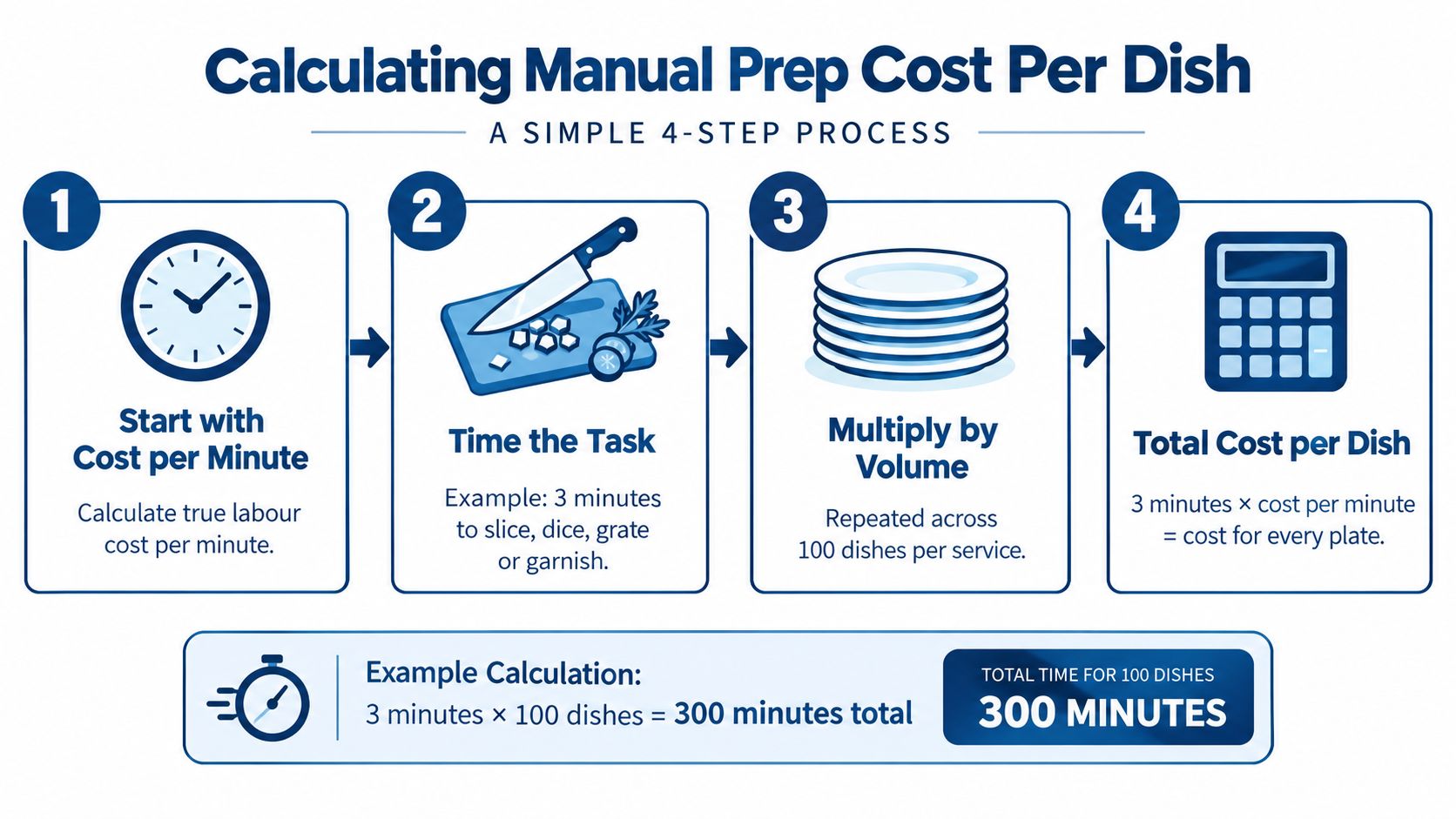
Assume a kitchen uses the illustrative loaded labour cost of NZ$35/hour. That equals approximately NZ$0.58/minute.
Now take a prep step that adds 3 minutes of labour to one dish. It might be slicing, dicing, grating, chopping garnish components, or assembling a repetitive prep element.
The calculation is straightforward:
- 3 minutes × NZ$0.58/minute = approximately NZ$1.75 labour per dish
- Across 100 dishes, that becomes approximately NZ$175 of preparation labour
That doesn't mean a machine wipes out the whole NZ$175. Staff still need to load, operate, unload, and clean equipment. But it shows why seemingly minor manual prep time becomes commercially significant at volume.
Small prep steps aren't small once they sit on every plate.
Why per-dish thinking matters
Many operators choose to cost labour at the roster level and leave it there. That's too broad for prep-heavy menus. If a dish or menu section carries a lot of hand labour, the kitchen can end up underpricing the work even when food cost looks under control.
A practical way to use this:
- Pick one repetitive prep step tied to a menu item.
- Time it during a real shift.
- Convert the labour to a per-dish amount using the loaded per-minute figure.
- Multiply by service volume.
That's where hidden margin loss usually appears. It's the same pattern seen in where most cafés lose money without realising it.
A warning on assumptions
This article doesn't present customer labour-cost-per-dish data because menus vary enormously. A salad station, burger bar, aged care kitchen, hotel breakfast line, and catering prep room all behave differently.
The point isn't to copy the example. The point is to swap in the kitchen's own numbers and force the manual task to justify itself.
Comparing Manual and Machine-Assisted Prep Per Batch
The only honest comparison is complete manual process versus complete machine-assisted process. Not knife time versus motor time.
Side-by-side batch comparison
Use one representative repetitive batch. Measure peeling if required, cutting, portioning, setup, and cleanup for both methods.
At the same illustrative NZ$35/hour loaded labour rate, the comparison looks like this:
| Step | Manual Batch (60 min) | Machine-Assisted Batch (20 min) |
|---|---|---|
| Ingredient handling | Included | Included |
| Cutting or processing | Included | Included |
| Portioning | Included | Included |
| Setup | Minimal | Included |
| Cleaning | Included | Included |
| Total labour time | 60 min | 20 min |
| Illustrative labour cost | NZ$35.00 | Approximately NZ$11.67 |
That creates an approximate labour difference of NZ$23.33 per batch.
What that looks like over a year
If the kitchen runs that batch five times per week over 50 weeks, the maths is:
- NZ$23.33 × 5 × 50 = approximately NZ$5,833 of annual labour capacity
That number matters. It does not automatically mean NZ$5,833 of cash profit. It may show up in different ways:
- Fewer paid preparation hours
- Reduced overtime
- Existing staff completing more productive work
- Greater production capacity
- Less need to add labour as volume grows
A common mistake is comparing hand prep only with machine run time. That inflates the case for equipment and leads to bad buying decisions. Setup and cleaning count. Operator familiarity counts. Workflow counts.
Compare the complete process, not just the part where the motor is running.
That's also why many operators weigh labour release against service bottlenecks rather than looking at prep in isolation. The same commercial logic sits behind whether a Robot Coupe pays for itself through labour savings in restaurant kitchens.
A Simple Payback Framework for Prep Equipment
Payback calculations don't need to be complicated, but they do need to be honest.
Start with the basic formula
The starting point is:
Equipment purchase cost ÷ monthly labour value created = indicative payback period
That gives operators a rough investment payback period framework to test whether a machine deserves serious consideration. It's useful because it turns bench-level time into a commercial decision.
If a machine frees up recurring prep hours every month, the kitchen can compare that monthly labour value against the purchase cost. But that first number is only a starting line.
What operators forget to include
Hospitality businesses often find the headline labour figure looks attractive, then gets overstated because the machine's ownership costs were ignored. Those costs include:
- Cleaning labour: Wash-down takes time and should be counted
- Setup time: Staff still need to assemble discs, bowls, blades, guards, or attachments
- Electricity use: Usually not the biggest line item, but still real
- Maintenance: Planned servicing, wear parts, and occasional downtime matter
- Consumables: Blades, discs, and other replaceable components wear out
- Training time: New staff need to use the machine safely and properly
- Floor space: Benchtop and storage footprint have a workflow cost
- Ventilation and layout: Some equipment changes traffic flow or placement options
Payback is not the whole decision
Some tasks are too irregular to justify dedicated machinery. Others are quality-sensitive enough that hand prep still wins. The right solution depends on frequency, spec consistency, and whether the machine fits the menu.
That's especially true for dough and mixing work. A kitchen might show decent payback on paper, then realise the issue is dough-production bottlenecks, staff technique variability, or batch timing rather than pure labour minutes. That's why operators should also weigh when a spiral mixer becomes cheaper than mixing by hand.
Reliable equipment with the wrong menu fit is still the wrong purchase.
Where Repetition Makes Mechanisation Worthwhile
Mechanisation makes sense where the kitchen repeats the same movement over and over against a consistent spec. That's where labour time is predictable and recoverable.
The task families that usually justify equipment
These are the prep categories where operators often find measurable labour value:
- Slicing: Tomatoes, cucumbers, onions, deli meats, cooked proteins
- Grating: Cheese, carrots, cabbage, root vegetables
- Dicing: Onion, capsicum, potatoes, mirepoix-style prep
- Chopping: Bulk vegetable prep for sauces, soups, slaws, sides
- Pureeing: Sauces, soups, dips, dressings
- Blending: Smooth mixtures, emulsions, beverage bases
- Mixing: Batters, fillings, mashed products, repeated bulk combines
- Dough preparation: Repeated kneading and mixing for pizza, bread, pastry applications
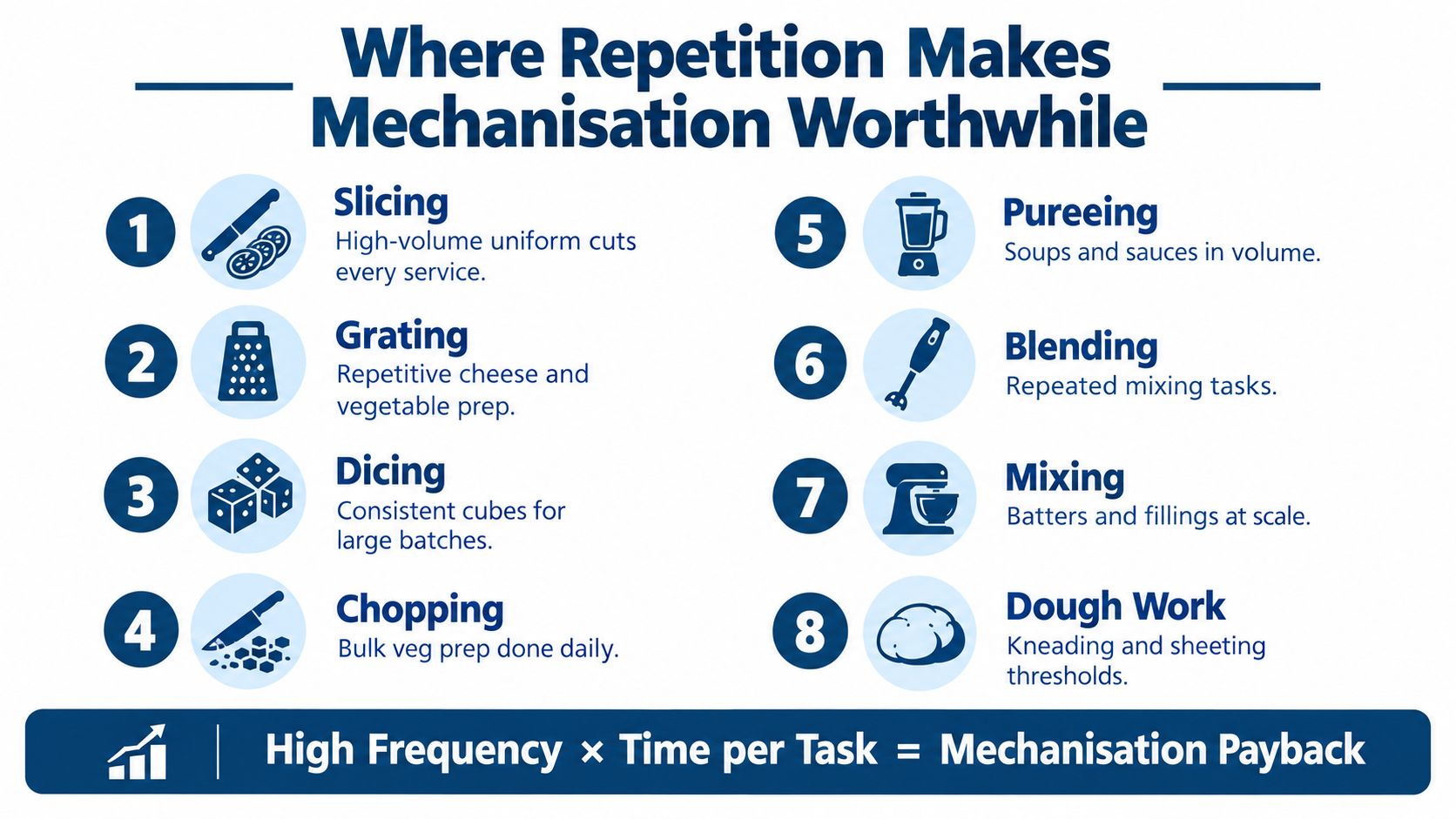
For these jobs, substantial attention usually lands on Robot Coupe food processors, especially where one machine can cover slicing, grating, chopping, dicing, and pureeing across multiple stations. The same conversation often includes Fimar preparation equipment, commercial mixers, slicers, and blenders, depending on the product type and volume.
Frequency is the deciding factor
Saving 10 minutes once a month is noise. Saving 10 minutes three times every day is approximately 183 hours across a 365-day operation. That's why frequency matters more than novelty.
A kitchen dicing bulk onions every day is a strong mechanisation candidate. A station hand-cutting a few tomatoes for a small salad section usually isn't.
Working rule: High frequency, low creative variation, and a consistent finished spec are where machines earn their space.
When mechanisation is the wrong call
Not every hand task should be replaced. Some jobs still belong with a cook and a knife:
- Delicate finishing garnishes
- Irregular whole-protein breakdown
- Low-volume specialty prep
- Visual presentation tasks that need judgement
- Seasonal menu items with weak repetition
A common issue seen in buying decisions is over-mechanising low-frequency tasks and under-mechanising repetitive prep. The smart move is the opposite.
Worked Scenarios for Cafes, Restaurants, Hotels and Caterers
The same maths lands differently depending on the venue. Covers, menu spread, and prep style change the answer.
Four common New Zealand scenarios
| Venue Type | Menu Focus | Daily Covers | Dominant Prep Task | Annual Prep Minutes | Best-Fit Equipment |
|---|---|---|---|---|---|
| Café | Tight brunch menu | 90 | Tomatoes, cheese, herbs, slaw-style prep | High if repeated daily | Benchtop food processor, slicer, blender |
| Restaurant | Broader bistro-style menu | 120 | Sauces, sides, vegetable prep, portioning | High across multiple stations | Mid-volume processor, mixer, slicer |
| Hotel | Breakfast, room service, events | Varies by outlet mix | Breakfast slicing, bulk mixing, pastry or dough prep | Concentrated around peak periods | Slicer, mixer, processor |
| Caterer | Repeated event production | 50 covers per event across 200 days | Bulk dicing, mixing, sauce prep, batch portioning | Very high through repetition | Higher-capacity processor, mixer, blender |
These are illustrative operating patterns, not customer case studies.
How the logic changes by venue type
A café often gets the quickest return from small benchtop prep gear because labour repetition sits in a narrow band of ingredients. Tomatoes, shredded cheese, herbs, relishes, and garnish prep happen constantly, often in modest but relentless volume.
A restaurant usually spreads manual prep across more categories. That makes a versatile machine more useful than a single-purpose one. Many operators choose equipment that can support slicing, grating, chopping, and pureeing in one footprint rather than buying separate tools too early.
Hotels are different again. Volume often spikes at breakfast, then shifts into banqueting, room service, and wider production. In those kitchens, the best labour release may come from slicers and mixers because consistency under time pressure matters as much as speed.
Caterers tend to feel prep repetition hardest because every site multiplies the same labour pattern. Once menu components standardise, batch production often makes mechanisation easier to justify.
Consistency matters too
Labour isn't the only return. Mechanisation may also improve repeatability of:
- Slice thickness
- Grating output
- Dice consistency
- Mixing uniformity
- Portion preparation
That doesn't get a made-up dollar value here, because it varies too much by menu and operation. But it still matters in production kitchens.
What to Do Next With Your Own Numbers
Operators don't need a consultant's spreadsheet to answer this. They need one week of honest timing.
The five-step process
- Choose the top three repetitive prep tasks on next week's prep sheet. Not the fancy tasks. The repeated ones.
- Time each task during a real shift with a phone stopwatch. Use actual production conditions, not best-case guesses.
- Work out the true per-minute labour cost for the staff member doing that prep by taking the loaded hourly figure and dividing by 60.
- Multiply minutes by weekly frequency, then multiply that by 50 working weeks if that reflects the operation.
- Compare the annual labour figure against the equipment category that could handle the job, while including cleaning, power, maintenance, and consumables.
What to shortlist first
The highest-value targets are usually the tasks that tick three boxes:
- Repeated often
- Labour-intensive
- Specification-driven
That's where equipment categories such as Robot Coupe food processors, Fimar prep machines, commercial mixers, slicers, and blenders become commercially sensible rather than merely desirable.
Many hospitality businesses also benefit from asking a harder question before buying anything. Should the task be mechanised, simplified, shifted to a different prep window, or removed altogether? That matters because wage pressure is still real. A union bulletin noted adult minimum wage settings changing to NZ$23.95/hour from 1 April 2026, while the Labour Cost Index for accommodation and food services rose 3.0% year-on-year and private-sector wage growth was 2.0% to March 2026 (March-April 2026 bulletin).
Don't ignore waste while counting prep
Prep cost isn't only about labour minutes. Over-prepping and oversized portions also burn labour without generating revenue. New Zealand hospitality waste guidance recommends measuring food waste, reconsidering portion sizes, offering sauces rather than automatically providing them, and using takeaway containers or food rescue for surplus in-date food (hospitality waste guide).
That means the smartest answer isn't always a bigger machine. Sometimes it's less unnecessary prep.
The useful number is the one that reflects what happens on the pass. Once the kitchen knows that number, the equipment conversation gets much easier.
Hospitality helps New Zealand operators work through these decisions with practical equipment advice across food processors, mixers, slicers, blenders, workflow planning, and broader commercial kitchen fit-out needs. If a kitchen wants to time a repetitive prep task, compare equipment categories properly, and avoid buying the wrong machine for the job, visit Simply Hospitality.