

How to Choose the Best Food Steamer for Your Venue
A kitchen can have an impressive menu and still lose time at service because the steamer can't finish enough food in the available production window. The best food steamer for a New Zealand venue isn't automatically the largest, fastest-looking, or most expensive machine. It's the unit that can handle the required portions, fit the kitchen's utilities, maintain consistent steam, and remain manageable to clean and service.
For operators comparing dedicated commercial steamers, combi ovens, and compact countertop equipment, the decision should start with production rather than product rankings. What matters most is whether the unit can keep up with peak service, suit the menu, fit the available utilities, and stay practical for staff to load, clean, and maintain. GlobalData's New Zealand foodservice market analysis provides broader market context, but the buying decision itself should stay grounded in day to day kitchen performance.
Rethinking Steam Capacity for Peak Service
At the start of service, a single steamer cycle can appear adequate. During the busiest production window, the same machine may be expected to handle vegetables, rice, dumplings, seafood, proteins, and regenerated meals while staff are also loading, unloading, portioning, and sending food to the pass. If the equipment can process only one batch while the kitchen needs three batches completed in the same window, staff wait for the machine rather than producing food.
That's why a steamer should be sized using a practical capacity equation:
Portions per batch × batches during the production window = practical steam capacity
The calculation is simple, but the inputs need careful thought. “Portions” might mean plated meals, dumpling pieces, trays of vegetables, hotel pans of rice, or containers prepared for a care facility. “Production window” should reflect the busiest realistic period, not a quiet prep session. A machine that performs well during advance preparation may still become a bottleneck when several menu items compete for the same chamber.
Cycle time isn't the whole answer
A short published cycle doesn't guarantee useful throughput. Staff need to allow for loading, unloading, door opening, product checks, recovery, and the time required to prepare the next batch. Steam recovery after a heavily loaded chamber can matter more than the nominal cooking programme.
Capacity planning should therefore ask:
- What needs steaming: Separate high-volume staples from occasional menu items.
- When it needs steaming: Identify the busiest production window and regeneration period.
- How many batches are realistic: Allow for loading, unloading, cleaning interruptions, and product changeovers.
- What must run together: Mixed products may require separate cycles because of timing, moisture, allergen, or flavour considerations.
- What happens if the machine is occupied: A second unit, alternative cooking method, or revised prep sequence may be necessary.
A practical review of planning equipment for consistent meal service should sit alongside this calculation. The steamer is one part of a wider workflow that includes refrigeration, preparation benches, holding, transport, and service.
The strongest buying decision often comes from mapping the peak workflow on paper. If the required output exceeds what one machine can achieve with realistic loading and recovery, buying a smaller unit to save space may just move the cost into labour pressure, delayed service, and menu restrictions.
Comparing Dedicated Steamers and Combi Ovens
Three equipment approaches cover most commercial steaming requirements: dedicated steamers, combi ovens with steam capability, and countertop or compact steamers. None is universally the best food steamer. Each suits a different balance of throughput, footprint, flexibility, utilities, and capital cost.
| Equipment Type | Best Suited For | Footprint & Flexibility |
|---|---|---|
| Dedicated commercial steamer | Repetitive, high-volume steaming such as vegetables, rice, dumplings, seafood, and batch meals | Focused footprint with strong steam specialisation, but limited use outside steaming |
| Combi oven with steam | Kitchens that bake, roast, grill, cook proteins, regenerate, and steam | Larger or shared cooking footprint, with broad menu flexibility |
| Countertop or compact steamer | Cafes, small kitchens, marae, kiosks, and institutional areas with constrained space | Small footprint and straightforward operation, but limited batch capacity and recovery |
Dedicated commercial steamers
A dedicated unit makes sense when steaming is a central production method rather than an occasional function. It can simplify repetitive work because staff aren't constantly changing between roasting, baking, and steaming programmes. That simplicity may help a kitchen maintain consistent batches of vegetables, dumplings, rice, seafood, or soft-texture meals.
The trade-off is specialisation. A dedicated steamer won't replace the roasting, baking, grilling, or dry-heat functions required elsewhere in the menu. It also needs appropriate water, drainage, cleaning, and service planning.
Combi ovens
Combi ovens from brands such as Convotherm and UNOX suit kitchens where steam shares time with other cooking methods. They can support baking, roasting, grilling, steaming, and regeneration in one cooking platform, which may be valuable when floor space is limited or the menu changes frequently.
The compromise is that steaming competes with other production. A combi oven may be the right answer for a restaurant cooking proteins and pastry alongside vegetables, but a high-volume dumpling operation may gain more from a dedicated chamber designed around repetitive steam production. A broader discussion of combi ovens in New Zealand can help operators assess whether multi-function cooking matches the menu.
Countertop and compact steamers
Compact units have a clear role where space, budget, or service scale limits the installation. One New Zealand countertop model is rated at 240V and 1.5kW with an 8-litre basket capacity, while a common domestic New Zealand model is rated at 800–950W with a 1.5-litre tank capacity. The listed commercial countertop specification illustrates why commercial buyers need to compare reservoir volume, power, and usable capacity rather than relying on cooking time alone.
These units can work well for smaller batch preparation or as an additional station. They become a poor choice when staff need continuous high-volume production, rapid recovery, or multiple GN trays during peak service.
Critical Specifications That Dictate Performance
A steamer can fit neatly beneath a bench and still fail the kitchen operationally. Specification checking needs to cover the chamber, utilities, loading pattern, and site infrastructure together.
Capacity and recovery
GN compatibility is one of the first practical checks. Operators should confirm the number and size of GN pans or trays that can be loaded without blocking steam circulation. A chamber's nominal pan count matters less if staff can't load it safely, separate products, or remove hot pans without disrupting the workflow.
Steam output and recovery deserve equal attention. A heavily loaded chamber needs to restore steam after the door opens. Ask the supplier or manufacturer how the unit is designed to generate steam, how it behaves after loading, and whether the stated performance assumes a particular water supply, gas input, or electrical connection.
Use the following checklist when comparing specifications:
- GN and tray capacity: Match the chamber to actual pan sizes and portion formats.
- Steam generation: Compare boiler, atmospheric, or instant-steam arrangements according to the manufacturer's documentation.
- Recovery: Check how quickly usable steam returns after loading and door opening.
- Cycle control: Look for controls that suit the staff's skill level and menu repetition.
- Drainage: Confirm where wastewater goes and whether the drain can handle the installation.
- Water supply: Verify pressure, connection requirements, and whether treated water is specified.
- Access: Leave room for door swing, loading height, cleaning, and service access.
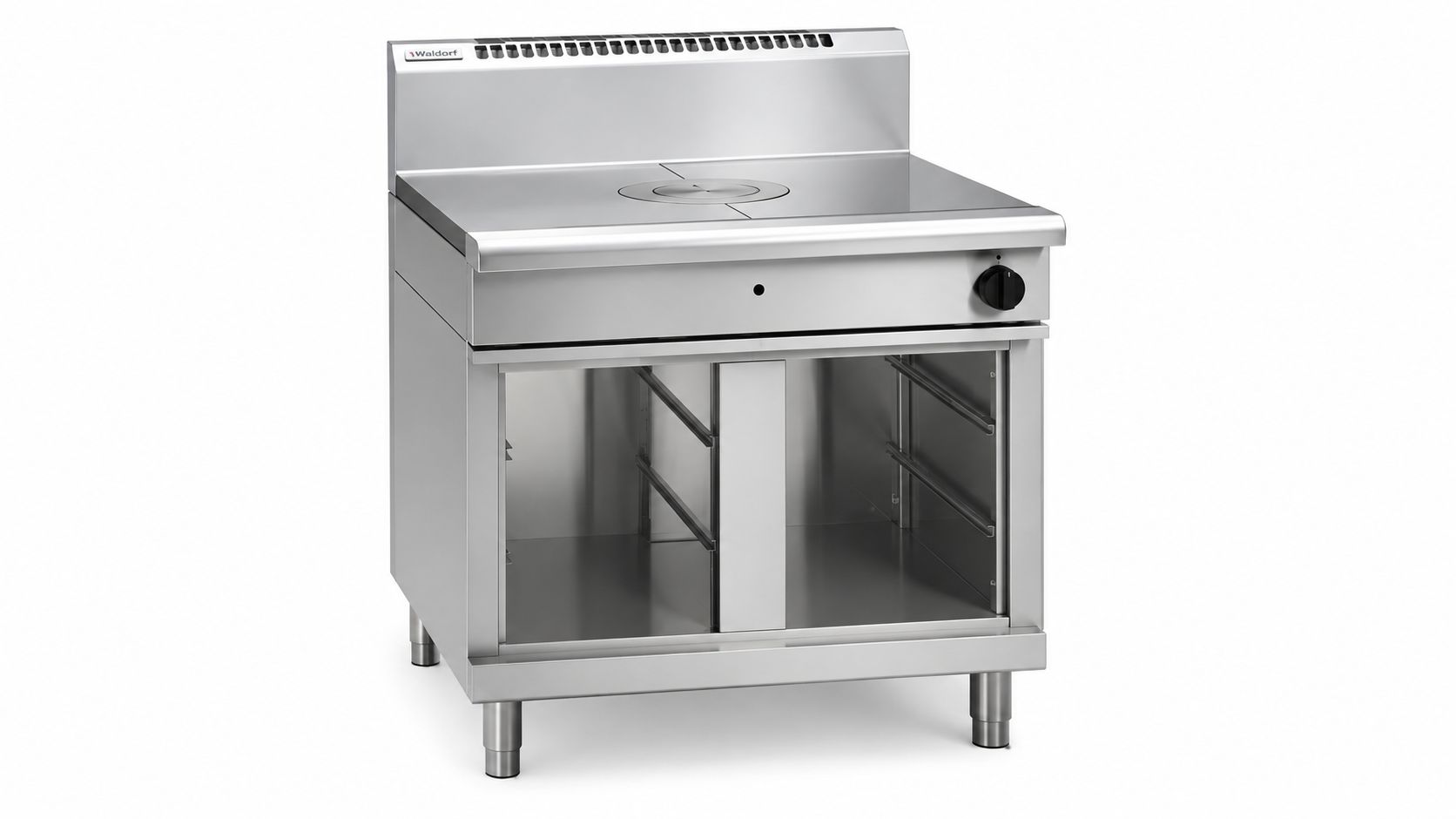
The Waldorf 800 Series RN8100G-CB - 900mm Gas Target Top - Cabinet Base is not a steamer, but it shows why adjacent cookline equipment needs to be planned as part of the same installation. Its 900mm gas Target Top uses a 45MJ/hr dual ring cast iron burner, with flame failure protection, a continuous pilot burner, adjustable feet, and two additional rollers. Operators comparing a gas cookline and a steam appliance should confirm fuel, extraction, clearances, and service access as one coordinated plan.
Power, footprint, and connections
Compact equipment may use a standard electrical supply, but larger steamers can require a different electrical arrangement or gas connection. The available power supply must match the machine's full operating demand, not just the number printed on a marketing summary. Gas-fired equipment also needs compliant installation, ventilation, extraction, and access for servicing.
The physical footprint includes more than width and depth. Allow space for water treatment, hoses, drainage, door movement, pan handling, cleaning chemicals, and technicians. A unit that fits the line but blocks a sink, drain, or access route can create a daily operational problem.
Water Quality and the Hidden Cost of Scale
Steam equipment doesn't just consume water. It relies on the quality of that water every day. Minerals carried into boilers, generators, valves, and steam paths can form scale, restrict flow, slow heat transfer, and make cleaning more demanding.
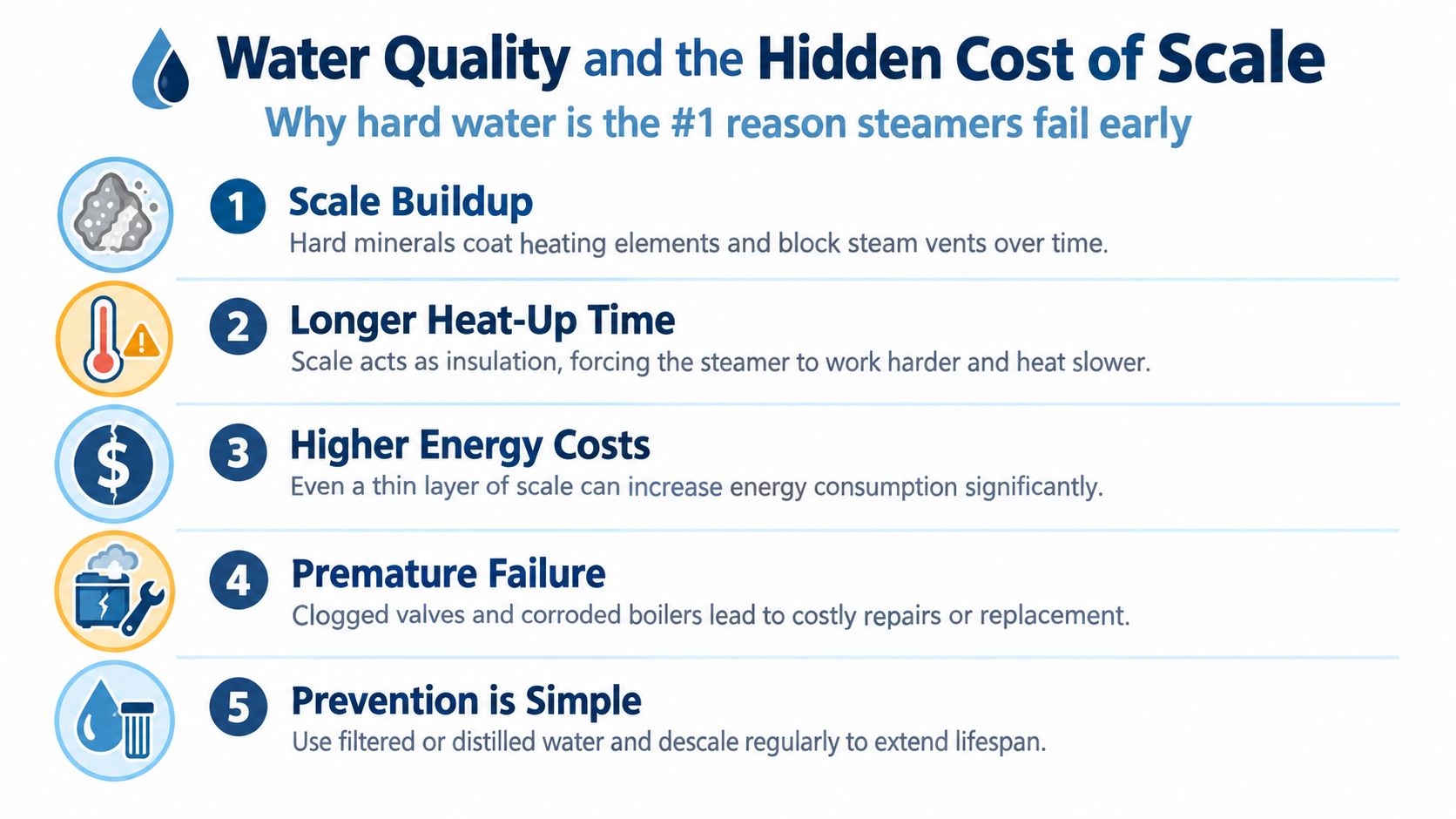
A sensible water-management decision happens before installation, not after the first fault. The right arrangement depends on the machine, the incoming water, and the manufacturer's requirements.
Build water treatment into the purchase
Operators should ask for the manufacturer's water-quality specification and then match the treatment system to it. A filter that suits one steamer may not suit another, and no single scale-prevention method can be declared universally superior without equipment-specific evidence.
The purchasing conversation should cover:
- Incoming water quality: Identify local hardness and any known treatment issues.
- Approved filtration: Use manufacturer-approved filtration where required.
- Automatic cleaning: Check what the automatic programme cleans, what it doesn't clean, and which chemicals it accepts.
- Descaling: Clarify the procedure, frequency guidance, staff responsibility, and service involvement.
- Drainage: Confirm that flushing and cleaning water can leave the machine safely.
- Documentation: Keep the installation and maintenance instructions accessible to the team.
The same principle applies to other heated water equipment. Operators comparing kitchen systems may find how water quality affects dishwasher performance useful because filtration, chemical compatibility, and cleaning discipline influence more than one appliance.
For a broader household comparison involving heated water systems, what boiling taps really cost provides useful context on why water, energy, installation, and maintenance should be considered together. The commercial steamer decision needs the same total-ownership mindset, even though the equipment and workload are different.
The Waldorf 800 Series INL8410ECF - 900mm Induction Range Convection Oven Low Back Version demonstrates another utilities trade-off. It combines four 5.0kW full-area induction zones with a GN 2/1 electric convection oven and requires suitable induction cookware and electrical infrastructure. That isn't a steamer specification, but it reinforces the need to assess equipment, services, and cleaning access as a complete installation.
Matching the Steamer to Your Venue Type
Venue type changes the meaning of “enough capacity”. A small cafe may need dependable steaming for a narrow menu, while a care kitchen may prioritise repeatability, texture, hygiene, and straightforward staff operation over maximum menu flexibility.
Cafes, takeaway outlets, and kiosks
Takeaway outlets, sports kiosks, and cafes often use steamers for dumplings, rice, vegetables, eggs, or prepared components. A dedicated atmospheric steamer can suit a repetitive menu where staff need simple loading and predictable batch output. A compact countertop unit may work where the volume is modest and the kitchen has no spare floor space.
The risk is under-sizing. If the steamer is also expected to support lunch preparation, holding, and last-minute replenishment, the operator should calculate the busiest output rather than choosing solely by footprint.
Aged care, hospitals, schools, and marae
Institutional kitchens often need reliable batch production and controlled textures. Steaming can support soft foods, vegetables, seafood, proteins, and regenerated meals, but the machine still needs a workflow that prevents cross-contact and makes cleaning practical between product groups.
For aged care and hospital use, useful priorities include:
- Stable output: Consistent cooking matters when meals must meet planned texture requirements.
- Clear controls: Staff should be able to select and repeat programmes without unnecessary complexity.
- Accessible cleaning: Internal surfaces, racks, seals, and drains need routine attention.
- Batch fit: Tray capacity should match meal numbers and the available service window.
- Regeneration suitability: Confirm that the chosen equipment and containers are appropriate for the intended reheating workflow.
Food premises in New Zealand also need hygienic facilities and processes. The Food Hygiene Regulations 1974 require wash-hand basins to have hot and cold running water, or tempered running water at a minimum temperature of 38°C, and require equipment used to wash containers, utensils, and appliances to operate at not less than 63°C. A steamer won't replace proper washing facilities, hand hygiene, or food-control procedures.
Restaurants and fine dining
A restaurant using steam as one element of a wider menu may benefit from a combi oven. Fine dining kitchens often need precise protein cooking, baking, roasting, and regeneration alongside steaming, so a multi-purpose platform may provide a better use of space.
Caterers and high-volume production
Caterers should focus on transport, holding, loading sequence, and batch timing. A dedicated steamer may outperform a combi oven when the workload is repetitive and steam-heavy. Operators can also use hospitality calculators to organise production assumptions, labour inputs, and equipment planning before committing to a configuration.
Navigating Compliance and Total Cost of Ownership
The purchase price is only one part of the commercial steamer decision. Energy input, water treatment, cleaning chemicals, staff time, service access, parts availability, and installation requirements all shape ownership.
ENERGY STAR commercial steam cooker specifications set minimum cooking energy efficiency at 50% for electric 3-pan-and-larger models and 38% for gas models, with up to 90% water savings versus standard steam cookers, approximately 3 gallons per hour compared with 40 gallons per hour. The relevant commercial steam equipment information gives operators a useful framework for comparing gas and electric formats. The actual suitability still depends on the model, site utilities, menu, and manufacturer documentation.
Electrical and gas compliance
Standards New Zealand explains that AS/NZS 3350.2.6:2006 covers household electric cooking appliances such as steam ovens, but excludes commercial electric ranges, commercial electric forced convection ovens, steam cookers, and steam convection ovens. Hospitality operators shouldn't use household-appliance rules as a substitute for commercial equipment compliance. The Standards New Zealand scope statement makes that distinction clear.
The Electricity Safety Amendment Regulations 2025 treat commercial electric kitchen machines as a regulated appliance class and reference IEC 60335-2-64. The regulations allow an older standard only until 4 May 2026, so installation and future-proofing should be checked before ordering.
For gas installations, New Zealand regulations list atmospheric steamers under AS 4563-2004 Commercial catering gas equipment. The applicable gas regulations should be reviewed with the appropriate licensed professionals.
Compare ownership, not just purchase price
A practical ownership review should include:
- Utility demand: Electricity, gas, and water requirements under the intended workload.
- Scale management: Filtration, descaling, automatic cleaning, and water-quality obligations.
- Service support: Local servicing, parts access, warranty terms, and manufacturer support.
- Operational simplicity: Whether staff can clean and operate the unit correctly every day.
- Menu value: How much of the venue's production the machine can handle.
- Installation burden: Plumbing, drainage, extraction, electrical upgrades, and access.
Operators assessing broader kitchen efficiency can also review energy-efficient appliances. The most economical machine on paper may not be the lowest-cost choice if it is poorly matched to the production window or difficult to maintain.
Planning Your Installation and Next Steps
Before selecting the best food steamer, the operator should complete a site assessment with the equipment specification in hand. The assessment should confirm:
- Production demand: Calculate portions per batch and realistic batches during the busiest window.
- Chamber fit: Check GN pan sizes, loading height, door clearance, and staff access.
- Utilities: Confirm electrical supply, gas requirements where relevant, water pressure, treatment, and drainage.
- Ventilation: Review steam discharge, extraction, room conditions, and surrounding equipment.
- Cleaning access: Make sure staff can reach seals, racks, drains, filters, and internal surfaces.
- Service access: Leave enough room for inspection, repairs, and component replacement.
- Compliance: Confirm that the proposed model and installation align with current New Zealand requirements.
The commercial kitchen installation process should be coordinated with builders, plumbers, electricians, gasfitters, extraction contractors, and the equipment supplier. A supplier such as Simply Hospitality can help compare suitable equipment categories, coordinate professional kitchen design, discuss flexible finance options, and connect the purchase with warranty and service requirements. The final choice should be based on the complete operating plan, not a product name alone.
Simply Hospitality helps New Zealand hospitality businesses compare commercial steamers, combi ovens, compact cooking equipment, and the supporting kitchen infrastructure required for installation. Visit Simply Hospitality to discuss production capacity, water treatment, utilities, venue suitability, and a practical equipment solution for the busiest part of service.