


Refrigeration Requirements in Healthcare Environments
A hospital kitchen can have plenty of cold storage and still struggle during meal service. A delivery arrives before breakfast, special-diet ingredients need clear separation, prepared meals are waiting for assembly, and staff are repeatedly opening the same doors while trying to keep production moving. The practical refrigeration requirements in healthcare environments are therefore about keeping the right food safely refrigerated throughout the entire journey, not just buying the cabinet with the largest advertised capacity.
For hospitals, aged-care facilities, retirement villages and other healthcare kitchens, the better question is where food needs temperature control from delivery through to service, how much stock is held at peak periods, and what happens if a critical unit becomes unavailable. Equipment selection, monitoring, cleaning, installation and contingency planning all form part of the same operating system.
Why Healthcare Refrigeration Is Different
A large upright refrigerator may look like the obvious answer when a facility needs more capacity. Yet a cabinet that holds a substantial volume of food can still create problems if it's positioned too far from preparation, loaded without regard to airflow, or unable to accommodate labelled special-diet ingredients without mixing storage zones.
Aged-care and hospital kitchens also work to a service timetable that doesn't pause when equipment becomes inconvenient. Deliveries, menu cycles, therapeutic meals, texture-modified food and individually identified meal components all place different demands on storage and access. A refrigeration plan must support the people receiving meals and the staff producing them, rather than treating every chilled product as interchangeable stock.
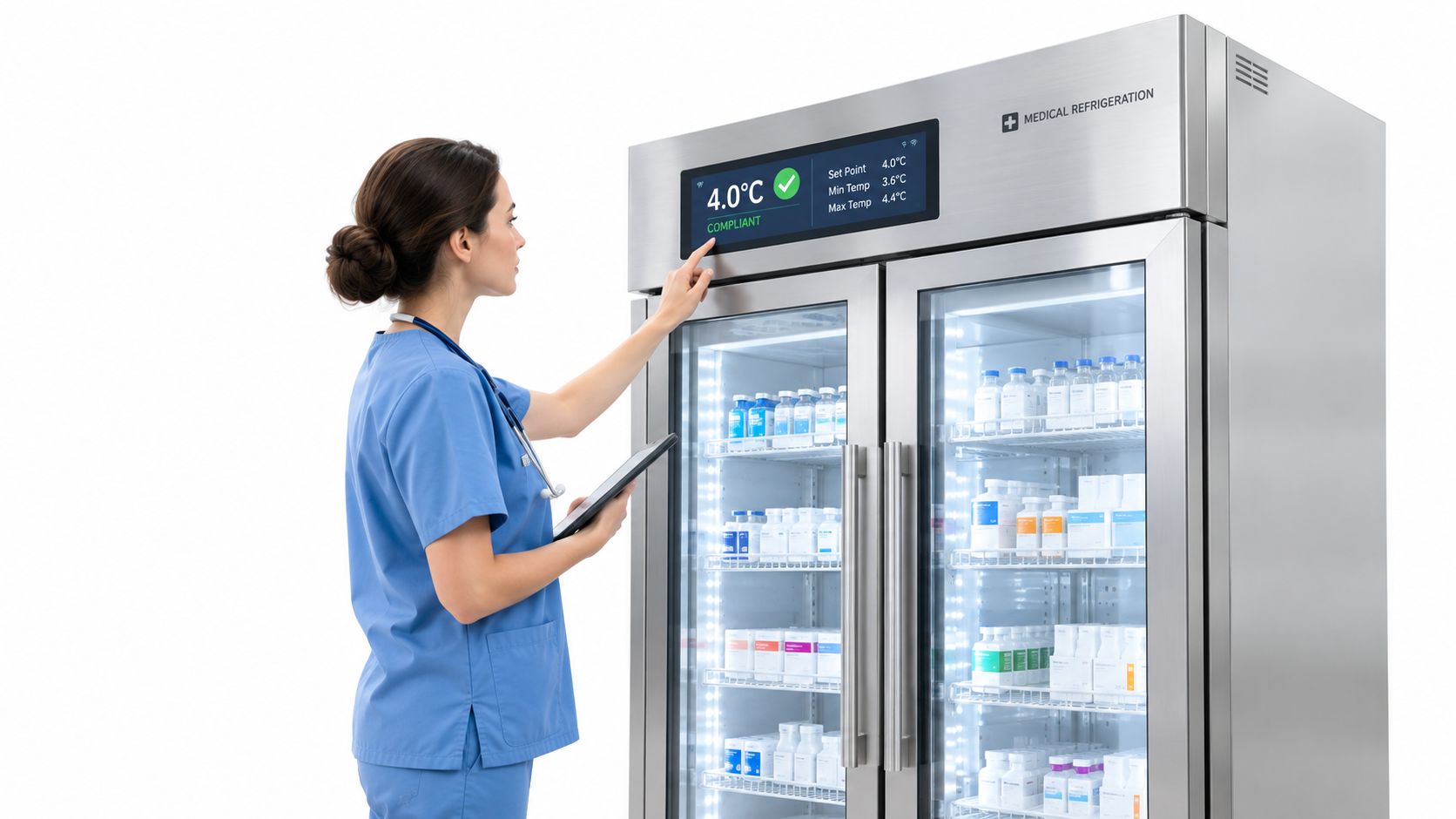
The image above depicts medical storage, but foodservice operators need to keep the distinction clear. Foodservice refrigeration for healthcare kitchens is not specialist vaccine, medicine, blood or laboratory refrigeration. It should be specified around food safety, production workflow, stock rotation and continuity of meal service. Specialist clinical products have separate approved storage requirements and shouldn't be treated as examples for choosing a kitchen cabinet.
A working system rather than a single appliance
A useful planning exercise follows food from the receiving area to chilled or frozen storage, preparation, cooking, cooling where applicable, portioning, meal assembly and service. This approach exposes gaps that a simple litres-based calculation can hide.
For a broader look at layout, equipment and operating decisions, the equipment considerations for healthcare foodservice provide useful context. The central principle remains straightforward: capacity matters, but location, access, monitoring and backup matter too.
Mapping Refrigeration Through the Food Journey
The most reliable way to plan refrigeration is to map each point where food is chilled, held or transferred. The kitchen may need several refrigeration roles, even when the total volume appears manageable.
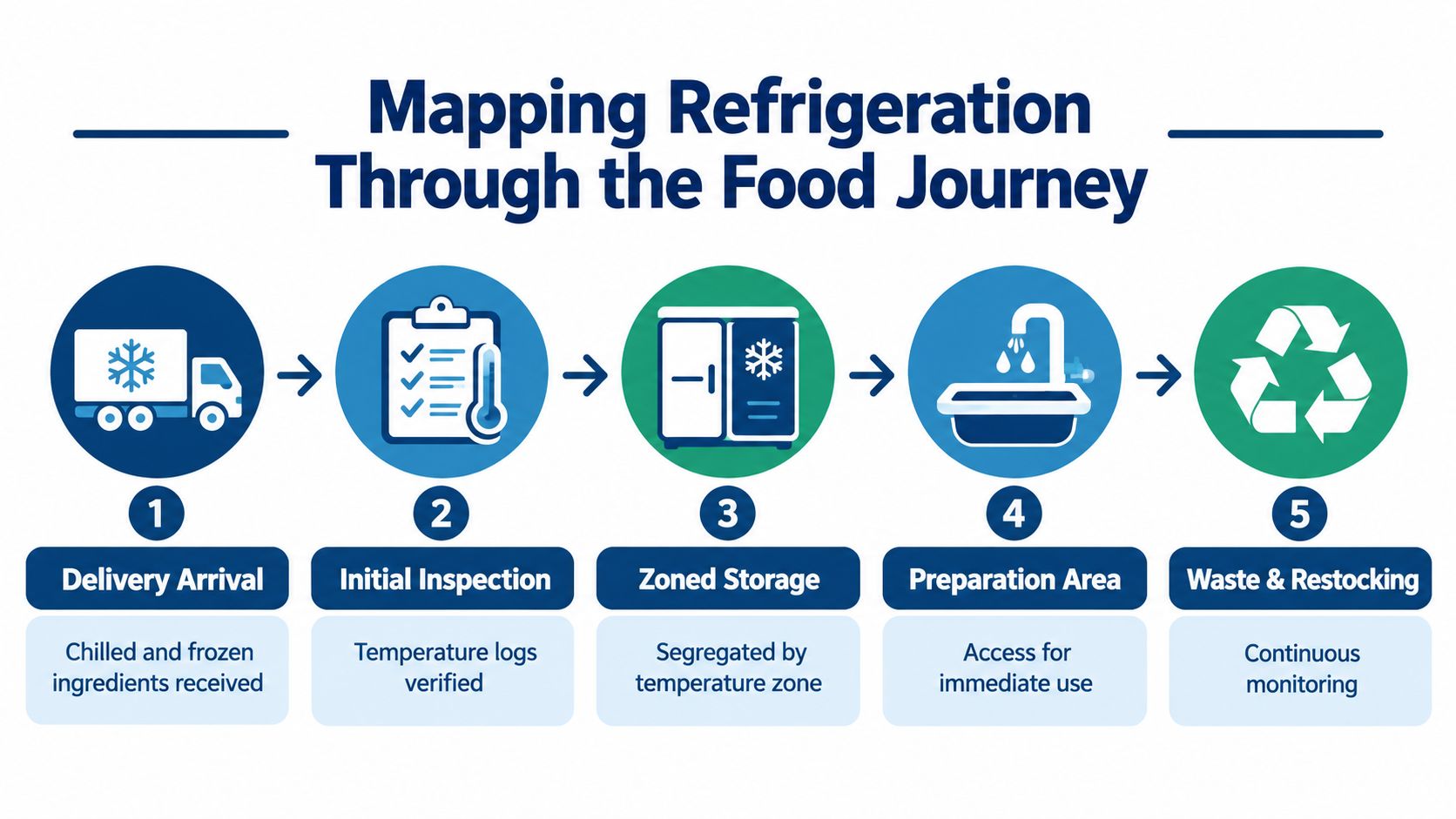
Delivery and initial inspection
Chilled and frozen ingredients need an organised receiving process before they disappear into storage. Staff should know where deliveries are checked, how temperature records are handled, which products require immediate transfer, and how damaged or questionable packaging is isolated under the facility's food-safety procedures.
The receiving area shouldn't become a temporary holding zone during a busy service. If deliveries regularly arrive while production is underway, the layout needs enough space and access to prevent incoming stock from blocking trolleys, preparation benches or emergency routes.
Zoned storage and preparation
Bulk storage normally belongs in upright fridges and freezers located near receiving and stock movement routes. Point-of-use refrigeration serves a different purpose. An underbench unit or preparation refrigerator near the assembly line keeps frequently used ingredients accessible and reduces unnecessary staff movement.
Storage zoning should reflect the facility's established separation, identification and labelling systems. That may include clearly identified ingredients for allergies, texture-modified meals, fortified foods and therapeutic diets. The refrigeration layout needs to make the correct process easy to follow, without providing clinical dietary advice that belongs with the facility's food-safety systems and relevant healthcare professionals.
Cooking, cooling and service
A holding refrigerator maintains already chilled food. It isn't automatically suitable for cooling large quantities of hot food. Where significant volumes of cooked food need controlled rapid cooling before portioning and storage, a blast chiller may be the more appropriate equipment category, subject to the facility's New Zealand food-safety procedures and current MPI guidance.
During portioning and meal assembly, small amounts of chilled food can move into point-of-use storage while bulk stock remains protected in the main cabinets. The cold-chain management guidance is useful when teams are reviewing how food moves between these stages.
Planning Capacity for Peak Stock and Daily Demand
Capacity should be modelled against the busiest realistic operating period, not an average delivery week. A facility might have enough room for routine stock yet run short when a menu cycle, public holiday, delayed delivery or special-diet requirement increases the amount held on site.
The starting information should come from the kitchen's operating pattern:
- Residents and patients served: Record the population receiving meals and how many meal services the kitchen supports.
- Meals produced: Include breakfast, lunch, dinner, snacks and supplementary items where relevant.
- Delivery frequency: Less frequent deliveries require more stock between deliveries.
- Menu cycle: Review ingredients and prepared foods across the full menu cycle instead of sizing from a single day.
- Chilled and frozen purchasing: Separate chilled volume from frozen volume, because each requires a different equipment type and storage arrangement.
- Special-diet storage: Allow space for labelled and segregated ingredients, texture-modified products and therapeutic foods.
- Peak and contingency stock: Include weekends, public holidays, delivery disruption and a sensible operational buffer.
A practical calculation is:
Maximum stock between deliveries + operational buffer + adequate internal airflow = practical capacity requirement
That formula still needs judgement. Advertised litres describe internal volume, not necessarily usable food-storage capacity. Shelving, container dimensions, packaging, vertical clearance, door-opening patterns and the space needed for air movement all affect how much food can be stored safely and retrieved efficiently.
Model the cabinet, not just the catalogue figure
An operator should test the proposed shelving against actual containers, trays and labelled meal components. A cabinet with fewer shelves may be awkward for small, frequently accessed items, while a densely packed cabinet can restrict airflow and make stock rotation difficult.
Special-diet management is another reason to avoid a generic multiplier based only on headcount. A smaller facility may still need substantial separation and identification space if it prepares varied meal components. The refrigeration planning advice based on business stage helps frame capacity around operating rhythm rather than a one-size-fits-all estimate.
Choosing the Right Equipment for Different Jobs
Each refrigeration type solves a different workflow problem. Upright cabinets are generally suited to bulk chilled or frozen storage, while underbench and preparation units bring frequently used ingredients closer to the people assembling meals.
| Equipment Type | Primary Role | Best Placement | Key Considerations |
|---|---|---|---|
| Upright fridge | Bulk chilled storage | Near receiving and main storage routes | Review usable shelving, door configuration, airflow and stock rotation |
| Upright freezer | Bulk frozen storage | In the main frozen-storage zone | Check temperature range, capacity, access, ambient rating and installation requirements |
| Underbench fridge | Point-of-use chilled storage | Beneath preparation or assembly benches | Prioritise access, bench compatibility, door swing and cleaning access |
| Preparation fridge | Mise en place and batch-prepped items | Along preparation or meal assembly lines | Assess container fit, worktop arrangement, ingredient separation and service access |
| Blast chiller | Controlled rapid cooling of cooked food | Near cooking and post-cook handling | Confirm the required cooling process, batch size, loading method and current NZ food-safety procedures |
Bulk storage and point-of-use access
An upright fridge or freezer is usually the better fit for inventory held between deliveries. It concentrates stock in a defined zone and can simplify receiving, labelling and rotation. The trade-off is staff travel. If cooks or meal assemblers repeatedly walk back to a remote storage room, the cabinet may be efficient for storage but inefficient for production.
Underbench refrigeration reduces that movement. It works best for ingredients and prepared components used repeatedly during a shift, not as a substitute for bulk storage. Overfilling a point-of-use cabinet can make identification and cleaning harder, so the unit should be sized around active workflow rather than every item the kitchen owns.
Preparation refrigeration and blast chilling
Preparation fridges can support organised mise en place, particularly where trays or containers need to remain close to a bench. Their usefulness depends on the facility's container system, labelling process and meal assembly sequence.
Blast chilling serves a separate food-safety and production function. A standard holding fridge is intended primarily to maintain cold food, not to cool large quantities of hot food safely. The distinction matters in kitchens preparing food in batches for later portioning. Current New Zealand food-safety requirements and MPI guidance should determine the cooling method, monitoring and release process.
SKOPE upright and underbench fridges, together with Atosa upright freezers, underbench fridges and preparation fridges, can all be considered where their verified specifications match the site. Compare capacity, dimensions, temperature range, door configuration, shelving, ambient rating, monitoring capability, energy information and warranty support rather than selecting by brand familiarity alone.
Before Ordering Refrigeration for Your Kitchen
A refrigeration order should be checked against the building, the workflow and the service plan before the equipment arrives. A cabinet that fits the specification sheet may still fail at the loading dock, block a trolley route or leave no practical access for maintenance.
Confirm the physical route
Measure the delivery path from the vehicle access point to the final position. Include doors, corridors, lifts, turns, thresholds and any temporary obstacles. Confirm the unit's external dimensions, door opening requirements and whether doors can be removed or adjusted during delivery if the manufacturer allows it.
Door swing deserves particular attention in busy healthcare kitchens. A door that opens into a preparation route can obstruct staff and trolleys, while a poorly chosen hinge position may force operators to work around the cabinet throughout every service.
Check the installation conditions
Ventilation and clearances must follow the manufacturer's installation requirements. There isn't a universal clearance that suits every cabinet, because condenser location, ventilation design and ambient conditions vary by model.
Before delivery, confirm:
- Electrical supply: Check power requirements, plug type and circuit arrangements with the electrician.
- Ambient rating: Review whether the unit is suitable for its intended position, especially near ovens, combi-ovens or other heat-producing equipment.
- Levelling: Ensure the floor and adjustment points allow the cabinet to sit level and the doors to seal correctly.
- Drainage: Check whether defrost or other drainage provisions apply to the selected equipment.
- Service access: Leave technicians a practical route to controls, compressors, condensers and other serviceable components.
The commercial refrigeration installation guidance covers the planning issues that are often missed when equipment is treated as a plug-in purchase. Kitchen designers and fit-out contractors should be involved before the final position is approved, especially where future layout changes or additional preparation equipment may be needed.
How Operating Conditions Affect Refrigeration Performance
A refrigeration cabinet behaves differently in a showroom than it does beside a busy cooking line. During service, staff may open the same door repeatedly, insert products that aren't fully chilled, load the shelves tightly and leave adjacent equipment producing heat.
The operating environment should be reviewed as part of the specification:
- Door openings: High-frequency access can challenge temperature stability and may favour point-of-use storage for active ingredients.
- Stock loading: Overloading can restrict internal airflow, while poor arrangement can create inaccessible areas and inconsistent cooling.
- Warm products: Food introduced before it has been appropriately cooled can increase the cabinet's workload.
- Ambient kitchen temperature: Heat in the room affects the refrigeration system, particularly near cooking equipment.
- Ventilation: Restricted airflow around the refrigeration system can affect operation and service access.
- Workflow pressure: Staff who rush during meal assembly may leave doors ajar or stack containers in ways that obstruct circulation.
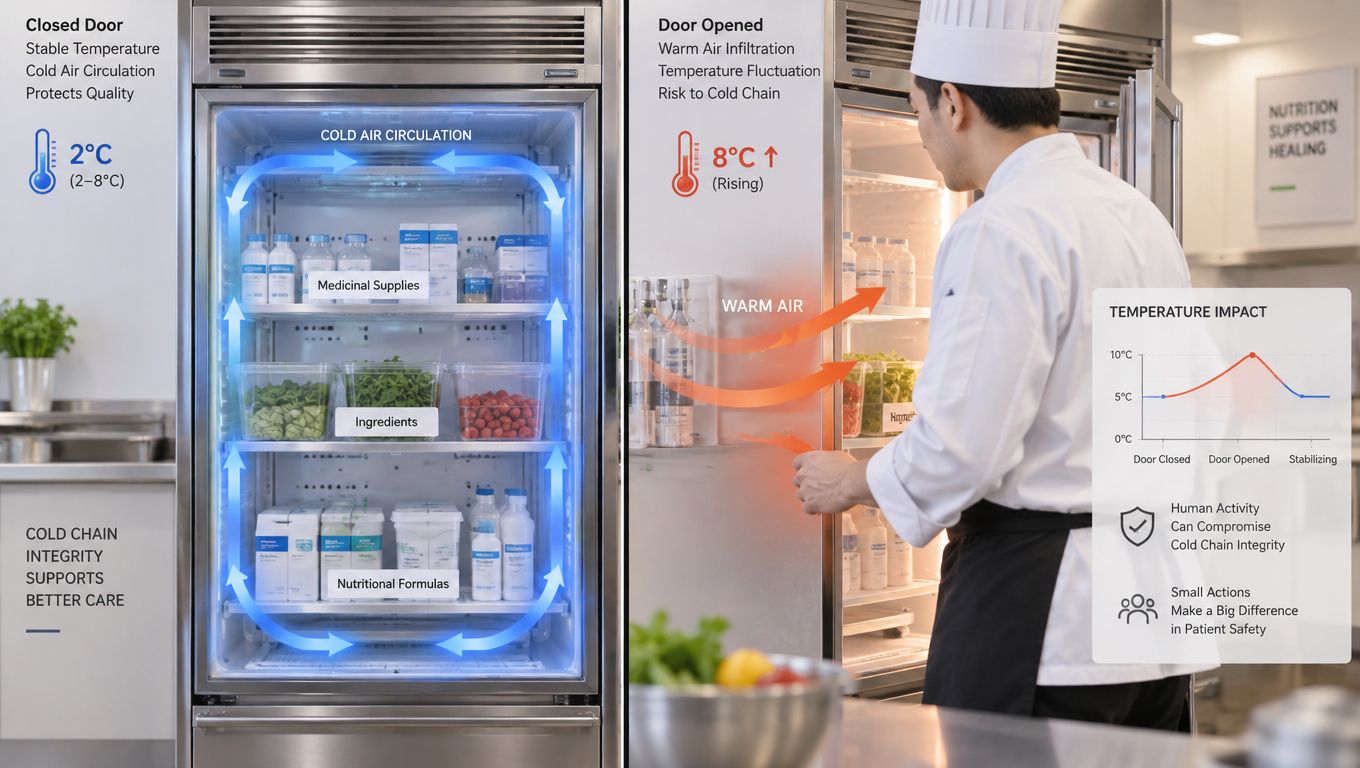
Manufacturer loading, ambient and installation requirements should take priority over assumed universal limits. Performance information is produced for defined conditions, so the selected unit needs to match the actual room, stock pattern and access frequency.
Look beyond the cabinet
The kitchen's wider energy and ventilation design also affects refrigeration. Operators reviewing cooling loads across a facility may find it useful to read about solar battery savings for ducted AC from HighFlow Energy, particularly when considering how building services interact with equipment operating continuously.
The point isn't to apply air-conditioning advice directly to a refrigerator. It's to recognise that nearby heat, ventilation and power planning influence the equipment environment. A cabinet placed in a cramped, hot corner can be the wrong choice even when its dimensions and nominal capacity appear suitable.
Hygiene, Maintenance, and Monitoring Practices
Healthcare foodservice refrigeration should make correct cleaning and checking practical. Internal surfaces, shelving, handles, door seals and drainage components need access, and the space around the cabinet must allow staff to clean without moving heavy equipment unnecessarily.
Cleaning procedures should follow the facility's food-safety system and the manufacturer's instructions. Particular attention belongs on seals and handles because staff touch them frequently, while shelving and internal surfaces need a layout that supports stock rotation and thorough cleaning. A cabinet with awkward corners or inaccessible drainage components can create recurring housekeeping problems.
Monitoring that supports action
A built-in display gives staff a local reading, but it shouldn't be the only control. Independent checks, written records and documented responses help teams identify whether a temperature issue is isolated, recurring or connected to loading and workflow.
Remote monitoring such as SKOPE Connect may be available on compatible SKOPE equipment and can help operators identify potential temperature issues earlier. It doesn't replace required staff checks, food-safety procedures, or the responsibility to assess and document what happens when food has been exposed to unsuitable conditions.
Healthcare operators can also use a formal critical-control framework to clarify who checks refrigeration, what gets recorded and what action follows an exception. A practical explanation of HACCP critical control points can help teams structure that discussion without treating an alert system as a substitute for trained staff.
Build the failure response before the failure
The right question is: If this refrigerator fails today, what food is at risk and what is the backup plan? The answer may include distributing critical stock, keeping suitable backup capacity available, recording temperature history and defining who decides whether affected food can be used.
HealthCERT guidance for vaccine storage provides a separate clinical example of the discipline required in a monitored cold chain. It recommends calibrated monitoring with data-logger alarm points commonly set at +2°C and +8°C, together with contingency equipment such as insulated chilly bins and conditioned ice packs for power or equipment failure. Those controls apply to vaccine storage, not ordinary healthcare kitchen refrigeration, but they illustrate why monitoring and contingency planning should be designed together.
The commercial refrigeration maintenance guidance provides a useful basis for reviewing cleaning, inspection and maintenance responsibilities. Manufacturer-required condenser cleaning and preventative maintenance intervals should be followed, because dust, usage intensity and ambient conditions vary between sites.
Making the Right Refrigeration Decision for Your Service
The best healthcare refrigeration decision balances equipment performance with the way the kitchen operates. A hospital production kitchen may prioritise bulk storage and batch preparation, while an aged-care or retirement-village kitchen may need more accessible point-of-use storage for varied meal components and clearly identified dietary requirements.
Purchase price is only one part of the assessment. The whole-of-life view includes:
- Purchase and installation: Include delivery access, electrical work, positioning and fit-out changes.
- Energy use: Review verified manufacturer information and consider how the unit will operate in its actual environment.
- Maintenance: Check cleaning access, condenser access and the manufacturer's maintenance requirements.
- Serviceability: Confirm warranty, support arrangements and the practical availability of service access.
- Food-loss exposure: Consider what could be affected if the cabinet fails and whether stock can be redistributed.
- Operational suitability: Assess door swing, shelving, container fit, workflow position and special-diet storage.
- Monitoring: Decide whether local displays, independent checks and compatible remote alerts provide the oversight the facility needs.
Verified specifications from SKOPE and Atosa can support a structured comparison, but neither brand should be treated as a universal answer. The right choice depends on the food journey, peak stock, installation environment, menu production method and the facility's contingency procedures.
For operators reviewing refrigeration requirements in healthcare environments, the central test is simple: can the proposed system keep the right food safely refrigerated at every stage from delivery to service, while allowing staff to work, clean, monitor and respond when conditions change? If the answer depends on one oversized cabinet, the plan probably needs another review.
Hospitality can help healthcare kitchens compare commercial fridges, freezers, preparation refrigeration and blast-chilling options against workflow, capacity and installation conditions. Visit Simply Hospitality to discuss the equipment mix that best supports safe food storage and dependable meal service.