

Choosing the Right Blast Chiller NZ Operators Can Rely On
A blast chiller in New Zealand should not be bought as if it were just another fridge. The better question is whether it helps a kitchen separate cooking from service, protect quality through batch production, and keep food moving through a documented cooling process without creating bottlenecks. That is the core value of a blast chiller NZ operators can rely on, especially in kitchens where labour, timing, and consistency all matter.
A common mistake is sizing the unit for today's menu and calling it done. That thinking usually underestimates how quickly a kitchen can outgrow its production plan, particularly once prep, catering, meal service, or central production starts to expand. In practice, the right chiller is a workflow decision first and a refrigeration purchase second.
Hospitality works with restaurants, hotels, caterers, and institutional kitchens that need equipment to support actual production, not just storage. The best advice is blunt. Choose the chiller around tomorrow's volume, not today's list of dishes.
Why a Blast Chiller Is a Production Tool, Not Just a Fridge
The wrong way to buy a blast chiller is to ask how cold it gets and stop there. The right way is to ask what it changes in the kitchen. A blast chiller changes when food is prepared, not just how it's cooled, and that shift matters more than most buyers realise. It lets chefs and owners cook when labour is available, then hold that work safely for later service, regeneration, or storage.
That is why capacity decisions should not be based only on a current menu. Menus change, functions get added, and production tends to grow faster than a kitchen's original assumptions. The equipment that looks “big enough” on day one often becomes the bottleneck by the time prep expands or service gets busier.
A good way to think about it is this. Refrigeration stores food, but a blast chiller organises production. It helps a kitchen move from reactive service cooking to planned batch production, which is a very different operating model. For operators who buy equipment in stages, that difference usually matters more than a glossy spec sheet. How equipment choice affects food quality more than recipes
Practical rule: if the unit doesn't improve the way a kitchen is run, it's too small, poorly placed, or simply the wrong type.
In our experience, serious buyers separate themselves from casual ones. They look at labour patterns, prep windows, and how the line runs, then size equipment around that reality. That approach gives the chiller a proper job, not just a shelf in the cold room.
What a Blast Chiller Actually Does in a Commercial Kitchen
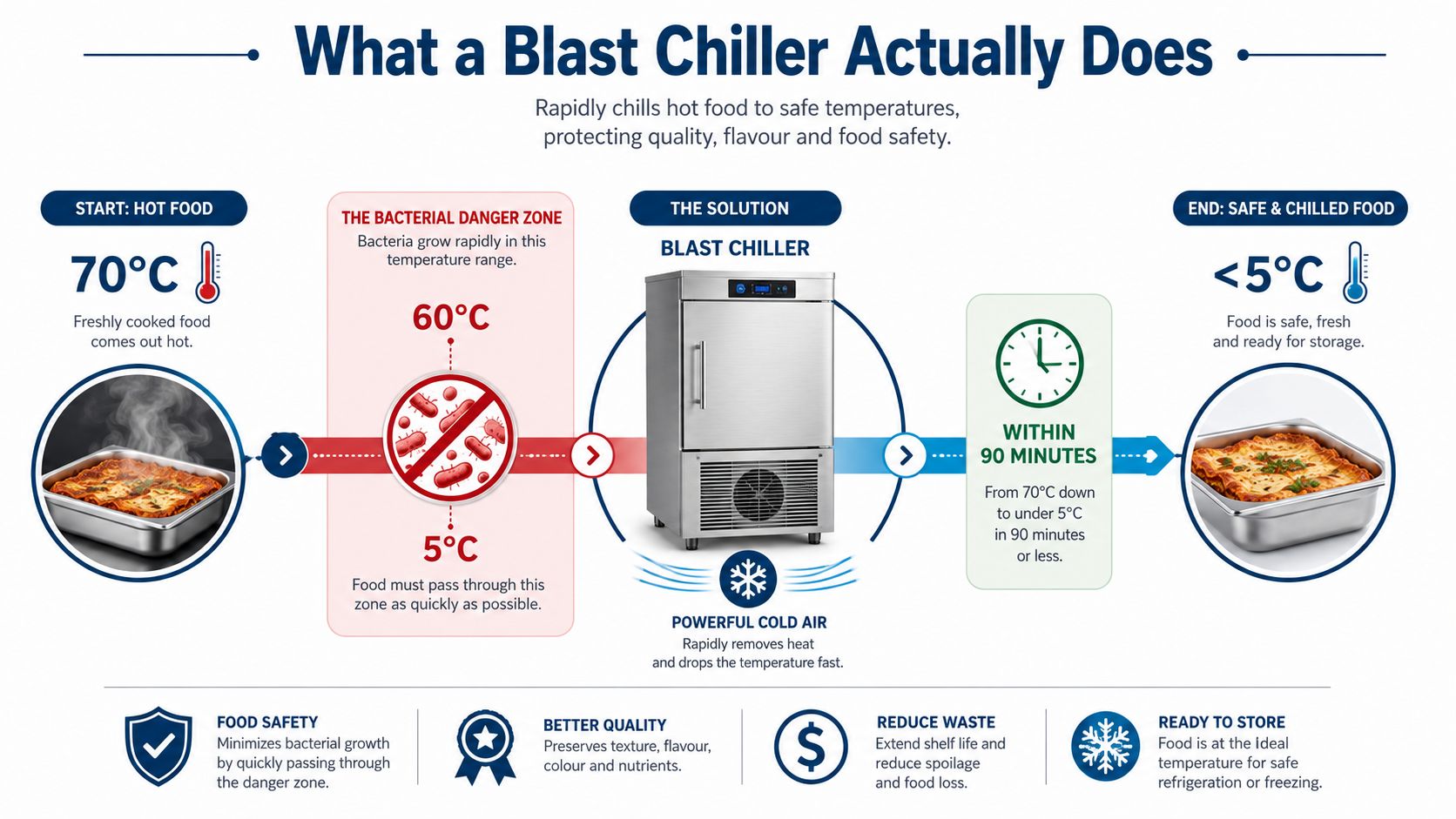
A commercial blast chiller is usually used to take cooked food from about 70°C to below 5°C in 90 minutes or less Simply Hospitality NZ guidance. That cooling window matters because it pushes food through the danger zone quickly and keeps the product in a condition that can be held safely later. The job is practical, not decorative. It gives the kitchen a controlled way to move hot production into chilled holding without dragging quality down.
The practical sequence
Hot food leaves the cook line, goes straight into the blast chiller, then drops into the chilled range fast enough to protect texture and safety. That sequence is what makes batch cooking realistic in a busy kitchen. Without it, staff either rush food out before it is ready or leave it sitting in unsafe territory.
The workflow changes once that cooling step is dependable. A kitchen can cook in proper production blocks, chill the output, then serve or regenerate later without rebuilding the whole day around the pass. That is why a blast chiller belongs in the production plan, not just in the cold room. Why Friginox blast chillers have become part of modern commercial kitchen planning
Food-safety guidance in New Zealand also sets clear holding limits. Potentially hazardous chilled food needs to be held at 5°C or below, frozen food at -18°C or below, and hot food at 60°C or above MPI-aligned cold-room compliance guidance. Those numbers define the endpoint the chiller has to reach. The equipment is doing more than cooling. It is getting the food into a state where the next step, storage, service, or regeneration can happen properly.
The blast chiller matters because it gives kitchens a controlled step between production and service, not because it is another cold box.
There is a real distinction between blast chilling and shock freezing. Blast chilling is about bringing cooked food quickly into the safe chilled zone for later service. Shock freezing goes further and is used when product needs to be frozen fast for longer holding. The right choice depends on the menu, the storage plan, and how often food gets regenerated.
A compact example in the market is the Festive Devon Chilled Compact Counter Top, which is described as a counter top cabinet with 4°C operating temperature and lengths of 900, 1200, 1530, 1770 and 2370 mm. That is not a substitute for every blast chilling job, but it shows how compact chilled equipment can support controlled holding in tight spaces where floor area is limited.
The point is simple. Good production planning often starts with rapid chilling. Once that step is under control, the rest of the kitchen can be organised with more discipline and less guesswork.
Decoupling Cooking From Service to Free Up the Kitchen
A blast chiller separates cooking from service. That's the big operational gain, and it's the one many buyers miss when they focus only on refrigeration performance. Once food can be cooled correctly and held for later use, a kitchen stops having to cook everything at the exact moment customers want it. That changes labour planning, line pressure, and how the whole week is organised.
What changes in the workflow
Batch cooking becomes more realistic. Sauces can be made in productive blocks. Proteins can be cooked when the line is less pressured. Prepared meals can be chilled, stored, and regenerated later instead of forcing the kitchen into constant last-minute production. In catering and central production kitchens, that flexibility is often the difference between tidy workflow and daily firefighting.
A blast chiller also supports more consistent quality across multiple service periods. A kitchen that prepares once and serves twice, or prepares in one site and finishes in another, needs food to stay predictable after cooling. That's where the chiller becomes a planning tool, not a back-of-house extra.
One consideration we regularly discuss with customers is labour timing. The kitchen doesn't always have to cook at peak service time. It can cook earlier, chill correctly, and regenerate later when the team is ready and the pass is under less strain. That's a cleaner way to work, and it usually reduces the number of hot, rushed decisions during service.
- Batch Production: Cook larger volumes in planned windows, then chill for later use.
- Regeneration: Hold product correctly so it can be brought back to serving temperature when needed.
- Reduced Service Pressure: Keep the line focused on finishing, not scrambling to start from zero.
- Catering and Central Production: Move work out of peak times and into controlled prep periods.
- Future Growth: Build a system that can handle more output without redesigning the kitchen from scratch.
A common misconception is that the chiller's value sits only in safety. Safety matters, but the bigger commercial win is usually operational discipline. Kitchens that plan ahead tend to waste less time, move less food around unnecessarily, and give staff clearer roles during busy periods. Planning equipment for consistent meal service
Lessons From a Working Commercial Kitchen
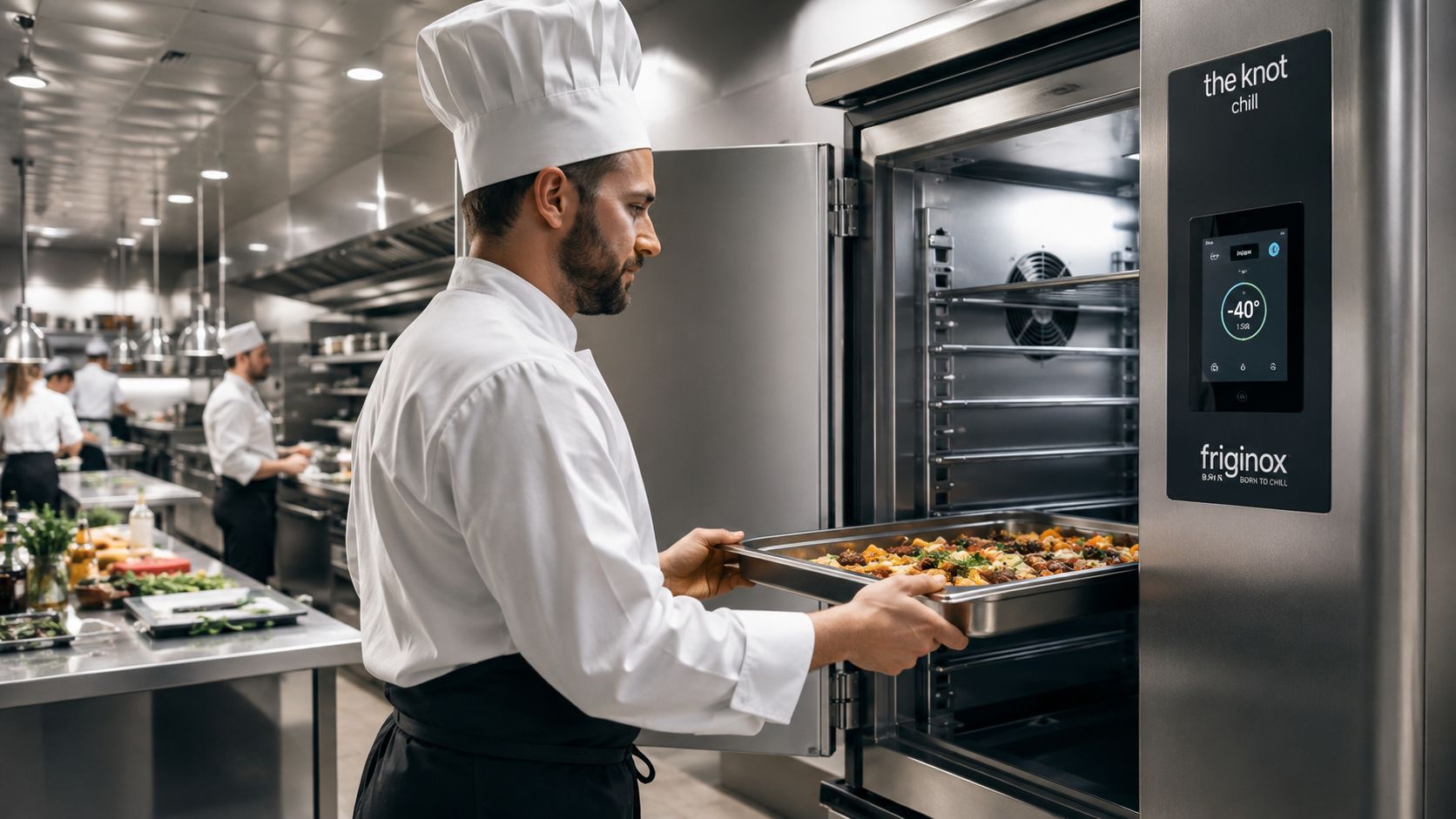
The clearest lesson from a working kitchen is simple. A blast chiller earns its place when it is treated as part of production planning, not as a spare cold box. In practice, that means cooked food can be cooled quickly before storage, then brought back into service later with less risk and more control.
That changes how the kitchen runs day to day. Once product is chilled properly, prep can be staged earlier, stock can be held with more confidence, and the team is not forced to improvise every time service gets busy. Those gains do not always show up on a spec sheet, but they show up in the way the kitchen feels under pressure.
What operators should borrow from that example
The first lesson is to identify which items belong in a batch-production system. Sauces, braised items, cooked proteins, soups, and prepared meals are obvious candidates because they hold their quality well after chilling and regeneration. If a menu item can be made ahead without losing consistency, it should be treated as a production item, not a last-minute job.
Placement is the other lesson operators should not ignore. In older kitchens, the best setup is often the most direct one, with the chiller beside the cooking area so hot food moves straight from production into rapid chilling. That cuts handling, keeps the workflow sensible, and reduces the chance of product sitting around while staff look for space.
A kitchen that chills well works with less noise in service. Staff know what has been cooked, what has been cooled, and what is ready to finish later. That kind of control matters more than a glossy equipment spec because it gives the chef a cleaner system to run on a busy night.
The real gain is confidence in the production line, not a faster-looking process on paper.
The operators who get the most value from a blast chiller ask a practical question before they buy. Which dishes can be made ahead, chilled correctly, and served later with less pressure on the line? That answer is more useful than any generic capacity label, and it points straight to the right type of equipment. For businesses still deciding how refrigeration should match their stage of growth, choosing refrigeration based on your business stage is the right place to start.
Sizing a Blast Chiller for Tomorrow, Not Today
The biggest mistake is buying a blast chiller that only fits this month's production. Kitchens evolve. Menus grow, functions get added, and batch production usually expands once a team sees that the system works. The unit has to match production volume, not just meal count, because the same number of covers can still mean very different amounts of prep work.
For many catering businesses and medium production kitchens, 5 or 10 GN 1/1 tray models are common starting points because they provide enough capacity for real batch production while still fitting into a practical kitchen layout. Smaller cafés often look at countertop formats first, especially when floor space is tight. Bigger venues, or venues planning for central production, usually need to think more carefully about a floor unit and how it fits into the rest of the cold chain. Choosing refrigeration based on your business stage
A simple sizing lens
- Small cafés and compact kitchens: a countertop format can be enough if production is limited and batches are small.
- Caterers and multi-service venues: 5 or 10 GN 1/1 tray capacity is often a sensible starting point.
- Growing kitchens and central production sites: think beyond today's menu and build for higher output, not just immediate need.
Position matters as much as tray capacity. A blast chiller placed immediately beside the cooking line usually creates the greatest workflow improvement because hot food moves a shorter distance and gets processed faster. In retrofit kitchens, that kind of placement can be more valuable than squeezing in a larger machine somewhere inconvenient.
The other thing to plan for is the downstream fridge and freezer space. A fast chiller only helps if the surrounding storage system can take the product cleanly. Otherwise, the kitchen gains speed in one place and loses it at the transfer point.
| Venue Type | Typical Starting Point | Key Driver | Watch Out For |
|---|---|---|---|
| Small café | Countertop unit | Limited space and smaller batches | Outgrowing capacity too early |
| Catering business | 5 or 10 GN 1/1 tray model | Batch production and regeneration | Buying only for today's menu |
| Medium production kitchen | 5 or 10 GN 1/1 tray model | Throughput and workflow control | Poor placement near the cooking line |
| Central production kitchen | Larger floor unit | Higher output and planned service | Downstream cold storage bottlenecks |
The right answer depends on future production, not just the current menu. That's the standard worth holding to.
Food Safety, Compliance, and the NZ Regulatory Picture
Blast chillers fall under AS/NZS 60335.2.89, the safety standard for electrically operated commercial refrigerating appliances with an incorporated compressor or split-system design Standards New Zealand. That matters because a blast chiller is not a loose refrigeration accessory. It is a defined commercial appliance with its own safety expectations.
What operators need to keep straight
The compliance picture is practical, not abstract. Food businesses need to be able to show that chilled food stays at 5°C or below, frozen food at -18°C or below, and hot food at 60°C or above. They also need a clear rule for food that sits in the danger zone. Food that spends less than two hours in the 5°C to 60°C range may be refrigerated for later use, while food between two and four hours must be used immediately, and food beyond that should be discarded if necessary.
The cooling benchmark operators usually work to is +70°C to +3°C or below within 90 minutes blast-chill benchmark reference. That gives kitchens a clear target for rapid chilling and a straightforward way to check whether the process is doing its job.
For food businesses storing non-animal products for human consumption, MPI states that compliance with the Food Act 2014 is required MPI cold and dry store requirements. That is the wider framework blast chilling sits inside. The machine does not create compliance on its own, but it makes compliance much easier to prove when the kitchen is busy and the workflow is under pressure.
For a practical check on cold-room expectations, this energy-efficient appliance guidance from Simply Hospitality is useful background when you are looking at the surrounding cold-chain setup.
Audit mindset: if the team cannot explain how food moves from cooking to chilling to storage, the process is not tight enough.
Good documentation, clear temperature checks, and disciplined transfer routines matter just as much as the machine itself. A blast chiller gives the kitchen a controlled process, but the staff still need to follow it every time.
Energy, Maintenance, Servicing, and Total Cost of Ownership
A blast chiller should be treated as production infrastructure, so the key question is how much it costs to run, keep healthy, and integrate into the kitchen. The upfront figure matters, but it only tells part of the story. The better filter is total cost of ownership, because that captures the purchase, installation, energy use, and servicing that sit behind the cabinet.
The purchase price for a unit in this category is usually discussed in broad ranges, and delivery plus installation add more to the final bill. Those figures are useful as a starting point, but they do not tell you whether the unit fits the way your kitchen works Simply Hospitality NZ guidance. If the machine is a poor match for the line, the cold room, or the storage flow after chilling, you end up paying for friction every day.
The cost picture that actually counts
- Purchase Price: the machine itself.
- Delivery and Installation: the practical cost of getting it into service.
- Energy Consumption: ongoing operating cost, which depends on usage and setup.
- Maintenance and Servicing: cleaning, gasket checks, and planned support.
The surrounding system matters as much as the cabinet. If the chiller sits too far from the cooking area, staff waste time and heat food longer than they should before transfer. If the downstream storage is weak, the chiller has to do more work than it should. That is why the cold chain needs to be set up as one working process, not a set of separate purchases. Energy efficient appliance guidance
Maintenance is not a nice extra. It is the difference between a machine that holds performance and one that drifts out of spec. Doors need a proper seal, interiors need regular cleaning, and defrosting has to be managed with discipline. Servicing should be scheduled before performance slips, because once food quality starts to suffer, the kitchen is already paying for the delay.
Ownership decisions should also reflect the stage of the business. Finance can make the machine easier to absorb, and certified used equipment can be a sensible entry point if the production need is real and the budget is tight. The right call is the one that supports current workload without blocking the next phase of growth.
A blast chiller earns its place when it helps the kitchen work cleaner, faster, and with less pressure on service. Judge it that way, and the ownership case is much stronger than the sticker price suggests.
Getting the Right Setup for Your Venue
The right blast chiller depends on workflow, not a generic template. A café, hotel kitchen, caterer, or central production site will all use the machine differently, and that changes the size, placement, and storage plan. The best setups are the ones that fit the actual production pattern and leave room for growth.
The smart move is to map what gets cooked, when it gets cooked, and where it needs to go next. That tells the truth faster than a menu count ever will. Then the chiller can be sized for tomorrow's output, not just today's service.
Hospitality can help match a unit to the kitchen layout, batch volume, and growth plan, whether the need is compact chilled holding or a more serious production workflow. The right answer is rarely one-size-fits-all, and it shouldn't be treated that way.
A CTA for Simply Hospitality.