

Burger Press NZ Buying and Use Guide for Hospitality
The usual moment when operators start searching for a Burger Press NZ solution is not when the first burger goes out well. It's when the rush starts, a second staff member jumps onto prep, and the patties stop matching. One is too thick in the centre, one spreads too wide on the plate, one shrinks away from the bun, and suddenly the grill section is compensating for prep inconsistency instead of just cooking.
That's where a burger press earns its place. Its real value isn't flavour. A burger press doesn't make a better burger by pressing it alone. Its commercial job is repeatability, so the 100th patty looks and cooks much more like the first. That matters in burger restaurants, cafés, pubs, takeaways, food trucks, caterers, production kitchens, and in some butchery settings where patties are formed regularly.
The category is worth taking seriously in New Zealand. Burger Fuel Group reported $111.4 million in groupwide sales in the 2026 financial year, up 2.93% on fiscal 2025, with New Zealand sales at $108 million, up 4.1% year-on-year, across 66 New Zealand restaurants according to this New Zealand burger market reference. Separate industry coverage also reported strong burger patty growth in New Zealand retail and foodservice, including 109,764 burger units sold by First Light, equal to 44,000 kilograms, a 41% year-to-date increase, while burger patty category sales rose by over 85% and premium burger patty sales by well over 150% in the same market coverage from the New Zealand Herald report on the burger market.
Why Consistency Matters More Than Speed
A busy burger service rarely falls apart because staff can't physically shape mince. It usually slips because each person shapes it a little differently. That creates variation in diameter, thickness, grill time, bun fit, and plating. The prep bench may think it's doing fine, but the pass sees the problem first.
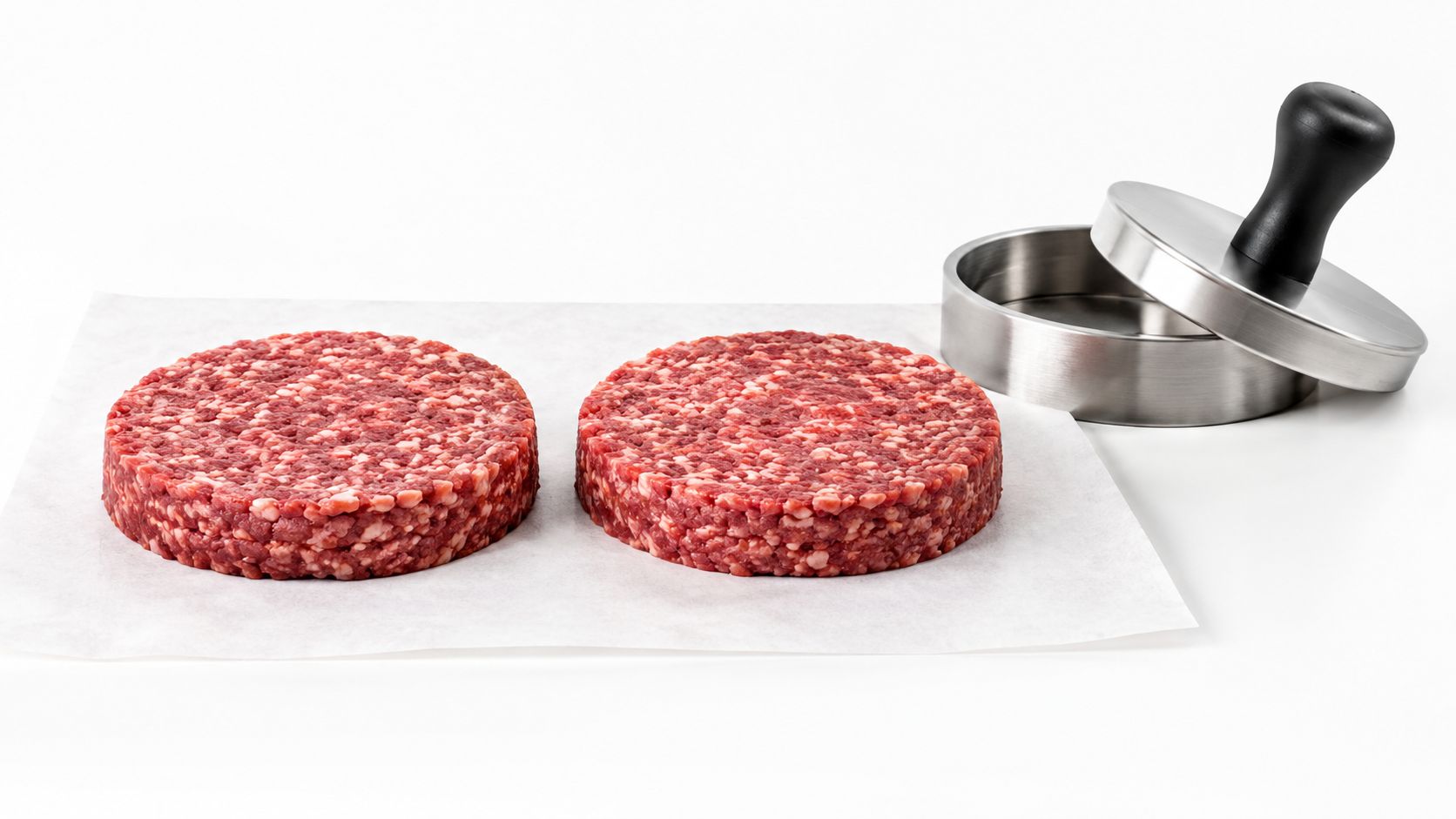
A burger press becomes useful when the kitchen needs a result that's easier to repeat across shifts, not just faster to produce. Hospitality businesses often find that predictable prep reduces pressure on the grill because staff aren't constantly adjusting timing for patties that were supposed to be identical. That's the same operational logic behind why consistent prep creates consistent profits.
What inconsistency actually costs
The hidden cost of hand-forming isn't only labour. It shows up in small service problems that stack up quickly:
- Cooking variation: Thicker patties need different heat exposure than flatter patties.
- Bun coverage: A narrow patty can make the burger look undersized even when the meat weight is correct.
- Presentation drift: The same menu item starts looking different depending on who prepped it.
- Training pressure: New staff have to learn a feel-based task instead of following a simple repeatable process.
Practical rule: If the grill chef has to keep asking who formed the patties today, the prep method needs attention.
Repeatability is the real commercial gain
Many operators focus on speed first because it's the obvious visible benefit. Speed matters, but consistency matters more. A press helps standardise the physical shape of the patty so the station becomes less dependent on one experienced person's hand skills.
That matters even more when the menu is built around repeatable burgers rather than chef-by-chef variation. In those settings, the press supports food costing, cleaner handovers, and steadier output during busy periods. The right solution depends on volume and burger style, but the principle stays the same. The press is there to reduce variation.
Portion Consistency and Shape Consistency Explained
Operators often use these terms as if they mean the same thing. They don't. This is one of the most important distinctions to get right before buying any burger press in NZ.
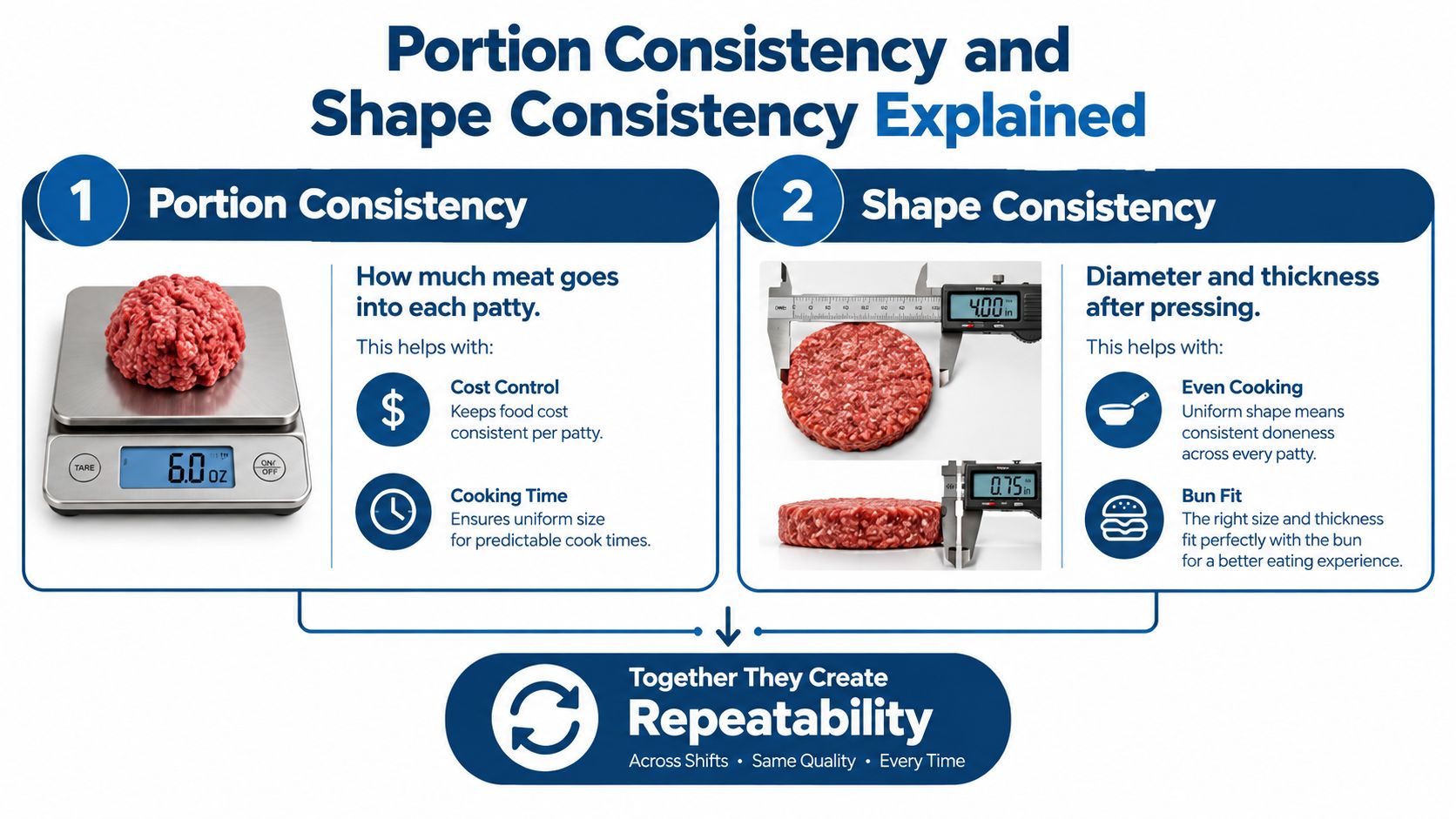
Portion consistency is how much meat goes into each patty.
Shape consistency is the diameter and thickness of the finished patty after pressing.
A standard manual press may improve shape consistency very well, but it doesn't automatically control portion weight unless the equipment also portions the product. Staff still need to measure or portion the meat correctly before it goes into the press. That's why many kitchens pair burger pressing with digital kitchen scales when menu costing and repeatability matter.
Why the difference matters in service
If portion weight changes, food cost moves with it. If shape changes, cooking performance and presentation shift with it. Those are related problems, but they're not the same problem.
A simple way to consider this is that
- Too much meat, right shape: The burger may still look good, but the portion cost is off.
- Right meat, wrong shape: The cost may be fine, but the bun fit and cooking result can still be inconsistent.
- Wrong meat, wrong shape: Service gets messy very quickly.
A burger press can standardise dimensions. It can't correct poor portioning unless it's designed to portion as well as form.
What this changes on the line
When portion and shape are both controlled properly, staff usually get a smoother workflow. Patties load onto the grill more predictably, cooking times are easier to teach, and handover between prep staff becomes simpler.
That can support more consistent:
- Cooking time
- Bun coverage
- Presentation
- Food costing
- Preparation workflow
- Staff training
- Repeatability between shifts
For operators batching pre-portioned mince ahead of service, even storage systems can affect how cleanly that workflow runs. A practical example is the Mepal Cirqula Rectangle 1000ml Nordic White, which is designed for storing, reheating and serving meal prep or a standard leftover portion in a shelf-efficient rectangular vessel. In a prep context, the rectangular footprint can make fridge and freezer organisation tidier than round containers.
The most common misunderstanding
A common issue seen in hospitality kitchens is buying a press to solve a weighing problem. If staff are loading uneven amounts of mince into the mould, the patties may all look similar from above while still varying in weight and thickness once cooked.
That's why a burger press should be treated as one part of a consistency system. Portion first. Press second. Then the grill section has something it can rely on.
Types of Burger Presses for NZ Hospitality Kitchens
Not every kitchen needs a press, and not every press suits commercial production. The right choice usually follows production volume more than menu ambition.
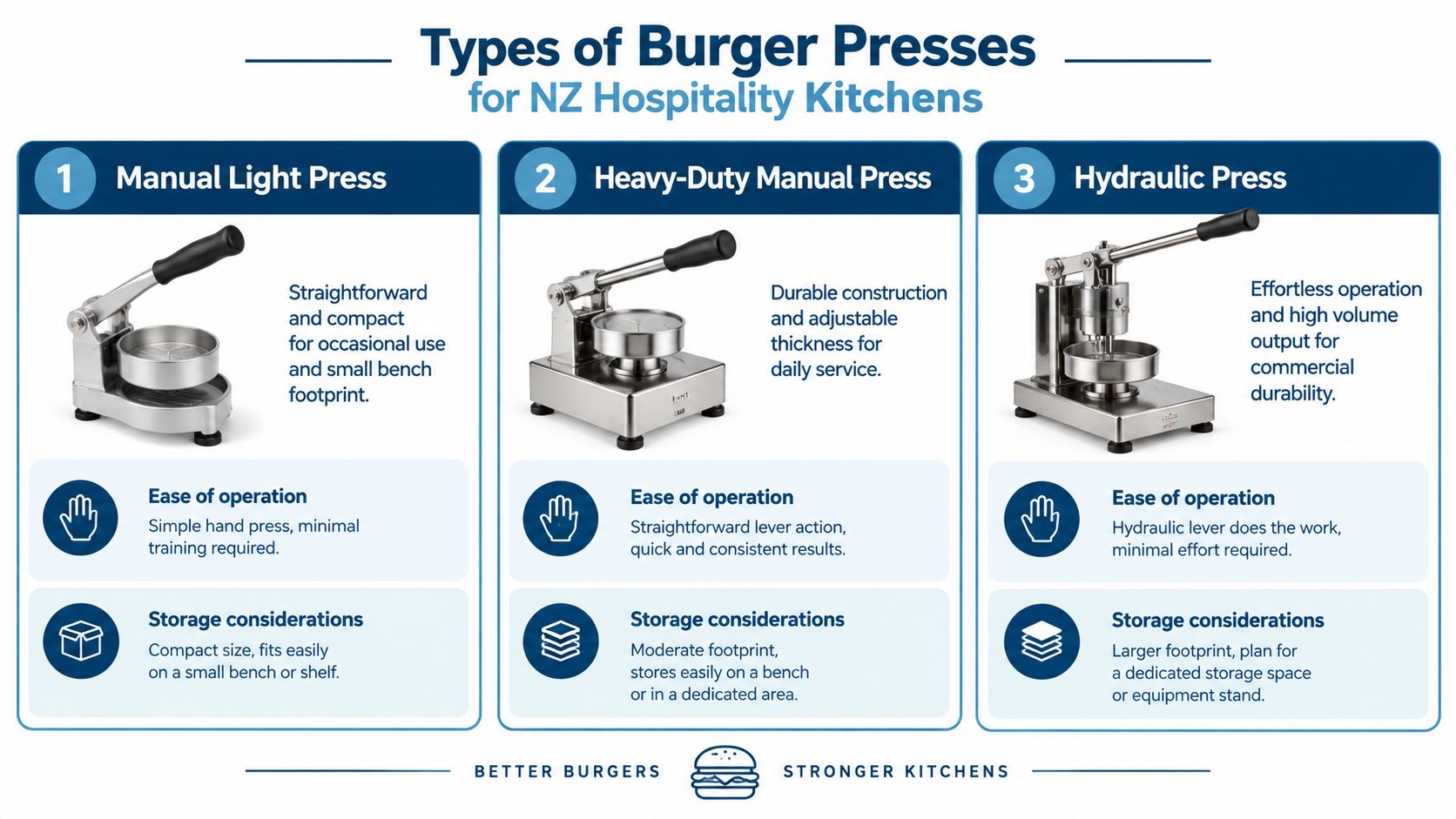
The simplest progression is this: occasional patties, hand forming may be enough; repetitive production, a manual press becomes useful; substantial production, higher-capacity portioning or forming equipment starts to make more sense.
Hand forming for occasional production
For venues making burgers infrequently, hand forming can be perfectly workable. This often suits cafés with a small burger menu, pubs where burgers are only one part of the offer, or caterers producing modest numbers for selected events.
Hand forming works best when:
- Volume is low: Prep demand isn't constant.
- Experienced staff are available: Someone can keep an eye on size and shape.
- The menu allows slight variation: The burger style isn't dependent on precise dimensions.
Manual presses for repetitive prep
Once patties are being formed regularly, a straightforward manual press becomes useful. This is often the practical middle ground for takeaways, food trucks, burger-focused cafés, and smaller production kitchens.
Many operators choose manual presses because they offer:
- Better repeatability: More consistent diameter and thickness.
- Simple operation: Staff can learn the workflow quickly.
- Compact footprint: Helpful where bench space is tight.
- Lower complexity: Fewer parts and fewer things to go wrong.
For food trucks building local demand, prep repeatability matters just as much as marketing. Operators planning mobile burger service often also look at broader growth tools such as TV advertising for local food trucks, especially when the challenge is moving from occasional trading into more regular, branded service.
Heavier-duty manual and higher-capacity equipment
Some kitchens outgrow light manual pressing. Production kitchens, larger burger businesses, caterers doing repeated batch prep, and butchers forming patties routinely may need sturdier manual units or higher-capacity portioning and forming equipment.
In those cases, selection shifts toward:
- Commercial durability
- Stability on the bench
- Speed of loading and releasing patties
- Repeatable thickness
- Suitability for larger prep runs
Hospitality businesses reviewing broader prep workflow can also compare this decision with other must-have prep equipment for commercial kitchens, because a burger press only solves one part of the prep chain.
Simple and repeatable often beats feature-heavy. For a repetitive raw-meat task, ease of use and ease of cleaning usually matter more than extra complexity.
How to Choose Diameter Thickness Materials and Footprint
Buying on appearance is a mistake with burger presses. Two models can look similar online and behave very differently on the bench. The better approach is to match the press to the burger, the grill, the prep volume, and the cleaning routine.
Match diameter to the burger you actually serve
Patty diameter should suit the bun and the style of burger leaving the pass. A thick pub burger, a flatter takeaway burger, and a smash-style preparation all place different demands on the tool.
One consideration regularly discussed with customers is that a patty can be the correct weight and still be the wrong size for the bun. That creates presentation problems even before cooking starts. Diameter affects bun coverage, stack appearance, and how the burger reads to the customer at first glance.
Thickness and adjustment affect repeatability
Thickness matters because it changes cooking behaviour. If the press allows adjustment, that can be useful for venues trying to keep a repeatable result across different staff members and different service periods.
Look closely at:
- Whether thickness is fixed or adjustable
- How easy the adjustment is to use
- Whether the setting stays stable during repeated use
- How cleanly patties release from the mould
A complicated adjustment system sounds helpful until it slows prep or becomes awkward to clean. For many kitchens, a simpler design with one reliable output is more useful than a highly adjustable unit that staff avoid using properly.
Materials and cleanability matter more than finish alone
In New Zealand food-premises design, food-contact surfaces for equipment such as a burger press need to be non-toxic, corrosion-resistant, non-contaminating, and cleanable under the conditions of use. For wet food-contact applications, 304L stainless steel is widely recognised as the lowest acceptable grade in NZ food-industry practice, with smooth finishes preferred and welds commonly limited to about 180-grit polishing for cleanability, as outlined in this food equipment design reference used in NZ industry practice.
That's why materials shouldn't be treated as a cosmetic feature. In raw-meat prep, smooth surfaces and sensible construction make day-to-day sanitation easier.
| Feature | What to Check | Why It Matters in Service |
|---|---|---|
| Diameter | Match the mould size to the bun and menu style | Supports bun coverage and presentation consistency |
| Thickness | Check fixed depth or adjustment method | Influences cooking repeatability |
| Construction | Look for food-contact suitable, corrosion-resistant materials | Affects hygiene, durability, and cleanability |
| Surface finish | Prefer smooth contact areas and tidy welds | Helps reduce product build-up and makes cleaning easier |
| Release method | Check how patties come out after pressing | Reduces tearing and rework during prep |
| Bench footprint | Measure usable prep space, not just storage space | Prevents congestion on small prep benches |
| Stability | Check whether the press stays planted during repeated use | Makes repetitive prep safer and less frustrating |
| Disassembly | Look at how the unit comes apart for washing | Faster, more thorough cleaning |
| Storage | Consider where it sits between uses | Avoids clutter and damage in tight kitchens |
Footprint and durability are practical buying points
Small presses still need room to operate comfortably. The lever arc, loading space, and landing space for patties all matter. A compact unit can be a poor fit if staff have to twist around other equipment to use it.
Commercial durability also matters more than many buyers expect. New Zealand processed-meat guidance requires presses or moulds to be regularly checked for rough or sharp edges that can puncture product casings, and it also requires metal detectors to be sensitive to ferrous, non-ferrous, and stainless steel contamination, checked daily against test pieces, and calibrated regularly, as set out in the MPI processed meat guidance. Even in kitchens not operating full meat-processing systems, the message is clear. Worn forming tools create hygiene and physical contamination risks.
Cleaning Food Safety and HACCP for Raw Meat Contact
A lunch rush exposes weak raw-meat prep fast. One staff member is pressing patties, another is building buns beside them, and a press that is awkward to strip down starts holding mince in creases and hinges. At that point, the issue is not burger flavour. It is whether the tool supports a clean, repeatable raw-meat workflow.
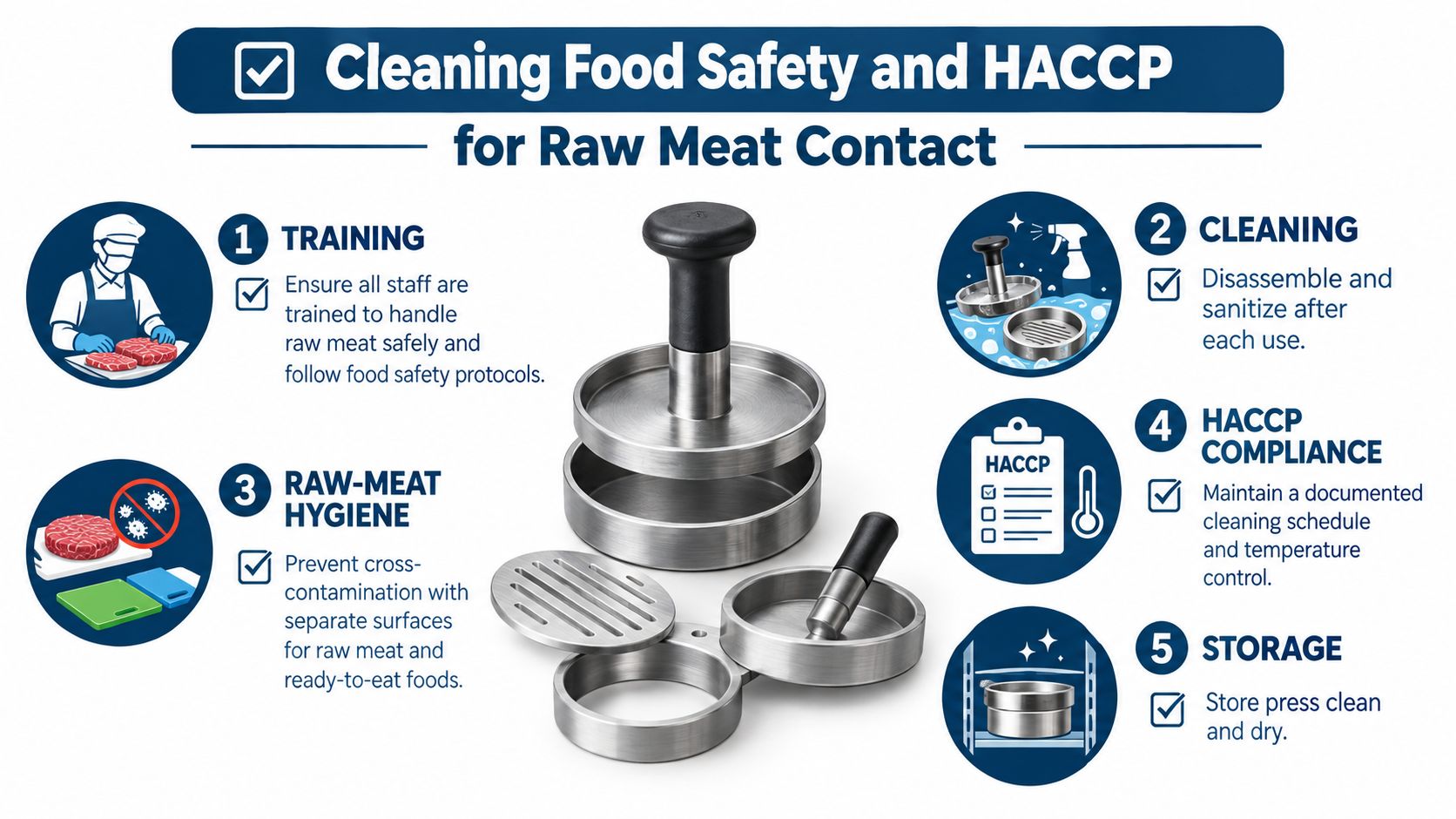
That is why a burger press should be assessed as a repeatability tool first. It helps keep portion size and shape stable across shifts, but it also has to be easy to clean between raw-meat tasks. If it cannot be washed, sanitised, dried, and checked properly, the consistency gain is not worth much in a commercial kitchen.
New Zealand Food Safety sets out the basic controls clearly: train staff, clean and sanitise, wash hands properly, keep raw and ready-to-eat food separate, and manage cooking and storage temperatures, as outlined in the NZ food safety toolkit. A burger press has to fit inside those controls and your HACCP plan or food control procedures.
What good practice looks like on the bench
For raw mince contact, the practical questions are simple. Can staff separate the press from ready-to-eat prep. Can they take it apart without tools or guesswork. Can they see and clean the contact points where fat and protein build up.
A workable routine usually includes:
- Dedicated raw-meat use: Keep the press in the raw prep zone, away from buns, salad, cheese, sauces, and plated food.
- Full disassembly where the design allows it: Wash moulds, plates, rings, hinges, and handles that pick up splash or residue.
- Clean, then sanitise, then dry: Sanitiser does not replace proper washing.
- Inspection before reassembly: Check for trapped mince, worn seals, rough spots, and cracks that make cleaning harder.
- Dry storage: Put it away clean and dry so residue is not sitting in joints between prep runs.
In our experience, removable parts matter more than polished marketing claims. A press with fewer hidden recesses often suits busy kitchens better than a heavier unit that is harder to strip and verify clean.
Pressing patties does not change minced-meat rules
A press only forms the mince. It does not change the risk profile of minced meat, because surface bacteria can be spread through the product during mincing. That is the point many operators need to separate clearly. Portion consistency and shape consistency can improve with a press, but safe handling and cooking rules stay the same.
Food preparation guidance states that hamburgers should be cooked thoroughly to an internal temperature of 75°C, checked with a food thermometer. The same guidance also covers separation of raw and ready-to-eat utensils, along with cooling limits for cooked food, in the food preparation and cooking guidance. New Zealand guidance also explains that minced meat generally needs thorough cooking, and that serving red-meat mince lightly cooked or raw sits under specialist rules for restaurants, cafés, caterers, and other food-service businesses, as explained in this NZ raw meat handling guidance.
The equipment still has to suit the premises
Cleaning is not only about the press itself. The surrounding setup matters. If the sink access is poor, the bench is overcrowded, or staff have to carry a raw-meat tool across ready-to-eat areas to wash it, the process is already weaker than it should be.
Food premises standards require space, equipment, and facilities that support cleaning, sanitising, maintenance, and potable water supply, as covered in the food premises and equipment standard. Businesses selling food also need to operate under the right registration pathway for their setup, with local guidance such as Palmerston North City Council food safety guidance showing how that applies in practice.
For a broader view of compliance obligations around equipment, handling, and registration, see our guide to food safety regulations in NZ.
Volume Maths Budgeting and When a Press Pays Off
Friday prep often exposes the problem. One staff member portions by eye, another shapes for bun coverage, and by dinner service the grill is dealing with patties that look similar enough but do not cook the same. A burger press earns its keep when that variation is costing time, stock control, or consistency.
Start with the menu and the prep pattern, not the catalogue.
A venue running a burger special now and then may be fine hand forming, especially if one experienced person does the job and the target weight is checked on scales. The equation changes once burgers become a steady seller, prep is shared across shifts, or patties are being made in batches ahead of service. At that point, a press is less about speed and more about repeatability.
That distinction matters. Portion consistency and shape consistency are not the same thing. Staff can hand shape a neat patty that still varies in weight, or they can portion accurately and still produce uneven thickness. A press helps standardise shape every time, and paired with weighing, it helps hold portion control as well. For hospitality operators, that is where the margin sits.
A press usually starts to make sense when these pressures show up together:
- Burger prep happens several times a week
- More than one staff member is forming patties
- Yield and food cost need tighter control
- The grill section benefits from more even thickness
- Reforming, trimming, or arguing over patty size is becoming normal prep work
Speed still counts, but it is rarely the best reason to buy. The better test is whether the press reduces wasted motion in the workflow. Less rework. Fewer oversized patties. Less variation between morning prep and afternoon top-up batches. Easier training for newer staff.
Budgeting in practice
Purchase price only tells part of the story. The useful comparison is labour plus consistency plus cleaning.
A cheap press can look fine on paper and become annoying fast if it sticks, has awkward parts, or takes too long to wash and reassemble between raw-meat tasks. A sturdier unit may cost more upfront and still be the better buy if it holds up under repeated use and fits the prep bench properly. Small kitchens in particular feel that trade-off because every tool needs to justify its space.
For budgeting, use a simple check:
- How many patties are made per batch
- How often batches are made each week
- How much staff time goes into portioning, shaping, and rework
- How much product drift shows up from inconsistent weights
- How much cleaning time the press adds or saves
If the kitchen already weighs portions accurately and hand shaping is quick, the payback may be modest. If patties vary between staff, burgers cook unevenly, or the head chef keeps correcting batch quality, the payback usually arrives through tighter process control rather than dramatic labour savings.
That is why operators often compare a burger press with other prep tools competing for the same budget. The method is similar to the approach outlined in this breakdown of whether a Robot Coupe pays for itself in restaurant kitchens. Look at workflow, output, cleaning time, and how often the equipment removes a recurring problem.
There is also a food safety angle, even without revisiting the cleaning detail covered earlier. As burger volume grows, minced meat prep needs a process staff can repeat without confusion. Equipment that is awkward to clean, hard to dismantle, or prone to being left on a crowded bench can create more handling steps than the kitchen needs. In practice, the right press pays off sooner when it supports a simple raw-meat workflow and consistent batch prep, not just faster pressing.
Sourcing Warranty and Complementary Equipment in NZ
There isn't enough credible NZ-wide sales data to name one burger press as the country's best seller, and that's not the most useful way to buy anyway. The stronger approach is to source around workload, patty style, cleaning demands, and the role the press will play in the kitchen.
What to prioritise when sourcing
When comparing options through New Zealand suppliers, the decision usually comes back to a short checklist:
- Appropriate patty size: The mould has to suit the burger on the menu.
- Construction: Food-contact materials and commercial durability matter.
- Ease of cleaning: Raw-meat contact makes this essential.
- Replacement availability: Relevant where wear parts or liners are involved.
- Value for expected workload: Domestic-style gear can be false economy in repetitive service.
A common issue seen with smallwares sourcing is buying the most feature-rich option rather than the most repeatable one. For burger prep, simple operation often wins. Staff need to load, press, release, clean, and store the unit without fuss.
Think beyond the press itself
The press is only one part of the burger workflow. Operators often need complementary equipment around it, including scales for portioning, storage containers for pre-portioned mince, refrigeration for organised holding, chopping boards and knives for raw-meat prep, and cleaning tools that support proper separation.
One practical refrigeration example in this workflow is the SKOPE ProSpec 9 Drawer Underbench Fridge - PG11.UBR.3.D9, which uses a 9 drawer configuration and a stainless steel 304 AISI cabinet construction for organised, food-safe cold storage in a professional kitchen. In burger production, drawer-based access can help separate working quantities cleanly at the cookline.
Quotes, trade accounts, warranty support, and service access also matter when equipment is expected to live in a commercial prep routine. The right supplier discussion usually isn't “what sells most”. It's “what will still make sense after repeated use, repeated cleaning, and repeated staff handovers”.
Hospitality supplies commercial food-preparation equipment, storage, refrigeration, cleaning support items, and smallwares that fit into real burger workflows, from occasional prep through to more repetitive service. For help choosing a burger press or the supporting equipment around it, operators can visit Simply Hospitality and discuss what suits their menu, volume, and kitchen setup.