


Can Better Equipment Reduce Staff Turnover in Hospitality?
Better equipment may help retention by making work safer and less frustrating, but it cannot solve staff turnover on its own. Pay, management, rostering and workload still shape whether a good employee decides to stay.
What if the reason a chef leaves is not the other job, but the same broken dishwasher, cramped prep bench and extra hour of cleaning faced every Friday night? Operators often ask, can better equipment reduce staff turnover in hospitality, expecting a yes or no. The honest answer sits in the middle. Equipment removes daily friction that staff feel in their hands, backs and finish times, and that friction can push someone already unhappy about hours or progression towards a competitor. A machine won't fix those wider issues, but unreliable kit can make them harder to tolerate.
What It Costs When a Kitchen Employee Leaves
An experienced kitchen employee carries value that doesn't appear on a roster. That person knows the menu, the prep order, the quirks of the oven, where backup stock sits and how the pass runs during a rush. When that person leaves, the business loses speed and operational knowledge at the same time, and the remaining team absorbs extra covers, extra training and extra close-down work.
The national picture shows why the workplace itself matters. The Ministry of Business, Innovation and Employment's 2024 Hospitality and Tourism Workforce Survey collected 1,032 valid responses and found 31.7% intended to leave their current job within the following 12 months, with another 29.3% unsure. Turnover intention reached 41.0% in restaurants and cafés, yet only 18.3% of those considering leaving their job intended to leave hospitality and tourism altogether. Many people, in other words, may change employers rather than leave the sector, so a less frustrating kitchen is a relevant part of competing for them.
A clearly hypothetical replacement cost
The figures below are illustrative assumptions for one New Zealand kitchen role, not industry averages. They help an operator build a local estimate using real hours and employment costs from the venue.
Illustrative cost of replacing one kitchen employee
| Cost item | Assumption | Illustrative amount | Cash or allocated |
|---|---|---|---|
| Recruitment | Advertising and related hiring expenses | $500 | Cash |
| Management time | 12 hours at an illustrative $40 employment cost | $480 | Often allocated time of existing managers |
| Training and supervision | 30 hours at an illustrative $30 an hour | $900 | Mix of paid hours and supervisor time |
| Combined illustration | Excludes overtime, disruption and lost covers | $1,880 | Not a survey average |
That $1,880 excludes advertising that runs longer than planned, temporary overtime, slower ticket times while a starter learns, mistakes on prep and the manager hours spent interviewing instead of running service. The $480 for management time is usually an allocated value, because the manager is already employed, not a new invoice. The training cost can be partly cash, through extra paid hours, and partly lost output from the experienced person doing the supervising.
Practical rule: Record actual hours and cash spent on the last hire before using any hypothetical figure in a purchasing decision.
Service can also become inconsistent during the transition, especially when new staff are still learning house processes and equipment settings. A detailed look at the cost of manual food preparation in a commercial kitchen helps separate paid prep time from the wider cost of replacing people. Not every venue faces the same staffing pressure, and no honest calculation should assume a resignation would have been prevented by a purchase.
How Poor Equipment Changes a Service
Say a café hits the Saturday lunch rush with one slow oven, a fridge at the far end of the line and a dishwasher that cannot return plates fast enough. The chef queues pans, the kitchen hand hand-scrubs between cycles, and someone walks past the hot pass carrying chilled ingredients for every second ticket. None of those delays looks dramatic alone, but they repeat on every order, so the team works faster to stand still.
That pattern matters because the physical load is already high. The WorkSafe worker exposure survey report reports 90.9% of surveyed workers experienced repetitive tasks and 92.9% worked at very high speed for at least a quarter of their working time. It also found 65.7% reported awkward or tiring positions, 64.7% lifting exposure and 66.7% hot or warm work environments. Those figures don't prove a particular venue is unsafe, but they explain why another awkward lift or another hot, rushed workaround lands harder late in a shift.
Three different equipment problems
- Inadequate equipment: The dishwasher, oven, or fridge is the wrong size or type for current covers and the menu, so staff build workarounds into every service.
- Neglected equipment: The machine could cope, but blocked filters, missed descaling, worn seals, or incorrect wash temperature cause breakdowns and slow cycles.
- Poorly understood equipment: Staff haven't been shown rack loading, programme selection, or cleaning steps, so they use the slowest or hardest method available.
A common issue is a breakdown blamed on age when cleaning or maintenance is the actual cause. Replacing that machine without changing the routine gives the new machine the same problem. The opposite also happens, where a team is told to work harder around a fridge that is too small, prep space that forces double-handling and a bench layout that puts heavy stock at floor level.
Poor positioning can be as tiring as poor performance. Advice on how to design a kitchen that saves time on every service is useful when extra steps, reaching and carrying are built into the layout. Repeated frustration during busy services may contribute to dissatisfaction, particularly when staff have raised the same issue and nothing changes, but that doesn't mean every equipment fault causes a resignation.
Which Equipment Changes Staff Working Days
A useful upgrade starts with a specific task: which part of the next busy service would be easier if it changed? The answer might be prep, cooking, refrigeration, warewashing or bench organisation. Naming the bottleneck helps avoid spending on a quiet station while the pressure point remains.
Look for changes staff can feel in the work. Less repetitive chopping or mixing can reduce hand work, though someone still needs to load, check and clean the machine. Cooking capacity that matches the menu can reduce queues for oven space. Better access to chilled ingredients can cut unnecessary trips. Easier-to-clean equipment may shorten close-down, while a more organised station can reduce reaching and double-handling. Consistent results can also make tasks easier to teach.
These improvements can reduce friction; they do not replace adequate staffing. A faster dishwasher does not make an understaffed floor adequately staffed.
Equipment and the staff frustration it may address
| Equipment | Staff frustration addressed | Potential operational benefit |
|---|---|---|
| Robot Coupe food processors | Repetitive chopping, slicing and preparation | Faster, more consistent prep with less hand work |
| Tyrone commercial mixers | Manual mixing and dough preparation | Less physical mixing during prep |
| Unox, Convotherm and Giorik ovens | Repetitive cooking and production demand | More predictable output in service |
| SKOPE and Atosa refrigeration | Poor access to chilled ingredients | Fewer trips and less rushed handling |
| Classeq and Winterhalter dishwashers | Warewashing bottlenecks and manual handling | Faster turnaround and less scrubbing |
| Stainless benches and trolleys | Poor organisation and awkward movement | Clearer stations and safer movement of suitable loads |
Robot Coupe food processors can suit venues with substantial slicing, grating or chopping before service. They also add cleaning, blade handling and disc storage. Check that the cut suits the dish; hand preparation may remain the better choice for small batches or delicate items. Tyrone mixers can reduce sustained manual mixing when dough or batter volume justifies the space. Bowl handling, batch capacity and cleaning still need to suit the work.
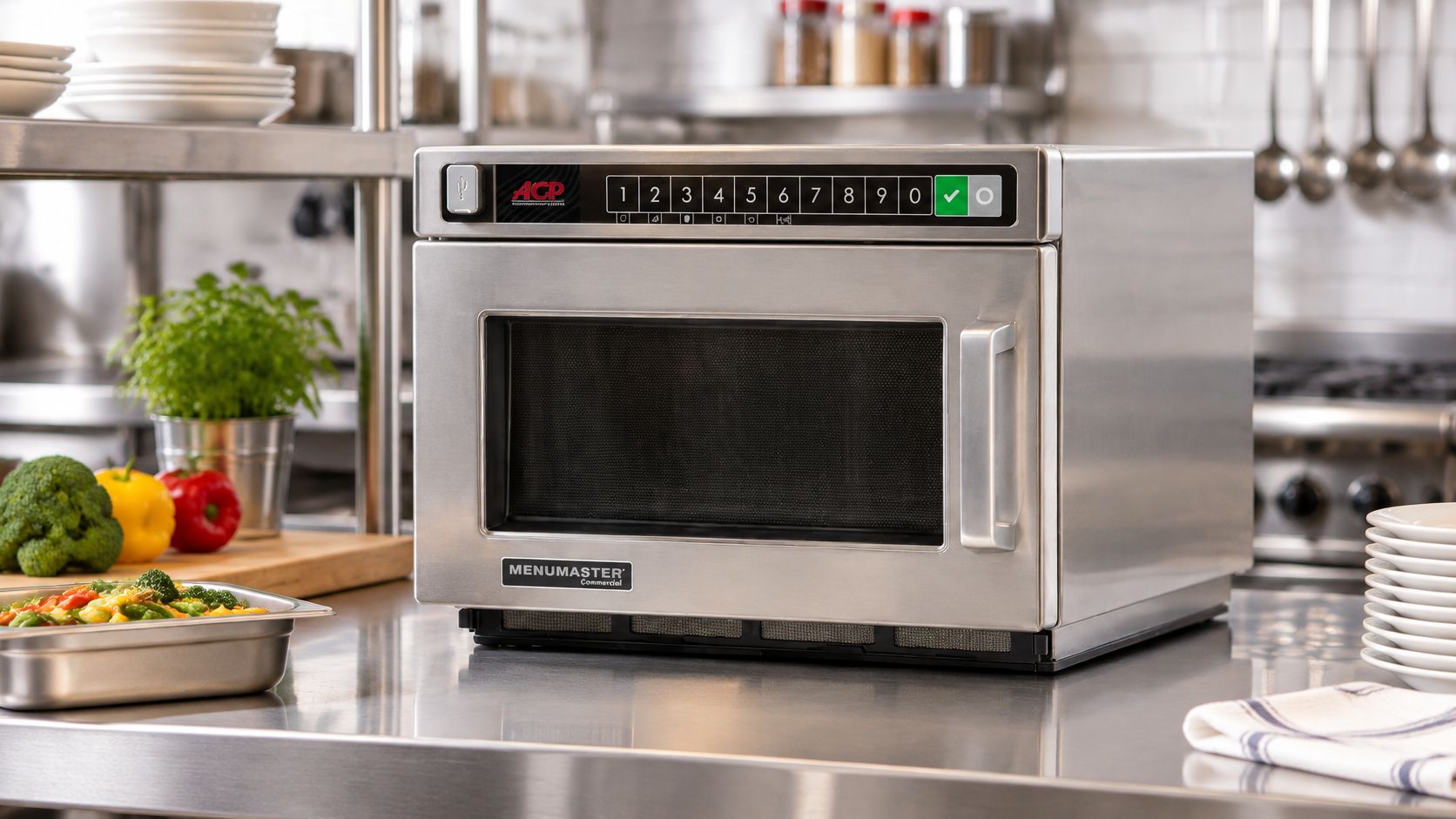
Unox, Convotherm and Giorik ovens may help when oven capacity or recovery is holding up repetitive cooking. Programme features are useful only if staff can operate them and the tray size, power supply and extraction suit the site. For repeated heating, the Menumaster DEC14E2A 1400W Heavy-Duty Microwave is one option to assess. Confirm its current specifications and site requirements before ordering. Choose equipment for the task, not for features that do not address the bottleneck.
Refrigeration layout affects how staff reach ingredients during service. Underbench, upright and prep-top units involve different access patterns, energy demands and cleaning routines, so consider the line and delivery cycle. Dishwashers may ease a wash-up queue if rack choice, water conditions, detergent dosing and unloading space are planned alongside the machine. A pass-through setup can still create problems if dirty and clean flows cross in a cramped corner.
Benches and trolleys can change movement without adding powered equipment. Suitable height, undershelves and mobile storage may reduce bending, floor-level stacking and carrying across wet areas, but cannot correct a poorly planned line. An anti-fatigue mat for a standing workstation may be a low-cost addition where staff stand for long periods. Check that it can be cleaned properly and does not create a trip risk.
A small café may need one prep change; a caterer may benefit more from refrigeration and transport organisation. Upgrading every category at once is rarely the sensible first move.
Before comparing models, check installation access, services, spare parts, cleaning time and staff training. A machine that saves prep time but adds difficult cleaning may leave the working day no better. Ask the people who prepare, clean and unload the equipment to assess the trade-offs before choosing.
Comparing an Upgrade With Replacement Costs
A $6,000 hypothetical equipment upgrade beside a $1,880 illustrative replacement cost invites a tempting but faulty calculation. Dividing one by the other doesn't prove the upgrade pays for itself if three people stay. Retention has too many causes, and a resignation avoided for unknown reasons can't be booked as a machine saving.
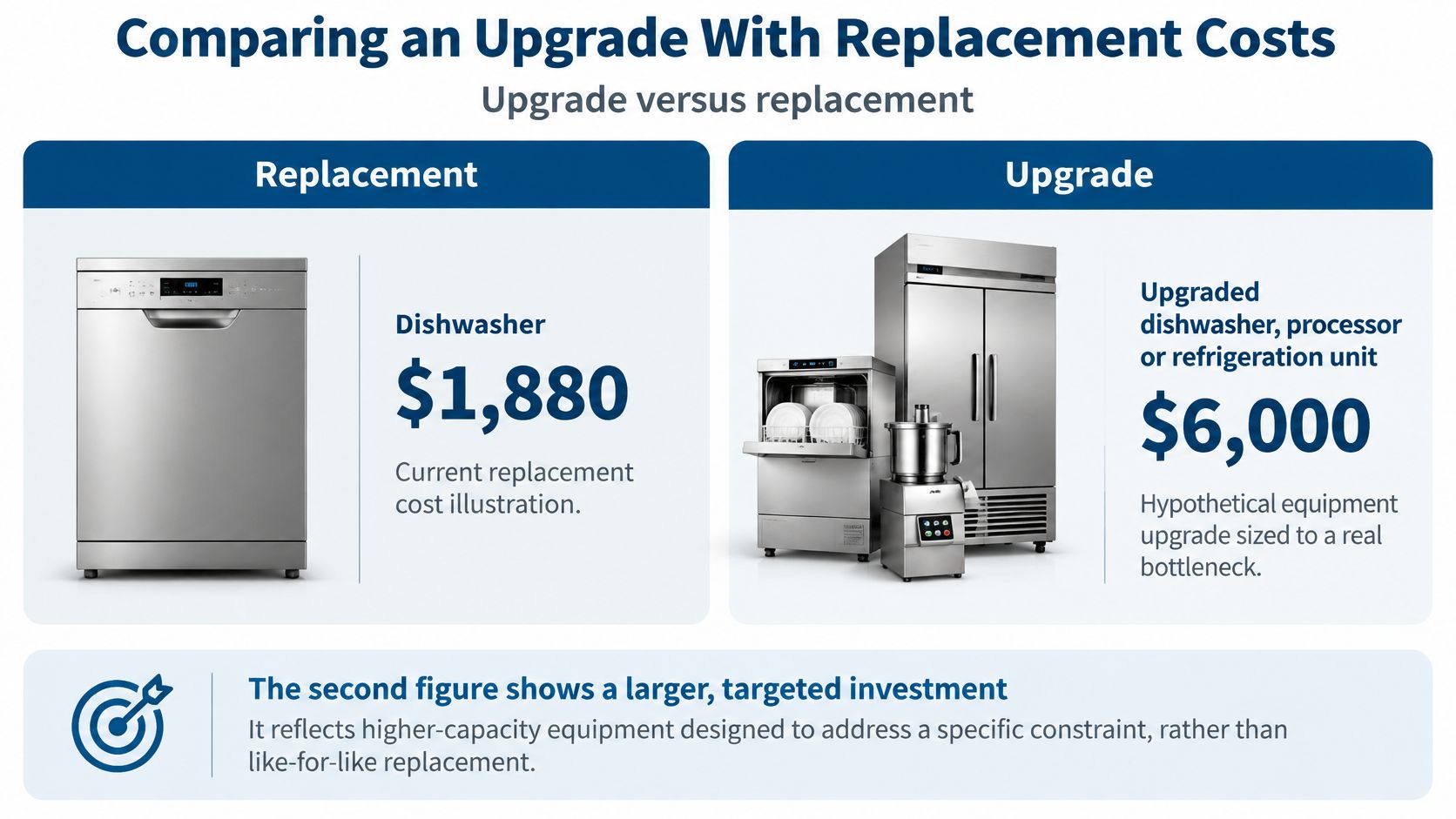
A cleaner comparison separates cash, allocated time and observed change. Purchase, installation, power, water, detergent and maintenance belong on the cost side. Timed prep, wash turnaround, ticket delays, late finishes and staff comments belong on the observed side until the venue has records strong enough to value them.
Recording the costs and benefits of an equipment change
| Cost or benefit | How to record it | Type |
|---|---|---|
| Purchase and installation | Written quote and installation access check | Cash |
| Power, water and detergent | Meter readings or supplier estimate, where relevant | Cash |
| Maintenance and cleaning time | Service schedule and hours spent | Cash and allocated |
| Measured prep or wash time | Timed before and after the change | Observed |
| Manual handling | Task log of lifts, reaches and loads | Observed |
| Employee comments | Structured feedback at 30, 60 and 90 days | Observed |
| Recruitment and training | Hiring records, only if hiring actually changes | Cash, only if evidenced |
Total ownership can change the answer. Delivery access, electrical or plumbing work, staff training, filters, water treatment, service support and daily cleaning may matter as much as the purchase price, a point also raised in buying cheap vs buying once when equipment actually saves money. An upgrade that removes a named daily problem is easier to justify than extra capacity the menu doesn't need.
Employee wellbeing is also a legitimate outcome in its own right. If a dishwasher change reliably gets the wash-up team home earlier and reduces manual scrubbing, that benefit has value even when the financial return can't be isolated. The disciplined approach is to state that plainly instead of dressing it up as guaranteed recruitment savings.
Why Equipment Cannot Carry Retention Alone
A new dishwasher cannot compensate for chronic understaffing, low pay or poor management. Good management, in turn, cannot forever offset a fridge that fails, a bench that forces awkward lifting or an oven that turns every busy service into a queue. Retention needs both decent employment conditions and a workplace that doesn't make the job unnecessarily hard.
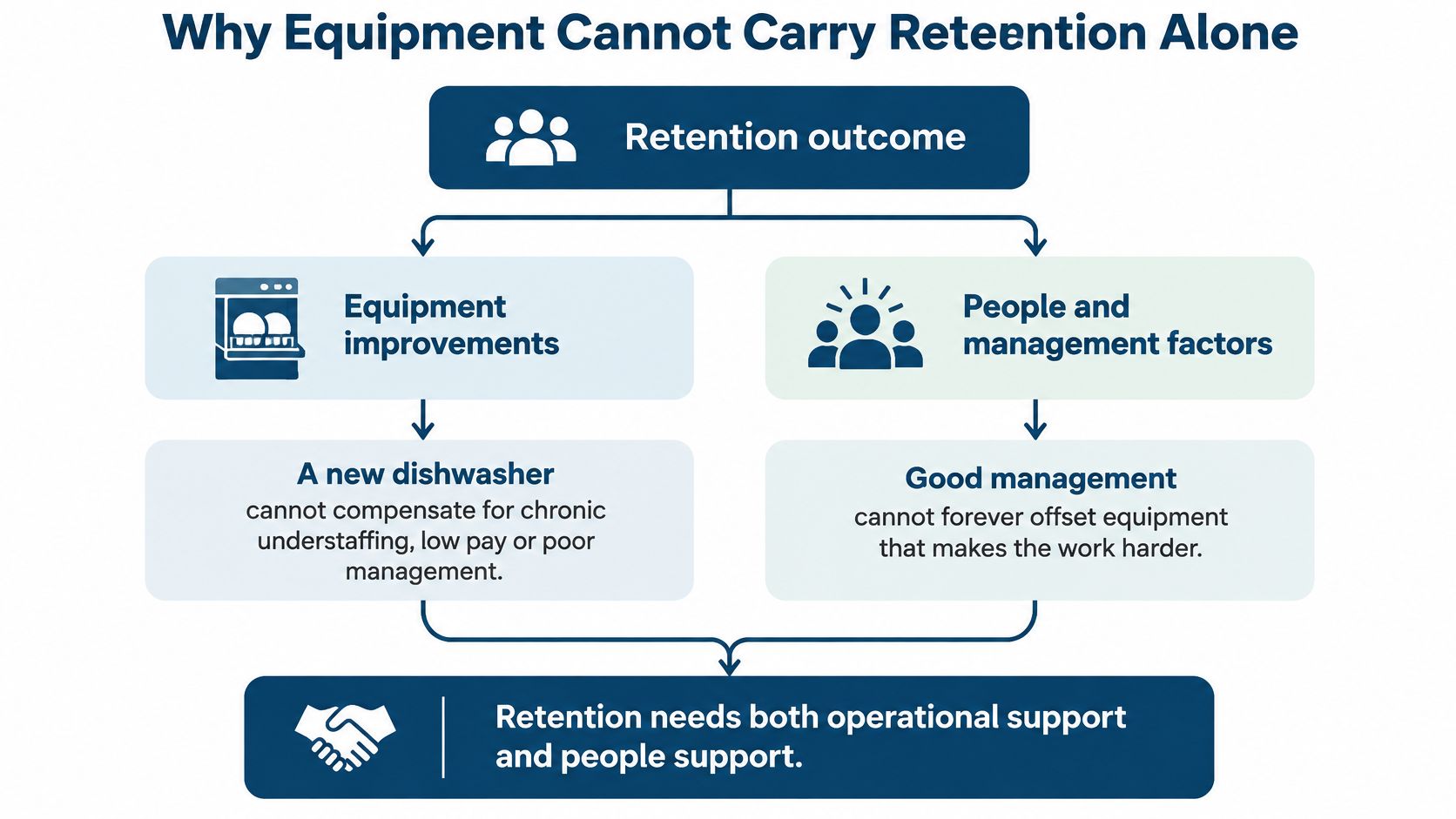
The 2025 MBIE/AUT workforce survey found only 48% of respondents felt fairly paid, 57% earned below the 2025/26 Living Wage of $28.95, and 43% showed an intention to leave their organisation. It also found turnover intention was highest among employees with less than three years' tenure, at roughly 47–49%. Reliable, simpler workflows may help during those early months, when a new starter is already learning the menu and the team, but equipment won't hold someone who feels underpaid, badly supervised or stuck without progression.
The wider reasons people leave
- Pay and conditions: Hourly rates, guaranteed hours and how changes are communicated.
- Rostering: Late finishes, missed breaks, unstable hours and repeated short staffing.
- Management and culture: Respect, communication, fair allocation of hard shifts and response to concerns.
- Development and training: A visible path to new skills rather than the same station indefinitely.
- Physical workplace: Heat, lifting, repetition, noise and equipment that staff can operate safely.
WorkSafe New Zealand guidance on physical strain and workplace risk reinforces that heat, lifting and repetitive work should be designed out where practical, not treated as a toughness test. Layout, maintenance, staffing and worker participation all affect whether an engineering control works in practice. Practical guidance on how to train kitchen staff on new equipment also matters, because an unfamiliar machine can increase stress if it's installed without clear instruction.
Equipment is a supporting condition for retention, not a substitute for decent work.
Broader team initiatives sit outside equipment purchasing, and operators looking at culture may also consider ways to build stronger employee loyalty through recognition and team connection. The equipment question remains narrower. Ask the people doing the task which station causes the difficulty, because managers can easily nominate the wrong one and spend money without changing the shift staff dread.
How to Judge an Equipment Change for Retention
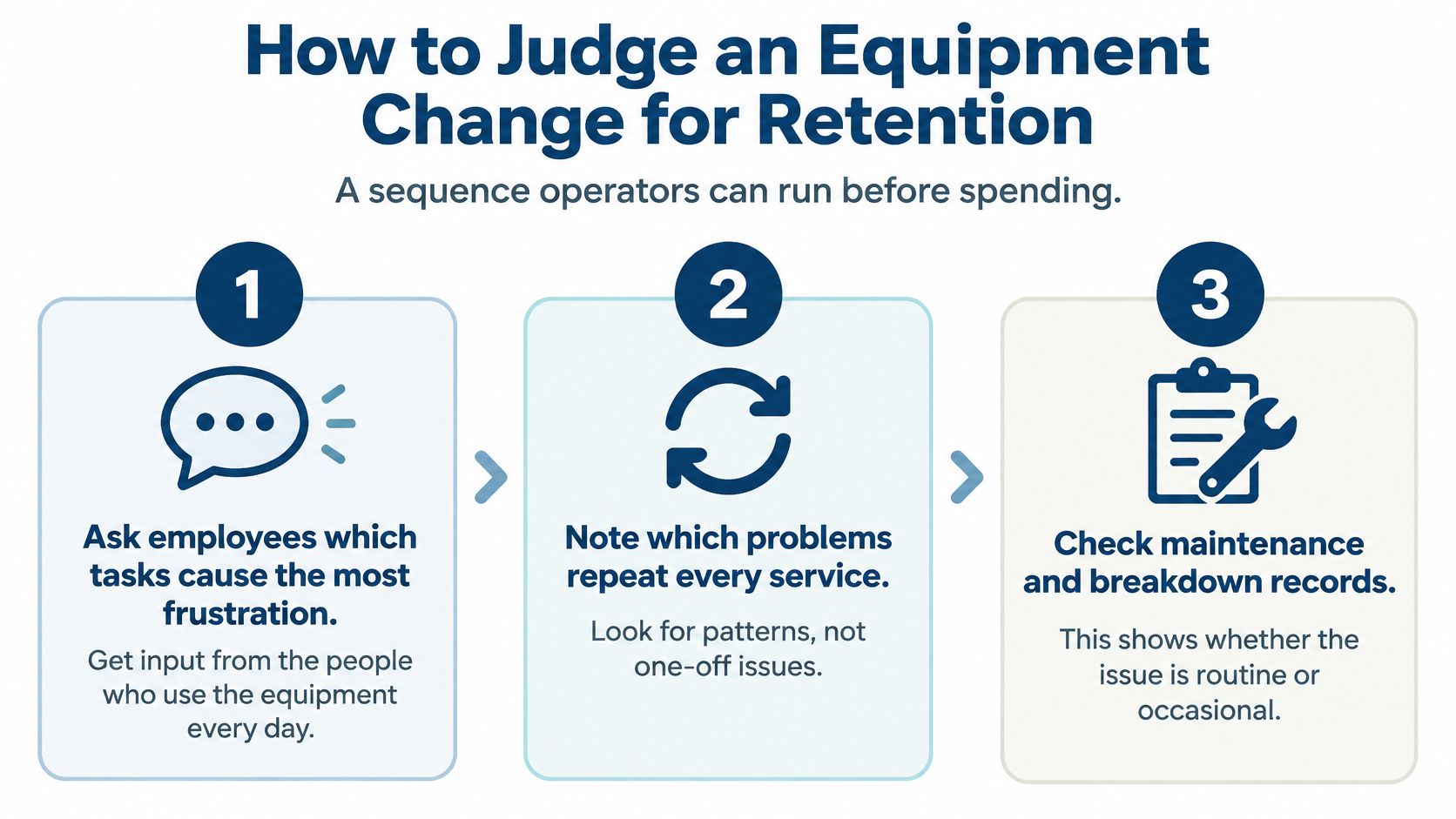
A short assessment before spending protects both the budget and credibility with staff. If employees name a problem, see it investigated, and then receive a sensible answer, the process itself can build confidence. If a costly machine arrives for a problem they didn't rank highly, scepticism is predictable.
Eight steps before approving a purchase
- Ask employees about frustrating tasks: Use specific prompts about prep, service, cleaning and close-down rather than a general satisfaction question.
- Note repeating problems: Separate a one-off failure from delays that appear on every busy service.
- Check maintenance records: Review breakdowns, service visits, parts replaced and cleaning compliance before assuming replacement is required.
- Assess physical demands: Record load weights, reach distances, cycle counts, bench heights and heat around the station.
- Test a process change: Move storage closer, change prep timing, revise rack flow or train staff on the existing machine.
- Compare alternatives for that task: Check capacity, footprint, services, cleaning, installation and suitability for the venue type.
- Calculate the full investment: Include purchase, installation, running costs, maintenance and training, then list only benefits that can be observed.
- Review after implementation: Ask for staff feedback and check task time, errors, late finishes and downtime after the team has settled into the change.
Standardised controls and written routines can reduce the training burden attached to any change. The MBIE 2022 workforce survey reported 13% of respondents had received no training for their current role and a further 7% had received no formal training. Clear operating instructions and repeatable cleaning steps help only when the business documents them and includes training in the implementation plan.
Staff concern, response and what to measure
| Staff concern | Possible response | What to measure |
|---|---|---|
| Repetitive chopping or mixing | Training, a better process, or a processor or mixer if volume justifies it | Prep time and discomfort comments |
| Slow wash-up | Maintenance, layout, or a dishwasher matched to the ware | Turnaround and how late close finishes |
| Waiting on ovens | Production timing, or cooking capacity matched to the menu | Late tickets and late finishes |
| Hard-to-reach chilled storage | Move storage, add shelving, or resize refrigeration | Extra trips and rushed handling |
| Breakdowns during service | Repair and a maintenance routine before replacement | Downtime and mid-service workarounds |
| Chronic understaffing | Rosters, breaks and hiring, not another machine | Hours, missed breaks and turnover over time |
Low-cost moves may be the better first response. Reorganising dry storage, labelling shelves, servicing a dishwasher, replacing worn racks or moving a bench can remove the complaint without capital spending. One consideration regularly discussed with customers is whether the team was involved in the choice, because involvement improves both specification and acceptance.
Retention should be monitored over months alongside absenteeism, overtime, equipment downtime, near-misses and pulse feedback. Those trends can move together without proving the machine caused a staffing change, particularly if pay, rosters or management changed at the same time. Honest measurement keeps the next decision grounded.
Talk to Simply Hospitality About the Station You Have Named
Better equipment may help a hospitality business keep people by making the day safer, more manageable and less frustrating. Retention still depends on fair pay, sound management, sustainable workloads and rosters the team can carry. The strongest purchasing case starts with a named station, a repeated task and evidence that the proposed change improves that part of the shift.
Bring the assessment results to the conversation, including staff concerns, maintenance records, downtime, task times and site constraints. That detail allows prep equipment, refrigeration, warewashing or stainless benching to be sized around the job rather than chosen by headline capacity. Hospitality is New Zealand owned and operated, offers a Service Request, and offers finance for equipment through SilverChef Finance.
Hospitality supplies commercial equipment and advice on choosing it. It doesn't provide recruitment, HR or employee retention consulting, and no equipment purchase should be sold as a promise of lower turnover. The useful outcome is a kitchen where good staff have fewer avoidable reasons to look elsewhere.
Bring the task list, measurements and maintenance history for the station causing concern, and talk through suitable prep, refrigeration, cooking, warewashing or bench options for the venue. Visit Simply Hospitality to start that equipment conversation, compare categories and arrange practical advice on the right fit.