

Champagne Bucket NZ Buying Guide for Venues
A Friday night bottle-service table can expose a poor champagne bucket choice very quickly. The bottle arrives looking right, but the bucket takes up the space needed for shared plates, water, and glassware. Or the stand solves the table-space problem but creates a pinch point in the service aisle. Or the bucket looks smart at the start of service, then leaves condensation, awkward carrying, and more clearing work than anyone expected.
That's why a search for Champagne bucket NZ usually isn't about finding any bucket. It's about finding one that works in a real venue. Restaurants, bars, hotels, wineries, caterers, and function centres all use champagne buckets differently, and the right choice depends less on trend and more on workflow.
This is a small item with three jobs. It needs to help maintain the bottle at an appropriate serving temperature, fit the venue's table and floor space without disrupting service, and present the bottle in a way that suits the experience being sold. If any one of those three jobs is missed, staff feel it during service.
That commercial lens matters in New Zealand. Hospitality demand is active across accommodation and food service. Stats NZ data published through Ringa Hora shows 39.9 million short-term commercial guest nights in the year ended March 2024, while food and beverage serving services spending rose by $961 million, or 23.9% year-on-year (Ringa Hora hospitality and food data). More premium beverage occasions usually mean more moments where chilled bottle service needs to be organised properly, not improvised.
Introduction
A busy service often turns a simple bucket into a front-of-house decision. One table orders sparkling for a celebration, another has a white wine on ice, and a third is sharing mains on a two-top with almost no spare room. The bucket that looked fine on a shelf suddenly affects pouring access, plate placement, and how often staff need to reach across guests.
New Zealand operators also buy into a market that is strongly import-led for front-of-house presentation and tableware. Official trade data shows imports of tableware and kitchenware of wood rose from NZD 3.38 million in 2010 to NZD 12.07 million in 2019, a 257% increase (Figure.NZ trade chart). In another tableware category, New Zealand imported NZD 36.28 million of plastic tableware and kitchenware in 2024, with China supplying NZD 25.32 million, or about 69.7% by value. The same trade source also shows NZD 10.99 million of porcelain-or-china tableware and kitchenware imported in 2022, including NZD 8.30 million from China (World Bank WITS NZ imports data). For buyers, that means consistency, replacement availability, and lead times are worth considering before placing an order.
Practical rule: A champagne bucket isn't just a presentation piece. In commercial use, it's part temperature control, part space management, and part service theatre.
Home users can still use the same buying logic, but venue operators need to think one step further ahead. Material, bucket format, stand use, quantity planning, cleaning routine, and storage footprint all affect day-to-day service far more than the product photo does.
Understanding Champagne Bucket Materials and Construction
Material changes how a bucket behaves in service. Two buckets can look similar on a product page and perform very differently once they're filled, carried, emptied, washed, and stacked away at the end of the night.
Stainless steel for everyday commercial use
Stainless steel is usually the practical workhorse for hospitality use. It suits venues that need durability, easy cleaning, and a finish that still fits a broad range of dining rooms and bars. Material choice also matters beyond appearance. New Zealand's Food Hygiene Regulations 1974 state that buckets and other items used for beer must be made of stainless steel or another material approved by an inspector, which makes material selection a genuine compliance consideration in licensed beverage settings (stainless steel ice bucket reference citing NZ regulation).
For fabrication and food-contact expectations, the New Zealand stainless steel code of practice is also relevant. The NZ Stainless Steel Development Association's code is intended to help industry achieve quality, structural integrity, and food safety, and local food-contact guidance commonly treats 304L as the lowest-alloy stainless grade acceptable for wet food-contact surfaces, with 316L also widely used (NZSSDA Blue Book). In practical terms, that points buyers toward corrosion-resistant construction, clean welds, and finishes that are easier to wash and dry properly.
A related read on stainless steel containers for hospitality use is useful if the venue is trying to standardise materials across serviceware.
Double-walled, acrylic, and silver-plated options
Double-walled stainless buckets help with insulation and often reduce exterior condensation. That can make them easier to manage in polished dining rooms where table surfaces, napery, and guest comfort matter. The trade-off is that they can be bulkier and sometimes heavier before ice and water are added.
Acrylic buckets are lighter and easier to carry across large venues or function spaces. They can also suit poolside, outdoor, or casual event environments where breakage risk and transport weight matter more than a formal finish. The compromise is usually long-term surface wear. Acrylic can show scratches and clouding over time, especially with frequent washing and stacked storage.
Silver-plated styles sit at the presentation end of the range. They can suit premium service, private dining, or venues aiming for a more traditional look. They also usually ask more of the care routine. Polished decorative finishes tend to show marks sooner and may not suit rough back-of-house handling.
The right solution depends on whether the venue is buying for hard daily use, formal presentation, or fast deployment across multiple simultaneous tables.
Construction details that matter more than the finish
A few details are easy to overlook during purchasing:
- Handle attachment: Loose or lightly fixed handles become a problem once the bucket is filled.
- Rim shape: A rolled or stable rim usually feels better in service and during cleaning.
- Base stability: Narrow or lightly balanced designs can feel less secure on crowded tables.
- Replacement consistency: Multi-unit venues often need the same look again later, not a near match.
Where bottle service is part of a wider chilled-beverage programme, cold storage planning matters as much as the bucket itself. For example, the SKOPE ActiveCore 3 Door Storage Freezer - Stainless - SKFT1500NS-A is a frozen-storage cabinet supplied with stainless steel construction and an operating range of -21°C to -18°C, adjustable from -26°C to -12°C. It isn't a champagne solution on its own, but it shows how many venues are already choosing stainless equipment where cleanability and professional durability matter.
Choosing Capacity and Format for Your Service Style
Capacity decisions affect service more than most operators expect. A bucket that's too small creates repeat trips and awkward bottle handling. One that's too large can dominate the table before the first pour.
Single-bottle buckets and larger coolers
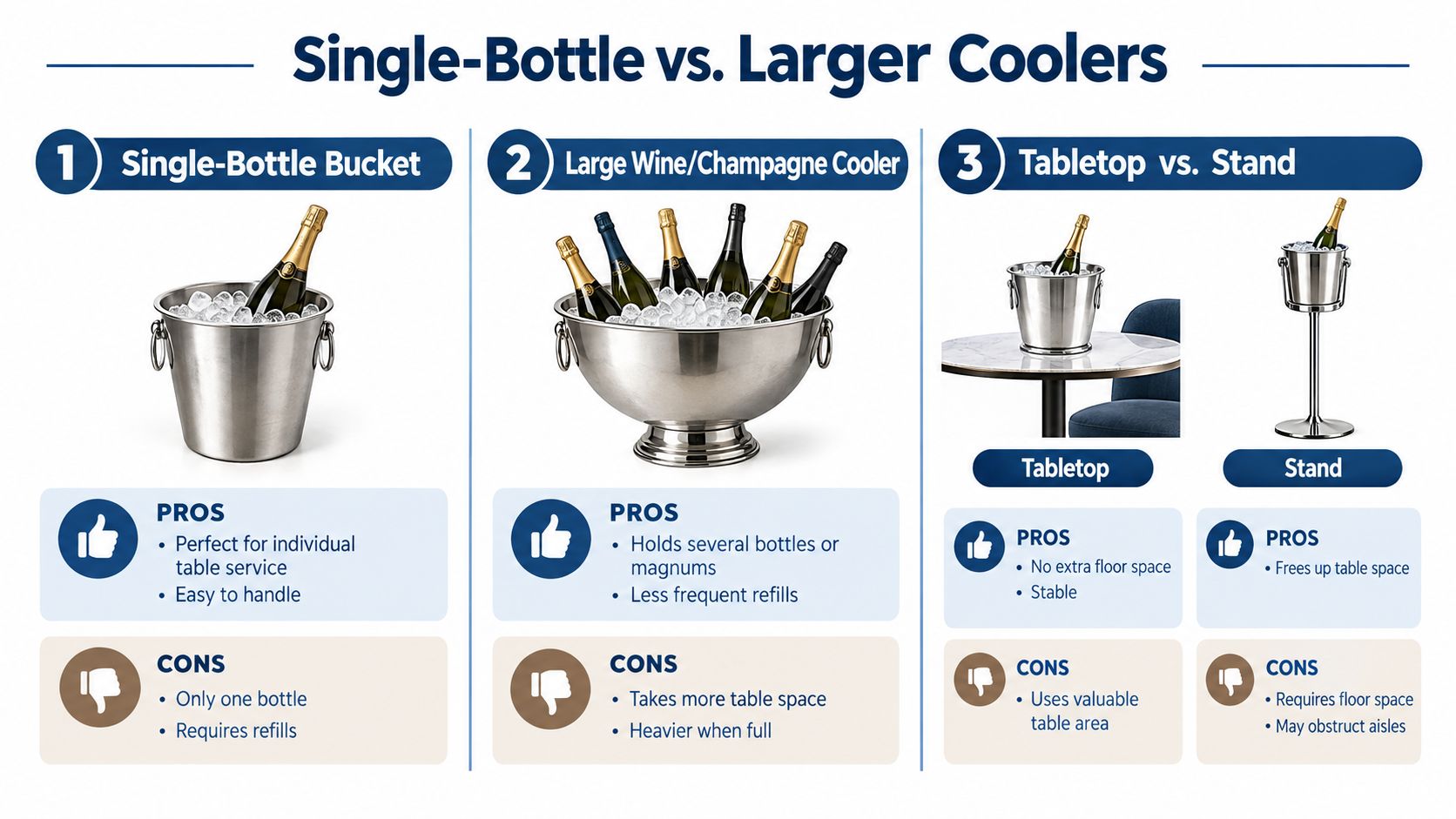
A single-bottle bucket suits restaurants, bars, and hotels where most orders involve one bottle at a time and the table layout is already tight. It's usually easier to place, easier to clear, and easier for staff to carry without disrupting surrounding tables.
A larger wine or champagne cooler makes more sense where service often includes multiple bottles, larger-format bottles, or shared group occasions. Function venues, wineries, and caterers often prefer this format because it reduces repeat runs for additional ice vessels. The trade-off is straightforward. Larger coolers are heavier when full and demand more planning around where they'll sit.
A practical product reference is the Chef Inox utility ice bucket in stainless steel 4.0L. The point isn't that every venue needs that exact size. It's that a clearly defined capacity helps buyers think through handling, storage, and table placement before ordering in quantity.
Tabletop buckets and stand-mounted service
Table space deserves more attention than many buyers give it. A champagne bucket can consume a surprising amount of usable area once menus, shared plates, side plates, water, candles, and stemware are all in play. On compact restaurant tables, that can turn bottle service into a constant rearranging exercise.
A tabletop bucket keeps everything self-contained and doesn't ask for extra floor space. It often suits bars, casual dining rooms, and venues where tables are broad enough to carry the service comfortably.
A bucket with a stand solves the table-space problem neatly in many restaurants. It keeps the bottle accessible, preserves room for food and glassware, and can make premium service feel more organised. But it also introduces a new variable. The stand occupies floor area and can interfere with narrow aisles, close table spacing, or busy circulation paths.
Restaurants often find that a stand improves the guest table but complicates the service aisle. That's a worthwhile trade if the floor plan can support it.
A simple way to compare formats
| Format | Usually suits | Main strength | Main compromise |
|---|---|---|---|
| Single-bottle tabletop | Restaurants, bars, hotel dining | Compact and simple to place | Uses table area |
| Larger cooler | Functions, wineries, group service | Fewer repeat trips | Heavier and bulkier |
| Bucket with stand | Premium dining, bottle-service tables | Frees table space | Needs floor space |
| Acrylic event bucket | Outdoor, casual events, mobile service | Lighter handling | Surface wear over time |
When reviewing Champagne bucket NZ options, operators should test the format against real service conditions, not just appearance. Carrying weight with ice and water, handle comfort, stability on uneven surfaces, and where the unit lives between services all matter.
How to Chill and Serve Without Slowing Service
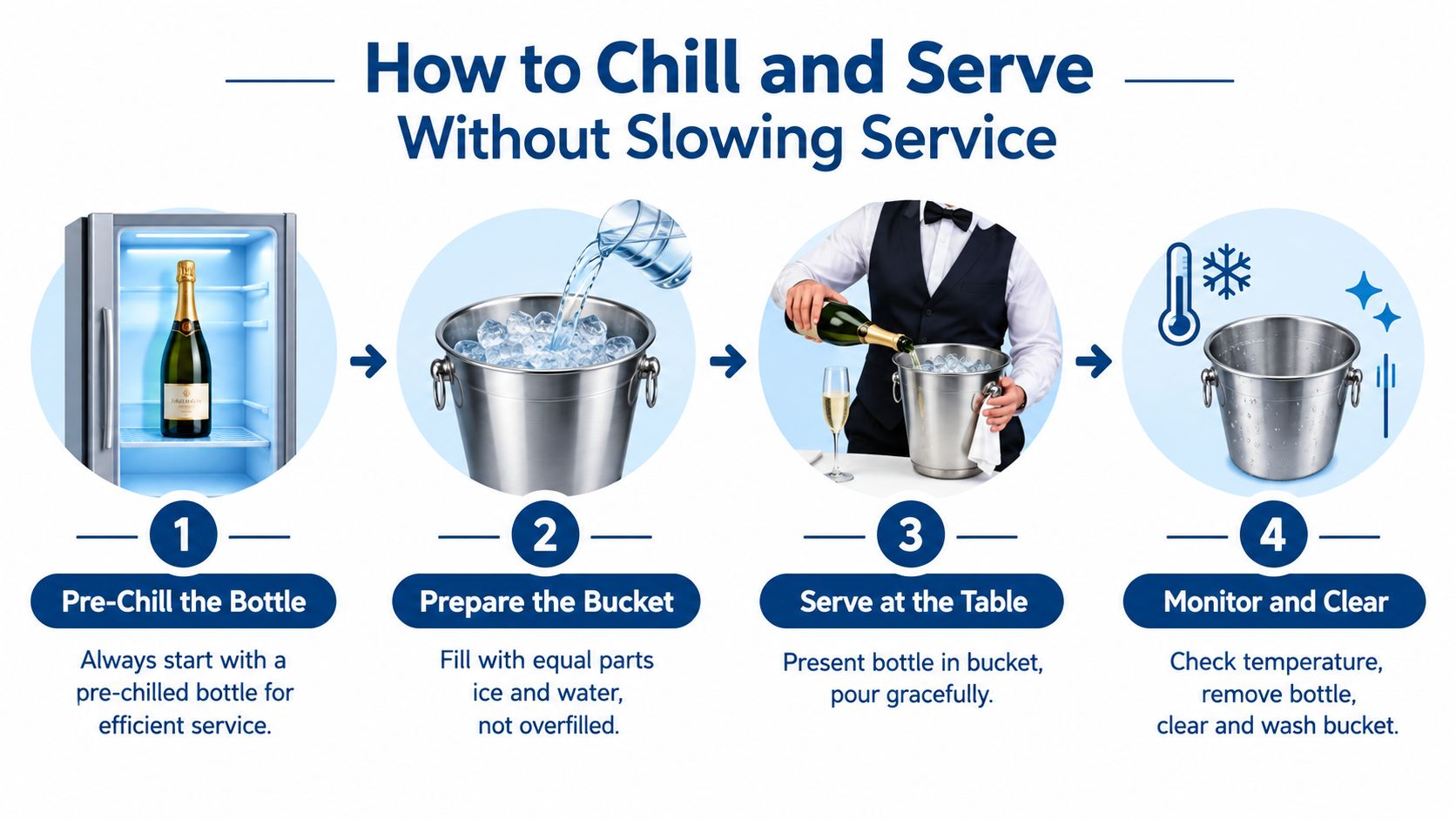
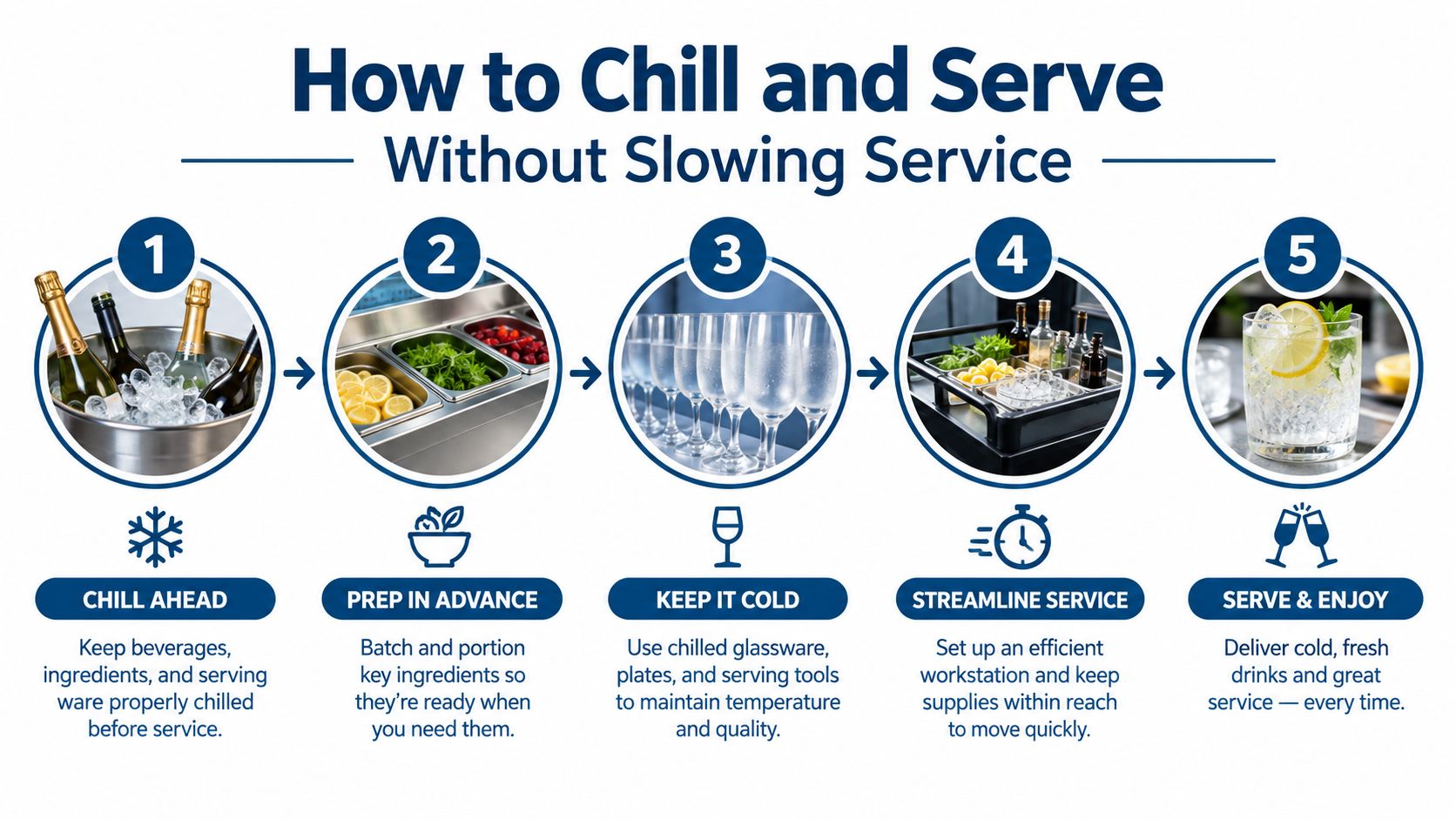
A champagne bucket shouldn't be expected to rescue a warm bottle every time. In commercial use, the better approach is to start with a bottle already chilled to the producer's or wine authority's serving guidance, then use the bucket to help maintain temperature during service.
The bucket is part of service equipment
That approach aligns with New Zealand hospitality training. NZQA guidance for serving bottled wine requires service equipment such as ice buckets and stands, chillers, and coolers to be available, clean, and maintained at the correct temperature for service (NZQA unit standard 27939). That's an operational point, not just a presentation one.
Ice and water work better together
Many operators use ice and water together because water increases contact around the bottle compared with ice alone. That improves the bucket's ability to hold temperature consistently during service. There isn't one fixed ratio that suits every venue, and overfilling creates its own problems, especially when staff still need to carry, pour, and remove the bottle cleanly.
One simple tip is to avoid treating the bucket as a container to pack as full as possible. Staff need space to grip the bottle, manage drips, and return it safely without splashing the table.
A workable service sequence
A reliable process usually looks like this:
- Bottle storage: Keep sparkling wine and champagne properly chilled before service.
- Bucket prep: Add ice and water in a practical amount for the bottle and the service path.
- Delivery: Present the bottle in the bucket at the table or on the stand.
- Pouring: Keep the bottle accessible so staff don't need to keep removing it for cooling.
- Monitoring and clearing: Clear promptly once the service window has ended.
A useful companion read is choosing the right ice machine for hospitality, especially for venues that find bottle service is placing more pressure on ice supply than expected.
Keep the workflow in order. Bottle storage, bucket preparation, delivery, pouring, monitoring, clearing, washing, storage.
Serving temperatures differ by wine style, producer, and house preference, so it's better to follow producer guidance than claim one temperature suits every sparkling wine. What matters most operationally is that the bucket supports service instead of forcing staff into repeated recovery work.
Presentation That Supports the Guest Experience
A champagne bucket does contribute to presentation, but it's most useful to think of it as one part of a complete front-of-house set. The bottle on its own rarely carries the whole moment.
The complete service picture
A practical framework is this:
- Bottle
- Appropriate glassware
- Bucket or bucket with stand
- Confident service
When those four elements match, chilled bottle service feels deliberate. That matters in restaurants, hotel bars, wineries, and event venues where premium beverages are part of the wider experience being sold.
Matching the bucket to the glassware and room
The bucket should sit comfortably with the venue's glassware, tabletop, and tone of service. A heavy polished bucket with a formal stand can look right in private dining and wrong in a casual bar. A clear acrylic bucket may feel efficient at a summer function and out of place in a more traditional dining room.
Many operators choose to align bottle presentation with their sparkling and champagne glassware range. That can include brands and collections such as Zwiesel / Schott Zwiesel, Pasabahce, Stölzle, and Luigi Bormioli, especially where stemware quality is already part of the venue standard. A related read on champagne flutes for New Zealand venues can help when reviewing the service as a whole rather than buying the bucket in isolation.
Good bottle presentation doesn't come from the bucket alone. It comes from the bucket fitting the room, the glassware, and the way staff serve.
Presentation supports guest experience, but there's no need to overstate it. A bucket can make service feel more complete, keep the bottle accessible, and reduce unnecessary back-and-forth for chilling. That's commercially useful on its own.
Cleaning Storage and Long Term Care in Commercial Use
The bucket's finish on delivery matters less than how it looks after repeated weekend services. Long-term appearance usually comes down to cleaning method, drying discipline, and storage habits.
Cleaning after service
Buckets should be emptied promptly after use rather than left holding meltwater. Standing water increases the chance of marks, trapped odour, and extra cleaning effort later. Washing should suit the material and finish, and polished surfaces generally need more care than heavily brushed utility styles.
A common issue seen in hospitality venues is abrasive cleaning on decorative finishes. Harsh pads and unsuitable chemicals can dull polished metal, mark acrylic, and shorten the useful presentation life of the item.
Drying and storage
Drying matters more than many teams expect. Even durable buckets can show water marks or develop harder-to-clean residue if they're stacked or shelved while still wet.
A practical storage routine usually includes:
- Dry before storing: This helps protect the finish and reduces stale odour.
- Store by format: Keep tabletop buckets, larger coolers, and stands in clearly separated areas.
- Protect polished finishes: Avoid rough stacking that causes unnecessary scratching.
- Check handles and joints: Inspect moving or fixed parts as part of routine clearing.
- Follow maker instructions: Specific care guidance should always override general habit.
Think about ownership, not just purchase
Construction decisions made at purchase show up again during washing and storage. Smooth interiors are easier to clean. Stable bases reduce accidental knocks. Handle strength affects both safety and replacement frequency.
New Zealand's stainless industry guidance is relevant here too. One code of practice states that its purpose is to help achieve the quality, structural integrity and food safety requirements needed for stainless steel plant and equipment (Simply Hospitality barware collection page referencing the stainless code). That same thinking applies to serviceware exposed to wet, cold, high-turnover use.
Buying for NZ Venues Price Durability and How Many You Need
Most commercial buyers aren't asking which bucket looks nicest in isolation. They're balancing price, durability, replacement availability, consistency of presentation, and quantity planning.
Purchase versus occasional rental thinking
For venues with regular bottle service, owning usually makes more operational sense because the setup stays consistent and staff know exactly how the service works. For occasional large events, some venues compare ownership with one-off hire or event-specific supply arrangements. The deciding factor is often how often the same service style repeats, not whether the bucket is used at all.
Planning quantity sensibly
There's no universal number that suits every venue. A better way to plan is:
- Maximum simultaneous bottle-service tables
- Plus function or event requirements
- Plus a clean reserve
A restaurant that serves sparkling occasionally may only need enough for peak dinner overlap and backup while used buckets are being washed. A wedding venue or function centre may need a much larger matching set ready to deploy at once.
One consideration regularly discussed with customers is replacement availability. If a venue buys multiple buckets, the ability to source the same or matching units later helps maintain a consistent room presentation when pieces are lost, damaged, or retired.
For operators also reviewing ice supply economics around bottle service, buying bagged ice versus owning an ice machine is a useful planning reference.
Final Checklist Before You Order
A good Champagne bucket NZ decision usually comes down to a short list of practical checks.
Order checklist
- Material and finish: Does stainless, double-walled, acrylic, or a more decorative finish suit the venue's real service conditions?
- Capacity: Is the venue mainly serving single bottles, or does it need room for larger-format or multiple-bottle service?
- Format: Will a tabletop bucket work, or does a stand make better sense for table space?
- Table fit: Is there enough usable room once plates, glassware, water, and condiments are in place?
- Floor fit for stands: Will stands interfere with aisles, chair movement, or service access?
- Handling: Can staff carry it safely once filled with ice and water?
- Durability: Are the handles, base, and finish likely to hold up in commercial washing and storage?
- Replacement consistency: Can the venue keep the same look over time if extra units are needed?
- Quantity: Has the order allowed for peak simultaneous service plus clean reserve?
- Care routine: Does the team know how the chosen material should be washed, dried, and stored?
The right solution depends on venue type, service style, and how bottle presentation fits the wider operation. The most reliable bucket isn't always the most formal-looking one, and the most elegant option isn't always the easiest to deploy across a busy floor.
Hospitality supplies hospitality businesses across New Zealand with commercial front-of-house and back-of-house equipment, including barware, glassware, serviceware, and the wider refrigeration and ice-support items that affect bottle service in practice. For help choosing the right champagne bucket, stand, or matching sparkling-wine service pieces for a venue, visit Simply Hospitality.