

Stainless Steel Containers: A Commercial Kitchen Guide
A busy kitchen rarely suffers because it has too few containers. More often, service slows because the right pan, lid or depth isn't available when staff need it. A salad station has a container that doesn't fit its chilled well, prepared ingredients are decanted into another tub before service, and the dishwash team receives a collection of mismatched shapes that are difficult to stack and clean. Stainless steel containers work best when they're treated as one standardised operating system, not as isolated pieces of equipment. In a commercial kitchen, the right GN sizes, depths, lids and construction can support preparation, refrigeration, holding, service and dishwashing with fewer unnecessary transfers.
Why Container Choice Shapes the Whole Service
At the start of a busy service, small container problems become workflow problems. A cook reaches for a lid that belongs to a different pan. A prep tray is too deep for the rack beneath the salad bench. A container filled during morning mise en place has to be emptied into another vessel because the bain marie accepts only a particular footprint.
None of those incidents is dramatic. Together, they create repeated handling, extra washing and uncertainty about where ingredients belong. Staff spend time checking compatibility instead of preparing food, and managers end up buying replacement pieces that don't match the original collection.
Standardisation removes avoidable decisions
The strongest operational argument for stainless steel containers is not only that stainless steel is durable. The greater benefit comes from standardisation. When preparation containers, refrigerator shelves, bain maries, heated displays and dishwashing racks are built around the same GN dimensions, one container can remain with an ingredient through several stages of the day.
That might mean:
- Preparation in a GN pan at the bench.
- Covered storage in a coolroom.
- Transfer to a compatible refrigerated well.
- Hot holding where the pan and equipment are suitable.
- Service from the same footprint.
- Collection for commercial dishwashing without repacking.
This continuity matters in restaurants, cafés, caterers, hotels, marae, aged-care kitchens and institutional food operations. The exact workflow differs, but every venue benefits when staff aren't forced to change vessels without a clear reason.
Practical rule: Choose the container system around the equipment already in the kitchen, then add pieces that preserve that system.
Operators comparing food-storage formats can also review these options for professional kitchens to see how different reusable container approaches address preparation and storage needs. The useful question isn't whether a container looks strong in isolation. It's whether its footprint, depth, lid and cleaning requirements make sense beside the equipment and routines already in place.
A common mistake is buying individual pans because each one appears inexpensive or convenient. That approach often creates a mixed collection with incompatible lids, awkward stacking and inconsistent depths. A planned set of stainless steel containers may require more thought at the beginning, but it gives the kitchen a repeatable language for storage and service.
Understanding the Gastronorm System
The Gastronorm, or GN, system standardises the outside footprint of commercial food containers. The base format is GN 1/1, measuring 325 by 530 millimetres, and smaller formats divide that footprint into recognised fractions. This lets pans sit in compatible benches, refrigeration equipment, bain maries, combi ovens, racks and service counters.
GN sizing reference
| GN Size | Footprint (mm) | Fraction of GN 1/1 |
|---|---|---|
| GN 1/1 | 325 x 530 | Full |
| GN 1/2 | 265 x 325 | Half |
| GN 1/3 | 176 x 325 | One third |
| GN 1/4 | 162 x 265 | One quarter |
| GN 2/3 | 354 x 325 | Two thirds |
| GN 2/1 | 650 x 530 | Double |
The footprint is only half the decision. Depth controls capacity, access and compatibility. Common commercial depths include 65, 100, 150 and 200 millimetres. A shallow pan is easier to reach during service, while a deeper pan may suit bulk storage, marinating or stock preparation. The correct depth must still clear shelves, wells, oven cavities and dishwasher arrangements.
A GN container can be prepared in the morning, covered for refrigeration, moved to a compatible holding unit and sent to the wash-up area without relabelling or decanting. That continuity is why GN formats are so useful in professional kitchens. The system also makes replacement easier because a kitchen can specify a familiar footprint rather than searching for a unique shape.
The Chef Inox gastronorm pan is an example of a GN-format pan that can be considered within this standardised approach. Product compatibility still needs to be checked against the equipment, lid style and required depth.
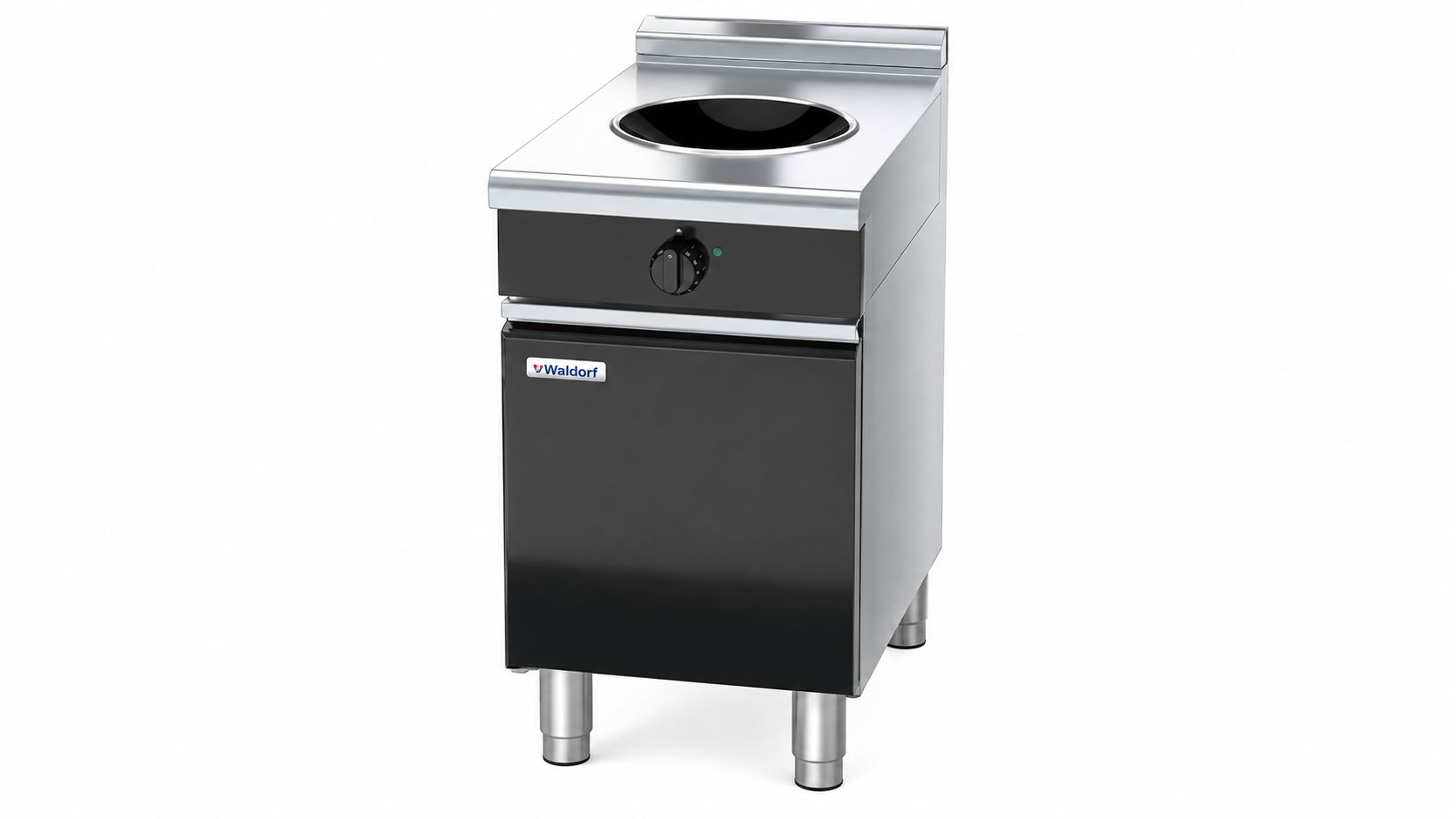
A coordinated cookline may also include equipment such as the Waldorf Bold INLB8100W3-CD 450mm Induction Wok Low Back Version with Cabinet Base, which has a 450 millimetre low-back profile, a 3.5kW single-phase induction zone and automatic pan detection. The relevant planning point is that cookware and surrounding storage should be specified as part of the complete working module, not selected separately.
Choosing the Right Container Format for Each Task
Once the GN footprint is clear, four decisions shape the practical choice: format, depth, perforation and lid. Each one should reflect where the container will be used and what staff need to do with it.
GN 1/1 and GN 1/2 pans commonly suit preparation benches, cold storage and larger service wells. GN 1/3 and GN 1/4 formats are useful where a station needs several ingredients in a narrower line-up, such as garnishes, toppings or sauces. GN 2/1 containers can suit larger-volume preparation, brining and equipment designed around the double footprint.
Matching container format to task
| Task | Suggested GN Size | Depth | Lid Type |
|---|---|---|---|
| Garnishes and dressings | GN 1/6, GN 1/3 or GN 1/4 | 65 mm | Notched or flat |
| General preparation | GN 1/1 or GN 1/2 | 100 mm | Flat or sealed |
| Bulk marinating | GN 1/1 or GN 2/1 | 150 to 200 mm | Sealed |
| Draining vegetables | GN 1/1 or GN 1/2 | 65 to 100 mm | Perforated insert or open |
| Service toppings | GN 1/3 or GN 1/4 | 65 to 100 mm | Notched |
| Covered refrigerated storage | GN 1/1 or GN 1/2 | Depends on shelf clearance | Flat or sealed |
Depth affects more than volume. A 65 millimetre pan gives staff quick access and makes small quantities visible. A 100 millimetre pan is a flexible general-purpose option. Deeper pans are useful for bulk ingredients, but they can be awkward on a busy line if cooks have to reach down repeatedly or if the well doesn't provide enough clearance.
Perforation and lids
Perforated containers or colander pans earn their place when liquid needs to drain away. They can assist with washed vegetables, draining pasta or holding food where pooling would affect texture. They aren't a universal substitute for solid pans, especially where the kitchen needs to retain sauces, brines or cooking liquid.
Lids should match the job:
- Flat lids support covered storage and can make stacking more predictable.
- Notched lids allow a ladle or utensil to remain in place during service.
- Sealed lids suit transport and refrigerated storage where spill control matters.
- Perforated covers may assist with drainage or specific preparation tasks, but they shouldn't be treated as airtight storage.
Small containers are particularly easy to get wrong because their lids and inserts can vary between ranges. A practical buying guide for small containers with lids can help operators assess how compact formats fit into a broader storage plan. For insulated transport requirements, the insulated food container information should be considered separately from ordinary GN storage pans, because transport performance depends on the complete container design rather than the stainless body alone.
Stackability also deserves attention. Rolled rims, external handles and lid profiles can affect how securely pans nest or stack. Before ordering a large quantity, kitchens should place sample pans in the actual rack, fridge shelf, bain marie and dishwasher arrangement.
Stainless Grades, Thickness and Finish in Plain English
A container specification affects how reliably it performs during a busy service. The label stainless steel alone does not identify the alloy, thickness or fabrication quality, so compare those details where the manufacturer provides them. For wet food-contact surfaces, New Zealand industry guidance recognises 304L as the lowest-alloyed stainless steel generally acceptable. 316L and duplex 2205 can suit applications with more demanding conditions. Food-contact metal should resist corrosion, remain non-toxic and non-contaminating, and be cleanable under its intended conditions. NZ stainless steel design guidance
For most indoor commercial kitchens, 304 is commonly suitable. 316 provides greater resistance in more corrosive environments, including conditions involving coastal exposure, salts or persistent moisture. BRANZ also notes its stronger resistance to pitting and crevice corrosion, plus better repassivation after damage to the passive layer. BRANZ stainless steel considerations BRANZ corrosion guidance
Stainless grades, gauge and finish at a glance
| Property | 304 Austenitic | 316 Austenitic | Gauge 0.8 to 1.0 mm | Gauge 1.0 to 1.2 mm | Brushed Finish | Mirror Finish |
|---|---|---|---|---|---|---|
| Typical role | General commercial use | More corrosive conditions | Lighter handling and storage | Greater resistance to denting | Hides light marks | Shows marks more readily |
| Main consideration | Suitable grade depends on use | Added resistance can justify specification | May flex under heavy use | Adds rigidity and weight | Practical appearance | High visibility surface |
| Best question | Is the environment ordinary or aggressive? | Are salts, coastal exposure or harsh conditions persistent? | Is the pan mostly stationary? | Will staff transport or stack it often? | Can the finish be cleaned without harsh abrasion? | Can the kitchen protect the surface? |
Thickness should follow the workload. Lighter construction can work well for stationary cold storage, while containers carried full, stacked frequently or handled roughly benefit from greater rigidity. Thicker material adds weight and may cost more. It also does not prevent damage from misuse. A thinner pan can still be the right choice for a controlled storage task.
Finish and fabrication affect cleaning and service life. New Zealand stainless steel guidance prefers a 2B mill finish for sheet and plate. A standard #4 finish is generally permitted but not encouraged for food-contact applications. NZ stainless steel code of practice Check the welds, rim and surface treatment as closely as the grade. A well-made 304 container may serve better than a poorly fabricated higher-grade alternative.
The same inspection applies to surrounding stainless equipment. A stainless steel sinks guide offers useful context on fabrication and cleaning zones. For containers, grade is one specification among several. Standardising a dependable format and finish across prep, storage and holding can reduce unnecessary transfers, extra dishes and confusion on the line.
Mapping Containers to Your Service Workflow
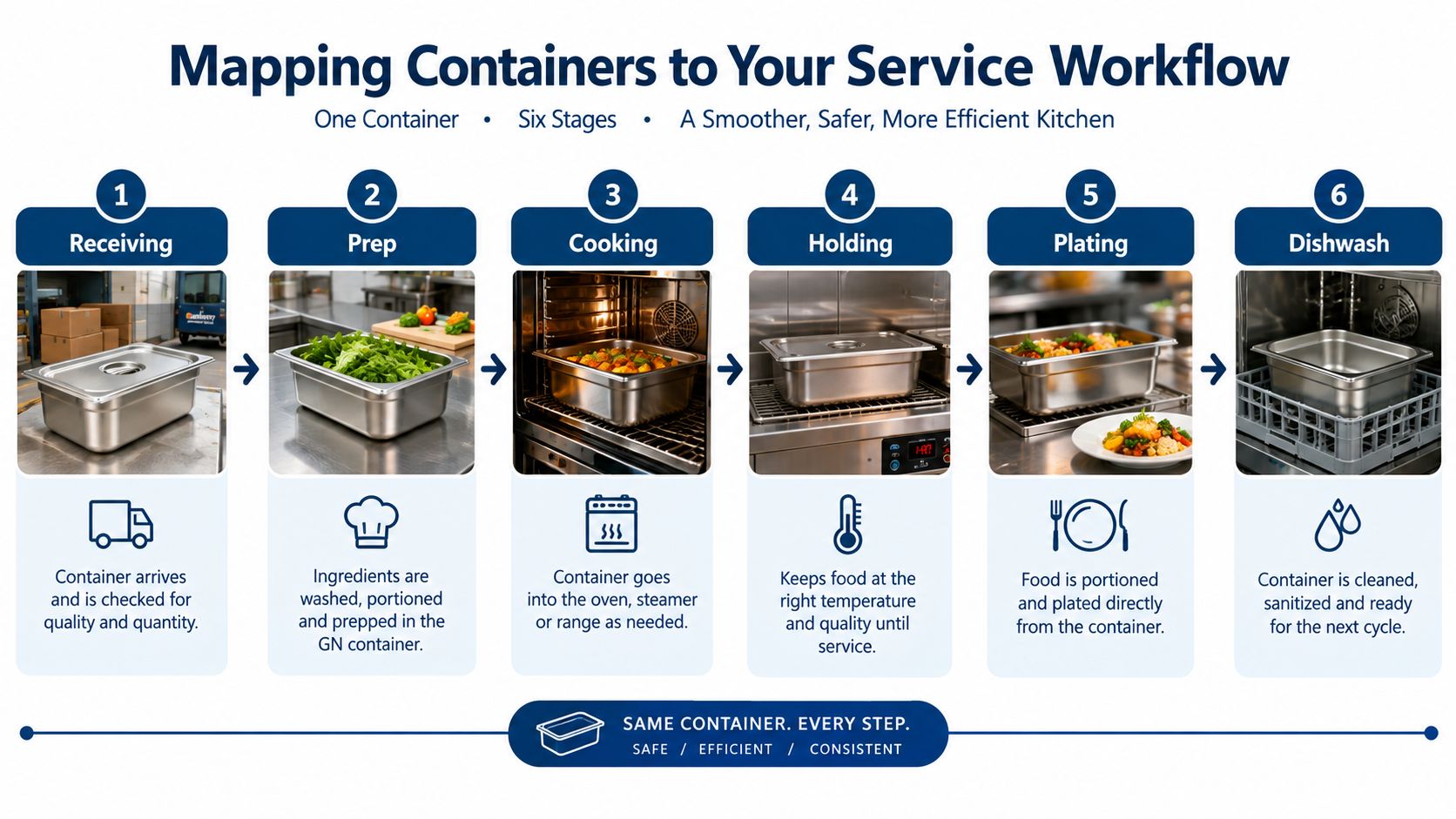
The most useful way to specify stainless steel containers is to map them against the movement of food through the kitchen. Standardisation works when the same footprint follows the ingredient wherever the equipment permits it, rather than forcing staff to decant food between incompatible vessels.
Receiving and preparation
Receiving teams may place ingredients into suitable GN 1/1 or GN 2/1 containers for organised cold-room storage, provided the container and handling process suit the product. Tight-fitting lids help control contamination and spills, while labels remain essential for identification and stock rotation.
At preparation, a shallow solid pan may suit chopped ingredients, while a perforated insert or colander pan can help with rinsing and draining vegetables. The container should match the task rather than forcing staff to improvise with a deep pan that hides the product or a perforated pan that cannot retain liquid.
Chilling, cooking and holding
A compatible GN pan can move into a blast chiller rack where the equipment is designed for that format. The same principle can apply to cooking equipment and bain maries, but the specific container must be suitable for the temperature, support and clearance involved. Not every pan, lid or seal is intended for every heating application.
Hot holding needs particular care. The pan must fit the well, the food must be appropriate for the holding method and the lid must not obstruct service or create an unsafe handling routine. A stainless body alone doesn't confirm suitability for a particular oven, heated cabinet or bain marie.
Workflow insight: The container creates the greatest value when it removes a transfer that the food and equipment never required.
Service and dishwashing
At the service station, GN 1/3 and GN 1/4 pans often help separate ingredients without consuming the full width of a well. Notched lids may support utensil access, while flat lids can be used during quieter periods or storage between service periods.
After service, compatible pans can go directly into the dishwashing process. Operators should confirm rack dimensions, loading limits and manufacturer cleaning instructions. A planned GN collection makes it easier for staff to establish consistent storage locations and return clean pans to the correct station.
For wider storage planning across a New Zealand operation, the storage containers guidance can sit alongside a GN audit. The key is to map receiving, preparation, refrigeration, holding, plating and dishwash as one connected process rather than purchasing each container for a single station.
Cleaning, Maintenance and Long-Term Longevity
A pan left with dried sauce after service takes longer to clean and is more likely to be scrubbed aggressively. Build the routine around prompt cleaning, suitable chemicals and early removal of damaged pieces. Manufacturer instructions take priority because finishes, seals and construction vary between products.
Food residue should be removed before it hardens. Use a suitable detergent, rinse thoroughly and dry the container fully. Cleanable, non-contaminating food-contact surfaces remain the practical standard, and the finish must suit the equipment and cleaning routine.
Daily care
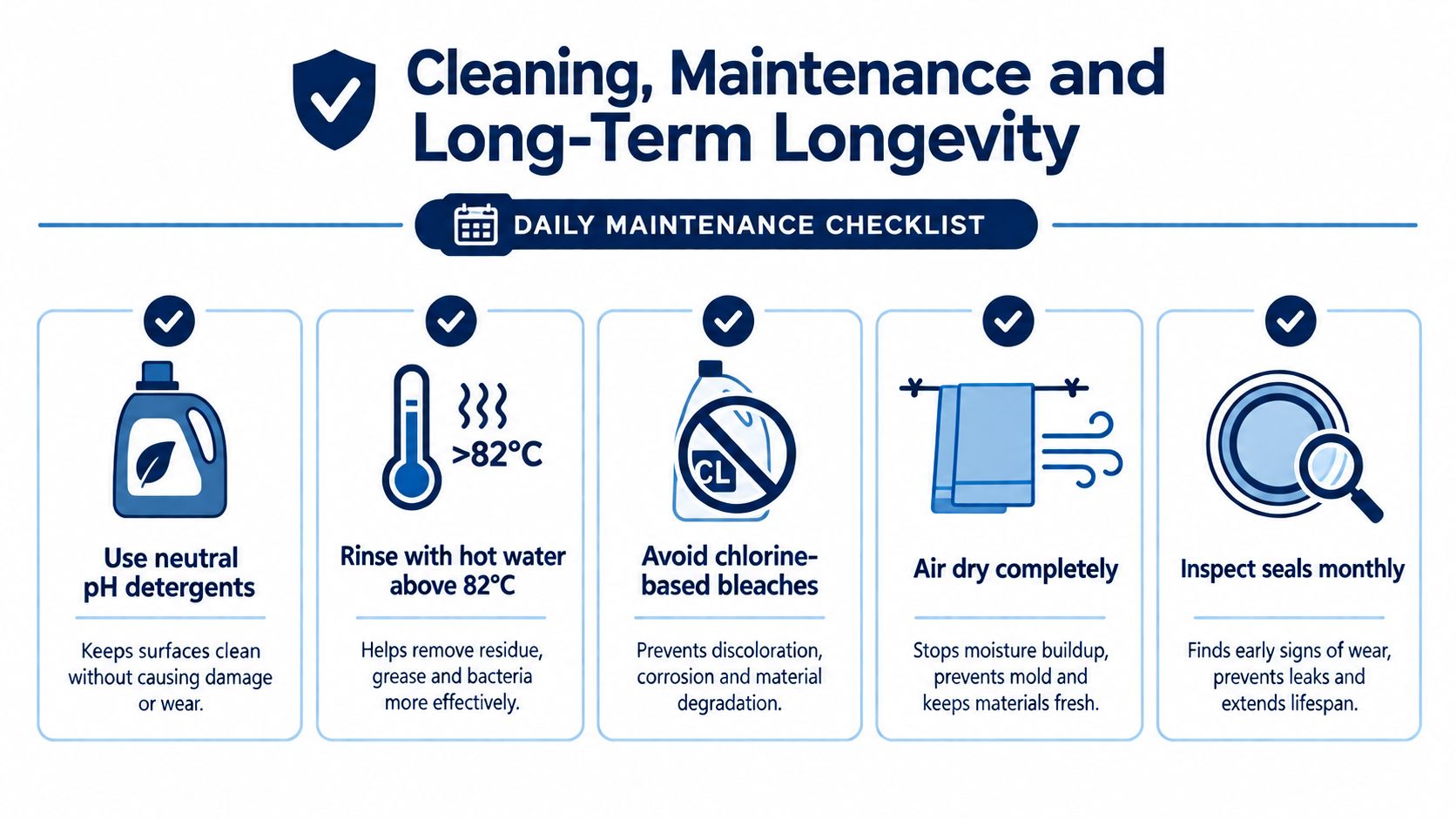
- Clean promptly: Remove residues before they harden and call for abrasive action.
- Use compatible chemicals: Check detergent and sanitiser instructions for the stainless grade, finish and any seal.
- Avoid damaging abrasives: Steel wool and harsh scouring can scratch the surface and affect corrosion resistance.
- Rinse thoroughly: Chemical residue can mark the finish and reduce food-contact cleanliness.
- Dry completely: Moisture around rims, welds and stacked pans can contribute to staining and corrosion.
Chlorine-based products need particular care. Do not apply them casually to standard stainless containers. Any permitted use should follow the chemical and equipment instructions, including the stated dilution where applicable. These professional stainless steel cleaning tips are useful as general guidance, but the product manufacturer's instructions take precedence.
Seals, rims and damage
Lids with gaskets need their own inspection routine. Check for cracking, distortion, trapped food and loss of elasticity, then confirm whether the lid is dishwasher-safe. Replacement timing depends on use and manufacturer guidance, so avoid setting an automatic interval without checking both.
Inspect pans for pitting around welds, deep scratches, heat tint, sharp dents and warped bases. A container that rocks on a bench, no longer fits its equipment or has a damaged food-contact surface should leave service until it has been assessed.
Keep replacement records and rotate stock so worn pans do not appear unexpectedly during a busy service. Consistent checks also help staff identify which lids, seals and containers belong together.
For chemical selection and handling within a wider kitchen programme, the cleaning chemicals guidance can support a consistent maintenance process. Appearance matters, but food-contact condition, cleanability and safe handling matter more than keeping every pan visually perfect.
When Stainless Is Not the Right Answer
Stainless steel is a strong default for many commercial food applications, but it isn't automatically the correct container for every task. A thin pan with a weak rim can dent quickly in transport. Poorly finished welds may collect residue or develop corrosion, and a damaged surface can undermine the cleanability that operators expected from the material.
The food and environment also matter. Prolonged exposure to highly salty or aggressive ingredients can challenge stainless surfaces, particularly when residue remains wet around welds or joins. Highly acidic foods require sensible specification and cleaning practices rather than a blanket assumption that every stainless grade will behave identically.
Where another material may fit better
- Microwave reheating: Aluminium or polypropylene inserts may be more practical where the equipment and product specification permit them.
- Dry-store tubs: Plastic containers can offer useful impact resistance for bulk dry goods where heat exposure isn't a concern.
- Proofing and low-temperature storage: Lightweight non-metal formats may be easier to handle for specific bakery workflows.
- Special transport tasks: Insulated systems may suit external delivery better than a plain stainless pan, particularly where temperature retention and spill control are central.
The right decision depends on food contact, temperature, cleaning chemicals, handling and equipment compatibility. Stainless can also interact poorly with careless maintenance, including aggressive abrasion or leaving salty brines sitting wet overnight.
Inspection should include the rolled rim, base stamping, corner geometry and handle welds. Standardisation remains valuable, but a standard footprint doesn't excuse weak fabrication. A well-specified alternative can be more practical than a poorly made stainless pan, particularly when the task involves microwaving, repeated impact or a container-specific transport requirement.
Buying Checklist and Getting the Right Advice
The most reliable purchasing process starts with an audit rather than a catalogue search. Staff should record which GN sizes and depths are already in use, where lids fail to match, where ingredients are transferred unnecessarily and which pans don't fit the racks, refrigeration wells or bain maries.
A practical buying checklist
- Map the workflow: Follow ingredients from receiving through preparation, refrigeration, holding, service and dishwashing.
- Count the current formats: Identify the GN footprints and depths used most often before adding another size.
- Separate tasks by intensity: Bulk production, à la carte service, banqueting, grab-and-go and external catering may need different lid and depth combinations.
- Match construction to handling: Choose more rigid containers for repeated lifting, transport and stacking, and use lighter construction only where the role permits it.
- Confirm equipment fit: Test pans in existing shelves, racks, combi ovens, bain maries and dishwasher baskets.
- Check the specification: Where a manufacturer states a stainless grade, finish, temperature range or cleaning requirement, keep that information with the purchasing record.
- Plan replacements: Select formats with readily available matching lids, inserts and additional pans.
Food-contact materials in New Zealand must not make food unsafe or tainted, and the Building CodeHub summary of BS EN 10088-2:2014 identifies general-purpose stainless steels as including use in contact with foodstuffs. Building CodeHub summary Operators should still verify the product specification and intended use rather than relying on the word “food-grade” alone.
Hospitality supplies commercial kitchen equipment and storage products, including Chef Inox Gastronorm Pans, for operators comparing container formats against an existing kitchen setup. For specification, sizing and bulk pricing, the practical next step is to contact the team with the venue's equipment dimensions, menu requirements and current GN inventory.
Hospitality operators can compare stainless steel containers, GN pans, lids and related storage equipment against the workflow already in place. Visit Simply Hospitality with the required sizes, depths and equipment details to get advice suited to the kitchen rather than a generic product list.