
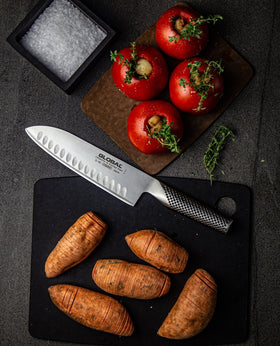

Chef Knives NZ: What you need to know.
A new café owner usually notices the knife problem before the equipment list is even finished. Prep takes longer than expected, cuts vary between staff, herbs bruise, tomatoes crush, and portion consistency starts drifting before service has properly settled. That often gets blamed on training, but the toolset matters just as much.
For most NZ hospitality businesses, chef knives aren't a lifestyle purchase. They're a working asset. The right choice depends on comfort, intended use, maintenance routine, staff skill level, and how easily the knife can be serviced or replaced locally. Brand matters, but operational fit matters more.
Why Your Knives Matter More Than You Think
A knife decision made in a rush usually shows up later as a workflow problem. One prep cook wants a lighter blade, another struggles with the handle, and a third keeps reaching for the smallest knife on the bench because the main chef's knife feels awkward. The result is inconsistency, not just inconvenience.
That matters in New Zealand because chef knives are part of a large professional market, not a niche household category. With around 20,000 professional chefs in Auckland and Wellington alone, knives sit firmly in the core production toolkit for hospitality businesses, which is why knife choice has a direct effect on labour efficiency and menu execution.
A common issue seen in new kitchens is treating knives as a minor sundry line rather than a frontline production tool. In practice, they affect:
- Prep consistency with more even slicing, dicing, and portioning
- Staff confidence when the knife feels predictable in hand
- Waste control because damaged produce and ragged cuts create avoidable trim loss
- Service flow when prep tasks don't keep stalling on blunt or unsuitable blades
Practical rule: Buy knives for the kitchen's actual workload, not for the brand name on the blade.
What goes wrong in first purchases
Many first-time operators either buy too cheaply or buy too delicately. The cheap option often arrives with poor balance, basic edge retention, and handles that aren't comfortable over a full shift. The overly delicate option may feel impressive on day one but becomes difficult to maintain in a shared kitchen.
Hospitality businesses often find that a sensible knife package works better than chasing a single “perfect” knife. One dependable chef's knife, a paring knife, and a serrated knife will usually do more for a prep station than one premium blade that nobody wants to sharpen.
Think like an operator, not a collector
The better question isn't “What's the sharpest knife?” It's “What knife will still be working properly after repeated daily use, varied staff handling, and a realistic cleaning and sharpening routine?”
That same thinking applies across equipment choices more broadly. This article on how equipment choice affects food quality more than recipes reflects the same operational principle. Tools shape output.
Decoding the Blade Types, Sizes, and Steels
The first knife purchase should solve jobs, not just fill a drawer. Most kitchens need a small set of dependable blades that match the prep list and the staff using them.

Essential knives for a commercial kitchen
A chef's knife does most of the heavy lifting, but it shouldn't do everything. Small, repetitive tasks and specialist prep become easier and safer when the blade suits the job.
| Knife Type | Typical Size | Primary Commercial Uses |
|---|---|---|
| Chef's knife | 20 to 25 cm | Chopping, slicing, dicing, general prep |
| Paring knife | Small | Peeling, trimming, fine garnish work |
| Serrated or bread knife | Long narrow blade | Bread, pastries, soft-skinned produce |
| Utility knife | Mid-sized | Light prep, sandwich stations, mixed tasks |
| Boning or filleting knife | Narrow specialist blade | Protein prep, trimming, portioning |
A standard chef's knife in the NZ market is typically 20 to 25 cm, which gives enough length for versatile prep and a controlled rocking motion, while shorter blades can be easier to manage in tighter prep spaces.
For many first kitchens, an 8 inch or 20 cm chef's knife is the safest place to start. A practical example is the Tramontina Century Forged Chef's Knife 8 20cm, which fits the common commercial size range and gives operators a useful benchmark when comparing shape, handle style, and forged construction.
Matching blade shape to the menu
Blade profile changes how a knife behaves on the board.
- Curved chef's knife profile suits rocking cuts and all-round prep
- Flatter Japanese-style profile often suits push cutting and cleaner straight slices
- Narrower utility shapes work well for lighter bench tasks
- Flexible boning blades help where protein trimming is frequent
Many chefs find that no single blade shape suits every station. A café doing cabinet food, sandwich prep, and light brunch service may prefer a lighter all-round knife. A bistro doing bulk onion, herb, and protein prep may want something with more authority through the heel.
A knife that's excellent for one skilled user can be the wrong knife for a shared prep bench.
Steel choice and what it means in real kitchens
Steel discussions often get abstract quickly. In commercial use, the practical questions are simpler:
- How long does the edge stay usable?
- How easy is it to sharpen properly?
- How forgiving is it under rushed handling?
- How resistant is it to staining and corrosion?
- How much maintenance discipline does the kitchen have?
There's no single steel that suits every operation. Many hospitality operators prioritise a balance of edge retention, ease of sharpening, durability, and corrosion resistance. That usually points towards sensible, serviceable stainless or high-carbon stainless options rather than chasing the thinnest or hardest edge available.
Don't confuse table knives with kitchen prep knives
It's also worth separating back-of-house knives from front-of-house cutlery. A product like the Tablekraft Melrose Dessert Knife 12 Pack serves a completely different role. Its lightweight 18/0 stainless steel construction, mirror-polished finish, and simple reeding make it suitable for everyday table service. It isn't part of the prep toolkit, but it's a useful reminder that “knife” purchasing in hospitality spans very different operational needs.
Beyond the Blade Handles, Balance, and Ergonomics
The blade gets most of the attention. The handle decides whether staff actually want to use the knife for a full shift.

A knife can look impressive on paper and still feel wrong the moment it's picked up. That's why ergonomics shouldn't be treated as a luxury feature. In commercial kitchens, comfort is part of safety.
Balance changes how a knife behaves
Balance affects control more than many buyers expect.
A blade-heavy knife can feel powerful in larger cuts but tiring in repetitive prep. A handle-heavy knife may feel light at the tip but less planted through denser product. A well-centred knife often gives the broadest appeal in mixed teams.
One consideration regularly discussed with customers is that a knife's “feel” doesn't always line up with its reputation. Some chefs prefer the light, distinctive all-steel profile associated with Global. Others want the practical familiarity often associated with Victorinox. Some still prefer the more traditional forged feel that draws users to Wüsthof. None of those preferences are wrong. They reflect different hands, techniques, and workloads.
Handle material matters in commercial use
The right handle depends on grip security, cleaning routine, and user preference.
- Composite or synthetic handles are often chosen for practicality, grip, and straightforward sanitation
- Wood handles can feel warmer and more traditional in hand, but buyers need to consider care requirements
- All-steel handles can appeal for hygiene and integrated construction, though some users find them less forgiving when hands are wet
A common issue seen in busy prep areas is staff adjusting grip mid-task because the handle shape doesn't suit their hand size or cutting style. That small discomfort adds up across repetitive use.
Trial matters more than theory
If a venue is buying for a team, one sample knife often tells more than a long specification sheet. Grip thickness, handle contour, and how the knife sits in a pinch grip all become obvious within minutes.
A product such as the Tramontina Century Wood Chef's Knife 8 20cm is useful as a comparison point because it highlights one of the most important practical decisions. Do staff prefer the feel of a more traditional handled knife, or would a synthetic or all-steel option be easier to live with in that kitchen?
Comfort isn't secondary. If staff avoid using a knife because it feels awkward, the purchase has already failed.
The Sharp End A Practical Guide to Knife Maintenance
A knife purchase only makes sense if the kitchen can maintain it. That's where many good knives go wrong. The issue usually isn't the blade. It's the routine around it.

Honing and sharpening are not the same job
These two jobs get mixed up constantly.
Honing realigns the working edge. It's part of routine upkeep.
Sharpening removes material to create a fresh edge. It's less frequent and more corrective.
When staff use a steel correctly, they can keep a knife performing consistently between full sharpening sessions. When they skip honing and keep pushing a dull edge, the knife usually reaches a worse state before anyone acts.
A simple option for maintaining that routine is a tool such as the Tramontina Diamond Sharpener 10 25cm, which gives kitchens a straightforward sharpening accessory to build into their prep setup.
Sharpness versus durability in real kitchens
This is one of the most important trade-offs for chef knives NZ buyers.
Western chef knives are often ground to 18 to 22 degrees per side, while Japanese-style knives are often 10 to 15 degrees per side, which creates a clear practical trade-off between a finer edge and a tougher one, as explained in this blade angle comparison.
For a disciplined kitchen with careful users and consistent sharpening habits, a finer edge may work well. For a shared kitchen with mixed staff skill levels, rushed prep, and occasional misuse, a slightly wider and more durable edge is often the better long-run choice.
A workable maintenance routine
Complicated systems usually fall apart. A simple routine holds.
-
During service prep
Staff hone as needed when the knife starts feeling less clean through product. -
After use
Wash by hand, dry promptly, and return the knife to protected storage. -
Weekly check
A supervisor or senior chef checks edge condition, chips, handle stability, and overall usability. -
Periodic sharpening
Sharpen before performance has deteriorated badly. That keeps the knife easier to restore and reduces unnecessary metal removal.
Storage and handling matter too
A properly sharpened knife still gets damaged if it's stored loosely in a drawer, dropped into a sink, or scraped across hard surfaces.
Useful habits include:
- Use suitable boards rather than hard, edge-damaging surfaces
- Store safely with guards, racks, rolls, or magnetic storage that protects the edge
- Avoid dishwashers for working chef knives
- Assign responsibility so maintenance doesn't become nobody's job
Kitchens usually don't replace knives because the steel was poor. They replace them because the maintenance system was poor.
Many professional chefs place more importance on maintaining knives properly than replacing them frequently. Regular care often does more for performance than buying another blade.
Sourcing Knives Budgeting and Procurement in NZ
Knife buying for a hospitality business isn't just a product choice. It's a procurement decision with a service and replacement lifecycle attached to it.

Think in total cost of ownership
A cheaper knife can cost more over time if it's uncomfortable, difficult to sharpen well, or regularly replaced. A premium knife can also become poor value if it's too delicate for the way the kitchen works.
The better approach is to assess:
- Expected workload on each station
- Who will use the knife and how varied their skill levels are
- Whether sharpening happens reliably
- How easy it is to replace or match the knife locally
- Whether spare stock and trade purchasing support are available
One article worth reading alongside this topic is buying cheap vs buying once when equipment actually saves money. The same principle applies to knives. The right purchase is the one that remains practical over time.
The NZ market has matured
By 2026, NZ knife buying guides were already treating chef knives as a mature, specification-driven category, with buyers expected to compare factors such as blade material, edge retention, balance and weight, handle comfort, brand reputation, and sharpening and care practices.
That matters because hospitality operators now need to buy with clearer intent. Price-only purchasing is usually a weak strategy in this category. A knife that matches the kitchen's maintenance capability and workload will often outperform a sharper but less practical alternative.
What sensible procurement looks like
For a new venue, the strongest procurement approach is usually modest and deliberate.
- Start with the core kit rather than overbuying specialist blades
- Standardise where practical so replacements are easier
- Allow for user preference on key knives if senior staff have strong ergonomic needs
- Set local service expectations before purchase, not after a problem appears
One factor often discussed with buyers is access. Can the same line be reordered easily through a trade account? Can the venue source sharpening help or replacement units without delay? Can the business keep the kit consistent if staff numbers grow?
Supplier relationship matters
A hospitality supplier proves more useful than a generic retail transaction. Trade accounts, equipment quotes, and service support don't change how sharp a knife is on day one, but they do change how manageable the category becomes over time.
Simply Hospitality is one NZ option for operators sourcing knives and wider kitchen equipment through a trade-focused supplier model, particularly when the knife decision sits alongside a larger fit-out, replacement cycle, or opening purchase.
The best knife to buy isn't always the one with the finest edge. It's often the one the business can maintain, replace, and keep in service without disruption.
Procurement Checklist and Next Steps
A first knife purchase becomes easier when it's treated as a short operational checklist rather than a brand debate.

Use this checklist before ordering
-
Define the main prep work
List the jobs the knives will handle. Vegetable prep, sandwich assembly, pastry work, and protein trimming place different demands on blade shape and size. -
Choose a realistic chef's knife size
For many kitchens, the common 20 to 25 cm range is the practical starting point, then adjusted based on bench space and staff preference. -
Match edge durability to the team
Fine edges can be excellent in the right hands. Shared kitchens often need something more forgiving. -
Check handle comfort and balance
If possible, get staff feedback before standardising a line. -
Decide who maintains the knives
If nobody owns honing, sharpening, and storage, performance will drift quickly. -
Plan replacement and servicing locally
A knife program only works if the business can keep it going without friction.
A common consideration is resisting the urge to buy too many specialist knives too early. Most new venues are better served by a smaller set of reliable, comfortable knives that staff will use properly and maintain consistently.
Knife buying should support the kitchen the business runs, not the one imagined on opening day.
If a venue is weighing up chef knives NZ options and wants practical advice on blade type, maintenance fit, or building a sensible first kit, Simply Hospitality can help match the purchase to the kitchen's workload, team, and long-term operating needs.