


Cleaning Chemical Dispenser System: Buying Guide 2026
A busy kitchen can have three different people preparing the same cleaning solution across one day, each estimating the concentrate slightly differently. The result may be a weak spray that leaves grease behind, an over-strength bucket that creates residue, or a staff member handling more concentrated product than necessary. A cleaning chemical dispenser system replaces that guesswork with a repeatable dilution process, helping hospitality, foodservice, accommodation, healthcare and other commercial environments produce the correct solution for each task.
The value isn't just using less chemical. It's using the correct chemical at the correct dilution, for the correct application, with the required contact time, then repeating that process reliably across every shift. The equipment supports that outcome, but it doesn't replace product labels, safety data sheets, food-control procedures, staff training or proper maintenance.
Why Cleaning Consistency Matters More Than You Might Think
At the end of a shift, one team member may pour concentrate into a spray bottle by eye, while another fills a mop bucket using a different estimate. A third person may connect a new container without checking whether it serves the same cleaning task. Each action can look reasonable in the moment, yet the finished solutions won't necessarily perform the same way.
That variation affects more than chemical consumption. Weak solutions may leave soil, grease or residue behind, while strong solutions can increase product use and create avoidable exposure or surface problems. In foodservice, inconsistent cleaning can also make it harder for supervisors to confirm that staff are following the documented cleaning process.
A dispenser gives staff a defined path:
- Select the labelled chemical.
- Use the designated outlet or setting.
- Fill the correct bottle, bucket or machine.
- Apply the solution according to the product instructions.
The same approach works whether the venue is a café with a compact back-of-house area, a hotel with housekeeping teams, or an institutional kitchen with several cleaning zones. It reduces reliance on individual habits, which matters when staff change between shifts or cleaning duties are shared across departments.
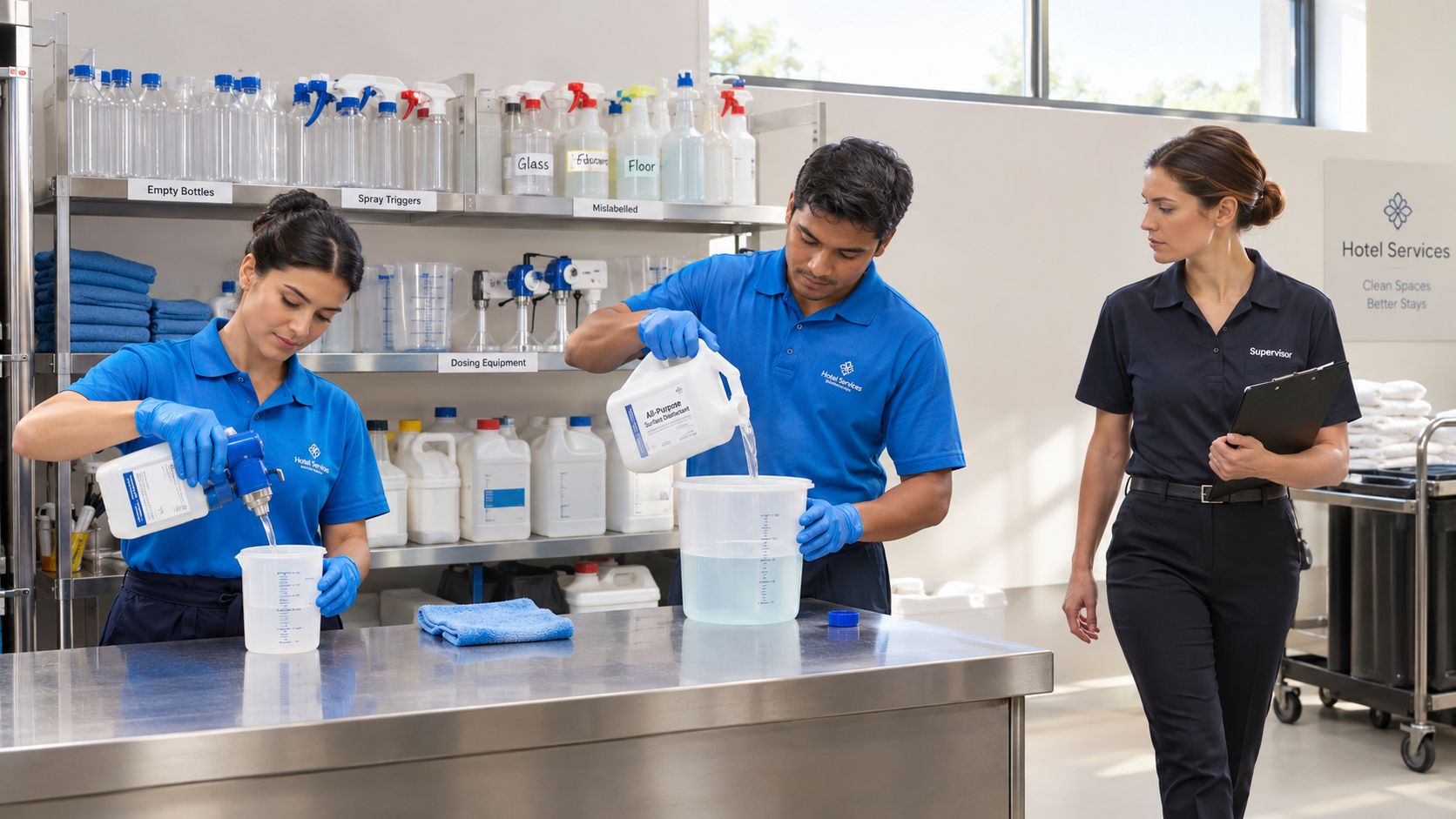
Practical rule: A dispenser is primarily a consistency tool. Cost control follows only when the chemical, setting, application and maintenance routine are all correct.
Many operators focus on the price of a concentrate container, but that doesn't show the practical cost of cleaning. The more useful comparison is:
Concentrate cost ÷ correctly diluted usable solution = practical chemical cost
That calculation only makes sense when the dilution is correct and the solution is being used for the intended job. Operators reviewing cleaning quality should also consider whether rewashing is costing the commercial kitchen, since poor cleaning results can create extra work even when chemical purchasing appears controlled.
Understanding Why Accurate Dilution Controls Safety and Effectiveness
Manual pouring gives staff too many opportunities to estimate incorrectly. A solution that's too weak may fail to remove grease or achieve the required cleaning result. A solution that's too strong can waste concentrate, leave residues, increase handling risk and affect surfaces or equipment, depending on the product.
The correct process is not dilution alone. It is:
Correct chemical + correct dilution + correct application + correct contact time where required = effective cleaning process
The chemical manufacturer's label and technical instructions always take priority. A dispenser can deliver a repeatable mix, but it can't decide whether a product is suitable for a bench, floor, food-contact surface, glass, washroom or sanitising task.
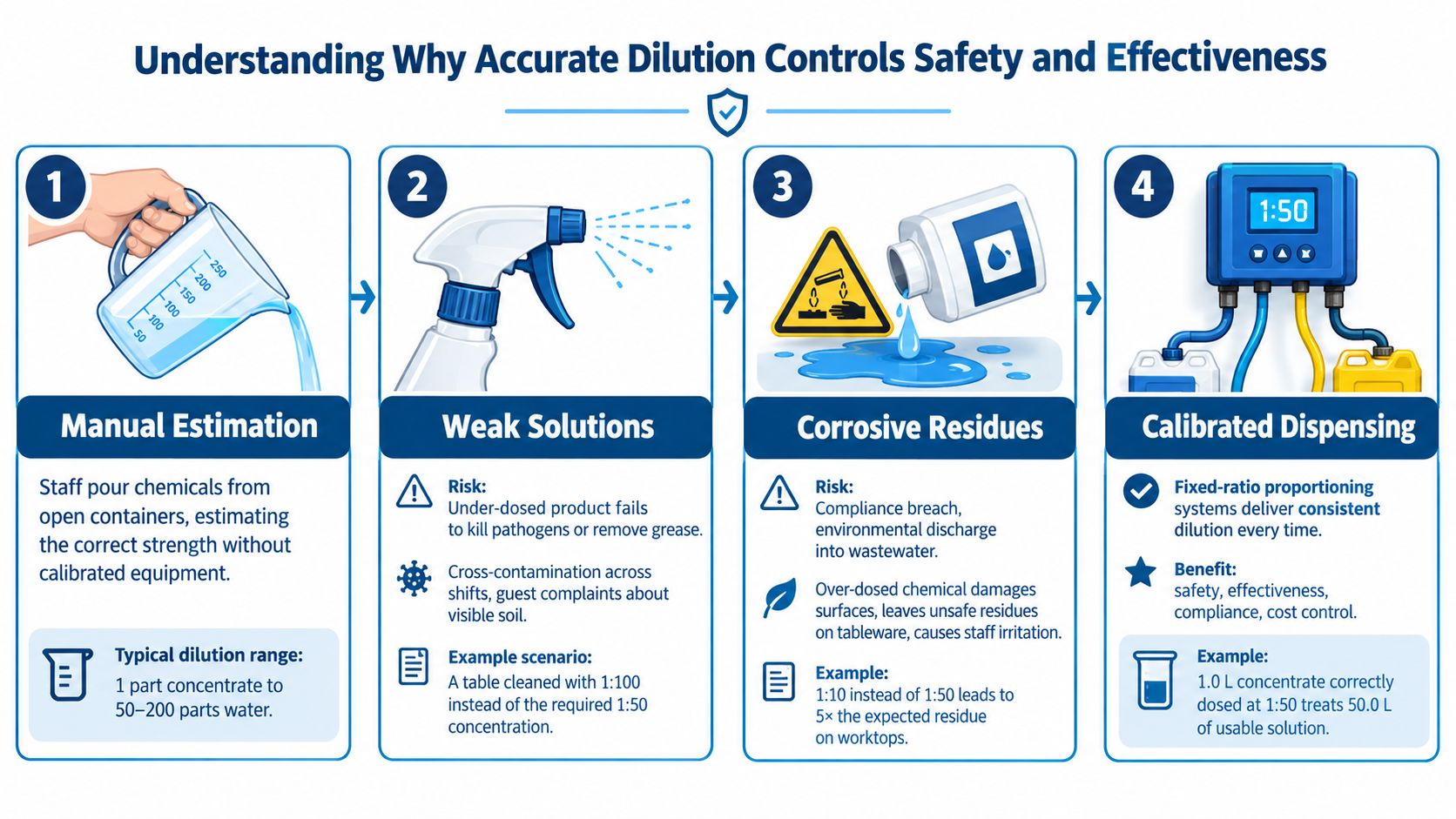
Weak and strong solutions create different problems
Under-dosing doesn't always look dramatic. A spray bottle may appear clean while leaving grease, soil or microorganisms inadequately controlled. Over-dosing can create a visible film, increase rinsing requirements or expose staff and surfaces to more concentrated chemistry than the task requires.
There isn't one universal dispenser setting. Different formulations and applications can require different concentrations, and one product may have more than one approved dilution rate. Staff need clear instructions for selecting the appropriate solution, especially where the same dispensing station serves general cleaning, degreasing and sanitising.
A WorkSafe-supported survey found that 68.7% of hospitality workers reported exposure to cleaning products, while 51% experienced wet-work exposure averaging 2.3 hours per day (WorkSafe worker exposure survey). That context makes reduced manual contact and better control worthwhile design considerations, although a dispenser doesn't eliminate exposure or prove that injuries will be prevented.
Food-contact cleaning requires particular discipline. MPI requires food businesses to follow the chemical manufacturer's directions when using food-grade cleaning chemicals on food-contact areas (MPI food safety direction). A useful companion reference for drainage decisions is this guidance on when to avoid bleach in drains. Operators can also review commercial cleaning chemicals when building a product-specific cleaning programme.
Different Types of Chemical Dispensing Systems for Hospitality Use
Not every dispenser serves the same workflow. A wall-mounted dilution unit for spray bottles and buckets operates differently from automatic dosing equipment installed inside a commercial dishwasher. Choosing between them starts with the cleaning tasks, not the equipment label.
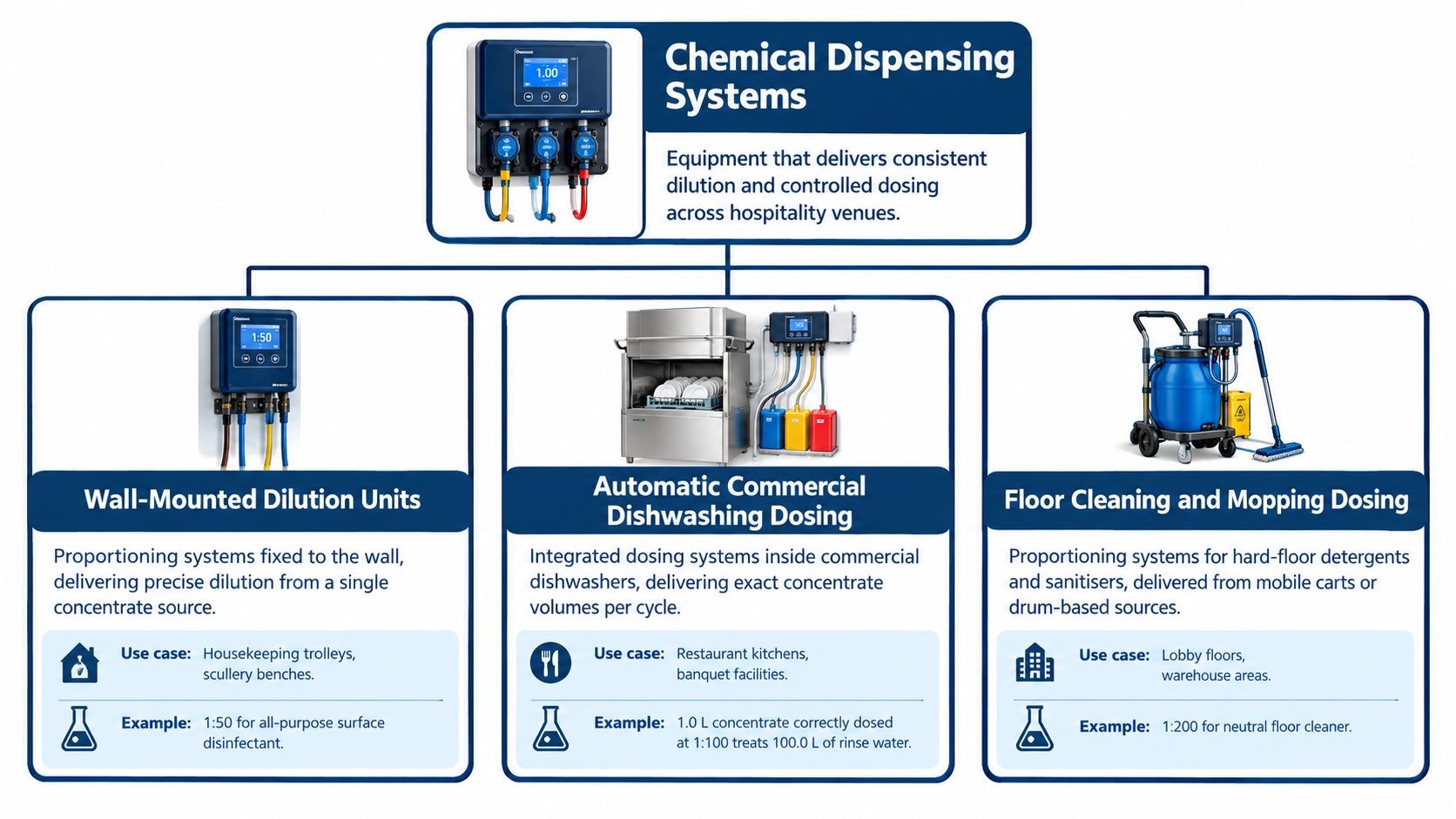
Wall-mounted dilution units
These systems are commonly positioned near a scullery bench, housekeeping store or cleaning cupboard. Depending on the design, they can draw concentrate and water through a proportioning arrangement to fill a spray bottle or bucket with a ready-to-use solution.
They suit tasks such as:
- Spray-bottle filling: General surface cleaning, washroom work or other labelled applications.
- Bucket filling: Floors, larger surfaces and cleaning routines that need more solution.
- Kitchen cleaning: Degreasing or other products where the concentrate must be controlled.
- Sanitising: Only where the product is approved for the intended task and the label instructions are followed.
- Laundry or washroom use: Dedicated outlets may support separate chemical workflows.
A wall-mounted unit can be a sensible fit for hotels, cafés, caterers and healthcare environments with repeatable cleaning stations. It may be less suitable where there is no reliable water connection, insufficient mounting space or a wide range of incompatible concentrates in one area.
Automatic dishwashing dosing
Commercial dishwashers generally use separate automatic dosing for detergent and rinse aid. This equipment is tied to the dishwasher, chemical formulation, water conditions and dosing controls, so it shouldn't be treated as an interchangeable version of a spray-bottle dispenser.
The system needs to be specified with the machine and the chemical together. Operators comparing warewashing options can also refer to Simply Hospitality's articles on commercial dishwashing detergent, dishwasher descaler and reverse osmosis and warewashing.
The New Zealand EPA Cleaning Products Group Standard requires covered products to comply with relevant Safety Data Sheet provisions and, for post-2006 products, to list hazardous chemical components on the New Zealand Inventory of Chemicals (EPA Cleaning Products Group Standard). Product identification and documentation therefore matter regardless of whether the chemical is dispensed into a bucket or through a dishwasher.
For a broader view of available equipment, operators can review the dispenser machine range.
How to Choose the Right Dispensing System for Your Venue
The right system depends on the venue's workflow, chemical range and available services. A compact café may need a single wall-mounted point for spray bottles and buckets, while a hotel, aged-care kitchen or hospital may need several controlled outlets across housekeeping, kitchens and washrooms.
Start by listing each task and the chemical currently used. Don't assume that one outlet or setting can serve every product. Check the label, SDS, intended application, required dilution and whether the chemical is compatible with the wetted materials, tubing, seals and connection arrangement.
| Factor | Why It Matters | What to Check |
|---|---|---|
| Chemicals requiring dispensing | Different products can require different settings and materials. | Product identity, label directions, SDS and compatibility information. |
| Cleaning tasks | Spray bottles, buckets, floors, degreasing and sanitising may need separate workflows. | Outlet type, intended application and staff instructions. |
| Daily solution volume | The station needs to fit the pace of service and cleaning. | How often bottles, buckets or machines are filled. |
| Available space | A dispenser must be accessible without obstructing food or equipment movement. | Wall, cupboard and concentrate-storage positions. |
| Water connection | Some units rely on incoming water to create the finished solution. | Pressure and flow requirements, connection type and backflow protection specified by the manufacturer. |
| Chemical compatibility | Incorrect tubing or seals can create leaks, damage or unreliable dosing. | Wetted materials and approved product combinations. |
| Staff control | Unauthorised changes can undermine standardisation. | Lockable or protected settings, clear labels and colour coding where appropriate. |
| Ongoing support | Small failed parts can stop a cleaning station during service. | Replacement components, maintenance advice and supplier support. |
Installation must follow the manufacturer's specifications and current New Zealand plumbing requirements. The chemical-storage position also matters. Concentrates should be clearly identified, kept away from food and protected from incorrect connections.
MPI's requirement to follow manufacturer directions on food-contact areas makes label-specified dosing operationally important. A buyer should ask whether the system can be calibrated or adjusted to the required product instruction, and whether those instructions can be displayed at the point where staff fill bottles or buckets.
Dispensers, Compliance and Environmental Considerations
A dispenser isn't automatically a compliance solution. It is one engineering control within a wider hazardous-substance system that should include a chemical inventory, current SDS access, labelled containers, suitable PPE, staff induction, spill response and documented procedures for refill, isolation and maintenance.
WorkSafe estimates that hazardous substances contribute to around 600 to 900 deaths and 30,000 cases of serious work-related ill health annually in New Zealand, with cleaning solutions among the commonly encountered hazardous products (New Zealand hazardous-substance information). Those national figures aren't dispenser-specific, but they show why equipment needs to sit inside a properly managed control programme.
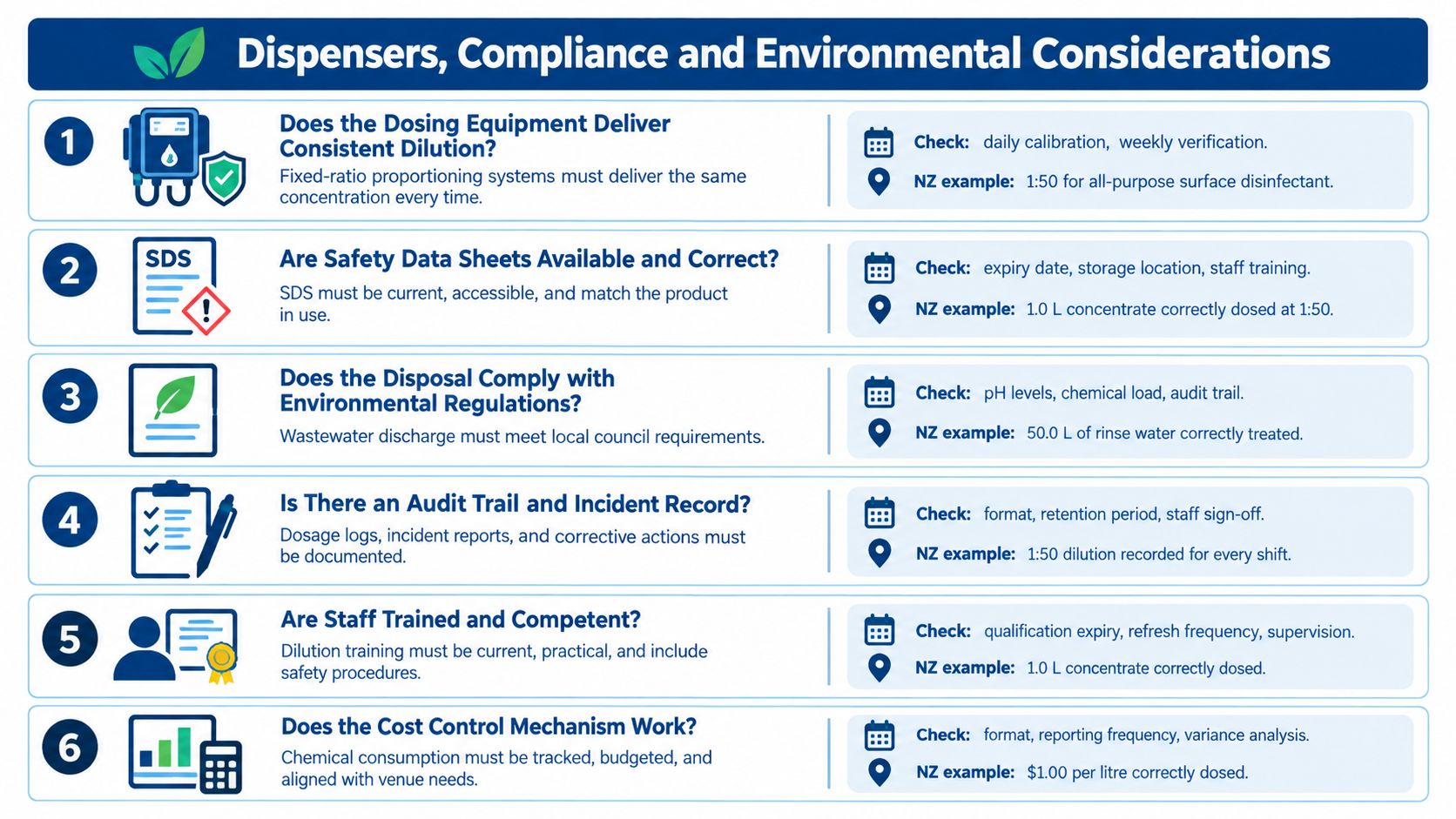
What remains after installation
Staff still need to know which concentrate is connected, what solution the outlet produces, where the finished solution can be used and what to do if a leak, spill or blocked injector occurs. The system should make those answers visible at the point of use.
A common failure occurs when someone swaps a container without updating the label, chemical register or instructions. Another occurs when staff bypass a setting because a dispenser appears slow or inconvenient. Automation can shift risk rather than remove it, particularly when a wrong product is connected or incompatible chemicals are handled together.
Different concentrates should never be mixed unless the manufacturer explicitly instructs it. Connections, labels and outlet design should make accidental mixing difficult. Colour coding can help, but it isn't a universal New Zealand requirement and it must be supported by clear product names and task instructions.
Environmental control requires a separate site decision. The Ministry for the Environment treats business-contaminated wastewater as trade wastewater and advises keeping wash water out of stormwater drains, containing or bunding it, and directing it to sewer only with the required council approval or permit (trade-waste and stormwater guidance).
Operators should check:
- Drain destination: Identify whether wash water goes to sewer, stormwater or an interceptor.
- Chemical loading: Review SDS disposal advice and the product's environmental instructions.
- Grease-trap compatibility: Confirm that detergents won't interfere with separator operation.
- Cleaning outcomes: Avoid under-dosing that causes repeat cleaning, extra rinsing or additional hot-water use.
- Local requirements: Confirm trade-waste conditions with the relevant territorial authority.
A practical overview of commercial cleaning hazards can help teams identify risks, while operators assessing product choices can also review eco-friendly cleaning products in New Zealand.
Installation, Operation and Ongoing Maintenance
A dispenser should be commissioned as part of the cleaning programme, not merely mounted on a wall and connected to a concentrate container. Before installation, the operator needs to confirm the water connection, flow and pressure requirements specified by the manufacturer, mounting position, hose arrangement, backflow protection and the location of chemical storage.
The first setup should verify the dispensed result using the method recommended for that product. The setting, chemical name, outlet and intended application should be recorded. The EPA group standard states that cleaning-product labels must provide directions for use, including dilution rates and dose rates where relevant (EPA label and dosing requirements).
A workable operating routine
A simple routine is easier to maintain than an undocumented one:
- Check the label and outlet before filling a bottle or bucket.
- Confirm the concentrate connection matches the displayed product.
- Fill the correct container and identify the finished solution.
- Apply the product according to the manufacturer's instructions.
- Report leaks, blockages or unusual flow before the unit is used again.
The system should be checked after maintenance, chemical changes or water-supply alterations. A setting that was correct for one product cannot be assumed correct for another.
Stock control improves when the venue records concentrate containers used, replacement frequency and unexpected increases in consumption. That doesn't mean a dispenser automatically prevents waste. Leaking connections, blocked injectors, incorrect product swaps and unauthorised bypassing can all increase usage or weaken the cleaning result.
Staff induction should cover refill procedures, shutoff or isolation arrangements, SDS access, PPE selection and spill response as specified for the actual products. Replacement tubing, seals and other components should be available through the supplier or manufacturer, because a failed small part can leave a busy cleaning station out of service.
Making Cleaning Systems Work Across Every Shift
A cleaning programme often fails at the handover point. The opening team fills spray bottles one way, the evening team prepares buckets another way, and a casual staff member follows neither process because the labels are unclear. The dispenser can't solve poor procedures, but a correctly configured unit can make the approved procedure much easier to repeat.
The strongest result comes from combining equipment with visible instructions:
- Name the chemical: The container and outlet should identify the concentrate clearly.
- Define the task: Staff should know whether the solution is for floors, food-contact surfaces, degreasing, washrooms or another approved application.
- Control the setting: Settings should be protected from casual adjustment where the equipment allows it.
- Train the user: New and rotating staff need practical instruction before working independently.
- Review consumption: Unusual usage should trigger a check for leaks, incorrect connections or changes in cleaning demand.
This approach supports a more dependable handover between shifts. It also reduces the need for supervisors to correct individual pouring habits throughout service. For cafés and restaurants, the benefit may be a clearer scullery routine. For accommodation, healthcare and institutional sites, standardisation can be more important because several teams may use the same chemical range in different areas.
The cleaning programmes for cafés approach is useful because it keeps equipment, product selection, task instructions and staff routines together. The dispenser is the delivery tool. It doesn't decide the right chemical, replace contact-time instructions or remove the need to check food-safety and hazardous-substance requirements.
A suitable cleaning chemical dispenser system should therefore be judged by repeatability first. When staff select the right product, dispense the required solution and apply it correctly, the venue gains better control over cleaning quality, chemical stock and day-to-day training. If the system is poorly matched, badly labelled or left without maintenance, automation can make the wrong process faster.
Simply Hospitality supplies commercial cleaning chemicals, dispensing equipment and related hospitality hygiene products for restaurants, cafés, accommodation providers, healthcare sites and institutional kitchens. Visit Simply Hospitality to discuss the chemicals, outlets, installation requirements and staff workflow before choosing a dispensing solution.