

What to Consider When Looking for a Cocktail Glass NZ
The most popular advice about cocktail glass NZ purchasing is backwards. A venue shouldn't choose attractive glassware and then force its cocktail list to fit. The practical order is cocktail first, glass second. The finished drink, service style, recipe volume, glasswasher, storage and replacement plan should decide whether a coupe, Nick & Nora, highball, Collins, rocks glass or specialist shape earns space behind the bar.
That matters across cocktail bars, restaurants, hotels, pubs, event venues and high-volume operations. A premium venue may accept the handling demands of fine stemware, while a busy pub may need tumblers that move quickly through clearing and washing. The right range depends on the drinks being sold, not on which glass looks most impressive in a catalogue.
Start With the Cocktail List, Not the Glass
Many hospitality businesses begin with a glassware mood board. That approach can create a collection of attractive pieces that don't suit the menu, the wash racks or the way staff work during a rush. A better starting point is the current cocktail list, or the proposed list for a new venue.
Classify every serve by how it's made and presented:
- Shaken and strained: Sours, daiquiris and similar drinks usually need a stemmed or small-bowl format with enough capacity for the finished pour.
- Stirred and spirit-forward: Martinis, Manhattans and related serves require a stable vessel with an appropriate rim and bowl.
- Built and iced: Highballs, spritzes and mixed long drinks need room for ice, mixer and garnish without becoming awkward to carry.
- Short serves: Old fashioneds and other concentrated drinks generally suit rocks or double old fashioned glasses.
- Specialist serves: Frozen, tiki and theatrical cocktails may justify dedicated shapes, but only where those drinks are a meaningful part of service.
A bar built around gin-based long serves has different glassware requirements from a programme focused on clarified punches in smaller stemware. The menu determines capacity, rim profile, stem height, base footprint and storage requirements before brand or finish enters the discussion.
Practical rule: If the recipe and finished volume haven't been confirmed, the glassware order is premature.
Capacity also affects the number of ranges a venue needs. A compact cocktail programme may work with a coupe or Nick & Nora for shaken and strained drinks, a highball for built serves, a Collins for longer drinks and a rocks glass for short pours. Adding every possible style increases washing, storage and replacement complexity.
Seasonal menus need the same discipline. Beverage planning guidance in winter beverage service ideas for hospitality venues can help identify whether a venue's service is moving towards hot, short, long or sharing formats, but the glass still needs to be matched to the actual recipe.
The most useful buying exercise is simple. Print the cocktail list, write the intended finished volume beside each drink, assign a glass format, then check whether one existing range can cover several serves without making presentation look sparse or forcing an overfill.
Core Cocktail Glass Formats Used in NZ Venues
No single cocktail glass style suits every New Zealand bar. Core formats cover most service, while specialist shapes should be added only when the menu and workflow justify them. Domestic NZ listings commonly show cocktail glass capacities from 200 mL to 270 mL, with smaller and larger formats also appearing across specialist ranges as reflected in local cocktail glass assortments.
The working formats
Coupe glasses have a broad bowl and stem. They suit champagne cocktails, shaken classics and drinks where the aroma and surface presentation matter. Capacity varies widely, so a shallow 160 mL coupe behaves very differently from a larger 300 mL version.
Martini glasses offer a recognisable presentation for strained, spirit-forward cocktails. Their wide rim can make garnish placement and carrying more demanding, particularly when the drink is filled close to the edge. Pasabahce Timeless, Luigi Bormioli Ypsilon and Stölzle Exquisit are useful reference points when comparing bowl shape, stem construction and capacity.
Nick & Nora glasses are smaller and more contained than a traditional martini glass. Formats around 150 mL to 170 mL are often suited to compact sours, pre-dinner serves and stirred cocktails where a smaller finished volume looks deliberate rather than under-filled.
Highballs and Collins glasses are designed for long drinks. A highball may sit around 345 mL, while an Ocean Libbey example may be around 355 mL. Collins glasses are generally taller, with some formats reaching 400 mL to 600 mL, so the recipe, ice quantity and mixer ratio must be set before ordering.
Rocks and old fashioned glasses provide a low centre of gravity for spirit-forward serves and drinks served over ice. Commercial ranges commonly include standard rocks formats around 230 mL and double old fashioned styles in the 200 mL to 300 mL region.
Specialist options include hurricane glasses, tiki mugs, margarita formats, flutes and large gin-and-tonic vessels. A local premium assortment includes gin-and-tonic glassware at 630 mL, which may suit presentation-led serves but needs careful checking against fill level, storage and dishwasher fit as shown in NZ specialist glassware listings.
| Glass Type | Typical Capacity (ml) | Best For | Common NZ Stock Examples |
|---|---|---|---|
| Coupe | 160 to 300 | Shaken classics and champagne cocktails | Pasabahce, Luigi Bormioli |
| Martini | 190 to 270 | Martinis and broad-bowled strained serves | Pasabahce Timeless, Luigi Bormioli Ypsilon, Stölzle Exquisit |
| Nick & Nora | 150 to 170 | Sours, stirred drinks and pre-dinner serves | Luigi Bormioli Mixology |
| Highball | Around 345 to 355 | Built long drinks and highballs | Stölzle Lausitz, Ocean Libbey |
| Collins | 400 to 600 | Taller long builds with substantial ice and mixer | Ocean and comparable commercial ranges |
| Rocks or old fashioned | 200 to 300 | Short, spirit-forward drinks | Pasabahce tumblers and comparable ranges |
| Specialist shapes | Varies | Tiki, hurricane, margarita and presentation serves | Pasabahce, Ocean and specialist collections |
The bar glassware range should be assessed beyond bowl shape. Check rim diameter, stem length, foot width, base stability, stackability and rack compatibility. Stackable tumblers can save valuable shelf space in high-volume bars, while delicate stemware may require dedicated racks and more careful unloading.
The Soehnle Bathroom Scales Style Sense Compact 300 Slate belongs to a different hospitality category, but its product specification illustrates why product selection should remain tied to the intended task rather than appearance alone.
Why Glass Capacity Has to Match the Recipe
A glass doesn't make a cocktail stronger. The recipe controls alcohol content, while the glass controls how that recipe is presented, carried and perceived. Oversized glassware can make a correctly portioned cocktail look under-filled, encouraging staff or guests to judge generosity by empty space rather than by the measured serve.
In Aotearoa New Zealand, a standard drink contains approximately 10 grams of pure alcohol, according to Alcohol.org.nz guidance on standard drinks and pour size. The same guidance gives a practical example: a bottle of wine marked as 8 standard drinks produces approximately 2 standard drinks or 20 grams per glass when poured into 4 glasses, but approximately 1.3 standard drinks or 13 grams per glass when poured into 6 glasses. It also notes that a 100 mL glass of wine at 12.5% alcohol equals 1.0 standard drink.
That relationship matters behind a cocktail bar because a vessel can disguise variation in the actual serve. Official New Zealand responsible drinking guidance identifies 30 mL of 42% spirits as a practical standard-drink equivalent, alongside 100 mL of 12.5% wine and 330 mL of 4% beer or cider. Cocktail specifications should therefore be costed and documented by measured ingredients, not by the nominal size of the glass.
A useful capacity check
The finished cocktail volume should sit comfortably within the vessel without looking lost. For shaken and stirred drinks, the measured liquid, dilution and garnish all affect the visual result. For built drinks, ice occupies part of the vessel, so a larger glass may be appropriate only when the recipe includes enough mixer and the intended ice format supports it.
A venue should check:
- Recipe volume: How much liquid reaches the glass after shaking, stirring or dilution?
- Ice displacement: Does the drink use cubes, crushed ice or no ice?
- Headspace: Does the finished serve look intentional rather than sparse?
- Rim and garnish: Will the garnish crowd the drinking edge?
- Standard-drink count: Does the measured spirit content remain clear in the recipe sheet?
A 270 mL bowl can be entirely appropriate for one drink and wasteful for another. A smaller glass can improve visual proportion, but reducing capacity without reviewing ice and dilution can make service untidy. The Luigi Bormioli Mixology Nick & Nora 150ml set is an example of a format where the smaller vessel can support a deliberately compact serve.
Presentation Versus Durability for Commercial Service
Stemmed glassware creates a different drinking experience. A coupe, martini or Nick & Nora lifts the cocktail above the bar, gives the drink a defined silhouette and can make the rim and garnish part of the presentation. That refinement comes with more points to protect during clearing, rack loading and storage.
Stemless glassware usually prioritises stability and handling. Rocks glasses and tumblers have a lower centre of gravity, a broad base and no stem to catch against a tray, bus tub or rack wire. This doesn't make every stemless glass indestructible. Poor loading, crowded shelves and careless stacking can still chip rims and damage bases.
Comparing the two approaches
| Factor | Stemmed, Coupe, Martini, Nick & Nora | Stemless, Rocks, DOF, Tumbler |
|---|---|---|
| Presentation | Refined silhouette and elevated drinking position | More grounded and functional |
| Carrying | Requires attention to stem and bowl stability | Usually easier to grip and transport |
| Storage | Often needs dedicated rack space | Some formats can stack efficiently |
| Washing | May need stemware-specific rack support | Generally suited to tumbler racks when dimensions match |
| Best venue fit | Premium cocktail bars, hotel lounges and destination restaurants | Pubs, high-volume bars, events and busy restaurant service |
| Main operational concern | Stem joins, feet and rim handling | Rim chips, stacking pressure and rack crowding |
Premium venues may favour Pasabahce, Stölzle, Schott Zwiesel or Luigi Bormioli formats where clarity, bowl profile and fine drinking feel support the experience. High-volume operations may prefer heavier Ocean or Pasabahce lines where practical handling and replacement availability carry more weight.
The choice isn't just premium versus cheap. A refined glass that survives the venue's racks and staff workflow may be more practical than expected, while a durable glass can still suffer losses if staff force pieces into unsuitable compartments. Premium glassware as an expense or an investment is best considered through the whole operating cycle, including presentation, washing, storage and replacement.
Rim thickness, foot diameter and the join between bowl and stem deserve close inspection. Fine pulled stems may look elegant, but the venue should confirm that staff can rack and unload them without catching adjacent pieces. Wide, stable feet can help during service, but only if the glasswasher rack supports them securely.
The Service to Storage Workflow Behind Breakage Rates
Glassware rarely fails only because of the material. It fails when people move it through an unsuitable process. The complete chain runs from service, clearing, rack loading, glasswashing, unloading and storage, and each handoff deserves attention.
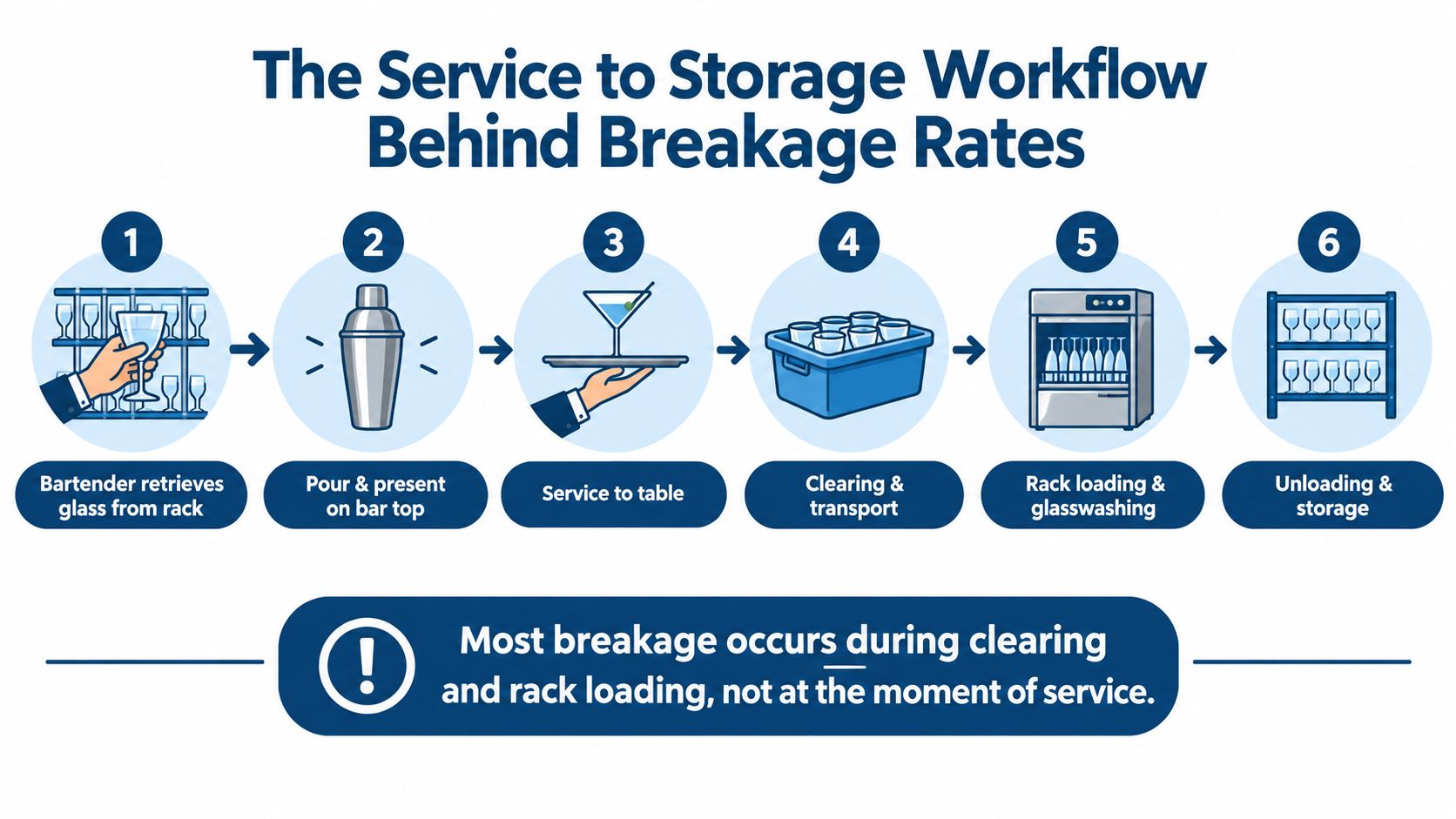
Six points where operators can reduce damage
- Retrieval: Staff should take the bowl or lower body where appropriate, rather than pulling a delicate stem from a crowded shelf. Overhead storage can look tidy, but it increases drop distance and may encourage awkward reaching.
- Service: A stable base and suitable rim reduce spills during placement. Trays should not be overloaded, especially with tall Collins glasses or wide martini bowls.
- Clearing: Empty glasses should be separated from cutlery, plates and heavy tumblers. A glass placed under pressure in a crowded bus tub can chip before it reaches the wash area.
- Rack loading: The rack must support the glass at its base and keep stems, rims and bowls from striking adjacent pieces. A martini bowl forced into a tumbler compartment is a poor fit, not a staff training issue.
- Glasswashing: New Zealand hygiene rules require beverage-service utensils on licensed premises to be effectively cleaned and rendered hygienic in an approved glass-washing machine, unless an alternative method is approved by a designated officer as outlined in local hospitality guidance. The chosen glass must therefore tolerate the commercial wash process and allow residue to clear.
- Unloading and storage: Staff should handle clean glassware without touching the drinking rim. Upright storage on a suitable, non-slip shelf is generally safer than stacking stemmed pieces rim-to-foot.
Racks and machine settings matter
NZQA treats glassware as part of the equipment required for preparing and serving alcoholic cocktails in a licensed commercial environment under the relevant hospitality unit standard. That reflects a practical reality. Glass format, stability and handling affect repeatable service, stock control and safe front-of-house work.
Detergent dosing and wash temperature should follow the machine and chemical supplier's specifications. Excessive heat, poor dosing or residue left on the surface can affect clarity and leave the glass unpleasant to drink from. Polishing should use a clean microfibre rather than a tea towel, which can transfer lint or introduce pressure at the rim.
Handling principle: A glasswasher cannot compensate for the wrong rack. Confirm compartment dimensions with the actual glass before committing to a full range.
Storage should also match the format. Stemmed pieces need enough vertical clearance and should not be wedged tightly together. Tumblers may stack, but only when the manufacturer's design supports it and the rims aren't carrying the load. The cheapest purchase price means little if the venue's process turns good glassware into frequent breakage.
Ordering Quantities, Case Pricing and Trade Options
Ordering cocktail glassware by style alone creates two common problems. A venue may buy too few of the glasses used most often, then keep service moving with unsuitable alternatives, or it may buy many attractive formats that sit in storage while staff repeatedly wash the same core pieces.
The order should follow the menu map. Primary formats need enough stock for active service, clearing and a full wash cycle, while secondary formats can be held in smaller quantities until demand proves they deserve more space.
Build the first order around usage
A practical order review should record:
- Core formats: Which glasses appear across the largest number of menu items?
- Peak service: Which pieces disappear first during a busy period?
- Wash capacity: How many glasses can the racks handle without unsafe crowding?
- Storage: Can clean stock be held without stacking pressure or unstable shelves?
- Replacement access: Can the same range be reordered if individual pieces are lost?
- Venue mix: Does the business need durable event glassware, premium stemware or both?
Case configuration varies by brand and product, so purchasing teams should compare the delivered case contents rather than assuming every range is packed the same way. A price comparison also needs to include usable capacity, breakage exposure, freight, rack requirements and whether a partial replacement can be sourced later.
Trade purchasing can be useful where a venue needs quoted supply, coordinated replenishment or help selecting complementary barware. The wholesale glassware information should be read alongside the actual menu and operating conditions, not used as a substitute for them.
Event venues and caterers may also consider reusable polycarbonate or hired glassware for functions where transport, outdoor service and loss control create different priorities. The trade-off is usually a change in clarity, weight and drinking feel, so the choice should be made per event format rather than applied to every service.
Building a Glassware Range That Actually Works
A reliable cocktail glass range comes from a short sequence of checks, not from collecting every shape available. Start with the drinks, assign each serve to a format, confirm finished volume, test the pieces in the commercial glasswasher, then order the quantities that match service pace and storage.
A venue should walk the floor with the current cocktail menu and mark the required glass beside every drink. That exercise often exposes unnecessary variety. Three or four dependable formats may cover most service, such as a coupe or Nick & Nora for shaken and strained cocktails, a highball for built drinks, a Collins for longer serves and a rocks glass for short, spirit-forward drinks.
Premium venues may add a martini glass, flute or specialist vessel when the menu needs it. Every additional shape creates another storage location, rack decision, cleaning requirement and replacement line. A broad range can improve presentation, but only when staff can identify, wash and store each piece reliably.
Final selection test: Buy the simplest version of each required format that survives the venue's actual service and wash cycle. Upgrade for clarity, refinement or brand consistency only after the operational fit is proven.
The right decision also depends on venue type:
- Cocktail bars: Prioritise recipe-specific capacity, rim quality and drinking experience.
- Restaurants and hotels: Balance presentation with shared glasswasher and storage systems.
- Pubs and high-volume bars: Favour stable bases, practical handling and reliable replacement.
- Event venues: Consider transport, outdoor use, rack compatibility and reusable alternatives.
- Premium hospitality: Use fine stemware selectively, where the presentation justifies additional care.
For businesses comparing cocktail glass NZ options, Pasabahce, Ocean, Stölzle, Schott Zwiesel and Luigi Bormioli provide useful brands to evaluate across the required formats. The decision should still come from the cocktail list and workflow. A well-matched standard range will usually outperform a decorative collection that doesn't fit the recipe, rack or storage area.
Hospitality supplies commercial glassware and related front-of-house equipment for NZ hospitality businesses, with product ranges and advice suited to cocktail menus, glasswasher requirements and venue workflow. Visit Simply Hospitality to discuss the right cocktail glass formats, capacities and replacement approach for the business.