

Coffee Machine and Grinder: Why They Are One System
Most operators choose the espresso machine first, then add a grinder once the major purchase is settled. That approach is backwards. A coffee machine and grinder form one production system, supported by water, milk, barista skill and station layout. A high-spec espresso machine can't produce fast, repeatable coffee if the grinder doses inconsistently, grinds too slowly or becomes difficult to adjust during the rush.
That decision starts before equipment specifications. Operators should first decide whether they want to own the coffee station or use equipment supplied by a roaster. Once that commercial question is clear, the machine, grinder, filtration, electrical supply and workflow can be specified as one working setup.
Why the Grinder Sets the Ceiling for Your Coffee Station
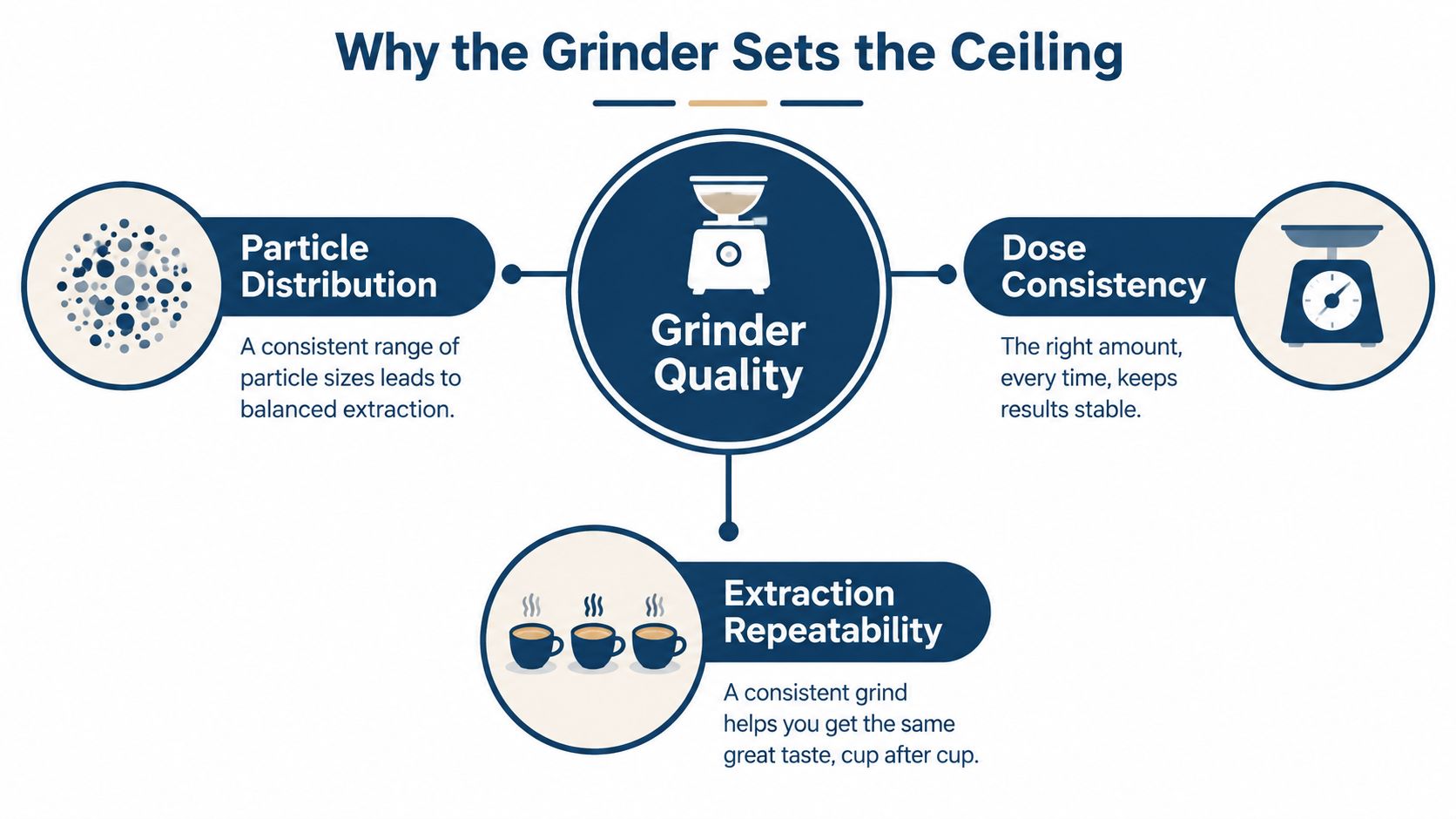
The espresso machine often gets the attention because it's larger, more visible and usually carries the heavier price tag. The grinder still sets much of the practical ceiling. It controls the ground coffee entering the basket, including particle distribution, dose consistency and the operator's ability to repeat an extraction from one shot to the next.
Two cafés can use the same espresso machine and produce noticeably different drinks because their grinders, recipes and workflows differ. Burr geometry, motor performance under load, grind retention, adjustment design and dosing control all influence whether the barista can prepare a predictable puck quickly. Boiler size and temperature control matter, but they can't correct a dose that varies or a grind that clumps and shifts during service.
A premium espresso machine paired with an unsuitable grinder creates a bottleneck at the first stage of production. The group head may be ready, the steam system may have capacity and the barista may be trained, but the coffee still can't be prepared consistently enough to use that capability.
Practical rule: Treat the grinder as a core production asset, not an accessory added after the espresso machine has consumed the budget.
That doesn't mean every venue needs the largest or most technically advanced grinder. A motel breakfast room, a small restaurant and a busy café have different demands. It does mean the grinder should be selected against peak workload, coffee programme, dosing method, cleaning expectations and the number of baristas using it.
Operators should also resist matching burr size directly to brew temperature. Those specifications solve different problems. Burr size and design relate to grinding performance, throughput and the intended coffee programme. Brew temperature belongs to the espresso machine and extraction recipe.
The central purchasing question is simple: can the grinder feed the machine quickly and consistently when the queue is longest? If the answer is no, the machine's unused capacity is expensive decoration.
Buying Versus Using a Roaster-Supplied Setup
The own-versus-roaster decision belongs near the beginning of the buying process, not after the machine has been selected. Some New Zealand operators prefer an owned setup because it gives them control over the machine, grinder, burr configuration, service arrangements and coffee supplier. Others use equipment supplied by a roaster under a bean agreement, which can reduce the initial equipment burden while tying the venue to defined purchasing conditions.
Neither route is automatically cheaper. The commercial answer depends on expected volume, contract terms, bean pricing, equipment ownership, exit clauses and responsibility for repairs or burr replacement.
| Factor | Owned Setup | Roaster-Supplied |
|---|---|---|
| Initial capital | Requires a planned equipment purchase | May reduce upfront equipment spending, depending on the agreement |
| Equipment choice | Operator chooses the machine and grinder | Choice may be limited to the roaster's approved equipment |
| Coffee supply | Allows broader supplier flexibility | Usually connects the venue to a defined bean arrangement |
| Servicing | Operator plans service, parts and filtration | Agreement should state who handles service and consumables |
| Upgrades | Grinder, burrs and workflow can be changed independently | Upgrades may require renegotiation or remain unavailable |
| Commercial control | Greater control over long-term operating decisions | Simpler setup, but less independence |
Many operators choose the roaster-supplied route when the venue is testing demand, operating at modest volume or prioritising a supported launch. Ownership becomes more attractive when coffee is central to the offer, the venue wants to test different coffees or the grinder needs to be customized for a particular workflow.
Before signing, the operator should compare bean price per kilogram, contract length, exit conditions, minimum purchase requirements, service obligations and ownership at the end of the agreement. The grinder deserves particular attention. A machine loan can sound attractive until the venue discovers that worn burrs, dosing faults or a replacement grinder fall outside the support arrangement.
The related article, Your Coffee Machine or the Roaster's: Which Actually Costs Less?, belongs in that commercial review before equipment specifications take over the conversation.
The Coffee Station as a Complete System
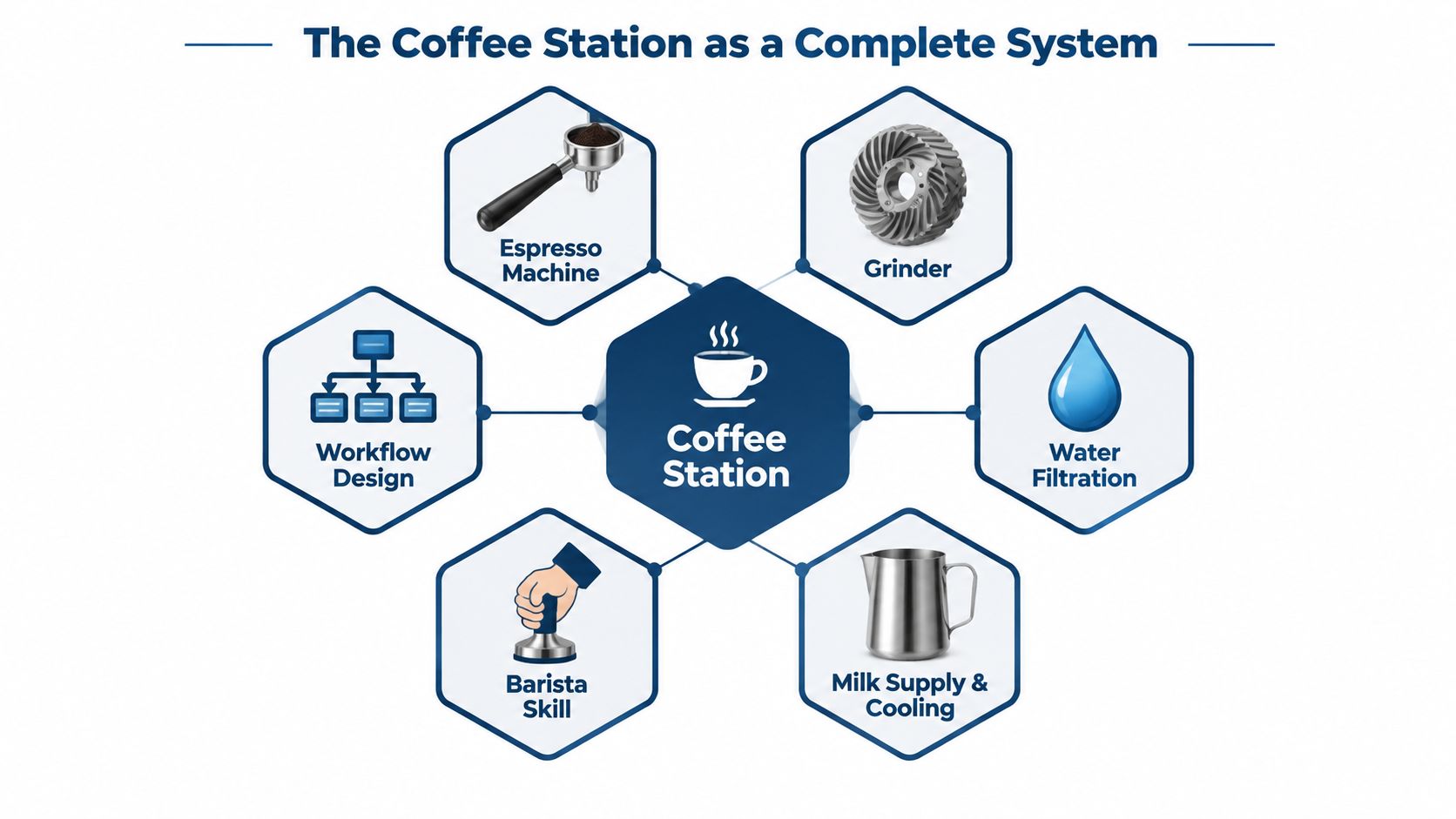
A dependable coffee station has six linked components:
- Espresso machine
- Grinder
- Water filtration
- Milk supply and cooling
- Barista skill
- Workflow design
The machine and grinder are the production core, but the rest of the station determines whether that core works in service. A grinder can be correctly specified and still underperform if the bench layout forces awkward movement. A powerful machine can still create inconsistent drinks if the water treatment doesn't suit the site or if staff haven't been trained to follow one recipe.
Check the site before choosing the equipment
New Zealand foodservice water can contain varying levels of mineral content, hardness and sediment, and supply characteristics can differ between areas or even within a city. That makes water filtration part of the machine specification, not a later add-on. The commercial foodservice water filtration guidance explains why filtration helps address scale, particulates and chlorine that can affect flavour, valves, boilers and service life.
The site survey should record:
- Water profile: Confirm hardness and filtration requirements before ordering.
- Power supply: Check voltage, circuit capacity and the machine's rated configuration.
- Drainage: Allow for waste water and cleaning procedures.
- Bench depth: Include clearance for handles, milk jugs, knock boxes and service access.
- Milk storage: Position refrigeration so staff aren't crossing the station repeatedly.
- Barista movement: Keep the grinder, machine, scales, cups and milk within a natural working sequence.
New Zealand's standard low-voltage supply is 230 V AC between phase and neutral, and installations operating from 200 V to 250 V must remain within 10% of that standard voltage, apart from momentary fluctuations, under the Electricity Safety Regulations. The actual machine specification and site electrical design still need to be checked by the appropriate qualified people.
Milk is part of capacity planning too. If the venue produces a large proportion of flat whites and lattes, the refrigeration location, jug availability and steam workflow need to support that pattern. A compact quick-service kitchen may also need to protect the coffee queue from other single-portion tasks. For example, the Menumaster MOC5241 2400W Heavy-Duty Microwave is designed for rapid single-portion regeneration, bun warming and sauce or side-dish heating, with a compact 9-litre cavity and 2400W output. It isn't coffee equipment, but separating that type of task from the coffee station can prevent unrelated orders from interrupting barista movement.
A coffee-focused layout should also account for alternative beverage services. Operators reviewing brewing formats can use the coffee percolator information when deciding whether the venue needs espresso, batch coffee or both.
Grinder Specifications Worth Comparing
Grinder specifications should be read as a service profile, not as a list of impressive numbers. The key question is whether the grinder can deliver the required dose, at the required speed, with enough control for the venue's coffee programme.
For medium-to-high traffic cafés, commercial grinder sizing commonly starts at 64 mm burrs. A practical distributor guide places 64 to 75 mm flat-burr grinders in medium-volume venues and 75 to 98 mm in high-volume operations, because larger burr sets generally support greater throughput and more repeatable particle distribution under sustained load. The same New Zealand specification example lists a 64 mm burr grinder at 6 to 9 kg per hour, with 230 V/50 Hz power, 350 W and a 1200 g hopper. Higher-output models are specified around 1400 rpm and 220 V to 240 V single-phase power. These figures are reference points, not universal performance guarantees, and the manufacturer's intended duty still matters.
| Specification | Light Volume, under 100 cups/day | Medium Volume, 100 to 300 cups/day | High Volume, 300+ cups/day |
|---|---|---|---|
| Burr format | Smaller commercial burr set may suit the duty | Compare 64 to 75 mm flat-burr options and the intended workload | Consider 75 to 98 mm options where sustained throughput requires them |
| Adjustment | Stepped adjustment can be practical for a stable recipe | Fine stepped or stepless adjustment supports regular dialling in | Fast, precise adjustment matters when coffee changes during service |
| Dosing | Timed dosing may suit a simple workflow | On-demand or controlled timed dosing should be assessed against staff habits | Weight control and repeatability deserve close attention |
| Hopper | Match capacity to fresh bean rotation | Avoid a hopper that encourages beans to sit longer than the coffee programme allows | Larger capacity can reduce refilling, but only where turnover supports it |
| Motor and duty | Manufacturer-rated light commercial use | Confirm repeated service capability | Confirm sustained-load performance, heat management and service support |
| Cleaning access | Simple disassembly is valuable | Burr access and retention control become more important | Cleaning time and replacement parts affect operational continuity |
Burrs, adjustment and dosing
Burr size is only one part of the decision. Burr design, motor torque, grind retention, adjustment range, dosing consistency and access for cleaning all deserve comparison. A large burr set won't solve a poor workflow if the adjustment is difficult to use or the dose changes between baristas.
Timed-on-demand dosing can be effective when staff follow a stable recipe. Gravimetric dosing measures weight rather than relying only on time, which can support tighter control when bean density or grind conditions change. The operator should compare the dosing method with the venue's training level, coffee range and tolerance for manual intervention.
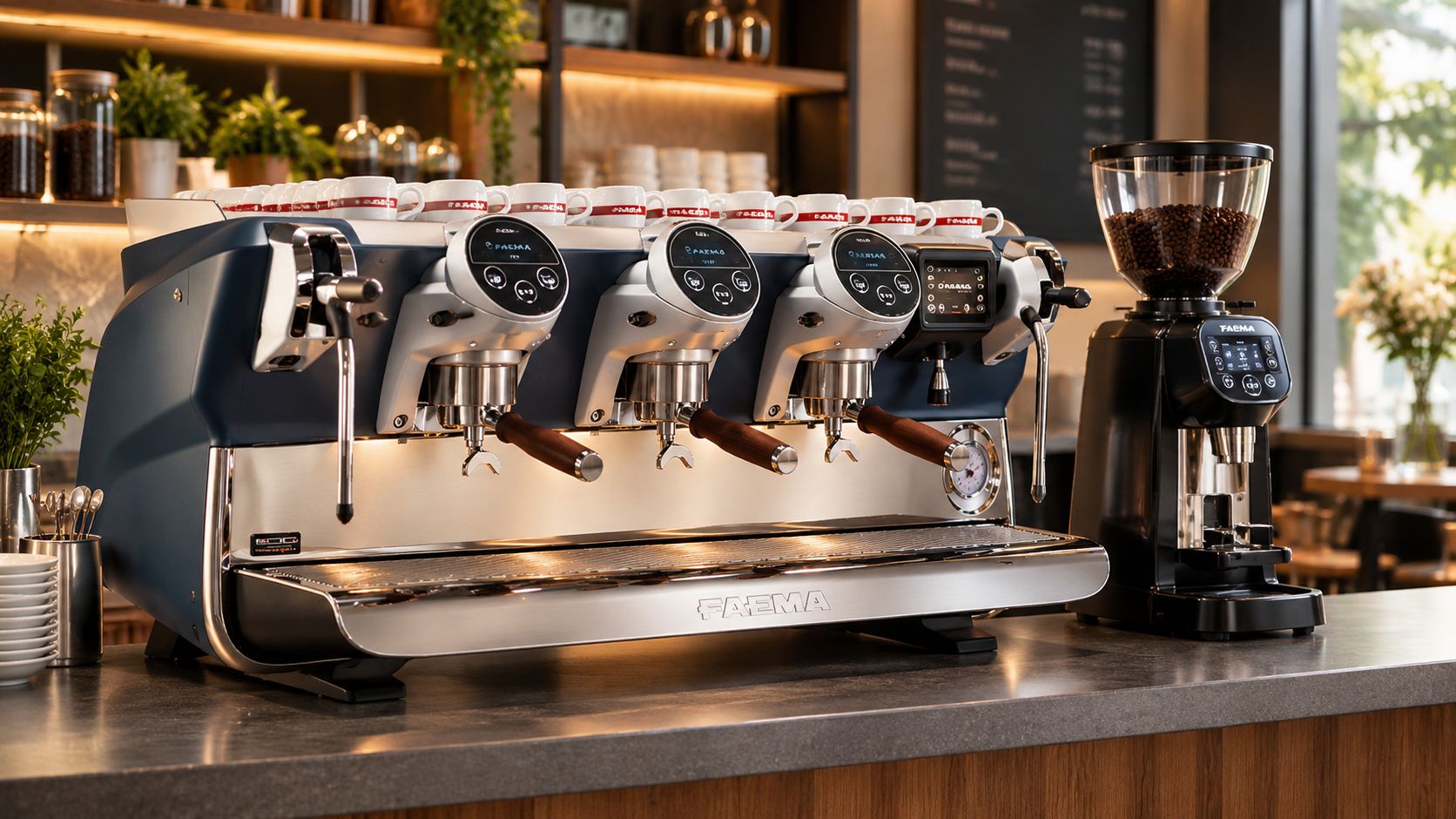
The Faema E71E Commercial Espresso Machine offers independent groups, group-specific temperature control and GTi infusion management, so it belongs in a barista-led setup where the grinder and recipe control need to support a deliberate coffee programme. It's a machine choice, not a reason to reduce attention on the grinder feeding it.
Cleaning access matters from the first day. Operators looking for a general explanation of coffee equipment hygiene can also review this clean Keurig with vinegar guide, while recognising that commercial grinder and espresso-machine procedures must follow the relevant manufacturer's instructions.
Espresso Machine Specifications That Pair With the Grinder
An espresso machine should be selected after the venue understands how many baristas will work at once, how drinks are ordered and how the grinder will feed each group during peak service. Machine specifications only create value when the rest of the station can keep up.
Group configuration and steam demand
Group count is the first practical decision. A single-group machine can suit a low-volume bar or a venue where espresso is a supporting offer. A two-group machine is a common fit for cafés with regular simultaneous production. Three- or four-group configurations belong in larger, high-traffic operations where the bar layout, grinder capacity and staffing can use them.
The group count shouldn't be chosen from an average daily figure alone. If the venue regularly has multiple baristas preparing drinks together, a machine with too few groups forces staff to queue for the same brew position. A machine with too many groups can consume bench space and capital without improving service.
Steam capacity needs the same scrutiny. Milk-heavy menus place sustained demand on the steam system, especially when several drinks are prepared consecutively. The operator should compare boiler arrangement, steam recovery, wand design, jug size and the number of milk drinks produced during the busiest period. A machine with long cold-touch wands can also make wiping and handling easier, but the full steam specification still needs to match the workload.
Water, voltage and installation
Water filtration protects the machine and stabilises the operating environment. One AU/NZ service manual gives descaling thresholds of 312,000 impulses for soft water, 168,000 for medium water and 96,000 for hard or very hard water for coffee delivery only. It also states that hot water counts three times and steam six times toward the descaling target. Those figures show why high steam use and hard water can bring maintenance requirements forward. The operator should follow the actual machine manual, not apply a universal interval.
Another New Zealand machine document states that a filter must be used from 5° dKH carbonate hardness and reports workplace sound pressure below 70 dB(A). That matters where the coffee station sits in an open kitchen, dining room or front-of-house area. Water and noise are operational considerations, not just technical footnotes.
Commercial espresso machines commonly specify 220 V to 240 V single-phase power, which aligns closely with New Zealand's standard 230 V AC supply. The La Marzocco Linea PB commercial specification demonstrates the type of local-rated configuration operators should check, but the actual site must still be assessed for circuit capacity, wiring, protection and available clearance.
| Specification | Low Volume | Medium Volume | High Volume |
|---|---|---|---|
| Groups | Single group may be sufficient | Two groups often support concurrent production | Three or four groups where demand and staffing justify them |
| Steam system | Moderate steam demand | Recovery should support repeated milk drinks | Strong sustained steam capacity is essential |
| Boiler approach | Simple systems may suit the menu | Heat exchange or multi-boiler options should be compared | Multi-boiler systems can support demanding simultaneous work |
| Water treatment | Still required where hardness demands it | Specify filtration before installation | Build filtration and monitoring into the service plan |
| Electrical planning | Confirm rated voltage and circuit | Check machine and grinder together | Confirm the full station load and site supply before ordering |
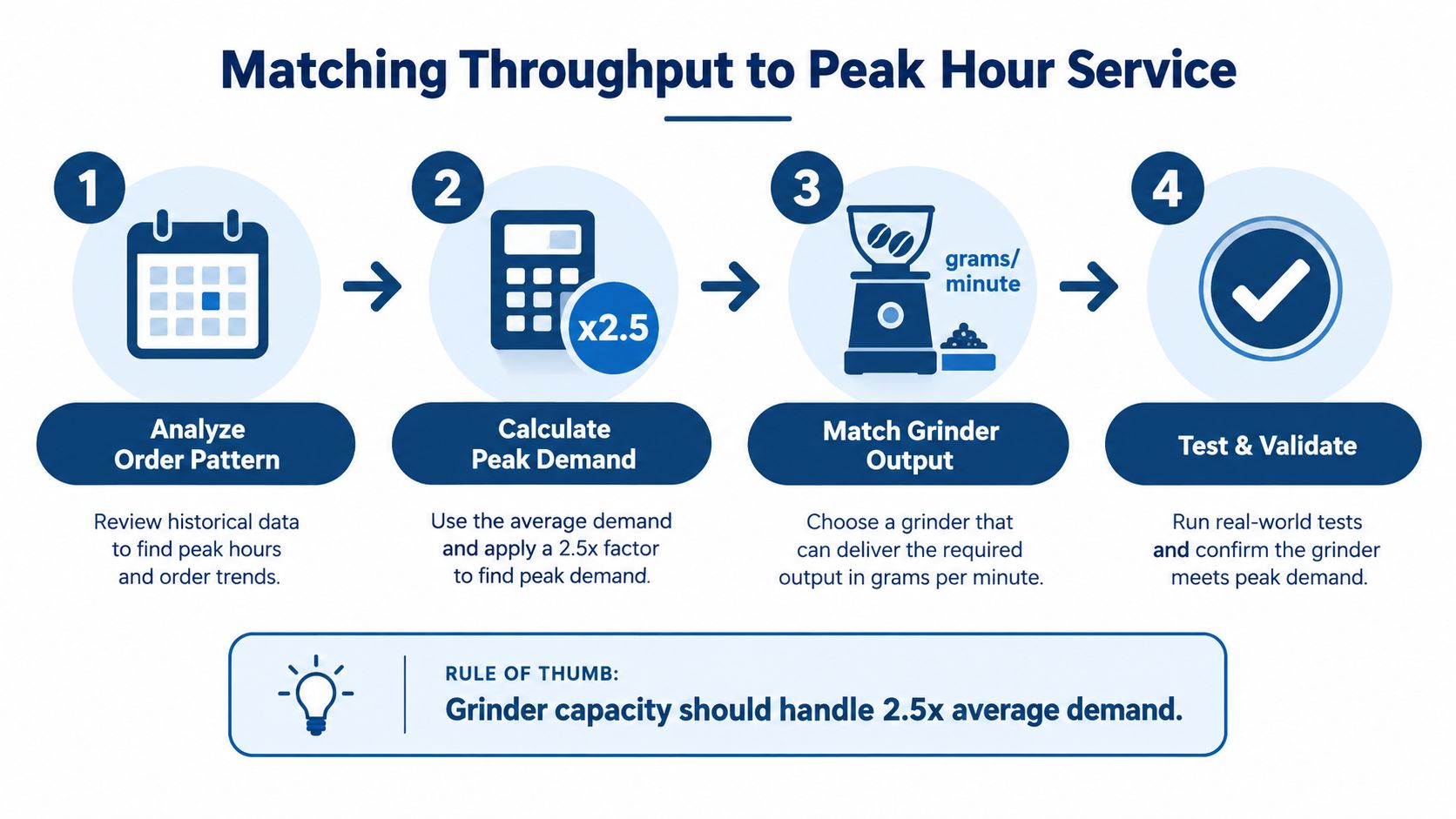
Matching Throughput to Peak Hour Service
Average daily volume hides the problem. A venue can have moderate overall demand and still overwhelm its coffee station during breakfast, school drop-off or the morning café rush.
The right planning window is the busiest service period. Operators should record how many espresso drinks arrive together, how many baristas are active, which drinks require steaming, whether decaf or alternative coffees need separate grinding and how often staff move away from the station to collect milk, cups or food.
Work backwards from the queue
A practical capacity check should include:
- Peak orders: Count the busiest short service window rather than relying on the daily average.
- Group use: Establish how many shots can be prepared concurrently without staff waiting.
- Grinder output: Confirm the grinder can deliver the required dose quickly at espresso setting.
- Barista count: Check whether one grinder serves one barista or creates a shared bottleneck.
- Drink mix: Separate espresso-only demand from drinks requiring steaming, pouring and extra handling.
- Recovery: Confirm that the machine, grinder and staff can repeat the cycle without quality falling away.
A single grinder can be entirely suitable for a small station. It can also become the slowest point in a two-barista workflow if both staff need the same adjustment, dosing outlet or hopper. Additional grinders may be justified for different coffees, decaf service or separated barista positions, but they should be selected from the order pattern rather than added automatically.
Peak-service test: A coffee station is correctly sized when the grinder, group heads, steam system and barista movements remain usable together during the busiest queue.
The grinder shouldn't be judged only by its headline output. Operators should ask how it behaves under repeated grinding, how much retention the workflow creates, how easily the dose can be corrected and whether staff can clean it without dismantling the station for an extended period.
The Coffee Machine for Cafe article provides useful related planning context, but the final decision still requires a site-specific assessment of group count, grinder capacity and queue pattern.
Cleaning and Maintenance for the Whole Station
A grinder is doing mechanical work every time a coffee is prepared. It shouldn't receive less attention than the espresso machine because its cleaning tasks are less visible.
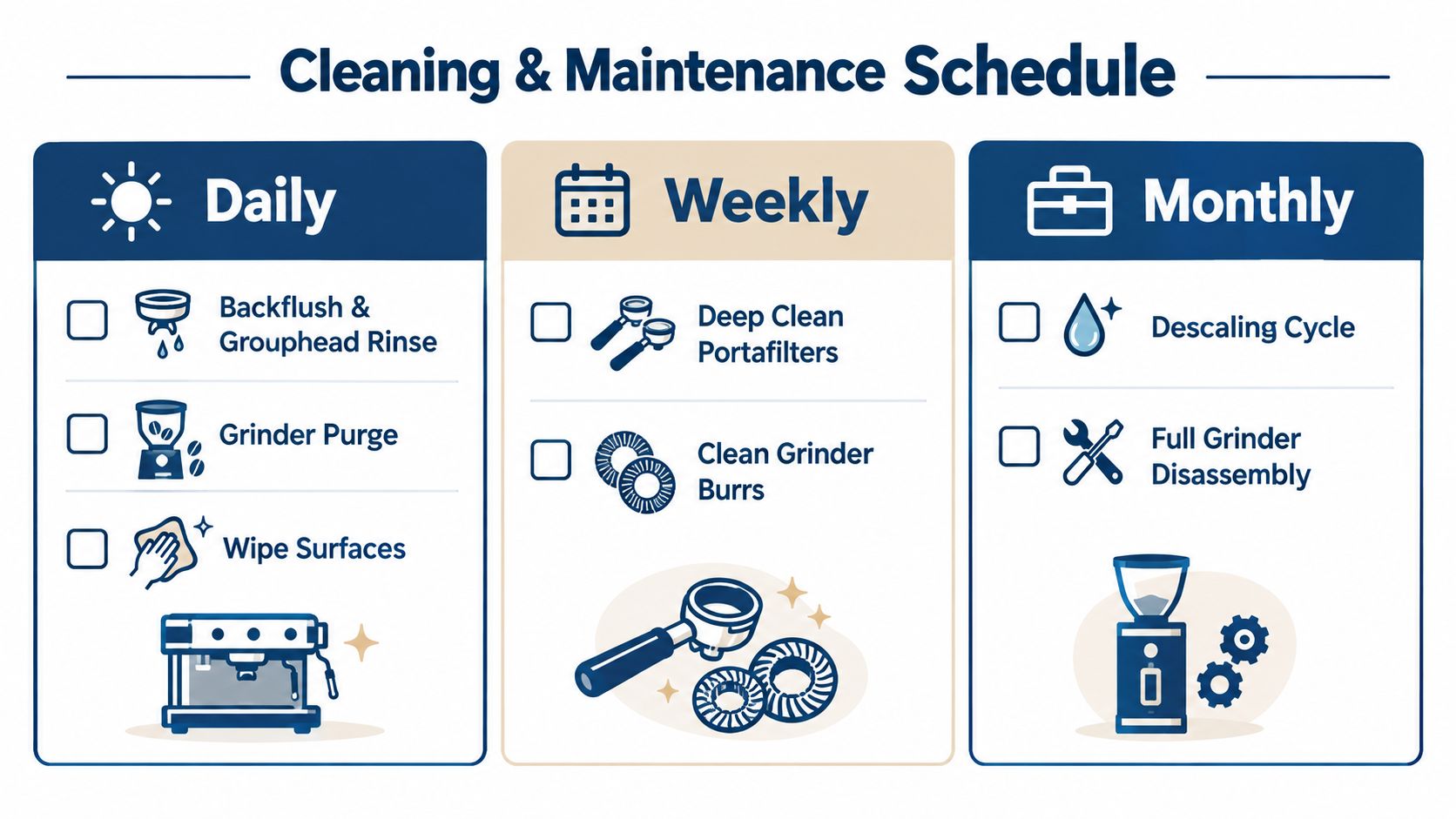
Daily care should cover the parts that contact coffee, milk and water. Staff should follow the manufacturer's cleaning products and procedures, particularly for backflushing, descaling, burr access and internal components.
Daily tasks
- Flush and rinse: Backflush and rinse group heads according to the machine instructions.
- Clean steam equipment: Purge steam wands after use and wipe them immediately.
- Purge the grinder: Remove retained coffee where the manufacturer's process allows.
- Wipe contact surfaces: Clean the hopper, dosing area, portafilters, baskets and bench.
- Protect milk handling: Keep milk refrigerated and prevent jugs, cloths and handles from becoming cross-contamination points.
Weekly tasks
- Inspect burrs: Look for changes in grind quality, unusual noise or uneven dosing.
- Clean portafilters: Soak and clean baskets and portafilters using approved products.
- Check group components: Inspect shower screens, seals and the areas staff can safely access.
- Review the recipe: Compare dose, grind setting and shot behaviour with the established coffee programme.
Periodic tasks
- Service the machine: Follow the manufacturer's preventative maintenance requirements.
- Replace wear parts: Plan for group seals, shower screens, burr sets and water filters when condition requires it.
- Check water treatment: Confirm that filtration remains appropriate for the local water profile.
- Record performance: Note changes in extraction, heating, steam behaviour, noise or dosing.
Water chemistry makes maintenance frequency site-specific. The AU/NZ manual thresholds discussed earlier show that steam and hot-water use can count more heavily toward descaling demand than coffee delivery alone. A venue should therefore avoid copying another operator's service calendar without checking its own water, volume and machine manual.
For broader hygiene context, the BacteriaFAQ.com coffee maker hygiene resource can help staff understand why warm, wet coffee equipment needs disciplined cleaning. Commercial operators still need to apply the exact procedures for their espresso machine, grinder, milk system and approved chemicals.
The questions hospitality operators ask about coffee machines can support the equipment review, but no article replaces the manufacturer's maintenance instructions or a site-specific service plan.
A Practical Buying and Ownership Checklist
The strongest purchasing brief starts with the operating conditions, not a preferred machine brand. The following questions should be answered before a supplier prepares a final recommendation.
Establish the commercial direction
- Own or use supplied equipment: Compare ownership, bean terms, contract restrictions and service responsibility.
- Map peak service: Record the busiest period, drink mix, barista count and queue pattern.
- Confirm the site: Check bench depth, drainage, electrical supply, water treatment and service clearance.
- Define the coffee programme: Decide whether the venue needs one coffee, decaf, separate profiles or a more hands-on specialty workflow.
Specify the production pair
- Choose group capacity: Match group count to simultaneous baristas and expected service pressure.
- Select the grinder first as seriously as the machine: Compare burr size and design, adjustment, dosing, retention, cleaning access and manufacturer-rated duty.
- Plan hopper use: Size the hopper around fresh bean rotation and actual service, rather than selecting the largest available option.
- Match steam to milk demand: Check recovery, wand configuration and the volume of milk drinks produced together.
- Confirm the power arrangement: Review the machine and grinder as a pair, including circuit capacity and rated voltage.
Protect the ownership decision
- Document support: Confirm warranty terms, service contacts, filtration requirements and the availability of wear parts.
- Train the team: Standardise recipes, grinder adjustments, milk handling, cleaning and escalation when performance changes.
- Keep a log: Record changes in grind setting, dose, extraction, cleaning and service work.
- Review the commercial result: Compare the owned setup with the roaster-supplied alternative after the first year, using the venue's actual bean use, service experience and workflow demands.
The New Zealand coffee machine market was valued at USD 27 million in 2025 and is forecast by the cited report to reach USD 42 million by 2032, implying a 5.9% CAGR over that period. The same report estimates about 532,700 machines sold in 2025, with household machines accounting for approximately 531,700 units, or 99.8% of volume, and about 1,020 commercial machines sold through specialist hospitality and roaster-led channels. That commercial volume makes specification discipline important for cafés, hotels, restaurants and institutional kitchens that need commercial equipment rather than consumer appliances. (New Zealand coffee machine market data)
A separate report places the wider New Zealand coffee equipment market at approximately NZD 60 million and forecasts a 2.96% CAGR from 2026 to 2031. It identifies espresso machines as the dominant revenue segment, gives single-dose grinders a growth score of 82/100, and states that the top five manufacturers control about 65% of market share. (New Zealand coffee equipment market report)
Those figures don't identify a best-selling package, and there isn't enough credible package-sales or performance-test data to nominate one. The better recommendation is more useful: specify the coffee machine and grinder as one production system, then verify that water, milk, baristas, power and workflow can support them.
Hospitality supplies commercial coffee equipment and related hospitality products for cafés, hotels, restaurants and institutional kitchens, with support for equipment selection, quotes, warranties and service requests. Operators planning a coffee machine and grinder setup can visit Simply Hospitality with their peak volume, site requirements and roaster agreement ready for a practical recommendation.