


Commercial Kitchen Equipment That Does Not Require a Hood
Some commercial kitchen equipment can operate without a conventional extraction hood. Commercial microwaves, induction cooktops, rice cookers, food processors and refrigerated preparation equipment all sit on that list, provided the cooking process produces limited grease, smoke, steam and combustion products and the installation meets New Zealand requirements. No appliance category is automatically exempt.
The most repeated advice on commercial kitchen equipment that does not require a hood is that electric appliances are fine and a ventless label settles the matter. Neither shortcut survives a close look at what the appliance releases during service. Ventilation obligations here attach to the contaminants a kitchen produces and to the building it sits in, so the same microwave that's straightforward on a back bench can sit in a room where mechanical extraction is required for entirely separate reasons.
The working question isn't whether an appliance appears with a hood in the catalogue photo. It's what leaves the cooking surface across a full service, and by what route it leaves the building.
Commercial Kitchen Equipment That May Run Without a Hood
The shortlist is real, but shorter than the marketing suggests. The deciding factor is the volume and type of effluent an appliance releases during a working day.
| Equipment type | Typical application | Ventilation considerations |
|---|---|---|
| Commercial microwaves | Reheating, regeneration and selected cooking | Heat and steam from food; follow manufacturer ventilation and clearance requirements |
| Induction cooktops | Simmering, boiling and sautéing in covered vessels | No combustion at the appliance, but grease, smoke and steam can still build up at high output |
| Rice cookers | Batch rice and grain cooking | Substantial steam at larger capacities; room moisture control needed |
| Food processors and mixers | Prep, mixing and puréeing | Few cooking emissions; electrical and bench-space requirements still apply |
| Refrigerated preparation equipment | Cold prep and holding | No cooking fumes; allow condenser airflow and clearances so the unit can reject heat |
| Selected rapid-cook ovens | Fast cooking, reheating and bake-style menus | Filtration, ventless configuration and approvals differ between models |
Every row carries a condition. A microwave regenerating sauce across 40 covers an hour is a different proposition from one running flat out on a fried-snack menu, and one rice cooker in a small café releases less moisture than three of them in a production kitchen. Heavy-duty microwaves such as the Menumaster DEC21E2 suit repeated single-portion regeneration, and that use pattern is what keeps the installation in low-emission territory.
No Conventional Hood Is Not the Same as No Ventilation
Three phrases get used as if they mean the same thing. They don't.
- No conventional hood: there's no canopy over the appliance, but a general exhaust or local arrangement may still be doing the work.
- No dedicated extraction system: there's no capture at source at all, which is unusual and usually means the room's general ventilation has been engineered to carry the load.
- No ventilation requirement: nothing in the building or food-safety framework asks for ventilation, which is almost never true for cooking equipment in a commercial kitchen.
Only the first is regularly achievable. Even then, it's the outcome of an assessment rather than a product feature.
The test that matters: name the appliance, then name what it releases across four hours of service. If nobody can answer the second half, the question is still open.
Robot Coupe and Fimar cover the preparation side of a hoodless layout with processors, mixers and slicing equipment that release no cooking effluent. SKOPE and Atosa cover refrigeration and prep refrigeration, where the workload is condenser airflow, clearances and room temperature instead of grease capture. On the cooking side, I'd treat any appliance that browns, fries or chars as an open question until someone prices the extraction.
The first practical step is a schedule: every appliance planned for the kitchen, with its ventilation need and its menu role written beside it, since the same microwave changes columns the moment it starts crisping instead of reheating. The Menumaster microwave range overview is a useful starting point for the reheating end of that list.
What Decides Whether Your Kitchen Needs Extraction
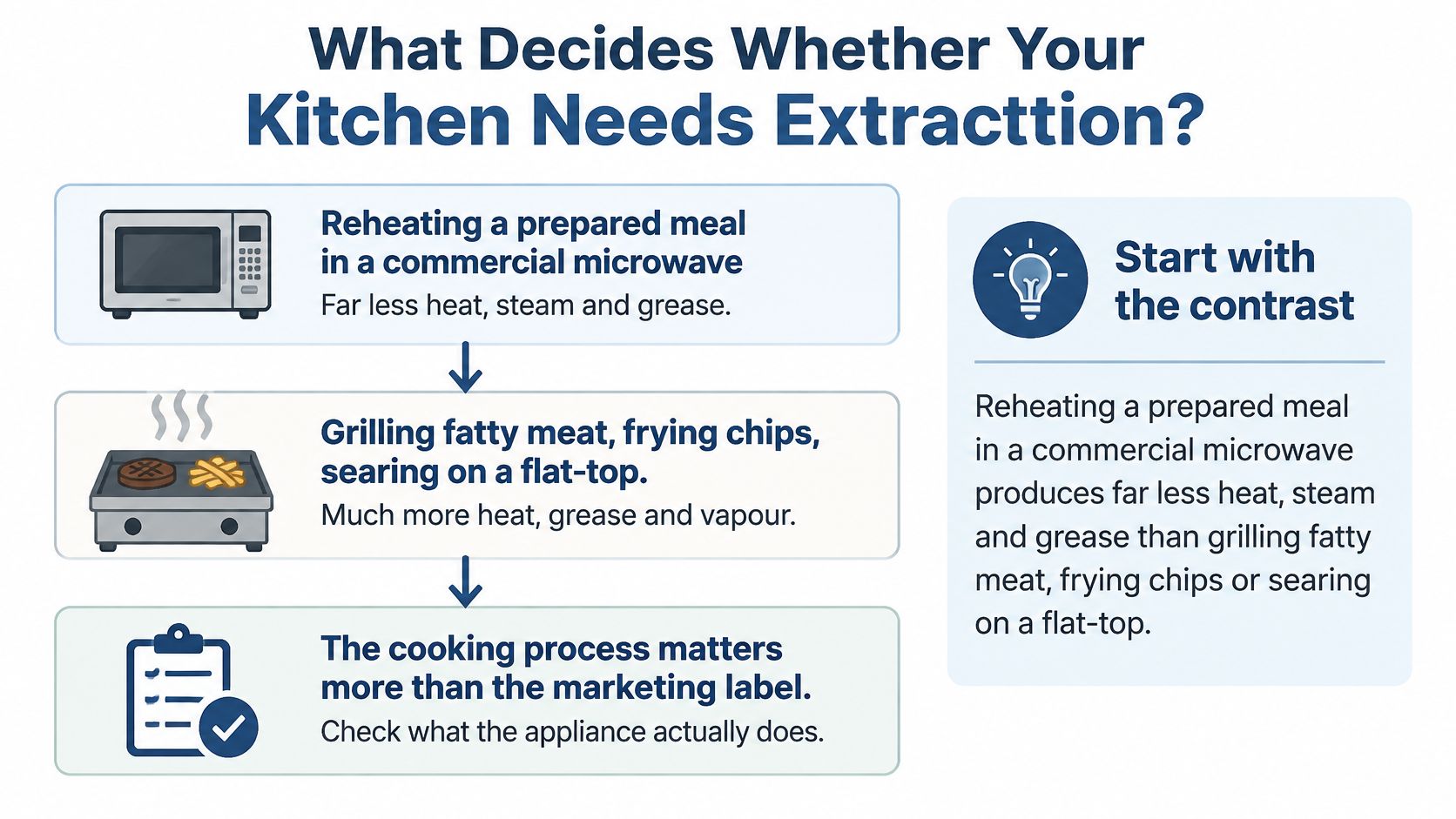
Reheating a prepared meal in a commercial microwave produces far less heat, steam and grease than grilling fatty meat, frying chips or searing on a flat-top. That gap, rather than the appliance category, is what a designer needs to hear from the operator.
The Factors That Decide the Answer
Work through each cooking station against the same checklist:
- Grease-laden vapour: the single strongest driver of dedicated extraction and fire-safety measures.
- Smoke: visible smoke from searing, charring or fat hitting a hot surface.
- Steam and moisture: rice cookers, boiling vessels, dishwashing and steam equipment load the room with humidity.
- Heat output: a hot line raises kitchen temperature and pushes general ventilation harder.
- Combustion products: any gas appliance adds a category of effluent that electric equipment doesn't produce.
- Duty cycle and capacity: a unit run for 40 minutes a day behaves nothing like the same unit run for six hours.
- Room size and existing airflow: a small tenancy with no mechanical ventilation has far less headroom than a large, well-serviced space.
- Fire safety and manufacturer instructions: both can impose requirements regardless of how much grease is produced.
New Zealand's Building Code doesn't treat hoodless equipment as exempt. The Ministry of Business, Innovation and Employment's G4 Ventilation Acceptable Solution regulates the contaminants an appliance produces, allows ventilation to be natural, mechanical or a combination, and directs commercial kitchen extract design to AS 1668.2 Section 5. It also requires mechanical extraction in kitchens in buildings with Type 5 fire-alarm systems, and additional ventilation for non-room-sealed gas appliances once combined gas input exceeds 1 kW per cubic metre of room volume.
General Ventilation Is Not Cooking Extraction
These are two different systems and they're routinely conflated. General room ventilation moves and dilutes air through the building. Dedicated cooking extraction captures effluent at the source before it spreads. A room can have excellent general airflow and still need extraction directly over a fryer.
Food premises guidance treats ventilation as a food-safety and workplace control as well, calling for it to reduce condensation, remove odour and support a comfortable working environment (South Wairarapa District Council food premises guidance). Capture equipment only delivers that while the filters and ductwork behind it stay clean, which is why maintaining restaurant exhaust system performance belongs in the operating budget, not the fit-out wish list.
Four questions belong in front of a designer: what does each appliance produce, at what rate, for how many hours a day, and by what route does it leave the building?
Ventless Cooking Equipment and What the Label Covers
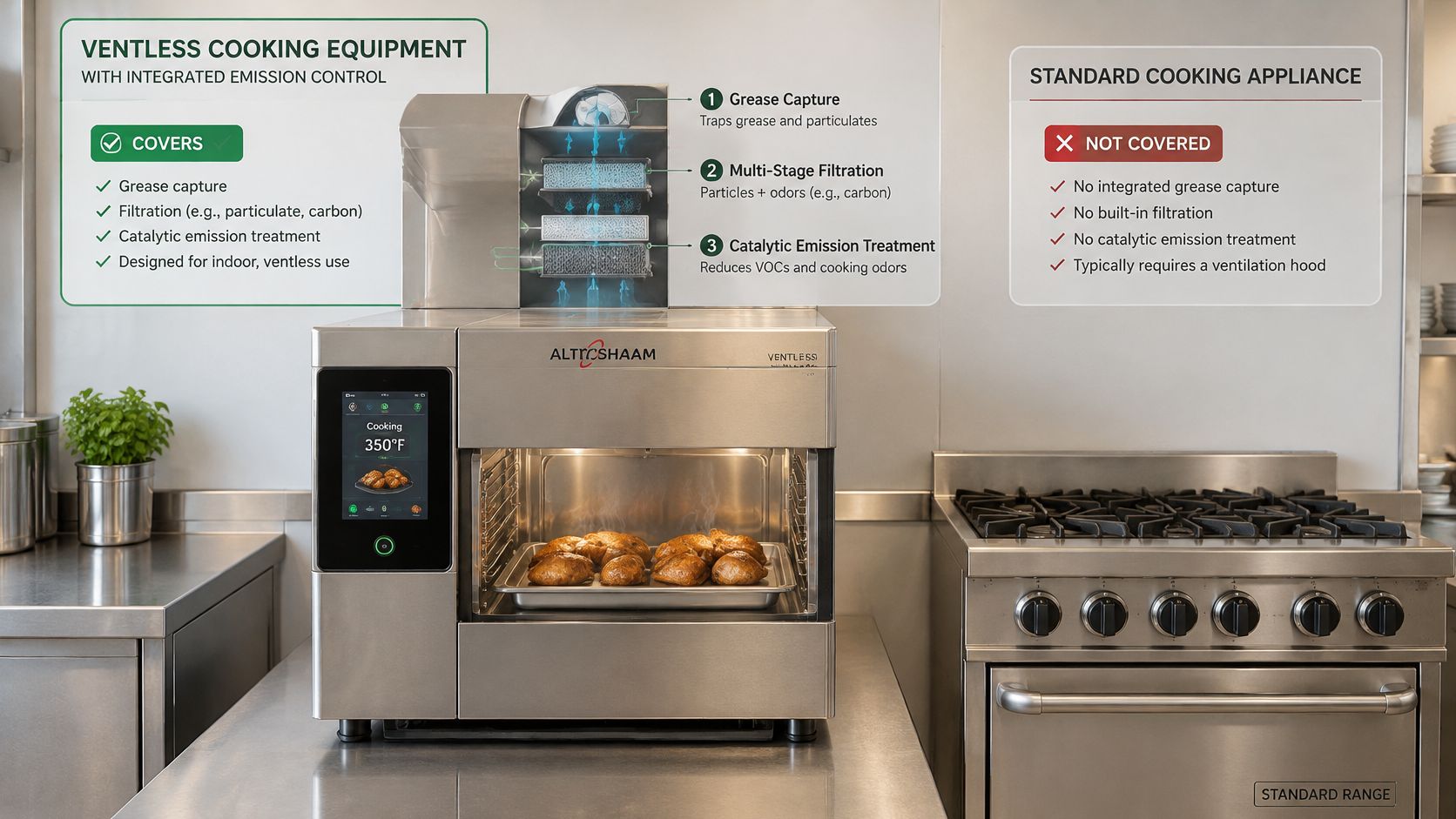
Purpose-designed ventless equipment differs from a standard appliance in construction, not just marketing. Typical features include integrated filtration, grease capture, catalytic or other emission-treatment stages, fully enclosed cooking chambers, and a manufacturer-specified ventilation arrangement stated in the installation manual.
What Filtration Does and Doesn't Remove
Filtration technologies vary widely between models and manufacturers, and none of them removes everything. Grease capture stages handle aerosolised fat. Carbon stages address odour and some smoke. Catalytic stages break down certain vapour-phase components. What filtration doesn't do is remove heat or moisture from the kitchen, so room airflow still matters even under a ventless hood.
Operating limits matter just as much. Every ventless unit has approved cooking applications, maximum loads, batch sizes and duty cycles in its manual. Push past them and the unit releases exactly what the label promised it wouldn't.
Maintenance is the other half of the deal. Filter inspection intervals, replacement filters, and chamber cleaning are recurring operating tasks with a real cost attached, and a missed filter degrades capture before anyone notices.
The Label Is Not a Compliance Certificate
A ventless designation doesn't establish New Zealand compliance on its own. Equipment still has to meet electrical-safety requirements where those apply, and New Zealand's electricity regulations reference IEC 60335-2-99 for commercial electric hoods and IEC 60335-2-64 for commercial electric kitchen machines, alongside standards for stationary cooking ranges, hobs, ovens, range hoods and other cooking-fume extractors (New Zealand electricity regulations). "No hood required" is not a substitute for checking certification, clearances and the appliance's intended commercial use.
Rapid-cook ovens are the category where this gets tested most often. Merrychef Connex models should be checked against the exact model's ventless capability, filtration requirements and installation instructions before anyone relies on the claim. A portable induction cooktop selection raises a similar question in a different form, since induction produces no combustion but still generates steam and, at high output, grease.
Before purchase, request the installation requirements, emissions data, clearance diagrams and electrical certification, and keep them with the equipment schedule.
Cooking Processes That Still Need Commercial Extraction
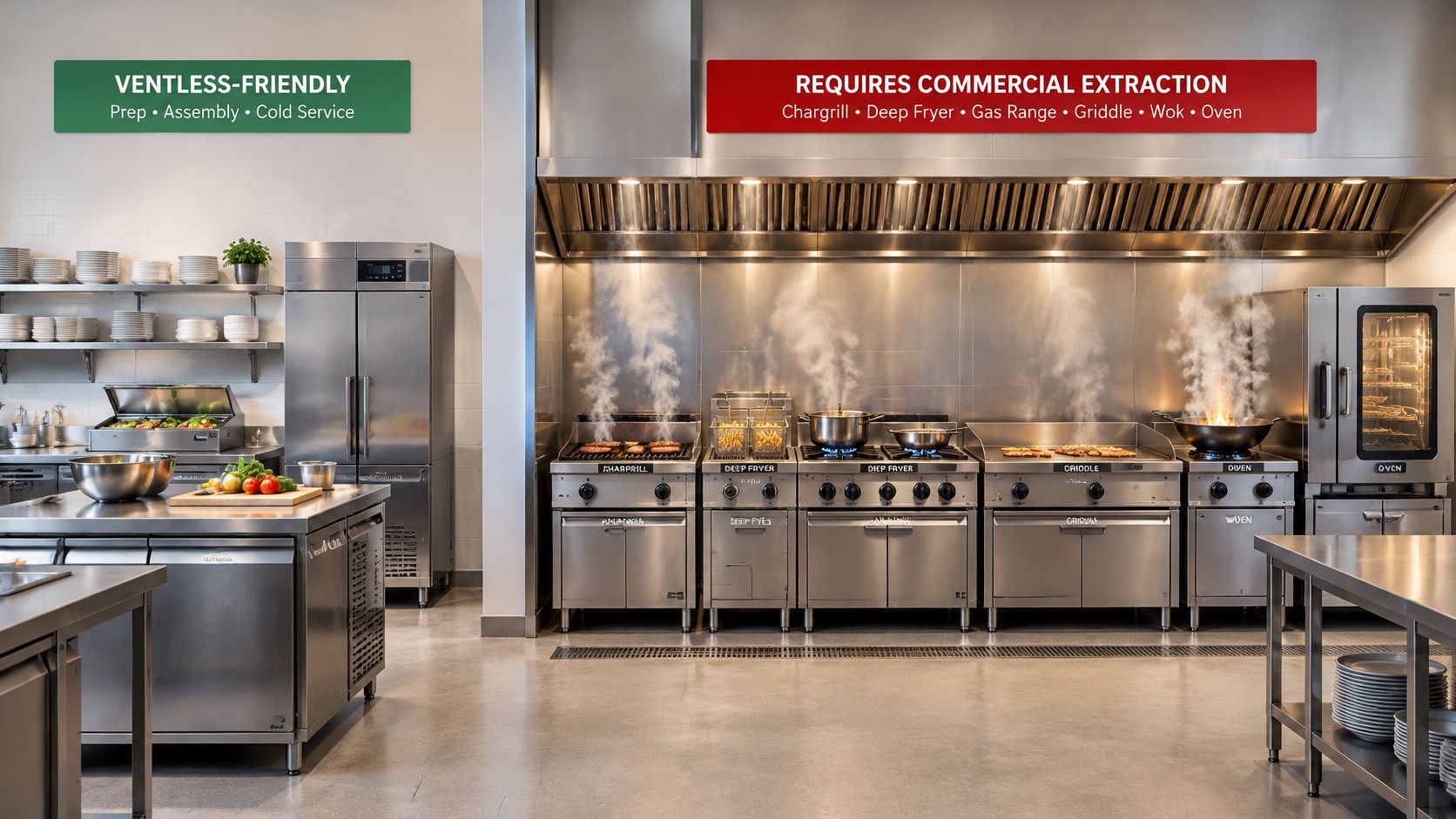
Some processes need dedicated extraction by their nature. Chargrills, deep fryers, gas cooking ranges, high-output griddles, wok stations, solid-fuel equipment and many commercial ovens generate grease aerosol, smoke, heat and, where gas or solid fuel is involved, combustion products. Those outputs drive both ventilation design and fire-safety provisions, regardless of what the appliance brochure calls the unit.
Electric Does Not Mean Low Emission
Swapping gas for electric removes combustion products, and that is all it removes. An electric deep fryer, a high-output electric griddle and a sustained searing station all produce grease and smoke without a flame anywhere in sight. An electric oven still releases heat and moisture into the room, which is why even a compact unit such as the Unox LINEMICRO 4-tray convection oven needs its installation requirements read rather than assumed.
Fuel source changes the emissions profile, so the building's ventilation assessment has to be redone for the new appliance.
Where Hoodless Use Holds Up
New Zealand's Building Code G4 provisions require contaminants including heat, moisture, fumes and odours to be removed, collected or diluted, with mechanical extract ventilation over cooking equipment where natural ventilation cannot manage the load, using methods aligned with AS 1668.2 (MBIE G4 Ventilation).
Within that framework, the most defensible low-emission processes are reheating, sous-vide regeneration, induction boiling with covered vessels and enclosed high-speed cooking. Open grilling, frying and charbroiling sit outside that group whatever fuel they run on.
A café that moves its bacon and toasted sandwich menu onto covered induction and an enclosed rapid-cook unit sits in a completely different position from one that keeps a flat-top griddle at full output through the lunch rush.
Solid-fuel equipment attracts a stricter review, and the considerations in what to check before buying a commercial woodfired pizza oven apply well beyond pizza.
Because approval depends on the appliance's actual emission profile, room volume, discharge arrangement and use pattern, written confirmation from the territorial authority, designer or building-control professional is the practical step before any order is placed.
Where Savings Are Real and Where They Are Not
Ventless and low-emission equipment usually costs more to buy and less to install. A canopy line costs less per appliance and considerably more to build, because the canopy, ducting, make-up air and fire suppression all arrive as construction work rather than a line on an equipment invoice.
The advantages are genuine in the right building: less dependence on extraction infrastructure, more flexibility in compact or leased premises, simpler equipment placement, and a viable operating model for smaller foodservice sites that could never justify a full ducted system.
The limitations are equally real: higher equipment purchase costs, restricted cooking methods, filter replacement and maintenance, heat and moisture still needing management, lower production capacity per square metre, and the cost of getting a compliance assessment done properly.
Where the Money Actually Moves
Take two cafés of similar size. Concept A runs a chargrill, a fryer and a gas range. Its spending concentrates in construction: a full canopy with ducting and make-up air, grease filters with scheduled duct cleaning, and the standard consent pathway. What it buys with that money is high batch output and unrestricted cooking methods.
Concept B is built around reheating, induction and cold prep. Its spending concentrates in the appliances themselves: higher purchase prices, filter inspection and replacement, and the emissions and consent evidence a lower-emission layout still needs to produce. Extraction may be reduced, subject to assessment, and peak throughput stays lower because appliance capacity sets the ceiling.
Neither concept can be priced in advance.
Installed cost in both cases comes down to a quotation against actual building conditions and an approved equipment configuration, which is why a claimed saving only becomes real once the site is known. Concept B costs less to open when the menu fits the equipment. A cheaper fit-out that forces the kitchen to drop dishes, or to add extraction later, costs more across the first year of trading than the original canopy would have. Which side of that line a kitchen lands on comes down to the cooking process more than the appliance category.
Any saving depends on actual quotations, building conditions and approved equipment configurations. Nobody can quote a figure before the site and the menu are known.
The honest position is that low-emission equipment trades installation complexity for operating discipline and menu restraint. A café that accepts a reduced menu keeps the saving through its first year, because its recurring ventilation costs are filter checks and replacement rather than duct cleaning and suppression servicing. An operator who buys the same equipment and then keeps adding high-emission dishes pays twice: once for the appliances, then again for the extraction the menu eventually demands.
Planning Questions for a Hoodless Kitchen
The logic runs menu first, equipment second. A hoodless kitchen should be designed around a menu the available equipment can reliably deliver, rather than buying appliances and then forcing every cooking process to fit around them. That single sequencing decision prevents most of the expensive surprises.
| Planning question | Why it matters | What to verify |
|---|---|---|
| Which cooking methods does the menu need at peak? | Method drives emissions and extraction need | Written list of methods per dish and station |
| How many covers and batches per peak hour? | Capacity decides whether low-emission equipment keeps pace | Peak output from manufacturer data and trial runs |
| Which appliances can run those methods? | Shortlists only equipment the menu actually uses | Manufacturer ventilation specification and approved applications |
| What ventilation and electrical capacity does the building have? | Room airflow, circuits and clearances limit installation | Assessment by a qualified building or ventilation professional |
| Who approves the layout, and when? | Approval timing affects equipment ordering | Written confirmation from council or building-control |
| How will cleaning and filters be maintained? | Filters and cleaning are ongoing operating tasks | Service schedule and filter replacement intervals |
| Will the menu change later? | New dishes can add emissions after approval | Reassessment before any menu change |
The Question That Comes First
Peak hour is where hoodless designs fail. A menu that works at 30 covers may not work at 90, because the appliances that keep emissions low are often the ones with tighter batch limits. Getting a realistic throughput number from manufacturer data before committing is more valuable than any specification comparison.
Electrical capacity deserves early attention too, since induction and rapid-cook equipment draw heavily and three-phase supply isn't universal in smaller tenancies. The three-phase and single-phase power capacity guide from On Time Home Services is a reasonable primer before a site assessment.
Where ventilation limits shape the whole layout, engaging design support early is cheaper than redesigning later. Hospitality's kitchen design only service exists for exactly that stage of a project.
NZ Compliance Steps Before You Assume No Hood
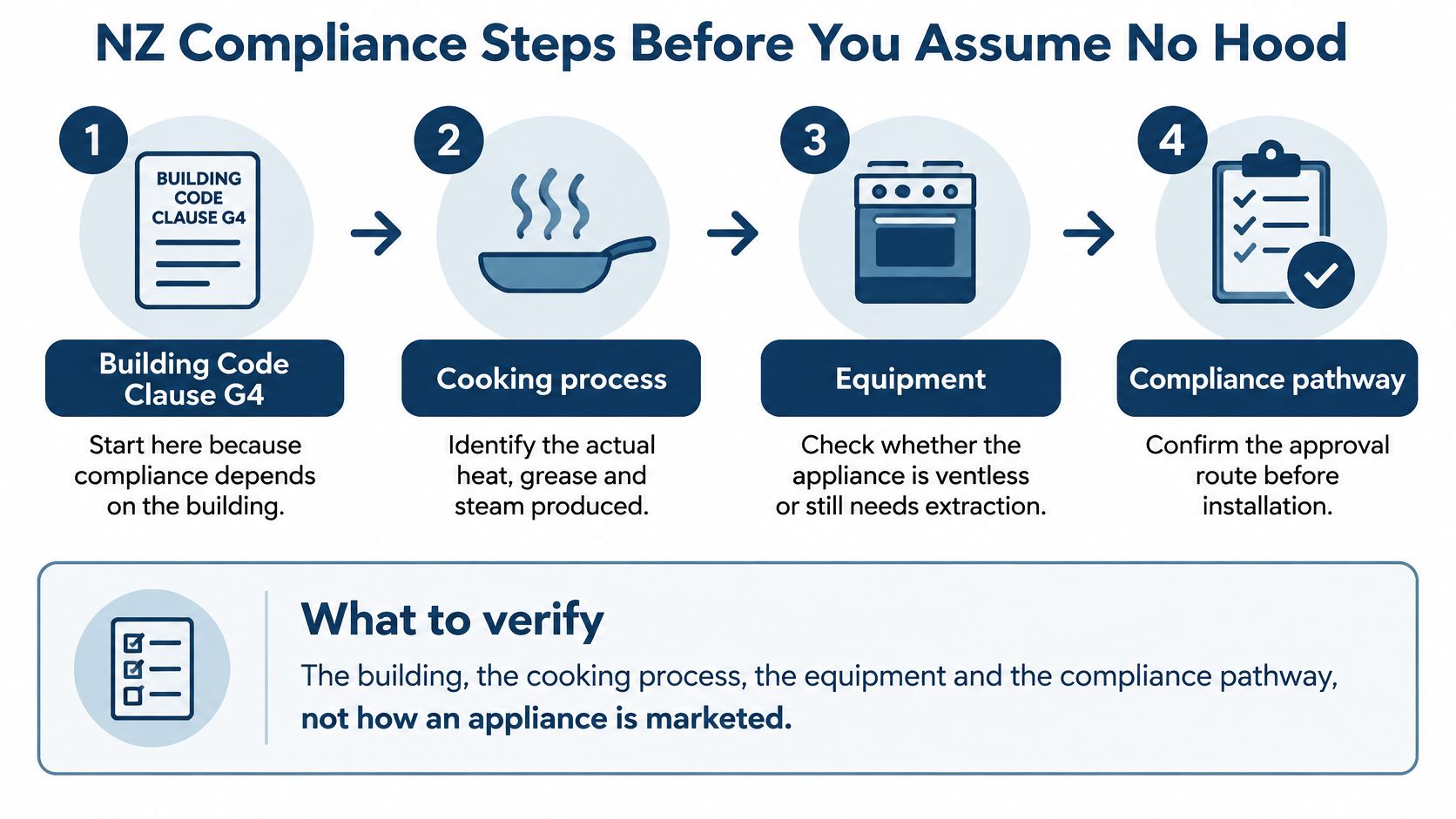
Building Regulations requirement G3.2.1 applies, where appropriate, to commercial and industrial buildings used for the manufacture, preparation, packaging or storage of food, which puts cafés, restaurants, catering kitchens, school food-service areas and aged-care kitchens squarely inside it (New Zealand Building Regulations). An appliance salesperson's statement that a unit is hoodless doesn't discharge that obligation.
Within that scope, Building Code Clause G4 sets the baseline: heat, moisture, fumes and odours must be removed, collected or diluted. The G4 Acceptable Solution then points commercial kitchen extract design toward the relevant standard rather than leaving it to judgement. The cooking process does most of the deciding here, since a steamer holding vegetables and a fryer under continuous load put very different demands on the same clause.
The Sequence to Follow
- Document the menu and cooking methods, station by station, including expected volumes.
- Collect manufacturer emissions and ventilation data for every shortlisted appliance.
- Engage a kitchen designer or ventilation specialist to assess the room and the discharge route.
- Confirm landlord consent and property rules early, since a refused roof penetration changes the available discharge options.
- Check the food-safety requirements running alongside the building work, starting with the NZ food safety regulations overview.
- Complete the fire-safety review, including any suppression requirements.
- Only then commit to the equipment.
WorkSafe NZ duties and the council's environmental-health requirements sit alongside the building work, and none of them appear in an appliance specification. That gap is where most hoodless assumptions break down. A unit may carry a ventless label while the room, the process and the tenancy still carry full obligations, so the paperwork trail matters as much as the equipment file.
No appliance is legally exempt nationwide. A ventless label is a product claim; the compliance outcome belongs to the building, the cooking process and the steps above.
Confirm Your Ventilation Pathway Before You Buy
Keep the roles separate, because blurring them is how projects go wrong. Qualified kitchen designers, ventilation specialists and building professionals own the design and the compliance assessment. They're the people who sign off the pathway.
Hospitality supplies commercial kitchen equipment and helps match appliances to a menu and to the documented specifications a designer hands over. The business stocks brands including Blue Seal, Convotherm, Unox, Turbofan, Robot Coupe, Vitamix (Commercial), SKOPE and Winterhalter, which covers most of what a low-emission kitchen needs across cooking, preparation and refrigeration. SACH Design can support hospitality kitchen layout, equipment specification and coordination of building services where ventilation limits shape the design.
If Merrychef Connex rapid-cook ovens are on the shortlist, check the exact model against its own installation instructions before relying on any ventless claim. Two models in the same family can carry different requirements.
For related reading, Hospitality's articles on designing a kitchen around service requirements and on whether bigger catering equipment is always better both help test whether a proposed line suits the workflow it has to serve.
Choosing equipment for a kitchen with limited ventilation is a sequence, not a purchase. Hospitality supplies the commercial microwaves, induction equipment, food preparation and refrigeration gear that make a low-emission kitchen workable, and can help match appliances to the menu and specifications you've had assessed. If you're planning a fit-out and need to know which equipment will support the ventilation pathway you've been given, Simply Hospitality is the place to start the conversation.