


Commercial Refrigeration Monitoring Systems for NZ Venues
A Saturday service can unravel before the first ticket prints. A prep fridge may still be humming, yet herbs wilt, meat warms and water collects beneath a shelf because nobody noticed the cabinet drifting out of range overnight or between kitchen checks. Commercial refrigeration monitoring systems give hospitality operators earlier visibility, alerts and a practical chance to act before a refrigeration fault becomes a food-safety and service problem.
The most useful way to assess connected refrigeration is simple: visibility leads to alerts, and alerts only matter when they lead to action. SKOPE-connect is the primary connected solution to consider for compatible SKOPE refrigeration, but the platform isn't a substitute for sound equipment selection, maintenance, calibrated monitoring or a documented response process.
The Moment a Fridge Lets You Down
At the start of a busy Saturday evening, a chef opens a prep fridge and finds wilted herbs, warm lamb and a puddle under the shelf. The cabinet is still making noise, so the problem doesn't look like a dramatic breakdown. Six hours earlier, the condenser fan had begun labouring. The cabinet continued cooling, just not well enough, and nobody was watching it closely enough to notice.
By the time the issue is discovered, the kitchen has several decisions to make. Stock must be assessed, potentially affected food separated, replacement ingredients found and a technician contacted. A function may need a refund or revised menu, while the business scrambles to keep service moving. The problem wasn't necessarily a sudden compressor failure. It was late discovery.
A traditional cabinet generally tells staff something is wrong only when they happen to look at it. The warning signs might be an abnormal temperature display, food that feels warm or equipment that has stopped visibly operating. At that point, the useful response window may already have narrowed.
Commercial fridge servicing advice remains important because monitoring can't repair a failing condenser, blocked airflow or damaged door seal. It can, however, change when the business learns that something requires attention.
Practical rule: The strongest reason to connect a fridge isn't knowing its temperature while a chef is standing in front of it. It's knowing something may be wrong when nobody is standing there.
With connected monitoring, an alert might arrive while the kitchen is preparing for service. A responsible person checks the cabinet and the surrounding equipment, assesses the stock, moves product if necessary and contacts a technician when the fault warrants it. That response doesn't guarantee that food will be saved, but it gives the team earlier information and a defined opportunity to act.
The value is especially clear during quiet periods, overnight operation and unattended gaps. A refrigeration cabinet doesn't need to stop completely to create trouble. A gradual temperature drift can be enough to affect stock and trigger a food-safety response before anyone notices a visible failure.
What a Commercial Refrigeration Monitoring System Does
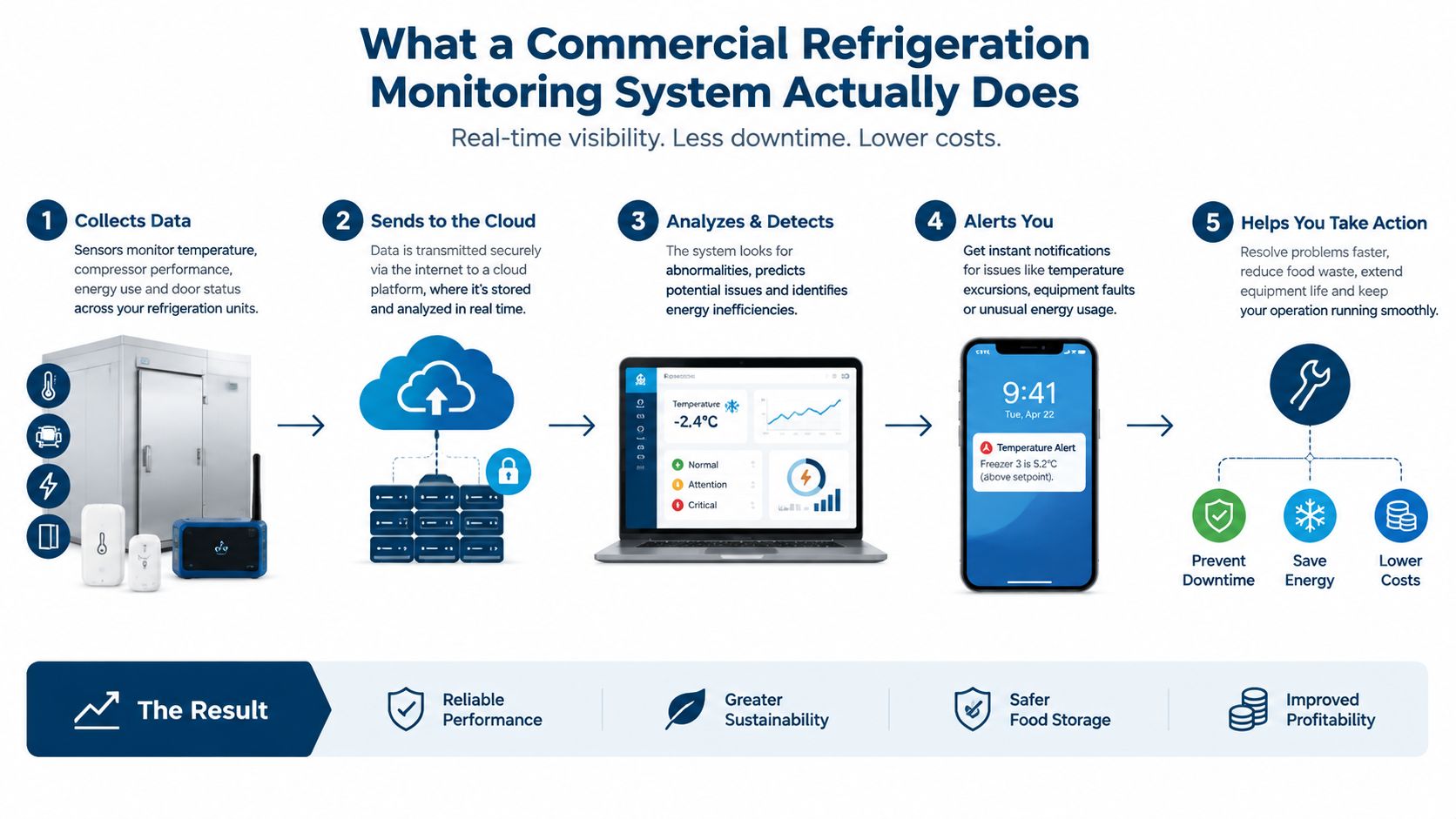
A commercial refrigeration monitoring system combines a sensor, controller and connection to an app or dashboard. The sensor measures conditions inside the cabinet, the controller processes the reading, and the network sends relevant information to authorised users. Capabilities vary by equipment and platform, so confirm what the selected SKOPE model supports rather than assuming every connected cabinet provides the same data.
The basic operating sequence has three parts:
- Visibility: Staff can review cabinet performance without standing in front of the unit.
- Alerts: A configured condition can trigger an alert through the platform's available channels.
- Action: A named person checks the equipment, investigates the situation and follows the venue's food-safety and maintenance process.
The sensor does not make a cabinet colder. It shortens the time a fault can remain unnoticed. That distinction matters when comparing a single-cabinet logger with a platform that groups several cabinets, locations or users in one view.
Sensor placement and equipment fit
Placement affects the usefulness of the reading. A probe positioned near a frequently opened door may show short temperature swings, while one placed near a warm air path or evaporator may not represent the stock area. Set the sensor where it reflects the condition the team needs to manage, then confirm readings against a calibrated probe during commissioning and at the venue's scheduled verification interval.
A small venue may only need monitoring for a milk cooler or one underbench fridge. Operators comparing equipment can also review a milk cooler from Premier Broadband as an example of a compact refrigeration application where access and operating routine matter.
For a larger kitchen, the monitoring system needs to fit the way the team works. The SKOPE ProSpec 3 Door Underbench Fridge - PG11.UBR.3.SD.RH has a three-door solid swing-door configuration, stainless steel 304 AISI cabinet construction, an operating range of 1°C to 4°C, adjustable operation from -2°C to +15°C, and an SCS Connect controller with Bluetooth wireless technology. It also includes adjustable shelving, interior lighting and R290 refrigerant. Those specifications describe the cabinet and controller, not an automatic promise of regulatory compliance.
What a system can't replace
A monitoring platform does not replace a calibrated probe, sensible sensor placement, routine cleaning, planned maintenance or staff checks. It cannot decide whether food should be discarded, whether a door was deliberately left open or whether a technician needs to attend.
The useful purchase is a system that fits the venue's equipment, connection method, alert ownership and operating procedures. The installation only pays off when someone is responsible for the alert and knows the next check to complete.
Why NZ Hospitality Operators Are Adding Connected Monitoring
The operational case for connected monitoring has three parts. It protects visibility around stock, supports usable food-safety records and gives maintenance teams more information about equipment behaviour. None of those benefits appears automatically when a device is installed.
New Zealand's MPI Code of Practice for Cold and Dry Stores requires equipment for accurate monitoring of temperatures and other refrigeration parameters to be provided and operating whenever refrigeration facilities are in use. It also requires sensors to be maintained so they accurately monitor conditions across the room, with enough sensors to cover different parts of the storage space. For chiller and cold-store environments, the code specifies calibrated automatic temperature recording equipment, making continuous monitoring a compliance consideration rather than an optional convenience. MPI's Code of Practice also reflects the need for usable records that support verification and audit.
Food businesses still need to manage the actual food limits. Cold food should be kept at 5°C or below, hot food at 60°C or above, and potentially hazardous food held between 5°C and 60°C must be monitored and recorded. The permitted response depends on the time spent in that range, including refrigeration or use when under 2 hours, immediate use between 2 and 4 hours, and discarding after more than 4 hours. These requirements are set out in Food Standards New Zealand's food safety appendix.
Energy and asset performance deserve equal attention. NZ refrigeration audit guidance says compressor efficiency should be assessed with kW and kVA load recorded on an energy meter when the compressor is fully loaded, which shows why temperature alone doesn't provide a complete picture. The refrigeration systems audit standard is useful context for operators considering electrical performance alongside cabinet temperature.
| Benefit | What monitoring delivers | What it cannot do |
|---|---|---|
| Stock protection | Earlier visibility when a cabinet may be drifting or faulting | It can't guarantee that stock will remain safe or be saved |
| Food-safety records | A digital information trail that can support the operator's own process | It doesn't automatically satisfy every regulatory requirement |
| Energy and maintenance awareness | Information that can help identify unusual operation for investigation | It won't reduce energy use without corrective action |
The practical test is whether someone uses the data. A passive log that nobody reviews won't improve a kitchen's response. Operators considering cold-chain management should treat monitoring as part of the operating system, not as a replacement for it.
SKOPE-connect and the Wider SKOPE Connectivity Line-Up
SKOPE is a major New Zealand commercial refrigeration brand, and SKOPE-connect is the connected platform to examine when a venue is choosing compatible SKOPE equipment. The important buying question isn't whether a cabinet carries a connectivity label. It's whether the specific model, controller and platform provide the information the venue can use.
Depending on the relevant SKOPE equipment and current platform functionality, connected refrigeration may provide access to cabinet information, alerts and recorded operating details through the available interface. Operators should confirm the supported capabilities for the exact model before relying on particular functions such as temperature history, door events, energy information, SMS alerts or email notifications.
Match monitoring depth to the cabinet mix
A single underbench unit needs a different approach from a group of upright fridges across several venues. A restaurant may want visibility around a prep fridge after closing. A multi-site operator may need a central view, defined users and a clear escalation process. A display cabinet facing customers may also require a different maintenance and access routine from a solid-door storage fridge.
Relevant SKOPE options can be reviewed across SKOPE Upright Fridges, SKOPE Underbench Fridges, SKOPE Bar Fridges, SKOPE Display Fridges and SKOPE Preparation Fridges. The cabinet's role, physical location and service access should be decided before the monitoring feature is assessed.
| Product | Monitoring depth | Alert channels | Best fit |
|---|---|---|---|
| Compatible SKOPE-connect equipment | Confirmed according to model and platform | Confirm supported channels for the selected setup | Sites needing connected visibility across compatible cabinets |
| Smaller connected SKOPE units | Confirm the model's available controller and connectivity | Confirm before purchase | Underbench or compact applications where space and access are limited |
| SKOPE ProSpec equipment | Confirm the specific controller and connected functions | Confirm by model | Professional kitchens where refrigeration forms part of the working layout |
| Basic independent logger | Usually focused on a single measured condition | Depends on the logger | A limited monitoring requirement with no broader platform need |
Operators wanting wider context on measurement systems can review how thermal submetering works. That information is relevant when a venue is considering equipment performance, but thermal submetering shouldn't be confused with cabinet temperature monitoring.
The SKOPE ProSpec range also illustrates why product selection and connectivity should be considered together. A cabinet that suits the kitchen's workflow is easier to monitor, maintain and include in a response plan.
Building an Alert Response Workflow That Actually Works
A connected cabinet that sends an alert to nobody is an expensive thermometer. The venue needs to decide who receives the notification, who checks the equipment and what happens to food that may have been exposed to an unsafe condition.
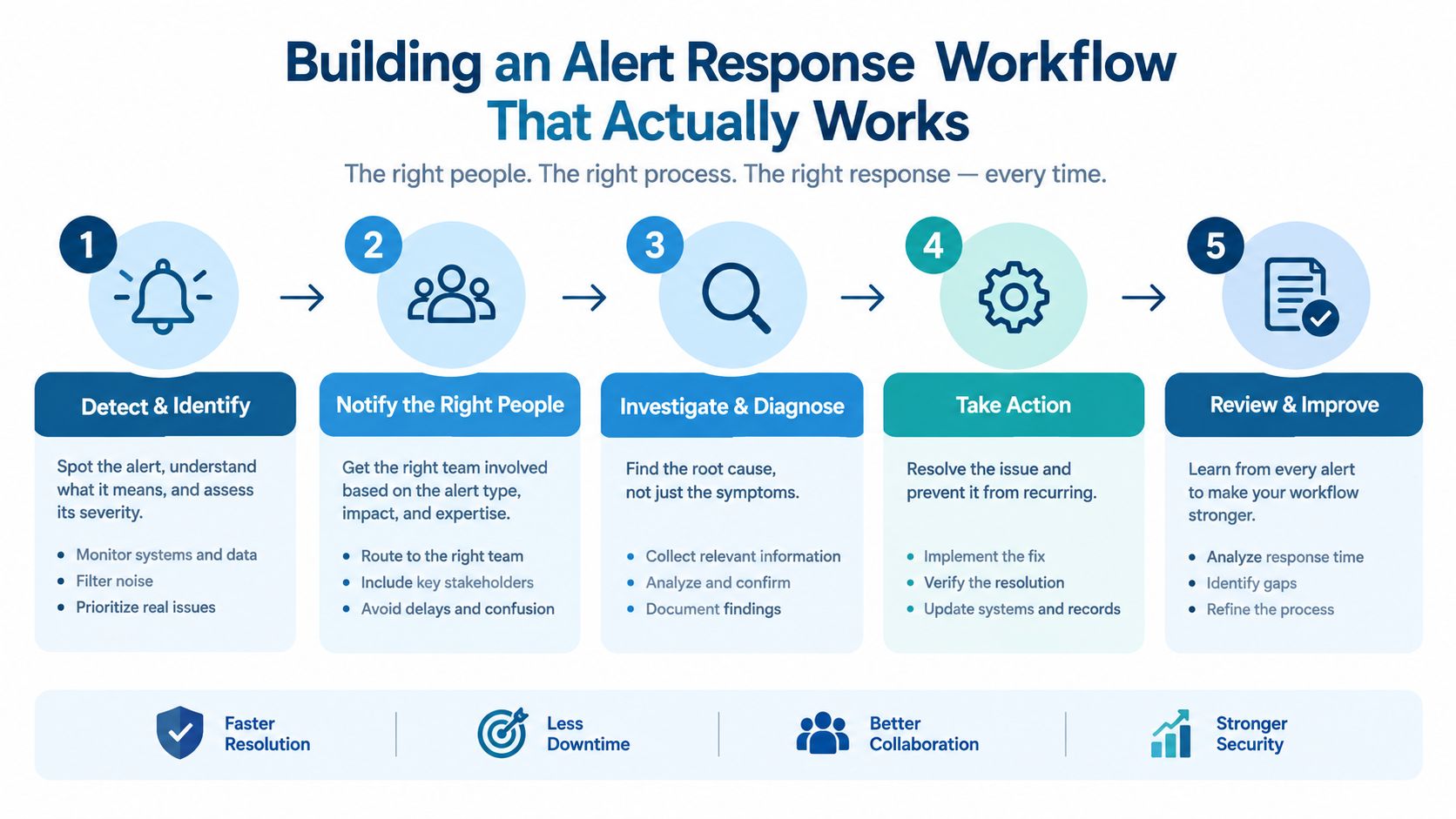
A workable process can be written in plain language:
- The cabinet identifies a condition requiring attention. The platform raises an alert according to the configured equipment and settings.
- A named person receives the alert. This may be the head chef, owner-operator, duty manager or regional contact.
- The recipient confirms the situation. The person checks the cabinet, display, doors, stock and surrounding equipment.
- The issue is recorded. A fault note should include the cabinet, time, observed condition and any useful photo or maintenance detail.
- The food-safety process is followed. Food is assessed against the business's documented procedure, including the applicable temperature and time requirements.
- The equipment response is escalated. A technician is contacted when the issue can't be resolved safely by the venue team, and the shift record is updated after the event.
Assign ownership before the first alert
A single-site venue may route an alert to the owner or head chef. A multi-site group may use a regional duty manager, with a second contact for missed notifications. The correct arrangement depends on staffing, opening hours and the seriousness of the stock held.
The response should be written into induction material and tested during normal operations. Staff need to know that an alert isn't automatically a reason to discard everything, and it isn't something to ignore because the cabinet still appears to be running.
A useful alert is one that reaches the right person, prompts a physical check and creates a documented decision.
Notification settings also need review. Too many irrelevant alerts can train staff to ignore messages, while overly narrow settings can delay discovery. The team should check that contact details remain current, after-hours responsibility is covered and a network or power interruption has a manual fallback.
Monitoring, Food-Safety Records and the Compliance Question
Digital monitoring can support a food business's record-keeping process, but monitoring isn't the same as compliance. MPI requirements place emphasis on accurate monitoring equipment, sensor coverage, calibration and records that can be used to verify documented procedures. Sector-specific rules also show the importance of routine and automatic recording in cold-chain operations, including daily monitoring for certain red-meat activities and continuous recorded monitoring for refrigerated shipping containers holding food derived from animals. MPI's storage and transport standard provides that wider context.
A venue still needs to understand the food-safety requirements that apply to its operation. It needs suitable probes, sensible sensor placement, a responsible person for the food control process, corrective actions for excursions and a fallback method when power, network access or the platform isn't available.
SKOPE-connect may help an operator see information without relying entirely on someone physically checking the cabinet at that moment. Recorded information can also help the team understand performance over time, where that functionality is available for the selected equipment and platform. It shouldn't be described as an automatic guarantee of compliance or an assurance of a particular audit result.
Operators can use New Zealand food-safety regulations as part of their planning, then confirm the requirements that apply to their own food control plan and verification arrangements. The practical objective is a record that supports a real process, not a digital file that nobody reviews.
Where Remote Refrigeration Visibility Pays Off Most
Remote visibility has the greatest practical value where late discovery creates the greatest operational risk. The cabinet may be perfectly accessible during prep, but nobody may be nearby when a fault begins.
Restaurants often benefit after closing. A manager can investigate a notification before the next preparation period rather than discovering the problem when staff open the cabinet for service. Hotels may have refrigeration spread across kitchens, bars, buffet areas or guest facilities, making central visibility useful where staff aren't checking every unit at the same time.
Bars and beverage-led venues have another reason to consider connected monitoring. A refrigeration issue can affect organised stock, service planning and product quality, particularly when the venue operates with a small after-hours team. Display and preparation units also deserve consideration because a fault may affect both stored ingredients and the service workflow.
Caterers face a more distributed operation. Food may move between kitchens, event spaces and temporary service locations, so responsibility for checking equipment and responding to a warning needs to be clear at each handover. Monitoring won't solve transport or handling problems by itself, but it can give the responsible team more information to investigate.
Situations where earlier notice matters
- Multi-site groups: A central operations team can use an agreed dashboard and escalation process instead of relying solely on separate paper checks at each venue.
- High-value stock: Businesses holding premium meats, aged cheeses, specialty gelato or other sensitive stock may place greater value on early warning.
- Overnight operations: Venues with skeleton staffing can route alerts to a manager rather than waiting for the next full shift.
- Unattended sites: A venue that closes completely still needs a clear contact and a plan for physical inspection.
- Hotels and accommodation: Distributed refrigeration requires careful decisions about who owns the response when equipment sits away from the main kitchen.
The principle is consistent across each setting. A venue that is most exposed to the gap between a refrigeration fault and its discovery is usually the venue with the strongest reason to consider remote alerts.
Getting the Right Setup for Your Venue
Selection starts with three practical questions. What needs monitoring, a single prep fridge, a complete kitchen suite or equipment across several sites? Who receives an alert, and can that person physically check the cabinet or arrange a response? Which compatible SKOPE cabinet type fits the workflow, whether that means an upright fridge, underbench fridge, bar fridge, display fridge or preparation fridge?
The answers should shape the system. A small café may need a focused setup with one responsible contact, while a hotel or multi-site group may need a broader platform and a documented escalation structure. The technology should reduce uncertainty, not add another screen that staff are expected to watch without a clear purpose.
Operators can also review advice on choosing refrigeration based on business stage before committing to a cabinet and monitoring arrangement. Simply Hospitality supplies commercial refrigeration and can help hospitality businesses compare SKOPE cabinet types, connectivity considerations, alert ownership and service requirements. The right setup is the one that turns visibility into a response the team can carry out.
Hospitality can help assess the refrigeration mix, workflow and monitoring requirements for a New Zealand venue, including compatible SKOPE options and practical alert ownership. Visit Simply Hospitality to discuss the right commercial refrigeration monitoring setup for the business.