

Digital Cooking Thermometer NZ
A cook checks a steak with a cheap infrared thermometer, sees a reassuring surface reading, and sends it to the pass. The centre is still undercooked, the customer sends it back, and the kitchen loses time fixing a problem that began with the wrong instrument. That's the practical issue behind choosing a digital cooking thermometer in New Zealand. The best model isn't the one with the biggest temperature range or the most features. It's the one that measures the right thing, in the right place, quickly and accurately enough for the job.
For home cooks, that may mean checking a roast, barbecue, frying oil or confectionery. For restaurants, cafés, caterers, schools, hospitals and aged-care kitchens, the thermometer may support cooking, reheating, hot holding, cooling and refrigeration checks. The choice should start with the food, the frequency of testing and the speed required during service.
Why the Right Thermometer Starts With the Task
A thermometer matched to a product catalogue can look impressive and still fail on the line. A thermometer matched to the workflow becomes a useful food-safety control.
Before buying, the operator should answer three questions:
- What food or process needs checking? Meat, poultry, sauces, reheated meals, refrigeration and cooking surfaces all present different measurement problems.
- How often will staff use it? Occasional home use has different demands from repeated checks during a busy service.
- How quickly must the result settle? A slow reading can interrupt a commercial workflow, while a fast, stable reading is easier for staff to use consistently.
An instant-read probe measures the internal temperature of food. A leave-in probe remains in food while it cooks, where the product is designed for that use. An infrared unit measures a surface without contact, and an oven thermometer measures the surrounding cooking environment rather than the food itself. These categories aren't interchangeable.
A restaurant manager comparing commercial kitchen equipment planning should treat a thermometer as part of the working layout. The right location may be beside the pass for cooked proteins, near the cool room for receiving checks, or at a preparation station handling reheated meals. A single unit shared across every station can become inconvenient, especially when staff need to clean it between raw and ready-to-eat foods.
Practical rule: Choose the thermometer around the measurement task, not its maximum advertised temperature.
The biggest mistake is confusing surface temperature with internal temperature. An infrared thermometer can help assess a griddle, equipment surface or the outside of a refrigerated product, but it can't confirm the centre of a steak, stuffed food or roast. For food-safety decisions that depend on internal temperature, a suitable probe is the primary instrument.
Probe, Infrared, Leave-In and Oven Thermometers Explained
Instant-read probe thermometers
An instant-read probe thermometer is the workhorse for most hospitality kitchens. Staff insert the penetration probe into the relevant part of the food, wait for the display to stabilise, then remove it, clean and sanitise it before the next product.
A thin tip suits smaller foods and reduces the size of the puncture. A folding probe can be convenient for storage, while a fixed probe may suit operators who prefer a straightforward, durable design. Backlighting, a hold function and a display that can be read from a practical angle matter more during service than decorative extras.
The main strength is flexibility. One probe can check poultry, minced meat, thick roasts, sauces, reheated portions and chilled foods, provided the probe's construction and stated range suit the task.
Infrared thermometers
An infrared thermometer reads emitted energy from a surface. It can be useful for cooking surfaces, equipment, refrigerated-product surfaces and receiving checks as an initial indication.
Its limitation is absolute. It doesn't see the internal centre of food. A surface may be hot while the middle remains cool, or a chilled outer surface may conceal a different temperature inside a dense product. Surface finish, distance and the manufacturer's specifications can also affect the result.
Infrared is a useful supporting tool, not a replacement for a penetration probe.
Leave-in and wireless probes
A leave-in thermometer is designed to remain in food during cooking. Models may use a cable, base unit or wireless connection, depending on the product. They suit long roasts, barbecue cooking and situations where opening an oven or grill repeatedly would disrupt the process.
Operators should confirm that the probe and cable are suitable for the intended oven, grill or cooking environment. A probe designed for internal food temperature isn't automatically suitable for direct contact with an oven element, open flame or extremely hot oil.
For techniques such as sous vide, the measurement method must suit the equipment and the food package. A practical explanation of the cooking process appears in this sous vide cooking guide.
Oven thermometers
An oven thermometer measures ambient air inside the cooking chamber. It helps identify whether the oven environment is broadly matching its setting, but it doesn't confirm the internal temperature of food.
The distinction matters for baking and roasting. An oven can show the expected air temperature while a dense product still needs more time to heat through.
| Thermometer type | Best for | Accuracy | Response | Price |
|---|---|---|---|---|
| Instant-read probe | Internal food checks during preparation and service | Use the manufacturer's stated accuracy | Fast, stable reading required | Varies by specification and construction |
| Leave-in probe | Monitoring food during longer cooking | Use the manufacturer's stated accuracy | Designed for ongoing measurement | Varies by probe, base and connectivity |
| Infrared | Surface and equipment checks | Depends on surface, distance and specification | Immediate surface indication | Varies by range and features |
| Oven thermometer | Ambient oven temperature | Use the manufacturer's stated accuracy | Continuous ambient indication | Varies by design |
For most NZ hospitality operations, an instant-read probe should be the primary instrument. Infrared and oven thermometers can earn their place as secondary tools when the kitchen has a clear surface or ambient-temperature task for them.
NZ Food Safety Temperatures You Should Be Checking Against
Temperature checks only help when staff compare the reading with the correct operating limit. New Zealand Ministry for Primary Industries guidance identifies poor handling, preparation, cooking and storage as contributors to foodborne illness, and states that thousands of New Zealanders get food poisoning each year. MPI reports around 6,000 Campylobacter cases annually, with thorough cooking important for poultry and other high-risk foods. MPI food-safety guidance provides the operating basis for cooking, reheating and storage checks.
For meat, MPI recognises these validated combinations:
- 75°C for 30 seconds
- 70°C for 3 minutes
- 65°C for 15 minutes
The probe belongs in the centre of the thickest part, not just against a browned surface. MPI also advises reheating leftovers until they're piping hot, above 75°C, and setting refrigerators between 2°C and 5°C.
For commercial temperature control, MPI identifies 5°C to 60°C as the danger zone. Cold food should remain at 5°C or below, while hot-held food should remain at 60°C or above. Food hot-held for more than two hours should be checked with a probe thermometer. FSANZ also defines temperature control around 5°C or below and 60°C or above, or another demonstrated safe temperature, and states that a thermometer used for potentially hazardous food must measure within ±1°C. See the NZ food-safety regulations overview for operational context.
Cooling needs its own control. MPI guidance states that freshly cooked food must move from 60°C to 5°C or below in less than six hours, otherwise it must be discarded. For cooked rice and other starchy foods, MPI advises keeping food not eaten immediately above 60°C, or cooling it to below 5°C within four hours and holding it at or below that temperature. These checks extend the thermometer's role beyond meat.
| Stage | Target | Time | Notes |
|---|---|---|---|
| Cooking meat | 75°C | 30 seconds | Centre of thickest part |
| Cooking meat | 70°C | 3 minutes | Validated alternative |
| Cooking meat | 65°C | 15 minutes | Validated alternative |
| Reheating leftovers | Above 75°C | Until piping hot | Check internally |
| Cold storage | 5°C or below | Ongoing control | Refrigerators are advised at 2°C to 5°C |
| Hot holding | 60°C or above | Ongoing control | Probe checks apply to longer holding |
| Cooling cooked food | From 60°C to 5°C or below | Less than six hours | Otherwise discard |
| Cooked rice and starchy food | Above 60°C, or below 5°C | Cool below 5°C within four hours | Follow the relevant food-control procedure |
These are food-safety controls, not merely preferences about doneness. A cooking recipe may suggest a target for texture, but the food business must follow its applicable Food Control Plan and validated process.
Where to Insert the Probe for a Reading You Can Trust
Probe placement determines whether the display shows the temperature that matters. MPI advises inserting a meat thermometer into the centre of the thickest part, because surface appearance alone may not confirm safe cooking.
For a thin burger or fish fillet, insert the probe from the side so the sensing tip reaches the centre. Inserting from the top can leave the tip too close to the surface, while pushing it through to a tray or pan can produce a misleading reading from the cookware.
Whole poultry needs attention to the thickest sections. The probe should avoid bones, cookware and container walls. Large roasts, filled trays, rolled joints and dense reheated portions may need checks in more than one location. Staff should use the lowest relevant reading for the control record when different areas produce different results.
Liquids require movement before measurement. Sauces, soups and stews should be stirred, then checked in the middle of the container without allowing the probe tip to touch the base or sides. A shallow reading near the top can miss a cooler area below.
Placement matters as much as the instrument. A high-quality thermometer inserted into the wrong place still produces the wrong answer.
The display should be allowed to stabilise. If the number is falling, the food may still be equalising internally or continuing to cool. Staff should avoid pulling the probe out as soon as the first number appears, especially when checking a thick portion or a large batch.
A short staff demonstration often improves checking quality more effectively than just buying a more expensive unit. The demonstration should cover insertion depth, bone and container contact, multiple-location checks, cleaning and recording the lowest relevant reading.
Speed, Accuracy, Resolution and Water Resistance
Commercial buyers often compare display resolution before checking accuracy. That reverses the priority.
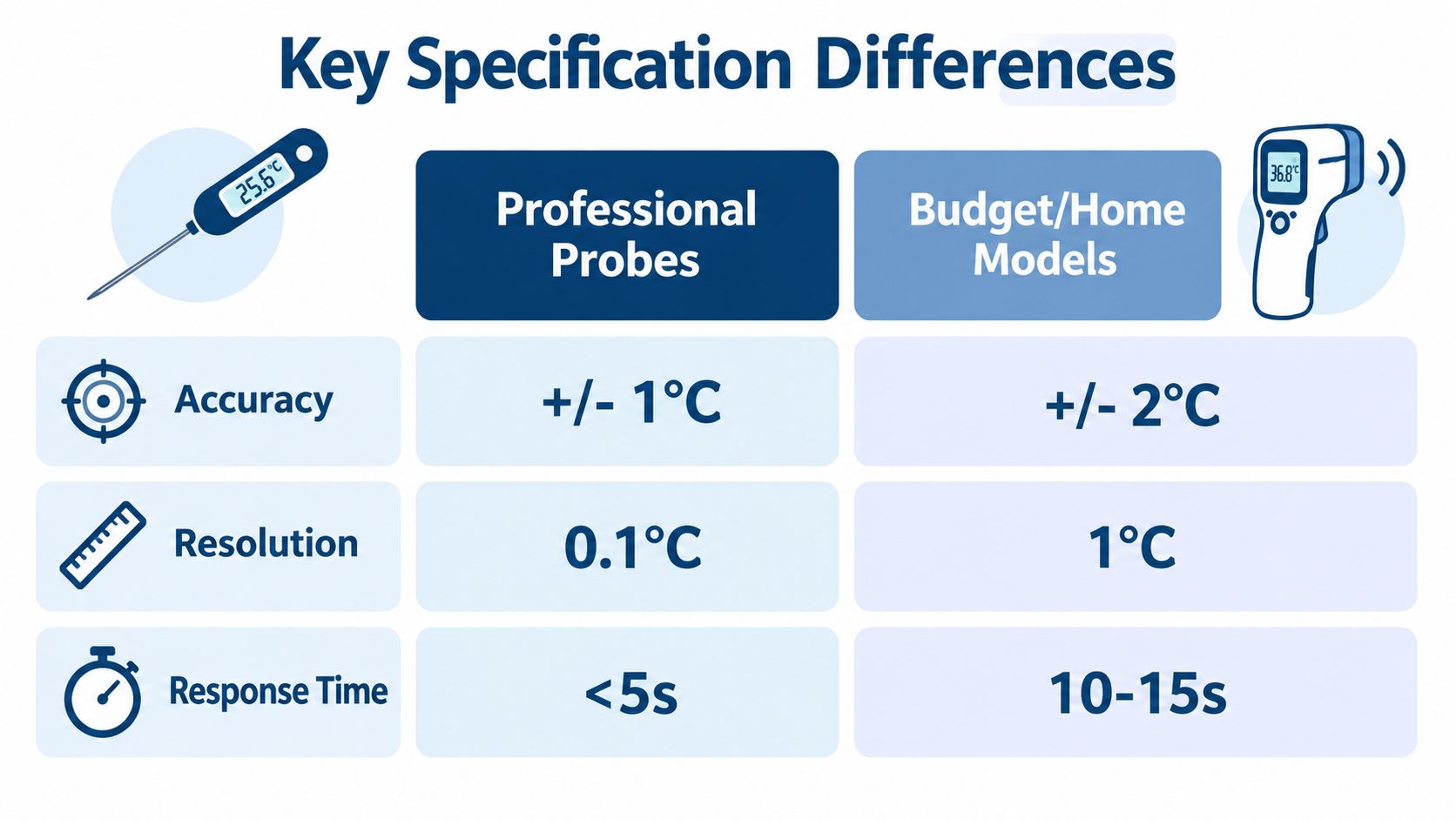
Accuracy describes how close the measurement is expected to be to the actual temperature within the manufacturer's specification. Resolution describes the increment shown by the display, such as 0.1°C or 1°C. A display showing tenths of a degree isn't automatically more accurate.
A thermometer used repeatedly during service should reach a stable reading quickly enough that staff can use it without creating a queue at the pass. The practical equation is simple:
Reading time × number of checks × frequency of checks
Only manufacturer documentation should be used when comparing response times. A seller shouldn't promise a response time that the product specification doesn't support.
| Specification | What to look for | Why it matters |
|---|---|---|
| Accuracy | A stated accuracy suitable for food-safety work, with ±1°C relevant to potentially hazardous food | A small error can affect classification near cold and hot holding limits |
| Resolution | A display increment suited to the task | Clear readings help staff record consistently, but more decimal places don't guarantee accuracy |
| Response time | A manufacturer-stated time appropriate to service demands | Faster stable readings reduce interruptions |
| Temperature range | A range covering the actual foods and processes | A broad display range doesn't make every probe suitable for oil, ovens or frozen products |
| Water resistance | An exact IP rating or manufacturer claim | Staff need to know what wipe-downs, splashes or immersion the unit can tolerate |
| Probe construction | A shape and length suited to the food | Thin foods, deep containers and large roasts need different geometry |
Water-resistant and waterproof aren't interchangeable. If a product carries an IP rating, the rating applies only within the manufacturer's stated conditions. The handle and probe may have different limitations, and a water-resistant handle doesn't mean the entire thermometer can be submerged or placed in a dishwasher.
A busy kitchen exposes equipment to steam, splashes, cleaning and wet hands. A clear cleaning procedure, protective storage and access to replacement probes can matter more over time than an oversized temperature range. The same principle applies to other precision tools, including digital kitchen scales, where readable measurements and repeatable use matter more than decorative features.
Calibration, Probe Hygiene and Cross-Contamination
A thermometer becomes useful evidence only when the kitchen has a process for checking its accuracy. MPI guidance recommends calibration as a way to confirm that measuring equipment remains accurate, and specifies an ice-point result between -1°C and +1°C.
For an ice-point check, place crushed ice in a glass and add only enough water to make an ice slurry. Immerse the sensing tip without touching the glass sides or bottom, wait for a stable display and document the result. An out-of-range reading requires supplier recalibration or replacement. Staff shouldn't compensate mentally for a thermometer that is outside the acceptable result.
Calibration should also be considered after a drop, exposure to extreme heat, implausible readings or probe damage. The frequency should follow the venue's Food Control Plan, manufacturer instructions and applicable guidance, rather than an arbitrary routine copied from another business.
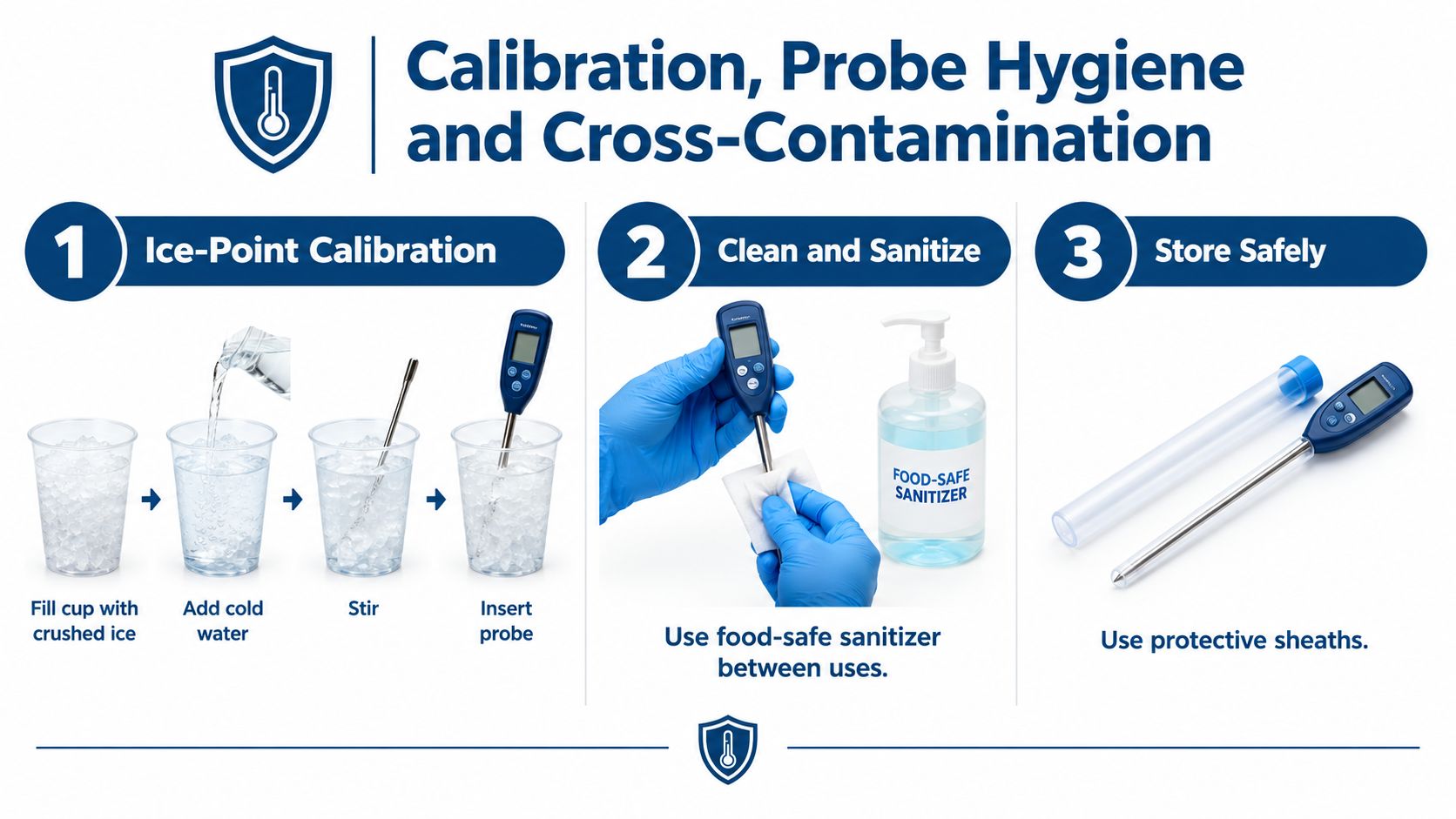
Probe hygiene is equally important. A probe moved from raw poultry to a ready-to-eat salad can carry contamination if staff don't clean and sanitise it properly. The working sequence is:
- Check temperature: Measure at the correct point.
- Clean and sanitise: Follow the sanitiser and manufacturer instructions.
- Move to the next product: Don't carry residue into another food.
MPI guidance specifically advises sanitising the probe before and after each food contact and allowing the disinfectant's required contact time. The probe should be protected from raw-product residue, and cleaning methods shouldn't exceed the manufacturer's limits.
Calibration records should include the date, thermometer identification, test result, corrective action and staff initials. A damaged probe, unstable display or failed verification should trigger action, not a note that the unit is “close enough”. More detail on separating raw and ready-to-eat work appears in this cross-contamination guide.
HACCP Records, Commercial Buying Criteria and a Selection Checklist
A digital thermometer supports a Food Control Plan. It doesn't create compliance by itself, and a basic thermometer shouldn't be described as HACCP certified without a properly supported, recognised claim.
Where the food-control procedure requires records, staff need to follow a complete chain:
Measure correctly → record appropriately → respond when results fall outside the required limit
The record may include the product, location, date, time, reading, staff member and corrective action, depending on the venue's documented procedure. A reading below the required cooking target or above the cold-storage limit needs a defined response. The thermometer detects a deviation, but it can't decide whether a batch should be reheated, rapidly cooled, held, discarded or escalated.
A commercial buyer should also consider whether one thermometer is enough. A busy kitchen may need separate units for preparation, cooking and receiving, particularly when moving a single probe between raw and ready-to-eat foods would slow the workflow or increase cleaning pressure.
Buying checklist
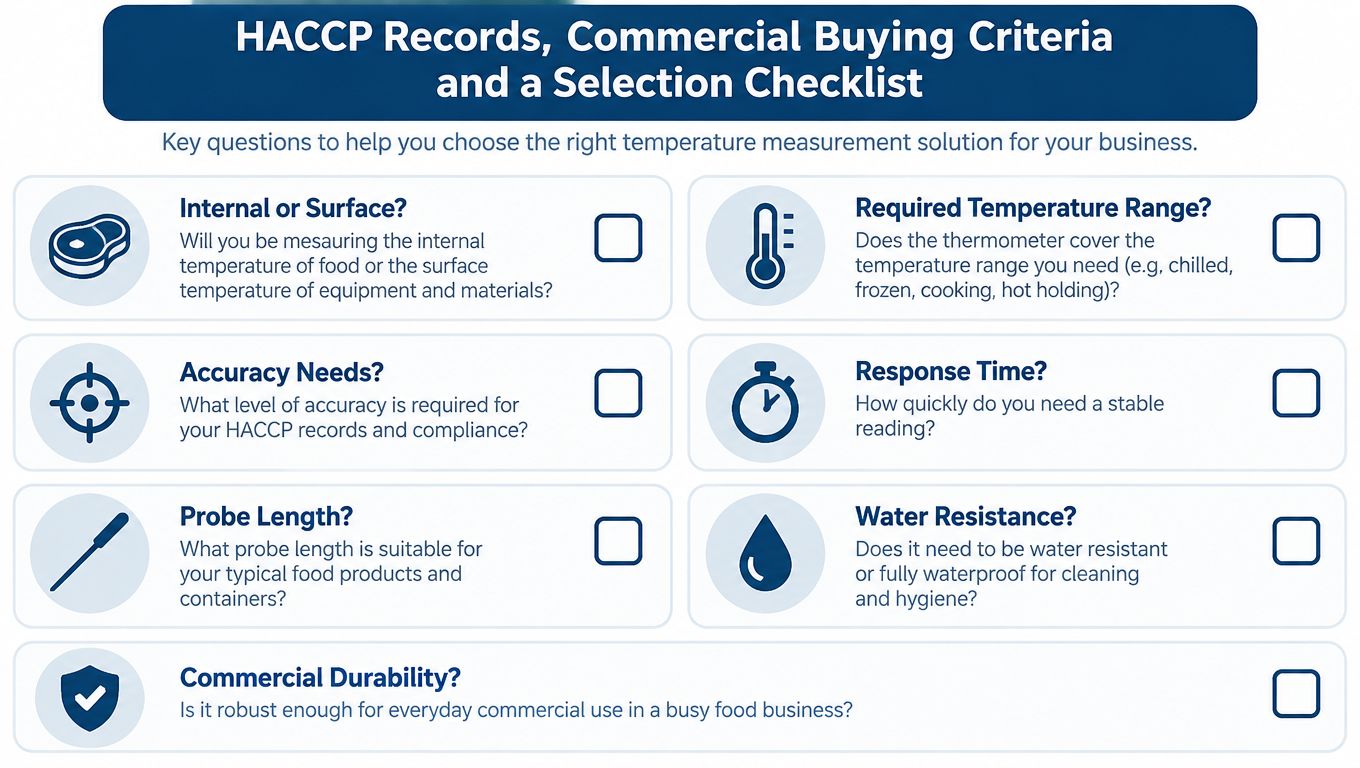
- Internal or surface temperature? Choose a probe for internal food checks. Choose infrared only for suitable surface work.
- What foods and processes need measuring? List meat, poultry, sauces, reheating, cooling, refrigeration, baking and any specialised work.
- What temperature range is required? Match the range to the actual application, not an impressive headline figure.
- How accurate must the measurement be? Check the manufacturer's accuracy specification. For potentially hazardous food, FSANZ specifies accuracy within ±1°C.
- How quickly is a reading needed? Compare stated response time with the number of checks completed during service.
- Is the probe suitable for the food size? Consider thin portions, deep containers, large roasts and liquids.
- Is water resistance important? Check the exact IP rating or manufacturer claim. Don't assume water resistance means submersion.
- How will the thermometer be checked or calibrated? Confirm the method, documentation and corrective action process.
- How will the probe be cleaned between uses? Follow food-safety guidance, sanitiser instructions and manufacturer limits.
- Is it suitable for repeated commercial use or occasional home use? Consider durability, battery availability, replacement probes, warranty and local support.
For home cooks, a dependable instant-read probe can remove guesswork from roasts, barbecues, baking and frying, provided the probe is placed correctly. For commercial kitchens, the strongest choice is usually a fast, accurate, cleanable probe that staff can use repeatedly and record without disrupting service. Infrared and oven thermometers remain useful when the kitchen has a genuine surface or ambient-temperature requirement.
Simply Hospitality supplies food thermometers and broader commercial kitchen equipment for restaurants, cafés, caterers, accommodation providers, institutions and care facilities across New Zealand. Visit Simply Hospitality for help matching probe type, accuracy, cleaning requirements and workflow to the food-safety tasks in the kitchen.