

Food Processor and Blender: Which One Your Kitchen Needs
You've got a busy prep window, a menu that mixes drinks and food, and one question that keeps coming up at buying time, food processor and blender, which one earns its bench space? The direct answer is this, a blender is built to drive ingredients towards a smooth, pourable result, while a food processor is built to prepare solid food into a cut, chopped, sliced, grated, or mixed form. In a commercial kitchen, the right choice is not the cheapest unit that “can do a bit of both”, it's the machine that matches the finished product, the volume per service, and the time available before service starts.
| Task | Best fit by default | When the assignment flips |
|---|---|---|
| Smoothies | Commercial blender | Rarely, unless the batch is very small and soft-fruit only |
| Milkshakes | Commercial blender | Only for very light, one-off prep |
| Pureed sauces | Blender or food processor | Depends on how smooth the final texture must be |
| Soups | Appropriate blender or processor | Depends on whether the soup needs a silky finish or a chunkier result |
| Chopping vegetables | Food processor | A blender only makes sense for a liquid-heavy puree |
| Slicing vegetables | Food processor | A blender doesn't suit this job |
| Grating cheese or vegetables | Food processor | Only if the kitchen needs a different texture and already has a separate prep method |
| Hummus and dips | Either | The desired texture decides it |
| Nut processing | Model and application dependent | Some blends need a processor, some need a blender, some need neither |
| Dough | Appropriate processor or dedicated mixer | A dedicated mixer is often the better answer |
| High-volume vegetable prep | Commercial food processor | A blender isn't the right tool |
Why the Food Processor vs Blender Question Is the Wrong Starting Point
A lot of operators start with the wrong decision rule. They look at two appliances, assume they overlap heavily, then try to pick the one that seems more versatile or better priced. That works in a home kitchen. It falls apart in service when staff need the right texture, repeatedly, without slowing the line.
A blender is a liquid-handling machine. Its narrow jug and blade set are designed to pull ingredients down into repeated circulation, which is why it suits mixtures with enough liquid to move cleanly through the blades. A food processor has a broader bowl-and-blade arrangement and is built for a much wider range of solid-food preparation, from dense vegetables to mixtures that need controlled cutting rather than full liquefaction. Consumer NZ's test framework for food processors treats measured performance, ease of use, predicted reliability, and owner satisfaction as separate issues, which is exactly how procurement should be handled in commercial settings, too. Consumer NZ's food processor test approach is useful because it separates raw task performance from the parts that matter in real service.
Practical rule: if the end result needs to pour, blend first. If the end result needs to be cut, chopped, sliced, or grated, process first.
The market also isn't standing still. Stats NZ data on food product manufacturing shows the industry grew from 2,088 enterprises in February 2000 to 3,486 in February 2024, an increase of 1,398 businesses, or about 67% over 24 years, which matters because more manufacturers and processors usually means more demand for prep equipment, parts, and replacements. Stats NZ manufacturing data, as summarised by Consumer NZ points to a larger, active base of users who need dependable prep gear, not one-off gadgets.
For operators comparing domestic-style appliances with commercial kit, the distinction between “can it do the task?” and “can it do it all shift?” is the whole game. Hospitality's own guidance on appliance categories is worth a look for that framing. Understand the difference between domestic, semi-commercial and commercial equipment
Matching Common Kitchen Tasks to the Right Machine
The fastest way to choose is to line the job up against the machine's core purpose, then be honest about where the overlap ends. A venue can force some tasks into either machine, but that doesn't mean both choices are sensible.
The practical task map
| Task | Best fit by default | When the assignment flips |
|---|---|---|
| Smoothies | Commercial blender | Very small batches, soft fruit only, or a different menu structure |
| Milkshakes | Commercial blender | Only if the kitchen is serving them occasionally |
| Pureed sauces | Blender | A food processor if the sauce should stay a little rustic |
| Soups | Blender | A processor if the soup is only being broken down, not fully smoothed |
| Chopping vegetables | Food processor | A blender only when the ingredient is already liquid-heavy |
| Slicing vegetables | Food processor | No real flip, this is processor territory |
| Grating cheese or vegetables | Food processor | No real flip, provided the right disc is on hand |
| Hummus and dips | Either | Texture and batch size decide it |
| Nut processing | Depends on model and load | Some products need longer blending, some need safer processing |
| Dough | Dedicated mixer or suitable processor | A blender is the wrong starting point |
| High-volume vegetable prep | Food processor | A blender doesn't belong here |
That's the shortlist, and it's enough to avoid most bad purchases. A salad bar, pizza kitchen, and catering prep room are asking for different tools than a smoothie bar or breakfast service.
Consumer NZ's benchtop blender testing covers pureeing, crushing, chopping, and green smoothie blending, with super blenders also tested for nut butter and sorbet. Consumer NZ's blender test method reinforces the point, the blender category is judged by specific food-prep workloads, not by marketing claims.
For beverage-led operations, Simply Hospitality's smoothie and juice equipment guidance is a useful companion read. Choosing equipment for smoothie and juice operations sits in the same practical lane, because drink production has its own workflow pressures.
A chunky tomato sauce, a loose pesto, and a velvet-smooth puree are not the same job. The correct machine changes with the texture target.
The easiest mistake is assuming the stronger motor is automatically the better answer. It isn't. The better answer is the machine that gives the required texture with the least handling, least rework, and least disruption to the prep bench.
Volume, Duty Cycle, and the Commercial Reality
Domestic buyers chase wattage. Commercial operators should mostly ignore it and ask a harder question, how much product must move through the machine, how many times, and how much time is available? That's what determines whether a blender or food processor pays its way on the prep bench.
A unit that can do one batch beautifully may still be the wrong buy if it needs to cool down, gets in the way of staff flow, or forces too many small loads. The same applies to a food processor. A bowl size that looks generous in a showroom can be far too small once a kitchen is doing repeated batches of chopped vegetables, crumbs, fillings, or purees during a production window.
What commercial buyers should focus on
- Batch count, not just batch size.
- Recovery time between loads.
- Ease of feeding ingredients without stopping the process.
- Changeover time for discs, blades, jugs, or bowls.
- Cleaning time, because a fast machine that's painful to clean loses value quickly.
The smoothie-rush example makes the point clearly. A blender that can make one drink is not automatically suitable for a service that needs drink after drink with no pause. The same logic applies to vegetable prep, where the issue is often not whether the machine works once, but whether staff can keep feeding it, emptying it, and cleaning it without blowing the prep window.
Consumer NZ's testing framework for food processors also separates predicted reliability and owner satisfaction from measured performance. That framework matters because commercial use is about sustained workflow, not showroom performance. For blender selection, the same thinking applies to the task coverage tested by Consumer NZ for regular and super blenders. The blender test scope shows why high-end units should be chosen by application, not by wattage alone.
In practice, a kitchen should ask whether the machine can match the service window. If the prep period is short and the batch load is repetitive, the wrong machine creates a bottleneck that shows up as overtime, stress, or delayed service.
Why Robot Coupe Sits at the Centre of Commercial Food Prep
Robot Coupe belongs in this conversation because it treats prep as a set of distinct operations, not as one vague “mixing” job. That's why it shows up so often in commercial kitchens, schools, aged care, cafés, and catering rooms where the prep list changes from day to day.
The job, then the attachment
A Robot Coupe unit can be matched to chopping, slicing, grating, mixing, and processing, but only where the correct model and disc or blade set are designed for that function. The continuous-feed R-series and bowl-style processors solve different prep problems, and no one should assume every model does every job. The accessory set is what makes the machine useful.
| Prep function | Attachment / blade | Typical unit | Notes |
|---|---|---|---|
| Chopping | Bowl blade or suitable processing blade | Bowl processor | Best for controlled batch prep |
| Slicing | Slicing disc | Continuous-feed unit | Use only where the disc and machine support it |
| Grating | Grating disc | Continuous-feed unit | Good for cheese and vegetables when the disc suits the product |
| Mixing | Bowl blade or mixing blade | Bowl processor or BLixer-style unit | Used for combining ingredients without aiming for a fully smooth liquid |
| Processing purées | Smooth blade or processing blade | Bowl processor or BLixer-style unit | Suits textured purees and smooth blends, depending on model |
Some models are better for a tight prep bench, some for continuous feeding, some for smoother output. That's the point. The machine should match the task, not the other way around.
Hospitality's Robot Coupe labour-savings article is a good companion piece for operators trying to turn that decision into a numbers-based brief. Does a Robot Coupe pay for itself in labour savings sits in the right place for that kind of buying conversation.
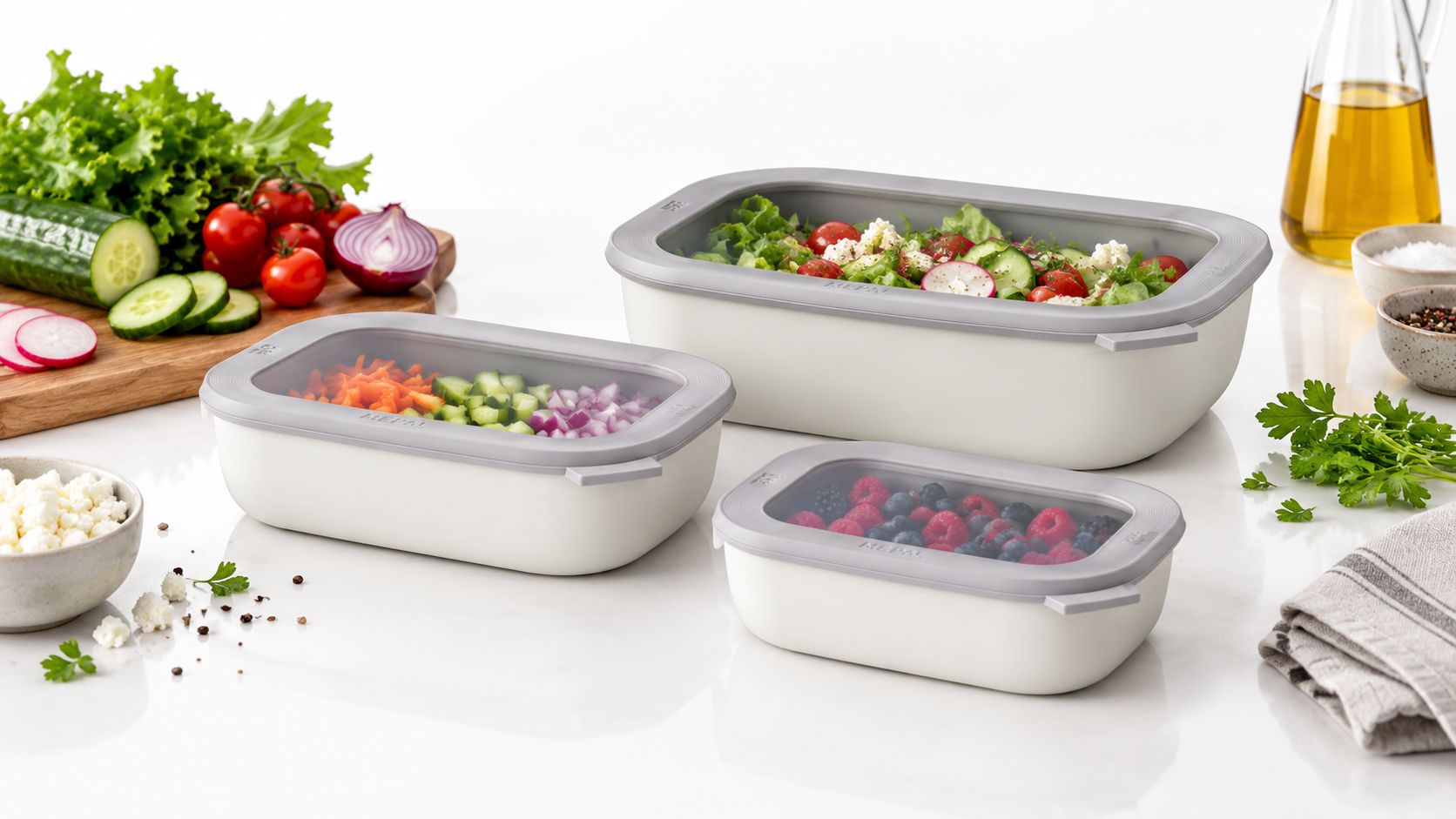
For storage between batches, a space-efficient container system can help keep prep organised. The Mepal Cirqula Rectangle Small Set 3-Piece Nordic White uses a rectangular footprint to make fridge and freezer space work more cleanly, and the 500 ml, 1000 ml, and 2000 ml bowls suit everyday portions without wasting shelf space.
Commercial Blender Options Worth Comparing
For blender buyers, the comparison is usually between Vitamix and Hamilton Beach Commercial. They're both relevant in commercial kitchens, but they don't solve every problem in the same way, and that's exactly why the menu matters more than the badge.
What operators should compare
| Specification | Vitamix Commercial Line | Hamilton Beach Commercial | Operator consideration |
|---|---|---|---|
| Jug capacity | Typically available in countertop sizes around 1.4 L to 2 L, with larger options in sound-enclosed setups | Typically available in similar countertop and service-focused sizes | Capacity should match the batch pattern, not the preference of the buyer |
| Motor output | Expressed in commercial-grade output and designed for sustained blending | Expressed in commercial-grade output and designed for service use | Power matters less than how the unit handles the actual ingredient load |
| Controls | Variable speed and, on some models, programmed cycles | Variable speed and programmed options on selected models | Controls should suit speed of service and staff consistency |
| Noise management | Some models use sound-reduction enclosures | Some models also use sound-enclosure designs | Important for front-of-house, hotels, and breakfast service |
| Duty cycle | Built for regular commercial service | Built for light-to-medium or service-led commercial use, depending on model | Pick the duty level that matches the menu volume |
| Replacement components | Jugs and components should be treated as wear items | Jugs and components should be treated as wear items | Spare jugs and parts matter more than buyers often realise |
A blender is only useful if the jug geometry, blade setup, and controls suit the actual product. A premium model that overcomplicates a simple smoothie line can be a poor fit. A simpler unit that gets buried under service pressure can be worse.
The right question is whether the blender belongs to a beverage-heavy workflow or a mixed kitchen where it will only see intermittent use. Simply Hospitality's article on premium blender value is relevant reading for that exact call. Is a premium commercial blender worth the extra money
Buying rule: choose the jug and programme set around the menu, then check the motor and noise features. The other way around is how bad purchases happen.
When the Real Answer Is a Dedicated Mixer
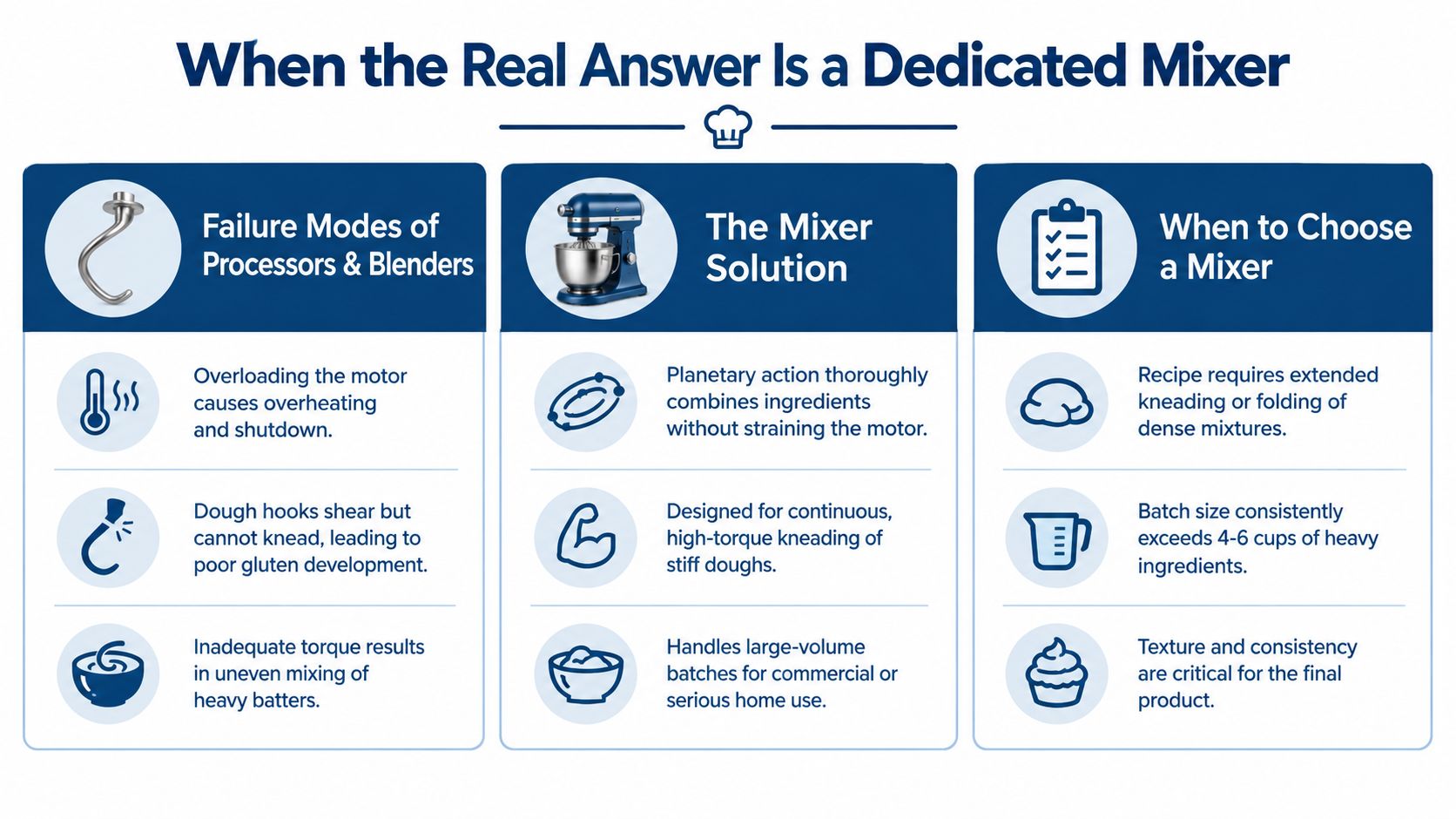
Sometimes the right answer is neither a food processor nor a blender. Dough, heavy batters, and large-volume mixing are their own category, and trying to push them through the wrong machine usually ends badly.
A processor can start to struggle when dough becomes heavy and dense. A blender is even less suited to it. The load can climb, the texture can become uneven, and the machine can stall or overwork itself. That's why a dedicated commercial mixer is often the honest recommendation for bread, pizza, and pastry production.
What belongs in mixer territory
- Extended kneading, where gluten development matters.
- Heavy batters, where consistent incorporation is more important than chopping.
- Large batch mixing, where a bowl designed for the job is more useful than a processor bowl.
- Menu centres built around dough, which need repeatable mixing rather than improvised processing.
Fimar is a sensible name to raise here because its preparation equipment and commercial mixers sit naturally in this space. In the right setup, a planetary mixer handles general dough and batter work, while a spiral mixer suits more dedicated dough production. The point isn't that one machine replaces every other one, it's that the menu should drive the machine choice.
For kitchens that live on bread, pizza, pastries, or heavy mixing, the best answer may be a mixer plus a smaller prep machine rather than one oversized compromise. That's not an upsell. It's the practical way to avoid turning a prep problem into a maintenance problem.
Total Process Time and the True Cost of Manual Prep
A machine's run time is not the same as the job's total time. Real processing includes getting ingredients out, setting the machine up, loading, running, emptying, cleaning, and putting everything back together. That's why a 30-second puree cycle can still absorb several minutes of paid labour once the whole loop is counted.
An illustrative labour example
Take a prep task that manually takes 30 minutes and machine-assisted prep that takes 10 minutes including setup and cleaning. At an illustrative total labour cost of $35 per hour, the 20 minutes saved is approximately $11.67 of labour capacity per batch. If that task happens twice per day across 300 trading days, that works out to approximately $7,002 of annual labour capacity. This is a calculation example, not a customer result.
| Step | Manual Prep (minutes) | Machine Prep (minutes) | Cost Difference per Batch |
|---|---|---|---|
| Ingredient prep and loading | Longer | Shorter | Lower handling cost when the machine suits the task |
| Processing | More labour intensive | Faster | Time saved only matters when the whole batch is counted |
| Emptying and cleanup | Still required | Still required, but often quicker | Cleaning can make or break the workflow advantage |
That number does not automatically become extra profit. The value can show up as lower labour requirements, less overtime, more output from the same staff, or more time for higher-value work on the line. The biggest mistake is judging the machine only by how fast the blade spins.
Hospitality's article on manual food prep cost is the right companion for operators comparing equipment against labour. What is the cost of manual food preparation in a commercial kitchen gives the broader framing for this calculation.
The cheapest machine is rarely the lowest-cost process. Kitchens pay for handling, cleaning, and staff time whether or not those costs show up neatly on the purchase order.
Buying Checklist and Whether One Machine Is Enough
The easiest way to get this right is to make the decision mechanical. List the menu, check the volumes, and test the workflow before anyone starts comparing brochures.
A practical buying checklist
- List the top five menu items that rely on the appliance. If the list is mostly drinks, a blender starts to make sense. If it is mostly chopping, slicing, grating, or batch prep, a food processor moves to the front.
- Measure peak volume and batches per service. A machine that copes with one batch but not five in a row is the wrong machine for service.
- Confirm duty cycle against the prep window. The machine must keep up with the time between prep start and ticket time, not just look good on a spec sheet.
- Assess disassembly and cleaning time on a stopwatch. If the machine is awkward to clean, the operational gain shrinks fast.
- Verify electrical supply, ventilation, and bench footprint. New Zealand appliances need the correct electrical specification for the installation, and that needs to be checked before purchase.
- Review warranty terms, service support, and replacement parts. Jugs, bowls, blades, and discs are working components, not afterthoughts.
- Confirm attachment compatibility for future menu changes. The kitchen may not run the same menu in twelve months, so flexibility matters.
New Zealand electrical guidance requires domestic and similar appliances to be rated and marked for the standard mains supply of 230 V or 400 V multi-phase, 50 Hz, and commercial kitchen machines sit under the relevant commercial standards framework. WorkSafe's appliance requirements make that plain enough, and operators should confirm the electrical specification before buying any higher-powered or specialist unit.
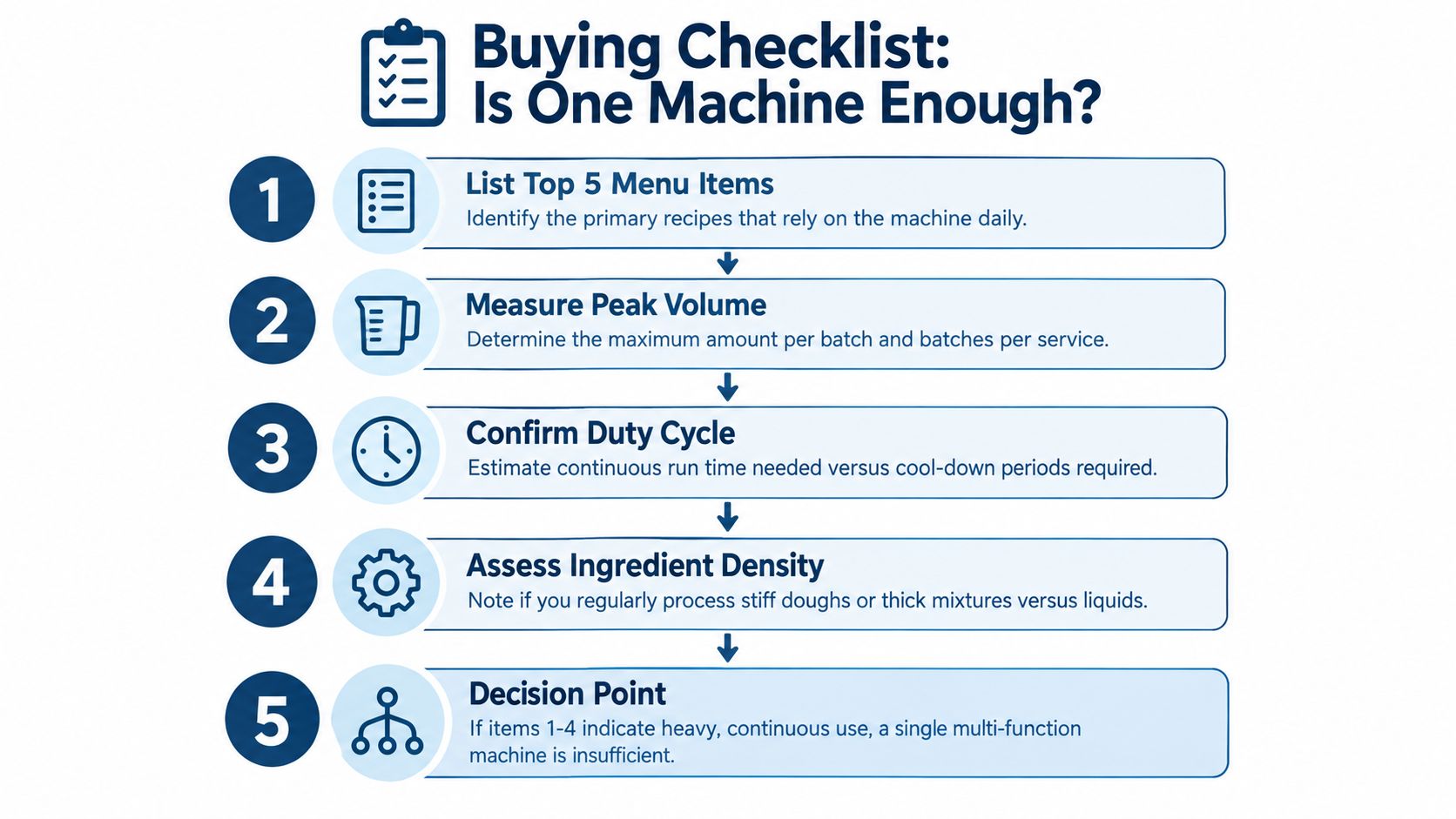
One machine is enough when the menu is narrow and the prep task is simple. Two machines are rational when the kitchen has two different high-frequency production problems. Don't buy two machines because they overlap a little. Buy two when they solve two separate bottlenecks.
For prep-heavy kitchens, a food processor can carry most of the load. For beverage-heavy venues, a commercial blender can do the same. For many full-service kitchens, both are justified, unless a dedicated mixer or another specialist machine is the right answer.
Hospitality supplies commercial food-preparation equipment, including Robot Coupe, Vitamix, Hamilton Beach Commercial, and Fimar-related solutions, along with advice on matching the machine to the menu. If the decision still comes down to blender, processor, or mixer, Simply Hospitality can help specify the right setup, quote the right model, and support the buying decision with practical after-sales guidance.