

FoodSaver Vacuum Packer or a Chamber Machine
A sealed bag looks finished, so is a FoodSaver vacuum packer already the right machine for a café prep bench? That is where a lot of buying goes wrong. A tight seal on the home bench is not the same job as a chamber that can run wet proteins, sauces and repeated batches without dragging liquid into the suction path.
FoodSaver is a recognised household vacuum sealing brand. It suits many home cooks who portion meat, fish and dry goods for the fridge or freezer. Hospitality does not stock FoodSaver vacuum sealers and is not affiliated with the brand. For restaurants, cafés, caterers and butcheries, the useful comparison is between that external suction style and a commercial chamber vacuum packer built for daily packing.
The notes below cover how an external sealer runs, where moisture trips it up, how chamber machines differ, which buyer each category fits, which bags match which machine, and the New Zealand food-safety controls that apply whichever sealer sits on the bench.
What a FoodSaver Vacuum Packer Does
A home cook portioning a side of beef for the freezer can use a FoodSaver vacuum packer to remove air from compatible bags and heat-seal them. The labelled packs are easier to stack and store in the fridge or freezer.
What the seal actually changes
Removing air reduces the oxygen around the food, while the heat seal closes the bag. This can help slow oxidation and freezer burn on suitable foods, and makes portions easier to label, date and stack.
Vacuum packing does not kill bacteria or make perishable food safe to leave at room temperature. Clean handling, refrigeration and freezing still matter.
Jobs that fit a home machine
Typical home uses include:
- Freezer portions: Meat or fish bought in bulk, divided and sealed for later.
- Meal prep: Firm foods that are not surrounded by liquid.
- Dry goods: Rice, nuts, coffee and similar pantry foods.
A FoodSaver-style sealer can suit occasional household use. For a café, restaurant, caterer or butchery packing regularly, a chamber machine may be a better fit for the workload. Low-temperature cooking is a separate equipment choice, covered in Simply Hospitality's guide to sous vide equipment.
How an External Suction Sealer Works
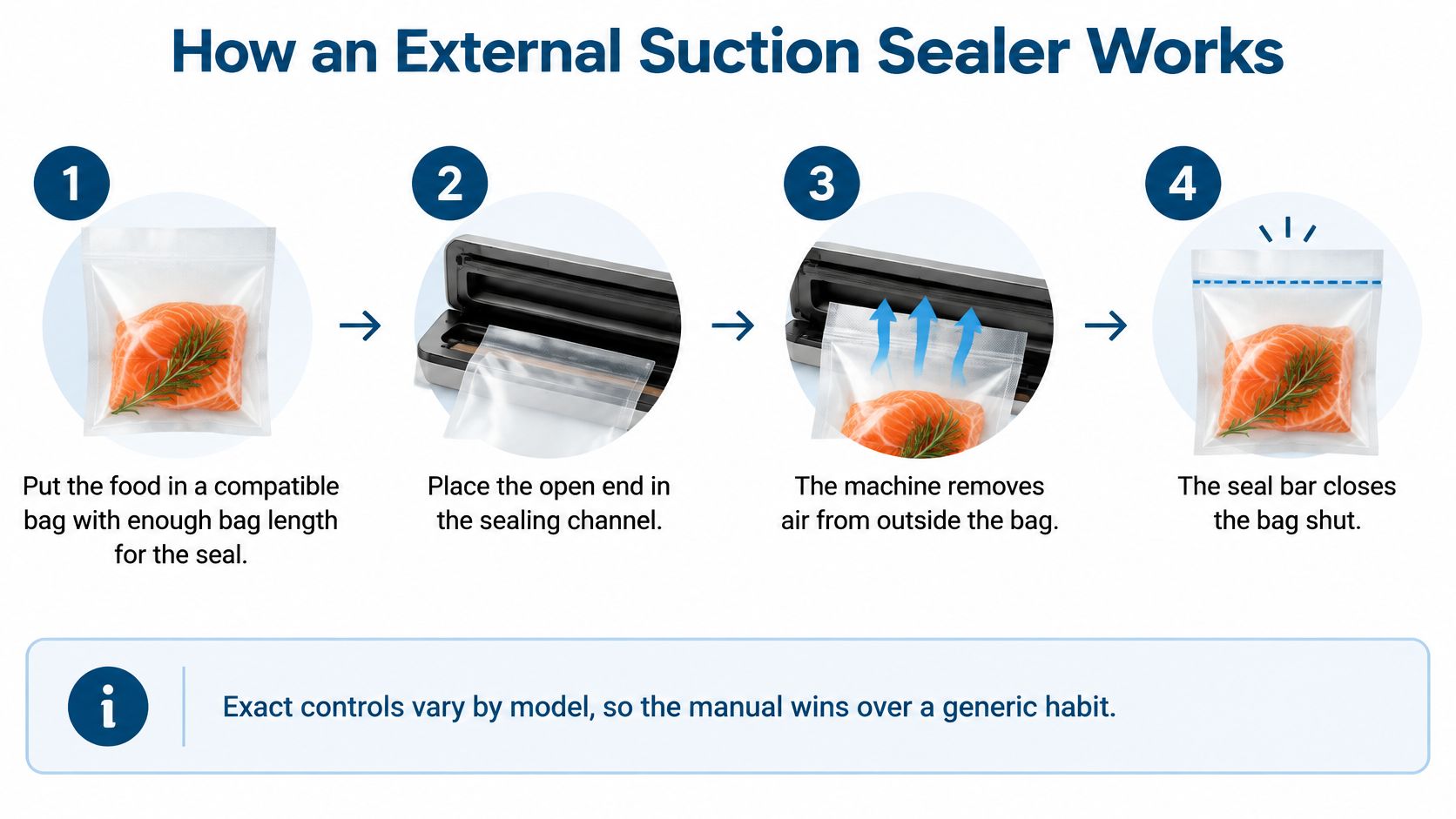
An external suction sealer, the layout many shoppers mean when they search for a FoodSaver vacuum packer, works from outside the bag. Exact buttons differ by model, so the manual wins over a generic habit.
Five actions and where each one fails
- Bag the food with spare length. Put the food in a compatible bag with enough material for the seal and a little headspace. A bag cut too short leaves no clean strip, so the seal lands on food.
- Seat the open end flat. Lay the open end in the sealing channel with no fold across the bar. A wrinkle becomes a path that lets air back in after the cycle sounds finished.
- Run suction until the pack tightens. The machine pulls air through the channel until the bag draws down. Stopping early, or letting liquid chase the air, leaves a loose pack or a wet seal line.
- Let the heat seal finish. Wait for the full cycle rather than opening the lid early. A half-formed seal looks closed, then peels in the freezer.
- Inspect, then chill or freeze. The seal should be even, with no wrinkles, moisture or food in the line. A doubtful seal is a food-handling problem, not a storage shortcut. Reseal or repack before the food goes away.
Why wet food fights this design
Suction can drag liquid toward the seal or into a drip tray. A wet seal fails. A domestic pump is not a chamber, so moist and liquid foods stay awkward even when a model offers a slower or pulse-style cycle. Those settings ease the rush of liquid. They do not turn the unit into a sauce packer.
Practical rule: Chill wet products first and keep liquid below the seal line.
Home jobs that fit this sequence are freezer portioning, firmer meat and fish, bulk dry goods, and meal-prep pieces that are not swimming in liquid.
FoodSaver Style Sealers Compared with Chamber Packers
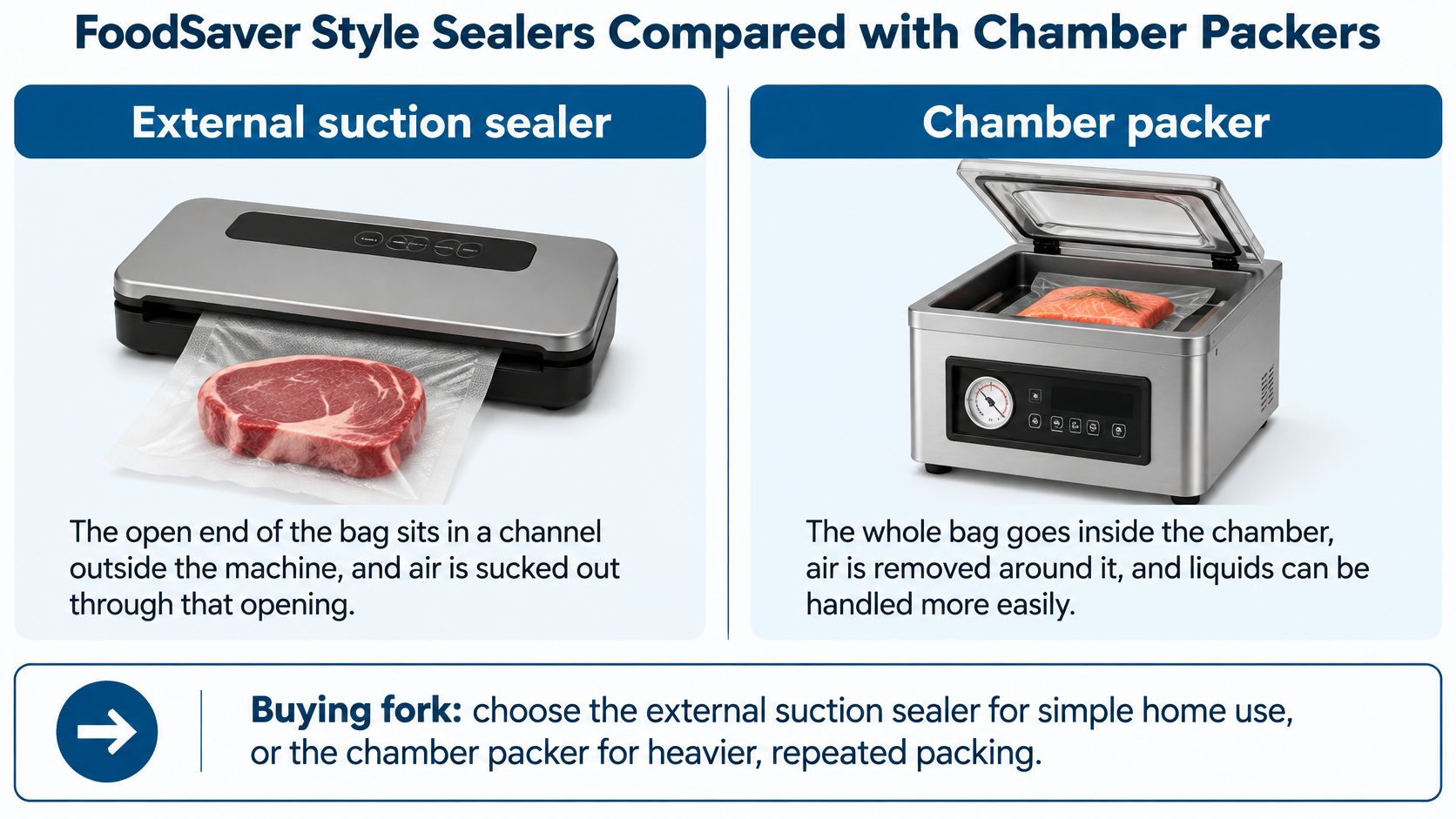
An external suction sealer holds the open end of the bag in a channel outside the machine, pulls air through that opening, then heat-seals. A chamber machine places the whole bag inside a lidded chamber, removes air from around the bag, and seals while the bag is supported.
That difference is why liquid often migrates toward the pump or the seal on an external machine, while a chamber handles suitable soups, marinades and wet proteins more predictably. Not every chamber performs the same. Pump size, seal quality and chamber shape still have to match the food.
Side by side
| Feature | FoodSaver-style external sealer | Commercial chamber vacuum packer |
|---|---|---|
| Intended usage | Occasional home storage and light meal prep | Regular packing in a food business |
| Packaging method | Air pulled from a bag held outside the machine, then heat-sealed | Air removed from the chamber around the bag, then heat-sealed |
| Suitable food types | Dry goods and firmer portions | A wider range, including moist foods the bag and cycle can handle |
| Liquids and moist ingredients | Often difficult; liquid can reach the seal or suction path | More predictable for suitable liquids and wet foods |
| Bag compatibility | Usually embossed or textured bags, and rolls where the model allows | Usually smooth vacuum pouches |
| Batch frequency | Short, occasional runs | Repeated batches through prep |
| Machine dimensions | Compact benchtop; one NZ FoodSaver listing is about 450 mm wide | Larger; chamber size limits portion size |
| Purchase cost | Lower upfront for household use | Higher upfront, matched to duty and capacity |
| Cleaning and maintenance | Seal area and drip tray after wet foods | Chamber, gasket and seal bar between food types, plus service access |
Rows operators misread
Liquids cause most of the disappointment. An external machine can manage a damp steak if the seal stays dry. It is a poor daily tool for marinade, sauce or juicy mince. A chamber is more predictable for those foods when the bag and the cycle suit them.
Bag style is the next miss. Textured bags, and rolls on some models, belong with external suction. Smooth pouches belong with chambers. A cheaper bag from the other system usually will not pull down.
Price and size get mixed up with performance. A lower home-machine price is rational for a few packs a week. A higher commercial price buys duty, chamber size and service access. It is not a promise of less waste.
One New Zealand retail listing shows how much control a home unit can carry, and how much bench it still needs. Common specs include multiple programmes, Dry, Moist, Pulse, Marinate and Sous Vide, plus dimensions of approximately 450 mm wide by 220 mm deep by 270 mm high, while a separate listing reports 120–130 W. That width still needs a clear benchtop, a drip tray emptied after wet foods, and liquid kept below the seal. The same user guidance is plain that perishables still need refrigeration or freezing, and that vacuum sealing is not a substitute for heat processing.
Commercial equipment is not automatic for a household. The same split between light-duty and food-business kit shows up across the kitchen, which is why it helps to read how domestic, semi-commercial and commercial equipment differ. Judge a FoodSaver-style unit on workflow fit, bench space and bag compatibility, not on any advertised storage-time multiple.
When a Commercial Vacuum Packer Pays Its Way
A Tuesday prep list is a different job from a weekend freezer tidy. Proteins are portioned before service, a caterer is bagging components for Friday, and one short external channel is the queue because bags are wet and seals are inconsistent.
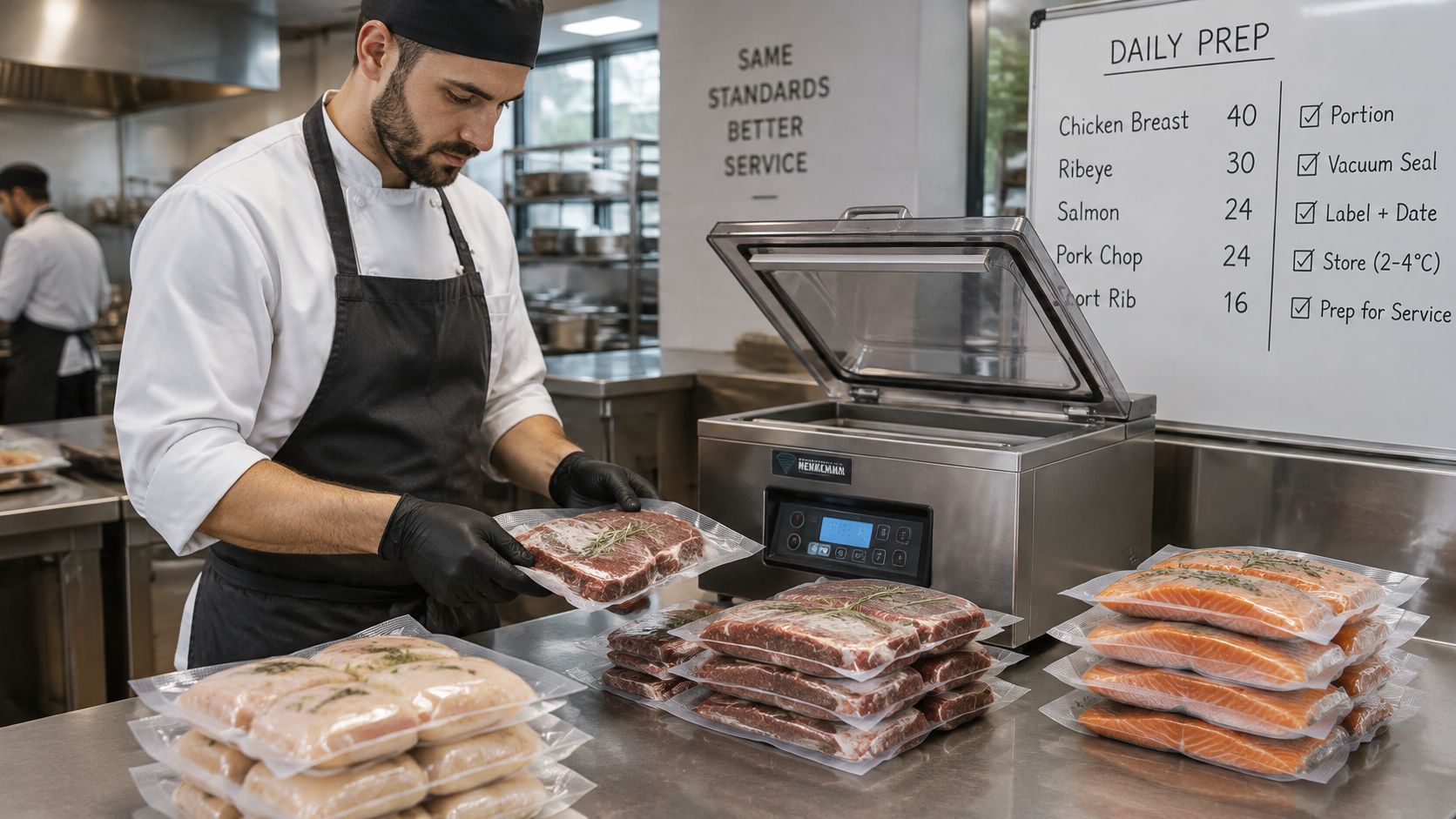
A commercial chamber packer is worth weighing when packing is a repeated station, not an occasional home task.
Where the slowdown shows
- Restaurants: Portioning proteins ahead of service, including pieces that carry marinade.
- Butchers: Bagging meat cuts through the trading day, not after a single household shop.
- Caterers: Working a production list so each pack leaves with contents and a date.
- Bulk breakdown: Turning a delivery into labelled units during a quiet prep window.
What changes in the workflow
The gains are operational. Portions repeat more closely. Labelled packs stack in a reach-in or freezer. Staff handle fewer bags twice because a seal failed on the first pass. Batching can sit in a planned window instead of between tickets.
Hospitality businesses often find the difference on the prep list, as a calmer sequence of tasks, not as a guaranteed cut in waste or labour.
Results follow volume, the foods, the bags, and whether someone owns cleaning and labelling. A small café doing a handful of dry portions may not need a chamber. A butchery, or a kitchen packing sauces and marinated proteins most days, often does.
Any talk of waste has to stay inside that limit. Hospitality's piece on how much food waste vacuum packing can eliminate is a prompt to measure a real menu, not a promise that a machine will hit a figure. Steady prep supports steady service, which is the point of why consistent prep creates consistent profits. Vacuum packing does not create profit by itself.
Packed food still needs the right fridge or freezer. Rapid chilling is a separate purchase, set out in the notes on blast chillers and shock freezers.
How to Choose the Right Vacuum Packer
Work down the pack, not the brochure. The machine type should already be clear from the foods and the pace of prep.
Ask in this order
- Foods, pack count and the wettest item. Write down a typical prep session, how many packs, and which product carries the most liquid. That one wet item often decides external suction versus a chamber.
- Chamber length, width and height against the largest portion. A pump figure cannot shrink a roast that will not fit. If the biggest cut hits the lid or the seal bar, the machine is the wrong size.
- Seal-bar length, and one bar or two. Longer bars suit wider pouches. Two bars can close more than one pouch in a cycle when the chamber allows it. They do not fix a chamber that is too shallow.
- Pump capacity as a clue, not a verdict. A stronger pump can shorten pull-down on a suitable load. It does not choose the bag, the gasket or the foods.
- Bags, footprint, cleaning, power and service. Confirm pouch compatibility, whether the chamber wipes clean between raw and ready-to-eat foods, the power supply on site, and who can service the machine in New Zealand.
Mistakes that show up after delivery
Buying on the pump figure alone, choosing a chamber too small for the largest cut, forgetting that bags are an ongoing cost, and leaving no bench space to clean the unit. Those four show up more often than a wrong badge on the lid.
Two benchtop specifications to look up
Bags are not included with either machine. Confirm current catalogue availability and the maker's sheet before ordering.
| Model | Seal bar | Pump |
|---|---|---|
| Yasaki ZJ-VM400B2 | Two 400 mm bars | 20 m3/h |
| Yasaki ZJ-VM500B2 | 500 mm | 20 m3/h |
The Yasaki ZJ-VM400B2 is listed with a 280 x 380 x 75 mm chamber, two 400 mm seal bars and a 20 m3/h pump. The Yasaki ZJ-VM500B2 steps up to a 365 x 500 x 100 mm chamber and 500 mm seal bars on that same pump rating, which is the difference that matters when portions are larger. Matching pump figures are exactly why the chamber, not the pump line, should lead the shortlist.
The right solution depends on the largest portion and the wettest product, not the brand name on a domestic sealer.
Bags That Match the Machine
The machine is only half the pack. A bag bought for the other system often will not pull down or seal.
Three formats
Embossed or textured vacuum bags are the usual match for an external suction sealer. The channels give air a path out of a bag that is otherwise clamped flat.
Smooth vacuum pouches are the usual match for a chamber. Air leaves the chamber rather than travelling along the bag wall, so the pouch does not need that texture.
Vacuum rolls suit machines that can make a custom bag length. They are not universal, and a roll made for an external sealer will not automatically run in a chamber.
What to check before a carton arrives
- Food-contact suitability: The bag has to be intended for food, not a general plastic sleeve.
- Puncture resistance: Bone, shell and sharp edges need a bag that survives that product. There is no single thickness that covers every cut.
- Seal quality: The seal line stays clear of wrinkles and food.
- Portion versus machine: The filled bag has to fit the channel width or the chamber, with room for the seal.
- Freezer use: Cold storage asks more of a film than a short chill.
- Heating: Only when that bag's manufacturer says the pouch may be heated.
Heating is a boundary, not a bonus
A FoodSaver vacuum packer or a chamber machine does not make an ordinary bag safe to cook. New Zealand MPI guidance on sous vide requires purpose-suitable vacuum packs with no creases in the sealed area, bags completely submerged and evenly spaced, and a check that the centre of the thickest part reaches the selected internal temperature before holding time begins, within four hours. For lower-temperature cooking, the water bath must not fall below 55°C for red meat or 60°C for poultry. Operators also need reliable temperature control, calibrated measurement and a written procedure.
Many operators choose bags in the same order as the machine. Confirm the sealer type first, then the largest portion, then puncture risk. Formats used with commercial machines are outlined in vacuum seal bags in New Zealand.
Vacuum Packing and Food Safety in New Zealand
The usual assumption is that a tighter bag means more days in the fridge. That is the wrong default. In New Zealand, vacuum packing is managed as a food-safety control, not as a guarantee of longer storage life.
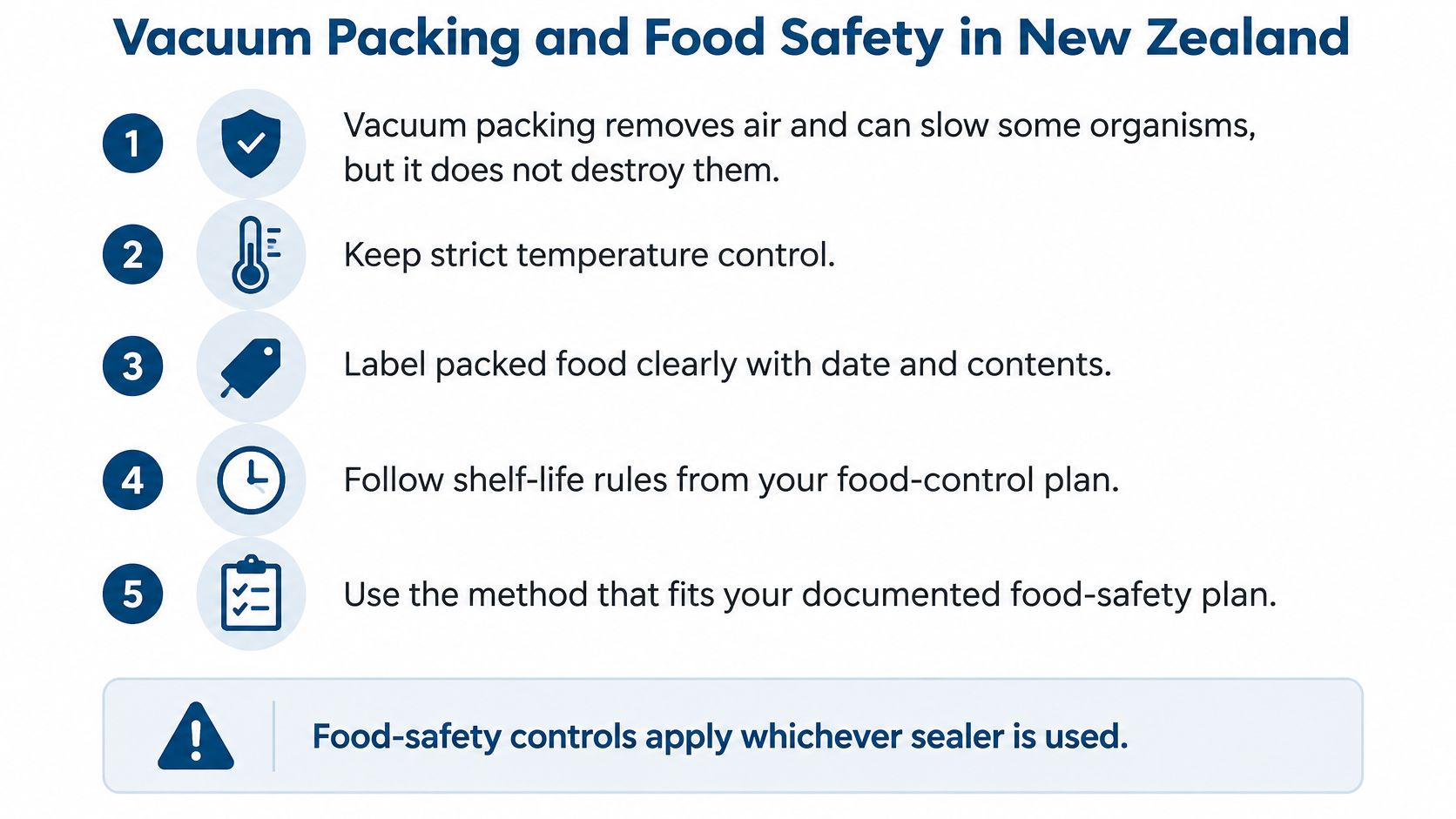
MPI guidance on modified atmosphere and vacuum packaging explains that vacuum packaging removes air from around food and can slow the growth of some microorganisms, but it does not destroy microorganisms already present. The same guidance warns that oxygen-free conditions can encourage Clostridium botulinum, the bacterium associated with botulism. Sealing does not replace refrigeration, hygienic preparation, validated shelf-life controls or use-by dates.
What a low-oxygen bag does not control
MPI shelf-life guidance adds two facts that belong on a prep bench. Listeria can grow both in air and without air, so vacuum packaging does not automatically control it. C. botulinum grows only in oxygen-free conditions, which is why it matters once air has been excluded. That document also notes that in-pack pasteurisation does not inactivate bacterial spores, so a heat step cannot be assumed to clear every hazard. Shelf life has to be judged for the specific food, process, packaging atmosphere, storage and distribution. There is no universal number of extra days.
Signals that disappear, and colour that does not mean spoilage
MPI states that most fresh and minimally processed foods packed under vacuum still need refrigeration and should be eaten by the labelled use-by date, with uneaten food discarded after that date. Conventional spoilage cues can vanish. Food can remain unsafe when mould, unusual odours or discolouration are absent.
Vacuum-packed meat may look purple-red because oxygen has been removed. MPI identifies that colour as normal, and the brighter red can return once the pack is opened to air. Staff who reject every dark pack, or who trust every bright one, are both reading the bag wrongly.
Habits that belong in the food-control plan
- Hygienic preparation: Clean hands, boards and utensils before the bag is filled.
- Separation: Raw and ready-to-eat foods do not share a seal area without a clean-down.
- Suitable packaging: Food-contact materials only, matched to chilled or frozen holding.
- Labels: Contents and date on every pack, tied to the business's own storage rules.
- Chilled holding: The pack goes into refrigeration or the freezer. It does not sit on the bench to finish cooling because it looks done.
- Machine cleaning: Chamber, gasket or drip tray is cleaned between raw proteins and other foods.
A sealed pack left on the bench to cool is still a cooling problem. The bag does not replace a cold room.
These controls apply whether the equipment is a domestic FoodSaver unit or a commercial vacuum sealer. Commercial operators must follow the food-safety requirements for their business and products. Home users still refrigerate or freeze perishable packs. How those duties sit inside a New Zealand food business is set out in food safety regulations in NZ.
Pick the Vacuum Packer That Matches Your Volume
| Buyer | Typical requirements | Recommended category |
|---|---|---|
| Occasional home cook | A few freezer or pantry packs, mostly dry or firm food | FoodSaver-style external sealer |
| Meal-prep enthusiast | Regular home batches, still not a commercial duty cycle | External sealer if foods stay manageable; chamber only if liquids are constant |
| Small cafe | Light daily prep, limited bench, mixed moisture | Small benchtop chamber if packs are wet; external only for rare dry packs |
| Restaurant | Portioned proteins and sauces before service | Chamber vacuum packer |
| Catering business | Production lists and labelled packs for events | Chamber vacuum packer sized to batch size |
| Butchery | Meat portions, larger cuts, frequent cycles | Wider commercial chamber |
| High-volume commercial kitchen | Continuous prep, several food types, cleaning between them | Commercial chamber with service support |
A FoodSaver-style domestic machine is enough for an occasional home cook, and for many meal-prep enthusiasts packing firm or dry food a few times a week. It becomes the wrong tool when liquids, bones, daily batches or several staff are normal.
Small cafés sit on the line. Stay with an external sealer only when packs are few and dry. Move to a small chamber once moist prep is regular. Restaurants, caterers, butcheries and higher-volume kitchens should shortlist a chamber sized to the largest pack they make, not the largest pack they might make one day.
Ownership past the sticker price
Compatible bags repeat on every pack, so running cost matters as much as the upfront price. Add time to clean the chamber or the drip tray, seal-bar wear, and whether someone can service the unit in New Zealand. There is no honest payback slogan to attach to the badge on the lid. Confirm current pricing and availability rather than guessing a saving.
SilverChef lets customers own top-tier commercial kitchen equipment without paying the full upfront cost. That route lets a kitchen match capacity to the prep list instead of buying the smallest unit that happens to fit this month's cash.
Hospitality does not stock FoodSaver vacuum sealers. For professional packing, the relevant range is commercial chamber machines and compatible vacuum bags, including the Yasaki ZJ-VM500B2 where larger packs are the normal job. Choose by actual usage, moisture and portion size, not by brand recognition alone.
Hospitality supplies commercial kitchen equipment to New Zealand hospitality businesses, including chamber vacuum packers and packaging for professional prep. If the choice is between a household external sealer and a chamber machine, the useful details are the foods, the largest portion and how many packs a prep session produces. Visit Simply Hospitality and talk that match through with the team.