

Freestanding Induction Cooker How to Choose for Hospitality
A lot of hospitality operators look at a freestanding induction cooker when the cookline is under pressure, the gas conversation is changing, or a refit is already on the table. The mistake is treating it as a simple appliance swap. In a commercial kitchen, the decision sits across three linked factors: cooking capacity, electrical capacity, and kitchen design.
That's why the right unit isn't automatically the biggest one, the newest one, or the one with the most zones. It's the one that matches peak pan demand, fits the site's electrical reality, and works with the rest of the line. This article focuses on that commercial decision, with practical guidance for New Zealand hospitality operators weighing up freestanding induction equipment, related induction formats, and the infrastructure that sits behind them.
What a Freestanding Induction Cooker Is and When It Fits
Friday dinner service is building, the fryer is full, the grill is loaded, and two chefs are waiting on pan space for sauces, sauté work, and allergy orders. That is the point where a freestanding induction cooker either earns its place or becomes an expensive mismatch.
A freestanding induction cooker is a floor-mounted commercial unit that gives you dedicated pan cooking in a self-contained body. In practical terms, it sits in the cookline like other heavy-duty equipment and needs to be chosen the same way, by what the kitchen has to produce at the busiest half hour of service and what the site can support.
The key question is fit. A good fit comes from three things lining up: how many pans need to run at once, how much electrical capacity the building has available, and how the cooker will sit in the line without creating awkward movement or bottlenecks.
That is why zone count on its own is a poor buying shortcut. Four zones look generous on a spec sheet, but if the menu regularly needs four large pans at the same time, plus decent access for plating and turning, some kitchens will still feel cramped. In other sites, two or three well-used zones are enough because the rest of the line carries the load.
What changes in day-to-day use
Induction heats the pan rather than an exposed burner surface. On the line, that usually means quicker response than traditional electric resistance cooking, less stray heat around the station, and a flatter top that is easier to wipe between jobs.
It also changes how the station behaves under pressure.
- Pan positions become more defined: Each cooking task tends to need its own zone, so sizing should be based on simultaneous pans, not just menu variety.
- Heat control is tighter: Useful for sauces, finishing, and smaller batch work where overshooting temperature slows the section down.
- The surface stays cleaner: Good for open kitchens and for teams that need fast wipe-downs during service.
- Cookware matters: If the pans are warped, poor quality, or not induction-compatible, performance drops quickly.
In our experience, the operators happiest with freestanding induction are usually the ones who planned the station around real service patterns first. They knew whether they needed two pans running hard all night, or four pans during short peaks, and they checked the board capacity before talking themselves into a bigger unit.
When it tends to fit best
This format often suits venues that need a dedicated pan station without relying on gas at the point of use. That includes refits where gas upgrades are awkward, new electric-first kitchens, island lines, and some front-of-house or open-kitchen setups where a cleaner visual finish matters.
It is less convincing in kitchens that have highly variable peak demand, limited three-phase capacity, or menus built around big stockpots and pan layouts that regularly overflow a standard freestanding footprint. In those cases, the issue is rarely induction itself. The issue is trying to force one format to carry more production than the site design allows.
Operators planning a wider refit also tend to look at finishes and sightlines around the line, especially in customer-facing spaces. For broader renovation inspiration, tile selection for your project can help map out how surrounding surfaces and service zones might work with the equipment layout.
A freestanding induction cooker fits best when it solves a real pan-capacity problem, the switchboard can support it, and the station improves the flow of service rather than just changing the fuel type.
Understanding the Different Types of Induction and Electric Cooking Equipment
Search intent around freestanding induction cookers is often messy because the same phrase gets used for very different products. Some people mean a domestic stove. Others mean a benchtop induction hob. In commercial kitchens, the distinction matters because each format affects workflow, services, and line planning differently.
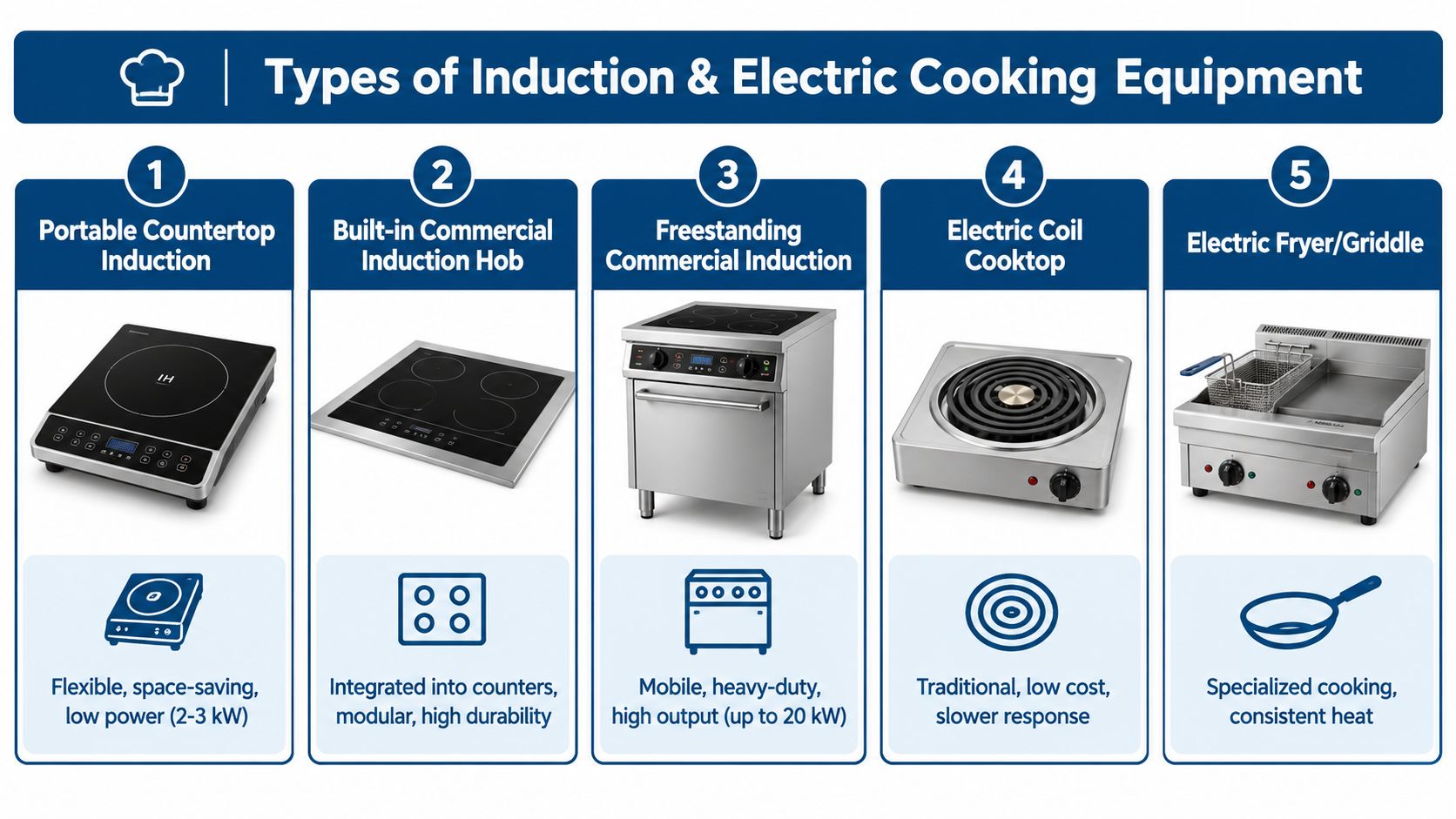
Five categories operators commonly compare
| Equipment type | Where it fits | What it's good for | Main limitation |
|---|---|---|---|
| Portable countertop induction | Bench, pass, temporary station | Extra pan position, demos, overflow | Usually not a full cookline solution |
| Built-in commercial induction hob | Integrated into benchtops or modular suites | Clean look, planned workflow, fixed stations | Best decided during design stage |
| Freestanding commercial induction cooker | Main cooking line | Self-contained pan cooking capacity | Needs proper electrical planning |
| Traditional electric resistance range | Existing all-electric kitchens | Familiar format, broad cookware compatibility | Slower response than induction |
| Commercial gas range | Traditional hot line | Open flame, familiar burner cooking | Needs gas service and different cleaning and ventilation considerations |
A useful point of comparison sits in electric cooktop and stove planning considerations, especially for operators trying to separate domestic assumptions from commercial reality.
Where bench induction fits, and where it doesn't
Portable induction units are often useful, but they shouldn't be confused with freestanding commercial ranges. A benchtop unit can solve a small workflow gap. It usually won't replace a dedicated cooking station in a kitchen that regularly runs multiple pans during service.
Built-in induction hobs sit somewhere in between. For example, the Waldorf Bold INLB8100F-B - 450mm Electric Induction Cooktop Low Back Version - Bench Model is a heavy-duty bench model with a 450 mm width, 1 x 5 kW full area induction zone, a 270 mm diameter square induction zone, 6 mm thick ceramic glass cooking surface, automatic pan detection, and infinitely variable power control. That makes it a useful reference point for operators considering modular induction within a coordinated cookline rather than a fully freestanding range format.
Some kitchens need one extra controlled pan position. Others need a whole pan-cooking section. Those are different equipment decisions.
Operators working through refit ideas sometimes also find value in broader layout inspiration such as top kitchen design ideas. The commercial answer will still depend on services, output, and compliance, but the planning questions often start in the same place.
How to Size Cooking Capacity for Peak Service
The first sizing question isn't “how many zones would suit the kitchen?” It's how many pans need to be cooking at the same time during the busiest production period. That one change in wording usually leads to a better specification.
A four-zone cooker can be too much, too little, or completely wrong. If the menu only needs two active pans but each pan needs strong recovery and room for larger cookware, two better-matched positions may outperform a higher zone count. On the other hand, a venue with several simultaneous sauté and sauce tasks can outgrow a compact setup very quickly.
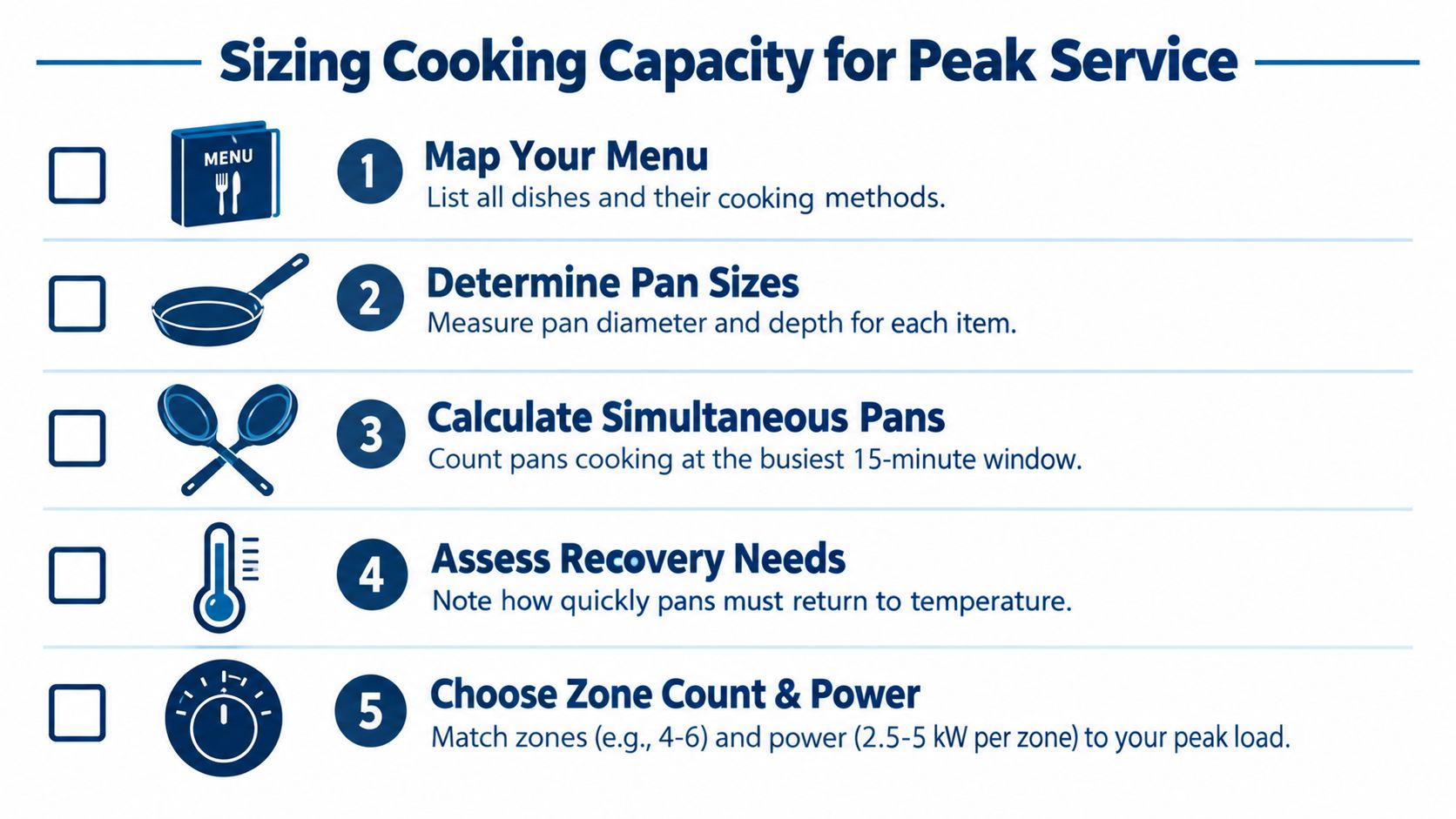
Questions that produce a usable capacity brief
A practical planning exercise is to review the kitchen's busiest service window and write down what's happening pan by pan.
-
Menu first
- List dishes that need pan cooking during service.
- Separate regular menu items from occasional tasks that can happen elsewhere.
-
Count simultaneous pans
- Look at the busiest run, not the average quiet patch.
- Count how many pans are active at once, including finishing and holding tasks.
-
Check pan sizes
- Wide sauté pans, stock pots, and smaller saucepans won't suit every zone equally.
- Pan diameter matters because induction performance depends on cookware matching the zone.
-
Think about recovery
- Some kitchens need quick temperature recovery between orders.
- Others run steadier, longer pan work where absolute speed matters less than consistency.
A related planning framework appears in equipment planning for consistent meal service, and it applies well here because induction should be sized around service flow, not brochure features.
What often gets missed
Operators often focus on the number of zones and miss the operational detail around them:
- Individual zone output: Two zones with stronger usable output can be more practical than more zones with compromises.
- Staffing pattern: If one chef can't comfortably manage four active pans during peak service, extra zones may not add real productivity.
- Line position: A cooker can be technically capable but awkwardly placed near the pass, fryer bank, or prep return.
- Adjacent landing space: Pans need safe set-down room. A cooker without workable side space can slow service.
A common issue seen in kitchen planning is over-specifying cooking positions and under-planning the space around them.
A simple decision filter
If the kitchen can answer these five points clearly, model selection gets easier:
- Peak simultaneous pans
- Typical pan diameters
- Whether all zones need to run hard at once
- Expected speed of response
- Available line space for cooking and landing
That gives a supplier, designer, or electrician something concrete to work from. Without that brief, the risk is paying for capacity the team won't use, or choosing a unit that looks right on paper but struggles when service compresses.
Electrical Infrastructure and Compliance Before You Choose a Model
Friday lunch is when weak planning shows up. The new cooker arrives, the menu suits it, the line has space for it, then the electrician opens the board and the project slows down because the site cannot carry the load without upgrades.
A freestanding induction cooker has to fit three things at once. Cooking capacity, electrical capacity, and the physical kitchen. If one of those is out of step, the model is wrong for the site even if the spec sheet looks right.
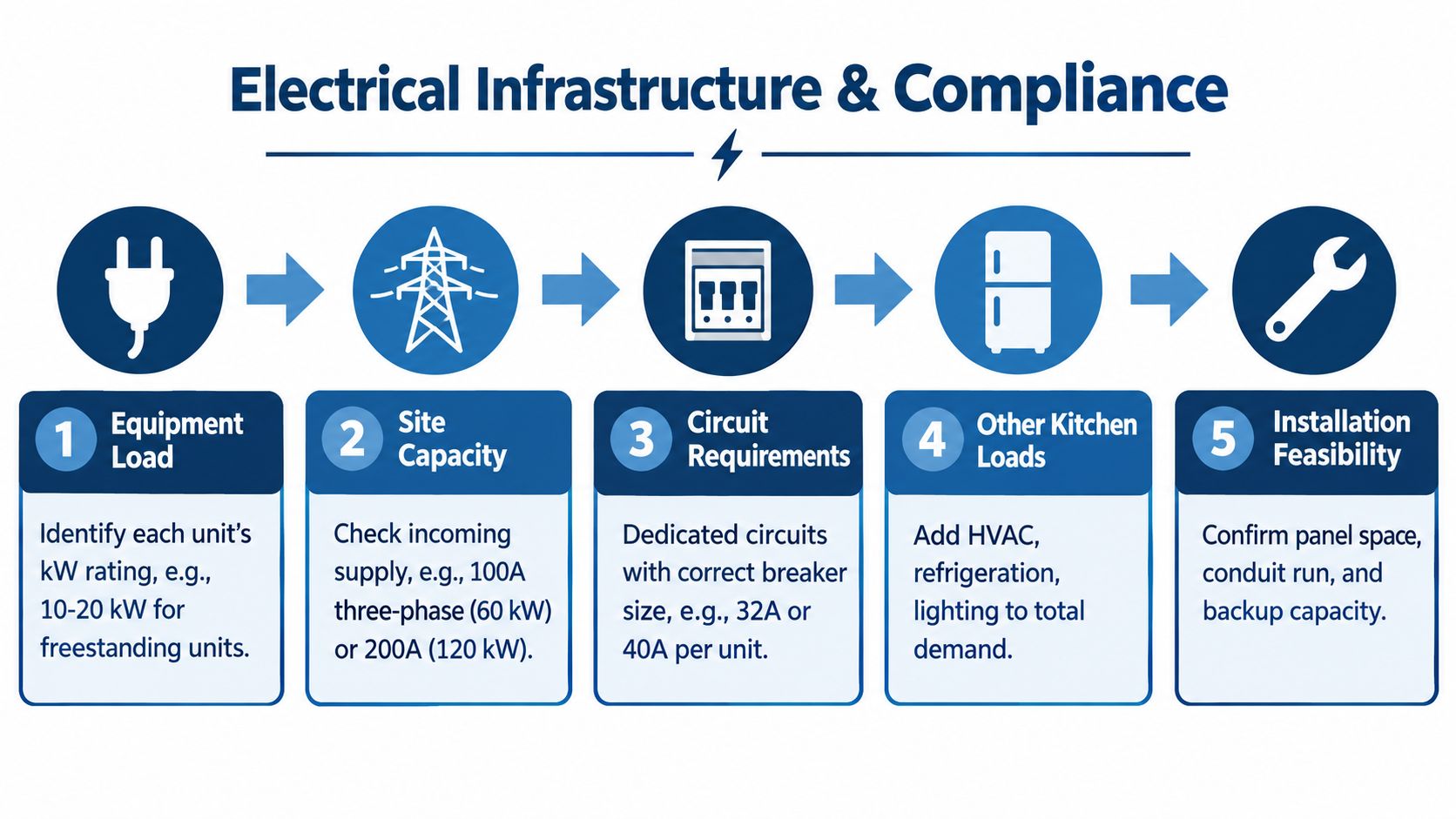
What to check before any model is shortlisted
Start with the actual unit, not a generic category. Two freestanding induction cookers with the same number of zones can have very different connected loads, supply requirements, and installation conditions.
The practical order is straightforward:
- Check the appliance load: Use the exact manufacturer specification for the model under consideration.
- Confirm the incoming supply: Find out what the tenancy or building can support now, not what someone assumes it should support.
- Allow for simultaneous kitchen loads: Refrigeration, dishwashers, extraction, hot water, combi ovens, and HVAC can all be drawing power during service.
- Confirm circuit and isolation requirements: Commercial cookers often need dedicated circuits, suitable protection, and accessible isolation.
- Bring the electrician in early: That is usually cheaper than redesigning the cookline after equipment has been chosen.
In retrofit jobs, this is often the decision point. A kitchen may have room for a larger induction unit, but not the spare capacity in the board or the budget for switchboard and cabling work. A smaller model with fewer zones can be the better fit if it matches actual simultaneous pan use and avoids major infrastructure work.
A useful reference for wider fit-out sequencing is commercial kitchen installation planning, especially where electrical, stainless, extraction, and equipment decisions need to line up.
New Zealand compliance context
New Zealand treats these units as commercial electric cooking ranges or hobs. They need to comply with IEC 60335-2-36:2021, or the transitional earlier edition until 4/05/2027. That same standard covers commercial kitchen settings such as restaurants, canteens, hospitals, bakeries, and butcheries, with rated voltages up to 250 V single-phase or 480 V for other appliances within its scope (Standards New Zealand IEC 60335-2-36:2021).
For operators, the takeaway is simple. Choose and commission the unit as commercial equipment. Do not treat it like a domestic hob on legs.
Marking and fixed-wiring questions worth asking
WorkSafe guidance matters here as well. Products sold in New Zealand must meet safety requirements, and appliances must be marked for 230 V or 400 V, or a range including those voltages, which is directly relevant when checking local supply compatibility for freestanding units (core appliance and fitting requirements).
Ask for these details before approving a model:
- Voltage marking
- Compliance documentation
- Manufacturer installation requirements
- Whether the unit is intended for commercial fixed installation
- Any site limitations that could affect sign-off, warranty, or insurance
In our experience, the expensive mistakes are usually boring ones. The cooker gets chosen around menu ambitions, then the electrical reality turns a straightforward replacement into a wider project. Getting the infrastructure checked first keeps the shortlist honest.
Kitchen Design Ventilation and Installation Considerations
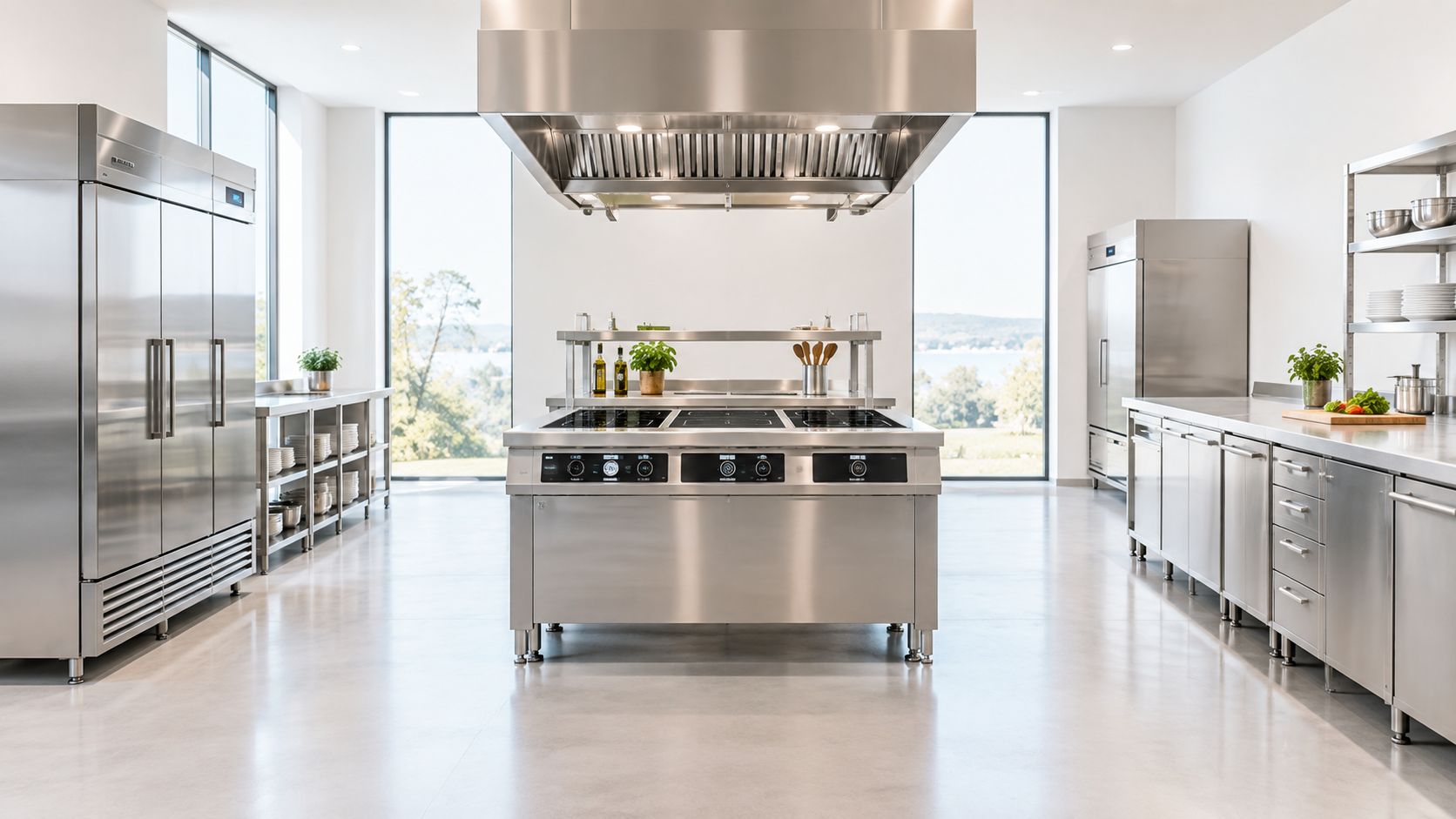
A freestanding induction cooker has to work with the rest of the kitchen, not just fit the menu. That includes extraction, prep flow, refrigeration access, staff movement, clearances, service access, and whatever equipment may be added later. In a new kitchen, those requirements can be planned from the outset. In a retrofit, the available electrical capacity often decides what's realistic before layout preferences do.
Ventilation is one of the most misunderstood parts of induction planning. Induction does not automatically remove the need for commercial kitchen ventilation. Ventilation depends on the cooking process, the equipment around it, and the installation as a whole.
New build versus retrofit
In a new build, a design team can align the induction decision with:
- Incoming electrical supply
- Extraction design
- Cookline layout
- Prep and landing space
- Future expansion allowance
In a retrofit, the questions are usually tighter. Can the board support the intended unit? Can circuits be run without major shutdown? Does the new cooker force other equipment to move? Those are planning questions, not sales questions.
For a household example of how material choices interact with kitchen use, durable kitchen and wardrobe surfaces can be a useful reference point. In commercial spaces, the same mindset applies, except surfaces also need to support cleaning routines, impact resistance, and service access.
Installation details that need coordination
For New Zealand installs, most induction hobs need a dedicated higher-capacity circuit rather than a standard outlet. Consumer reports that common installations use a 32-amp or higher circuit breaker, a dedicated 6 mm cable, and a separate isolation switch within reach of the cooktop because these appliances draw far more current than typical household circuits (Consumer NZ on moving to induction cooking).
Manufacturer installation instructions sold into the New Zealand market also state that an omnipolar switch with a minimum 3 mm contact opening must be incorporated in the fixed wiring, in line with AS/NZS 3000 requirements (Elba induction hob user and installation instructions).
A useful technical reference for ventilation context sits in commercial kitchen exhaust hood considerations, because cooker placement and extraction planning usually need to be resolved together.
Why SACH Design matters here
SACH Design is relevant because induction selection shouldn't happen in isolation. A freestanding induction cooker affects electrical infrastructure, extraction decisions, line spacing, adjacent refrigeration, and prep circulation. In a well-run project, those pieces are coordinated before the unit arrives on site.
Cookware Compatibility Cleaning and Daily Maintenance
Cookware is often the part that trips a project up late. The cooker arrives, the electrical work is done, then the kitchen finds half the sauté pans either do not register properly or do not sit flat enough to transfer heat well. On induction, pan fit affects day-to-day output just as much as the number of cooking zones.
Start with the pan base, not the badge on the box. A magnetic base is the minimum requirement, but it is not the whole story. Commercial kitchens get better results from pans with a flat, stable base that matches the zone size reasonably well. A small pan on an oversized zone can cycle poorly on some units. An oversized stockpot can also reduce responsiveness if the cooker is not designed for that load.
That matters most in busy service, where capacity is really about simultaneous usable pans, not just how many circles are printed on the glass.
If the venue is already reviewing replacement pans, stockpots, or sauté ware, it helps to assess them alongside the cooker choice. A mixed battery of old aluminium pans, lightweight stainless, and a few induction-ready pieces usually leads to uneven results across the line. For kitchens updating both at once, these commercial cookware sets and kitchen cookware options are a practical starting point for checking induction-suitable ranges.
Surface care affects service life
Induction tops are usually simpler to wipe down than open burners because the surface stays flatter and spills are easier to see. The trade-off is that the glass-ceramic top shows poor habits quickly. Dragged pans, burnt sugar, carbon on pan bases, and the wrong chemicals all shorten the tidy life of the unit.
In our experience, the kitchens that keep induction units looking good are not spending more time cleaning. They are using the right method early, before residue bakes on.
Daily habits that prevent avoidable wear
- Keep pan bases clean and dry: Carbon, grit, and moisture mark the surface and reduce clean contact with the zone.
- Lift pans instead of sliding them: This is one of the quickest ways to avoid scratches.
- Clean spills early: Sugary, starchy, and oily residue gets harder to remove once reheated through multiple services.
- Wait until the surface is safe to clean: Follow the unit instructions, especially if a scraper or specialised cleaner is specified.
- Use products approved for ceramic induction tops: General stainless cleaners and abrasive pads are a common cause of surface damage.
A flat induction surface is straightforward to wipe between jobs, but burnt-on residue still needs the method specified for that model.
One more practical point. Daily maintenance should be matched to how hard the unit will be used. A café using one or two zones during short peaks can get away with a simpler cleaning routine than a production kitchen running several pans hard across lunch and dinner. That is the same three-way fit seen elsewhere in the decision. Cooking load, electrical capacity, and kitchen design all matter, and the cookware and cleaning plan should match the way the cooker will be used.
Choosing the Right Freestanding Induction Cooker for Your Venue and Next Steps
The right freestanding induction cooker depends on the venue's service style more than the headline format. A restaurant with regular sauté work may need a different zone configuration from a café that only needs extra pan capacity during short peaks. Hotels, schools, aged care kitchens, marae, and institutional sites often weigh consistency, throughput, and staff usability differently from à la carte kitchens.
Venue fit matters more than labels
Many operators choose based on a mix of these questions:
- Restaurants and bistros: How many active pans run during the busiest service push?
- Hotels and institutions: Does the cooker need to support repeatable batch production across shifts?
- Caterers and event venues: Will the unit serve a fixed line, or does the kitchen layout change regularly?
- Schools, hospitals, and aged care: Are simple controls and predictable operation more important than maximum flexibility?
- Marae and community kitchens: Can the site infrastructure support the intended load without compromising other equipment?
A freestanding unit that looks generous on paper can still be wrong if it overloads the electrical plan or interrupts line movement. The better outcome is usually the one that balances pan capacity, control style, and connected load with the service pattern.
Blue Seal and Waldorf considerations
Blue Seal and Waldorf both sit naturally in the commercial conversation for operators wanting established cooking brands rather than improvised solutions. In practice, the trade-off often comes back to how the unit fits the rest of the cookline, what configuration is needed, and how the electrical and installation requirements line up with the project.
For operators comparing options, these resources are the useful starting points:
- Blue Seal Induction Cooktops collection
- Waldorf Induction Cooktops collection
- Blue Seal commercial cooking content
- Waldorf commercial cooking content
- Commercial kitchen design articles
One practical option among those planning routes is Simply Hospitality, which supplies commercial induction equipment from brands including Blue Seal and Waldorf and can help align product selection with the wider kitchen brief.
Choosing a freestanding induction cooker isn't only about how the kitchen wants to cook. It's about whether cooking capacity, electrical capacity, and kitchen design all work together.
Hospitality helps New Zealand hospitality operators compare commercial induction options, review cooking-line requirements, and narrow down equipment that suits the site rather than just the wish list. For practical advice on freestanding induction cookers, related cookline equipment, and design planning, visit Simply Hospitality.