

How Does a Blast Chiller Work in a Commercial Kitchen
A pot of stock has finished cooking, the next catering batch needs the bench, and the storage fridge is already full. A blast chiller is commercial refrigeration equipment that rapidly removes heat from hot or warm food using controlled refrigeration and high-velocity airflow. Its job is to make cooling a managed production step, rather than leave staff relying on a crowded fridge and guesswork.
For chefs, caterers and kitchen managers, the important question isn't just how does a blast chiller work. It's whether the equipment can cool the kitchen's actual food loads safely, fit the preparation schedule and hand finished batches over to suitable refrigerated storage.
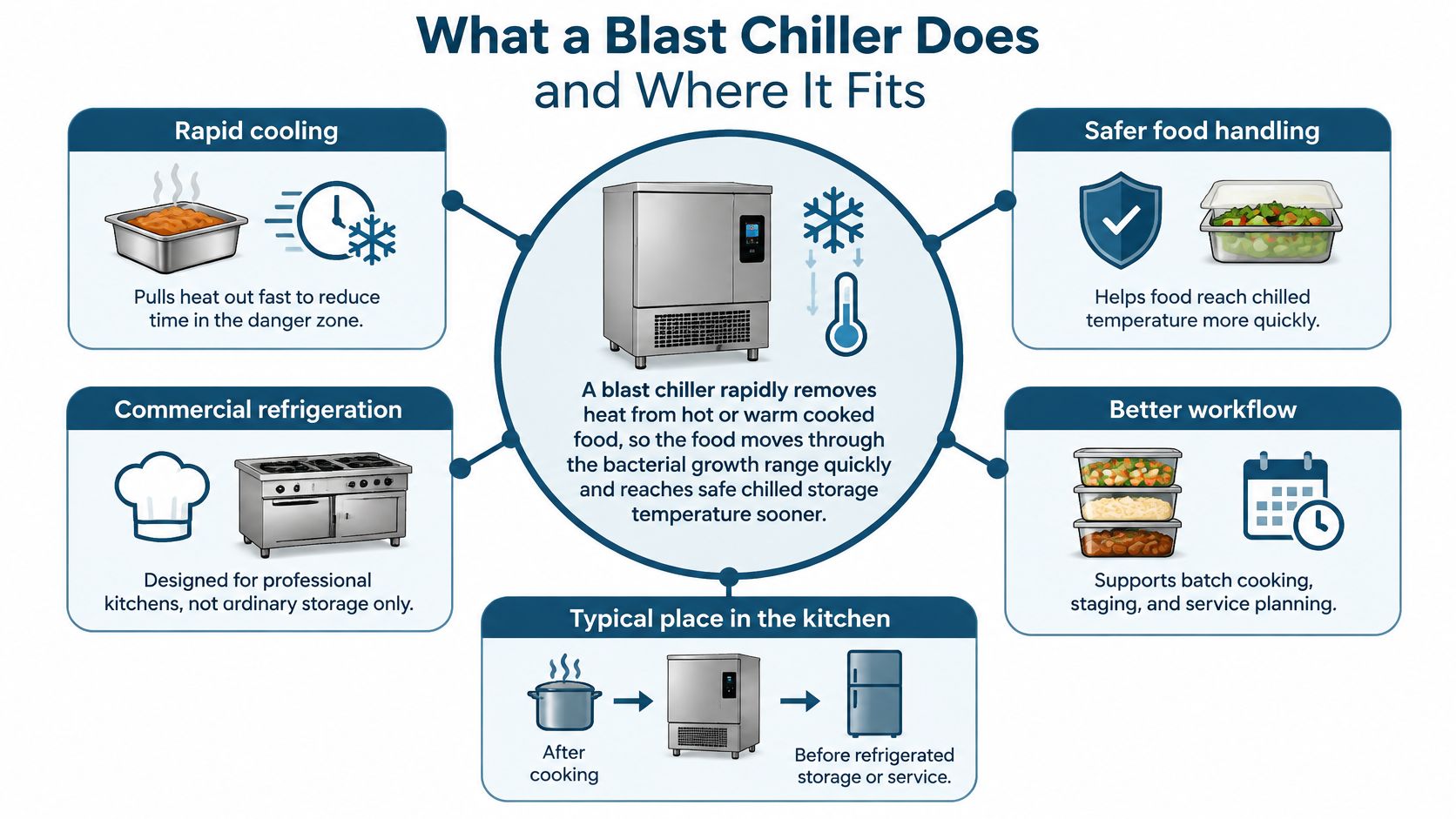
What a Blast Chiller Does and Where It Fits
A blast chiller controls how quickly heat leaves cooked food. It sits between cooking and storage, helping operators bring prepared food down to a suitable chilled condition before holding it for later use.
Consider a catering kitchen preparing soup ahead of an event. The cooking vessel suits production, but it isn't necessarily a suitable cooling container. Staff need to divide the soup into manageable trays, chill it under a controlled process, then package, label and store it.
MPI's food-safety guidance identifies 5°C to 60°C as the temperature danger zone and recommends measures including shallow, heat-conductive trays, smaller portions and improved air circulation to accelerate cooling. The machine and the loading method work together.
Four jobs that shouldn't be confused
- Blast chilling removes heat rapidly from cooked food before refrigerated storage.
- Conventional refrigeration primarily maintains chilled food at its storage temperature.
- Blast freezing rapidly freezes food intended for frozen storage.
- Standard food storage holds food that has already completed its cooling or freezing process.
A useful analogy is a fridge keeping a cold drink cold, while an ice bath actively cools a hot pot. A blast chiller performs that active heat-removal role with refrigeration and moving air.
Practical distinction: A blast chiller is production equipment, not simply extra fridge space.
That distinction matters in cook-chill production, batch preparation, catering and institutional kitchens. Food can be prepared ahead, but only within its established storage life and food-safety procedures. The wider cold-chain management process still includes handling, packaging, storage and transport after chilling.
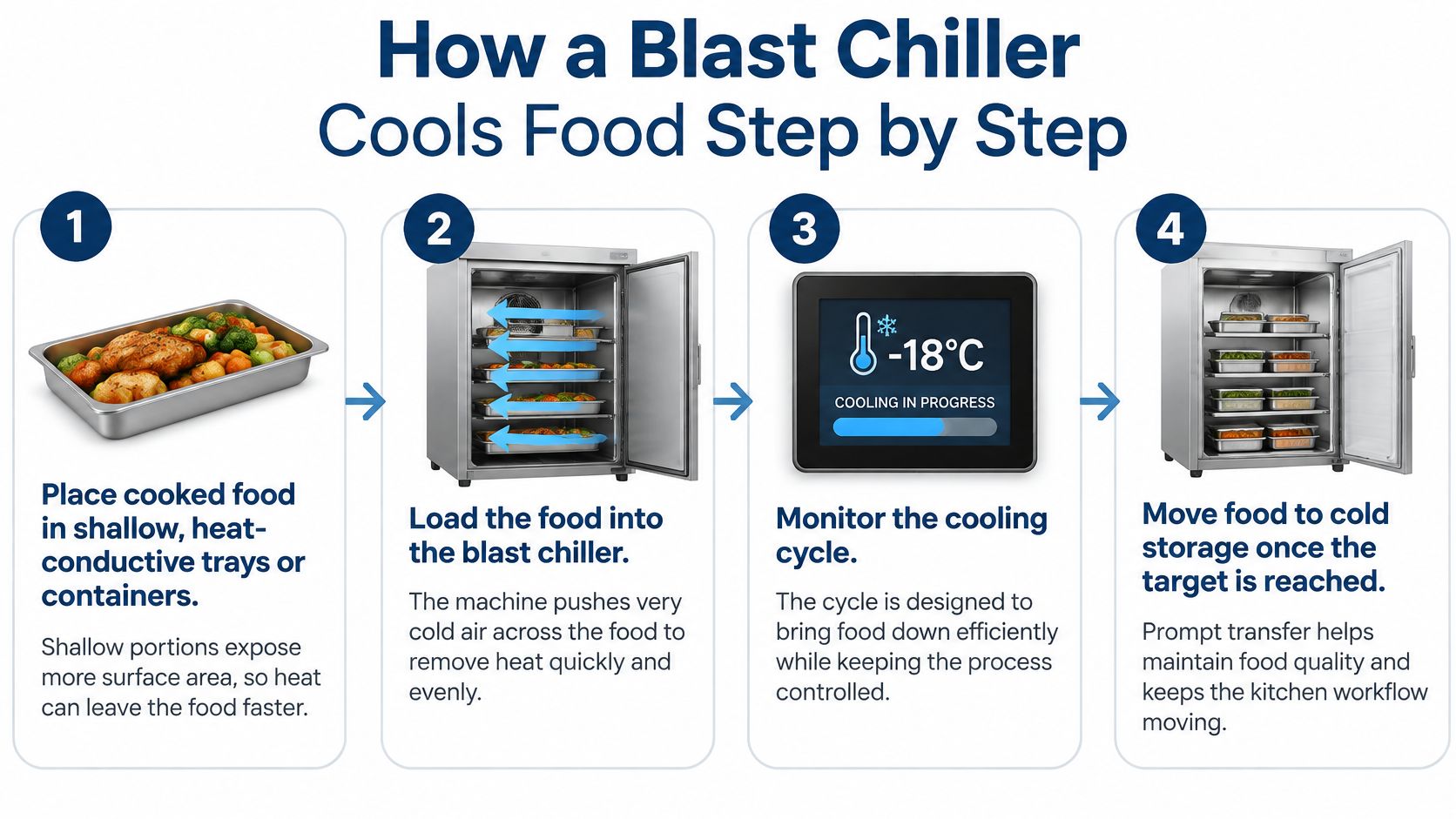
How a Blast Chiller Cools Food Step by Step
The cooling cycle combines a refrigeration circuit, moving air and temperature control. Food preparation and loading determine whether those components can do their job properly.
From cooking to controlled cooling
- Place food in suitable trays. Shallow, heat-conductive containers allow heat to leave more readily than deep, densely filled vessels. Arrange portions so circulating air can reach exposed surfaces.
- Select the appropriate programme. Staff choose a cycle suited to the food, loading arrangement and manufacturer's instructions. A delicate pastry component and a dense cooked joint shouldn't automatically receive the same treatment.
- The refrigeration circuit removes heat. The compressor raises the refrigerant's pressure, the condenser releases collected heat outside the cabinet, and the evaporator absorbs heat from the air inside. That's why ventilation around the equipment matters.
- Fans circulate cold air around the load. Moving air continually replaces the warmer air beside the food's surface. Blocked airflow reduces the benefit, even when the refrigeration system is working correctly.
- Heat travels out from the food. Heat moves from the warmer interior towards the cooler surface, then into the circulating air. The centre of a thick, dense portion generally takes longer to cool than its outside.
- Temperature monitoring guides the cycle. Where fitted, a core probe reports food temperature to the controller. Timer-based programmes need particular care because elapsed time alone doesn't prove that the centre has reached its target.
- Transfer the finished load to storage. Once the required food temperature has been verified, staff move it into appropriate refrigerated storage, following the kitchen's packaging and labelling procedure.
MPI's cooling guidance recognises blast chilling alongside smaller portions, thin layers, conductive trays and rack positioning as ways to accelerate cooling. Those supporting measures aren't optional extras when a difficult load needs them.
Reading the display correctly
Staff should understand the selected programme, whether the display shows cabinet air or food-probe temperature, and what the cycle-end signal means. A cold cabinet doesn't prove that a dense product has cooled adequately.
A clean, calibrated penetration thermometer remains useful for independent checks and products without a connected probe. The digital thermometer guide helps distinguish suitable tools from devices that only measure surface temperature.
Actual performance rests on food thickness, load size, container type and equipment capacity. A programme name can't compensate for unsuitable loading.
MPI Cooling Targets and Time Limits You Must Meet
The MPI cooling requirements set the following limits for potentially hazardous food: cooling from 60°C to 21°C within 2 hours, then from 21°C to 5°C or below within a further 4 hours, completing the process within 6 hours in total.
| Stage | Temperature range | Time limit | What to record |
|---|---|---|---|
| Start of cooling | 60°C | Timing begins when food reaches 60°C | Time food reached 60°C |
| Stage one | 60°C to 21°C | Within 2 hours | Time food reached 21°C |
| Stage two | 21°C to 5°C or below | Within a further 4 hours | Time food reached 5°C |
| Overall process | 60°C to 5°C or below | Within 6 hours in total | Discard if 5°C is not reached within 6 hours |
The stages are separate checks, not permission to use the entire allowance however convenient. Staff need to demonstrate that the first stage succeeded as well as recording the final result.
Speed matters because bacteria can multiply while cooked food remains warm. A batch that feels cool around the edges may still have a warm centre, particularly with soup, curry, rice or a thick sauce.
Make compliance part of the production method
The kitchen's applicable Food Control Plan should describe the cooling method, monitoring, records and corrective action. A blast-chiller programme doesn't replace that procedure, and a manufacturer's advertised cycle isn't proof that a particular recipe and loading pattern will comply.
Food reaching the intermediate cooling point should continue cooling in a refrigerator or chiller, rather than remain on the bench. Protection from contamination must continue throughout: separate raw and cooked food, use clean utensils, and select covers or protective arrangements that don't undermine the validated cooling method.
Food-safety check: Record the food's temperature, not just the machine's setpoint.
A workable validation process starts with the slowest-cooling product and position. Staff use a calibrated probe at the centre of the deepest or densest portion, then check whether the proposed loading method achieves every required stage.
Keep the resulting time-and-temperature records with the kitchen's food-safety documentation. The commercial kitchen HACCP planning guide provides useful context for linking monitoring to corrective action.
If cooling fails, staff should follow the documented corrective procedure rather than assume another cold cycle will rescue the batch. The discard rule in the table is a food-safety limit, not a quality preference.
Blast Chiller vs Commercial Refrigerator for Hot Food
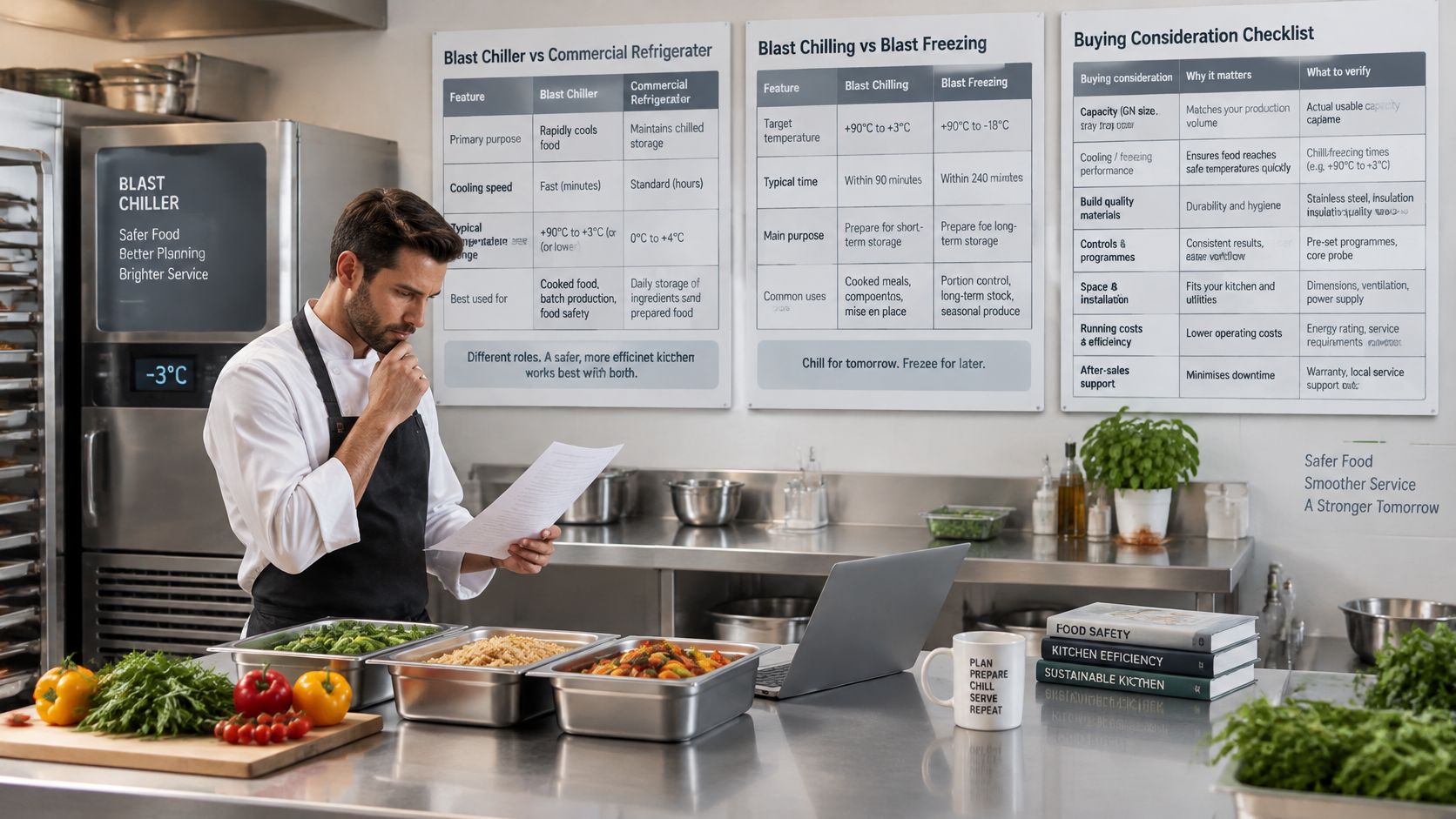
A caterer cooling batches of soup and sauce while storing ingredients for daily service has two different jobs to manage. A blast chiller handles hot production loads; a commercial refrigerator holds chilled food. The table compares their typical roles, since specifications vary by model.
| Feature | Blast chiller | Commercial refrigerator |
|---|---|---|
| Primary purpose | Cool cooked food quickly before storage | Hold food at safe storage temperatures |
| Cooling speed | Designed for rapid heat removal under a selected programme | Primarily designed to maintain temperature |
| Air circulation | Strong forced airflow across appropriately spaced trays | Storage-focused airflow, with design differing by model |
| Handling hot food | Accepts suitable hot loads within stated loading instructions | Hot loads increase cabinet demand and can warm stored stock |
| Temperature monitoring | Food probes and cycle records on suitably equipped models | Cabinet display is common; food-probe functions need checking |
| Production applications | Cook-chill, batch preparation and portion cooling | Daily storage, preparation and service |
| Storage suitability | Cooling cycle followed by transfer to storage | Main holding space for chilled food |
| Equipment cost | Obtain a quote for the required processing specification | Compare equivalent storage capacity and features, not cabinet size alone |
MPI's temperature-recording guidance distinguishes controlled cooling from maintaining safe holding conditions. A large, hot load in an ordinary refrigerator can cool slowly and warm food already in the cabinet.
The stockpot problem
A large pot of hot stock adds heat to the cabinet and has relatively little surface area for its volume. That combination can slow cooling while putting nearby chilled ingredients at risk of warming.
Probe the centre of the largest pan. The surface can look cool while the core is still warm, so assess cooling with temperature measurements.
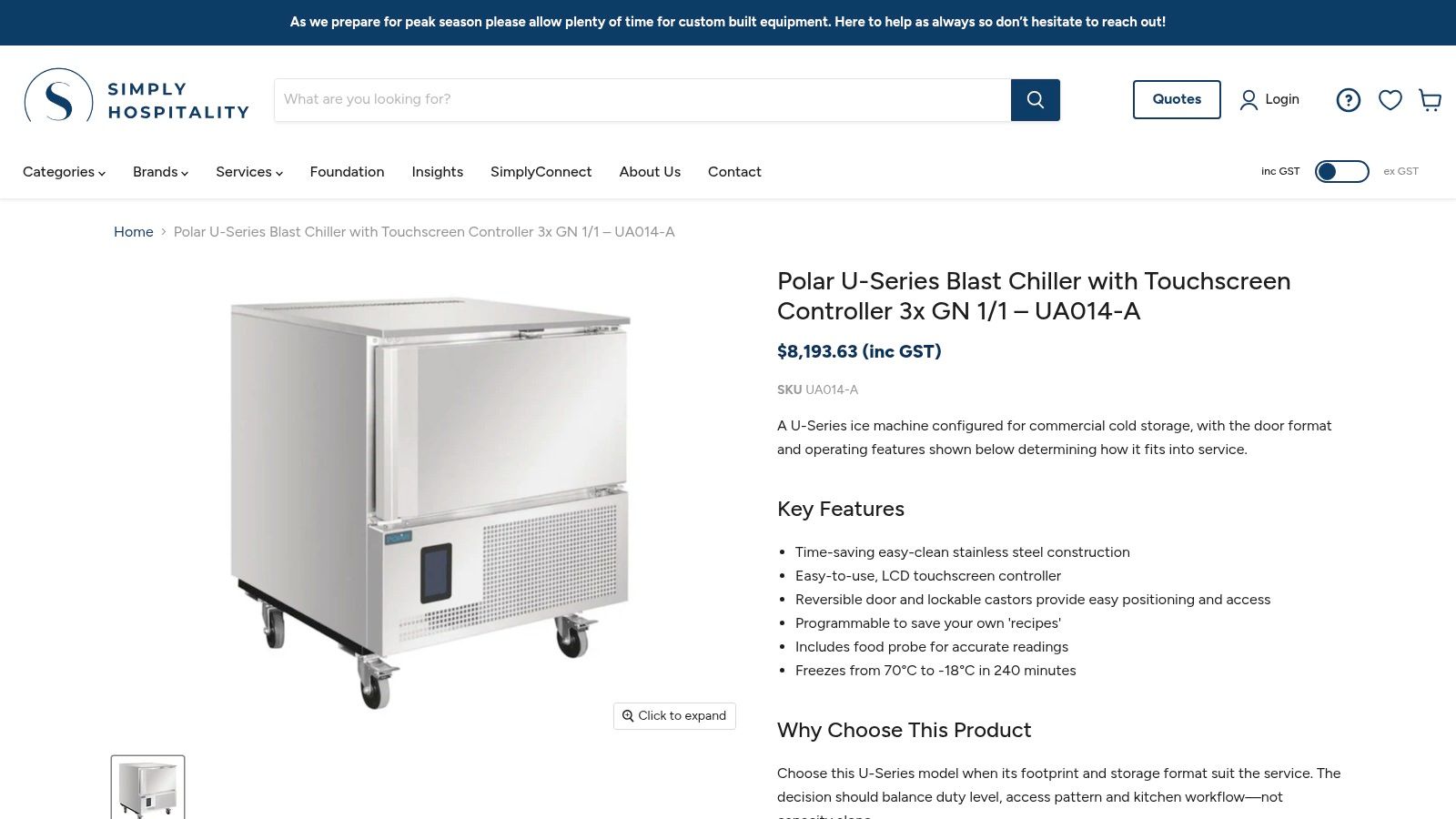
The Polar U-Series Blast Chiller with Touchscreen Controller 3x GN 1/1, UA014-A is one product to compare when assessing blast-chiller options. Check that the food load and installation space suit the kitchen's requirements.
A caterer preparing soup and sauce batches alongside daily storage may need both types of equipment. The commercial fridge selection guide can help assess storage capacity separately from rapid-cooling needs.
Blast Chilling vs Blast Freezing Explained
A batch of stock made for next week's service may need freezing; one intended for tomorrow may be better held chilled. The choice affects the food's texture, storage and handling plan.
| Factor | Blast chilling | Blast freezing |
|---|---|---|
| Intended final temperature | Refrigerated-storage target under the food-safety procedure | Frozen-storage target set by the freeze programme |
| Main objective | Rapid cooling before refrigerated storage | Rapid freezing before longer-term frozen storage |
| Ice crystal formation | Food isn't intended to freeze | Faster freezing tends to produce smaller crystals, but doesn't eliminate damage |
| Storage requirements | Refrigerator or chiller | Suitable freezer, with thawing planned where required |
| Typical applications | Cooked meats, sauces, soups and batch preparation | Stock portions, prepared meals and make-ahead components |
| Equipment | Chill-only equipment or combined chiller/freezers | Freeze-only equipment or combined chiller/freezers |
Freezing may help preserve texture by limiting ice-crystal size, but the result after thawing still depends on the recipe, portion size, packaging, frozen storage and thawing method. A technically successful cycle does not guarantee the food will suit the menu.
A sauce planned for an upcoming service may suit chilled storage within its validated life. Soup portions intended for later use may be better suited to freezing. Neither method extends safe use indefinitely.
Check both functions separately
Some cabinets chill and freeze; others provide only one function. Check the technical documentation for the cycle capacity of each function and whether it suits the loads your kitchen needs to process.
For occasional freezing, a combined cabinet may be practical. If freezing is part of daily production, check whether its cycle capacity leaves enough time for chilling work. A combined machine can perform both jobs, but may not perform them at the same time.
Product trials can help assess delicate components. Texture after thawing matters as much as whether the food freezes successfully.
Which Foods Suit Blast Chilling and How to Load Them
Blast chilling suits a wide range of prepared foods, but the loading method should follow the product rather than a habit of filling every available pan.
- Cooked meats: Assess joint thickness and whether hygienic portioning before chilling fits the production method. A large joint needs a different plan from sliced portions.
- Sauces and stocks: Divide the batch between suitable shallow pans rather than leaving it in the cooking vessel.
- Soups: Spread the load across containers and account for dense ingredients, not just the surrounding liquid.
- Rice and pasta dishes: Use thin, even layers instead of compact mounds, following the recipe's food-safety procedure.
- Prepared vegetables: Arrange pieces without unnecessary piling and check that the selected programme suits their texture.
- Bakery and pastry components: Use programmes suitable for delicate products, with separate handling where strong airflow or aggressive cooling could affect the finish.
- Ready-made meals: Check the thickest component and the container's suitability for the process.
- Catering batches: Standardise portion weights and tray loading so staff can repeat the validated method.
Why tray depth matters
Food thickness determines how far heat must travel before it reaches an exposed surface. A shallow layer shortens that path, while a deep pan can leave the middle warm after the edges have cooled.
Air also needs a clear route through the cabinet. Overloading shelves, stacking containers or pushing pans against airflow openings can obstruct circulation and undermine the selected programme.
Choose food-contact-safe, temperature-suitable containers that fit the racks and the intended handling process. The kitchen storage container guide helps distinguish storage needs from containers suitable for preparation and cooling.
A simple loading improvement is to divide a large batch before it enters the machine. That puts the centre of each portion closer to the surface, provided portioning remains hygienic and consistent with the manufacturer's instructions and the kitchen's food-safety procedure.
Costs, Limits and Whether a Blast Chiller Pays Off
A blast chiller can support more controlled cooling, predictable batch scheduling and preparation outside service peaks. It may also reduce avoidable waste when poor cooling or disorganised production currently causes food to be discarded.
Those benefits aren't automatic. Staff still need a repeatable method, enough storage for the finished batches and a production schedule that uses the equipment sensibly.
Count the whole ownership cost
- Purchase and installation: Include access, electrical work where necessary and suitable positioning.
- Electricity: Assess expected cycle use rather than assuming cabinet size predicts consumption.
- Cleaning and maintenance: Allow staff time for cleaning probes, trays, seals and accessible surfaces, plus professional maintenance under the manufacturer's instructions.
- Space and ventilation: Account for working access and heat rejection, not just the footprint.
- Training: Staff need to understand loading, programme selection, monitoring and failed-cycle responses.
Illustrative calculation only: Suppose a catering kitchen avoids $50 in preventable food waste weekly through improved cooling and production planning. Across 50 operating weeks, that represents $2,500 before equipment costs, not a guaranteed saving or an equipment payback calculation.
Rapid cooling doesn't establish shelf life
MPI's microbiological guidance explains that some bacteria can grow during chilled storage and potentially reach unsafe levels or produce toxins. Relevant concerns include Clostridium perfringens in meat and Bacillus species in foods including cereals and dairy products.
Blast chilling doesn't sterilise food, reverse contamination or independently establish a safe storage life. Batch-cooked food doesn't become safe for any number of days because it passed through a blast chiller.
Shelf life needs a defensible basis for the recipe, packaging and storage conditions. Hygienic handling, refrigerator control, labelling and an appropriate use-by period remain necessary.
For a small cook-to-order kitchen cooling little food, shallow trays and an ice bath may already provide an adequate validated method. A purchase makes more sense when the existing method creates a genuine safety, labour or production constraint.
Choosing the Right Blast Chiller for Your Kitchen
A blast chiller needs to keep pace with the food leaving the ovens. Check how many batches you need to cool, the pan sizes and weights, and when each batch is ready. If a Unox or Convotherm oven finishes another load while the chiller is still running, that delay can affect the production schedule.
| Buying consideration | Why it matters | What to verify |
|---|---|---|
| Chilling capacity in kilograms | Sets the food load per cycle | Rated capacity, test conditions and food type |
| Tray and gastronorm compatibility | Determines how pans fit and how much food can be loaded | Supported pan sizes and rack spacing |
| Cycle performance | Shows whether the unit can meet your cooling schedule | Published cycle times and the test load behind them |
| Food probe and controls | Affect how staff monitor and run cycles | Probe type, programme options and any logging capability |
| Blast freezing function | Matters if the kitchen also needs to freeze food | Whether a separate freeze programme is available |
| Cabinet dimensions | Determines whether the unit can be delivered and positioned | External dimensions, door swing and delivery route |
| Warranty and service support | Affects the response if the unit needs attention | Warranty terms, service arrangements and parts availability |
| Daily production volume | Helps match the unit to the kitchen's workload | Batch count, peak periods and loading schedule |
Compare rated capacity per cycle
The Friginox MX30AT7R 10-Tray Reach-In Blast Chiller / Freezer is one model to consider. Check its current product specifications for rated chilling and freezing capacities, tray compatibility and cycle conditions before comparing it with other units. A tray count alone does not show how much food the machine can process in a cycle.
The Polar U-Series Blast Chiller with Touchscreen Controller 5x GN 1/1, UA015-A is another option. Compare models using the same load and cycle requirements, so the stated performance relates to the food and batch size your kitchen plans to chill.
Confirm access before ordering
Measure the doorway, delivery route and installation area before placing an order. Tipping refrigeration as it enters the premises is not covered under Simply Hospitality's warranty, so check that the unit can reach its intended position without tipping.
Read the manufacturer's test conditions alongside the cycle results. Performance for one food type or loading arrangement does not establish how a full load of dense prepared meals will cool.
Hospitality can help with equipment selection. That support does not replace the operator's food-safety procedures or qualified technical service.
Hospitality supplies commercial kitchen equipment for hospitality businesses. When discussing a blast chiller, have the proposed batch weights, tray sizes, oven schedule and installation measurements ready. These details help narrow the choice to equipment suited to the kitchen's production requirements.