

HACCP Plan for Commercial Kitchen NZ Explained
A Friday service is underway, the coolroom is full, a batch of soup is cooling beside the prep bench, and a casual staff member is moving between raw chicken and salad preparation. At that point, a HACCP plan for a commercial kitchen in NZ shouldn't be a document downloaded and filed away. It should connect the menu, workflow, equipment, staff responsibilities and records to the food safety requirements that apply to that business.
The first decision isn't which template to copy. It's identifying whether the kitchen operates under a template Food Control Plan, a National Programme, a custom Food Control Plan or another approved arrangement. Not every New Zealand commercial kitchen needs standalone HACCP certification or a separate formal HACCP plan, but every food business must manage the hazards relevant to its activities and follow its registered or approved food safety system.
What NZ Kitchens Actually Need for Food Safety
HACCP means Hazard Analysis and Critical Control Points. It's a preventive method for identifying, assessing and controlling food safety hazards before they reach a customer. The three traditional hazard groups are biological hazards, such as harmful microorganisms and contamination, chemical hazards, including cleaning chemicals and allergens, and physical hazards, such as glass, metal fragments or other foreign objects.
A final-dish check can tell a kitchen that something has gone wrong. HACCP asks where the problem could arise and which control can prevent it. That difference matters during receiving, storage, preparation, cooking, cooling, reheating, holding, service, cleaning and waste handling.
The regulatory pathway comes first
New Zealand's HACCP framework operates through the Food Act 2014. Where applicable, a food business must use a documented Food Control Plan, or FCP, designed for its particular operation to identify, control, manage and eliminate or minimise hazards affecting food safety and suitability. The plan must be written and submitted for registration with the appropriate authority, generally the relevant territorial authority for template-based plans. Registration is effective for 12 months, unless the registration authority specifies a later date, so renewal becomes a recurring compliance milestone for restaurants, cafés, caterers, accommodation kitchens and institutional food operations. These requirements apply to food offered for sale, and the Food Act replaced the Food Act 1981. Food safety regulations in NZ should be read alongside the current legislation rather than used as a substitute for official advice.
The correct pathway depends on the food activities, processes, sites and delivery arrangements. Many restaurants and cafés use a template FCP. A caterer, hotel, institution, high-volume production kitchen or multi-site operator may need a more complex arrangement, including a custom FCP or another approved food safety system.
FCP, National Programme and formal HACCP are not interchangeable
A Food Control Plan is the legal food safety plan used by many food businesses. A National Programme applies to certain lower-risk activities under a different risk-based structure. A custom FCP is developed for operations that don't fit an available template and may require independent evaluation, registration with MPI, annual renewal and an appointed verifier. The evaluator and verifier must be different people.
A formal HACCP plan may sit within one of these arrangements, but it isn't automatically the same thing as the legal registration document. MPI states that HACCP principles are mandatory within a risk-based programme, including an FCP under the Food Act 2014, while the business must still choose the pathway that matches its activities.
Operators should use the current MPI My Food Rules tool to identify the likely requirements, then confirm details with MPI, the registration authority or a suitably qualified food safety professional. A generic online HACCP template can't determine whether a kitchen's menu, production method, delivery model or multiple locations create obligations outside a simple template.
Practical rule: Start with the legal pathway, then build the food safety controls around the actual kitchen. Starting with a blank HACCP form often produces paperwork that doesn't match the floor.
The Seven HACCP Principles in Kitchen Language
MPI describes HACCP implementation in New Zealand as a seven-principle system covering the full food operation. The principles are practical when translated into decisions made by chefs, kitchen managers, duty managers and owners.
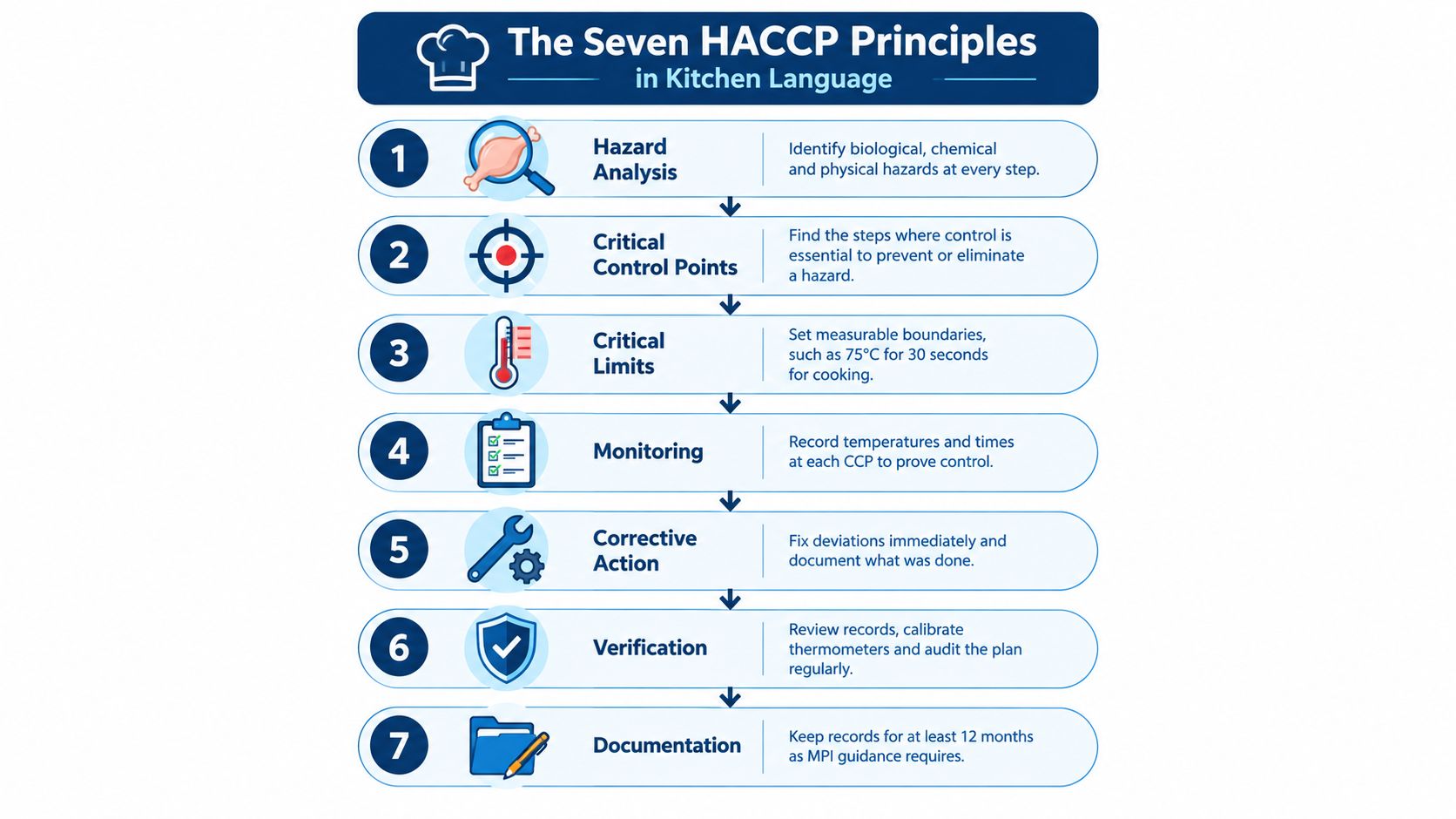
1. Conduct a hazard analysis
List biological, chemical, physical and allergen hazards at each step. Raw poultry may introduce biological hazards, sanitiser residue creates a chemical risk, and a damaged utensil may create a physical hazard. Allergen cross-contact also needs a deliberate control, even though allergens don't fit neatly into only one of the traditional three categories.
2. Determine Critical Control Points
A Critical Control Point, or CCP, is a step where control can prevent, eliminate or reduce a hazard to an acceptable level. Final cooking or controlled cooling may be a CCP for a particular process. Handwashing, supplier approval, pest control and routine cleaning are vital, but they're often managed through prerequisite programmes rather than labelled CCPs.
3. Establish validated critical limits
A critical limit separates acceptable from unacceptable operation. It must be measurable and appropriate to the food and process. A kitchen shouldn't copy a number from another business without confirming that the limit applies to its recipe, batch size, equipment and approved procedure.
4. Establish monitoring procedures
Decide what gets checked, how it's measured, who takes the reading, when it's taken and where the result is recorded. A probe reading taken during service is useful. A temperature written from memory at the end of the shift isn't reliable monitoring.
5. Establish corrective actions
The plan should state what happens when a limit isn't met. The response may involve isolating food, assessing whether it can be safely reworked, discarding it, restoring equipment control and recording the deviation. Corrective action should also address why the failure happened.
6. Establish verification procedures
Verification checks whether the system works in practice. It can include reviewing records, checking thermometer calibration, observing staff, inspecting cleaning results and reassessing the plan after a menu, equipment, supplier, layout or staffing change.
7. Establish documentation and records
MPI requires records covering hazard analysis, CCP selection, critical limits, monitoring, corrective actions and verification. The NZ Food Regulations 2015 also require relevant FCP information about the physical boundaries and layout of the food business, the activities conducted there and activities outside the business that may create risk.
The distinction between a CCP and a prerequisite programme keeps the system usable. A restaurant that calls every bench, fridge, sink and handwashing routine a CCP can create so many checks that staff start ticking boxes without thinking. A focused plan gives genuine critical steps the attention they require. Guidance on how to prevent cross contamination can support the wider prerequisite programme, but it doesn't replace the kitchen's own hazard analysis.
Mapping Risks From Receiving to Service
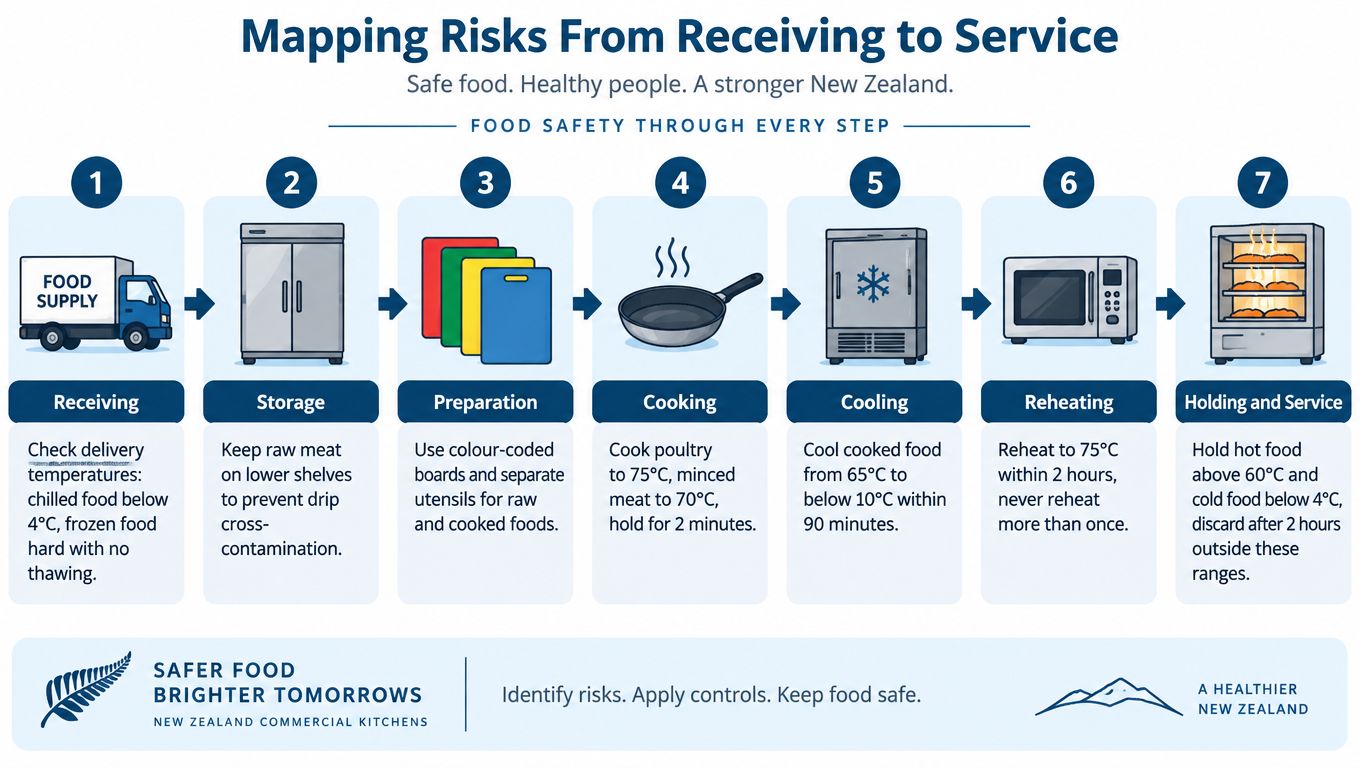
A kitchen's hazard analysis becomes more useful when the team walks the food journey physically. The flow should reflect what staff do during a quiet preparation period and during the busiest service.
Receiving and storage
At receiving, staff should check the delivery against the order, inspect packaging and assess the condition of chilled and frozen food using the procedure required by the applicable FCP or approved system. Damaged packaging, signs of thawing, unsuitable temperatures or unclear traceability information should trigger a defined response rather than being accepted because the delivery is already on the loading dock.
Storage controls depend on the food and process. Raw meat should be separated from ready-to-eat food, with storage arranged to prevent drips and contact. A full coolroom can create risks even when the refrigeration unit is working correctly, because blocked air movement, crowded shelves and poorly organised containers make control harder.
Preparation and cooking
Preparation brings hands, boards, knives, utensils and benches into contact with multiple food types. Raw and ready-to-eat foods need separation, and staff must understand when handwashing, glove changes and cleaning between tasks are required. Allergen information needs to move from the recipe and supplier label to the kitchen and service team, particularly when substitutions occur.
Cooking controls must be based on the relevant food, method and approved procedure. “Cooked” is not a measurable result. A calibrated probe and a defined monitoring method provide stronger evidence that the process has achieved the required outcome.
Cooling, reheating, holding and service
Batch cooking can create a bottleneck when food leaves the oven or range faster than the kitchen can cool it. The operator needs to assess pan depth, batch size, airflow, available refrigeration and staff responsibility. A holding fridge is designed to maintain cold food, while rapid chilling requires equipment and a process suited to that task.
Reheating and hot holding also need clear procedures. Staff shouldn't automatically reheat or serve food involved in a failed time or temperature control. They need to isolate the affected food, assess it against the applicable requirements and follow the documented corrective action.
For a wider practical resource on handling risks across work areas, operators can review ways to prevent cross-contamination in 2025, then adapt the ideas to their own workflow. A useful internal reference is cold chain management, particularly when receiving, storage, preparation and delivery are split between different staff or locations.
For a new operation using a custom FCP, MPI states that the first verifier visit must occur within 3 months of registration, while existing businesses must be visited within 6 months. Commissioning records, thermometer checks, staff competency checks and mock traceability exercises should therefore be completed before opening, not assembled after the first concern arises.
Temperature Control and Equipment That Holds It
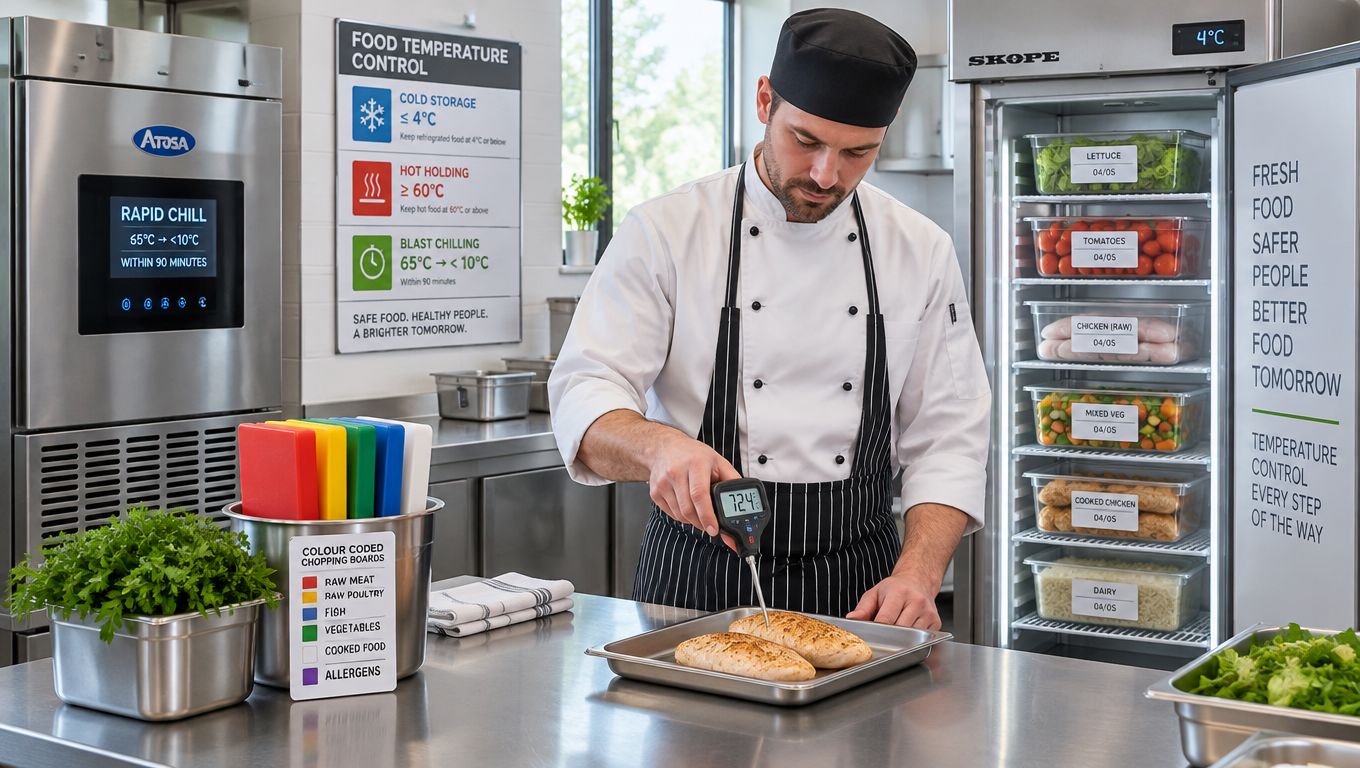
Time and temperature control sits behind many kitchen food safety procedures, but different equipment performs different jobs. A commercial refrigerator holds food cold. It isn't automatically a rapid-chilling system, and a blast chiller shouldn't be treated as ordinary storage.
Match capacity to the real service pattern
Refrigerated storage should be selected around the menu, delivery rhythm, prep volume and peak production, not only the footprint available in the fit-out. The team should consider:
- Capacity: Shelves need enough room for air movement and organised separation.
- Access: High-use ingredients should be reachable without leaving the door open while staff search.
- Monitoring: Staff need a reliable way to check and respond to operating conditions.
- Maintenance: Door seals, condenser areas, shelves, drains and internal surfaces need regular attention.
- Failure response: The plan should state what happens if equipment moves outside its required range.
SKOPE and Atosa commercial refrigeration can be considered where their capacity, configuration and service support suit the venue. Compatible models with SKOPE Connect may provide additional monitoring information, but digital alerts don't replace staff responsibility for checking food, confirming conditions and taking corrective action.
A monitoring system can show that a cabinet's condition has changed. It can't decide whether affected food is safe to retain. That decision belongs in the food safety procedure.
Separate holding, cooking and rapid chilling
Cooking equipment influences repeatability, access and monitoring. Unox, Convotherm and Turbofan ovens may suit different kitchen sizes and production styles, while commercial ranges remain practical where chefs need direct heat and flexible pan work. The selection should consider batch size, recovery, cleaning access, probe use and whether the equipment supports the documented process.
A blast chiller serves a different purpose from a fridge. It is designed to remove heat rapidly from suitable food loads, while a refrigerator is designed to keep already chilled food within its operating range. Purchasing a combi oven or blast chiller doesn't make a kitchen HACCP-compliant. The operator still needs validated procedures, trained staff, monitoring, corrective actions and verification.
Oven performance also needs checking after installation, servicing or a change in production. A practical guide to finding oven hot spots can help a kitchen investigate uneven heating, but any critical cooking limit must be validated for the actual food and process. For refrigeration planning, commercial refrigeration monitoring systems offer useful selection considerations, especially where operators need visibility across more than one cabinet or site.
The regulatory route still matters here. Businesses requiring a custom FCP must have the plan independently evaluated, register it with MPI, renew registration annually and appoint a verifier. Equipment supports that system, but it doesn't determine the legal pathway or replace operator responsibility.
Monitoring Records and Fixing Problems Fast
A workable record system captures what staff need to know, at the point where the control occurs. Depending on the applicable FCP, National Programme or other approved system, records may include refrigeration checks, cooking and cooling results, cleaning tasks, receiving checks, maintenance, training and verification activities.
The purpose isn't to create a large stack of forms. It's to show whether controls worked, identify deviations quickly and make the response consistent.
Build records around decisions
A useful monitoring sheet or digital system should identify the food or equipment, the measured result, the responsible person, the time and the required response when the result falls outside the approved limit. Retrospective entries weaken the system because staff may no longer know which food, batch or cabinet the reading represented.
MPI states that verification frequency can range from every 3 months to once every 18 months, depending on process complexity, food types and how effectively the business manages food safety. Operators should treat verification as a risk-management outcome, not as a fixed annual inspection. Monthly trend reviews and reviews after menu, equipment, supplier, layout or staffing changes can reveal repeated failures before they become normalised.
Useful management measures include:
- Temperature checks completed: Review whether required readings are taken.
- CCP deviations: Track failed controls and the food affected.
- Corrective-action closure: Check whether the cause was fixed, not just the batch dealt with.
- Cleaning failures: Look for repeated missed tasks or sanitising problems.
- Allergen incidents: Record errors, near misses and communication breakdowns.
- Supplier non-conformances: Identify recurring delivery or packaging issues.
- Traceability tests: Confirm that the business can identify relevant ingredients and affected food when required.
New Zealand's Ministry of Health estimates that approximately 200,000 people suffer foodborne illness each year. The cited common causes include incorrect storage temperatures, undercooking or inadequate reheating, cross-contamination and dirty preparation surfaces. Digital thermometer guidance for NZ kitchens is relevant when selecting tools, but a thermometer only helps when staff use it correctly and act on the result.
What to do when control fails
A warm fridge, undercooked protein, slow cooling process, allergen handling error or failed dishwasher sanitising process should start a defined response:
- Isolate affected food so it isn't used or served while the situation is assessed.
- Check the facts, including time, temperature, batch, equipment and staff actions.
- Apply the approved corrective action, which may involve safe rework, further processing, disposal or another documented disposition.
- Record the deviation where required, including what happened and what was done.
- Find the cause, such as an overloaded cabinet, shallow probe placement, incorrect chemical dilution or incomplete training.
- Prevent recurrence through maintenance, workflow changes, supervision or retraining.
Food shouldn't be automatically served, reheated or retained because disposal is inconvenient.
Illustrative HACCP Planning Framework
This table is a starting framework, not a complete legally compliant HACCP plan. Each business must adapt it to its actual menu, equipment, processes and applicable requirements.
| Process stage | Potential hazard | Control measure | Monitoring | Corrective action |
|---|---|---|---|---|
| Receiving | Unsafe delivery condition, contamination or damaged packaging | Use approved suppliers and inspect deliveries under the applicable procedure | Check delivery condition and required temperature information | Isolate or reject affected food and record the issue where required |
| Storage | Growth, drip contamination or allergen cross-contact | Separate raw and ready-to-eat foods and maintain suitable storage conditions | Check cabinet operation and storage arrangement | Move or isolate food, assess safety and investigate capacity or equipment failure |
| Preparation | Cross-contamination, allergen cross-contact or chemical residue | Separate tasks, wash hands, clean and sanitise surfaces and use controlled utensils | Observe preparation and complete required checks | Stop the task, isolate affected food, clean correctly and retrain if needed |
| Cooking | Survival of biological hazards | Follow the approved cooking method and validated limit | Measure with a suitable calibrated probe | Continue cooking where permitted by the procedure, or isolate and dispose of affected food |
| Cooling | Growth during slow cooling | Use an approved cooling method suited to the batch and equipment | Record the required time and temperature checks | Isolate food, assess against the procedure, dispose of unsafe food and investigate capacity |
| Service | Contamination, unsuitable holding or allergen communication failure | Protect food, control holding and communicate allergen information | Check holding conditions and service practices | Stop service of affected food, isolate it and correct the process |
Checklist Mistakes and Helpful Next Steps
The most common failure is copying a generic plan without walking the kitchen. A document that shows equipment the site doesn't have, omits a delivery step or ignores peak production won't protect the operation when service becomes busy.
Other warning signs include:
- Confusing FCP and HACCP certification: An FCP is part of New Zealand's regulatory framework. HACCP is the hazard-control system applied within the appropriate risk-based pathway.
- Recording without acting: A failed temperature check needs a decision, not just a tick beside a number.
- Ignoring peak demand: A fridge that works during quiet prep may struggle when staff load it with hot pans or frequent deliveries.
- Weak allergen controls: Recipe changes, substitutions and shared utensils need clear communication.
- Thin staff training: Casual and temporary staff must understand the controls they perform, including who can stop a process.
- Paperwork over practice: Records matter, but they should reflect real work rather than replace it.
The Food Act 2014 provides the legislative foundation. MPI remains the appropriate source for current requirements, including Food Control Plan guidance and food business verification information. Businesses should confirm their obligations with MPI, their registration authority or a suitably qualified food safety professional before opening or changing a process.
Simply Hospitality can help operators compare refrigeration, probes, cooking equipment, dishwashers, chopping boards, stainless steel preparation benches and cleaning supplies against the workflow that the food safety system needs to control. Visit Simply Hospitality to discuss equipment selection for a new fit-out, menu change, capacity issue or monitoring requirement.