

Choosing an Insulated Food Container for Catering
A catering job rarely falls apart in the kitchen. It slips when hot food sits too long while a van is loaded, when lids get opened three times on the road, or when the wrong pan format forces extra handling at the venue. That's why an insulated food container should be treated as part of a transport system, not as a standalone fix for temperature control.
For New Zealand operators, that matters in school lunch runs, marae catering, aged-care delivery, hotel functions, and off-site events where food has to travel and still arrive serviceable. Public-health and food-safety practice in NZ puts the focus on keeping hot food above 60°C and cold food at 5°C or below, because the container is there to help maintain safe holding conditions during transport and short-term holding. The right buying decision starts with the whole journey, from production kitchen to final service, not with a glossy insulation claim. Cold chain management for hospitality operators is worth keeping close while planning that process.
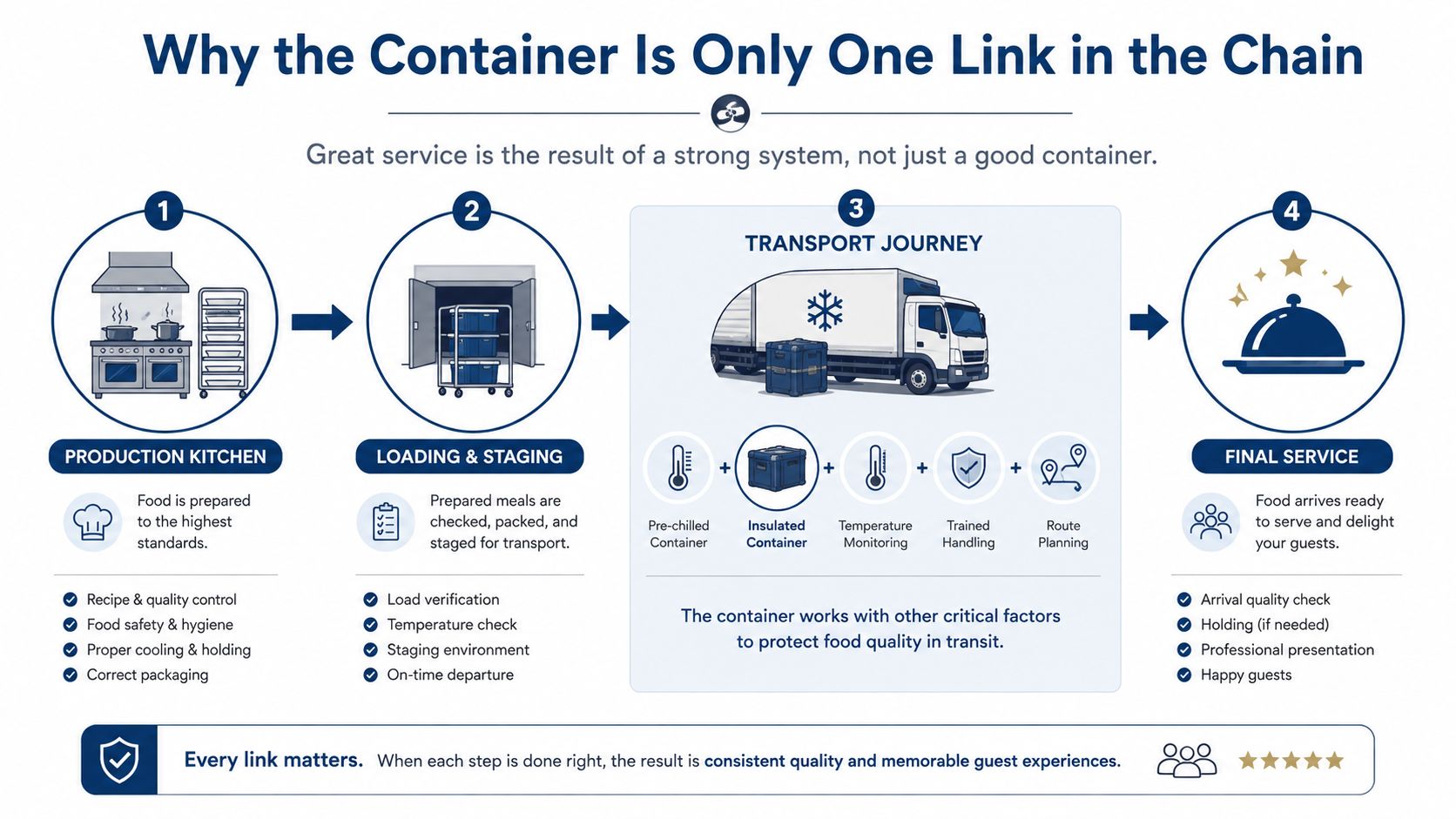
Why the Container Is Only One Link in the Chain
A caterer loading 120 meals doesn't need a box. They need a sequence that keeps food protected from the moment it leaves prep until it reaches service. If the handoff between kitchen, loading, transport, holding, and service is weak, even a solid container will only preserve a bad process for longer.
Start with the journey, not the box
The best decisions begin with the route. How far is the kitchen from the venue, how many times will staff open the carrier, and will food wait inside the container before it's plated? Those questions matter because the insulated carrier can only preserve the temperature you've already created and protected.
Practical rule: if the loading sequence is messy, the container choice is already compromised.
Operators often get caught. They buy a container for its insulation language, then discover it's awkward to stage, hard to stack, or too narrow for their pans. The result is more handling, slower loading, and more chance of quality loss before service.
For a useful external reference on transport systems, build a restaurant delivery system shows why delivery performance depends on the whole workflow, not one item of gear. That thinking is exactly right for commercial catering too. The insulated container is one link in the chain, and the chain is only as strong as the weakest handoff.
What the container must support
Hospitality businesses often find that the container has to do more than hold heat or cold. It needs to work with the pans, fit the vehicle, survive repeated handling, and still be easy to clean at the end of the shift. That's why the buying brief should cover transport, holding, stacking, and service, not just insulation.
One simple test helps. If the container doesn't make the whole journey easier, it isn't the right one.
Front-Loading, Top-Loading and GN-Compatible Formats
Front-loading carriers suit organised runs
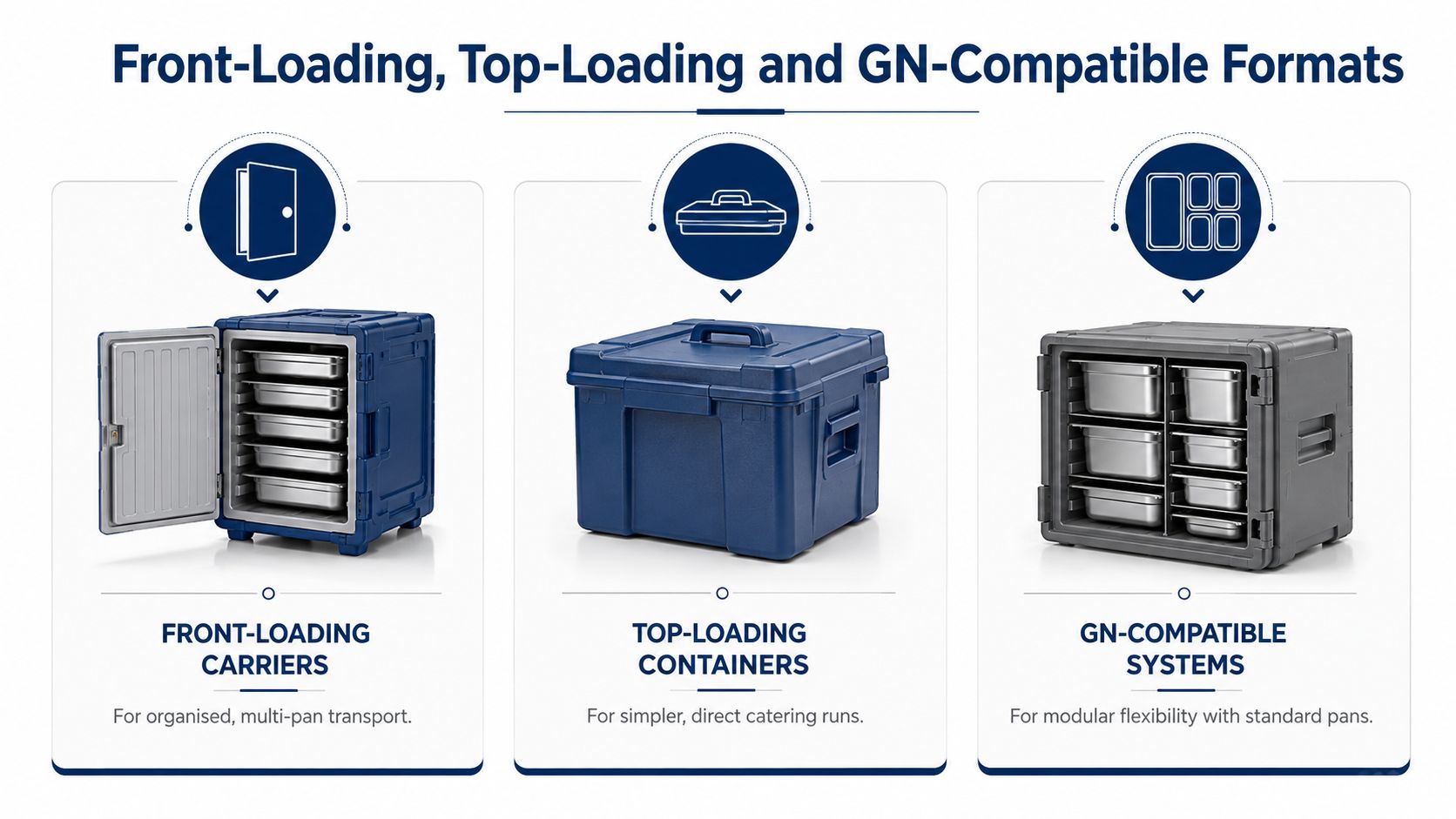
Front-loading carriers work well when the menu is built around several pans that need to travel in a fixed order. Staff can load, check, and unload them with less rummaging, which helps when the service team needs a tidy handoff at the other end. For larger catering runs, that orderliness saves time and cuts mistakes.
The trade-off is rigidity. A front-loading unit is only useful if the food production setup matches it. If the pans don't fit the system, the carrier becomes a constraint instead of a tool.
Top-loading containers suit simpler jobs
Top-loading containers are easier to understand and often quicker to pack for simpler runs. They're a good fit where the operator is moving one or two vessels, or where the catering style doesn't need a highly structured multi-pan layout. They're also easier for some staff to handle when the vehicle space is tight.
That said, top-loading units can create more lifting and repositioning if the team is moving multiple dishes. More handling means more opportunity for heat loss, spillage, or rushed packing.
GN compatibility is the operating system
GN compatibility is where commercial catering gets more efficient. Food can move from preparation to cooking or chilling, then into transport, then to service using compatible pan formats, which reduces unnecessary handling. That standardisation matters because it lets the kitchen work like one coordinated system rather than a pile of separate containers.
Hospitality's catering equipment NZ resource is useful context here, because transport gear should be chosen alongside the pans and workflow that support it. A product like Standard Gastronorm Clear Polycarbonate - GN 1/9 fits that logic when a team needs secure GN coverage with clear visibility in prep, storage, and service.
Good standardisation reduces handling. That's often more valuable than chasing the most robust-looking container on the shelf.
A Caterer Moving 120 Meals from Kitchen to Service
A 120-meal run is where theory gets exposed. The meals might leave the production kitchen in excellent condition, but the transport chain has to preserve that condition through loading, vehicle movement, and venue handoff. If any stage is clumsy, the container won't rescue the job.
Load for the route, not for convenience
Container choice changes how that 120-meal run behaves. A top-loading box with loose trays usually means more handling, more opening, and more chance of disorganised packing. A GN-compatible carrier lets pans travel unchanged from oven or blast chiller to holding to service, which is cleaner and faster for a commercial team.
If the operation also uses the CookTek ThermaCube Food Delivery Bag, the same logic still applies. The bag is only one part of the journey, and the pans inside still have to be packed to suit the route and service plan.
Treat pre-conditioning as part of the workflow
Hot food should go into a hot carrier, and cold food should go into a cold one when the product and process call for it. That sounds obvious, but it's where many transport jobs lose temperature before the van even moves. Pre-conditioning is not a nice extra, it's part of the loading routine.
The venue handoff matters too. If staff open the container repeatedly while unloading, the holding window shrinks quickly. The less rummaging, the better the result.
Keep the vehicle load tidy
Operators often focus on insulation and ignore physical handling. Stackability, carrying points, and how the container sits in the van all affect the job. If carriers slide, tip, or block access to other items, staff end up opening them more often than they should.
The container has to fit the route, the vehicle, and the team's hands. If it misses one of those, the whole run gets slower.
Temperature Retention and What Real-World Performance Looks Like
A container can look impressive on a spec sheet and still underperform on a real run. The numbers only mean something if you read them against the actual job, because retention changes with the food, the starting temperature, the ambient temperature, how full the carrier is, whether it was pre-heated or pre-chilled where needed, how often staff open it, and how long the trip lasts. Ignore those variables and you end up buying a unit that sounds good in procurement but fails in service.
The BCIT study on insulated lunch containers is a useful reality check. None of the tested containers kept food above 60°C for more than three hours, even when preheated, and the measured hold time above 60°C ranged from 2.5 to 2.9 hours. The report also recommended preheating with boiling water for at least five minutes before use (BCIT study). If you are planning anything beyond a short transfer, those figures matter more than a loose claim that a container “keeps food hot.” For a broader discussion of heat retention limits and warm-holding choices, see food warmer guidance for NZ operators.
Cold transport deserves the same discipline. A published time-temperature study found that, with frozen gel packs, insulated containers could keep foods starting at 4.4°C or less within the Food Code recommendation of under 21.1°C for 4 hours, and that hotter ambient conditions at 37.8°C pushed food temperatures up faster than at 21.1°C (time-temperature study). That is the practical warning operators miss. The outside environment changes the result, and it changes it fast.
| Variable | Why it matters | Direction of effect |
|---|---|---|
| Starting food temperature | Hotter food starts with more thermal headroom | Better when starting hotter |
| Ambient temperature | The outside environment speeds up warming or cooling | Worse in hotter conditions |
| Fill level | More product means more thermal mass | Better when fuller |
| Pre-heating or pre-chilling | Prepares the container walls so they do not steal temperature from the food | Better when done properly |
| Opening frequency | Every opening releases conditioned air | Worse when opened often |
| Transport duration | Longer trips create more exposure time | Worse as time stretches out |
For packing discipline, the tips from My Safety Manager are a useful reminder that time and temperature control belong in the workflow, not in someone's memory. Read the spec sheet against the route your team runs, then judge whether the carrier suits the trip instead of the sales pitch.
Practical Selection Questions Before You Specify
The fastest way to buy the wrong carrier is to start with capacity alone. A better approach is to define the food first, then match the container to the trip, the pans, and the staff who'll use it. That approach avoids the common mistake of buying a big unit that's awkward to load or a smaller one that forces unsafe overpacking.
Ask the right questions before pricing anything
A good supplier conversation starts with these basics:
- What are you transporting? Hot meals, chilled desserts, plated components, or GN pans all need different handling.
- How many meals or pans? Capacity planning has to reflect the actual load, not the occasional busiest day.
- How long is the journey? Short inter-kitchen moves and regional catering runs are not the same job.
- What are the handling needs? Staff need to lift, stack, and unload the carrier without fighting it.
Those questions point directly to commercial durability and fit-for-purpose design. A container that works for a school kitchen on one site might be clumsy for an event venue serving from a vehicle bay, and vice versa.
Think about opening frequency and stackability
If the container will be opened only once at handoff, the priority is usually retention and secure closure. If it will be opened during the journey, the focus shifts to organisation and how quickly the staff can get in and out without disrupting the whole load. That is where front-loading, top-loading, and GN-compatible formats start to behave very differently.
A common issue we see is operators buying for the van instead of the workflow. Stackability inside the vehicle matters, but so does how easily the team can carry the load from kitchen to curb to venue. If the handles are awkward or the unit is badly balanced, the process slows down immediately.
For another practical take on hot food container guide, it's worth comparing the advice against the actual dishes, route times, and holding needs of the operation. The best choice is the one that fits the full process, not just the product photo.
Cleaning, Durability and the Long-Term Cost Picture
A cheap container gets expensive when it's hard to clean, chips at the edges, or loses its seal before the season is over. Hospitality businesses should judge these units by what they look like after repeated transport, repeated washing, and repeated staff use, because that's where the cost sits.
Cleaning design matters more than most buyers think
Easy-clean internal surfaces are essential. If staff have to fight corners, trapped residue, or awkward lids, cleaning gets rushed and hygiene suffers. For food-safe workflows, a container that supports fast visual checks and straightforward washing is far more valuable than one with unnecessary complexity.
The same applies to gaskets, closures, and stackable parts. If components are damaged, missing, or hard to inspect, the whole system becomes less reliable. Food safety documentation and HACCP-friendly routines matter here because the transport container should fit into the kitchen's existing cleaning and checking process, not sit outside it.
Durable construction pays for itself in use, not in theory
Repeated transport is punishing. Doors get shut on carriers, carts nudge them, and staff lift them from awkward angles. Commercial construction should therefore be judged by how well it handles daily abuse, not by how impressive it looks on day one.
The right container also needs a sensible maintenance plan. Replacement parts, visible wear points, and straightforward staff training all help extend useful life. That's especially important in schools, aged care, and multi-site catering, where different teams may use the same equipment across shifts.
Total cost of ownership is the real number
Price on the invoice is only the opening figure. The cost includes cleaning time, breakdown risk, replacement parts, staff errors, and how often the carrier forces extra handling because it doesn't match the pans or the vehicle layout. A well-matched insulated system usually costs less over time because it does the job without creating friction everywhere else.
The kitchen trolleys NZ article is a useful companion piece, because transport gear should work together from kitchen bench to van to service point. That's the long-term view. If the container still feels easy to use after the novelty wears off, it's probably the right one.
Building a Transport System That Actually Works
The strongest buying decisions start with the journey. Define what's being transported, how it's packed, how long it travels, and how it will be held or served on arrival, then choose the format that fits those conditions. That approach is more reliable than chasing a generic insulation claim.
For many operators, GN compatibility should be the first filter because it keeps prep, holding, transport, and service aligned. When the pans work as one system, staff handle food less, load faster, and make fewer mistakes under pressure. Front-loading carriers, top-loading containers, and transport bags all have a place, but only when they match the actual menu and movement pattern.
A sensible specification process looks like this:
- Define the food path. Map kitchen, loading, transport, holding, and service.
- Match the container format. Choose front-loading, top-loading, or GN-compatible gear based on the run.
- Check the retention data. Compare manufacturer testing with your route, your ambient conditions, and your opening frequency.
- Plan for cleaning and durability. Make sure staff can wash, inspect, stack, and store the equipment without hassle.
Temperature retention only matters if the container supports the whole workflow. That's why the insulated box should never be treated as a standalone purchase. It's part of a food transport system, and that system has to work for the kitchen, the vehicle, and the service team every single time.
If a catering, hotel, school, aged-care, or production kitchen team wants help matching an insulated food container to the actual job, Hospitality can help narrow the options and talk through the container format, capacity, and pan compatibility that make sense for the operation. Visit Simply Hospitality to discuss the transport setup that fits the way the business really works.