

Kebab and Grill Corner: How to Set Up a Production Line
A kebab and grill corner can look straightforward from the front counter, but the work behind it is all about flow. If the menu is moving fast at lunch, the core question isn't which appliance looks strongest on paper, it's whether the whole line can keep up without the cook, the assembler and the dishwasher tripping over each other.
For New Zealand operators, that matters because kebab and souvlaki service has long sat in the mainstream of halal and takeaway dining, not on the fringe. A practical fit-out has to handle raw meat, cooked meat, salads, sauces, wraps and cleaning in one compact footprint, with the right extraction, refrigeration and service pace behind it.
Designing a Kebab and Grill Corner Around a Production Line
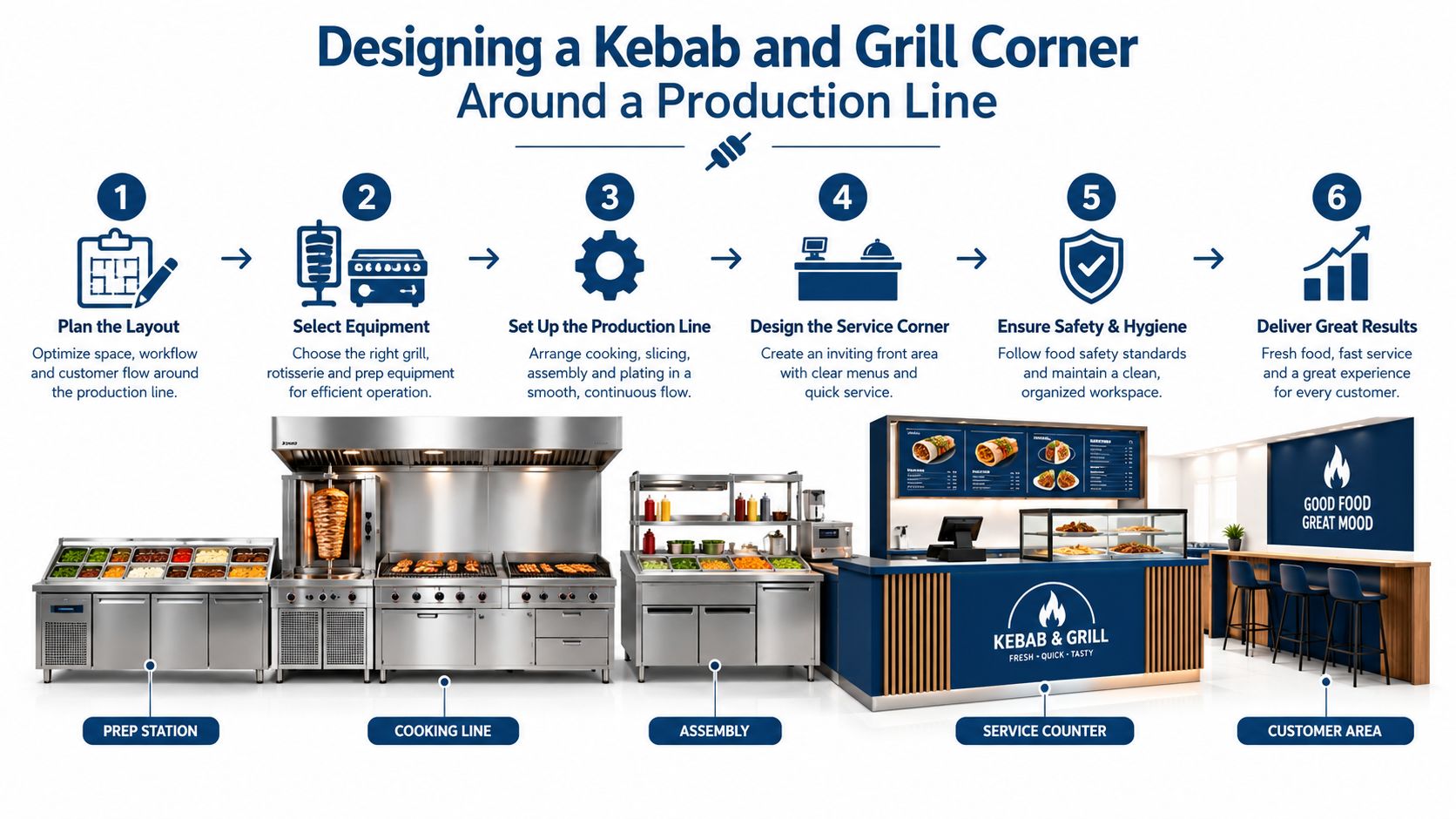
The strongest kebab kitchens are built like production lines, not equipment showrooms. Menu choice comes first, then the busiest service window, then the stations that have to work together without constant backtracking. If the line can't move cleanly from cold storage to prep, then to cooking, assembly and service, the whole setup feels busy even when the room isn't full.
A useful way to plan it is to map the order journey. Raw product arrives from cold storage, proteins are prepped or skewered, the kebab machine or grill does the cooking, fried items finish separately, then sauces, salad and wraps are assembled at the pass. That sequence sounds simple, but every handoff has a capacity limit, and the slowest station sets the pace.
Practical rule: buy to the bottleneck, not to the most impressive appliance on the invoice.
A lunch counter that needs to move a lot of wraps can't be judged by the speed of one machine alone. For a venue doing 120 shawarma wraps at peak, the line has to support that burst across multiple stations, because one person slicing meat faster won't help if the prep fridge is too small or the assembly bench forces staff to walk back and forth. That same logic sits behind how to design a kitchen that saves time on every service, where the layout only works when the movement is short and predictable.
The footprint should be locked in before equipment is ordered. So should power, gas, drainage where needed, and enough clearance for cleaning, servicing and the staff who have to work around the kit all day. If that groundwork is wrong, even good equipment becomes awkward.
For operators also looking to control odour and heat in the dining or service area, it can be worth browsing kitchen purifier selection alongside the ventilation plan, especially where the counter is close to customers or front-of-house seating.
Choosing the Menu That Drives Your Equipment Decisions
Menu design sets the equipment list, not the other way around. A kebab and grill corner built around wraps needs a different line from one serving plated grills, skewers and side dishes, even if the branding looks similar. The safest way to avoid overbuying is to sort the menu by cooking method first, then decide which items justify a station of their own.
A vertical doner or shawarma item shifts demand toward the kebab machine, slicing tools and hot holding. Grilled skewers, kofta and chicken portions point toward chargrilling or griddling, while chips and falafel bring frying into the line. Cold assembly, salads, sauces and wraps often decide whether service feels fast or strained, because that station becomes the handoff point for every ticket.
| Menu Item | Cooking Method | Portion (g) | Covers/hr Target | Station |
|---|---|---|---|---|
| Doner wrap | Vertical kebab machine | Menu-specific | Peak service volume | Kebab machine and assembly |
| Shawarma plate | Vertical kebab machine plus plating | Menu-specific | Peak service volume | Kebab machine and pass |
| Chicken skewer | Chargrill | Menu-specific | Peak service volume | Grill line |
| Kofta | Griddle or chargrill | Menu-specific | Peak service volume | Grill line |
| Chips | Fryer | Menu-specific | Peak service volume | Fryer |
| Falafel | Fryer or finishing fryer | Menu-specific | Peak service volume | Fryer and assembly |
| Salads and sauces | Cold assembly | Menu-specific | Peak service volume | Prep fridge and bench |
A menu heavy on doner and chips needs tighter control of hot holding, fryer rhythm and assembly speed. A grill-led menu needs more chargrill capacity, stronger extraction and a different pass layout, because cook times and finishing steps are not the same. Portioning matters as much as appliance choice. Every extra gram adds storage load, prep time and recovery pressure at the line.
A common mistake is building the line around the item that feels iconic, then discovering that the side dish or salad station is what delays service.
For operators comparing menu structures and line capacity, this commercial charcoal grill article is a useful reference point for what direct-heat cooking asks from the rest of the kitchen.
Sizing the Vertical Kebab Machine to Your Demand
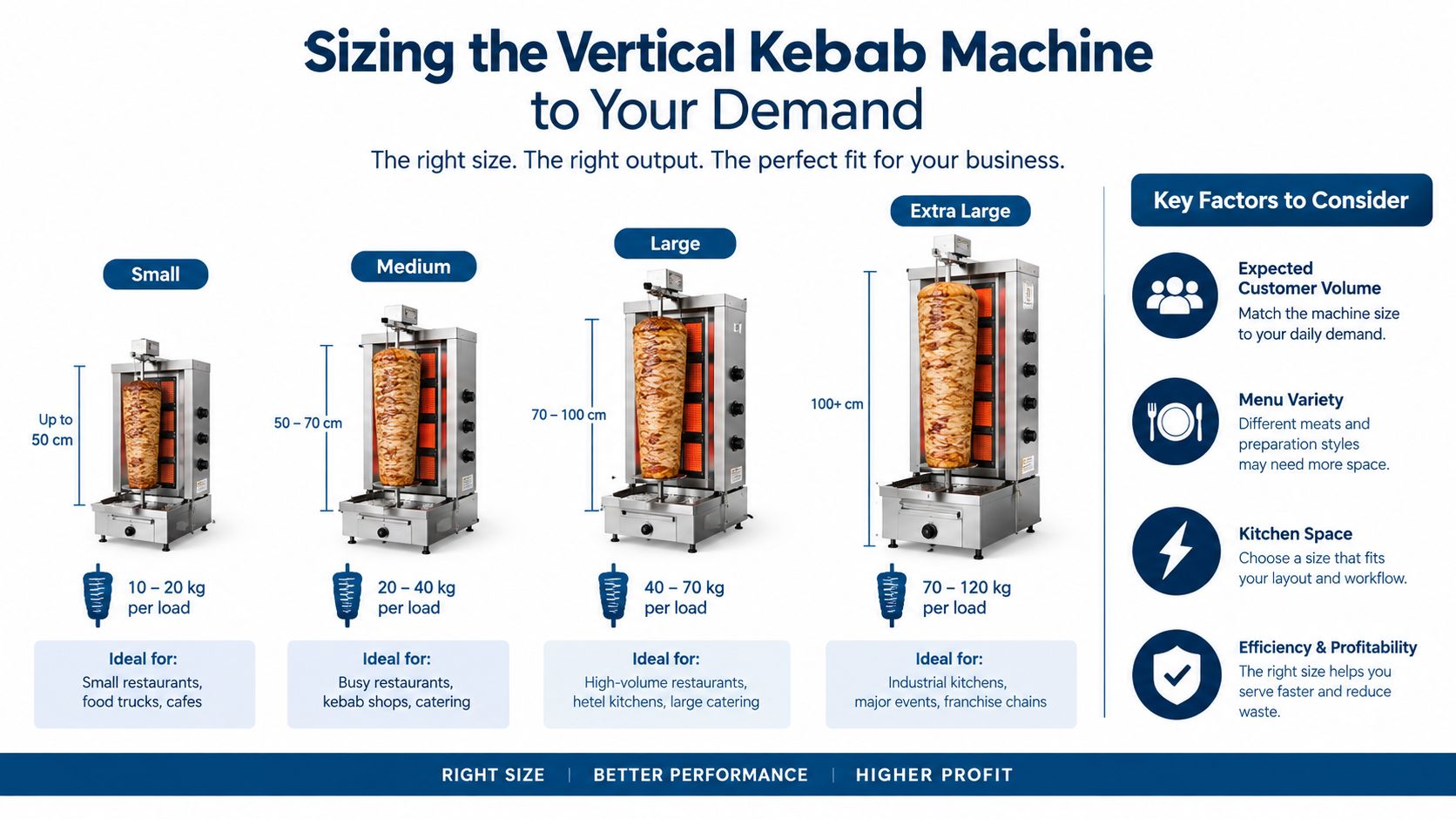
A vertical kebab machine only earns its place when it matches the menu and the peak load. The temptation is to buy for the biggest possible future trade, but that often creates a hotter room, more idle equipment and no real improvement in service if the rest of the line can't keep up.
Burner configuration and recovery
Gas units can come with single, dual or three-burner setups, and burner count changes how quickly the meat surface recovers after each shave. More burners don't automatically mean better results, but they do help maintain cooking stability when the lunch rush comes in waves. Electric infrared alternatives can simplify siting where gas services are awkward, though they usually shift the decision toward upfront cost and electrical capacity.
Capacity has to suit the actual trade pattern. A 20 kg stack suits a smaller takeaway, 30 to 40 kg is more comfortable for a mid-volume grill corner, and 60 kg-plus is for a high-throughput venue, but only if the prep bench, slicing method and holding space are also sized for it. If the stack is bigger than the surrounding workflow, the machine becomes a heat source rather than a throughput gain.
Cleaning and access matter
The machine has to be serviceable daily. Check whether the spit removes easily, whether the drip tray can be cleaned without dismantling half the unit, and whether there is enough access around the sides and front for safe shaving and sanitising. A tight fit might look neat on a plan, then become frustrating once staff are trying to clean around grease and residue at close quarters.
For readers comparing sizing against daily service demands, planning equipment for consistent meal service is a helpful planning lens, because consistency matters more than occasional peak performance.
Verification checklist: confirm burner count, fuel type, stack capacity, external dimensions, service clearances, cleaning access, drip tray removal, and the manufacturer's installation and operating instructions before ordering.
Gas versus electric is not a generic good-versus-bad choice. Gas can suit kitchens already set up for flame cooking, while electric can simplify some installs where flue design or gas connection is difficult, but the final answer depends on the premises, the ventilation plan and the energy services already available.
Matching Chargrills, Griddles, Fryers and Cooktops to the Menu
A kebab and grill corner works best as a production line, not a shopping list of appliances. If one unit is asked to cover every item, the line usually slows somewhere else, often at the point where heat, holding space, or cleaning capacity falls behind demand.
Appliance choice by job
Open chargrills suit direct grilling where surface char, colour and live heat matter, especially for skewers and some meats. Griddles give a steadier result for flatter items and for cooks who need even contact heat with less flare-up. Fryers handle chips, falafel and similar sides, while cooktops take sauces, finishing work and pan-based prep that should stay off the main grill. For operators weighing direct-heat options, the trade-offs are also covered in commercial charcoal grill guidance for restaurants, where the key question is how the appliance fits the menu and extraction plan.
| Appliance | Best For | Capacity Cue | Watch Out For |
|---|---|---|---|
| Chargrill | Skewers, meats, vegetables | Strong peak order flow | Heat load into the hood |
| Griddle | Burgers, kofta, flat items | Stable batch cooking | Slower visual char |
| Fryer | Chips, falafel, fried sides | Side-dish demand | Oil management and odour |
| Cooktop | Sauces, reductions, finishing | Small batch prep | Can become a catch-all |
The right choice depends on the skill the menu asks from the cook. A chargrill can suit the right team, but it is not always the fastest answer for a high-volume chicken item. A small fryer can be enough if chips and falafel are supporting items, while oversizing it adds heat, oil upkeep and pressure on the floor plan.
The useful rule is simple. Assign one appliance to each menu cluster, then keep a small neutral zone for finishing and warming. That makes the line easier to train, easier to clean and easier to balance when the ticket mix shifts during service.
A kebab corner rarely fails because it lacks equipment. It fails when one machine becomes the bottleneck and everything else waits on it.
Building the Assembly Station Around Preparation Refrigeration
The assembly station is usually the second bottleneck after cooking. If the cook line is moving well but staff still have to walk to another fridge for lettuce, tomato, onions, sauces or cheese, the whole service slows down. The fix is not more haste, it's better access.
Two-zone layout works best
A refrigerated topping rail is the most efficient way to keep salads, sauces and pickles right where the wrap or box is built. That rail can sit over a cold well with GN pans, while bulk proteins and backup mise en place stay in an under-bench or upright fridge nearby. Atosa Preparation Fridges are a sensible fit for this kind of workflow because they bring the chilled ingredients to the working point instead of forcing staff to travel for every ticket.
Operational rule: every unnecessary step between fridge, bench and pass gets paid for during the busiest 15 minutes.
The bench itself should be stainless and easy to clean, with enough room for containers, utensils and wrapping materials. Colour-coded chopping boards help keep raw chicken and raw meat away from ready-to-eat ingredients, and dedicated containers for allergens should sit in the same zone so they're not scattered across the line. If the wrap or plate needs weighing or portion control, keep the tools close enough that one person can build without breaking rhythm.
Smallwares decide speed
The right tongs, squeeze bottles, portion scales and wrapping materials matter more than many operators expect. They have to sit in a logical order, because assembly only feels fast when the tools are where the hands already want to move. A well-set station should let a single operator build a wrap, plate or box without constant turning, reaching or crossing back over the bench.
For readers comparing fridge styles and working depth, finding the best commercial fridge for your space is a useful way to narrow the choice before the fit-out starts.
One consideration we regularly discuss with customers is that symmetry on paper rarely beats the actual order flow. The bench should follow the dominant movement of the kitchen, not a neat drawing that looks balanced but forces staff to twist and cross each other under pressure.
Ventilation, Food Safety and Warewashing for a Compliant Corner
A kebab and grill corner can only work properly if the extraction and hygiene setup keeps pace with the heat and grease load. Ventilation is not just about comfort, it's a compliance and performance issue. In New Zealand, food-premises rules require adequate ventilation to prevent overheating, condensation and odour or fume build-up, and where natural ventilation isn't enough, mechanical extraction is mandatory.
The canopy has to match the cooking line
Canopy design has to suit the equipment under it, not the other way around. The hood should cover the cooking equipment fully, include removable grease filters and discharge to the exterior, with ducting and build quality that suit the premises and the building-code requirements. A domestic extractor won't cope with a vertical kebab machine, a chargrill and a fryer running together, and it will usually fail both practical use and inspection.
For NZ operators, the ventilation plan has to be designed around the equipment mix, the gas load, the heat signature and the site conditions. That is why commercial kitchen ventilation should be treated as part of the fit-out, not a late add-on. If the canopy is undersized or incomplete, grease builds up faster, odours linger and the kitchen becomes harder to maintain.
For a deeper planning reference, this kitchen exhaust hood article is useful when the canopy and mechanical extraction design need to be locked down early.
Food safety and warewashing stay in the same loop
The food-safety side is just as important. New Zealand guidance for kebab and grill operations is clear that kebab meat should be cooked to 75°C, then held at 60°C or above until service, with a second grill step for sliced meat recommended to reduce pathogen risk. MPI guidance also sets 75°C through the centre as the verification point for poultry, mince and tenderised meats, with alternate time-temperature equivalents of 70°C for 3 minutes or 65°C for 15 minutes. External browning is not proof of safety, so a probe thermometer belongs at the thickest point, not just on the surface.
Warewashing has to keep pace with the front line. A commercial dishwasher or a properly planned three-compartment sink setup should be sized for actual peak use, not slow periods, because utensils, trays, knives and prep containers have to come back into service quickly. Documentation matters too, so temperature records, cleaning schedules and allergen information need to be easy to maintain during service, not hidden in a folder nobody opens.
If the kitchen team needs broader support around hygiene systems, outsourced health and safety is the sort of external support many operators consider when compliance tasks are competing with trading pressures.
Putting It All Together with a Functional Equipment Checklist
A kebab and grill corner works best when every piece of equipment is doing a job the line actually needs. Menu, service style, floor space, utilities and cleaning capacity all have to fit together. If one part is oversized or missing, the pressure shows up somewhere else, usually at the exact point staff are trying to keep orders moving.
Checklist by function
- Storage: refrigeration, freezer space and dry storage sized for peak ingredient flow, not just quiet-day use.
- Preparation: stainless-steel benches, food-safe chopping boards, knives, containers and small prep tools set up for short, direct movement.
- Cooking: a vertical kebab machine matched to the expected doner, shawarma or mixed grill load, plus chargrill, griddle, fryer and cooktop where the menu calls for them.
- Assembly: preparation fridge, GN inserts, sauce rail, wrapping space and enough bench depth to let one order finish before the next one lands.
- Holding and service: hot holding or pass equipment only where the menu needs it, because every extra warm zone takes space and cleaning time.
- Warewashing: commercial dishwasher or sink setup, racking, hand wash basin and waste handling that can keep pace with the rush.
- Ventilation: extraction sized for the full cooking load, with canopy coverage, grease filters and proper exterior discharge.
- Cleaning and hygiene: chemical storage, sanitising gear, probes, logs and food-safety signage that staff can reach and use during service.
For a substantial fit-out, custom stainless fabrication can make better use of awkward corners, narrow service corridors and tight prep spaces than off-the-shelf benches alone. Simple planning around commercial refrigeration can also help the cold side, the prep bench and the cooking run work as one line instead of three separate work areas.
The practical test is simple. Product should move from cold storage to prep, cook, assemble, serve and wash without staff crossing paths or backtracking for ingredients. If that flow breaks, the bottleneck will show up every night in the same place.