

Kitchen Storage Shelves Plastic: When Polymer Beats Steel
Plastic kitchen shelving is often treated as the compromise operators make when stainless steel is out of reach. That advice is too simple. In a commercial kitchen, polymer shelving can be the more suitable material in cool rooms, freezers, wash-up areas, humid stores and other zones exposed to condensation or repeated cleaning. Stainless steel remains an excellent all-round solution, but the right choice depends on the environment, the load, the cleaning routine and how easily staff need to find stock.
New Zealand food premises must use storage surfaces that are smooth, impervious and readily cleanable, with shelving arranged so floors and surrounding areas can be cleaned properly. Whakatāne District Council's kitchen guideline and Auckland Council's food-business guidance make that operational rather than theoretical. The question isn't whether plastic is automatically better than steel. It's whether the shelf material matches the conditions in which it will spend its working life.
Why Plastic Shelving Is Not Just a Budget Alternative
The popular assumption is that plastic shelving belongs in a domestic pantry, while serious hospitality kitchens should use stainless steel everywhere. That can lead operators to specify a metal system for a wet or refrigerated zone where corrosion, damaged coatings or difficult cleaning become ongoing problems. Plastic shelving earns consideration because it solves a material problem, not just a budget problem.
Suitable commercial polymer shelving doesn't rust in the same way as conventional metal shelving. That makes it particularly useful where condensation, humidity, splashes and frequent wash-downs are normal. A cool room, freezer, dish area or damp back-of-house store can be a poor environment for shelving that depends on an intact coating to resist moisture.
That doesn't make every plastic shelf suitable for commercial use. Lightweight household units may lack the structural stability, load capacity and component availability needed in a busy kitchen. Operators should look for a genuine commercial system designed for hospitality loads, adjustable configurations and regular cleaning.
Practical rule: Specify shelving by zone, not by habit. A material that works well in dry stores may be the wrong choice beside a wash-up sink or inside refrigerated storage.
A mixed-material fit-out often makes more sense than choosing one material throughout. Stainless steel may suit a hot prep bench, pass, open kitchen or general-purpose dry store where its rigidity, appearance and broad commercial durability are valuable. Polymer shelving may suit the cool room, freezer or wet storage area where corrosion resistance and removable shelf sections carry more operational value.
This approach also supports better long-term purchasing decisions. The buying cheap versus buying once discussion is relevant here, but “buy once” doesn't mean “buy stainless steel by default”. It means selecting construction that can handle the actual conditions, including moisture, temperature, cleaning chemicals, load and access requirements.
New Zealand's wider plastic recovery system reinforces why buyers should also think about responsible specification. The national benchmark records 45,113 tonnes of plastic packaging recycled in 2022, a 17.1% recycling rate against plastic packaging placed on the market, while around 55,000 tonnes of plastic waste are collected each year from households and businesses for recycling. Those figures concern plastic packaging rather than shelving directly, but they show why operators should identify materials correctly and plan for replacement components and end-of-life handling rather than treating plastic equipment as disposable. New Zealand's national recycling rate report provides that wider context.
Polymer vs Stainless Steel Shelving Compared
A useful comparison starts with the work each shelf must perform. Polymer shelving is attractive in moisture-heavy environments, while stainless steel offers a dependable, hygienic solution across a broad range of kitchen applications. Neither material wins every category, and the shelf design matters as much as the base material.
| Criterion | Polymer Shelving | Stainless Steel Shelving |
|---|---|---|
| Moisture and corrosion | Well suited to wet, humid and refrigerated areas because suitable polymer components aren't susceptible to rust in the same way as metal | Highly durable and corrosion resistant, particularly when correctly specified for the environment |
| Cleaning | Smooth shelf surfaces and removable sections can make deep cleaning straightforward | Smooth, hygienic and easy to wipe down, with robust fixed construction |
| Load capacity | Varies by system, size and construction. The manufacturer's rating must be followed | Varies by design, gauge, span and manufacturer. The stated rating remains the controlling figure |
| Refrigerated storage | Solid or open shelf designs can support organisation, but stock must not block required airflow | Strong and hygienic, though the configuration still needs to suit condensation and airflow |
| Modularity | Often available with adjustable heights, removable shelf sections and interchangeable components | Can be adjustable and modular, though the system design determines how easily it can be changed |
| Visibility and FIFO | Shelf layout can support clear product grouping and rotation | Strong option for visible, organised storage when shelf spacing and access are planned properly |
| Commercial durability | Strong when purpose-built for hospitality, not when taken from domestic storage | Excellent general-purpose commercial durability |
| Long-term ownership | Replacement mats, shelves, posts and connectors should be available | Replacement parts, welds, feet and fixings should be checked before purchase |
Load rating deserves particular attention. New Zealand product information includes a plastic shelf system rated at 25 kg per shelf and another specified at 50 kg per shelf, so “plastic shelving” isn't a sufficient specification by itself.
Stainless steel still wins where the kitchen needs a rigid, premium-feeling surface across varied tasks, especially in visible prep and service areas. Polymer can be the better call where corrosion would otherwise be a continuing concern. Operators comparing broader metal options can also use Simply Hospitality's discussion of metal shelving in New Zealand to assess how finish and application affect the decision.
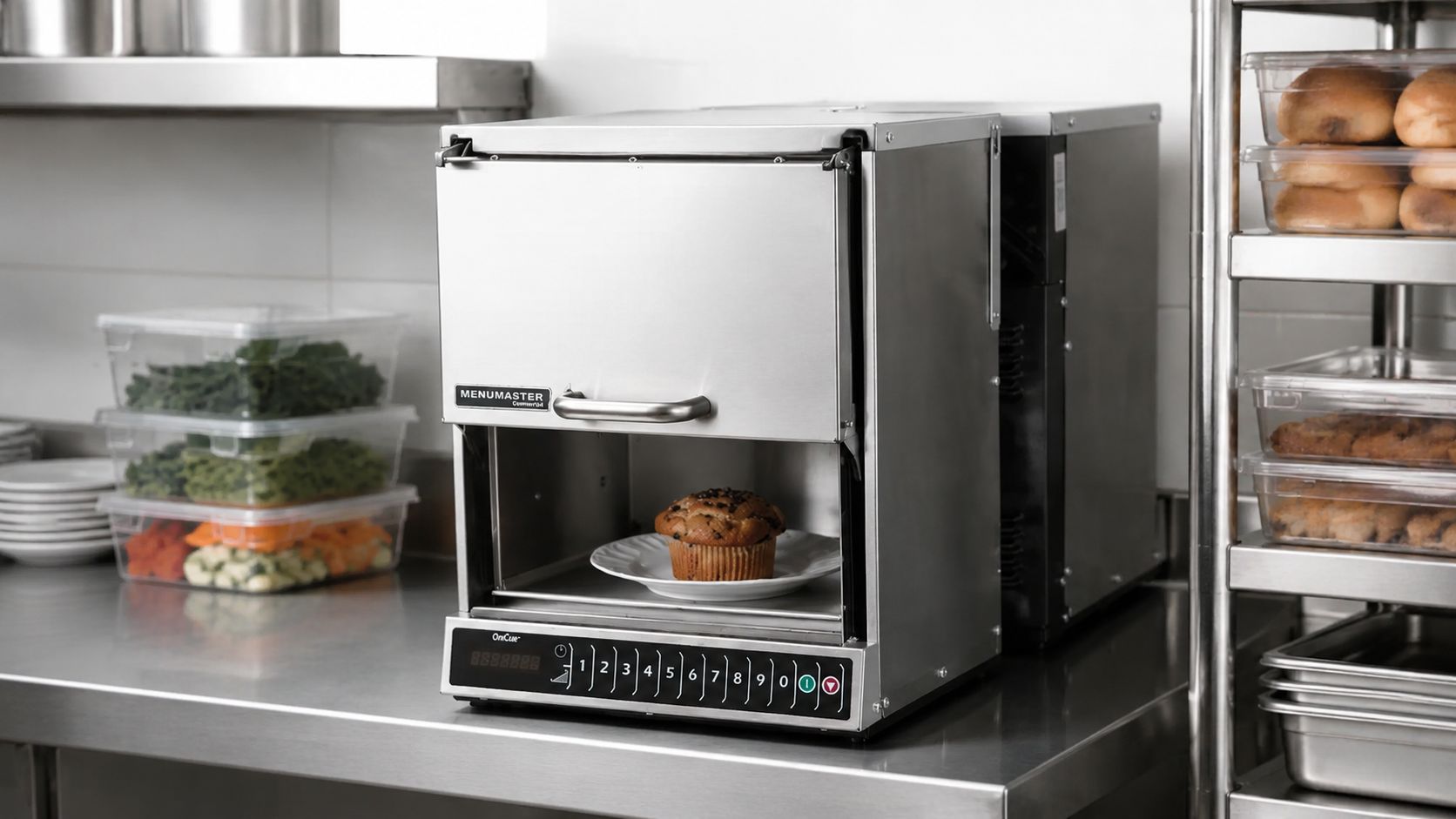
Storage planning shouldn't happen in isolation from equipment placement. For example, the Menumaster MOC5241 2400W Heavy-Duty Microwave uses a compact 9-litre cavity, accepts a 152 mm deep quarter-size pan and can be positioned back-to-back on a 724 mm shelf. That kind of footprint detail shows why shelf depth, clearances and equipment access need to be checked together, regardless of whether the shelf itself is polymer or stainless steel.
Where Plastic Shelving Earns Its Place in Commercial Kitchens
Plastic shelving earns its place where moisture is routine, cleaning is frequent and corrosion would create an ongoing maintenance problem. Cool rooms and freezers are obvious examples. The material supports organised storage without adding a rust concern, provided the system leaves enough space for air to move around refrigerated products.
Wet prep areas, wash-up zones, dish-storage rooms and humid back-of-house spaces can also suit plastic. Removable shelf sections can be lifted out, washed separately and replaced without dismantling the entire bay. That does not replace proper cleaning, but it gives staff a more practical way to reach surfaces and deal with spills.
New Zealand food-storage areas need surfaces that are smooth, impervious and easy to clean. The New Zealand food-premises requirements state that surfaces likely to be wetted or fouled should be impervious to a height of at least 2 metres from the floor. A polymer shelf with a sealed, smooth surface can therefore suit splash-prone storage, but the full unit and its installation must still allow staff to clean around and beneath it.
Food must also stay off the floor. Food Standards Australia New Zealand guidance requires food to be stored on shelves or otherwise raised from the floor, reducing contact with pests, water and contamination from wet-cleaned surfaces. MPI's general food-hygiene principles support separating food, packaging and non-food chemicals, while keeping stock above ground and preferably away from walls.
Cleaning access matters as much as material choice. A corrosion-resistant shelf can still create a poor hygiene arrangement if it leaves an inaccessible void beneath it.
Cool rooms are often overfilled because operators focus on physical capacity rather than airflow. Stock must not obstruct the refrigeration system's required circulation. Open-grid polymer sections can improve visibility and ventilation, while solid shelves offer better support for spills and smaller containers. Select the format according to the stock, refrigeration layout and cleaning method. For smaller items, kitchen storage shelves with baskets can also help separate loose ingredients and consumables.
Containers affect how well the storage plan works. The Mepal Cirqula Rectangle 1000ml Nordic White is a rectangular 1000 ml polypropylene bowl with a flexible TPE-sealed window lid, suitable for storing, reheating and serving meal preparation or a standard leftover portion. Containers that remain visible and stack predictably make any shelving system easier to organise, whether the supporting shelves are polymer or stainless steel.
Specifying Plastic Shelving for Real Kitchen Loads
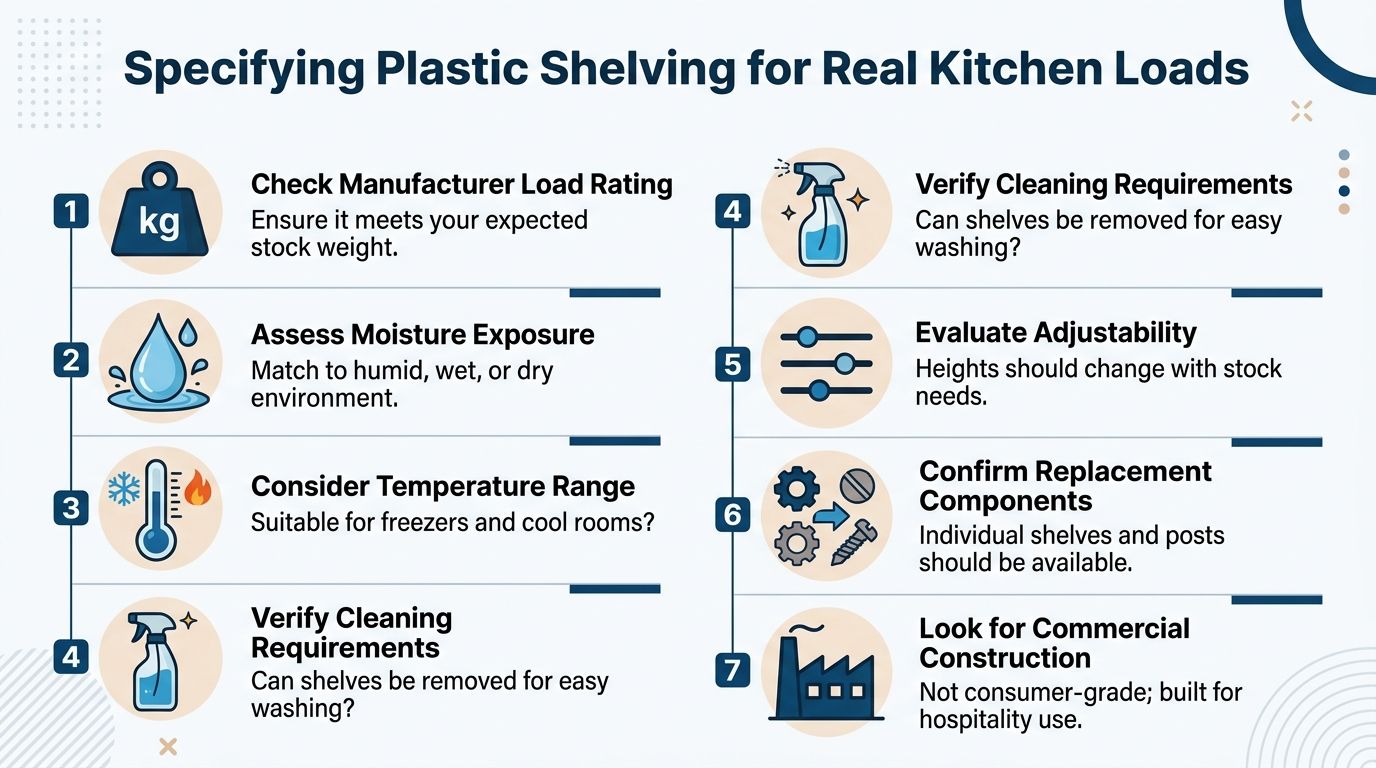
The first specification question is simple: what will the shelf carry? Dry ingredients, food containers, bulk supplies and smallwares create different loading patterns. Operators should record the likely weight on each shelf, then compare it with the manufacturer's stated rating for that exact configuration.
New Zealand product information gives examples of 25 kg per shelf and 50 kg per shelf, but those figures belong to specific products and must not be generalised to every plastic system. The supplier does not independently load-test commercial shelving, so the manufacturer's stated load rating remains the reference point. Domestic shelving shouldn't be substituted into a commercial kitchen because the dimensions appear convenient.
Check the structure before the finish
Adjustable shelf heights are valuable when one bay needs to hold food containers and another carries bulk supplies. In schools, hospitals and other institutional kitchens, storage zones often change as menus, service requirements and stock formats change. A modular system lets staff reposition levels for dry ingredients, consumables, smallwares and containers instead of leaving unusable vertical gaps.
The shelf should also support stock visibility. Staff need to see labels, reach the rear of the shelf and rotate older stock first. FIFO organisation becomes harder when deep shelves are overloaded or when containers are hidden behind one another.
- Confirm the load rating: Check the manufacturer's rating for each shelf and the complete unit.
- Measure the clearances: Allow room for walls, doors, refrigeration components, staff movement and cleaning underneath.
- Check adjustment: Confirm that shelf heights can be changed without creating an unstable configuration.
- Assess airflow: Keep refrigerated products from obstructing the cold room's required air circulation.
- Verify replacement components: Ask whether individual shelf sections, posts, feet, connectors or mats can be replaced.
Commercial construction includes more than the shelf surface. Posts, joints, feet and locking mechanisms determine whether the unit stays stable during loading, cleaning and restocking. Mobile systems also need suitable castors and a safe operating method, while fixed shelving needs enough clearance around and beneath it for cleaning.
Operators planning storage across different sites can also review Southern Ontario shelving solutions for a useful perspective on wall-to-wall planning and how the available footprint affects storage design. For New Zealand hospitality applications, the relevant principles remain the same: measure first, separate zones, protect access and specify the actual working load.
A practical shelving plan should show what belongs on every level. If the only reason for choosing a unit is that it holds the maximum possible quantity, the design may be working against the kitchen. Commercial shelving planning advice from Simply Hospitality is useful when the layout needs to balance capacity with access, cleaning and workflow.
Cleaning, Chemicals and Compliance for Plastic Shelves
Plastic shelving is easy to clean only when the design and cleaning method support that outcome. Smooth, non-absorbent shelf sections can be wiped efficiently, and removable mats can be washed separately where the system allows it. Fixed units still need enough clearance around posts, walls and floors for staff to remove food residue, dust and moisture.
Operators shouldn't assume that plastic resists every commercial chemical. MPI guidance on plastic packaging and microplastics explains that plastics used properly in food settings are generally stable, while additives can leach when plastics are used for the wrong purpose or exposed to unsuitable harsh detergents or bleach. That makes the manufacturer's cleaning instructions essential.
Use a controlled cleaning routine
The cleaning team should follow the stated chemical concentration, contact time and application method for the specific shelving system. A chemical that is appropriate for one polymer, finish or component may not be suitable for another, and repeated misuse can damage surfaces even when the shelving initially appears durable.
A workable routine includes:
- Remove what can be removed: Take out shelf sections where the manufacturer permits this, then clean them separately.
- Control chemical use: Follow the recommended concentration and contact time rather than applying stronger product on the assumption that it cleans better.
- Rinse where required: Residue can transfer to food containers, so staff should follow the product and chemical instructions for rinsing.
- Inspect joints and feet: Look for trapped residue, cracks, movement or damaged components during routine cleaning.
- Keep zones separate: Food, packaging, cleaning chemicals and lubricants need distinct storage arrangements.
Auckland Council requires shelving to be fitted so walls and floors remain easy to clean, with clearance beneath and around equipment that cannot be moved easily. That means leg design, shelf footprint and wall spacing deserve the same attention as the material itself.
The hospitality cleaning chemical guidance from Simply Hospitality can help operators think through chemical selection and handling, but the shelving manufacturer's instructions remain the controlling reference for material compatibility.
Choosing the Right Shelving for Your Venue Type
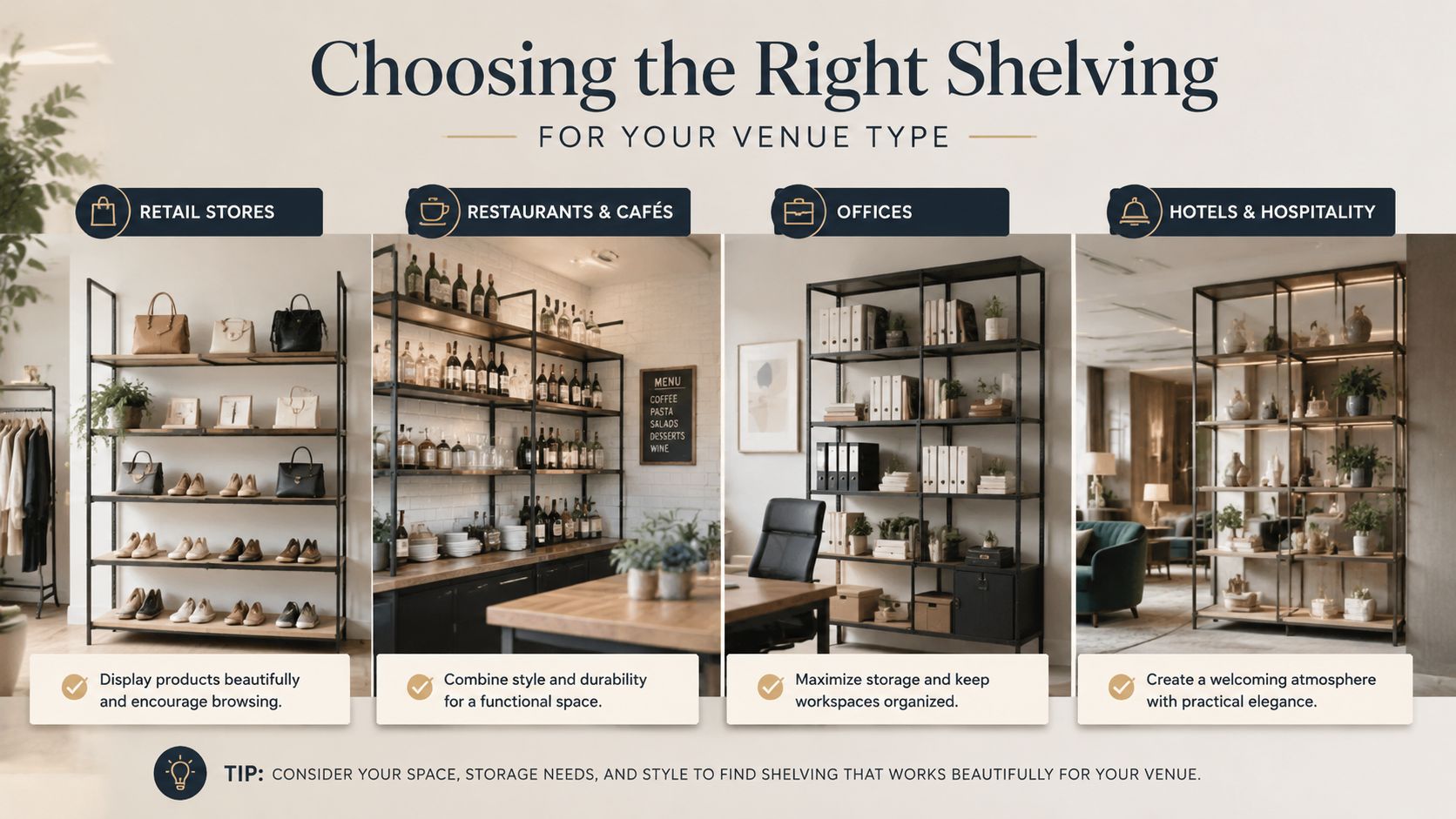
The right material depends on the venue's workflow, not the word “commercial” on a product description. In a restaurant, polymer shelving is well suited to cool rooms, freezers, dish areas and damp dry stores, where moisture and corrosion are ongoing concerns. Stainless steel earns its place on the pass, open preparation line and visible service areas, where rigidity, presentation and resistance to heat or impact matter more.
A café often needs both materials in close proximity. Polymer works well in refrigerated back-of-house storage and other humid areas. Stainless steel is usually the safer choice around coffee equipment, hot vessels and small appliances that staff move frequently. Keeping those decisions separate can prevent an unsuitable shelf from being installed beside a heat source or in a high-contact work area.
Hotels and caterers face a broader mix of storage conditions. Cold rooms, humid service-support areas and linen stores can suit modular polymer shelving, particularly where frequent washing and condensation are routine. Production benches, plating areas and heavy-use preparation storage generally favour stainless steel because it handles heat, knocks and repeated handling more confidently.
Institutional kitchens need changeable storage
Schools, hospitals and aged-care facilities often support several service styles from the same back-of-house operation. Polymer shelving can suit cool, damp storage and areas that receive frequent cleaning, while stainless steel remains better suited to high-impact preparation zones and heavier equipment loads. Hospitals also need storage arrangements that keep food-related items apart from chemicals and other non-food supplies.
Bars, pubs and accommodation operations have another set of priorities. Bottle and glass storage may require stainless steel or purpose-built units for stable support and repeated handling. Damp cellars, wash-up areas and refrigerated stores can benefit from polymer's resistance to rust. In every case, staff need clear access and stable storage during busy service.
The best fit-out rarely uses one material everywhere. Place polymer in moisture-heavy, refrigerated or frequently cleaned zones, then specify stainless steel where heat, appearance, rigidity or heavy handling carry greater weight. That deliberate split is often easier to maintain and more suitable for the venue's cleaning and compliance requirements.
Practical Next Steps for Your Kitchen Shelving
Before ordering plastic kitchen storage shelves, assess each location separately. Record the stock, moisture exposure, temperature, cleaning routine, available footprint and required clearances. Ask the supplier:
- Is the unit suitable for a cool room or freezer?
- What moisture will it encounter?
- What load rating applies to this exact unit?
- Can shelves be removed for cleaning and adjusted for height?
- Will stock remain visible for FIFO rotation?
- Could corrosion affect nearby fittings?
- Are replacement shelves, posts, feet and connectors available?
Material selection should follow the work zone. Polymer suits wet, humid and refrigerated areas because it resists rust and tolerates frequent washing. Stainless steel remains the safer choice around heat, heavy handling, high visibility or changing loads.
A compliant fit-out also needs clear access, stable storage and cleaning procedures staff can follow consistently.
Hospitality supplies commercial kitchen equipment and storage solutions for New Zealand restaurants, cafés, hotels, caterers, schools, hospitals and institutional kitchens. Visit Simply Hospitality for help matching shelving, refrigeration, food-storage equipment and cleaning requirements to each zone of the business.