

Large Storage Containers: A Guide for NZ Kitchens
You know the scene. Flour's been opened, a sugar bag has split at the corner, rice is sitting in a half-creased sack, and every staff member is trying to work around the same cluttered corner of the store room. That's where large storage containers stop being “extra bins” and start acting like part of the kitchen system, because bulk buying only saves money if the ingredients are stored properly.
In hospitality, the difference between storing ingredients and managing ingredients shows up in the daily grind. Good containers protect dry goods, make stock easier to identify, and keep prep moving without staff having to lift, rummage, or re-bag the same products over and over. For operators who also need sensible business storage for documents and stock, the same logic applies, organised systems save time, reduce mess, and make the whole operation easier to run, as outlined in business storage for documents and stock.
Why Large Storage Containers Matter in Commercial Kitchens
A catering kitchen with three opened 25 kg bags on the floor can look busy and efficient right up until lunch service starts. One bag gets damp near a loading bay, another tears when staff shift it, and the third disappears behind a trolley of disposables. The kitchen still has flour, sugar, and rice, but it no longer has control.
That's the job of large storage containers. They turn bulk buying into an organised ingredient system, where product is protected, visible, and ready for use. In New Zealand, that matters because major port-based freight networks keep the country supplied, and the wider container system is built around standardised handling that moves goods from ship to truck or rail without repacking, which is why storage discipline on site matters so much in the first place.
From bulk purchase to usable stock
Bulk ingredients only help when the kitchen can receive, label, stack, and rotate them cleanly. Otherwise, the savings get eaten up by wasted time and poor visibility.
Practical rule: if staff can't see what's inside or reach it quickly, the container is creating work instead of removing it.
That's why operators often standardise containers around the ingredients they use most. A rice sack goes into one container, flour into another, and sugar into a third, each with a lid that seals properly and a body that fits the shelving. The kitchen stops handling damaged packaging and starts managing stock in a predictable way.
This approach also makes it easier to keep commercial kitchens aligned with storage practices that are already common in other business settings. For example, space-conscious operators often use large storage for business needs thinking in the same way, by planning around access, visibility, and movement rather than just volume.
How Bulk Ingredient Storage Improves Daily Workflow
The simplest workflow improvement comes from turning an awkward delivery into something the team can use every day. A 25 kg flour bag is useful at purchase time, but once it's opened, the bag itself becomes a weak point. Paper tears, corners split, and moisture can creep in if the packaging isn't protected.
What happens when ingredients are transferred properly
The transfer itself matters. Once flour, sugar, or rice goes into a dedicated food-safe container, staff can store it in a way that supports labelling, stock rotation, and daily access. The ingredient no longer depends on the strength of the original bag.
A simple example is a bakery or pizza kitchen receiving bulk flour. Rather than leaving it in a damaged sack after opening, the team decants it into a clean, food-safe container with a tight-fitting lid. The benefit isn't only protection, it's also faster prep because the product is easier to identify and measure out during service.
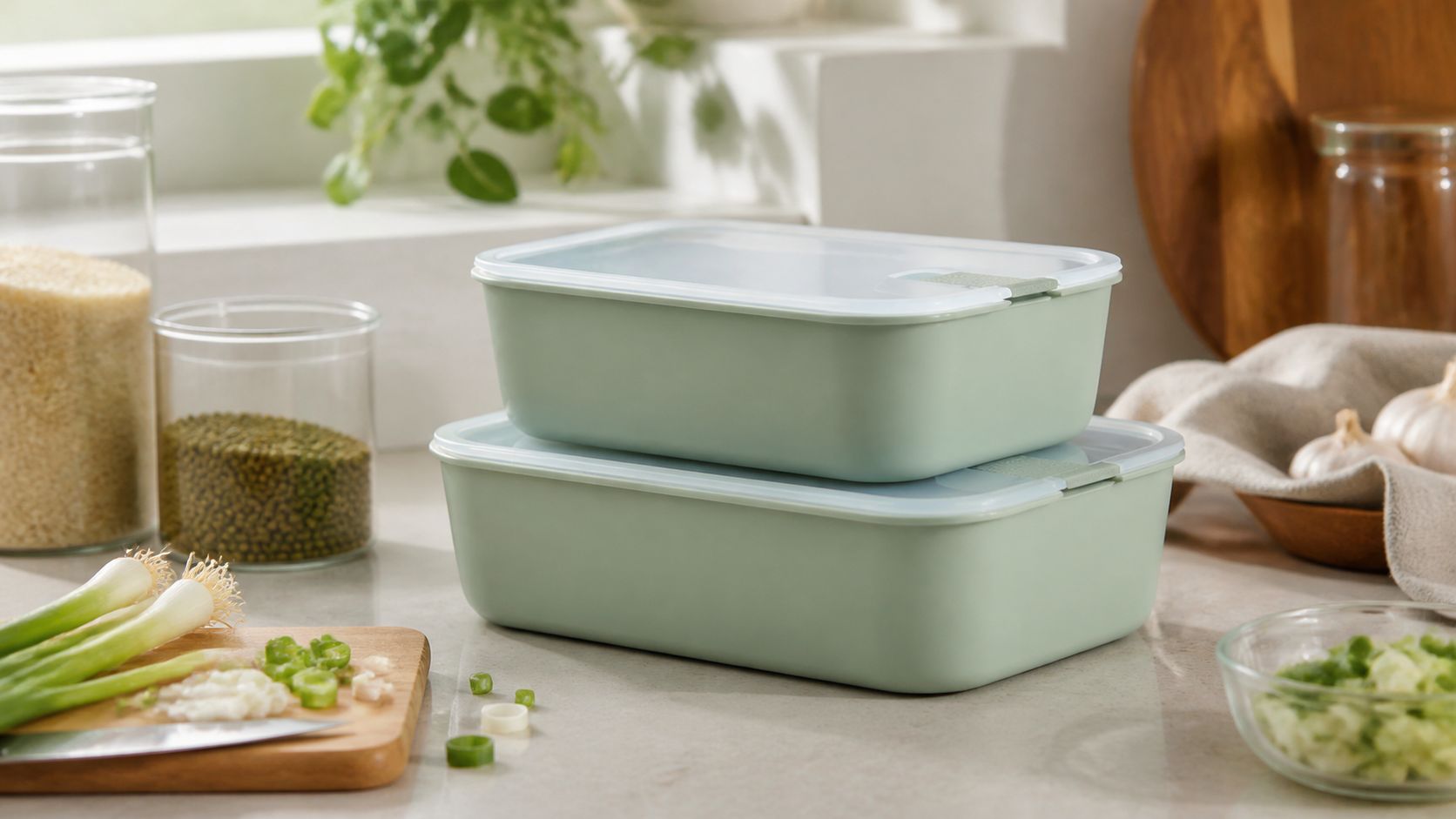
For smaller prep or fridge use, a product like Mepal Easyclip Storage 2250ml Nordic Sage shows the same principle at a different scale, with an air and aroma tight closure, a microwave-safe lid, and a transparent lid that lets staff see contents at a glance. The point is not the consumer format itself, but the operational idea behind it, quick identification and secure storage.
The practical features that help most
Operators usually get the best results when containers support a few basic habits:
- Tight-fitting lids: These help keep ingredients covered and reduce exposure during busy shifts.
- Stackability: Stackable containers keep back-of-house storage neater and easier to access.
- Standardised sizes: Repeated dimensions make shelving and lid management simpler.
- Clear labelling: Durable labels save time when staff are moving quickly.
- Food-safe construction: Dry goods need containers designed for food storage, not general-purpose tubs.
The reason this works is straightforward. Good kitchens organise ingredients before they need them. The best storage system is the one staff never have to think about.
For a practical example of ingredient management in a commercial setting, the Jiwins ingredient bin with caster wheels is the sort of format many operators look at when they need bulk access and mobility in one place.
Choosing the Right Materials and Features
Not every kitchen needs the same material, and the wrong choice can make storage harder than it should be. The decision usually comes down to how the container will be used, how often it will be cleaned, and whether the team needs visibility or colour coding more than a polished appearance.
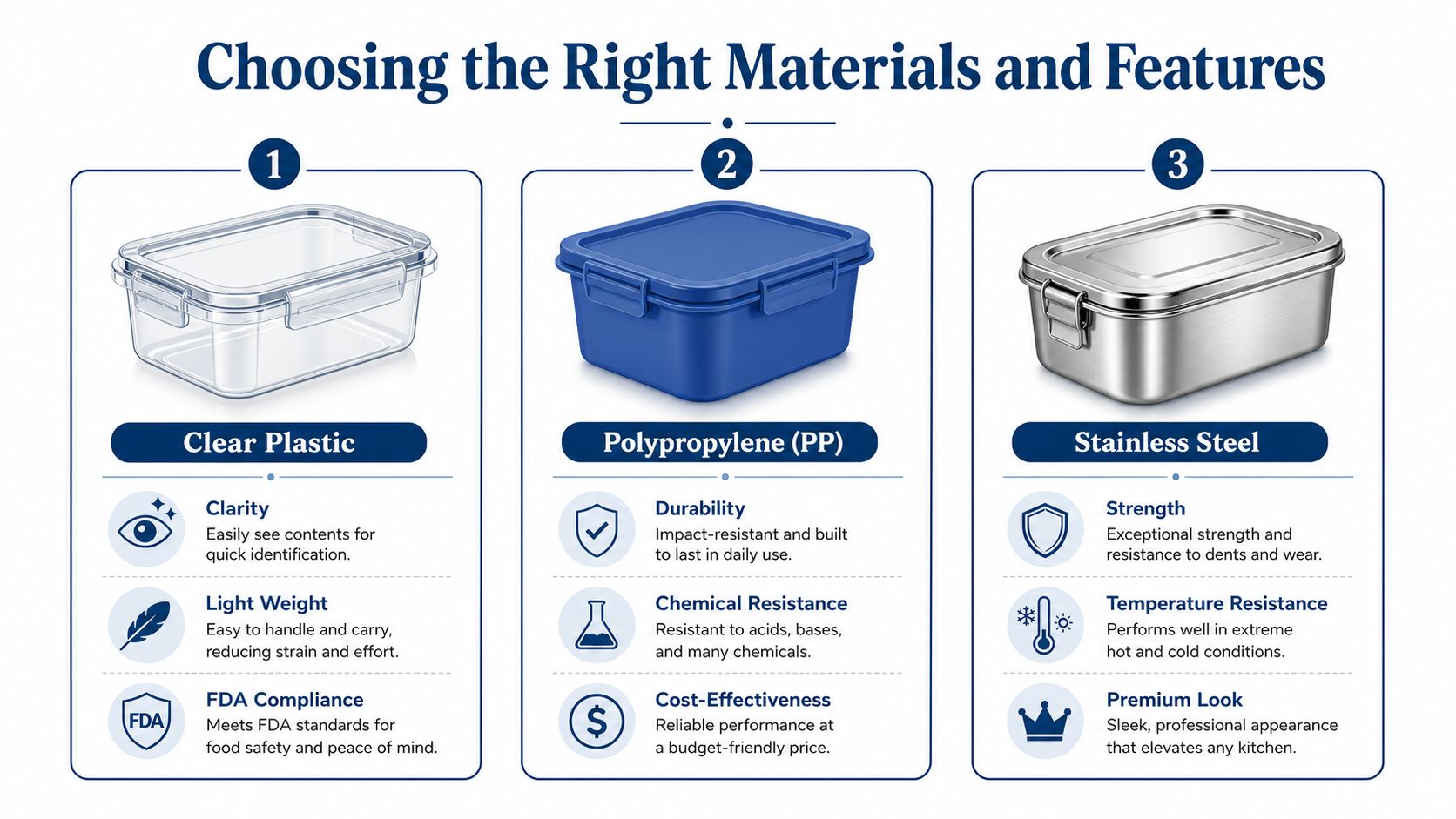
The comparison below is useful because it shows the trade-offs clearly.
Material choice depends on the job
Clear food-safe plastic works well when staff need to identify contents quickly. That's useful in bakeries, cafés, and kitchens with frequent staff turnover, where seeing the product can save time during prep. A downside is that clear containers can make cross-use errors more likely if labels aren't kept up to date.
Polypropylene is often chosen for its durability and chemical resistance, especially where containers are cleaned regularly and handled hard. It's a practical option for busy kitchens that want a sturdy, lower-friction storage system without chasing appearance.
Stainless steel has a different role. It brings strength, temperature resistance, and a more premium look, but it isn't always the easiest choice for every bulk dry-goods area. Many operators reserve it for specific applications rather than using it for every ingredient.
The features that actually matter
The key is to match the material to the workflow. A bakery might prioritise visibility and stackability, while a catering operation may care more about wipe-down cleaning and colour-coding. Schools and institutional kitchens often need predictable, durable storage that's easy for different staff members to use consistently.
Best practice: pick containers for the ingredient and the shelf, not for the catalogue photo.
For operators wanting a straightforward read on food-safe plastic options, the internal article on plastic containers for food is a useful reference point. The main question is never “which material looks smartest”, it's “which material reduces handling mistakes in this kitchen”.
The Power of Standardising Your Storage System
One of the biggest storage improvements comes from stopping the habit of buying a different container every time a new product appears. Kitchens that standardise around a small set of sizes create a cleaner, faster, easier system almost immediately.
Why standardisation pays off in real kitchens
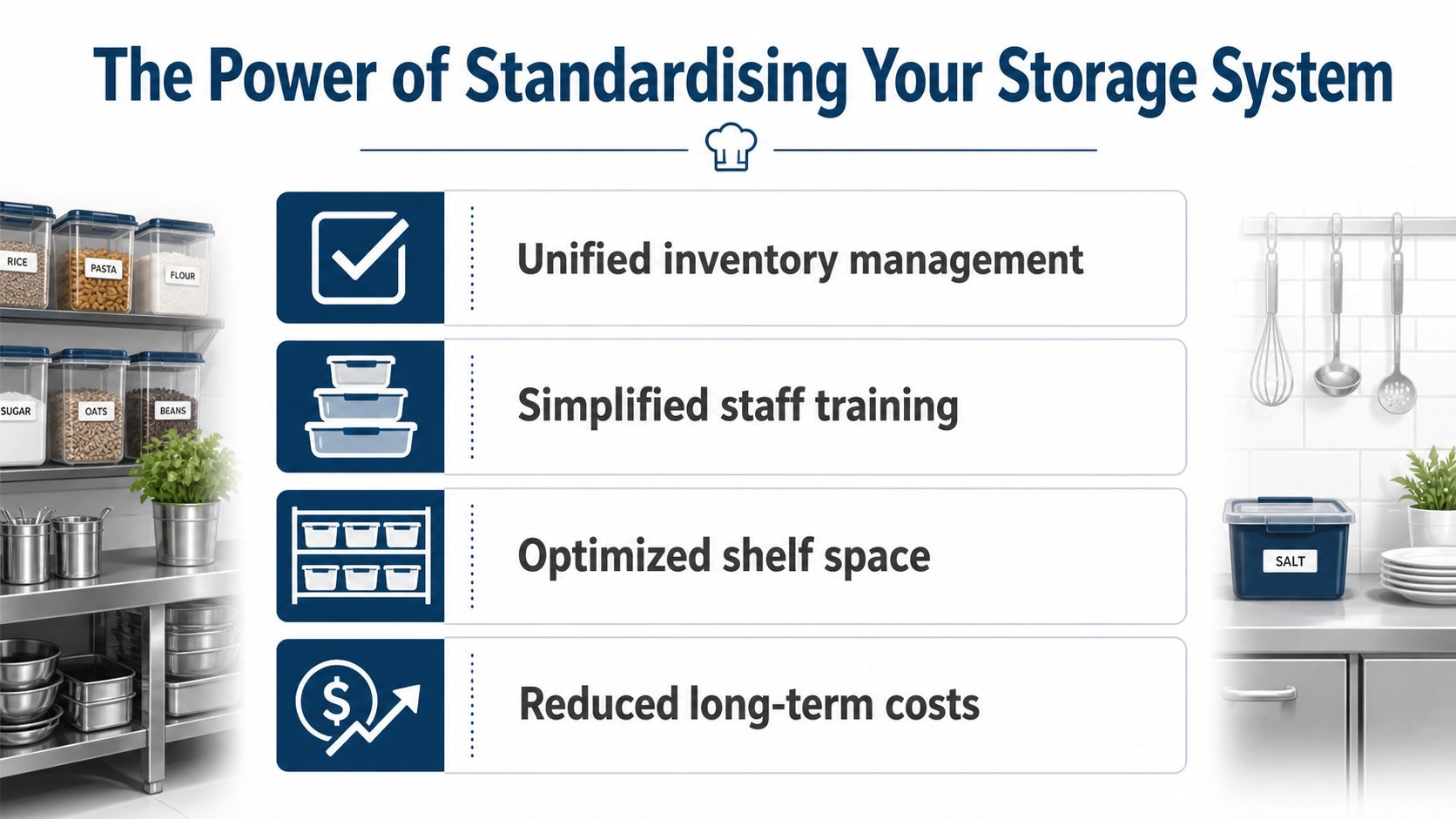
Standardisation simplifies everything. When containers share the same footprint, staff know where they fit, what lids belong together, and how they stack without guesswork. That reduces clutter and makes shelves easier to read at a glance.
It also helps with cleaning. Fewer random shapes mean fewer awkward corners, fewer mismatched lids, and fewer items sitting unused because nobody can find the right mate. Stock visibility improves as well, because identical or near-identical containers create a cleaner visual pattern in the store room.
The internal article on storage containers NZ covers the local buying angle well, especially for operators trying to build a system rather than collect individual products.
What standardisation changes day to day
A standard container set makes it easier to move between prep, service, and cleaning without rethinking the storage layout every week. It supports:
- Simpler shelving: Shelves can be planned around a consistent footprint.
- Better lid management: Interchangeable lids reduce confusion.
- Faster stock identification: Staff know where ingredients live.
- Cleaner presentation: The store room looks less cluttered and is easier to maintain.
Good kitchens organise ingredients before they need them. That sounds basic, but it's usually the difference between a tidy working store and a back-room pile-up of half-used tubs.
A reusable system beats random additions
Operators often start with one or two containers and then keep adding more as problems appear. That usually creates a patchwork of sizes that are hard to stack and annoying to clean. Standardisation prevents that drift.
The result is a storage system that supports the work instead of fighting it. Large storage containers should be part of the kitchen's operating rhythm, not an afterthought parked wherever there's spare space.
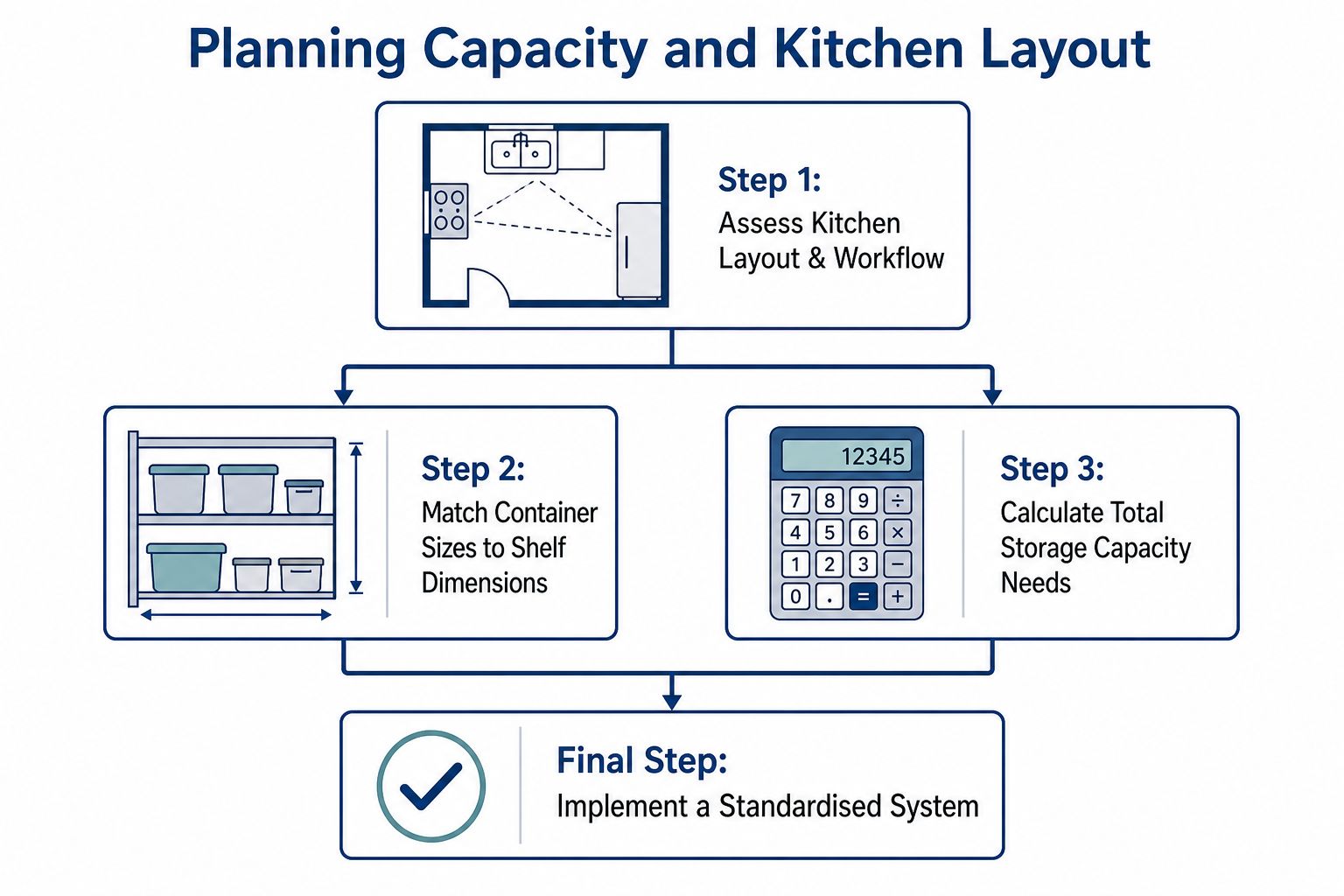
Planning Capacity and Kitchen Layout
Capacity planning starts with the shelves, not the container catalogue. If the storage area is cramped, a bulky bin that looks sensible on paper can still fail in practice because it blocks access, sits awkwardly on a shelf, or forces staff to move other items out of the way every time they need stock.
The questions worth asking before buying
Operators usually make better decisions when they work through a few simple checks:
- Do our containers fit our shelving? Internal shelf dimensions matter more than a brochure headline.
- Can they stack safely? Safe stacking keeps aisles clear and reduces clutter.
- Are lids interchangeable? Shared lids make daily use easier.
- Can staff quickly identify ingredients? If not, labels and container choice need rethinking.
- Are we storing ingredients or managing ingredients? That question gets to the heart of the system.
These are practical questions, not theory questions. The right answer depends on how the kitchen receives deliveries, where prep happens, and how often staff need to access the dry store during service.
Layout should follow workflow
A kitchen with a bakery section, a pizza line, and a catering prep zone may need different container placement for each area. The flour needs to be close to the dough bench, bulk sugar near baking prep, and rice or other dry goods positioned where they can be reached without crossing traffic paths. Storage works best when it supports movement, not when it forces people to detour.
For a broader planning reference, the restaurant kitchen layout ideas article shows how storage, prep, and circulation should fit together. The same principle applies here, if the layout is wrong, even excellent containers become awkward to use.
Keep the storage area close enough to be useful, but not so close that it creates congestion.
One consideration often discussed with operators is how container height interacts with overhead clearance and shelving depth. That's why internal dimensions matter so much. Planning around the actual envelope, not just the nominal size, avoids expensive mistakes later.
Food Safety and Compliance Considerations
A container isn't food-safe just because it has a lid. In busy back-of-house storage, the core issue is whether the container protects ingredients from unnecessary exposure to moisture, contamination, and rough handling during the day.
If a kitchen is storing flour, rice, or sugar in containers that are hard to seal or awkward to clean, the hygiene task becomes harder than it needs to be. That matters in New Zealand because food businesses working under the MPI Food Control Plan framework need documented hygiene and storage controls, not casual assumptions that the stock room is “good enough”.
What to look for from a compliance point of view
Operators usually benefit from checking the following:
- Airtight sealing: Helps keep ingredients protected during storage.
- Wash-down compatibility: Containers should suit the cleaning routine, not fight it.
- Label durability: Labels need to survive repeated washing and handling.
- Moisture resistance: Back-of-house conditions change, especially near dish areas or loading points.
- Separate storage discipline: Chemical separation matters just as much as tidy stacking.
The practical reason is simple. Temperature and moisture variation can affect pests, condensation, and ingredient quality, especially in older back-of-house spaces where airflow isn't perfect. That's why a storage system needs more than a lid, it needs a shape, material, and labelling approach that supports the whole cleaning routine.
The internal guide on how to prevent cross-contamination fits neatly with this topic, because the same storage habits that improve food safety also make daily handling clearer for staff.
For operators comparing storage systems more generally, affordable storage is a useful reminder that “cheap” only works when the system stays controlled, accessible, and easy to maintain. In a kitchen, a low-cost container that's hard to clean or impossible to label properly can end up costing more in labour and confusion.
Evaluating Long-Term Value and Making Your Decision
The right container is the one that keeps working after the first few weeks of use. Commercial durability, easy cleaning, and reliable lids matter more than a shallow promise of more storage space, because poor-fitting or awkward containers usually create more work over time.
A good decision framework starts with the ingredients themselves. Dry goods such as flour, sugar, rice, and bulk mixes need a storage pattern that matches how often they're accessed, how they're labelled, and where they're used. Bakeries and pizza restaurants often need fast access and easy identification. Caterers and production kitchens usually care more about volume control and order. Schools, aged care, and institutional kitchens tend to need predictable systems that different staff can follow without confusion.
A practical checklist for choosing well
- Match the ingredient: Dry goods, prep overflow, and colour-coded separation each point to different container needs.
- Match the space: Shelving depth, aisle width, and handling routes should guide the size choice.
- Match the cleaning routine: If cleaning is awkward, the container will be used less consistently.
- Match the staff workflow: If staff can't lift, label, or identify it quickly, it'll slow service down.
- Match the storage system: Single containers rarely fix a systemic problem on their own.
One of the biggest mistakes is overfilling containers beyond how they're designed to be used. Long-term reliability comes from choosing the right format and using it properly, not from forcing extra product into a bin that wasn't intended for that load or layout.
For operators comparing options, Hospitality can help with commercial kitchen storage choices, including ingredient bins, stackable food-safe containers, and related storage equipment used across hospitality and institutional settings. The right answer depends on the venue, the ingredients, and the way staff move through the space.
If your kitchen needs a cleaner way to manage bulk ingredients, Hospitality can help you choose storage that fits the way your team works. Visit Simply Hospitality to compare options for commercial food storage and get practical advice on the right container system for your venue.