

Storage Containers NZ: Time-Saving Systems
Most advice on storage containers NZ gets the emphasis backwards. It treats containers as a buying decision, when the win comes from standardisation, fit-out discipline, and a layout staff can run without thinking. In a busy hospitality kitchen, storage containers don't save time on their own, a clear system does.
That matters because the pressure isn't usually inside the container, it's around it, lids, labels, shelf space, fridge flow, and who knows where the batch went. Kitchens that keep adding mismatched tubs end up creating more searching, more repacking, and more friction during service. The better way to think about storage is as an organisational system that supports workflow, not just a set of plastic boxes.
Why Storage Containers Save Less Time Than You Think
A bigger pile of containers does not make a kitchen more organised. It usually does the opposite. If a team keeps mixing sizes, lids and brands, the mess just turns into more expensive plastic.
The core problem is usually standardisation
A storage drawer full of nearly matching tubs can waste more time than having fewer containers at all. Staff end up hunting for a lid that fits, repacking food into the wrong shape, or leaving ingredients in containers that do not stack neatly on the shelf. That is not a container shortage. That is a system failure.
Practical rule: if a container cannot be found, stacked, labelled and returned in the same place every shift, it is part of the problem.
The same logic applies to site storage or back-of-house space. A well-planned unit only earns its keep when the layout is predictable, and the same principle shows up in the hidden cost of slow prep and how the right approach fixes it. Kitchens that keep things predictable move faster than kitchens that keep adding variety.
What busy kitchens lose
The daily losses are small and annoying, which is why they are easy to ignore. A cook spends a minute looking for the right lid, another minute repacking something that should have stayed in place, and someone else spends the next service hunting through the same drawer. Over a week, that becomes a workflow problem, not an inconvenience.
There is also a labour cost hiding in that mess. If three staff members each lose a few minutes every shift on container searches, matching lids and repacking ingredients, the total quickly becomes real paid time that never reaches the pass. In a busy NZ venue, that is money spent on friction instead of food service.
The right takeaway is blunt. Storage containers do not save time. Standardisation does. Once a kitchen accepts that, the buying decisions get much easier.
The Hidden Cost of a Chaotic Container Drawer
A practical way to size the problem is to look at the minutes nobody notices. Across three staff working 365 days a year, losing about two minutes per shift on container searches, matching lids and repacking ingredients comes to roughly 36 labour hours annually, or more than NZ$1,000 of productive time at an illustrative labour rate of NZ$30 per hour. These figures are illustrative rather than measured customer data.
That's not a dramatic claim, it's a simple arithmetic check. The point is to show how quickly a few lost minutes turn into a real labour drain when the same friction repeats every day. In a café or small restaurant, the drawer becomes a hidden cost centre.
A quick way to test a venue
Operators can estimate their own exposure with a basic question. How many staff touch containers each shift, and how often do they stop to find the right lid, the right size, or the right batch? Even rough answers usually reveal more waste than the team expected.
The kitchen doesn't need a perfect spreadsheet to see the problem. It needs a sensible standard and enough discipline to stick to it.
For operators comparing kitchen organisation habits with wider prep flow, the same theme appears in plastic containers NZ, where the container itself matters far less than the system built around it. The right arrangement reduces search time. The wrong one keeps charging the kitchen for the same mistake.
The Menumaster Commercial Microwave RMS510TSAA is another reminder that workflow beats clutter. It's a bottom-fed microwave with a full stainless steel interior and a fixed bottom tray, so there's no rotating plate to manage in a busy food service kitchen.
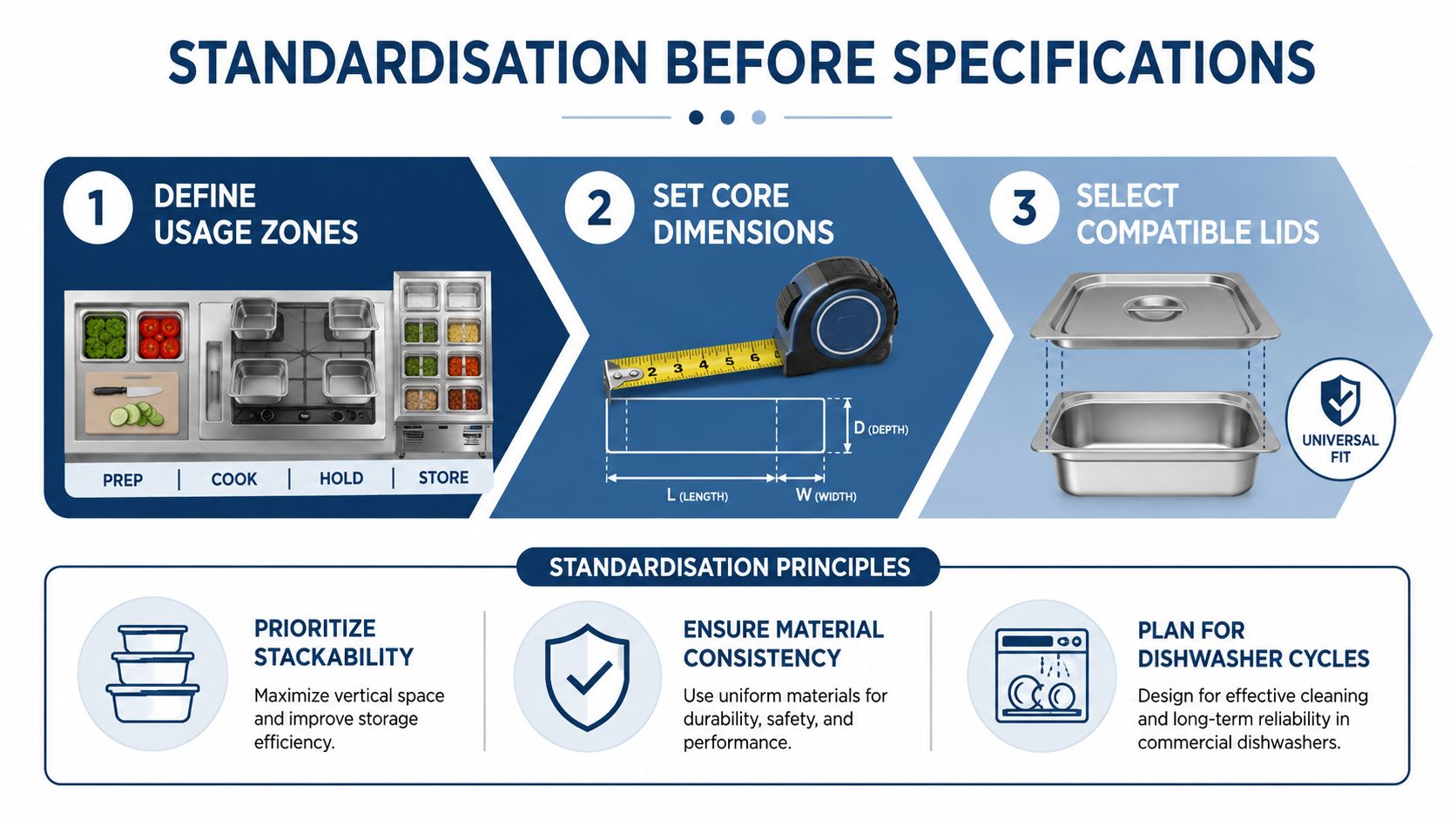
Standardisation Before Specifications
Start with the system, not the shopping list. A kitchen that standardises first can buy fewer sizes, reduce lid confusion and keep storage in the same mental map for every shift.
Build around common prep quantities
Containers should match the way the kitchen works. If a venue preps sauces, garnishes, dry mixes or sliced product in repeatable batch sizes, the container range should reflect that pattern instead of becoming a random collection of whatever was on hand that week. Standard sizes make it easier to portion, label and restock without debate.
Make lids part of the system
Interchangeable lids matter more than most buyers expect. When lids can move across the same family of containers, staff stop wasting time sorting through near-identical covers and guessing which one belongs where. That single decision can make the drawer far easier to manage.
Check the shelves before the catalogue
A container that doesn't fit the shelving is a planning mistake, not a product choice. The system should work with existing racking, under-bench spaces and cold storage, not fight them. The right fit also matters for stackability, because a container that stacks cleanly is easier to move, store and return in the right place.
One of the clearest checks is whether staff can answer these questions without hesitation:
- Can all containers stack together?
- Do lids interchange?
- Do containers fit existing shelving?
- Is the venue standardising, or just accumulating?
- Will staff know exactly where everything belongs?
For shelving fit and layout planning, kitchen shelving NZ is the other half of the conversation. Containers and shelving should be designed together, because the shelf often decides whether the system stays tidy.
Standardisation simplifies everything. Fewer surprises, fewer substitutions, fewer chances for the prep bench to turn into a pile of mismatched plastic.
Matching Container Materials to Commercial Tasks
The smart move is to match the container to the job. A kitchen doesn't need one material to do everything, it needs the right material for refrigeration, freezer storage, dry goods, microwave use where appropriate, or tougher handling.
| Material | Typical Use Cases | Strengths | Cautions |
|---|---|---|---|
| Food-grade plastic | Dry storage, general prep, fridge organisation | Light, practical, easy to sort into a standard range | Suitability depends on the specific product and intended use |
| Polycarbonate | Cold storage, visible prep items, high-use kitchens | Clear visibility, useful for stock checks, common in busy prep areas | Confirm it suits the intended food-contact application and cleaning routine |
| Stainless steel | Heavy-handling tasks, durable commercial storage, tougher work zones | Strong, hard-wearing feel, suitable where rough handling is expected | Not every storage task needs it, and visibility is lower than clear containers |
The main point is to stop expecting one container to cover every task. A freezer tub, a dry-store tub and a microwave-safe prep container are not interchangeable just because they're all boxes. That's where kitchens get sloppy.
Commercial use also means commercial food contact. Operators should confirm that the container is designed for that purpose, then check whether it suits the temperature range, cleaning routine and handling demands of the venue. The label on the product matters less than whether it fits the way the kitchen runs.
For broader space-planning logic, storage solutions kitchen cupboards is a useful comparison point. Cupboards, shelving and containers all succeed or fail on the same thing, whether the contents can be put away and found again without fuss.
How a Standardised System Supports FIFO and Prep
A small café with a tight prep window does not need another pile of mixed tubs. It needs containers that behave the same way every day. Standardisation turns storage from a mess of loose pieces into a working system, and FIFO gets easier because older stock sits in the same place, moves to the front, and gets used before newer stock.
What it looks like on shift
A prep cook opens the fridge and sees clear labels, predictable container shapes, and lids that fit the same way across the range. There is no pause to hunt for a matching top. The manager can scan the shelf and spot low stock quickly because the containers sit in fixed positions.
That kind of order cuts wasteful movement during service. Staff stop walking back and forth to check whether product has been stashed in a different tub, and they stop transferring food just to make it fit the shelf. In a busy venue, that saves more time than people expect, and time is labour cost.
Here is the practical calculation. If three staff members each lose ten minutes a day dealing with a chaotic container setup, that is half an hour of paid time gone before the shift has even settled. Over a week, that is real money spent on rummaging, relabelling, and reshuffling instead of serving guests. In a hospitality venue, that leakage shows up, then keeps repeating.
A good container setup also makes labelling mean something. If the venue uses date labels, the team has to apply them the same way every time, or FIFO turns into guesswork. Clear rules beat good intentions.
For kitchens that also care about cold-chain discipline, cold chain management belongs in the same operational conversation. Containers do not fix a poor system, but they make the right system easier to run.
Good kitchens are organised before they become busy.
That is the advantage. Standardisation keeps the day calmer, even when service gets loud.
Cleaning, Labelling and Daily Maintenance Habits
A container system only works if the team keeps it clean and honest. The routine should be short enough that staff follow it, and strict enough that the system doesn't drift.
Keep the routine simple
Containers should be washed on a predictable schedule, with dishwasher-safe items used where the kitchen can support them. Stains, odours and cloudy surfaces are warning signs that the item is getting harder to use, harder to read, or harder to trust. A damaged container undermines the whole drawer.
Treat labels as part of the equipment
Date dots, removable tape and label printers all work if the team uses them the same way. The issue is consistency between shifts. If one shift labels carefully and the next one doesn't, FIFO stops being reliable.
Retire the damaged pieces
Cracked, warped or badly stained containers should leave circulation. Keeping them around just because they still “work” is a false economy, because those units cause confusion and can make the storage area look messy even when the stock is fine.
For cleaning discipline around food-contact items, effective cleaning chemicals NZ for hospitality is worth using alongside the container routine. The wrong chemical can create avoidable damage, and once seals, surfaces or clarity are compromised, the whole system starts to slide.
The rule is straightforward. If staff can't clean it, label it and trust it, it doesn't belong in the main system.
Compliance, Trade Accounts and Long-Term Ownership
Storage containers in a commercial kitchen are part of the food-safety setup, not just back-of-house convenience. Operators should choose products designed for commercial food storage, then confirm they suit the intended use, the temperature environment and the cleaning process the kitchen runs. That sounds obvious, but plenty of venues still buy containers as if they were household tubs.
The other mistake is buying on unit price alone. A cheaper item can become expensive if it doesn't fit the shelving, doesn't share lids, or gets replaced early because the team can't keep it in service. Long-term ownership is about consistency, not just the first invoice.
Trade accounts matter here because venues need a repeatable supply path. When a kitchen standardises its container range, reordering becomes easier, replacement planning becomes cleaner, and the storage system stays intact instead of slowly mutating into random extras. That makes the whole operation easier to manage over time.
The right setup also depends on the venue type. A café, hotel kitchen, education site and catering operation won't use the same container mix in the same way. The more controlled the system, the less time the team spends improvising around it.
For operators who want a practical starting point, Hospitality supplies commercial storage options, including Mepal Easyclip Storage 2250ml Nordic Sage, alongside broader kitchen and storage ranges. The useful question isn't which box looks neat, it's which range your team can standardise, clean, label and replace without breaking the workflow.
If the venue is reworking its storage, the next step is to map the shelves, decide the core sizes, and stop buying one-off containers that create more problems than they solve. For help choosing a storage system that fits the way a New Zealand kitchen runs, contact Simply Hospitality and talk through the options with a team that understands commercial workflow, not just product labels.
If the kitchen needs a storage system that works in service, Hospitality can help with container ranges, shelving fit and practical layout choices for hospitality operations. Visit Simply Hospitality to compare options and choose a setup that keeps prep, labelling and stock rotation running cleanly.