


Choosing the Right Mops and Mop Heads for Kitchens
The most common mistake with mops and mop heads is treating them like a simple buy-and-replace item. In a busy kitchen or dining operation, mop choice affects how fast staff can clean, how much liquid gets moved, how often floors need a second pass, and how well different areas stay separated for hygiene. The right setup is the one that matches the floor, the spill, and the workflow, not just the cheapest head on the shelf.
Why Your Mop Choice Matters More Than You Think
A mop is part of the cleaning system, not just a tool with fibres on the end. In hospitality, that matters because floor cleaning sits inside a wider routine that includes food safety, staff time, and the way different areas are managed through the day. The wrong mop can slow cleaning, leave residue behind, or force staff to re-mop areas that should have been finished on the first pass.
Focus on the job, not the label
The broad commercial cleaning supply chain in New Zealand runs through wholesale channels, and Stats NZ tracks that activity as part of the wider wholesale trade sector rather than as a standalone mop category. That makes the regional picture indirect, but the operational reality is clear. Commercial cleaning consumables move through a large and important distribution network in NZ, and operators still have to choose the right tools for the work in front of them.
Practical rule: buy for the floor you clean every day, not the one-off spill you hope to avoid.
Cleaning efficiency starts with the right equipment. A large, absorbent head may suit a back-of-house spill zone, while a flatter system can be faster on smooth front-of-house floors. Hygiene matters as well, because worn or poorly matched heads can spread soil instead of removing it, especially when staff are moving quickly between service, cleanup, and reset.
A common issue we see is operators standardising on one mop because it seems simpler. That often creates more labour, not less. One mop system rarely handles daily dust pickup, greasy kitchen water, and sanitary zoning equally well.
Worn heads are a good example. They do not always fail in an obvious way, but they hold less liquid, drag more dirt, and make each pass less effective. Over a shift, that turns into extra labour hours, more wringing, more passes, and more chances for a floor to stay damp longer than it should.
For operators building a cleaner setup from the start, specialist cleaning supplies for hospitality teams should be chosen with that workflow in mind, not just with an eye on unit price.
Understanding the Main Mop and Mop Head Systems
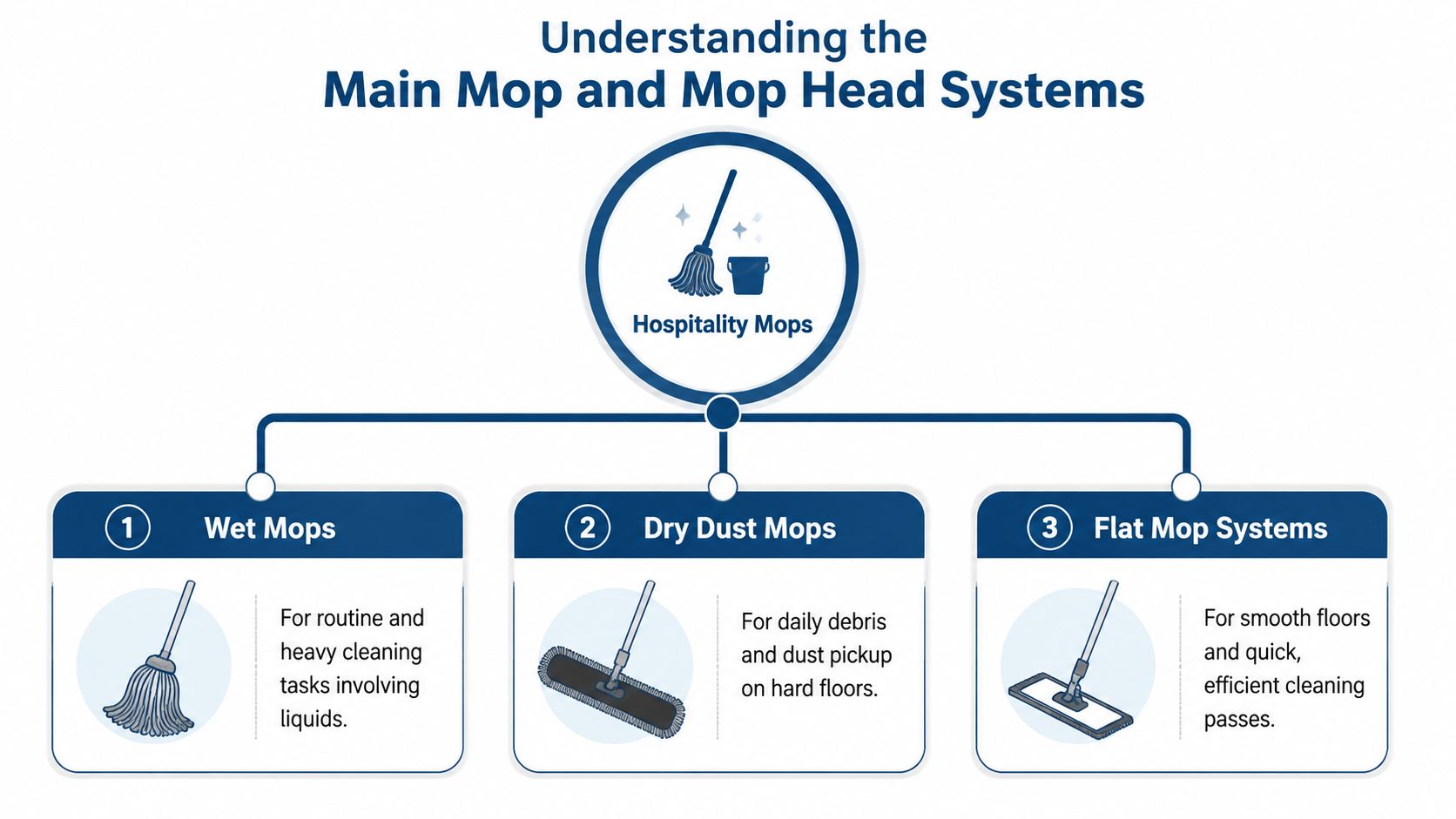
For most hospitality venues, the choice starts with three practical systems. Each one handles a different cleaning job, and good cleaning programmes usually rely on more than one.
Wet mops for liquid and heavier soil
Wet mops are the workhorse option for spills, greasy residue, and detergent-based cleaning. In commercial use, the head size changes how the mop behaves on the floor. Larger wet mop heads commonly hold about 680-910 mL of liquid and extra-large heads 910-1,180 mL, while narrow 25-32 mm headbands suit stirrup or gate-style handles (Alsco industrial mop guidance). A bigger head picks up more in each pass, but it also needs more wringing and usually takes longer to dry.
That trade-off matters in kitchens and wash areas, where a mop that stays too wet can slow the next task and leave a floor open to re-soiling.
Dry dust mops for daily debris pickup
Dry dust mops are built for loose dust, lint, and dry debris on hard floors. They are useful before wet cleaning, because grit mixed into wash water turns into muddy streaks fast. On concrete and polished surfaces, a dry pass first keeps the wet stage cleaner and cuts down on extra passes (concrete floor cleaning guidance).
They are especially useful where staff need to clear breakfast crumbs, tracked-in grit, or packaging dust before service starts.
Flat mop systems for smooth floors
Flat mop systems suit smooth commercial floors where teams need quick turnaround and easy head replacement. They are common where staff move through repeated cleaning cycles across tiled, vinyl, or sealed hard floors. Many operators prefer them because the mop face sits flatter to the surface, which makes routine maintenance easier to organise across shifts.
They also make it simpler to swap heads before one becomes overloaded, which helps when hygiene zones are separated and the same crew is moving from front-of-house to back-of-house work.
A useful way to sort these systems is straightforward. Wet mops handle liquid. Dry dust mops handle debris. Flat mops handle fast routine cleaning on consistent floors. In some venues, a conventional string mop still earns its place because it handles heavier wet work and awkward spill response better than a flatter setup.
One related supplier category is a specialist cleaning supplies range, because mop systems usually sit alongside buckets, handles, wringers, and chemical choices rather than being bought in isolation. Even a product like the Menumaster Commercial Microwave RCS511TSA, with its stainless steel interior and fixed bottom tray, follows the same operational logic, equipment needs to suit the daily rhythm of the kitchen, not just the spec sheet.
Comparing Microfibre, Cotton, and Synthetic Blend Mop Heads
Microfibre, cotton, and synthetic blends all have a place. The mistake is assuming one of them is universally better. In hospitality, the better question is which material suits the floor, the liquid load, and the cleaning pace.
The full range of options can be found here but more specifially you can find the coloured heads here.
Microfibre for routine cleaning on smooth floors
Microfibre is a strong choice for routine maintenance on smooth commercial floors. It's good at soil removal, and it often needs less water than traditional string systems, which helps where surfaces shouldn't be left overly wet. That makes it useful for front-of-house tiles, sealed vinyl, and other hard floors that need frequent light cleaning.
Microfibre also tends to suit flat mop systems well, especially in venues that prioritise quick daily passes. The trade-off is that it's not always the simplest answer for large liquid spills or heavy back-of-house mess.
Cotton for absorbency and heavier wet work
Cotton remains popular because it soaks up a lot of liquid. That makes it useful where larger spills are common, or where staff need a mop that can move a lot of water during heavier cleaning. Traditional string mops often use cotton or cotton-rich heads for that reason.
The downside is that cotton can dry more slowly and can become a problem if it's left damp or reused when it should have been changed. In a busy kitchen, that matters because slow drying creates handling issues between cleans.
Synthetic blends for general-purpose value
Synthetic blends usually sit in the middle. They can offer a practical balance of durability, absorbency, and commercial value, especially where the same mop system needs to cope with day-to-day general cleaning. The quality varies, so the buying decision should focus on construction, not just the term “synthetic”.
| Mop head materials at a glance | Best For | Absorbency | Drying Time | Commercial Value |
|---|---|---|---|---|
| Microfibre | Smooth floors, routine maintenance, flat mop systems | Moderate | Generally quicker than cotton | Strong for regular use where soil removal matters |
| Cotton | Larger spills, heavier wet cleaning, string mop systems | High | Slower | Good where absorbency is the priority |
| Synthetic blend | General-purpose cleaning, mixed-use venues | Moderate | Varies by construction | Useful balance of durability and value |
For foodservice and healthcare support areas, mop-head construction also affects what gets left behind. Cleanroom-grade systems use knitted polyester fabric over foam, flame-bonded construction, and low-residue materials to reduce particulate carryover, which is why low-lint performance matters in higher-hygiene environments (cleanroom mop data).
Colour Coding and Cross-Contamination Control
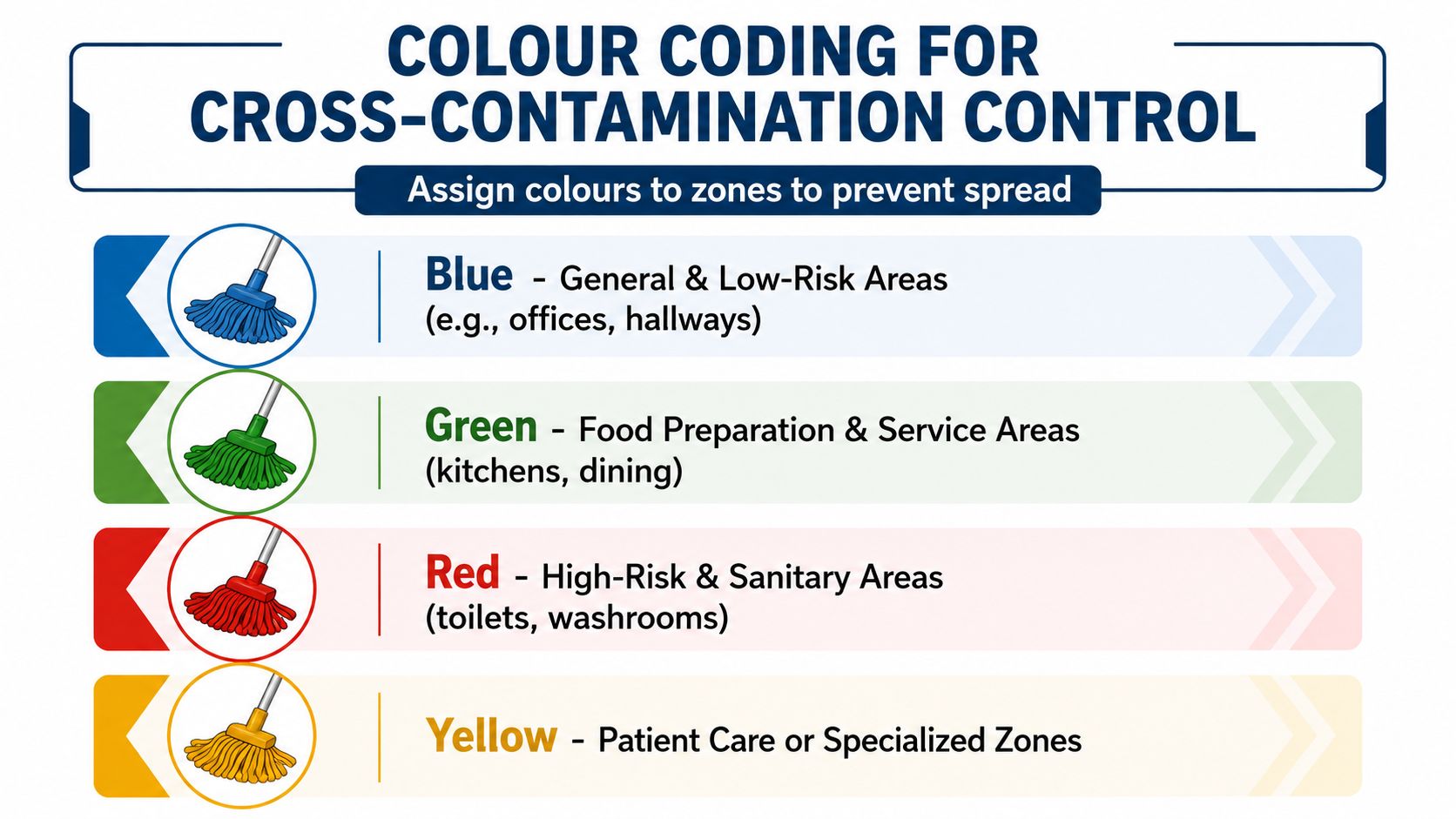
Colour coding is one of the simplest controls in a cleaning programme, but only if the team follows it. The system is less about the exact palette and more about keeping equipment tied to the right zone every single time.
Make the zones obvious
Many commercial cleaning programmes use different colours for different spaces, such as food preparation areas, general kitchen floors, washrooms, and public areas. The important part is consistency. If one staff member uses a green head for kitchen floors and another uses it in a washroom, the whole system breaks down.
Colour coding only works when every staff member can recognise the equipment instantly and use it the same way every shift.
The practical value is strongest in kitchens, aged care, healthcare, and any site where auditors, clients, or managers expect clear separation between cleaning zones. A site can buy colour-coded gear and still undermine it through poor training or casual swapping of handles and heads.
The same principle shows up in hospital and facility guidance, which recommends changing damp mop heads frequently, laundering dirty heads daily with detergent and full wash and dry cycles, and replacing them immediately after blood or body-fluid cleanup or when they look or smell dirty (Nunavut floor equipment manual). In the same vein, EPA guidance warns that reusing cotton string mop heads with disinfectant can increase floor contamination rather than reduce it.
A practical internal guide on how to prevent cross-contamination fits well here, because the mop itself is only one part of the control. Staff habits decide whether the system stays safe.
How Worn Mop Heads Quietly Cost You Labour Hours
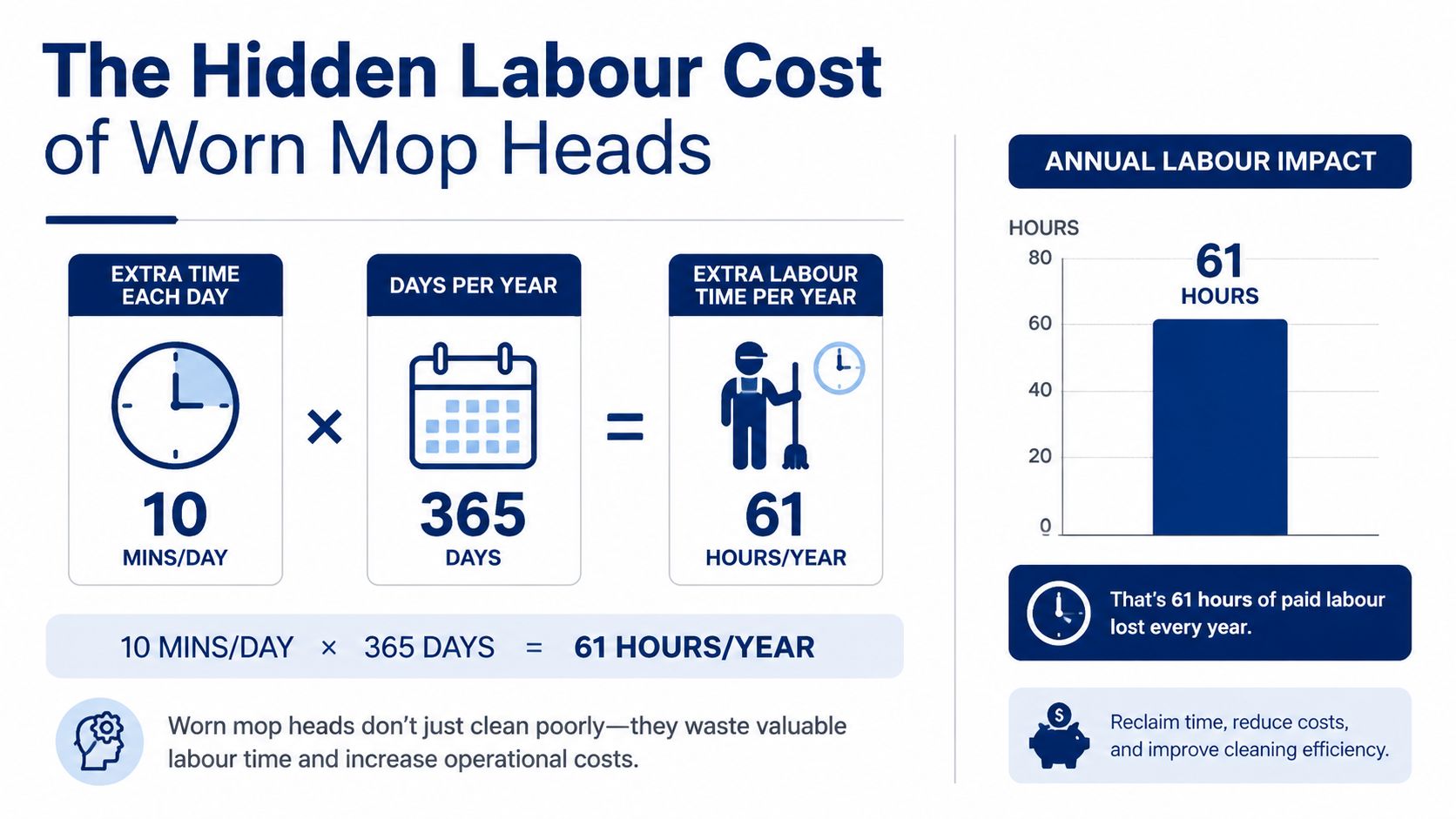
Worn mop heads often look like a small maintenance issue. In practice, they can drain time every day because staff go back over the same patch, wring more often, or switch to more aggressive chemical use when the head has lost effectiveness.
A simple working example
If a cleaner spends 10 extra minutes each day re-mopping areas because the head no longer cleans properly, that adds up to about 61 labour hours each year. Using an illustrative labour rate of NZ$30/hour, that equals about NZ$1,830 of productive labour capacity annually. These figures are illustrative calculations, not measured customer results, but they show how small delays become meaningful when cleaning happens every day.
Maintenance rule: replace worn mop heads before they become inefficient, because inefficiency usually costs more time than replacement does.
The same point shows up in commercial cleaning advice, which says mop heads should be replaced when fibres are falling off, discoloured, or frayed, and that a traditional string mop head often gets replaced every 2 to 3 months under normal use (commercial cleaning guide). That doesn't mean every venue should follow the same calendar, but it does show that mop heads are consumables, not permanent gear.
For operators who want to reduce end-of-day drag, even small workflow changes matter. A guide to reducing clean-up time becomes more effective when mop heads are still doing their job properly. There's no point tightening the close-down routine if the mop is already forcing extra passes.
Choosing the Right System for Your Floor and Cleaning Chemicals
The right mop system starts with the floor, the mess, and the chemistry sitting in the bucket. Price alone rarely tells the full story, because laundering, replacement frequency, and labour time all shape the cost of a setup.
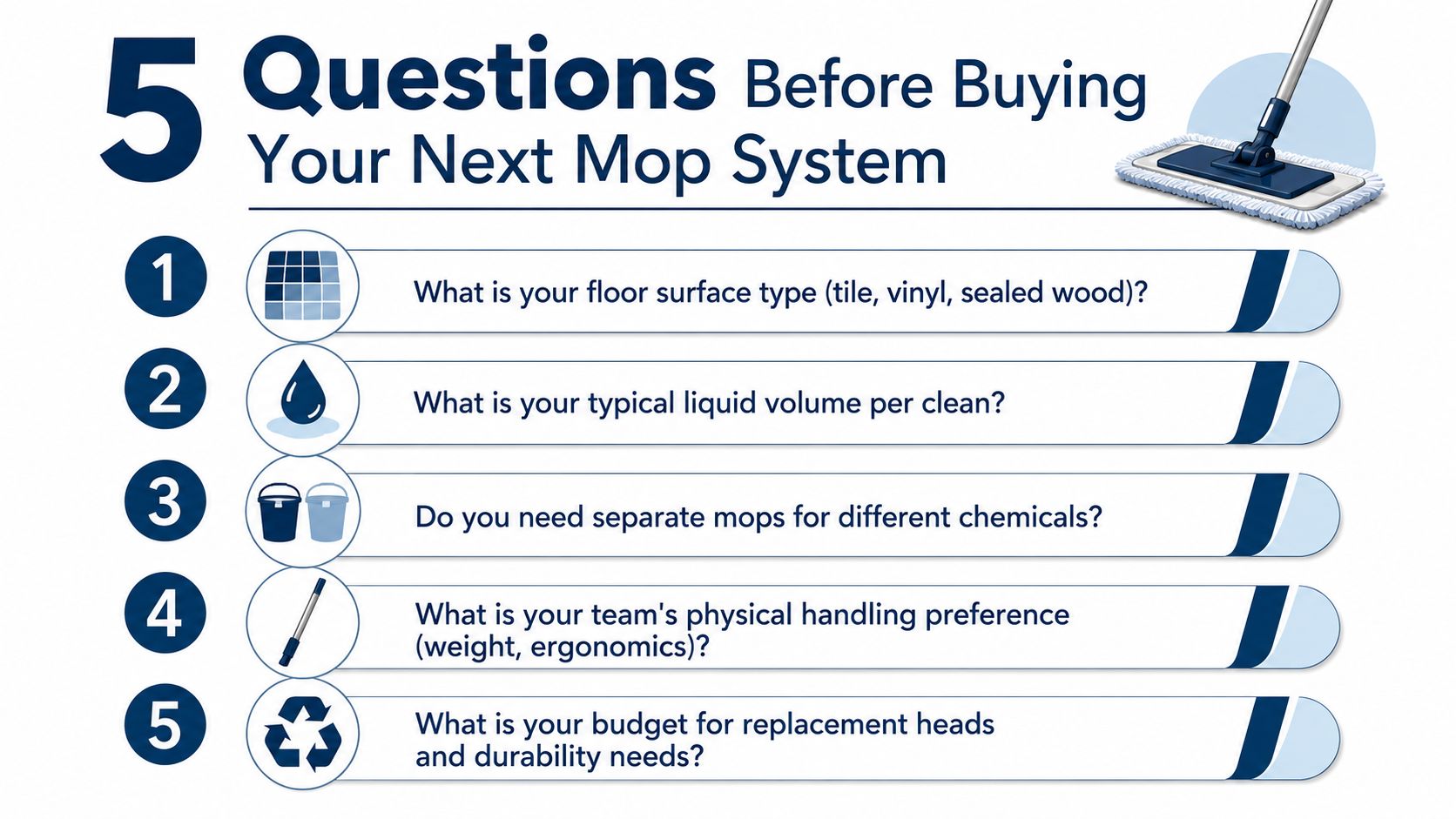
Start with five questions
- What floor surface are we cleaning? Tile, vinyl, sealed timber, and concrete all react differently to water load and mop pressure.
- How much liquid is typically being cleaned? Spill-heavy areas need more absorbency than routine maintenance zones.
- Do we need separate mops for different areas? If we do, colour coding becomes part of the buying decision, not an afterthought.
- How often are mop heads replaced? If the answer is unclear, the system is probably being pushed too hard.
- Are staff following the colour-coding system consistently? A labelled cart does little if heads still move between zones.
For vinyl floors, chemistry matters as much as the mop. A practical guide to gentle cleaners for vinyl floors is useful context, because some finishes do not handle harsh products or excess moisture well.
The chemical side matters in commercial cleaning. Some disinfectants interact badly with certain mop materials, and reused cotton string heads can spread contamination when they are paired with the wrong chemical programme. A 2022 peer-reviewed study on mop reuse found that reusing cotton string mop heads with quaternary ammonium disinfectant increased floor contamination, while hydrogen-peroxide disinfectant stayed effective for only up to three reuses (2022 peer-reviewed study on mop reuse).
The other decision is practical, not theoretical. Handling comfort, laundering access, and total ownership cost all matter on a busy roster. A sturdy synthetic blend can suit a general-purpose cleaning programme, while a microfibre flat system often fits smooth floors and frequent reset cleaning better. For venues using commercial cleaning chemicals, the matching chemical advice can be checked against effective cleaning chemicals NZ for hospitality.
Matching Mop Systems to Different Venue Types
A café, a hospital support area, and a back-of-house kitchen don't need the same mop setup. The venue shape, the floor finish, and the type of mess all push the decision in different directions.
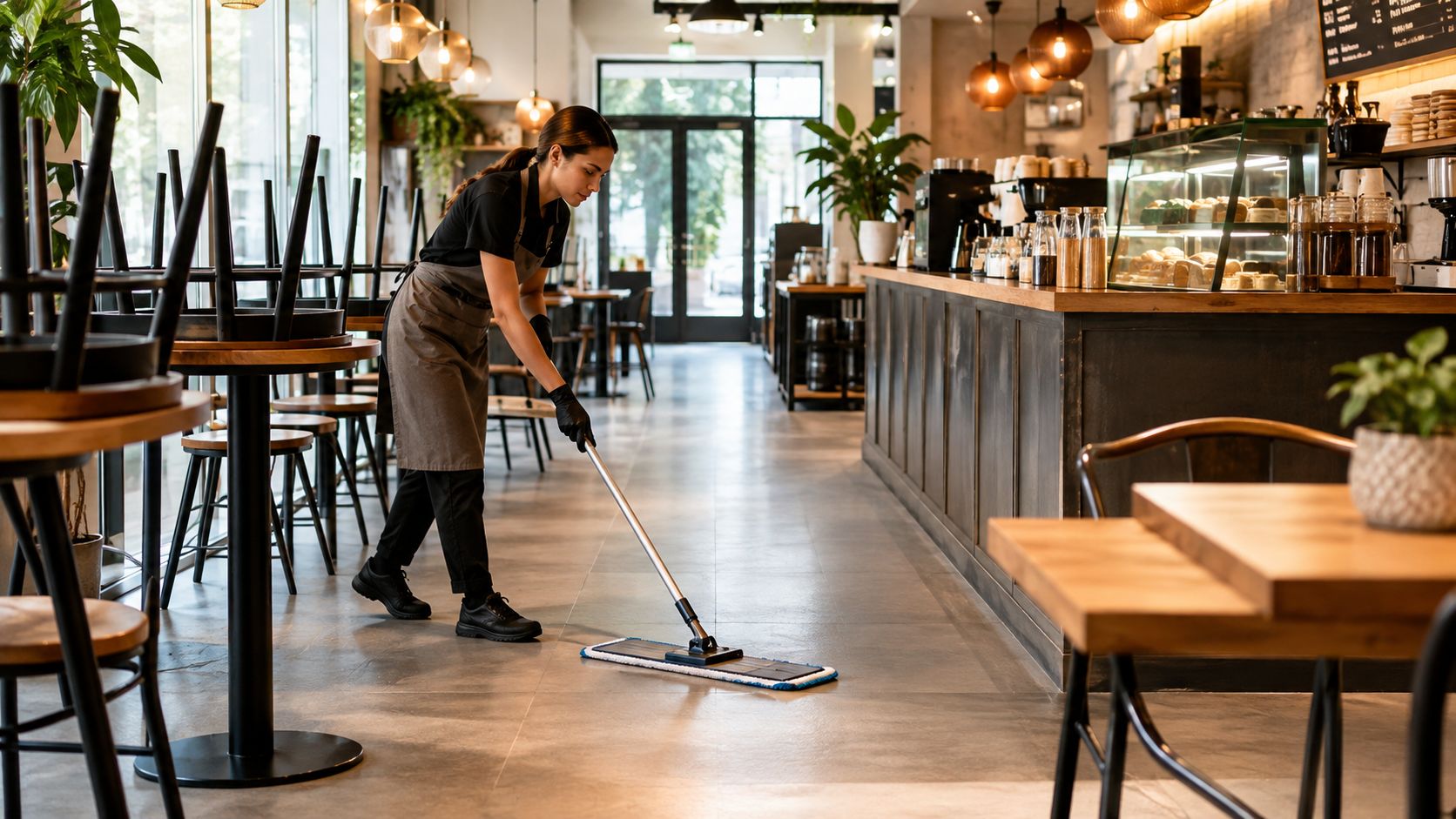
Busy café or casual dining floor
A café with smooth tile or sealed hard flooring often benefits from a flat microfibre system for routine cleaning. It's quick to move, easy to swap, and well suited to the kind of light daily maintenance that keeps front-of-house presentable without a lot of water. Staff can clear crumbs and splash marks without turning the whole floor into a wet zone.
Restaurant kitchen with frequent spills
A full-service kitchen is different. Cotton string mops still earn their place where larger liquid spills, grease washdown, and heavier wet cleaning happen. Many operators use a mixed system here, microfibre or flat mop for routine touch-ups, cotton for spill response and deeper wet work. That combination is usually more efficient than asking one mop type to do everything.
Aged care, healthcare, and institutional sites
In aged care or healthcare support areas, low-lint heads, frequent laundering, and strict colour coding are essential. The cleaning load is only part of the story. These environments also need staff to control what gets carried from one area to another, and that means the mop system needs to be simple, obvious, and disciplined.
Marae, hotel, and institutional kitchens
Durability and replacement rhythm matter most in larger shared facilities. A hotel housekeeping team may value a different handle, head, and bucket arrangement from a marae kitchen or an education site, but the same principle applies, the mop system has to match the workflow. The most efficient operators usually run more than one mop type rather than forcing a single head to cover every task.
One consideration we regularly discuss with customers is whether a venue needs a complete replacement or a better mix of tools. Often, the answer is a combination of systems, not a full switch.
Getting the Right Mop System for Your Business
Good hygiene relies on systems as much as products. Match the mop to the floor and task, keep colour coding consistent, and replace worn heads before they cost labour hours or create extra passes. If your venue needs help choosing between flat mop systems, string mops, microfibre, cotton, or synthetic blends, Hospitality can help you map the right setup to your cleaning programme and floor types. For a starting point, see the mop bucket with mop product discussion.
If you're reviewing your cleaning setup, Simply Hospitality can help you choose mops and mop heads that suit your floors, your chemical programme, and your staff workflow. Visit Simply Hospitality to talk through the right cleaning setup for your kitchen, café, aged-care facility, or institutional site.