


Pass Through Dishwasher: A Guide for Busy Kitchens
A pass through dishwasher isn't automatically the right answer for a busy kitchen. The upgrade happens when the whole wash area flows faster, from dirty return and scraping through to clean storage. If staff still fight for bench space, wait for racks to be loaded, or rewash poorly cleaned ware, a faster machine alone won't solve the bottleneck.
This guide helps hospitality operators decide when to move from an undercounter dishwasher to a pass-through system, with practical advice on workflow, capacity, utilities, compliance, maintenance and ownership costs. It also compares the considerations behind Starline, Classeq and Winterhalter options available through Hospitality, without pretending one model is universally highest-throughput.
Why a Faster Machine Is Rarely the Real Problem
The dishwasher is often blamed because it is the most visible equipment in the wash area. The actual bottleneck may be the scraping sink, pre-rinse position, rack supply, dirty return, or a clean-side bench that cannot receive finished ware.
A faster pass-through machine does not create capacity if racks still wait for an operator. For example, a hood-type dishwasher may complete its programmed cycle before the team has finished clearing trays, loading plates, or finding space for the clean rack. The published cycle time then describes the machine, not the wash area's output.
The right test is simple: time one rack from dirty return to clean storage during peak service. If the rack takes longer to prepare than to wash, the queue sits before the machine. If the outlet bench is full, the queue sits after it. In both cases, replacing the dishwasher leaves the actual constraint in place.
Find the hand-off that stops the flow
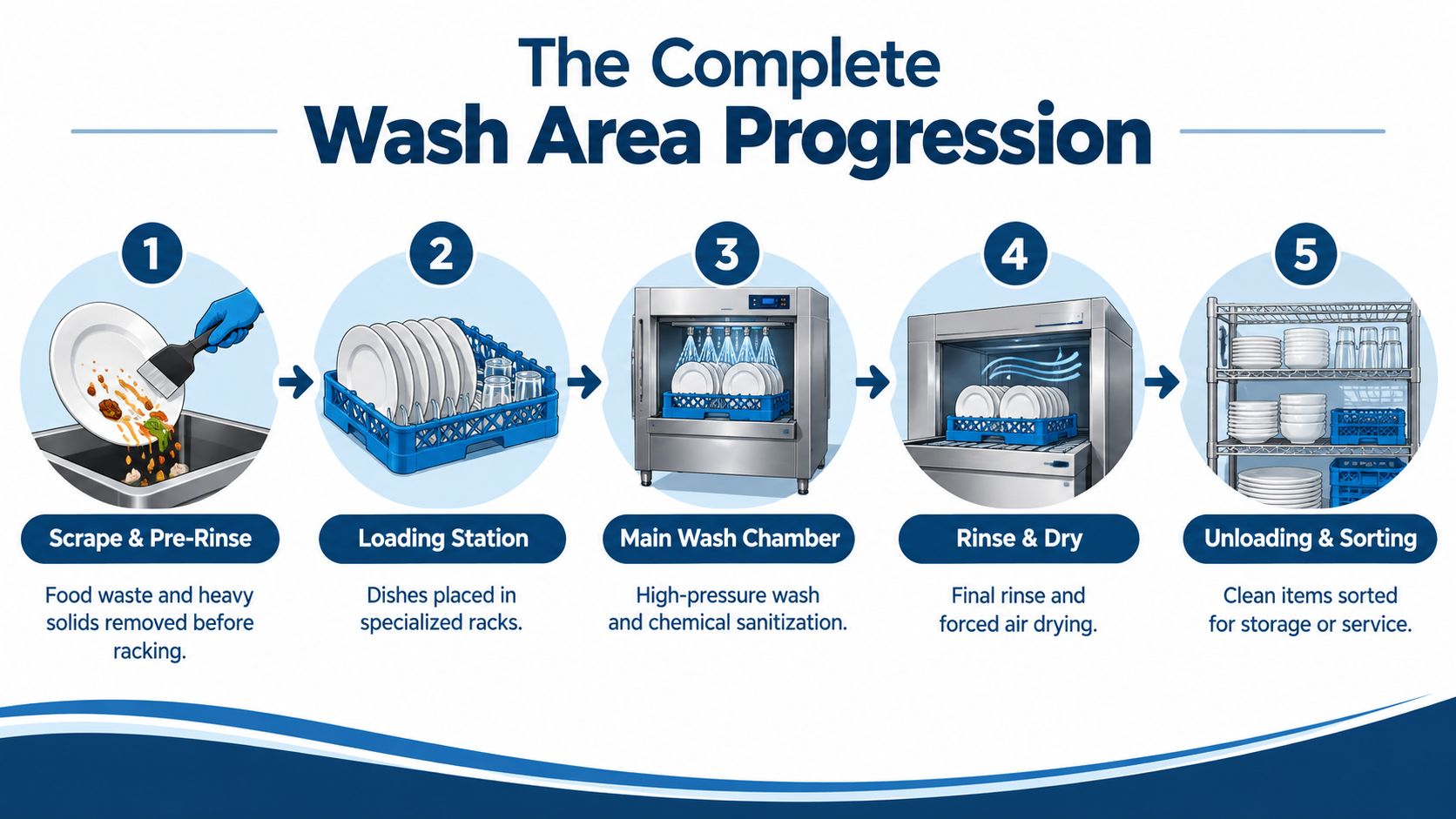
Watch the wash area as five connected hand-offs:
- Dirty return: Soiled plates, trays, cookware and glassware arrive without blocking clean ware.
- Scrape and pre-rinse: Food waste and heavy solids are removed before the rack enters the machine.
- Loading: Staff place each item in the correct rack position instead of overloading or mixing unsuitable ware.
- Wash and rinse: The dishwasher completes its programmed cleaning and thermal sanitisation cycle.
- Inspection and exit: Clean items move to sorting, drying, polishing or storage.
A single operator handling tray clearing, rack loading and unloading exposes the weakness quickly. The machine may have room for another cycle, but the team has no clear hand-off point or spare rack ready to enter.
Equipment speed creates value only when the surrounding process can use it, as explained in how a faster pizza oven can increase restaurant revenue. Apply the same test to the wash area.
Practical rule: Specify a pass-through dishwasher as one part of the workflow. Size the rack, inlet and outlet benches, and operator positions together.
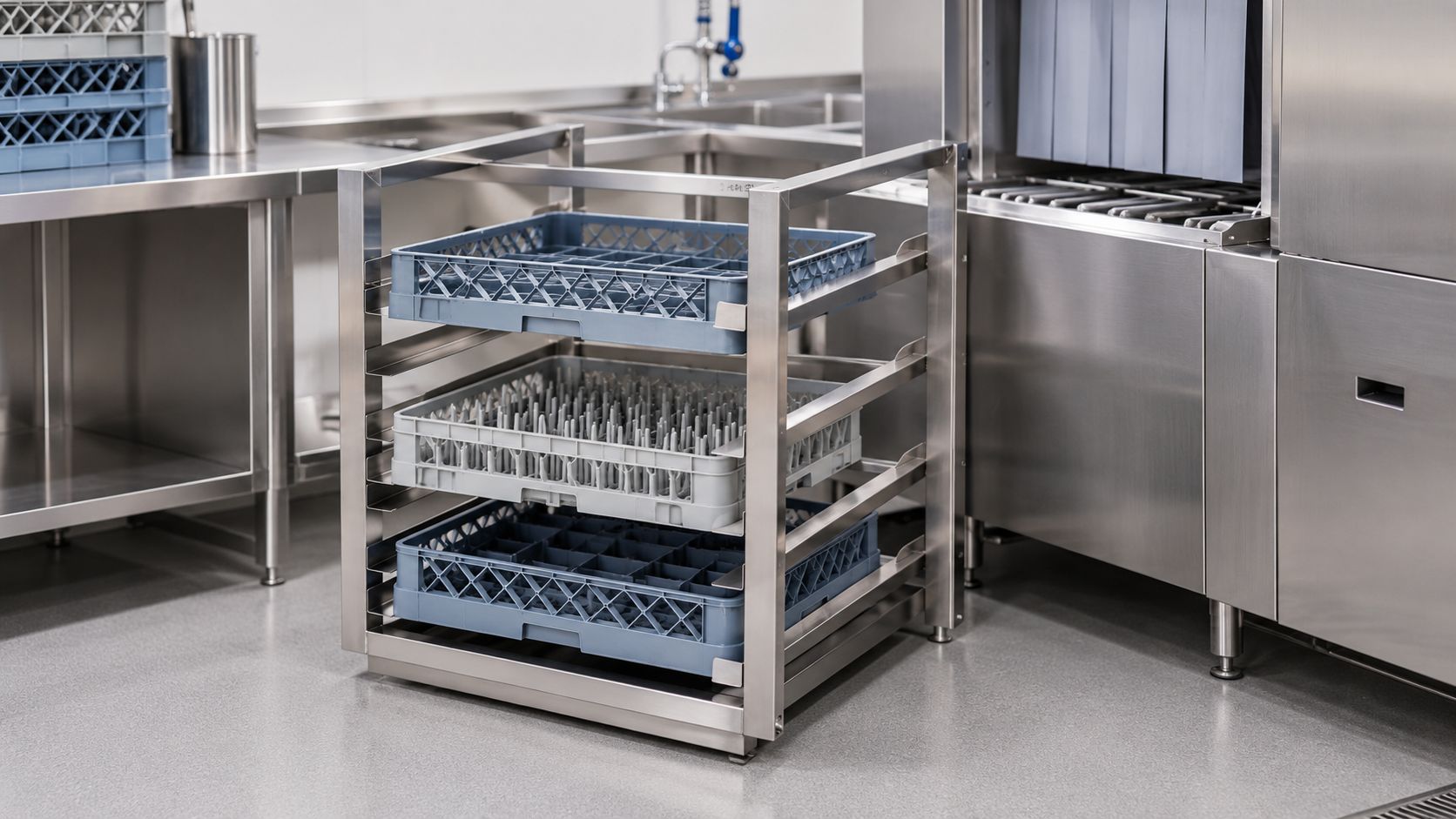
A Modular Stainless Dishwasher Basket Cassette gives spare or sorted baskets a defined home near the machine, keeping the floor and working bench clearer.
The Complete Wash Area Progression
A well-planned wash area follows a clear dirty-to-clean direction. The exact layout varies by venue, but the progression should remain easy for staff to understand during a pressured service.
Start with dirty return and pre-rinse
Dirty ware needs a landing point before it reaches the rack. Scraping removes food waste and heavy solids, while pre-rinsing reduces the soil entering the wash tank. Staff should have room to separate plates, cups, cutlery, glassware and larger items before loading.
This stage also controls what the dishwasher has to handle. A rack filled with loose food debris can shorten filter life, affect wash results and increase the likelihood of rewashing.
Give loading its own working position
The loading station should sit between pre-rinse and the machine, not on top of the clean outlet. Staff need enough room to fill racks without placing dirty items where clean ware will later be handled.
A pass-through dishwasher is commonly a hood-type commercial machine. The lift-up hood sits between benches, and flat surfaces on both sides allow racks to slide in and out efficiently. The system therefore needs more than the machine body. It needs a dirty-side landing area, an inlet bench, the dishwasher, a clean outlet bench and a route towards storage.
An inlet bench for a modular stainless dishwasher can form part of this staging area, but its value depends on how the complete room is arranged.
Keep the clean side genuinely clean
Once the rack exits, clean ware needs a place to land without blocking the next rack. Staff should be able to inspect items, allow suitable drying, sort by service area and move ware to storage without crossing back through dirty traffic.
Undercounter installations often compress scraping, loading and unloading into one bench. That can make dirty and clean ware share the same surface, especially when the kitchen is busy. A pass-through layout creates a clearer separation, but only if the benches and staff paths are designed around it.
The machine can wash a rack only when the wash area can receive it, clear it and move it forward.
Pass Through Versus Undercounter in Practice
An undercounter dishwasher suits kitchens where space is restricted and wash volumes are manageable. It sits beneath a bench, usually receives and returns ware from the same side, and can be practical for a small café or secondary wash station.
A pass-through dishwasher changes the physical movement of ware. Racks enter from the dirty side and leave towards the clean side, usually through a lift-up hood or another pass-through configuration. That separation is the main operational benefit, not just a shorter cycle.
| Dimension | Undercounter | Pass Through |
|---|---|---|
| Dirty and clean separation | Often compressed into one working zone | Can create a clearer one-way flow |
| Bench requirement | Usually less surrounding space | Requires inlet and outlet benches |
| Operator movement | More bending, opening, unloading and turning | Racks can progress across the wash area |
| Rack handling | Often one rack at a time in a compact station | Better suited to staged rack movement |
| Room planning | Fits beneath an existing bench | Requires a dedicated wash-area footprint |
| Ceiling and access | Generally simpler overhead clearance | Hood models need suitable clearance |
| Best fit | Smaller or lower-volume operations | Busy kitchens with sustained rack demand |
The distinction between hood and door-type pass-through machines also matters. A hood needs overhead clearance and a comfortable lifting path. A sliding-door design may suit a different room shape, but the correct choice depends on the full installation, not the label alone.
A common mistake is to compare only nominal racks per hour. Rack size, rack loading, operator reach, pre-rinse speed and clean-side space determine whether that published figure is achievable during service.
The commercial café dishwasher buying discussion is useful context for operators weighing compact equipment against a more structured wash station.
A pass-through dishwasher earns its footprint when the team needs continuous rack flow, not merely because the kitchen wants a larger machine.
Sizing the System to Your Peak Hour
Capacity should be treated as a system equation:
Machine capacity + pre-rinse + rack loading + inlet space + outlet space + staff workflow = practical warewashing capacity
That equation prevents a common purchasing error. A machine's published racks per hour describe what the machine can process under its stated conditions. They don't confirm that staff can scrape, load, transfer and clear those racks at the same pace.
Convert peak demand into rack demand
The starting point is the busiest service period, not the daily average. Operators should record the number of plates, bowls, cups, glasses, cutlery items, trays and cookware pieces arriving during that period, then assess how those items fit into the selected rack formats.
Many commercial machines use 500 × 500 mm racks, where applicable. That dimension affects rack storage, bench depth, turning space and how easily staff can push a loaded rack across the wash area.
The calculation should also account for:
- Rack loading: The number of usable items per rack depends on item shape, spacing and the selected rack type.
- Recovery between cycles: A machine may complete a cycle quickly, but the next rack still needs to be ready.
- Inlet capacity: Pre-rinsed racks need somewhere to wait without blocking dirty return.
- Outlet capacity: Clean racks need space before sorting and storage.
- Peak-hour volume: The system must cope with the busiest arrival pattern, not a quiet period.
The right model therefore depends on the venue's actual ware profile. Starline, Classeq and Winterhalter machines may suit different production requirements and budgets, but no single model should be called universally highest-throughput without comparing current specifications across the relevant range.
Bench length becomes the silent constraint
A café with a steady flow of cups and plates may need a straightforward hood-type system with organised staging. A hotel, hospital, marae or aged-care kitchen may handle mixed trays, dishes and serviceware that require more sorting and storage control.
Rack-conveyor systems should be assessed only when the operation has sustained demand that justifies their greater footprint and installation complexity. A hood machine can be the better choice when staff can keep racks moving but the kitchen doesn't have room for a conveyor arrangement.
| Venue Type | Covers/Service | Est. Dishes/Hr | Racks/Hr Needed | Machine Class | Bench Guidance |
|---|---|---|---|---|---|
| Café | Not assumed | Measure peak arrivals | Calculate from actual rack loading | Undercounter or hood pass-through | Keep dirty and clean landing points distinct |
| Full-service restaurant | Not assumed | Measure plates, glassware and cookware separately | Allow for mixed rack types | Hood pass-through | Provide staging on both sides |
| Hotel or institutional kitchen | Not assumed | Measure tray and serviceware peaks | Include tray and rack recovery | Higher-capacity pass-through or conveyor where justified | Plan storage and staff paths before purchase |
No invented cover count can replace a short site audit. The commercial dishwasher guidance for New Zealand kitchens should be considered alongside current manufacturer specifications and the actual rack-loading pattern.
Plumbing, Power, Water Treatment and Ventilation
A pass-through dishwasher needs a utility envelope that supports its wash and rinse performance. The machine should be specified only after the kitchen confirms water supply, drainage, electrical capacity, chemical dosing, ventilation and service access.
New Zealand's current food-business guidance treats dishwasher performance as a compliance matter. Commercial models used for reusable plates, crockery, cutlery and glasses are expected to include automatic detergent dosing, an accurate thermometer, suitable backflow prevention and temperature control that prevents operation below the required rinse temperature. The guidance specifies a 60°C wash cycle and a 77°C rinse cycle for at least 10 seconds, with temperatures measured inside the washing cabinet. New Zealand food-business guidance
Confirm thermal sanitisation and electrical safety
The historical compliance framework is clear. New Zealand's Food Hygiene Regulations 1974 required reusable utensils to be washed in water at not less than 60°C, followed by a clean-water rinse at not less than 77°C for at least 10 seconds. The regulations also addressed automatic detergent dosing, complete wetting of utensils and suitable equipment for making food-contact surfaces hygienic. The New Zealand standards reference
Commercial dishwashers should also be specified against AS/NZS 60335.2.58:2015, which covers safety for electrically operated commercial dishwashing machines used for plates, dishes, glassware, cutlery and similar items. The commercial dishwasher safety standard
Before delivery, the installer should confirm:
- Water inlet: Flow, pressure, temperature and connection requirements must match the selected machine.
- Drainage: The waste route needs suitable capacity, fall and access for cleaning.
- Power: Booster heaters and larger machines may require electrical work beyond the existing kitchen circuit.
- Backflow protection: The installation must address potable-water protection requirements.
- Chemical dosing: Built-in or external pumps must be compatible with the detergent and rinse aid selected.
Where electrical changes are needed, operators should use a qualified professional and can review guidance on how to hire a licensed sparky for 15 amp equipment safely.
Treat water quality as part of the machine specification
Hard water can affect wash results, spotting, scale and chemical performance. Depending on the site and the required finish, the design may include a water softener or reverse osmosis system. The correct detergent and rinse-aid dose should follow the machine and chemical supplier's requirements, not a guess based on another kitchen.
Water quality and dishwasher performance deserves attention before the machine is ordered, because poor inlet water can undermine an otherwise suitable unit.
Ventilation needs the same practical assessment. Some newer pass-through models are designed for operation without an extraction canopy in most conditions, and supplier guidance states that certain models can reduce water-heating costs by 38% through their operating technology. Supplier information on Planet technology Even where a canopy isn't required, heat and steam still affect staff comfort and room design.
Day-to-Day Care and What Rewashing Really Signals
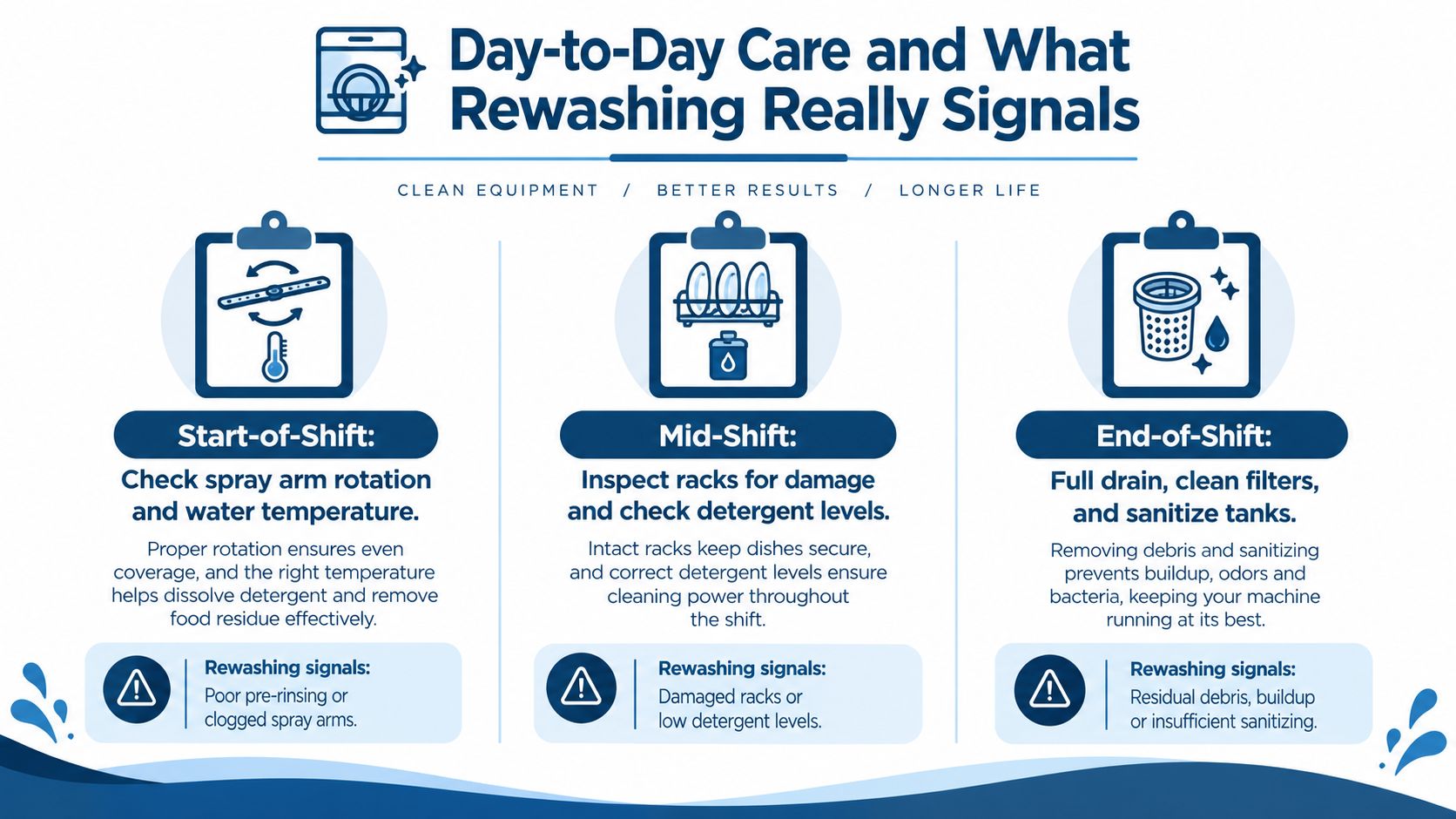
A pass-through dishwasher needs a disciplined operating routine. Staff should check the machine at the start of the shift, monitor it during service and leave it clean and ready for the next session.
Use wash results as diagnostic information
The first signs of trouble often appear on the ware, not on the control panel.
- Food residue: Check pre-rinsing, rack loading, wash-arm movement, filters and water pressure.
- Spotting or filming: Investigate water hardness, rinse aid, dosing and final-rinse performance.
- Cloudy glassware: Check rinse temperature, chemical supply and whether the glassware is suitable for the cycle.
- Streaking: Review chemical concentration, water condition and blocked spray openings.
Staff shouldn't accept deteriorating results as normal. If plates suddenly need rewashing, the cause may be blocked wash arms, poor pre-rinse practice, an empty chemical container, a dosing issue, water treatment failure or a temperature problem.
Daily care should include:
- Start of shift: Check spray-arm rotation, filters, tank condition and operating temperatures.
- During service: Inspect racks for damage, keep filters clear and check detergent and rinse-aid levels.
- End of shift: Drain the machine according to the manufacturer's procedure, clean filters and strainers, rinse wash and rinse arms, and clean the interior.
Operators should follow the maintenance requirements for the selected machine and arrange servicing through the appropriate service provider. Recorded temperature checks, chemical observations and wash-result notes make it easier to identify a decline before it becomes a persistent rewash problem.
Practical detergent handling also matters. Guidance on dishwasher powder tips can help staff understand why correct product use and dosing affect results.
Rewashing isn't a normal cost of trading. It consumes time, water, energy and chemical while weakening the workflow case for the upgrade.
Energy, Water and Total Cost of Ownership
The ownership cost of a pass-through dishwasher includes more than the purchase price. Operators should compare water, energy, chemicals, staff handling, maintenance, servicing, water treatment and the cost of poor wash results.
Water demand deserves particular attention because commercial machines operate repeatedly during busy periods. Commercial dishwasher guidance notes wash water can range from about 75 to 100 litres per hour in busy operation, with rinse water adding around 30% more. Commercial dishwasher water calculator guidance
That demand affects hot-water recovery, pipework and energy use. The dishwasher may be efficient while the hot-water system struggles to supply consistent temperature during peak loading. Buyers should therefore ask whether the existing water-heating arrangement can support the proposed machine without compromising rinse performance.
Compare efficiency on a like-for-like basis
New dishwashers sold in New Zealand fall under the WELS scheme, and suppliers must meet the applicable regulations. New machines sold in stores or online require a WELS label showing water efficiency. Commerce Commission WELS information
BRANZ notes that dishwashers must meet a minimum 3-star WELS rating, with a commonly available 3-star dishwasher using just under 17 litres per wash, compared with just under 13 litres per wash for a 4.5-star model. BRANZ water-management guidance Commercial pass-through machines need to be compared using their own published operating data, rack format and cycle conditions.
A sound TCO comparison should hold the following constant:
- Capacity: Compare the same peak-hour requirement.
- Rack format: A larger rack may change the number of items processed per cycle.
- Operating pattern: Repeated peak cycles create different water and heat demand from occasional use.
- Water treatment: Include softeners, filtration or reverse osmosis where required.
- Wash quality: Include the effect of rewashing and polishing when comparing workflows.
- Service access: Allow for cleaning, repairs and scheduled maintenance.
Winterhalter's efficiency positioning may appeal to operators focused on water, heat and recovery features, while Starline and Classeq may suit different equipment specifications and budgets. The right comparison uses current manufacturer data rather than a generic claim that one brand or format always costs less.
Recent New Zealand efficiency data shows household dishwasher energy use has remained flat at around 239 to 240 kWh per year in 2023 and 2024, reinforcing the point that system design and operating practice matter alongside the age of the unit. New Zealand dishwasher efficiency data
Specification Checklist Before You Buy
The purchase decision should start with the room and the workload. A pass-through dishwasher is suitable when the venue can support a one-way wash progression and the team has enough peak demand to justify the extra footprint.
For cafés and compact restaurants
A café should first check whether the current undercounter bottleneck comes from cycle capacity or poor bench organisation. The specification should confirm:
- Rack size: Check whether 500 × 500 mm racks suit the crockery and available bench depth.
- Inlet and outlet space: Allow separate landing points for dirty and clean racks.
- Hood clearance: Confirm overhead height and lifting access before choosing a hood model.
- Water and drainage: Verify connection requirements with the installer.
- Chemical dosing: Confirm whether the machine uses internal or external dosing pumps.
- Ventilation: Assess heat and steam even if the selected model doesn't require a canopy.
- Service access: Leave room to reach filters, pumps, arms, dosing equipment and electrical components.
For hotels, institutions and high-volume kitchens
Hotels, hospitals, aged-care kitchens, marae and staff cafeterias should map trays, plates, cutlery, glassware and cookware separately. A mixed ware profile can make rack selection and bench organisation more important than a headline cycle time.
The pre-purchase checklist should include:
- Peak arrival pattern: Measure the busiest wash period and separate different ware types.
- Rack recovery: Confirm that staff can clear loaded and clean racks without blocking the next cycle.
- Water treatment: Test inlet water and specify treatment where hardness or spotting requires it.
- Thermal performance: Confirm the machine can meet the required wash and rinse temperatures under operating conditions.
- Electrical supply: Check phase, circuit capacity and booster-heater demand.
- Drainage and backflow: Confirm the installation plan with qualified trades.
- Cleaning routine: Obtain the manufacturer's daily and scheduled maintenance requirements.
- Documentation: Keep operating instructions, temperature records and service information accessible.
New Zealand guidance expects commercial dishwashers to operate and be serviced according to the manufacturer's instructions. The technical benchmark includes a 60°C wash, a 77°C rinse for at least 10 seconds, automatic detergent dosing, an accurate thermometer, backflow prevention and temperature control. Whakatāne commercial kitchen guidance
The dishwasher collections from Hospitality provide a starting point for comparing hood, door and related commercial wash systems, including options from Rhima, Starline, Classeq and Winterhalter. Product selection should then be checked against the site plan, rack requirements, utilities, water treatment and manufacturer specifications.
A pass-through dishwasher is justified when it improves the entire sequence, not when it promises a faster cycle. Hospitality operators can compare dishwasher options, wash-area accessories and installation requirements for the actual workflow. Visit Simply Hospitality to discuss the right solution for the venue's rack demand, space, utilities and service requirements.