

Pizza Oven Pan: A Buyer's Guide for 2026
A pizza oven pan can look like a minor purchase until a kitchen changes pans and the next service produces pale bases, uneven browning or a crust with a noticeably different bite. The pan sits between the dough and the oven's heat, so its material, thickness, finish, shape and perforation all influence the finished pizza. The practical equation is simple: dough + pan + oven + temperature + cooking time = finished pizza.
For New Zealand hospitality businesses, the decision belongs in the wider commercial kitchen plan. The hospitality sector includes more than 25,000 businesses, generates $21.4 billion in revenue and employs more than 193,000 people, creating a substantial installed base of commercial kitchens that rely on durable foodservice equipment, including bakeware and oven pans (New Zealand hospitality sector review). This guide helps operators choose a pizza pan by cooking style, oven compatibility, menu size, throughput, food safety and long-term handling, rather than by diameter alone.
Why the Pan Changes Everything
A common service problem starts with a reasonable assumption. An operator replaces a worn pizza pan with another pan of the same advertised diameter, loads the same dough, selects the familiar oven setting and expects the same result. Instead, the base may colour differently, moisture may remain in the crust, or the edge may develop a texture that no longer matches the menu.
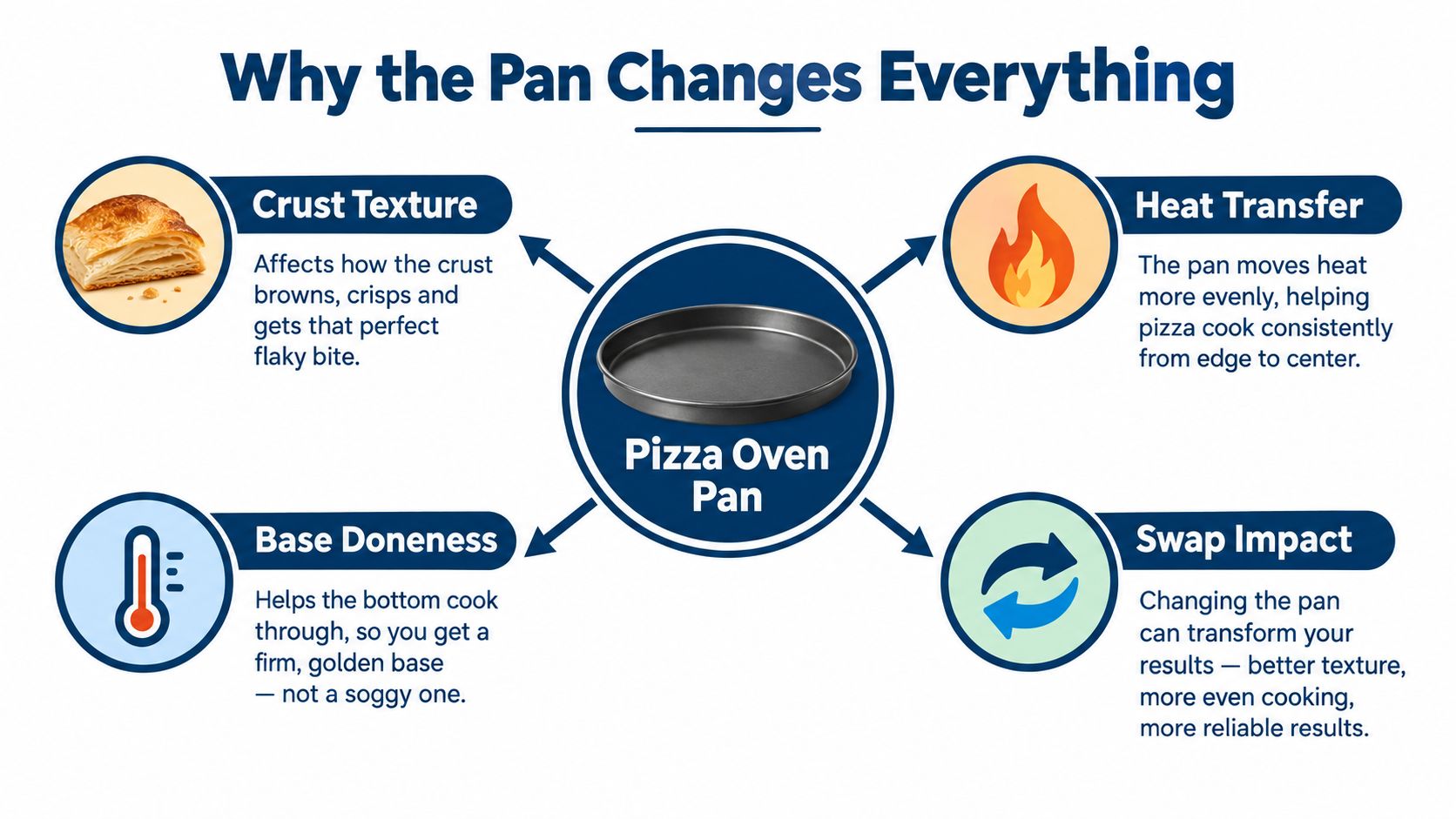
The oven hasn't necessarily failed, and the dough may not be the only variable. A pizza pan is an active part of the heat-transfer path. Aluminium, steel, cast iron and coated constructions don't respond identically, while thickness, colour, surface finish and perforation can alter the way heat reaches the dough.
The cooking system matters more than the accessory
The central relationship is:
Dough + pan + oven + temperature + cooking time = finished pizza
The pan affects the connection between the oven and the base. A solid surface keeps the dough in continuous contact with the pan, while openings in a perforated pizza pan change exposure to oven air and the way moisture escapes. A heavy steel pan can behave differently from a lightweight aluminium pizza baking pan, and a dark finish may absorb radiant heat differently from a bright finish.
That doesn't make one pizza oven tray universally better. It means a pan change can require a process change. Operators should avoid changing the pan, dough, temperature and cooking time simultaneously because the kitchen then loses the ability to identify what caused the new result.
Practical rule: When a new pan changes the bake, change one variable at a time and record the result.
This approach is particularly useful when reviewing what successful pizza operators consider before buying equipment. The pan should be assessed alongside the oven floor, loading pattern, dough formulation and desired crust, not as an isolated piece of smallware.
Solid Versus Perforated Pizza Pans
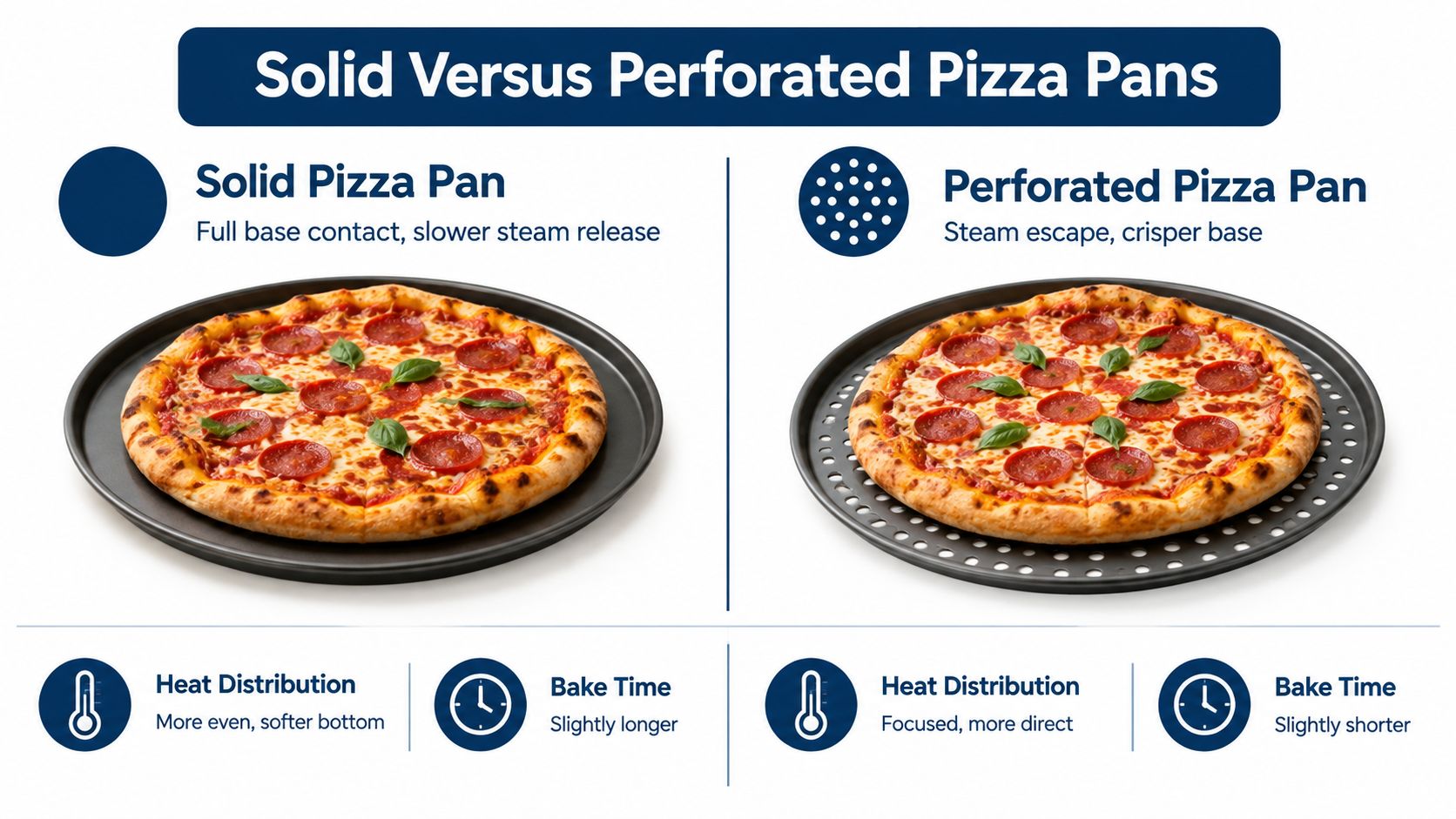
Solid and perforated pans create different contact conditions beneath the dough. A solid pizza pan supports the base across its cooking surface, while a perforated pizza pan has openings that expose parts of the dough to the oven environment and allow moisture to escape differently.
Neither construction wins in every kitchen. The right choice depends on the pizza style, dough, oven, service speed and desired base texture.
Solid pans
A solid commercial pizza pan gives the dough continuous contact with the pan across the base. That can suit operators who want a defined, supported shape and a consistent contact surface during baking. It can also make handling straightforward because the pan supports the pizza from preparation through to oven loading and removal.
The pan itself becomes the main interface between the oven's heat and the dough. Material, thickness and finish therefore matter. A solid aluminium pizza pan may respond differently from a heavier steel construction, even when both are listed for the same pizza diameter.
Solid pans can be useful for:
- Structured pan pizzas: The pan supports dough that needs to remain within a defined shape.
- Repeatable handling: Staff can prepare, move and bake the pizza without transferring it between surfaces.
- Menu consistency: A standard pan specification can help maintain a familiar edge and base profile.
Perforated pans
Openings in a perforated pan expose more of the base to the oven air and alter moisture movement during cooking. Some operators choose this style when they want a particular crust characteristic, but the result depends on the complete cooking process.
A perforated surface isn't automatically crispier, faster or better. Dough hydration, oven type, pan position, temperature and cooking time all affect the outcome. A perforated pan that works well in one oven may not produce the same result in another, especially where the oven provides a different balance of floor heat and circulating air.
For buyers comparing constructions, the Chef Inox perforated gastronorm pan illustrates why the perforation pattern and intended format should be checked rather than inferred from the word “perforated” alone.
The practical selection question is not “Which pan is superior?” It's “Which base does the menu require, and how does this pan create that result in this oven?” A change from solid to perforated should be tested with the actual dough and toppings used during service.
Pan Materials and Thermal Properties
Material affects how a pizza pan handles heat, weight and repeated service. Aluminium is a common commercial choice because it's relatively light, easy to handle and conducts heat effectively. NZ supplier information describes aluminium's high thermal conductivity as supporting faster, more even heat spread, fewer hot spots and more uniform browning in pizza-style applications (aluminium baking tray characteristics).
That response can suit a busy kitchen. Staff can move aluminium pans easily, and the material responds promptly as the cooking cycle changes. It can support repeatable crust development where operators need a practical balance between handling and heat transfer. The same responsiveness means that oven settings, pan position and loading habits still need to be controlled.
Aluminium and steel serve different purposes
Aluminium pizza pans are often a sensible starting point where the menu requires:
- Lower handling weight: Staff can load and unload multiple pans with less bulk.
- Responsive heat transfer: The pan spreads heat efficiently across the cooking surface.
- Commercial formats: Standardised diameters and tray shapes are available for foodservice use.
Steel brings a different set of characteristics. For deeper-dish or Detroit-style pizza, heavy-gauge steel, higher mass and a 75° angled sidewall can help the pan hold heat under substantial topping loads and support a caramelised cheese edge (Detroit-style pan construction). A stainless lid can also support proofing and topping protection where the product includes that feature.
Steel's mass can be useful for a structured, high-heat result, but it also changes handling. A heavier pan may require more deliberate storage, loading and removal procedures than a lightweight aluminium pizza pan.
Finish and colour are process variables
Bright and dark finishes can absorb and reflect radiant heat differently, which may influence cooking behaviour. That doesn't justify assigning a fixed cooking time or temperature to every dark or bright pan because the oven, dough and construction remain part of the system.
A kitchen changing from bright aluminium to a darker or heavier pan should test the finished product rather than assume existing settings will transfer unchanged. The practical guidance in Pizza Oven Temperature Celsius applies here: temperature is important, but it isn't the only control available when the base cooks incorrectly.
Choosing Pan Size and Quantity
Pan sizing should begin with the menu, not the oven shelf. The useful sequence is:
Advertised pizza size → dough weight → finished product → appropriate pan diameter
There isn't a universal dough weight for every advertised diameter because dough formulation, rim style, hydration and finished thickness vary. The pan should match the actual product the customer receives, including how much edge expansion the kitchen expects during proofing and baking.
Standardise around the menu
If a restaurant sells 10-inch, 12-inch and 14-inch pizzas as illustrative menu sizes, matching each size with a defined pan specification can make several daily tasks more repeatable:
- Dough portioning: Staff work to a consistent format for each menu size.
- Topping control: Kitchen teams can develop quantities around a known surface area.
- Pricing: The product specification remains linked to the advertised size.
- Cooking: Staff aren't guessing which pan best suits a particular dough portion.
- Training: New team members learn a smaller number of standard processes.
A Chef Inox aluminium utility pizza plate may be relevant where the required format matches the product specification, but operators should confirm the intended use, diameter and oven conditions before standardising it across service.
The same discipline applies to storage and preparation. For example, Mepal Cirqula Rectangle Small Set 3-Piece Nordic White uses 500 ml, 1000 ml and 2000 ml polypropylene bowls with TPE-sealed window lids, and its rectangular footprint is designed to use fridge and freezer space efficiently. It isn't a pizza pan, but it demonstrates the value of matching storage formats to actual portioning and shelf-space requirements.
Calculate practical pan quantity
Operators often ask which pizza oven pan to buy and overlook how many pans the workflow needs. A useful planning equation is:
Pizzas simultaneously in production + pans awaiting cooking + pans cooling or being cleaned + operational reserve = practical pan requirement
| Component | Purpose | Consideration |
|---|---|---|
| Pizzas simultaneously in production | Supports current preparation and topping | Count the number of pizzas the team handles at the same time |
| Pans awaiting cooking | Keeps prepared pizzas moving towards the oven | Allow for the gap between preparation and loading |
| Pans cooling or being cleaned | Prevents the clean supply from disappearing during service | Include the actual cleaning and cooling workflow |
| Operational reserve | Covers breakage, damage, menu variation or a late rush | Set the reserve according to the venue's risk and service pattern |
A restaurant producing five pizzas an hour has a different requirement from a kitchen producing continuously through peak service. Pan quantity should reflect the actual workflow, available storage and expected growth, not a universal pan-to-oven ratio.
Pan Compatibility with Commercial Ovens
A pizza pan must suit the oven's intended cooking method. Pan cooking and direct deck or stone cooking are different workflows, even when both produce pizza.
With pan cooking, the pan supports the dough during preparation, loading and removal. The base receives heat through the pan, so the relationship is floor heat → pan → dough. Direct deck cooking exposes the dough to the cooking surface itself, which changes handling, base contact, transfer technique and the style of pizza the oven is being used to produce.
Match the pan to the oven design
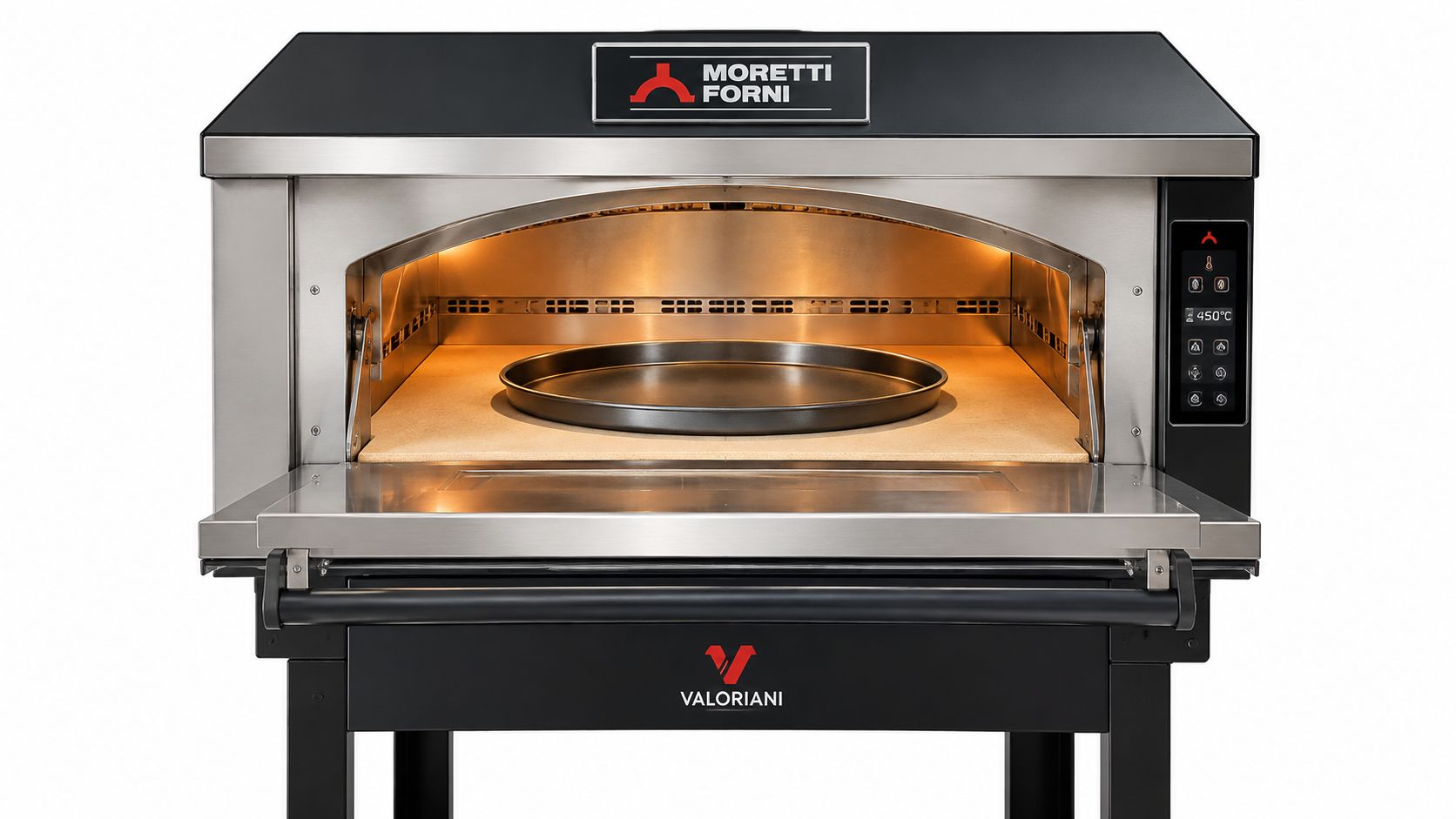
Moretti Forni ranges, including iDeck, Serie S and Serie X ovens where stocked, should be assessed according to the manufacturer's stated operating method and the pizza style required. Valoriani pizza ovens are associated with traditional refractory and deck cooking approaches, where direct baking on the oven floor may be appropriate depending on the operating method and menu.
That doesn't mean every oven should receive a pan, or that every pizza should be moved from the deck into a tray. Operators should never place a pizza oven pan into an oven where the manufacturer doesn't recommend its use. The pan's material, dimensions, handles, coating and temperature rating all need to suit the equipment.
Recalibrate rather than blame the temperature
Changing from direct deck cooking to pan cooking, or switching from aluminium to heavier steel, changes how heat reaches the base. If the base is pale, too dark, soft or uneven, oven temperature may be one variable, but it isn't necessarily the only one worth changing.
Check pan construction, shelf position, loading pattern and cooking time, then alter one variable at a time. This preserves a clear cause-and-effect record and helps the kitchen standardise the new process.
Oven choice also affects the wider commercial plan. The article on choosing a pizza oven for a restaurant, bar or food truck provides useful context for matching oven format to venue workflow. Once the cooking system is consistent, operators can also consider customer-facing resources such as Instagram growth for pizza businesses without confusing marketing activity with the underlying production standard.
Cleaning, Seasoning, and Pan Maintenance
Commercial pizza pans should be cleaned according to the manufacturer's instructions. A method that suits one aluminium finish may damage another surface, while aggressive chemicals, abrasive tools or dishwashing may be unsuitable for a particular product.
Seasoning also depends on the pan. Some materials or finishes may require preparation before use, while others have different care requirements. There isn't a universal oil, temperature or seasoning cycle that guarantees release across every pizza pan.
Investigate sticking as a process problem
When pizzas begin sticking, adding more release medium isn't always the right answer. Potential contributors include:
- Pan material and finish: The surface may respond differently as it wears or changes.
- Manufacturer-required preparation: The product may require a specific initial or ongoing care procedure.
- Dough formulation: Flour, hydration and fermentation can affect release.
- Preparation method: Stretching, proofing, topping and loading all influence contact with the pan.
- Oven conditions: Temperature, pan position and cooking time can change the base.
- Cleaning practices: Residue, damage or unsuitable cleaning can alter the cooking surface.
If a pan previously released pizza reliably and suddenly doesn't, the kitchen should identify what changed. The dough may be different, the pan may have deteriorated, the preparation process may have shifted, or the oven may be operating under different conditions.
Know when a pan should leave service
A pan deserves assessment or replacement when significant deformation affects safe handling, causes uneven contact with the cooking surface or changes the finished product. Deterioration that creates sharp edges, damaged surfaces or uncertainty about food contact should also be treated seriously.
Food-contact articles used for storage, preparation, cooking, presentation or consumption must not be sold in New Zealand if they can impart lead, antimony, arsenic, cadmium or another toxic substance to food, or if they aren't resistant to vinegar under the Food (Safety) Regulations 2002. Operators should retain product information and follow the manufacturer's instructions for the specific pan.
Performance Gaps Between Pan Types in the NZ Market
The New Zealand market includes pizza pans with very different temperature limits and intended uses. One NZ-sold non-stick crisper pan is rated to 200°C (product temperature specification), while other products are positioned for hotter pizza-oven use. That difference is operationally important because a pan designed for home baking isn't automatically suitable for repeated commercial service.
The cheapest perforated pizza pan can be the wrong choice when a kitchen needs high-heat production. Perforation alone doesn't establish durability, temperature compatibility or even cooking performance. Buyers should check the construction, finish, manufacturer's maximum temperature, intended oven type and care instructions.
Read beyond the product label
A commercial buyer should ask:
- What heat can the pan handle? Confirm the manufacturer's rating for the actual oven.
- What workload is intended? Consider repeated loading, unloading, stacking and cleaning.
- What does the menu require? Thin crust, deep pan, focaccia and structured Detroit-style pizza may need different constructions.
- What happens after service? Check whether the care instructions fit the kitchen's cleaning system.
Some NZ listings also position pizza pans as multi-purpose service vessels for focaccia, roasting, sizzling dishes and other menu items. That flexibility can help smaller venues reduce the number of separate SKUs, but it shouldn't override temperature suitability, food-contact requirements or repeatable pizza performance.
New Zealand's wider baking ecosystem is substantial as well. Stats NZ-linked data record 1,626 enterprises in bakery product manufacturing in February 2025, compared with 1,029 in 2000, an increase of about 58% over 25 years; Auckland accounted for 612 geographic units, Wellington 138 and Canterbury 108 in 2025 (Stats NZ-linked bakery business data). Those figures indicate a broad commercial food-preparation base, but they don't remove the need to match each pan to its actual kitchen system.
Making the Right Pan Decision for Your Kitchen
The right pizza oven pan isn't chosen by price or diameter alone. Start with the advertised menu size, then select the pan material, construction, finish and perforation according to the desired crust and the oven's operating method.
For a commercial kitchen, the decision should cover:
- Product specification: Match the pan to the finished pizza, not just the dough ball.
- Heat behaviour: Consider aluminium's light handling and conductivity against the characteristics of heavier constructions.
- Workflow: Plan enough pans for production, cooking, cooling, cleaning and reserve capacity.
- Standardisation: Use consistent pan specifications for each menu size.
- Compatibility: Confirm that the pan is suitable for the oven and cooking method.
- Care: Follow manufacturer cleaning, seasoning and storage instructions.
The commercial value is consistency. A pizza pan may be inexpensive compared with a commercial oven, but it sits directly between the dough and the heat source, influencing every pizza produced. The most reliable operation standardises the pan, dough and oven settings so the hundredth pizza can be made as consistently as the first.
Simply Hospitality supplies commercial pizza pans, pizza oven trays, pizza preparation equipment and commercial cooking equipment for New Zealand hospitality businesses. Visit Simply Hospitality to review suitable equipment categories or contact the team for help matching pan size, construction and quantity to the venue's menu and oven.