

Pizza Oven Temperature Celsius: Setting the Right Heat
A pizza leaves the oven with a scorched base, pale toppings, or a crust that changes halfway through service. The operator checks the dial and sees the expected number, yet the result still isn't consistent. The problem is often not the headline setting. Pizza oven temperature in Celsius only makes sense when the set temperature, chamber air, deck surface, top heat, dough and service load are considered together.
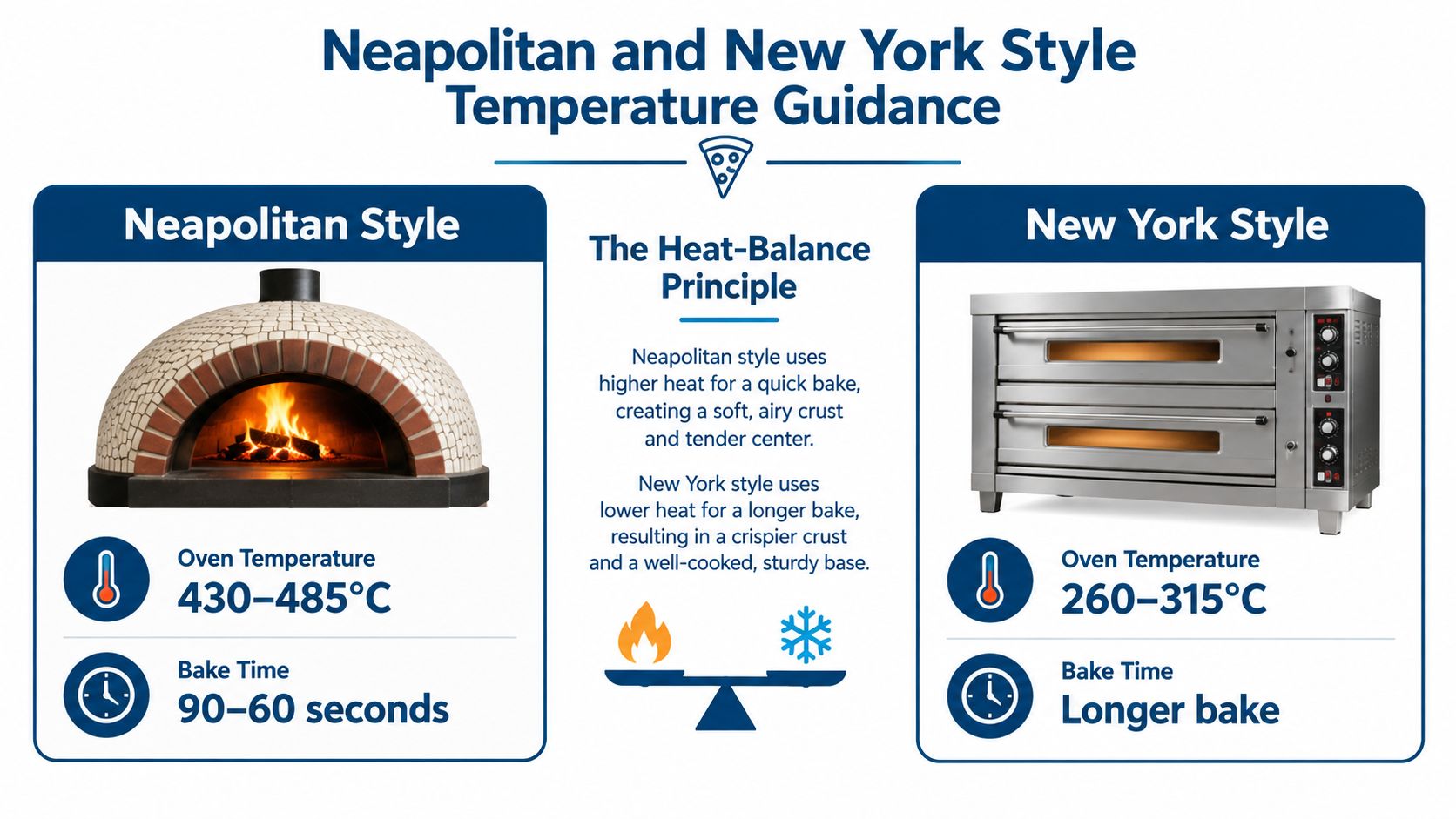
As a practical starting point, traditional Neapolitan-style pizza commonly uses approximately 430°C to 485°C, while New York-style pizza generally uses approximately 260°C to 315°C. Other deck-oven pizzas need a more flexible starting point because dough thickness, hydration, toppings and oven configuration can shift the correct balance.
Understanding Pizza Oven Temperature Beyond the Dial
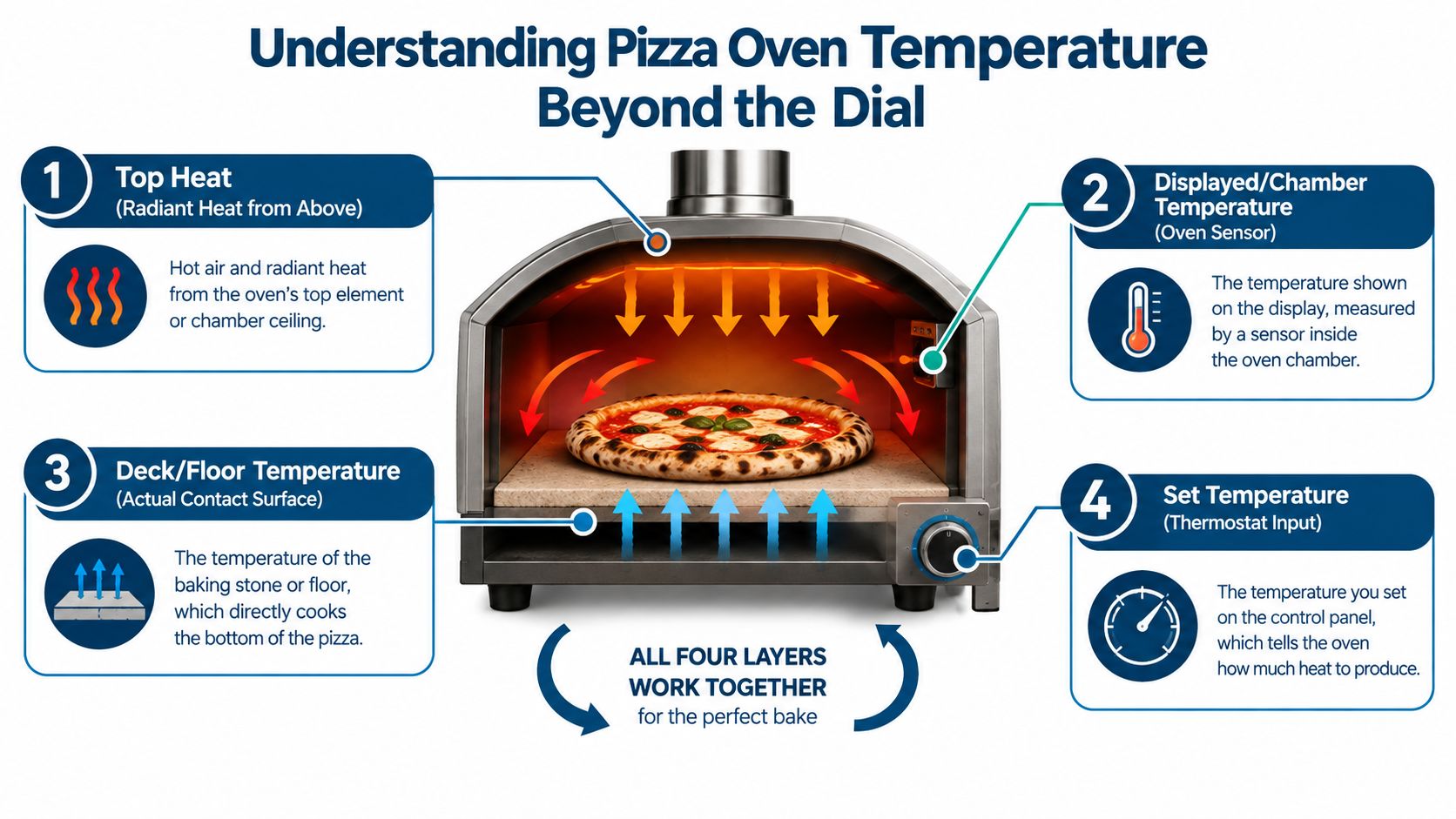
The most common mistake is setting the thermostat to a recommended number and expecting that number to describe every part of the oven. It doesn't. A commercial pizza oven can report a chamber temperature that differs materially from the temperature of the deck where the dough sits, while radiant heat from above affects the toppings and upper crust in a different way again.
Four measurements matter:
- Set temperature: The temperature the operator asks the oven to reach.
- Displayed or chamber temperature: The reading reported by the oven's control system.
- Deck or floor temperature: The heat on the stone, steel or hearth that contacts the dough.
- Top heat: Radiant or circulating heat acting on the toppings and upper crust.
Those temperatures interact, but they aren't interchangeable. A thermostat can be set correctly while a cooler deck produces a pale base, or an aggressive floor can char the underside before the cheese and toppings are ready.
What the operator should diagnose
A useful temperature check starts with the question, “Which part of the bake is failing?” If the bottom is too dark, the deck may be too hot relative to the top heat, although dough and topping variables also need checking. If the top develops colour before the base has structure, the floor may be under-heated or the heat balance may not suit the pizza.
This distinction becomes particularly important when comparing what to consider before buying a commercial woodfired pizza oven. Operators need to understand not only the oven's advertised maximum, but also how heat is distributed, measured and recovered during actual service.
Practical rule: The useful temperature is the one that produces the required pizza consistently, not simply the highest number shown on the display.
Practical Temperature Ranges for Common Pizza Styles
The immediate answer to the pizza oven temperature Celsius question depends on the style being produced. These ranges are useful starting points, not universal mandatory settings.
| Pizza style | Useful starting temperature range | Key variables |
|---|---|---|
| Neapolitan-style | Approximately 430°C to 485°C | Dough formulation, thickness, hydration, topping load, hearth temperature and top heat |
| New York-style | Approximately 260°C to 315°C | Crust thickness, dough structure, toppings, bake duration and oven configuration |
| Other deck-oven pizzas | Depends substantially on the dough, thickness, toppings and oven | Floor heat, top heat, loading pattern and desired crust finish |
New Zealand guidance places practical hearth temperatures for many commercial and residential pizza ovens around 350°C to 425°C, with some guidance identifying 375°C to 425°C as a useful range for very fast cooking. Authentic-oven guidance for pizza hearth temperatures also indicates that very fast bakes can vary from about 40 seconds to 1.5 minutes, depending on dough thickness. These figures show why a style range shouldn't be treated as a fixed recipe.
Adjust for the product, not the label
A thin pizza with a light topping load can tolerate a different floor and top-heat relationship from a thicker pizza carrying more moisture. A heavily topped pizza may need more time for the centre to cook, while an excessively hot deck can darken the base before that happens.
Compact and home appliances also operate differently from dedicated commercial ovens. A New Zealand oven manual recommends preheating to 200°C and using about 190°C for pizza, while local kitchen guidance notes that most domestic ovens top out around 250°C. Choosing a pizza oven for a restaurant, bar or food truck can therefore not be reduced to buying the appliance with the highest advertised setting. The venue's pizza style, menu role and expected production pattern matter more.
Pizza Cooking as a Heat-Balance Problem
Pizza baking is a heat-balance problem. The final result depends on dough, pizza thickness, toppings, floor heat, top heat, cooking time and oven loading, rather than a single thermostat number.
Floor heat drives the base. Top heat develops colour, melts cheese and cooks the exposed toppings. Cooking time determines how long those two sources act on the pizza. If one part is too strong or too weak, the operator may see a defect that looks like a temperature problem but actually comes from the relationship between several variables.
Reading the result
A base that burns before the top is ready points towards excessive floor heat relative to the rest of the bake, although dough formulation, moisture and thickness should also be investigated. Lowering the set temperature might help, but it can also weaken top heat and lengthen the bake without correcting the underlying imbalance.
When the top cooks before the base, the operator should examine deck temperature, heat balance and the pizza itself. The dough may be too thick for the current floor conditions, or the surface may not have stored enough heat for the required bake.
Loading changes the equation
Two pizzas baked at the same displayed temperature can behave differently when one is launched into an empty oven and the other follows repeated loading. Each pizza removes thermal energy from the cooking surface. The deck, dome and heating system then need to restore that energy while the next pizza is being prepared.
That is why a pizza that looks excellent at the start of service may become pale or slow later. Increasing the thermostat isn't automatically the answer. The oven may need better recovery, a different loading pattern or a production rate that matches its stored heat.
Neapolitan and New York Style Temperature Guidance
Neapolitan-style and New York-style pizzas demonstrate why there isn't one correct pizza oven temperature in Celsius. They use different dough structures, bake durations and heat balances, so copying one style's setting into the other can produce poor results.
Traditional Neapolitan-style cooking uses very high heat and a very short bake. New Zealand guidance cites approximately 430°C to 480°C for authentic Neapolitan-style pizza, while other local guidance identifies an optimum hearth range of approximately 375°C to 425°C. The difference reflects the fact that oven chamber temperature, hearth temperature, measurement location and oven design aren't always described in the same way.
Neapolitan-style production
The attraction of high heat is speed and the style of crust it can produce. Local guidance describes Neapolitan-style cooking in a range of about 40 seconds to 1.5 minutes, depending on dough thickness, while another New Zealand source cites a cooking range of 430°C to 480°C. The operator needs strong floor heat, effective top heat and enough recovery to repeat the result.
Valoriani equipment, including the IGLOO range, is designed for high-temperature pizza work. Where gas is part of the installation, appropriate Spitfire gas integration or options need to be assessed against the specific oven configuration, services and extraction plan. Not every pizza cooked in a Valoriani oven must follow one temperature profile. The dough, menu and intended service still determine the working setting.
Further practical context is available in the guide to wood fired ovens for pizza, particularly where hearth management and recovery are central to the workflow.
New York-style production
New York-style pizza generally uses a lower temperature and a longer bake than Neapolitan-style pizza. A broad starting range of 260°C to 315°C can suit the format, but it isn't an official mandatory setting. Dough formulation, thickness, hydration, topping quantity and oven configuration all affect the result.
Moretti Forni commercial ovens can be considered where a venue needs controlled deck baking across a broader menu. The iDeck, Serie S, Serie X and Neapolis ranges shouldn't be treated as interchangeable, because chamber arrangements, controls, temperature capabilities and operating characteristics vary by model. Operators should verify the actual manufacturer specification for the selected unit rather than applying a range-wide assumption.
Troubleshooting Common Pizza Quality Symptoms
Pizza quality symptoms provide useful clues, but they rarely identify one guaranteed adjustment. The operator should separate heat problems from dough, topping, loading and process problems before changing the thermostat.
The base burns before the top is ready
Start with the cooking surface. Excessive floor heat relative to top heat can colour or scorch the base while the upper crust remains underdeveloped. Check whether the pizza is too thin for the current hearth condition, whether flour or semolina is accumulating on the deck, and whether the topping load requires a longer bake.
A cooler deck may be appropriate, but the adjustment should be controlled. Reducing the chamber setting can leave both the floor and top underpowered.
The top cooks before the base
This pattern suggests that the deck isn't delivering enough heat to the dough, or that the pizza needs a different balance between floor heat and radiant heat from above. A thicker dough, a wet centre or a heavy topping load can make the base appear slow even when the oven's chamber reading looks normal.
The operator should check the actual deck surface rather than relying only on the display. A surface reading can show whether the hearth is ready, but it won't replace an assessment of dough thickness, topping moisture and bake time.
The first pizzas are good, then production slows
This is usually a commercial heat-recovery issue rather than proof that the thermostat is set too low. An empty oven can reach its target while the cooking surface loses stored energy through repeated loading.
New Zealand guidance notes that commercial operations commonly work around 450°C, with one local supplier estimating roughly 50 pizzas per hour at that setting. Commercial electric oven guidance also includes a consumer example of an oven reaching 400°C in about 17 minutes. Those figures describe different equipment and contexts, so they shouldn't be combined as a universal production promise.
The useful question is whether the oven can recover between launches at the venue's required pace. If it can't, adding heat may worsen scorching without restoring consistent throughput.
Measuring Deck, Chamber, and Surface Temperature Accurately
The right thermometer depends on the temperature the operator is trying to understand. An infrared thermometer, a probe and the oven's internal sensor don't measure the same thing.
Infrared thermometer
An infrared thermometer measures surface temperature, making it particularly useful for checking a stone, steel or deck before launching a pizza. The reading can be affected by the instrument's characteristics, measurement distance and the surface being measured, so the operator should follow the thermometer's instructions and use a consistent measuring approach.
A deck reading is most useful when several points are checked. A single spot may not represent the entire cooking surface, particularly in an oven with noticeable hot and cool zones.
Probe thermometer
A probe measures temperature at the probe itself. It can be useful for appropriate food or process measurements, but it doesn't directly tell the operator the temperature across the pizza deck. Placing a probe in the chamber therefore shouldn't be treated as a substitute for measuring the cooking surface.
For context, a separate holding application uses the SKOPE Open Deck Display Fridge - Black - OD460N, an open-deck commercial unit with a 1°C to 5°C operating range. That illustrates why measurement always needs to match the equipment and process being assessed.
Oven sensor and maintenance
The oven's internal sensor serves the control system, and its location may not represent every point on the deck. A stable display therefore doesn't prove that the floor is behaving as expected.
Operators should follow the oven manufacturer's instructions for temperature checks, calibration and servicing. No arbitrary weekly or monthly schedule should be applied without manufacturer guidance. If cooking performance changes noticeably while displayed settings remain unchanged, the equipment, heat recovery and measurement method need investigation. Hospitality supplies equipment but doesn't operate an equipment repair or service department, so qualified servicing should be arranged where required.
Heat Recovery and Commercial Production Consistency
Peak temperature tells an operator what an oven can reach. Heat recovery indicates what it can repeatedly produce. Those are different purchasing questions.
An oven that reaches a high temperature while empty may still struggle when pizzas are launched continuously. Every pizza removes thermal energy from the deck and chamber. The oven then needs enough stored energy and recovery capability to restore productive conditions before the next load.
Match the oven to the service
A restaurant producing a few pizzas alongside a broad menu has a different requirement from a dedicated pizzeria trying to maintain continuous production through a busy Friday service. A bar or event kitchen may value flexibility and a compact footprint, while a dedicated operation may prioritise deck area, recovery behaviour, loading access and service continuity.
The buying sequence should look like this:
Pizza style → required temperature → production rate → heat recovery → oven capacity → appropriate equipment
That sequence is more useful than selecting the model with the highest advertised maximum. Equipment selection should also account for electrical or gas services, extraction, ventilation, installation clearances, cleaning access and the physical path into the kitchen.
What successful pizza operators consider before buying equipment is relevant because production consistency depends on the whole operating setup, not only the oven's maximum temperature.
Capacity affects workflow
An undersized oven can create a queue between preparation and baking, encourage rushed loading and make recovery harder. An oversized oven can introduce unnecessary installation, space and operating complexity if the menu doesn't require its capacity.
The correct specification should reflect expected service patterns, pizza size, number of decks, operator skill, menu breadth and the consequences of delay. SACH Design can be relevant when oven capacity, extraction, gas or electrical services and workflow need to be planned as part of a broader commercial kitchen.
Controlled Recipe Development and Consistent Results
Random temperature changes make pizza development difficult because several variables can shift at once. A more reliable approach is to change one variable at a time and record what happens.
Keep the dough formulation consistent during a test. Use consistent portion sizes, keep toppings reasonably consistent, record floor and chamber conditions, note cooking time, then assess the base, centre, rim and topping finish.
A practical test record
A simple record can include:
- Dough: Formula, hydration, fermentation process and portion size.
- Load: Topping quantity and moisture level.
- Oven: Displayed chamber condition and measured deck surface condition.
- Bake: Launch position, rotation, cooking time and final result.
- Decision: The single change to test next.
A fixed adjustment such as 10°C shouldn't be presented as a guaranteed solution to a crust problem. Small changes can affect results, but the correct response depends on the oven, dough, loading and heat balance.
New Zealand guidance for conventional or electric appliances shows why equipment capability matters. One local manual recommends preheating to 200°C and using about 190°C for pizza, while a New Zealand kitchen reference says most domestic ovens top out around 250°C. Local oven guidance therefore needs to be interpreted differently from commercial high-heat hearth guidance.
Controlled testing beats thermostat chasing. A repeatable record helps the kitchen distinguish a recipe issue from a surface-temperature or recovery issue.
Celsius and Fahrenheit Conversion Reference
International recipes and equipment manuals often use Fahrenheit. These are approximate, rounded conversions for quick kitchen reference.
| Celsius | Fahrenheit |
|---|---|
| 260°C | Approximately 500°F |
| 315°C | Approximately 600°F |
| 400°C | Approximately 752°F |
| 430°C | Approximately 806°F |
| 450°C | Approximately 842°F |
| 485°C | Approximately 905°F |
The conversion doesn't tell the operator whether the floor, chamber or top heat is suitable. It only translates the displayed scale. Can a faster pizza oven increase your restaurant's revenue is best considered alongside production rate, recovery and workflow rather than temperature alone.
The central decision remains practical: choose the heat balance that suits the pizza, then confirm that the oven can maintain it throughout service.
Simply Hospitality supplies commercial cooking equipment and can help hospitality businesses compare pizza ovens, capacity, services, workflow and related kitchen requirements. Visit Simply Hospitality to discuss a pizza oven setup that matches the venue's menu and production demands.