

Pizza Oven Portable: What NZ Operators Should Check First
The smallest oven isn't necessarily the most portable solution. A portable pizza oven is a compact, movable appliance that cooks pizza using gas, wood, electricity or another manufacturer-approved fuel, but its practical footprint includes the stand, fuel, preparation space, refrigeration and cleaning equipment needed to operate it. For NZ buyers comparing “pizza oven portable” options, the better starting point is realistic demand and the complete setup, not maximum temperature or oven weight alone.
What a Portable Pizza Oven Is and Where It Fits
Portable describes equipment that can be relocated rather than permanently built into a cooking installation. It doesn't automatically mean lightweight, cordless or suitable for indoor operation.
Some ovens can travel easily in a car. Others require lifting assistance, a trolley and a substantial bench, especially once their cooking stone and accessories are included.
Common applications include:
- Backyard entertaining and outdoor kitchens, where cooking is part of the occasion.
- Markets and events, where equipment must arrive, operate and leave within the venue's timetable.
- Mobile catering and pop-up restaurants, where service conditions change between bookings.
- Food trucks and small hospitality venues, where space is restricted and every appliance needs a defined role.
The important distinction is between occasional cooking and dependable production. An oven used for family gatherings can pause while the cook stretches dough or replenishes fuel. Equipment supporting a booked catering service needs to match the promised meal schedule.
A portable oven can also provide a way to test a pizza menu without immediately committing to a permanent installation. However, that trial still needs appropriate food handling, fuel arrangements and a workable service layout.
Define the job before comparing ovens
Buyers should establish three things before shortlisting equipment:
- Location: An open outdoor area, covered cooking position and indoor kitchen create different approval and installation questions.
- Frequency: Occasional entertaining places different demands on components, cleaning and handling than repeated commercial service.
- Operator: A home enthusiast may enjoy managing a fire; catering staff may need straightforward controls and repeatable procedures.
Practical rule: Portability should be judged from vehicle unloading to final pack-down, not just from the oven's carrying handles.
For home use, convenience and the preferred cooking experience may lead the decision. For hospitality, the oven must fit a production system. A clearly defined location, operating frequency and staffing arrangement will separate a flexible occasional-use appliance from equipment expected to earn its place in regular service.
Gas, Wood, Electric and Multi-Fuel Ovens Compared
Portable pizza oven types at a glance
| Oven type | Advantages | Limitations | Suitable applications |
|---|---|---|---|
| Gas | Convenient temperature adjustment and straightforward operation | Outdoor-rated models need outdoor placement, compatible gas components and cylinder management | Markets, events, outdoor entertaining and mobile catering where approved |
| Wood-fired | Traditional fire-led cooking experience and potential smoke character | Fuel sourcing, fire tending, ash removal and preparation before service | Home entertaining and outdoor kitchens where the cook enjoys the process |
| Electric | No combustion at the appliance; may suit locations where gas is impractical | Suitable electrical supply and installation checks; temperature range needs confirmation | Sites with appropriate power and a model approved for the location |
| Multi-fuel | Fuel flexibility where the model supports it | Every fuel and conversion component must be approved; performance can differ | Operators working across sites with different fuel arrangements |
Match the fuel to the site
Gas suits buyers wanting direct burner adjustment without tending a wood fire. Fuel availability means checking cylinder refill or exchange arrangements, rather than assuming a spare bottle will be available near an event. Preparation includes inspecting connections and positioning the cylinder; cleaning means keeping burner areas free of debris, and transport calls for a safe cylinder arrangement.
Wood-fired cooking makes fire management part of the job. Suitable dry fuel needs protected storage, the cooking floor needs time to absorb heat, and ash must cool before safe removal. Transport planning must account for fuel, fire tools and dirty equipment, not just the oven itself.
Electric equipment avoids carrying combustion fuel, so the supply question moves to the venue. Plug type, circuit capacity, weather protection and any installation requirements must match the exact appliance. Preparation still includes heating the cooking surface, while cleaning and transport need to protect controls, cables and the stone.
Multi-fuel equipment offers genuine flexibility only when the manufacturer approves each configuration. A burner attachment or conversion kit approves the fuel it was designed for, and running anything else places the oven outside its stated conditions. Compare preparation, cleaning and output in each approved mode, because the same body can behave differently on gas than on wood.
The wood-fired versus gas pizza oven comparison provides further context for buyers choosing between active fire management and burner control.
Check the stated temperature range against the stone
Fuel choice says little about the heat a pizza receives. Dome shape, stone thickness and airflow decide how evenly a base cooks and how quickly the floor recovers between loads, so two ovens running the same fuel can turn out very different pizzas. Check each model's stated temperature range and how the manufacturer describes the cooking surface before committing. A compact unit rated for general baking may handle flatbreads well yet fall short of the fierce, rapid bake that Neapolitan-style dough needs, and a thin stone that heats quickly on paper can also lose heat quickly once repeated loading begins.
That is why the smallest, lightest oven is rarely the most portable in commercial terms. Before choosing a fuel, write down what a normal service day requires on site: supply, preparation time, cleaning and transport. Then pick the fuel your venues can support at full pace. A heavier oven with fuel, power and workflow it can rely on travels better in practice than a lighter one that stalls mid-service.
Portable Pizza Oven or Commercial Pizza Oven
Portable pizza oven compared with commercial pizza oven
| Feature | Portable pizza oven | Commercial pizza oven |
|---|---|---|
| Cooking capacity | Often a single pizza or small batch; verify usable floor area | Capacity specified for the model and intended production |
| Continuous production | Consumer models may need recovery breaks | Commercial models should be specified for the required duty |
| Temperature recovery | Test repeated loading, not just the first bake | Confirm recovery under the proposed service load |
| Durability | Lightweight construction can favour transport over intensive use | Construction should suit repeated professional operation |
| Fuel consumption | Request model-specific consumption information | Request consumption information at the intended workload |
| Installation | Check support surface, utilities and clearances | Confirm defined utility, extraction and installation requirements |
| Cleaning | Small openings can restrict access | Check routine cleaning access and shutdown procedures |
| Warranty conditions | Domestic-use exclusions may restrict business use | Commercial coverage remains subject to stated conditions |
| Professional use suitability | Must be expressly established for the proposed application | Confirm the model matches the particular commercial task |
A good individual pizza doesn't prove an oven can handle a busy service. Say an operator produces an excellent test bake, then starts accepting consecutive orders on a Friday evening. Repeated loading draws heat from the cooking floor, bases become slower to finish, and the queue grows even though the displayed chamber temperature looks satisfactory.
Temperature recovery is the time the oven needs to return to useful cooking conditions after loading food. Dough absorbs heat from the stone, while openings and handling release heat from the chamber. An appliance that performs well after a long preheat may behave very differently once orders stack up.
Run a back-to-back bake test before committing
A spec sheet describes a single bake under favourable conditions, so the meaningful test replicates service. Load the oven repeatedly at the pace the menu demands, and time how long the floor takes to recover between launches. If recovery stretches with each cycle, the oven has found its duty limit.
Documentation matters as much as the bake itself. A compact oven may be rated for professional use, while a larger domestic appliance may exclude it entirely. Manufacturer paperwork should establish intended application, operating limits, installation conditions and warranty coverage. Handles, hinges, controls and stone supports also need to tolerate the proposed handling, since a sturdy exterior reveals little about whether internal components are built for continuous production.
The commercial wood-fired pizza oven buying considerations help frame the questions associated with more substantial equipment. Dedicated pizza oven equipment should be compared by service specification rather than appearance.
For a broader comparison of production-oven selection, this guide to better ovens for busy UK bakeries offers an adjacent perspective, though NZ installation advice and pizza-specific manufacturer specifications take precedence.
Match the proposed workload to the manufacturer's intended use. A portable oven stops being the right tool when staff must repeatedly interrupt promised service to compensate for its operating limits.
How Many Pizzas a Portable Oven Really Produces
Production starts before the pizza reaches the oven. Dough must be ready, toppings accessible, the launch area clear and finished pizzas moved somewhere that doesn't obstruct the next order.
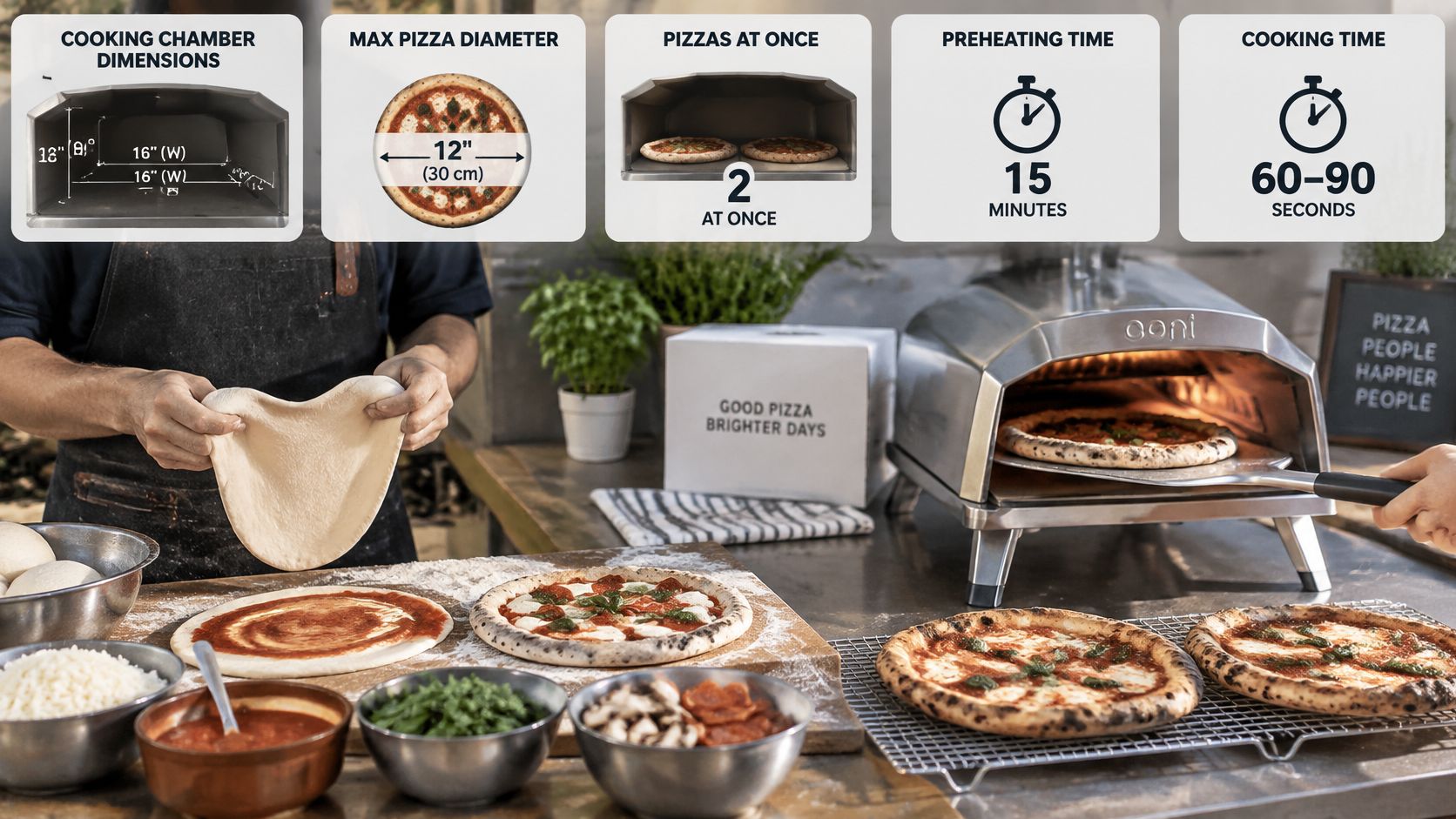
Capacity assessment needs to cover:
- Physical fit: Cooking chamber dimensions, maximum pizza diameter and space for turning.
- Thermal performance: Preheating, cooking and recovery under repeated loading.
- Handling: Launching, turning, unloading and clearing the peel.
- Preparation: Dough portioning, stretching, topping and ingredient replenishment.
- Staff capability: Consistent technique and a clear division of responsibilities.
An advertised cooking time generally describes a bake under particular conditions. It doesn't include every task surrounding that bake, and it shouldn't be treated as sustained hourly throughput.
Compare complete cycles
Consider a hypothetical comparison: a smaller oven accommodates one pizza per cycle, while a larger model accommodates two. With equal cycle times, the larger oven provides twice the theoretical output per cycle, but only if preparation and handling keep pace.
That advantage disappears if the cook can't stretch and top dough quickly enough, or if both pizzas can't be turned safely. Conversely, a single-pizza oven may suit a solo pop-up serving a measured flow of orders without unnecessary equipment or staffing.
Dough preparation can become the hidden bottleneck. A larger cooking floor won't fix dough that isn't ready to stretch, poorly positioned toppings or a bench shared with packaging and payments.
Test the service, not the demonstration
A useful capacity trial records the number of saleable pizzas completed during a timed session. Dividing that count by the session duration establishes a measured production rate; multiplying the rate by the proposed service window gives a starting estimate, with allowance needed for interruptions.
The trial should use the intended dough, pizza size, toppings and staff arrangement. It should also include replenishment and normal cleaning tasks rather than a staged run with everything already assembled.
The discussion of whether a faster pizza oven can increase restaurant revenue is useful when separating faster baking from better overall service.
Where preparation limits output, compare dough mixer batch capacity, dough storage and refrigerated preparation bench space against the oven's measured cycle. Increasing oven capacity alone won't improve a process constrained elsewhere.
Buying Checklist for a Portable Pizza Oven
A kilogram saved on the spec sheet can cost far more at the kerb. A slightly heavier appliance with a stable base, accessible components and workable transport arrangements usually runs more reliably across a full season of loading, firing and pack-down. Commercial portability is decided by the total operating load: the oven, its stand, fuel supply, peels and the hands available to move all of it safely.
Portable pizza oven buying checklist
| Buying consideration | Why it matters | What to verify |
|---|---|---|
| Overall dimensions | Determines whether the setup fits | Footprint plus door, peel and connection clearances |
| Weight and portability | Affects lifting and transport | Complete handling weight and lifting arrangements |
| Cooking surface size | Limits pizza size and batch capacity | Usable floor area and maximum pizza diameter |
| Fuel requirements | Determines site logistics | Approved fuel, cylinder or power supply, regulator and hose |
| Temperature control | Supports repeatable cooking | Control range and chamber versus stone readings |
| Heat retention | Affects repeated bakes | Insulation and recovery in a realistic trial |
| Construction materials | Affects handling durability | Materials, coatings, stone support and replacement components |
| Cleaning access | Influences pack-down time | Residue removal and access permitted by the manual |
| Weather protection | Protects equipment outdoors | Wet-weather restrictions, cover and dry storage |
| Compatible accessories | Completes the working setup | Peel, stand and cover fit for the exact model |
| Warranty and spare parts | Affects repair options | Commercial-use conditions and NZ parts support |
Two rows deserve extra attention on any mobile job. Cooking surface size sets the largest pizza you can sell and how many fit side by side, so measure usable floor area rather than the appliance's external width. Warranty and spare parts decide what happens after the first season of bumps and vibration, so confirm in writing that mobile or commercial use sits inside the cover and that parts are stocked locally.
Check the complete gas system
WorkSafe's LPG in hospitality guidance requires appliances to suit their specified gas and distinguishes cylinder-connected appliances from installations requiring a licensed or registered gasfitter. Buyers should obtain documented compatibility for the oven, regulator and hose as a matched set. Treating those parts as interchangeable is how operators end up with equipment that fails a site check.
Before deployment, inspect hoses and check connections for leaks using soapy water, following the operating instructions. Never use a flame for leak testing or substitute natural-gas components for LPG components.
Compare an actual indoor appliance
The Cuisinart Pizzeria Pro Indoor Pizza Oven (CPZ-120XA) is described in its catalogue listing as a home-focused appliance. Before relying on it for anything beyond that, confirm the temperature range, maximum pizza size and stone construction against the product page and the manufacturer manual. A description written for home use is no evidence of approval for continuous commercial catering.
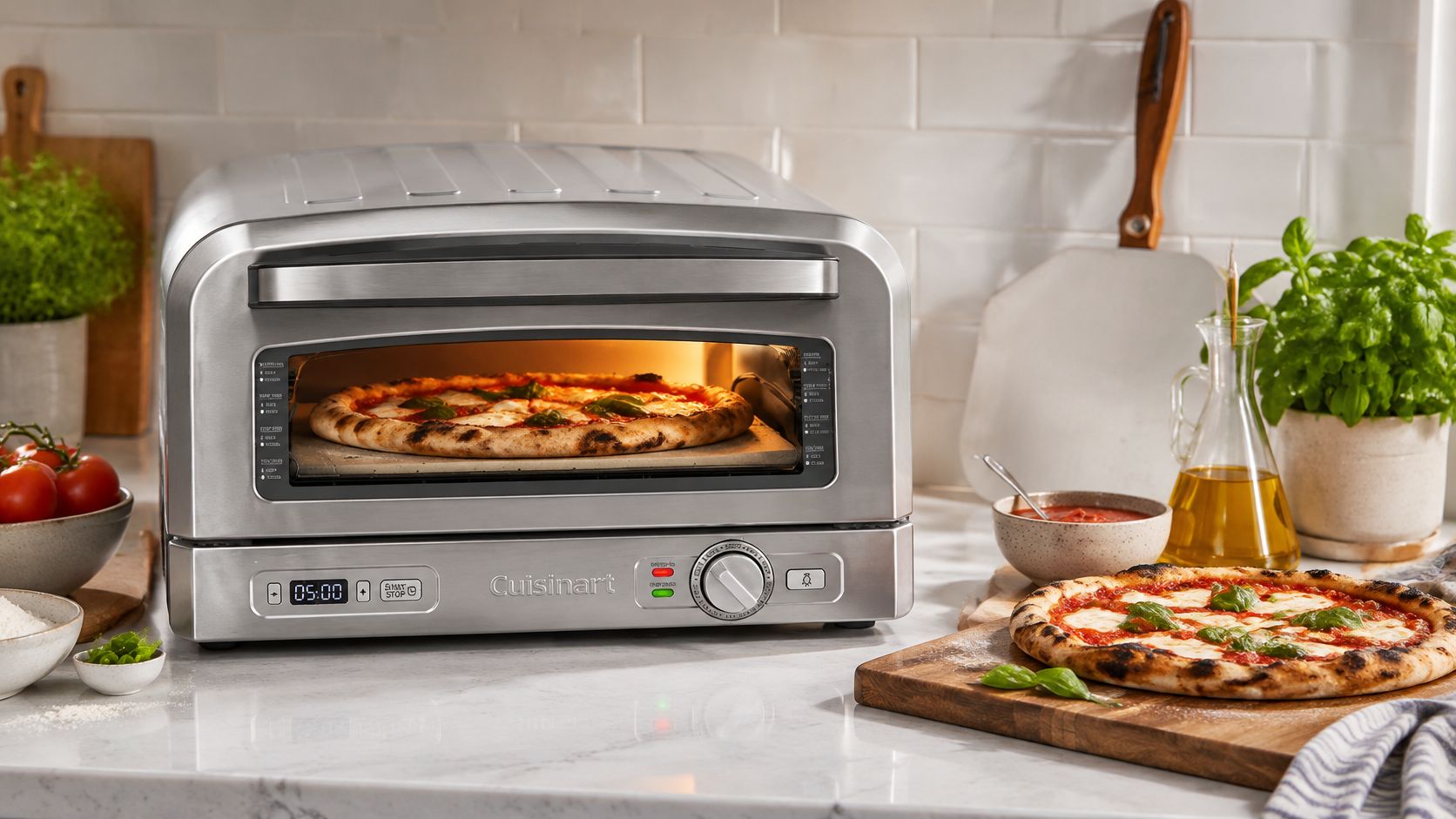
For mobile work, assess the full arrival-to-pack-down routine rather than the bare appliance weight. Loading ramps, cooling time, dry storage and access through gates all shape how portable an oven really is on a working day.
Peels also need checking against the oven mouth and available working space. A peel that's comfortable at a permanent bench may be awkward inside a tightly arranged catering station.
Using a Portable Pizza Oven for Commercial Catering
A portable oven can support commercial catering only when its intended application, construction, capacity and warranty conditions allow it, and the food business and site arrangements comply with NZ requirements. Portability isn't commercial approval.
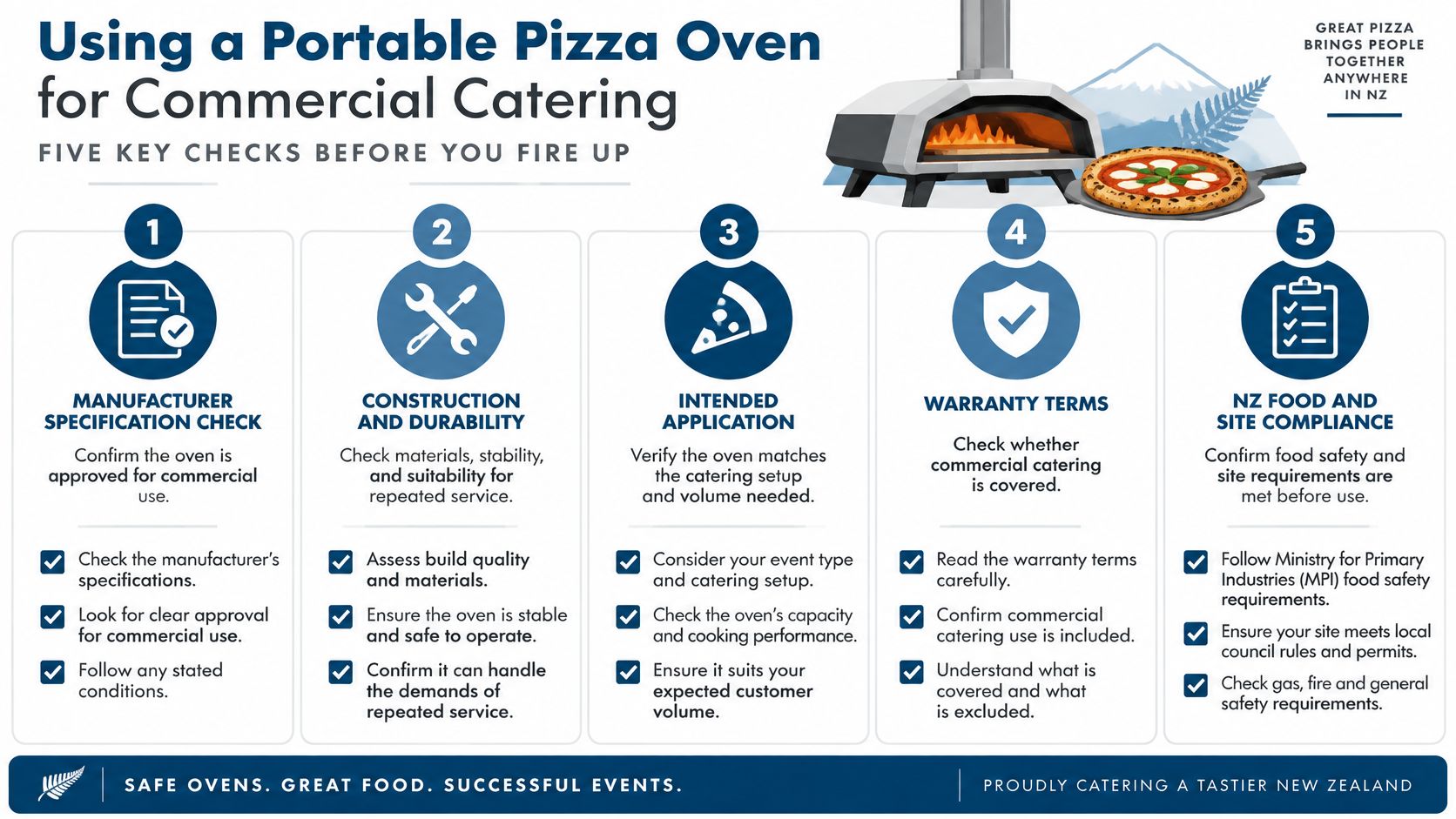
Keep food and combustion controls separate
MPI's occasional-event food guidance identifies 5°C to 60°C as the food danger zone and specifies keeping hot food above 60°C. It also calls for food protection and cleaning equipment and surfaces between activities.
Mobile operators need to establish their registration and verification requirements before trading. Electrical equipment needs appropriate safety checks, while the service station needs handwashing, chilled ingredient storage, suitable fire equipment and first-aid provisions.
WorkSafe's carbon monoxide guidance warns that outdoor gas appliances must never be used indoors because they can produce carbon monoxide. An outdoor-rated LPG oven shouldn't be moved into a kitchen, garage, marquee or enclosed courtyard as a wet-weather workaround.
Select a position with unrestricted airflow, protected customer circulation and room to operate the door and peel. Keep cylinders upright and away from radiant heat, inspect burner areas, and stop operation if gas is smelled, soot appears or flames behave abnormally.
Establish the venue rules before booking
The Building Performance guidance for permanent outdoor fireplaces and ovens describes an exemption involving at least 1 metre separation and a cooking surface no larger than 1 square metre. Those permanent-installation conditions aren't blanket permission for every portable setup; manufacturer instructions, local fire restrictions, smoke nuisance and venue requirements still need checking.
Gas, wood and electric models create different site questions. A food truck installation requires specific assessment rather than an assumption that a benchtop appliance can be secured inside.
For supporting equipment, the NZ catering equipment planning article helps broaden the assessment beyond the oven. MODERN LYFE's discussion of sanitation supplies for open-air food service provides additional cleaning-planning context, without replacing NZ food requirements.
Before accepting a booking, prepare a service sheet covering fuel, workspace, power, weather contingency, cleaning and emergency shut-off.
Running Costs Beyond the Purchase Price
Purchase price doesn't describe the full cost of operating an oven. Preheating, travel, staffing and pack-down can make a lightly attended event expensive even when the appliance itself is modestly priced.
| Cost item | What the operator should include |
|---|---|
| Gas, electricity or wood | Local supply rates and documented appliance consumption |
| Preheating | Fuel or power used before sales begin |
| Ingredients | Dough, toppings, wastage and packaging |
| Cleaning and maintenance | Chemicals, tools, component replacement and servicing |
| Transport | Loading, vehicle use and unloading |
| Accessories | Stand, peels, covers and storage containers |
| Staff and site | Preparation, service, pack-down, site fees and insurance |
| Fuel storage | Spare-cylinder arrangements and emergency equipment |
A hypothetical event calculation
Suppose an operator sells 40 pizzas at $20 each, generating $800 in revenue. At an illustrative $8 contribution per pizza before oven-related operating costs, that event produces $320 in contribution.
That contribution isn't profit. Fuel, labour not already included in the calculation, transport, site fees, insurance and equipment costs still need accounting for, without deducting the same expense twice.
In another hypothetical comparison, demand reaches 40 pizzas, but the setup can supply only 25 within the service window, leaving 15 orders unserved. Additional capacity could help in that situation, but it creates no automatic financial benefit when demand is absent.
Include compliance in the budget
WorkSafe's LPG hospitality guidance specifies a 2 kg dry-chemical extinguisher when more than 50 kg of LPG is held, and requires LPG holdings above 100 kg to be stored outside. Total site stock matters, including spare cylinders.
Budget for secure, ventilated cylinder storage and appropriate emergency equipment before pricing an event. The energy-efficient appliances discussion offers broader purchasing context, but model-specific consumption information and local supply rates are needed for a useful operating budget.
Which Portable Pizza Oven Is Best for Your Needs?
Portability is a property of the whole operation, with the oven as only one part of it. A compact unit that still needs gas bottles, a separate prep table and a cooling rack can be harder to run off-site than a heavier oven with integrated workspace. Weight and heat-up time are the easy numbers to compare. Total operating load, compliance and workflow decide whether a setup genuinely travels.
| Application | Main priority | Recommended oven characteristics |
|---|---|---|
| Home entertaining | Easy setup and occasional use | Compact dimensions, straightforward fuel and manageable cleaning |
| Outdoor kitchens | Safe integration with the cooking area | Clear placement plan, suitable weather protection and required clearances |
| Occasional catering | Dependable output for bookings | Tested capacity, approved components and documented commercial suitability |
| Markets and pop-ups | Transport, setup and steady production | Stable base, manageable handling and practical fuel storage |
| Food trucks | Safe integration into the vehicle | Installation, mounting, utilities and ventilation approved for the setup |
| High-volume pizza businesses | Sustained production | Dedicated commercial equipment specified for the workload |
A portable oven earns its place when demand fits its realistic output, the site suits the appliance and the complete rig travels as one efficient unit. Dedicated commercial equipment takes over once sustained production, fixed installation or business continuity sit beyond what a portable model is built to carry.
Indoor pizza ovens are a separate purchasing category. Indoor approval must be established for the exact model, not inferred from its size, electric connection or marketing photographs.
Assess the complete requirement
Three questions settle most shortlists. Does the manufacturer document the model for the intended use, domestic or commercial? Can the specific site meet its installation, clearance and fuel-storage requirements? And does expected growth justify stepping up a size now, or would that buy capacity that sits idle?
Buying on speculation ties up money and floor space. The question behind Is Bigger Catering Equipment Always Better? applies here: additional size only helps when it solves a demonstrated constraint, whether that constraint is cooking capacity, dough preparation or site compatibility.
Set the ceiling before buying. Estimate the pizzas one oven can produce in the busiest hour of service, then compare that figure with booked demand. When demand regularly exceeds output, the answer is added capacity or dedicated commercial equipment.
Hospitality supplies commercial cooking and food preparation equipment and can help buyers assess how a pizza oven fits the wider setup. Visit Simply Hospitality with the proposed venue, fuel preference, transport arrangements and expected pizza volume to discuss a practical equipment shortlist.