

Spoon Rest NZ Buying Guide for Home and Commercial Kitchens
A saucepan is bubbling, a wooden spoon needs somewhere to go, and the nearest clear patch of bench is already carrying prep bowls, cloths and ingredients. In a home kitchen, that usually means a sauce mark on the worktop. In a café or restaurant, it can mean a utensil landing in a splash zone or beside food residue. A spoon rest NZ buyers can rely on gives frequently used utensils a defined landing place, but its value depends on the right size, material, placement and cleaning routine.
A spoon rest is a temporary surface for spoons, ladles, spatulas, tongs and, where suitable, serving utensils. It helps contain drips instead of transferring them directly to the bench. It isn't a food-safety control by itself, and it doesn't replace proper utensil handling, cleaning, sanitising or allergen procedures.
The Role of a Spoon Rest at the Cooking Station
During service, a cook may lift a ladle from a saucepan, stir sauce, taste or portion it, then need both hands for another task. Leaving the ladle on the bench transfers residue to the work surface and may dirty the handle. Holding it over the pan is awkward when the utensil must be used repeatedly.
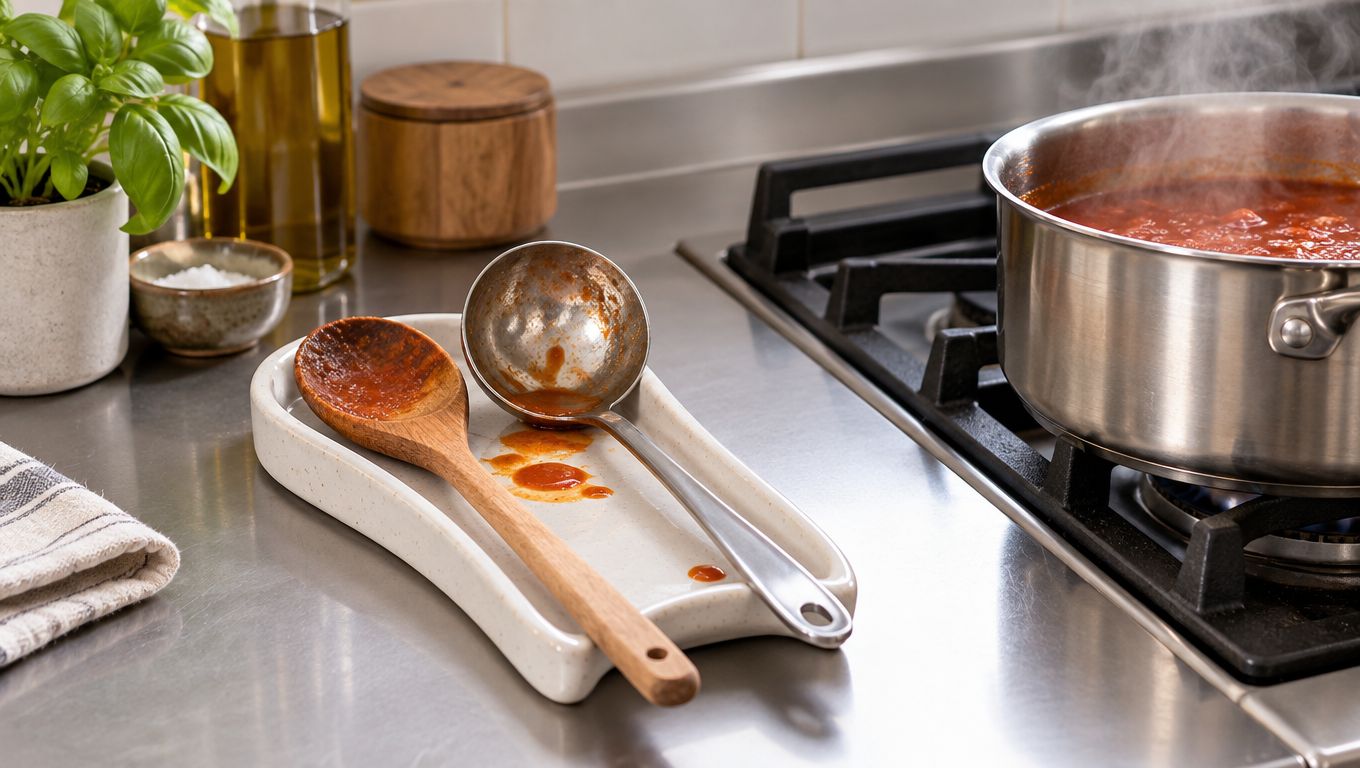
A spoon rest provides one defined landing place beside the cookline. A suitable design catches sauce, oil and water from a spoon or spatula head, while raised edges help contain drips. The gain is modest but useful: the utensil stays within reach, and the bench has fewer avoidable marks.
A landing place, not a safety shortcut
A spoon rest does not make a contaminated utensil safe. If a spoon has touched raw meat, an allergen or an unclean surface, setting it on a clean-looking rest does not remove the risk. The rest can collect residue too, so it belongs in the normal cleaning process as soon as it becomes soiled.
At home, a small ceramic rest beside the cooktop can keep the bench cleaner during dinner preparation. Wash it before residue dries. In a café or restaurant, place rests at suitable stations, away from splash, grease and unnecessary contact with unclean surfaces. MPI-aligned practice still depends on separating tasks, cleaning and sanitising utensils, and following the site's food-safety procedures.
A kitchen utensil holder approach can support wider station organisation by keeping frequently used tools within reach and occasional utensils elsewhere. Choose a single rest for one active utensil, a broader surface for several tools, or storage when the station needs more than a temporary landing place.
Key Factors to Weigh When Choosing a Spoon Rest
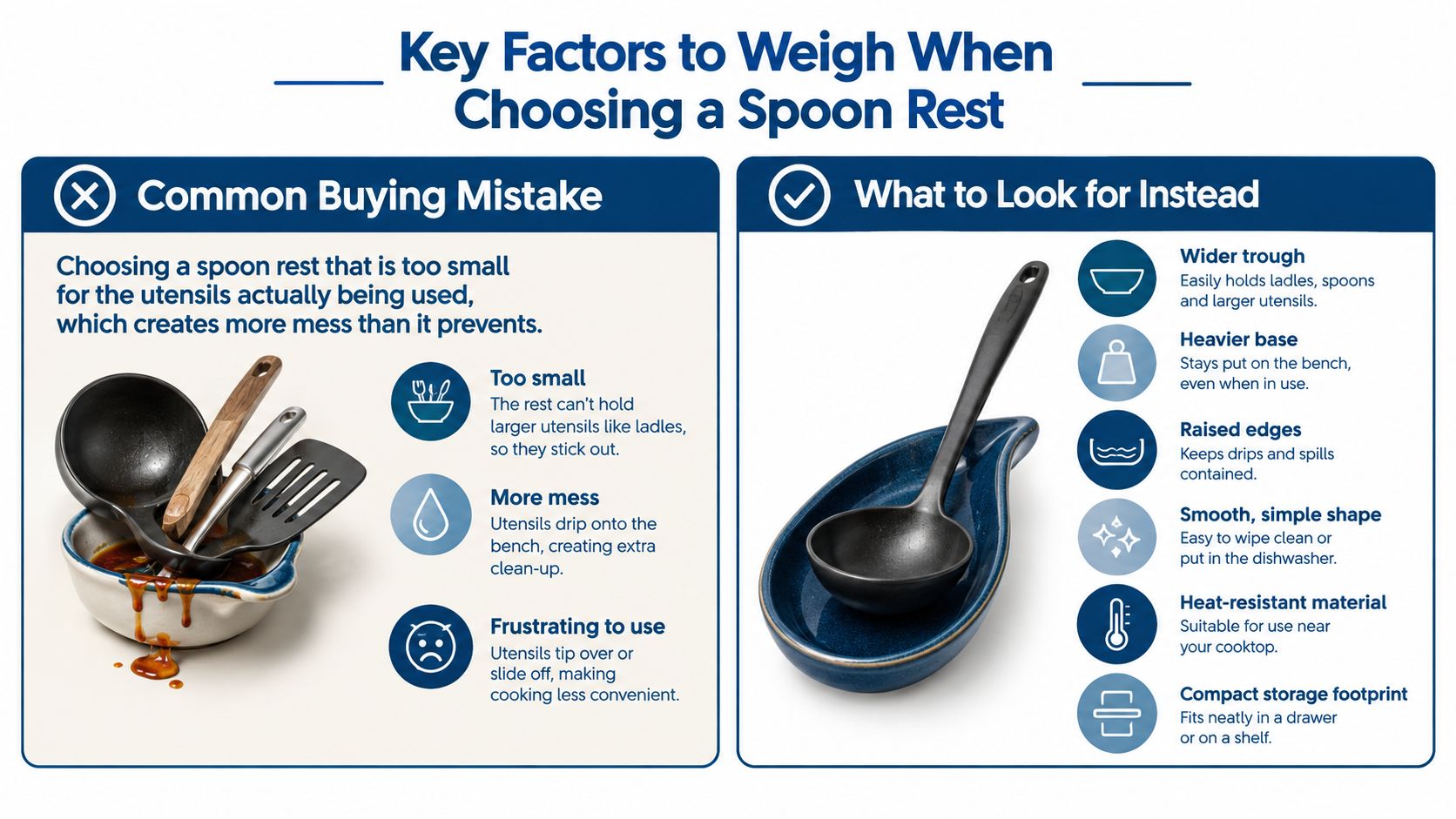
The most common buying mistake is choosing a spoon rest based on its appearance before checking the utensils it must hold. A narrow rest may suit a teaspoon or small cooking spoon but become unstable when a full ladle or broad spatula is placed across it.
Start with the working utensil
Measure the utensil heads and handles in practical terms, even if that only means placing them beside the product dimensions on screen. A wider trough or deeper bowl suits ladles and serving spoons better than a shallow dish. Raised edges are useful when the utensil carries sauce, but very high edges can make cleaning and utensil removal less convenient.
- Size: Choose a surface that supports the largest utensil used at that station, not just the smallest spoon.
- Stability: A heavier or broader base is more suitable for a high-traffic cookline where tools are put down quickly.
- Shape: Simple curves and open surfaces are easier to inspect, wipe and wash than deep decorative recesses.
- Drip control: Raised sides can contain liquid, provided the rest doesn't become a small reservoir of old residue.
- Storage: Check whether several units can stack, stand upright or fit into the venue's existing storage system.
- Material: Consider weight, breakage risk, cleaning requirements and compatibility with the approved process.
- Heat exposure: Confirm the manufacturer's guidance before placing a product close to hot equipment or relying on heat resistance.
Practical rule: If the utensil head overhangs the rest or the handle tips the unit forward, the spoon rest is too small or too light for that station.
Home cooks often need one compact unit. A sauce station, griddle or preparation bench may need a larger rest, several dedicated rests or a utensil tray instead. The useful purchase is the one that fits the workflow without creating another object that staff must move, clean and store.
Comparing Stainless Steel, Ceramic and Silicone Materials
Material changes how a spoon rest behaves in daily use. Stainless steel, ceramic and silicone can all be sensible choices, but they suit different stations and handling habits.
Stainless steel is the practical workhorse for many commercial settings. It has a neutral appearance, usually feels stable on the bench and can suit back-of-house use where visual presentation matters less than straightforward handling. Dishwasher suitability must still be confirmed for the specific product, as should any manufacturer guidance about exposure to heat or cleaning chemicals. A thin, light unit may be easy to store but less stable than a heavier design.
Ceramic brings weight, a finished appearance and a familiar domestic-kitchen feel. New Zealand's ceramic tradition developed from practical household production, including baking dishes, butter crocks, pudding bowls, teapots, colanders and vegetable dishes at regional factories such as the Tokomairiro Steam Pottery Works in Milton, South Otago. The same functional tradition makes a ceramic spoon rest a natural fit for home kitchens and customer-facing settings, although a fast commercial line must account for breakage, chips and the additional weight of moving stock.
Silicone is flexible and easy to store, which can help in smaller kitchens or domestic cupboards. Its softer construction may reduce the consequences of knocks, but the exact cleaning, heat and dishwasher instructions vary by product. Silicone can also feel less substantial when a large ladle or heavy utensil is placed on it, so stability should be checked rather than assumed.
Matching the material to the setting
A home cook may favour ceramic for weight and appearance, or silicone when cupboard space is limited. A commercial kitchen may prefer stainless steel where the unit will be handled frequently and stored with other smallwares. A front-of-house station may require a more presentable finish, while a high-volume cookline needs easy inspection and uncomplicated cleaning.
No material is automatically superior. The decision should follow the utensil size, bench traffic, storage arrangement and manufacturer's care instructions. Related silicone products, such as silicone muffin trays, also show why flexibility and heat performance should be checked against the particular item rather than general assumptions about the material.
Placing Spoon Rests in a Commercial Kitchen
A spoon rest earns its place when it sits close enough to be used without thought. Beside a cooktop, it can support the spoon used for a saucepan. At a sauce station, it can give a ladle or spatula a defined landing point. Near a griddle or preparation area, it can keep frequently handled tools off a cluttered bench.
The placement should be deliberate:
- Cooktops and saucepans: Position the rest close to the active pan, but outside direct splash and heat exposure unless the manufacturer permits the application.
- Sauce stations: Use a suitable size for ladles and broad spatulas, then avoid combining tools that handle incompatible foods.
- Griddles: Keep the rest on a stable, clean section of bench rather than where grease accumulates.
- Preparation areas: Place it near the task without putting it in a raw-food splash zone.
- Service points: Consider a dedicated unit for serving utensils where it can be inspected and cleaned easily.
One rest per station is a useful starting point for a line with clearly separated tasks. A domestic kitchen may need only one or two. A larger operation may need multiple units, dedicated rests by food type or a larger utensil tray when several tools are active at once.
A spoon rest won't transform a kitchen layout. It can, however, make the intended place for a frequently used utensil obvious.
Placement should support the wider workflow rather than compensate for poor bench planning. Guidance on restaurant kitchen layout ideas is relevant here because smallwares work best when storage, preparation, cooking and wash-up routes are considered together. A rest placed in a narrow pass, beside a handwashing sink or under a constant drip will quickly become an obstruction or contamination point.
Preventing Cross-Contamination Between Utensils
Cross-contamination is a workflow issue, not a product feature. A spoon rest can hold a utensil neatly while still allowing residue to move from one tool to another if staff place raw-food, ready-to-eat and allergen-related utensils together.
New Zealand food-safety guidance treats unclean utensils and surfaces as possible sources of contamination. Food businesses must keep equipment and food-contact surfaces clean and sanitary, and MPI guidance recommends separate equipment or thorough washing and sanitising between relevant uses. Allergen controls also require attention to shared equipment and surfaces, because residues can transfer during a busy service.
Practical separation at the bench
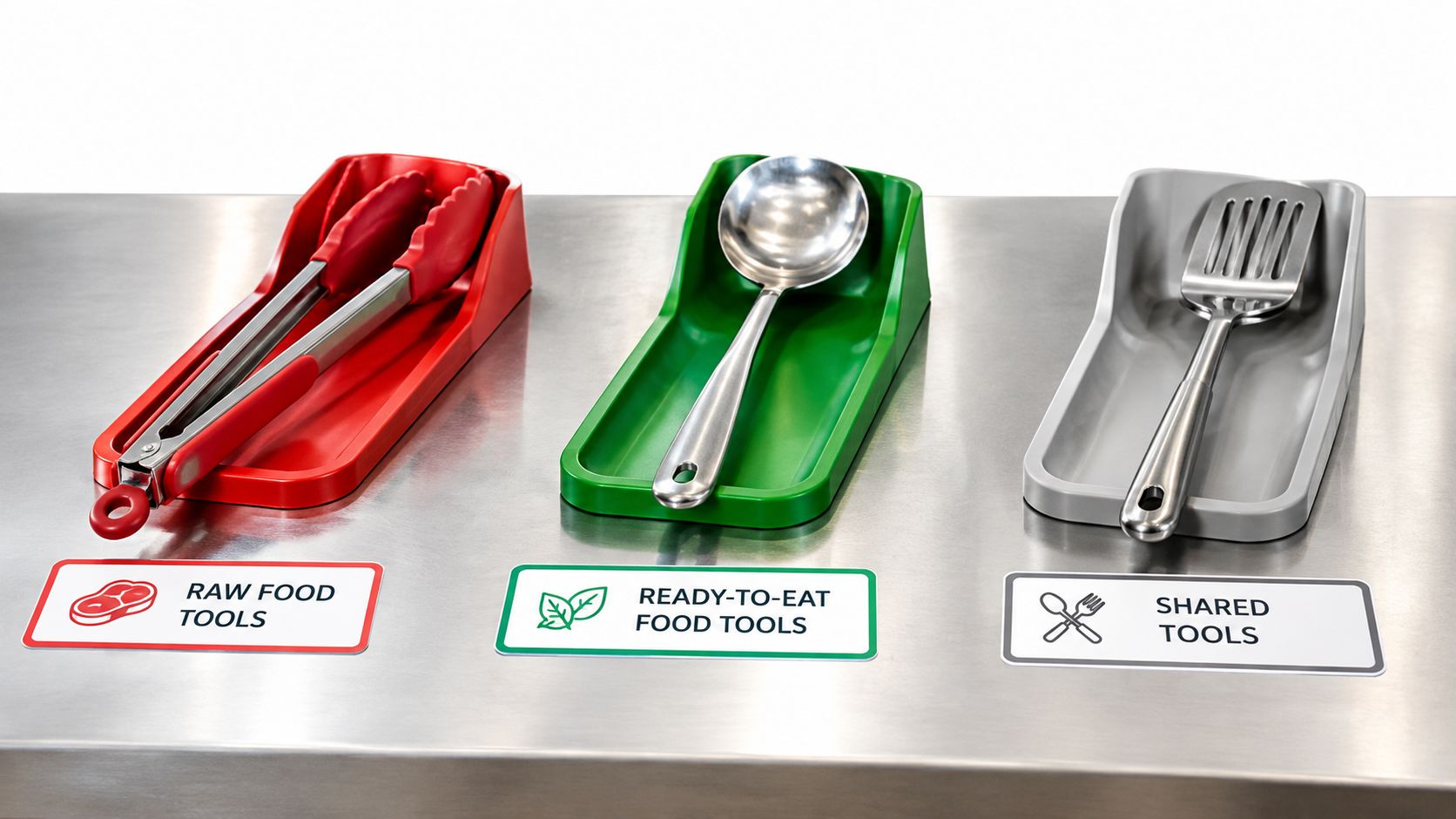
A useful station plan may allocate:
- Raw-food tools: A clearly designated rest or resting area that doesn't mix with tools returning to cooked or ready-to-eat food.
- Ready-to-eat tools: A clean, protected landing point away from raw-food preparation and splash.
- Allergen-sensitive work: Separate equipment where practical, or a complete clean and sanitise between tasks.
- Shared service utensils: A controlled area that isn't used for preparation tools carrying sauce, raw juices or allergen residues.
A common failure is wiping visible sauce from a rest and immediately returning it to service. Grease and protein can remain after the visible mark disappears, and residue can reduce the effectiveness of sanitiser. Another failure is leaving a contaminated rest at the station because the team has no agreed place for sending it to wash-up.
The cross-contamination prevention guidance supports a broader rule for spoon rests: separate where separation is needed, and clean and sanitise between tasks where equipment must be shared. A rest should be removed immediately if raw juices, allergens or other contamination reach it. Staff should send it to wash-up rather than topping up residue with a cloth.
Spoon Rests Versus Saucers, Trays and Gastro Pans
A small plate or saucer is often the first substitute. It can work in a home kitchen, particularly for one spoon, but it may be too shallow or unstable for a ladle. Its larger surface can also encourage several utensils to accumulate without clear separation.
A dedicated spoon rest normally takes less bench space and gives one utensil, or a small number of compatible utensils, a defined position. It becomes less suitable when a station needs to hold multiple large tools at once.
| Option | Where it tends to work | Main trade-off |
|---|---|---|
| Spoon rest | Home kitchens, individual pans and focused stations | Limited capacity if several large tools are active |
| Small plate or saucer | Domestic cooking and occasional use | May slide, overflow or become an improvised shared surface |
| Utensil tray | Busy stations with several frequently used tools | Takes more bench and storage space |
| Gastro pan | Larger-volume preparation or controlled collection of utensils | Can be unnecessarily large for one spoon and may encourage tool mixing |
| Dedicated utensil holder | Tools that need storage rather than temporary resting | Doesn't necessarily contain drips from active cooking |
A commercial line may find a tray or several dedicated resting areas more practical than one small rest. A home cook usually doesn't need that capacity. At a buffet or condiment station, a suitable rest can provide a tidy place for a shared serving spoon, but staff still need to monitor residue and clean the item as part of normal service procedures.
Cleaning, Care and Long-Term Use
Spoon rests collect exactly what they are intended to contain: sauces, oils, water and food residue. The useful design is therefore smooth, non-porous where appropriate, easy to inspect and free from deep seams or decorative recesses that trap grease. Food businesses must keep utensils and surfaces that contact food clean and sanitary, and a rest supporting food-contact utensils should be treated as part of that working environment.
A practical clean-as-you-go method begins by removing the utensil and visible residue. The rest should then be washed with hot water and detergent, rinsed where the chemical label requires it, sanitised with a food-area product at the manufacturer's stated concentration and contact time, and air-dried before returning to service. Cleaning removes soil and most microorganisms, while sanitising reduces microorganisms to a safe level. Sanitising won't work properly on a dirty surface.
Assigning responsibility
The rest should be cleaned whenever it becomes visibly soiled or residue builds up, and at the end of service. If it has been stored unused for several days, it should be cleaned before reuse. During service, the practical trigger is contamination, not a fixed timetable. A venue's cleaning schedule should identify the item, assign responsibility by shift and specify the approved chemicals and process.
Operators should also check the label and manufacturer instructions before assuming a rest is dishwasher-safe, heat-resistant or compatible with a particular sanitiser. A product that is cracked, heavily scratched, chipped or difficult to inspect should be removed from service, regardless of how attractive it remains.
Decorative ceramic rests can suit a domestic kitchen, dining table or customer-facing buffet when appearance matters. Commercial stations generally benefit from simpler forms that wash, rinse and dry without extra handling. The wider New Zealand craft tradition includes both practical domestic wares and design-led ceramics, but operational use still comes down to whether the item can be kept clean and positioned safely.
For cafés, restaurants and home kitchens comparing materials, sizes and related smallwares, Simply Hospitality provides kitchen utensils, ladles, serving utensils, cookware and commercial kitchen equipment to help match a spoon rest with the actual cooking station. Contact the team for practical advice on selecting a suitable resting surface, tray or utensil-storage option for the venue's workflow.