


Understanding Compostable Packaging for NZ Hospitality
A compostable container isn't automatically a better environmental choice. If a café sends it to a waste stream that can't process it, the label has done little more than create confusion. Understanding compostable packaging in New Zealand starts with the disposal system, not the material name. Certification, food contamination, bin infrastructure, collection services and the final composting facility all need to work together.
That reality matters for cafés, restaurants, takeaway businesses, caterers, marae, hotels and event venues. A package selected for the wrong waste pathway can create rejected loads, staff uncertainty and customer confusion, even when the product itself carries a legitimate compostability claim.
Why Compostable Packaging Is Not a Complete Solution
The popular advice is simple: replace conventional plastic with compostable packaging and the environmental problem is solved. That advice is incomplete.
A PLA-lined coffee cup placed in general waste isn't being processed under composting conditions. A compostable container placed in kerbside recycling may be treated as an incompatible material. The result depends on what happens after the customer finishes the food, not only on what the package is made from.
The food packaging guidance for hospitality operators is useful because it places packaging within the wider service operation. A takeaway item needs to protect food, perform during transport and fit the venue's actual waste process.
The disposal chain decides the outcome
The full journey looks like this:
- Packaging is selected.
- Food is served and consumed.
- The item is placed in a bin.
- The bin is collected.
- A waste processor sorts or rejects the material.
- The accepted material reaches its intended destination.
If that chain doesn't lead to an appropriate composting facility, purchasing compostable packaging doesn't guarantee composting.
New Zealand's Ministry for the Environment says the country has insufficient infrastructure to manage compostable packaging at scale. Its guidance states that most compostable products need industrial composting rather than home composting, and that only 8 industrial and 2 community facilities accept compostable products under the government's referenced guidance (Ministry for the Environment guidance).
Practical rule: A compostable claim should be treated as a pathway claim, not a disposal instruction.
The trade-offs are operational
Compostable packaging may suit a controlled event with a confirmed organics contractor. It may be a poor fit for open takeaway, where customers dispose of items across different council and commercial systems.
Reusable packaging can also be preferable where return, washing, storage and customer participation are practical. It isn't automatically suitable for every venue, but a reuse system can avoid the need to manage a single-use item at the point of disposal. The sensible choice depends on the full operating model, not on a green colour or a plant-based feedstock.
Compostable, Biodegradable, Recyclable, and Reusable Defined
These terms aren't interchangeable. A venue that confuses them can give customers the wrong bin instruction and purchase packaging that its waste contractor rejects.
Compostable means a product is designed to break down into compost under specified conditions. The claim should be supported by relevant certification and clear disposal instructions. Industrially compostable packaging needs a commercial facility with the right process, while home compostable packaging is assessed for a different environment.
Biodegradable is broader. It indicates that biological processes can break down the material, but it doesn't necessarily explain how quickly that happens, under what conditions it occurs or what remains afterwards. It's a weak procurement term unless the supplier provides precise supporting information.
Recyclable means the item can enter an appropriate recycling stream where that material is accepted, sorted and processed. A package may be technically recyclable but unsuitable for a particular local collection service. Food residue, coatings and mixed materials can change the outcome.
Reusable describes a repeated-use system rather than a material. It requires a practical return, washing, storage and redistribution process. A reusable cup or container only delivers that intended benefit if customers return it and the venue can manage the handling safely.
Packaging terms compared for hospitality buyers
| Term | What it actually means | Typical NZ hospitality example | Acceptable end-of-life |
|---|---|---|---|
| Compostable | Breaks down under specified composting conditions | Certified fibre container or compostable bioplastic lid | The named commercial or home composting pathway, where accepted |
| Biodegradable | Can break down biologically, without necessarily defining conditions or outcome | Packaging promoted with a broad biodegradable claim | Must be verified. The term alone doesn't identify a suitable bin |
| Recyclable | Can be collected and processed through an appropriate recycling stream | A clean, accepted single-material item | The local recycling service that accepts that format |
| Reusable | Designed for repeated use through a managed system | Returnable cup or food container | Washing, storage and another service cycle |
A practical NZ disposable food container reference should sit alongside the waste contractor's acceptance rules. Packaging selection begins with the food and service requirement, but it ends with a verified destination.
Industrial Versus Home Composting
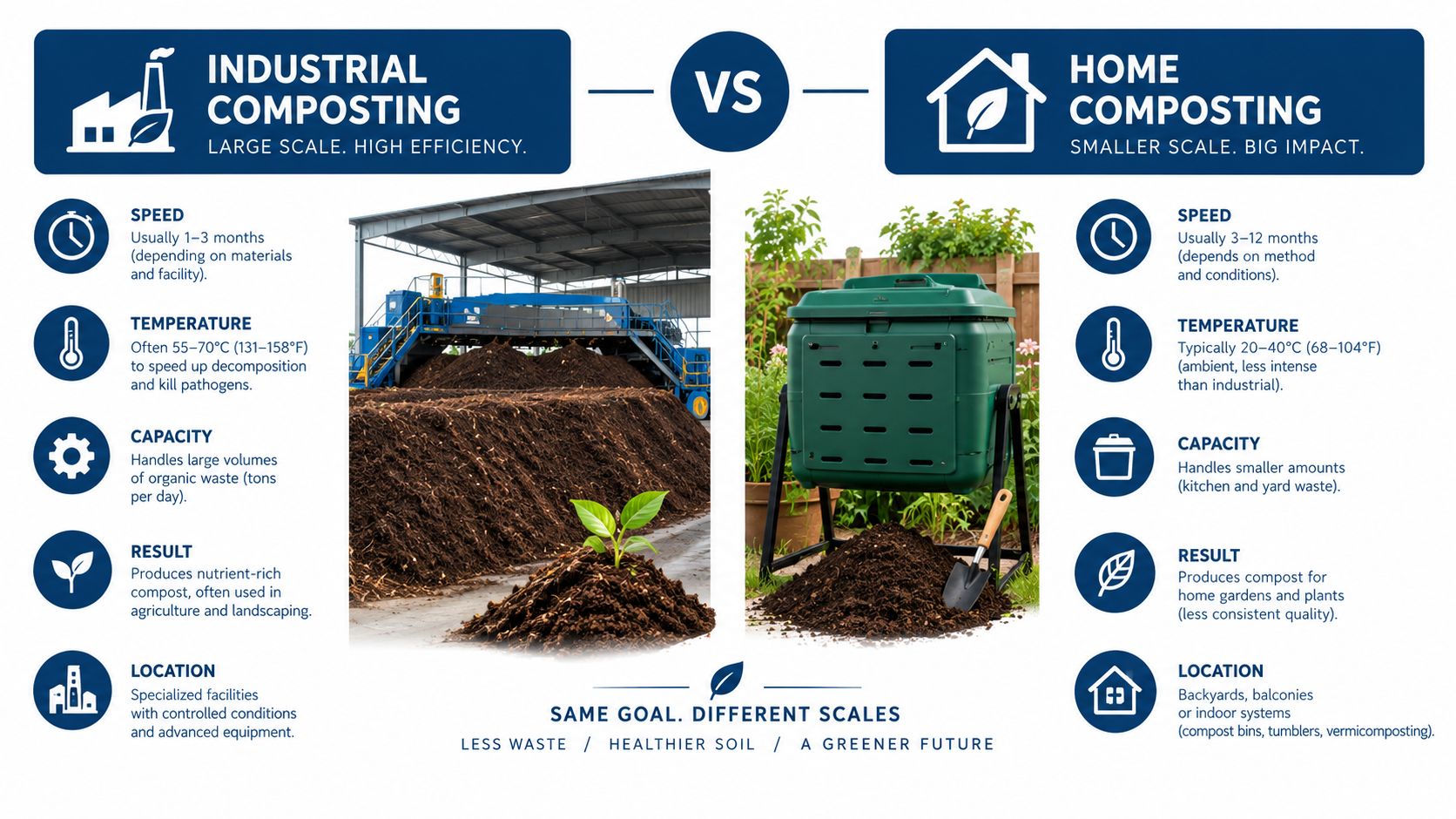
Compostable packaging is not a disposal plan. It works only when the venue's waste stream reaches a processor whose conditions and acceptance rules match the product. Start with that destination, then choose the packaging. Industrial and home composting are separate pathways, not interchangeable versions of one system.
Industrial facilities control temperature, moisture, aeration, turning and processing time so certified products can disintegrate under defined conditions. A backyard bin varies with weather, contents, moisture, aeration and maintenance. A product certified for commercial composting must not be sold as home compostable.
The Ministry for the Environment's product guidance says industrial composting certification must achieve at least 90% biodegradation within a maximum of 6 months, while home composting certification must achieve at least 90% biodegradation within 12 months (government guidance on selecting compostable products). These are test requirements, not a promise that an item will break down in the venue's bin or local collection.
What NZ operators can assume
A commercial composting claim refers to a defined industrial process. It does not confirm that the processor collecting a venue's waste accepts that product.
Council food-scraps bins also have their own rules. From 1 February 2024, Ministry for the Environment kerbside guidance excludes compostable packaging from food-scraps and food-and-garden collections, although councils may allow limited paper bags or compostable liners as caddy liners (kerbside collection exclusions).
For comparisons outside New Zealand, composting in Chicago tips offers general context. The final decision belongs to the New Zealand council, contractor or processor handling the venue's waste.
Certification Standards and What They Actually Prove
Certification gives operators evidence that a product has been assessed against defined requirements. It doesn't give the package permission to enter every bin.
Supplier documents may refer to standards and schemes such as AS 5810, AS 4736, EN 13432, OK Compost, BPI or Australasian Bioplastics Association marks. These names should be checked against current manufacturer documentation, the exact product, the claimed composting environment and the certification number.
The Ministry for the Environment says there's currently no New Zealand certification standard for industrially compostable products and no New Zealand standard for industrial or home composting (compostables guidance). That makes verification especially important when products are imported or marketed using overseas certification.
Certification is evidence, not acceptance
Certification generally demonstrates that the product has been assessed under particular test conditions. It doesn't prove that a New Zealand processor has the equipment, residence time, moisture control or sorting process needed for that item.
Scion's Aotearoa field work found that disintegration varied between industrial composting sites. Temperature, mixing protocol, shredding timing and moisture all affected performance, with moisture identified as the biggest single contributor to successful composting (Scion field research).
| Certification | Region or market context | What it helps verify | Key caveat |
|---|---|---|---|
| AS 5810 | Australia and New Zealand context | A home composting claim where the product documentation supports it | Doesn't confirm local collection acceptance |
| AS 4736 | Australia and New Zealand context | An industrial composting claim where the product documentation supports it | The processor may still reject the item |
| EN 13432 | European standard context | Compostability requirements for packaging under defined industrial conditions | Doesn't make the item home compostable |
| OK Compost | Certification scheme used in relevant markets | A claim tied to the scheme's stated conditions | The exact mark and product scope must be verified |
| BPI | North American certification context | A claim assessed under the scheme's requirements | The certification doesn't establish NZ acceptance |
A sensible purchasing file should contain the product specification, certification evidence, disposal instructions and written confirmation from the intended waste provider. The guidance on disposable plates reinforces the same buying discipline: the claimed material and actual use need to match.
Common Materials Hospitality Operators Encounter
Materials often look straightforward until coatings, linings and food residue enter the picture. A paper container isn't automatically suitable for paper recycling or composting, and a plant-based input isn't automatically compostable.
Paper and board can provide a familiar, printable structure, but the coating may determine the end-of-life route. A paper cup with a compostable lining has a different specification from a paper cup with a conventional plastic lining. Food residue can also affect acceptance.
Bagasse or sugarcane fibre is commonly used for clamshells, plates and trays. Its fibre structure may suit a composting pathway, but the complete item still needs to be certified where a claim is made and accepted by the intended facility.
PLA and other compostable bioplastics can appear in cup linings, lids and clear foodware. The “plant-based” description doesn't identify the disposal route. The product's certification and the receiving processor matter more than the feedstock story.
Cellulose-based materials may be used for films, windows or wraps. Their performance depends on moisture, grease, heat and the complete construction, including inks, adhesives and coatings.
Wood and bamboo products can perform well for selected utensils, stirrers and service items. Operators still need to check whether the specific product carries a compostability claim and whether the destination facility accepts it.
Ask what happens to the whole item
A supplier should be able to answer four direct questions:
- Fibre: What is the main structural material?
- Lining: What coating, film or barrier touches the food?
- Certification: Which exact claim applies to the complete product?
- Destination: Which local facility accepts it after use?
The same discipline applies to adjacent items, including organic sleep tea for relaxation, where the packaging format and disposal claim need to be assessed separately from the contents.
Operators evaluating BioPak-related packaging should review the current product documentation rather than relying on a range name. The Biopak sustainable products discussion can support that review, but the waste provider remains the final authority on acceptance.
Building a Front-of-House System That Works
Packaging and bin infrastructure need to be designed as one system. A café that sells compostable takeaway packaging but offers only general waste and recycling bins has created a product claim without creating a reliable disposal route.
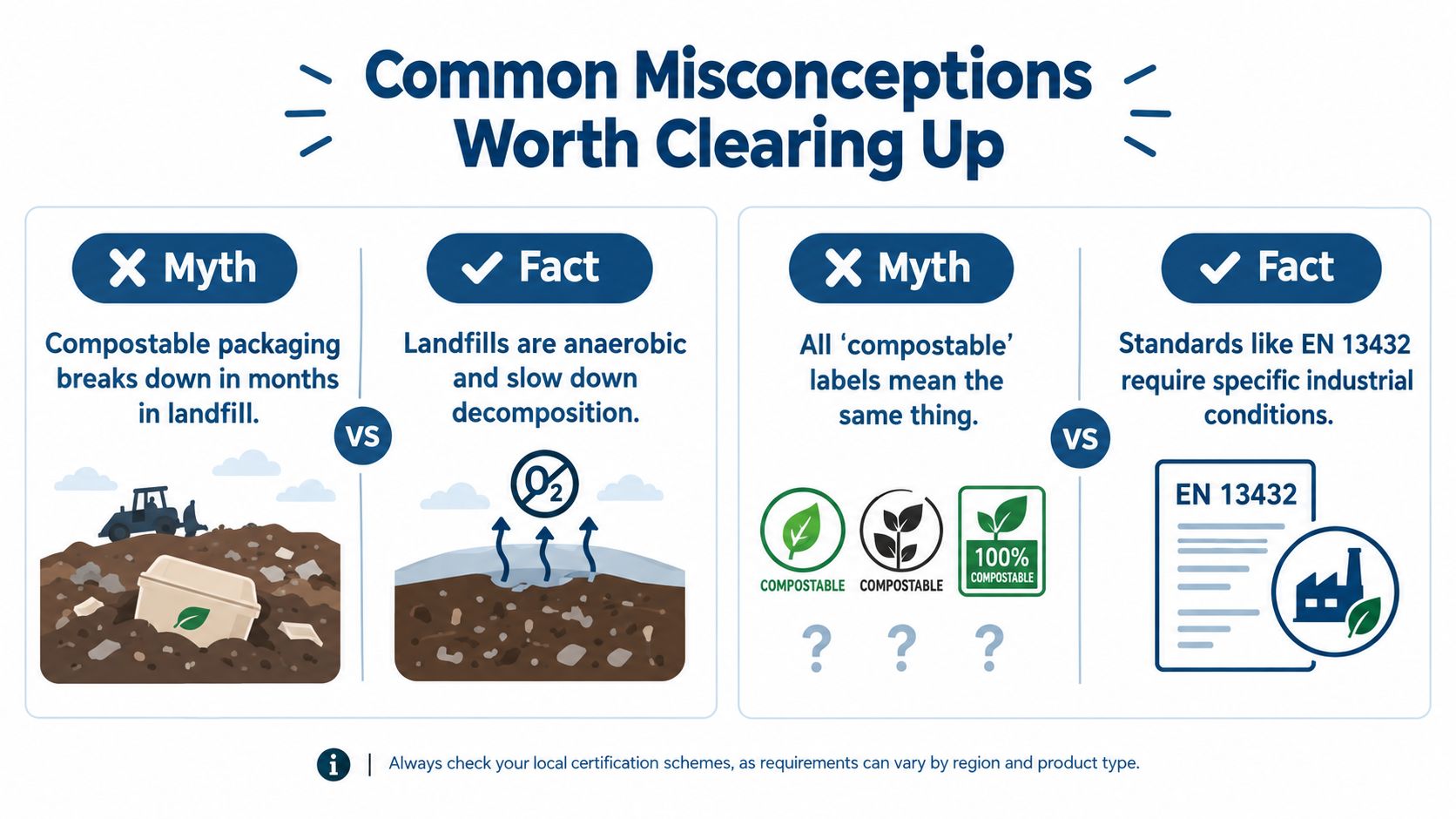
A working setup makes the correct action obvious. In a café, that might mean paired waste stations with clear pictograms, a dedicated container for the accepted organics stream and signage that names the actual council scheme or commercial processor. In a catered function, it might mean staff-controlled clearing stations rather than relying on every guest to interpret a generic green bin.
Standardise the customer experience
A common issue is the use of visually similar items with different disposal requirements. One clear lid may be accepted by a particular processor while another lid that looks identical may not be. The same problem occurs when several suppliers provide cups with different linings.
Operators should:
- Reduce unnecessary SKU variation: Fewer packaging formats make staff training and signage more reliable.
- Separate incompatible items: Don't place compostable, recyclable and general-waste products in one confusing station.
- Use plain language: Name the accepted items rather than relying on colour or a leaf symbol.
- Train the clearing team: Staff should know which items are accepted and what to do with food residue.
- Review the bin room: Regular checks can reveal where customers and staff are making the wrong choice.
Keep the system current
Signage becomes inaccurate when a supplier changes a lid, a contractor changes its acceptance list or a council changes its collection rules. Someone should own the update process.
In a closed environment such as a workplace, institution, event venue or catered function, the operator can control the packaging and the collection service. Open takeaway is harder. The item leaves the premises and may enter a household bin, public rubbish station or a commercial collection system with different rules.
The takeaway coffee cup selection guidance is most useful when read alongside that operational reality. A technically suitable cup still needs a bin system that can receive it.
Common Misconceptions Worth Clearing Up
Myth: Compostable packaging disappears quickly in landfill.
Landfill provides neither the controlled conditions nor the processing route required for composting. A compostable item sent with general waste should be treated as waste, not as a guaranteed environmental benefit. Tell staff and customers where it must go.
Myth: Compostable packaging belongs in recycling.
A compostable product does not become recyclable because it looks like paper or plastic. It can contaminate a conventional recycling stream, while local collection and sorting rules determine the correct destination.
Myth: Every food-soiled compostable item belongs in food scraps.
Food residue does not override a processor's acceptance rules. New Zealand guidance excludes compostable packaging from standard kerbside food-scraps and food-and-garden collections, with limited caddy-liner provisions (kerbside food-scraps guidance). Check the receiving facility before placing any item in a food-organics stream.
Myth: Plant-based means compostable.
Plant-based describes the source material. It does not confirm how the finished package breaks down or whether a suitable recovery route exists. Without that route, the package may still need general waste.
Myth: Compostable packaging is always environmentally superior.
The outcome belongs to the whole system, not the product label. Extra layers, poor performance in service or disposal through an unsuitable stream can remove the intended benefit.
Compostable doesn't mean litter-friendly
A compostable item is still litter if it is dropped in a street, left in a park or sent into a waterway. Outdoor conditions do not provide a managed composting process, so never market compostability as permission to discard packaging carelessly.
Consumer understanding remains uneven. 82% of respondents agreed that compostable packaging is better for the environment than plastic packaging, while 49% incorrectly believed it could be recycled, according to Ministry for the Environment consumer guidance (plastic products and consumer guidance). Give customers a clear disposal instruction and make sure it matches the service that receives the packaging.
Working Backwards from the Composting Facility
A compostable package is a procurement decision with a disposal requirement attached. Order the product before confirming its destination, and the venue may end up paying for packaging that still goes to general waste.
Start with the facility, then specify the product
- Name the receiving facility. Ask the waste contractor or commercial composting site where the venue's food-service packaging could go.
- Get written acceptance. Confirm the facility accepts the food residue, fibre or resin, lining, lid and relevant certification.
- Check collection logistics. Establish whether the venue can access a suitable commercial collection service and what its rules allow.
- Choose to the specification. Select packaging that meets the facility's requirements as well as the food, temperature, strength and transport needs.
- Set up the bins. Place clearly labelled bins where customers, kitchen staff and event teams discard items.
- Give one disposal instruction. State what goes in, what stays out and which service receives it.
- Test the takeaway boundary. Decide what advice applies once customers leave the venue.
For example, a Wellington café could confirm with Capital Compost that a fibre clamshell with a PLA lining, identified as AS 4736 #XXXX, is accepted before placing an order. That check is more useful than relying on a supplier's “eco” description.
Request the exact fibre or resin description, lining material, certification evidence and number, food-contact information, temperature limits and disposal instruction. If the supplier cannot provide those details, do not approve the product.
The Ministry for the Environment's compostables position statement supports clear on-pack information, including the certification logo, unique certification number, a direct verification link and end-of-life instructions (compostable product selection guidance). Give staff and customers instructions they can follow, not a vague environmental claim.
The ten-question purchasing check
- What food or drink will it hold?
- What performance does service require?
- What material and lining does it contain?
- Which environmental claims have independent support?
- Is it home or commercially compostable?
- Does the local provider accept it?
- Can customers reach the correct waste stream?
- Is the instruction obvious?
- What happens after the package leaves?
- Does the complete system work for the venue?
Check hot or cold food, grease, liquid, transport, holding time, lid fit, strength and food-contact suitability against the manufacturer's specifications. A leaking or collapsing container may require doubling, creating more cost and waste even when its end-of-life claim is valid.
Assess cost per service, not carton price alone:
Packaging cost per meal or order + waste collection requirements + operational performance + customer disposal behaviour
The right answer may be compostable, recyclable, reusable or conventional packaging connected to a reliable waste stream. Choose the format that performs at the counter and reaches its confirmed destination.
Simply Hospitality supplies takeaway packaging, food containers, cups, lids and waste-management consumables for New Zealand hospitality businesses. Operators can visit Simply Hospitality to compare product documentation with their food, collection service and end destination.