

What Hospitality Operators Should Know About Hamilton Beach Blenders
The most popular advice on blenders is wrong for hospitality. The right question isn't which unit has the loudest motor or the flashiest speed chart, it's which one will still give the same result when the barista, duty manager, and breakfast team have all used it before 10 a.m. What hospitality operators should know about Hamilton Beach blenders starts with that reality, because a commercial blender earns its place by surviving repeat use, fast cleaning, and busy service without becoming another thing staff have to think about.
Why the Best Blender Is the One You Never Have to Think About
The best commercial blender is the one staff can use without stopping to second-guess it. It makes the 500th blend behave the same way as the first, and it keeps the line moving without drawing attention to itself.
On a busy Saturday morning, that is where a blender earns or loses its place on the bench. Orders arrive in bursts, smoothies, frappés, and iced drinks all stack up at once, and any machine that needs awkward restarts or a cleaning pause after every few drinks slows the whole station down. Staff feel it first. Customers do too.
Repeatability beats novelty
Hospitality operators often buy a blender because the motor sounds strong, then judge it later by how often it interrupts service. The test is simpler. Does it give the same recipe the same result when different staff members are on the machine?
Practical rule: the blender should fit into service, not ask the team to reorganise service around it.
Hamilton Beach commercial units make sense in that context as reliability tools. They are there to give steady output, predictable texture, and a machine that disappears into the workflow once the programme or speed is set. The trade-off is straightforward. The operator has to choose a machine built for repeated hospitality use, because a domestic-style unit may cope for a while and then start showing its limits once the rush hits.
The first blend proves the recipe works. The next hundred prove the blender belongs on the bench.
For operators weighing drink prep against other production tasks, the same logic applies to [fresh juice equipment choices for NZ venues]. The machine that saves time in service is usually the one that keeps output consistent and keeps cleanup simple.
What Hospitality Operators Actually Use a Commercial Blender For
Hamilton Beach blenders show up in venues because the menu keeps asking for the same jobs, over and over, under time pressure. The machine needs to handle smoothies, frappés, cocktails, frozen drinks, and back-of-house prep without turning every order into a separate project.
A café running drinks through breakfast service needs a different pace from a bar turning out frozen cocktails in waves. Smoothies need a stable texture and quick turnaround. Frappés and frozen drinks need consistent ice fracture and enough control that the drink does not separate before it reaches the counter.
Match the blender to the menu mix
The planning question is how often the menu asks the machine to blend the same thing under pressure. If the blender is only there for occasional prep, many features will never be used. If it sits on a drink station, repeatability and speed between orders matter more than a long feature list.
Hamilton Beach's own Blend & Store guidance says to add liquid first, then fruits, vegetables, yoghurt, boosts, and ice, to use at least 8 oz of liquid, never fill above the MAX line of 52 oz, and not to blend hot liquids. Those limits matter because they help control overflow, improve batch consistency, and make service safer in a rush.
The blending sequence matters too, because staff need habits they can repeat under pressure. Guides such as fresh juice better margins the case for making it in house are useful in the wider prep conversation, even when the beverage itself is different.
For some kitchens, a blender sits alongside other quick-turn equipment like the Menumaster Commercial Dial Panel Microwave RCS511DSE, which is described as a long term favourite of the brand and suitable for a medium volume in many settings. The common thread is the need for equipment that keeps pace with service without constant babysitting.
Sizing the Blender to Your Trading Pattern
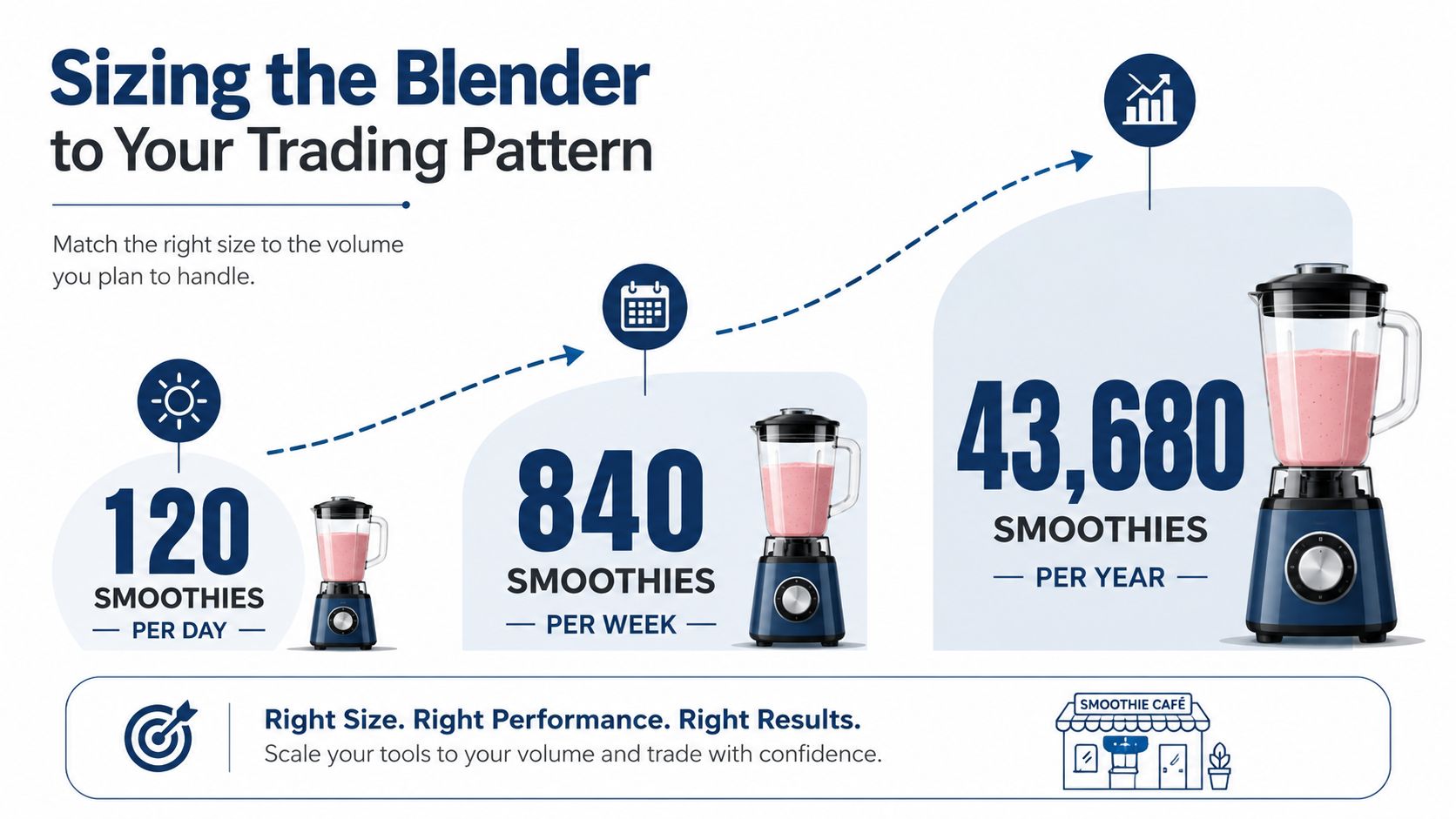
The clearest way to size a blender is to work from trading patterns, not from marketing language. A café producing 120 smoothies per day is doing about 840 blends each week and more than 43,000 blends every year. Those figures are illustrative examples, not customer production data, but they show how quickly a machine can move from light use to hard service.
In hospitality, repeatability under pressure is the key concern. A blender on a bar bench or café pass has to survive back-to-back starts, short gaps between drinks, and cleaning between orders without slowing the team down. Commercial selection should be based on the busiest part of service, because that is where failures, delays, and staff frustration show up first.
Use the busiest hour as the benchmark
The practical question is how many blends land in the peak window, and how much time the team has between them. If the answer is tight, the blender needs to be chosen for throughput, cleaning speed, and how easily staff can reset it for the next order.
That approach applies across cafés, bars, hotels, and quick-service venues.
- Cafés: judge the blender by breakfast and brunch surges, not the mid-afternoon lull.
- Bars: judge it by cocktail rounds and frozen drink runs, not the slowest weekday.
- Hotels: judge it by breakfast service and group arrivals, not the housekeeping shift.
- Institutional kitchens: judge it by the line of prep tasks that stack up before service.
Consistency builds customer confidence. Guests do notice when the second drink tastes different from the first.
Buying decisions become clearer when they are tied to real output, not menu ideas that may only happen once in a while. The better test is whether the blender can keep its pace through the messiest part of service, then get cleaned and returned to use without holding up the station. For a broader look at how equipment choice affects back-of-house efficiency, the article on commercial kitchen safety planning and the piece on does a Robot Coupe pay for itself labour savings restaurant kitchens both point to the same trade-off, the machine has to earn its space through daily workflow, not brochure claims.
Specs That Matter in a Busy Service
Hamilton Beach commercial blenders are built around service workflow, and the details worth comparing are the ones that affect the bench during a rush. The commercial blender manuals note an integrated circuit breaker and a timed workflow. In practice, staff confirm the breaker is on, load ingredients, secure the container, set speed and time, then hold the switch in START until the cycle begins and stops on its own at the selected time.
That setup suits venues where several people may use the same station in one shift. Repeatable steps reduce handover errors, and a timed stop helps keep drinks moving when the queue starts backing up.
A spec sheet can look impressive and still tell you little about service. The useful questions are simpler, and they come from what fails when the room is full, the tickets are piling up, and someone needs to reset the blender fast. For a useful buying reference, the product notes on commercial blender NZ help frame what matters in day-to-day operation.
Power, control, and the noise question
Hamilton Beach's current models sit in different performance bands. One high-performance model is rated at 1,680 watts peak and 22,000 RPM, while another commercial-performance model is 1,500 watts with a quiet shield and variable speed control from 3,000 to 18,000 RPM. In service terms, more peak power and a higher RPM ceiling help with ice and frozen fruit, while a quieter shielded model can suit counters where guests are close to the machine.
That trade-off shows up most clearly in cafés, bars, and breakfast areas. A quieter blender can make the room easier to work in, but the shield adds a handling step for staff. An open setup can feel quicker, yet it may be harder to live with in a customer-facing space.
A few points deserve a proper look before purchase:
- Control layout: timed or variable controls help staff produce the same result across shifts.
- Jar design: the jar needs to load cleanly and sit securely in the hand.
- Noise control: open-plan venues should treat sound as part of the service layout.
- Speed range: more control helps when the menu covers both smooth drinks and rough frozen ingredients.
The right choice still depends on the room around the blender. Good commercial kitchen safety planning should cover where the machine sits, how staff move around it, and whether noise or splash risk will slow the station down.
Cleaning, Sanitising, and Day-to-Day Maintenance
The fastest way to slow a blender station down is to let residue dry in the jar. Clean it straight after use. Once dried mix sticks to the blades or the container, staff spend longer on scrubbing and the blender stays out of service longer than it should.
A simple between-service routine works well in busy venues. Fill the jar with warm water and a small amount of detergent, run it briefly, rinse it, then leave it to dry. That keeps the jug cleaner, helps the next blend perform properly, and lowers the chance that last drink's texture carries into the next one.
Safety rules staff must follow
Hamilton Beach's use-and-care instructions are clear about handling. Staff should always keep the lid on while blending, never put hands or utensils in the container, wait until the blades stop rotating before removing the jar, and never replace the jar while the motor is running. These are the basics that keep a fast-moving kitchen from creating preventable injuries.
The blender is only easy to use if the team uses it the same safe way every time.
Cleaning chemistry matters in a professional wash-up routine too. Staff need the right products and enough contact time, which is why a short read on cleaning chemicals NZ is useful when standardising how the station gets cleaned.
The maintenance rhythm should be simple and visible:
- Daily: check the jar, lid, and obvious wear points.
- Weekly: look for looseness, poor fit, or residue build-up.
- Quarterly: inspect the blades and drive components before they turn into a service problem.
That routine is cheaper than waiting for a failure. In a venue running short on staff, even a brief interruption at the wrong moment can throw the whole service off.
Preventative Maintenance and Total Cost of Ownership
The sticker price only tells part of the story. In a busy café or bar, the cost shows up when a blender starts to wobble, leak, or slow down under service pressure, because staff feel that change straight away at the station.
Hamilton Beach manuals warn that cutter assemblies and related parts wear out, recommend routine inspection, and in some cases suggest replacement intervals as frequent as every 90 days. They also warn against misuse such as moving the blender during operation or overfilling hot liquids. That points to a simple truth, wear parts need a plan before they fail during service.
Build the ownership cost into the buying decision
A commercial blender should be treated as a working asset, not a one-off purchase. Jars, lids, blades, and drive components all matter because any one of them can stop the machine at the wrong time. If blending is part of the drinks offer, spare parts should already be part of the purchase conversation.
The other cost sits in downtime. When a blender fails during peak service, staff lose time, drinks back up, and the queue stretches fast. That is why the question around whether a premium commercial blender is worth the extra money keeps coming back to uptime and service continuity, not the sticker price alone.
A realistic ownership budget covers:
- Spare parts: jars, lids, blades, and drive components.
- Staff time: cleaning, inspection, and rework when the machine leaves residue or slows the line.
- Downtime: lost service capacity during a rush.
- Wear cycles: repeated use that gradually changes performance.
- Misuse risk: hot liquids, overfilling, or moving the unit while it is running.
Maintenance also needs to fit the roster. A blender that is easy to inspect and keep clean costs less in staff time than one that takes careful handling every shift. In practice, the cheaper unit can end up costing more if it keeps pulling staff away from the pass and into avoidable fixes.
The Four Questions to Ask Before You Buy
The buying decision gets clearer once it is tied to service, cleaning speed, and repeatable output. Hospitality operators should ask four questions before choosing a Hamilton Beach blender, and each one points to a real pressure point on the floor.
First, how many blends do we complete each day? That tells the team whether the machine needs to cope with steady use or hard use across a full shift. Second, how important is consistency to the menu? If customers expect the same smoothie, frappe, or frozen drink every time, repeatable results matter more than flashy settings.
Ask about cleaning and uptime
The third question is how quickly can staff clean the blender between orders? That often decides whether the machine suits the station. If cleaning slows the line, the blender becomes a choke point instead of a help.
The fourth question is what happens if the blender stops during peak service? That is the practical test. A unit that is cheap to buy but hard to service can become expensive very quickly when a rush hits and staff have no backup.
These questions tell you more than wattage alone. They push the decision onto the floor where the work happens, in the middle of service, with real staff, real queues, and real customer expectations.
The best commercial blender is the one that keeps producing the same result under pressure. It should handle repeated use in a busy shift without turning into a maintenance problem.
That is the right standard for commercial service. Reliability matters most during the busiest hour of the day, when nobody has time to baby a machine or work around a poor fit.
Choosing the Right Commercial Blender for Your Venue
Hamilton Beach blenders suit venues that need repeatable blending across a busy day. The buying question is rarely about brand familiarity on its own. It is about whether the machine gives the same result during the first order and the fiftieth, while staff are clearing cups, resetting the station, and keeping the queue moving.
The commercial blender market is large and competitive, which is useful context, but the decision still happens on the floor. Operators should compare models on how they fit the work, not on the size of the marketing claims attached to them. In practice, that means looking at the menu, the peak service pattern, how quickly the unit can be cleaned between orders, and how much attention it needs from staff and service partners.
A café, a hotel breakfast line, and a bar all place different pressure on the same appliance. A café often needs quick recovery between smoothies and frappes. A hotel breakfast service may need steady output over a longer run, with different staff touching the machine. A bar often cares most about speed, consistency, and how well the blender holds up when the station is under pressure and no one has time to pause service.
For a New Zealand venue, the most useful test is simple. If the blender sits on a crowded bench and must be wiped, rinsed, and returned to service without slowing the next order, that points to one kind of machine. If the venue can tolerate a slower station and lower turnover, the choice changes again. The right fit depends on where the blender lives, who uses it, and how much downtime the team can absorb.
Hospitality can talk through that choice with a café, bar, or hotel team that wants a practical match for daily volume, cleaning routine, continuity of service, and spare-part planning. Visit Simply Hospitality to get advice on commercial kitchen equipment for real hospitality use.