


What Is Laundry Detergent and How Does It Actually Work
Laundry detergent is a formulated cleaning product that combines surfactants with supporting ingredients, which may include builders, enzymes and brighteners, to lift soils from fabric and suspend them in wash water. The right formulation and dose depend on the fabric, soil, water conditions and washing machine.
If a detergent smells fresh and produces plenty of suds, does that mean it's doing the right job? For a household, the answer affects clothing care. For a hotel, restaurant or aged-care facility, it also affects linen presentation, chemical consumption and the work involved in washing items again.
What Laundry Detergent Actually Is
Laundry detergent is a cleaning system, not soap. Its main active ingredients are surfactants, supported by other ingredients selected for particular stains, textiles and washing conditions. This distinction matters because a product suitable for greasy uniforms isn't automatically suitable for woollen garments or sensitive-skin bedding.
Traditional soap and modern laundry detergent shouldn't be treated as interchangeable products. Rather than being a single cleaning ingredient, detergent combines ingredients with different jobs, including soil removal, water conditioning and formulation stability. The relationship between detergent choice, textile care and washing practices is discussed in New Zealand research on laundry behaviour and sustainability.
The whole wash matters
The product works within a process. Water carries the ingredients through the load, mechanical washing action helps loosen contamination, and the selected temperature influences how the formulation performs.
- Fabric type: A wool jumper, cotton napkin and synthetic uniform may require different care.
- Soil type: Cooking oil presents a different cleaning challenge from blood or loose dirt.
- Equipment: The detergent needs to suit the machine and its wash programme.
- Water conditions: Water hardness can affect the formulation and dose required.
A practical example is a restaurant washing both chef jackets and table linen. Choosing a detergent only because it makes the tablecloths look bright overlooks the jackets' grease and food soils.
Practical rule: Specify the laundry first, then choose the detergent. Starting with the bottle and trying to make every textile fit its instructions reverses the decision.
The useful answer to “what is laundry detergent?” therefore includes both chemistry and application. It's a product designed to help water clean textiles, but its suitability depends on the laundry process around it.
How Laundry Detergent Works on Fabric
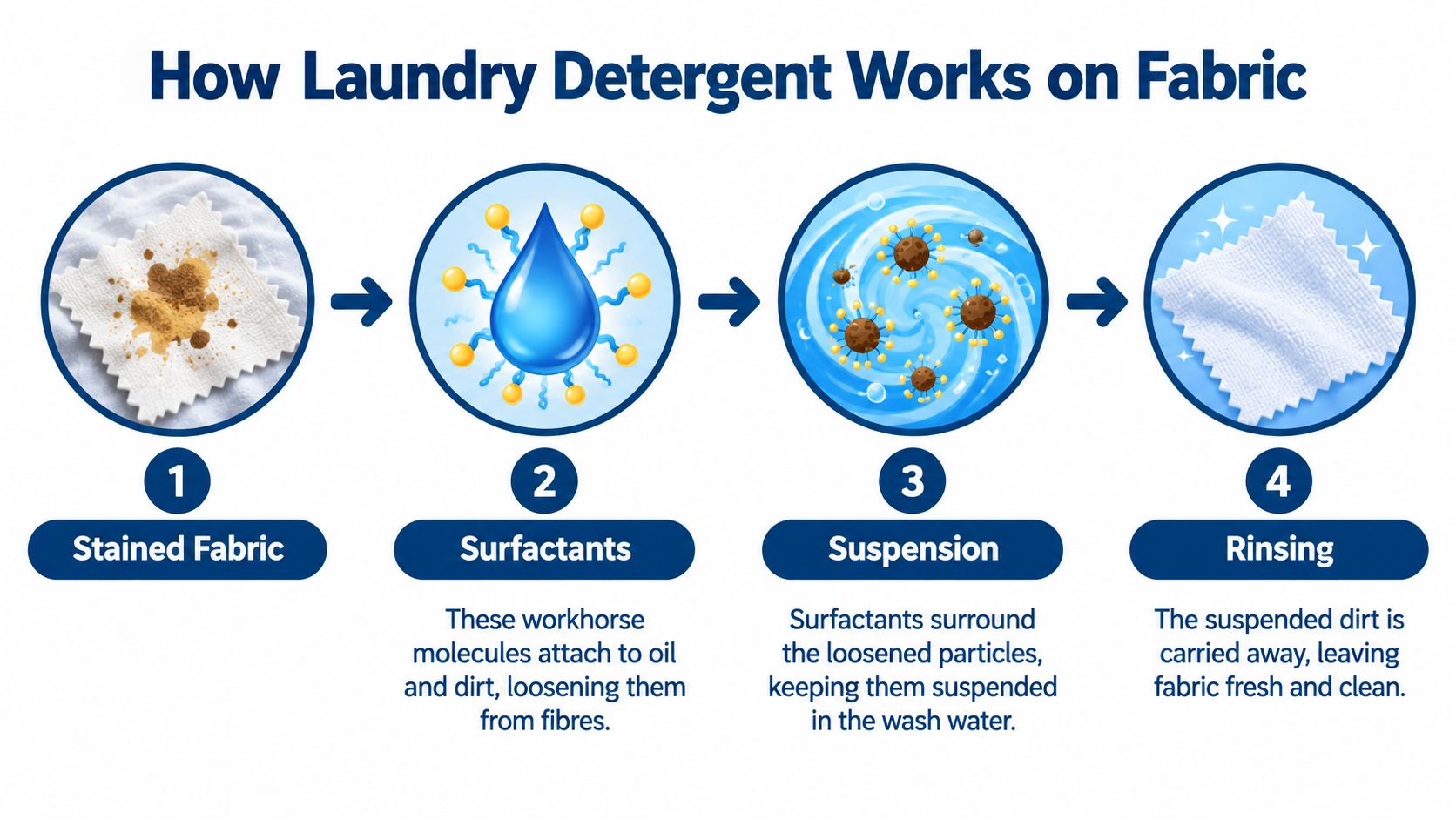
Water alone struggles with oily contamination. Surfactants help by reducing water's surface tension, allowing it to penetrate fabrics and interact with soils. They also surround loosened grease and dirt so those materials remain suspended rather than settling back onto the textile.
The sequence is straightforward: detergent dissolves or disperses → ingredients interact with soils → washing action loosens contamination → rinsing removes suspended soils and detergent.
What the supporting ingredients do
Different formulations use different combinations. Not every detergent contains enzymes, bleach or optical brighteners.
- Enzymes: Target particular soils, including proteins, starches and fats.
- Builders and water softeners: Help manage hardness minerals that can interfere with washing performance.
- Bleaching agents: Appear in some formulations to help address certain stains.
- Optical brighteners: Change how fabrics reflect light, improving apparent brightness rather than removing additional dirt.
- Fragrances: Add scent. They aren't essential to cleaning.
- Other additives: May support stability, preservation or soil suspension.
For a kitchen uniform, the useful question is whether the formulation addresses the actual food and oil soils. A fragrance description gives no answer to that question.
Temperature isn't a shortcut
Some products are explicitly designed for low-temperature washing. Selection should follow their instructions rather than an assumption that more heat always produces better results.
Consumer NZ's detergent testing method uses 20°C as a common everyday wash temperature and found only a small overall improvement in soil removal at 40°C, with results varying by stain. Its guidance also notes that protein stains such as blood can set more firmly in warm water, making a cold initial wash preferable.
In practice, chemistry, temperature, contact time and mechanical action need to work together. A shorter programme or a different temperature may require a review of the detergent and wash settings, not just a larger dose.
The Main Types of Laundry Detergent
Powder, liquid and capsules describe product formats, not guaranteed levels of cleaning performance. Concentration describes how much product is required, while commercial suitability describes the intended application. A liquid can therefore also be concentrated and intended for professional laundry use.
The most useful starting point is the degree of dosing control the laundry needs.
Laundry detergent formats at a glance
| Detergent type | Main advantages | Considerations | Common applications |
|---|---|---|---|
| Powder detergent | Often economical; formulations suit different requirements | Accurate measurement and suitable dissolution conditions matter | Household washing and compatible commercial applications |
| Liquid detergent | Convenient measurement; some products suit stain pretreatment | Pretreatment suitability must be confirmed on the label | Everyday clothing and compatible laundry systems |
| Capsules or pods | Premeasured convenience | Less flexibility when load size or soil level changes | Household loads matching product instructions |
| Concentrated detergent | Smaller measured quantity for the intended wash | Requires careful measurement; bottle size alone is misleading | Domestic or commercial use, depending on formulation |
| Commercial laundry detergent | Designed for specified professional workloads and systems | Requires equipment, programme and chemical-system checks | Hospitality and other professional laundries |
Choose for the workflow
A household washing broadly similar loads may value a premeasured format. An accommodation provider washing varying quantities of towels and bedding may need more flexible dosing.
Liquid pretreatment can be convenient, but only where the product instructions allow direct application to the relevant fabric. A concentrated product may reduce the quantity handled per wash, yet careless pouring can undermine that advantage.
Storage also deserves attention. Operators should compare pack handling, measuring arrangements and safe storage requirements rather than choosing solely by container size.
Environmental positioning is another separate consideration. The discussion of eco-friendly cleaning products in New Zealand provides useful purchasing context, but format alone doesn't establish environmental suitability.
Ultimately, formulation, dosage, programme and soil type determine suitability. There's no sound basis for assuming every powder outperforms every liquid, or that a product labelled commercial suits every professional machine.
Detergent Versus Other Laundry Products
A laundry shelf can contain several products with different purposes. Detergent performs the primary soil-removal function. Additional products should address a defined need rather than become automatic additions to every load.
Fabric softener isn't a substitute for detergent, and bleach isn't automatically necessary for effective cleaning.
Different products, different jobs
| Product | Intended supporting role |
|---|---|
| Fabric softener | Changes fabric feel rather than replacing cleaning |
| Stain remover | Targets particular stains before or during washing |
| Laundry sanitiser | Provides a separate hygiene function under specified label conditions |
| Oxygen-based bleach | Supports stain treatment where the textile and product instructions permit |
| Chlorine bleach | A distinct bleaching chemical requiring careful compatibility checks |
| Laundry booster | Supplements the wash for a specified purpose, such as water conditioning |
Oxygen-based bleach and chlorine bleach shouldn't be treated as interchangeable. Operators need the exact product instructions and fabric-care requirements, not a general assumption about what “bleach” means.
The same applies to stain removers and boosters. Their usefulness depends on the stain, textile and existing wash formula. Bleach must never be mixed with other cleaning chemicals. The guidance on cleaning chemicals in New Zealand offers related purchasing context.
Clean and comfortable aren't identical claims
A freshly scented towel may be clean but still unsuitable for someone with fragrance allergy. DermNet-associated fragrance-allergy guidance notes that scented detergent on clothing can cause problems during prolonged skin contact, particularly with moisture and heat, and recommends fragrance-free detergent for affected people.
A fragrance-free specification addresses a different concern from a stain-removal specification. Neither should be used as a substitute for the other.
For aged-care bedding or uniforms worn throughout a shift, ingredient information and rinse performance deserve attention alongside visible cleanliness. A strong scent isn't evidence of a better wash.
How Much Detergent You Should Actually Use
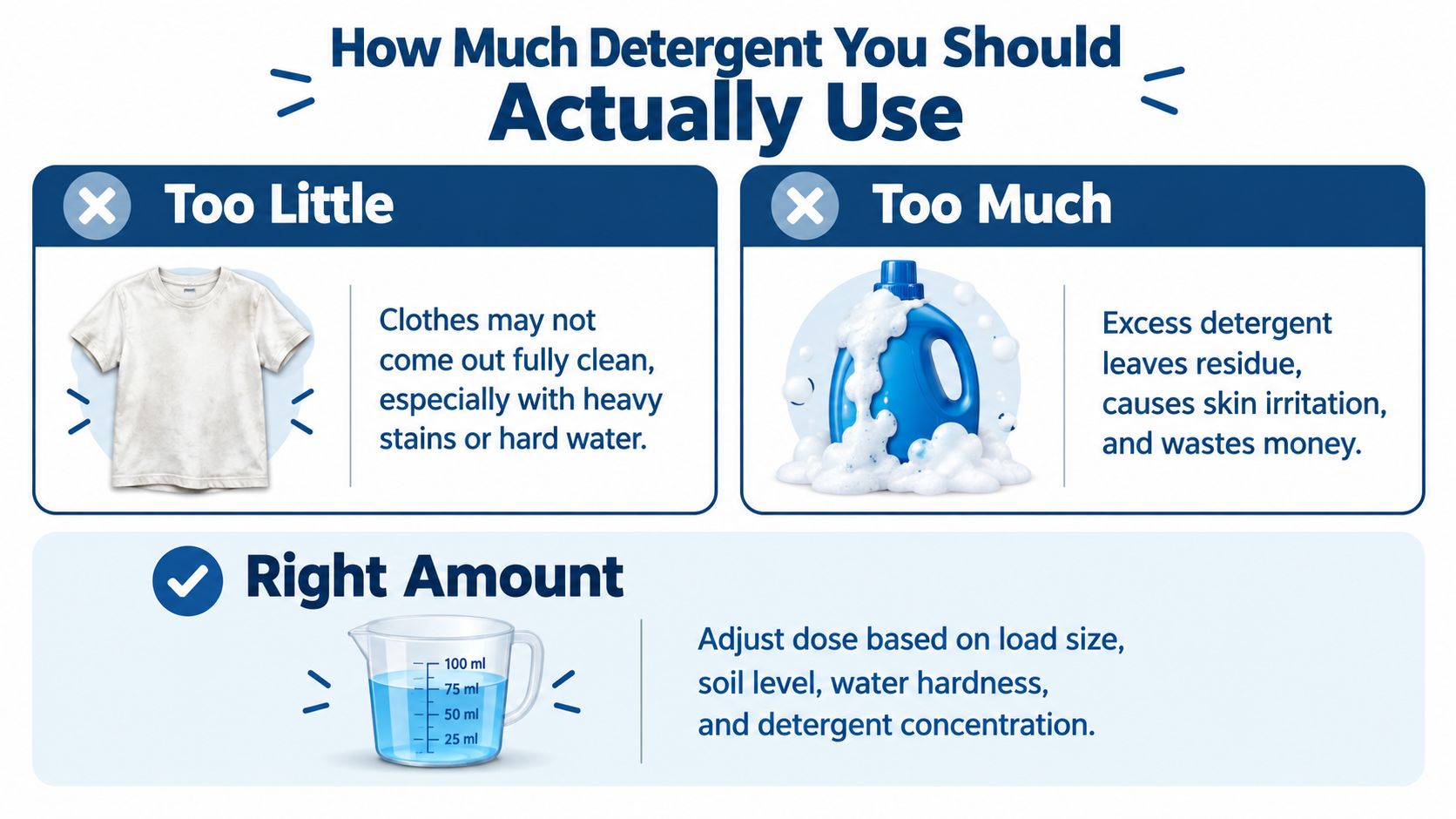
There's no universal dose per wash. The correct amount depends on the product instructions and the actual load, not a habitual capful or scoop.
Overdosing can waste chemical, leave residue, complicate rinsing and increase unnecessary wastewater discharge. Underdosing can reduce soil removal and create a reason to wash the load again.
What determines the dose
- Load size: Use the manufacturer's guidance for the quantity being washed.
- Soil level: Lightly worn clothing and greasy workwear may have different requirements.
- Water hardness: Check whether the label specifies an adjustment.
- Concentration: A smaller dose may be intended, so an old measuring habit may be inappropriate.
- Machine type: Follow both detergent and equipment instructions.
- Wash programme: Confirm that dosing suits the selected cycle and application.
Consumer NZ's clean-and-green laundry guidance recommends following product dosage instructions and selecting the lowest acceptable wash temperature. “Acceptable” matters: commercial hygiene requirements and fabric instructions still need to be satisfied.
Compare cost per wash, not pack price
An illustrative comparison doesn't need invented prices or dosing rates. Suppose a concentrated product costs more per container than a standard formulation but requires a smaller labelled dose. Its chemical cost per wash may be lower, similar or higher depending on the pack contents and usable number of washes.
The calculation is:
Pack price ÷ number of correctly dosed washes = detergent cost per wash.
That figure should then be considered alongside results. A cheaper chemical dose isn't necessarily a cheaper laundry process if staff must repeat the wash.
Dosing check: When a detergent changes, the measuring method and staff instructions should change with it.
For a commercial laundry, clearly recorded dosing guidance helps staff avoid interpreting concentration, load size or soil adjustments differently.
Choosing Detergent for Different Fabrics and Stains
A mixed laundry basket isn't a single cleaning problem. The fabric-care label should establish the limits before detergent, stain treatment and programme are selected.
Match the product to the textile
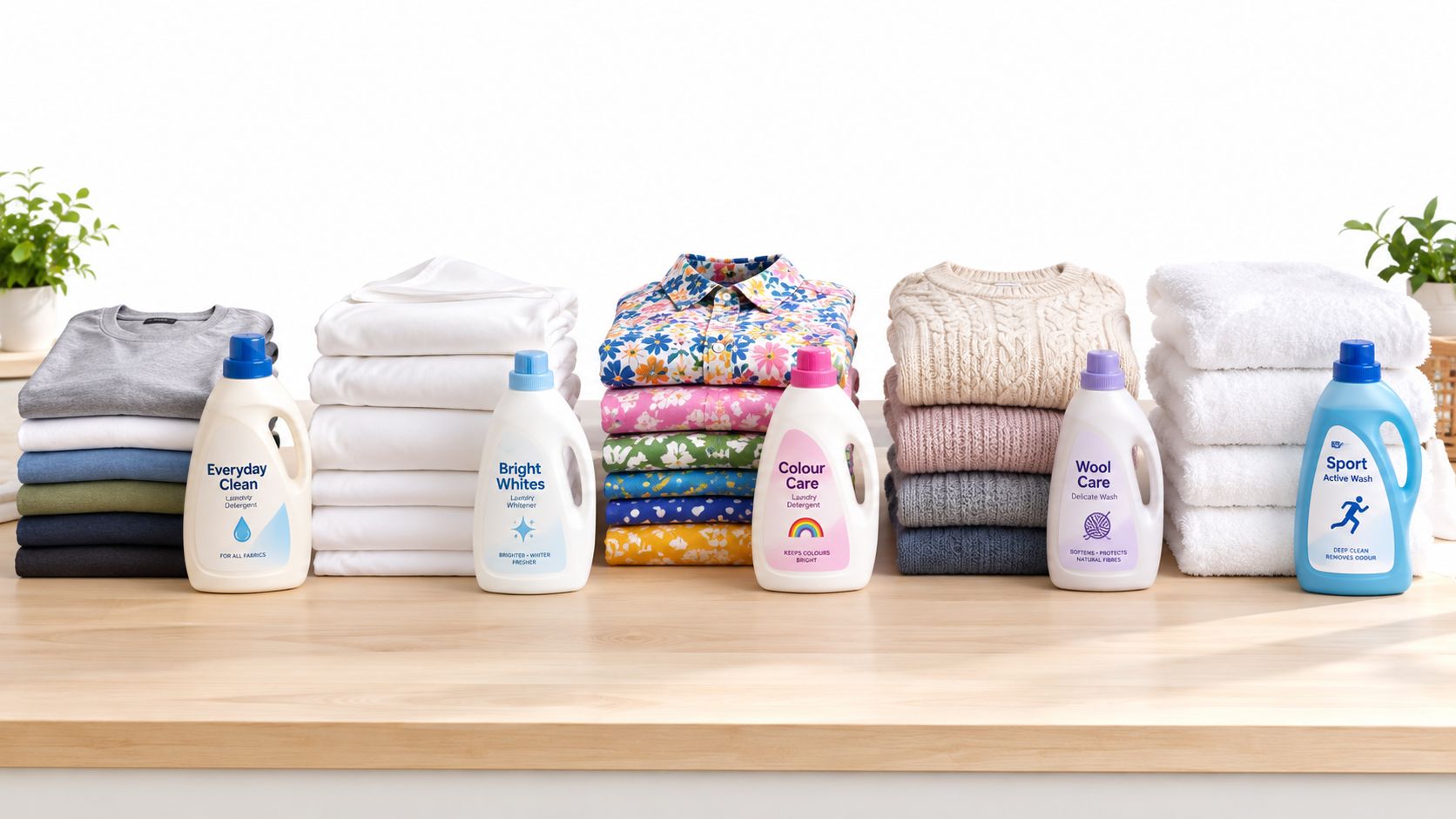
- Everyday clothing: Select a formulation compatible with the fabrics and usual wash programme.
- White clothes and linen: Assess actual soil removal separately from visual brightening. The related article Laundry Detergent for White Clothes addresses this purchasing question.
- Coloured fabrics: Check suitability for colours before using a detergent or supplementary bleaching product.
- Delicates and wool: Use textile-specific care guidance rather than treating them like ordinary workwear.
- Towels: Consider body soils, rinsing and the intended fabric-care requirements.
- Heavily soiled workwear: Identify the contamination before selecting the wash formula.
- Greasy kitchen uniforms: Prioritise suitability for oils and food stains, with approved pretreatment where appropriate.
- Bedding and hospitality linen: Balance soil removal, presentation and suitability for prolonged skin contact.
Kitchen textiles deserve their own attention. The cotton tea towel discussion provides related fabric context for operators reviewing frequently washed cleaning and drying cloths.
Treat the stain, not just the whole load
Pretreatment should follow the stain-remover or detergent label and the textile's care instructions. Increasing the overall detergent dose to tackle one marked item may expose the rest of the load to unnecessary chemical.
Temperature selection also needs to account for the stain and any required hygiene process. Household stain advice shouldn't override a facility's validated laundry procedures.
Bedroom allergy management is another separate issue. Protect-A-Bed's resource on dust mite prevention for bedrooms offers wider bedroom-care context, rather than evidence that ordinary detergent alone resolves allergy concerns.
The practical aim is a compatible combination of textile care, stain treatment and washing conditions. The strongest product on the shelf may not be the most appropriate choice.
Laundry Detergent in Commercial Hospitality Operations
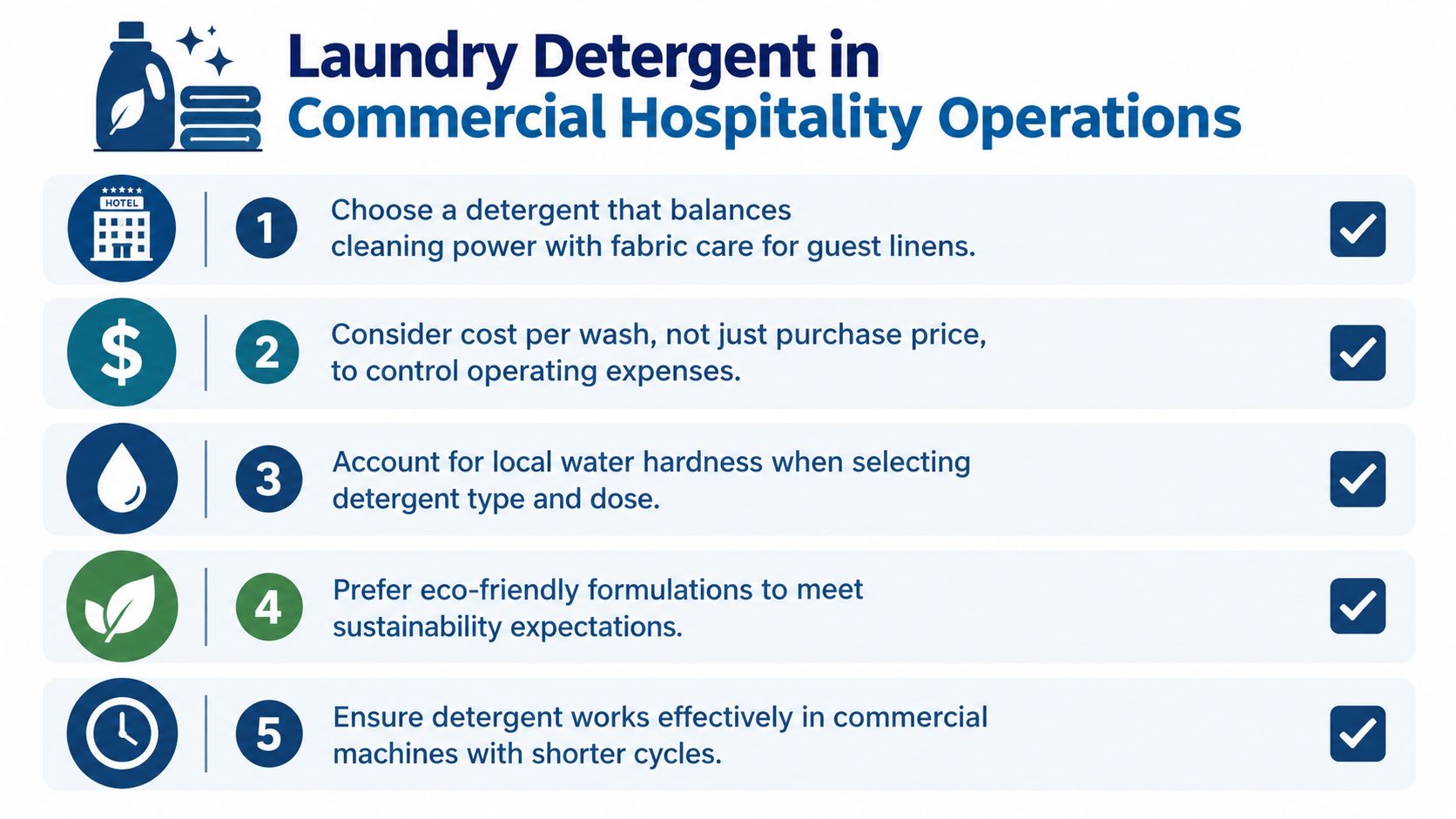
Hotels and motels need consistent results across sheets, pillowcases and towels. Restaurants face tablecloths, napkins, chef jackets and kitchen uniforms with different soils. Aged-care facilities, schools, marae and commercial laundries may also have specific hygiene, skin-sensitivity or wastewater requirements.
A domestic detergent may suit some small workplace applications where its documentation supports that use. Specialised commercial laundry systems require a more detailed match between chemicals, equipment and wash programmes.
Specify the process alongside the product
- Cleaning requirements: Identify grease, food, body soils and recurring stains.
- Capacity and workflow: Match load sizes and programmes to the laundry being processed.
- Machine compatibility: Confirm approved products and dosing arrangements.
- Fabric care: Include linen condition and presentation in the assessment.
- Rewashing: Record unsuccessful loads so staff can investigate the cause rather than automatically add chemical.
For LG Giant C+ and Titan C commercial laundry equipment, compatibility should be confirmed against the relevant machine documentation and detergent instructions. The commercial laundry purchasing considerations provide useful equipment-planning context.
Automatic dosing may be appropriate where staff process repeated loads or use a specialised chemical system. It isn't required for every commercial laundry, and installation alone doesn't establish correct dosing. The settings still need to match the approved formula.
Wastewater belongs in the specification
Sites with septic systems or proposed greywater reuse need product-specific information. Consumer NZ's detergent selection guidance identifies sodium, phosphorus and high pH as relevant concerns, and discusses Eco Choice Aotearoa criteria for surfactant degradability and phosphorus-containing formulations.
Operators should request documented wastewater suitability rather than rely on “natural” or “green” wording. Effective cleaning, controlled chemical use and appropriate discharge characteristics are connected purchasing considerations, not separate projects.
Choosing Laundry Detergent in New Zealand
A purchasing decision should begin with the laundry specification and end with verified product documentation. Product names, pack sizes and dosage claims should be checked against current labels and technical information before an order is placed.
Laundry detergent purchasing checklist for NZ operators
| Consideration | What to check | Why it matters |
|---|---|---|
| Laundry type | Clothing, kitchen textiles, towels or bedding | Establishes the application |
| Fabric compatibility | Textile care labels and product restrictions | Supports appropriate fabric care |
| Common stains | Oils, food, proteins or general dirt | Guides formulation selection |
| Machine suitability | Equipment and detergent instructions | Confirms the intended system |
| Detergent format | Powder, liquid, premeasured or concentrated | Affects handling and flexibility |
| Recommended dosage | Guidance for load, soil and water conditions | Supports consistent use |
| Cost per wash | Pack contents and labelled dose | Enables a meaningful comparison |
| Water hardness | Local conditions and dose adjustments | Affects washing performance |
| Safety instructions | Current label and SDS | Establishes handling requirements |
| Commercial versus household use | Documented intended application | Avoids unsuitable substitutions |
Check documentation before stocking
No named laundry chemical should be selected on an unverified formulation or dosing claim. For products obtained through Matthews Packaging & Hygiene, operators should confirm the actual product brand, purpose, pack size, machine compatibility and safety requirements. The distributor's name isn't a substitute for the brand on the container.
WorkSafe's safety data sheet guidance requires a current SDS for each hazardous substance held, regardless of quantity, with safety information readily accessible to relevant workers and emergency personnel. WorkSafe's hazardous-substance inventory requirements also require businesses to record hazardous substances and relevant storage or segregation information.
Facilities with additional care requirements can consult the commercial laundry considerations for healthcare facilities. The purchasing priority remains a suitable formulation used correctly, not the strongest or cheapest product.
For help matching detergent, supporting laundry chemicals and commercial equipment to a hospitality operation, visit Simply Hospitality. Its team can discuss the textiles, typical stains, machine model and dosing arrangements, then help identify suitable options and the product documentation needed before purchase.