


Why Aged Care Facilities Have Different Warewashing Requirements: What to Buy
On 31 March 2020, the New Zealand Ministry of Health recorded 34,646 people receiving aged residential care, with 45% on rest-home-level care, 40% on hospital-level care, 12% on dementia care and 3% on psychogeriatric care. Add the drinks, snacks, modified-texture meals and supper rounds that sit between three main meals, and you have a kitchen running racks from early morning to late evening, every day of the year.
That's the short answer to why aged care facilities have different warewashing requirements. The machine isn't chosen for a busy Friday night. It's chosen for a vulnerable resident population, a meal schedule with no closing time, and a documented process that has to hold up when someone asks how a failed wash was handled.
Get the choice wrong and the consequences appear on the trolley. Trays get held back, care staff end up hand washing in a sink, and a food control plan develops a gap nobody planned for.
Why Aged Care Warewashing Runs on a Different Clock
A restaurant has a finish line. The last table is cleared, the machine is drained, the kitchen resets and the lights go off. An aged care kitchen doesn't get that reset. Breakfast trays are still coming back while morning tea is being plated, and the bowls that held porridge are sitting in the rack when the lunch prep starts.
The schedule doesn't relax on a Saturday, a Sunday or a public holiday either. It often gets harder, because the roster is thinner and an agency staff member may not know which programme to select or where the clean racks are stored. Add room service to a hospital-level or dementia wing and you've introduced covered transport racks, lidded cups and tray ware into the same wash load.
What continuous service does to the dish pit
- There's no overnight catch-up. A restaurant that falls behind at 9pm can clear the backlog after service. A facility that falls behind at 8am carries that debt into lunch.
- The ware is more varied. Thickened fluids arrive in lidded cups, fortified drinks in beakers, pureed and minced meals in bowls, and adaptive cutlery and non-slip mats come back on the tray as well.
- The residue sets harder. Texture-modified meals, high-protein supplements and fortified desserts cling to the sides of cups and bowls in a way that a plate of toast doesn't.
- The people clearing trays aren't dish hands. Care staff and food service assistants collect ware between clinical tasks, which makes a simple, forgiving workflow more important than a clever one.
Practical rule: Count wash windows, not residents. A facility serving three meals plus morning tea, afternoon tea and supper hands the machine six chances a day to fall behind.
The population matters as much as the schedule. Crockery, cutlery and cups pass through the hands of residents with frailty, cognitive impairment, swallowing difficulties or reduced immunity, so a wash that leaves soil or a film behind isn't a presentation problem. It's a hygiene control that hasn't been met, and the equipment has to make the right outcome repeatable under pressure rather than only achievable when someone is watching.
Before comparing machines, list every meal, snack and beverage round in a typical week and mark which ones generate dirty ware. That list is the brief, and it will tell you more than any showroom demonstration.
What the Wash Must Achieve for Infection Prevention
The distinction that matters most in warewashing is the one most often skimmed over. Cleaning removes food, grease and most microorganisms. Sanitising kills what's left, and it only works on a surface that's already clean, as MPI's cleaning and sanitising guidance sets out. Put a plate with dried egg through a sanitising cycle and the egg is warmed, not sanitised.
In aged residential care that sequence sits inside an infection control framework. Providers are audited against Ngā Paerewa NZS 8134:2021, which covers infection prevention and environmental safety, so warewashing is a control the facility has to describe, demonstrate and evidence. The dishwasher is part of that system rather than the whole of it.
New Zealand food hygiene requirements set measurable reference values, summarised in Food Standards guidance on cleaning and sanitising. In daily operation they translate like this.
| Process step | Reference value | What it means in practice |
|---|---|---|
| Machine wash | At least 60°C with detergent | Soil is lifted before sanitising begins |
| Machine final rinse | At least 77°C for at least 10 seconds | Achieved temperature at the ware surface matters, not only the programme setting |
| Manual hot-water sanitising | 77°C for 2 minutes | Used only where items cannot go through a dishwasher |
| Drying after washing | Air-drying preferred | Avoids reusing cloths that may recontaminate clean ware |
Two points get missed when a facility reads that table. The first is that the number on the display isn't necessarily the number at the ware, so temperatures should be verified at the cabinet or the ware surface, with corrective action recorded for any failed cycle. The second is that heat isn't a standalone control. Sanitiser effectiveness depends on the correct concentration, temperature and contact time, and an excessive wash temperature can bake protein or fat onto utensils, which then shields soil from the rinse.
For the mechanics of how heat inactivates microorganisms and why contact time matters as much as peak temperature, the VirusFAQ.com guide to heat disinfection is a clear explainer to hand to supervisors when briefing staff.
Where the standard sequence needs a workaround
Heat-sensitive plastics, some melamine and certain adaptive or modified-texture dining aids may not tolerate a 77°C final rinse. MPI's guidance for food businesses is explicit that dishwashers must be operated and serviced to the manufacturer's instructions, and for items that can't go through a machine it specifies a pre-clean, a detergent wash and a clean hot-water rinse. The facility needs a documented alternative for those items: validated low-temperature chemical sanitising on a machine and chemical combination that supports it, or single-use ware, confirmed with the supplier against current MPI guidance before it enters service.
Written procedures turn that into a system. Naming who loads and unloads, which method applies to which ware, how a failed cycle is quarantined and where clean items are stored does more for hygiene outcomes than a higher specification on paper. The guide to preventing cross contamination in the kitchen covers the handling side of the same problem.
Walk the current programme against the table and note every step where nobody can say who checks it or how the result is recorded.
Planning Capacity for Daily Ware Volumes
Start with the facility's own numbers, not the national ones. Take a facility with 80 residents serving three main meals daily. That's 240 resident meal settings before snacks, beverages, kitchen utensils and the trays themselves are counted. Each setting may include a plate, a bowl, a cup or glass, cutlery, a serving utensil and a tray, so the true item count runs well past the resident headcount.
Resident numbers alone tell you almost nothing about whether a machine will cope. Peak windows do. Breakfast and dinner are usually the pinch points, because meal service collides with medication rounds and handover, and every tray needs clean ware at roughly the same time.
The sector backdrop is large and growing. Ministry of Health modelling puts around 34,530 people in aged residential care in 2024/25, generating approximately 12.6 million resident bed days, with demand projected to rise by 33%, or 11,600 additional bed years, between 2024/25 and 2034/35 (Ministry of Health aged care modelling). That's useful when planning a new wing and useless when specifying a machine, unless it's translated into your own load.
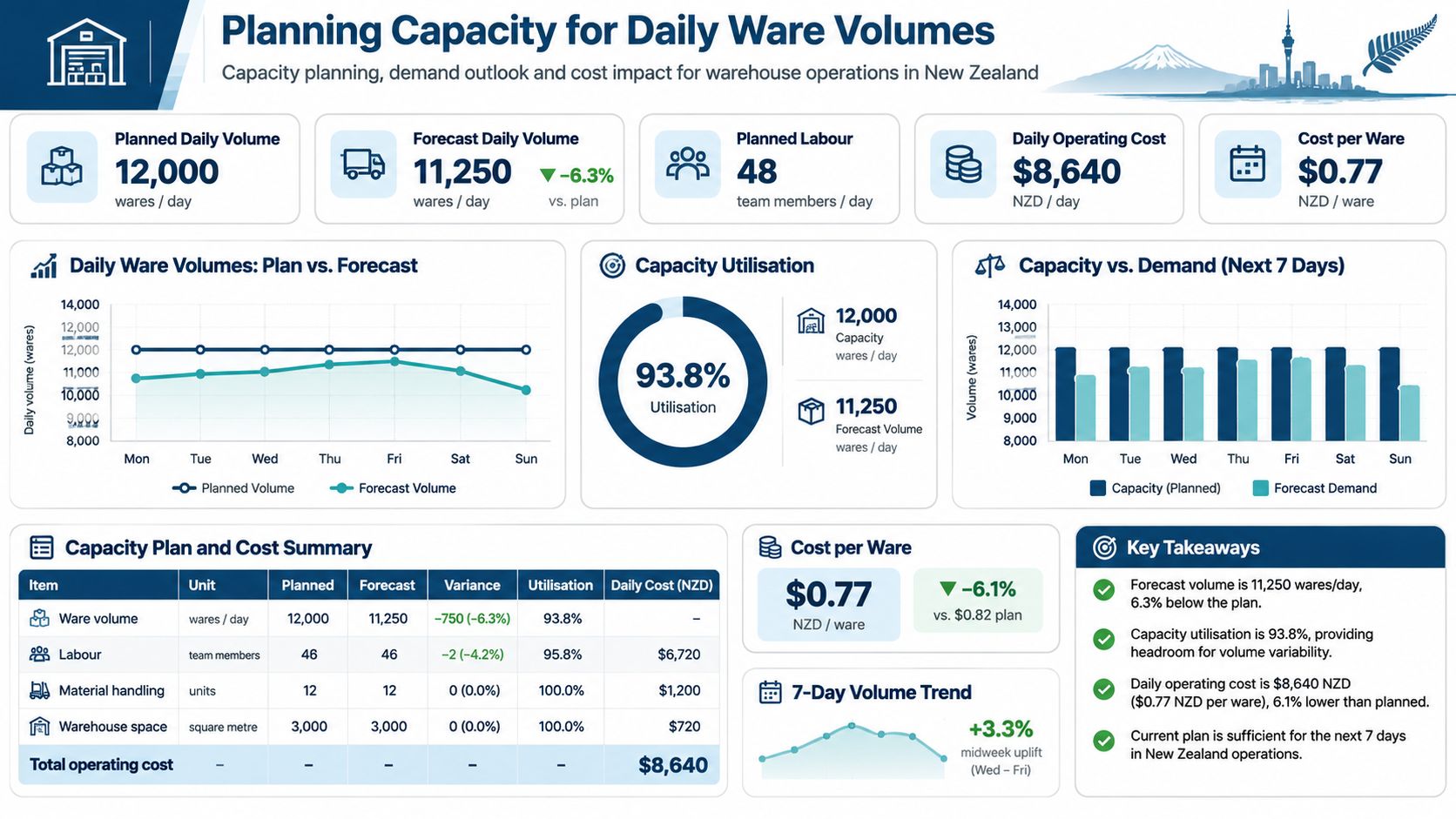
Work through the load in this order:
- Count settings per meal period, including the satellite pantry or ward kitchen if it plates separately.
- Add snack, beverage and supper ware, plus lidded cups and feeding aids.
- Add kitchen utensils, gastronorm pans, chopping boards and food preparation equipment.
- Divide the total item count by rack capacity and multiply by cycle time to get cycles per window.
- Compare that against the actual minutes available between service and the next tray collection.
- Add a margin for a failed load, a breakdown or a shift running short.
One more factor inflates the cycle count. MPI requires utensils used for raw, ready-to-eat or cooked food to be thoroughly washed and then sanitised between uses (MPI food safety guidance), so a kitchen swapping between food categories mid-service generates extra washes that never appear in a resident-per-machine calculation.
The 80-resident example is illustrative only. Build a peak-period load sheet from your own meal times before you look at specification sheets.
Choosing Between Undercounter and Pass-Through Dishwashers
Three categories cover most aged care installations. The differences that decide the choice are where dirty ware enters, where clean ware leaves, and how much staff time each load consumes.
| Dishwasher type | Typical application | Operational considerations |
|---|---|---|
| Undercounter dishwasher | Smaller facilities, satellite kitchens or wards with modest peak volumes | Fits under benches, but rack changes and loading take more staff time per load |
| Pass-through dishwasher | Larger kitchens with steady rack flow and continuous meal service | Supports dirty-to-clean movement; needs room at both ends and clear rack handling |
| Larger automated warewashing system | High-volume or multi-site facilities with a dedicated washing area | Higher installation and infrastructure needs; service planning and backup become critical |
An undercounter machine is often the sensible answer for a rest-home wing or a satellite pantry, because the alternative is carrying racks of dirty ware down a corridor. The trade-off is staff time: every load is a manual rack change, and a 40-rack lunch is 40 interruptions.
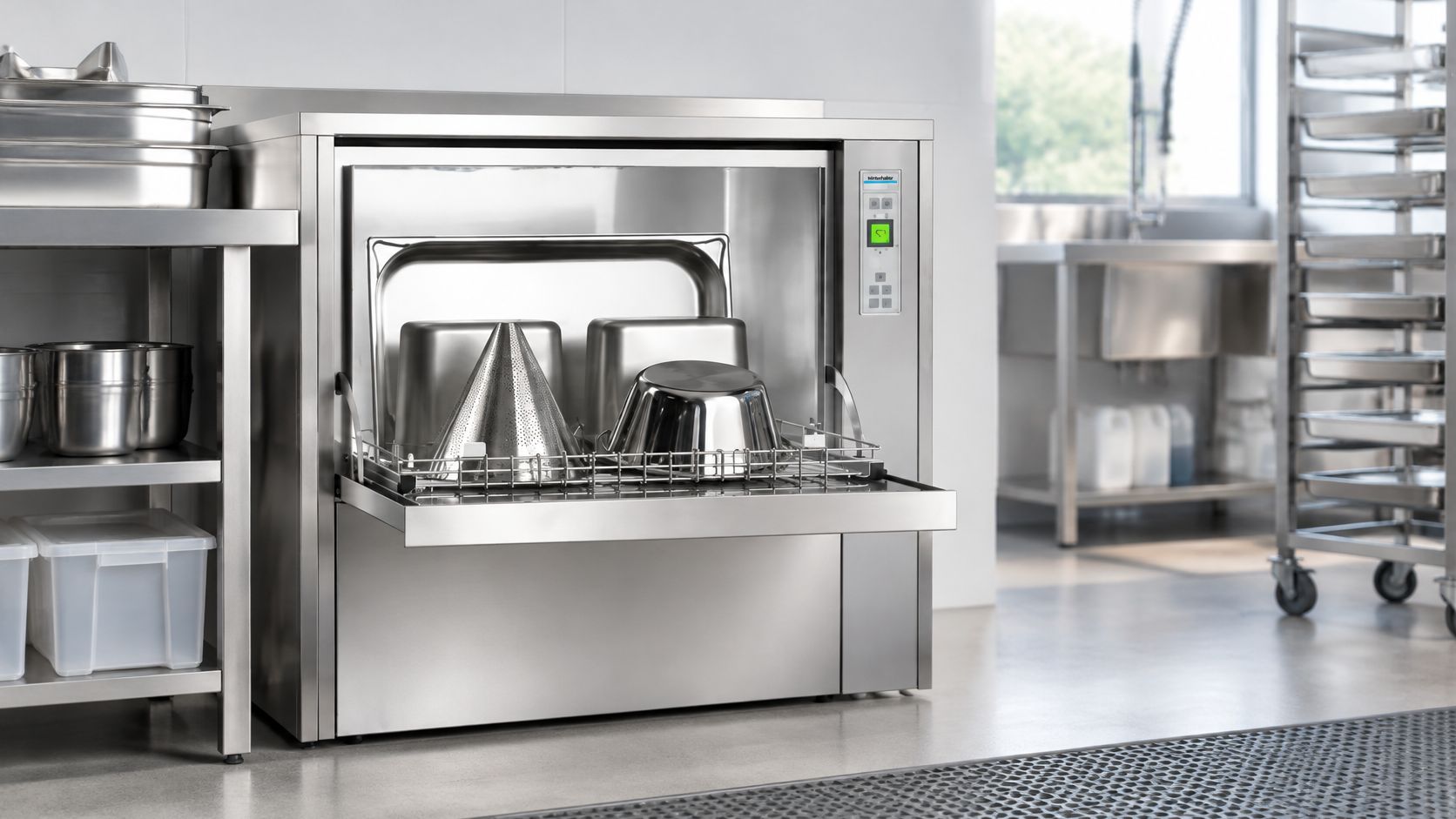
Some sites also need a machine that handles production ware rather than plates. The Winterhalter GS 630 Compact Utensil Washer is a compact undercounter utensil washer for trays, GN containers and production tools. It suits a kitchen where ordinary dishwashers are too light for the pans but the floor plan rules out a full-size pot washer.
A pass-through earns its space where racks flow continuously. Dirty ware goes in one side, clean ware comes out the other, and the wall between them does the separation work that staff otherwise have to do by hand. It needs clearance at both ends, a landing bench for clean racks, and a loading height that doesn't put every tray above shoulder level. For aged care kitchens with a high proportion of older or part-time staff, loading height and rack weight matter as much as cycle time.
Larger automated systems suit high-volume or multi-site facilities with a dedicated wash area. They bring installation requirements, service planning and a genuine need for backup arrangements. Rhima's Med Sparkle Washer is listed for aged care kitchens and wards and runs a hygiene-oriented programme with a high-temperature final rinse, which shows how far machine design has moved toward healthcare settings.
The ranges worth comparing by volume are Winterhalter commercial dishwashers and integrated warewashing solutions, alongside Classeq and Rhima commercial dishwashers. The commercial dishwasher range overview is a reasonable starting point before narrowing to models. Match the machine type to peak load and room layout first, and the shortlist usually writes itself.
Designing a Clean-to-Dirty Warewashing Workflow
A facility running several meal services a day repeats the same wash sequence four, five or six times before lunch is cleared, so a layout fault that costs a restaurant a minute costs an aged care kitchen real time. Set the room up so ware moves one way and never crosses back.
- Collect at a single trolley return. Dirty ware should arrive at one point, not be stacked on whichever bench is free. The common slip is a trolley left in the corridor because the wash area has no allocated bay.
- Scrape into a lidded bin. Scraping removes the bulk of soil before it reaches the machine. The slip is scraping over an open bin placed next to clean rack storage.
- Pre-rinse at a dedicated sink. A quick rinse stops residue drying on and reduces wash water loading. The slip is putting the pre-rinse sink after the loading point, so soiled racks travel through the clean zone to get to it.
- Load racks by ware type. Plates in a plate rack, cups in a cup rack, cutlery flat in a basket so spray reaches every surface. Overloading is the most common loading fault, because it shields surfaces from spray.
- Wash and sanitise on the validated cycle. The cycle is only as good as the rinse temperature or chemical dose achieved, which is why verification and records belong at this step rather than in a folder.
- Unload onto a clean bench. The receiving bench should never hold dirty items, even briefly. A single dirty rack set down there undoes the cycle.
- Store clean ware covered and dry. Covered storage keeps dust and splash off, and drying stays on the air-drying rule already set for the wash area rather than a cloth at the bench.
Arrangement is also an infection control question. New Zealand Health Quality & Safety Commission guidance requires strict separation of meal preparation from resident-care, cleaning and laundry tasks, because staff can move microorganisms between care environments and food operations (HQSC aged residential care guidance). In practice that means dedicated or clearly segregated transport equipment for meal service and hand hygiene before and after food handling, on top of a hot final rinse.
Documentation completes the workflow. MPI advises checking that cleaning and sanitising are being done correctly, keeping records and writing clear instructions (MPI cleaning and sanitising guidance). A one-page procedure that names who loads, which method applies, how failed cycles are handled and where clean items live is worth more than a wall chart nobody reads.
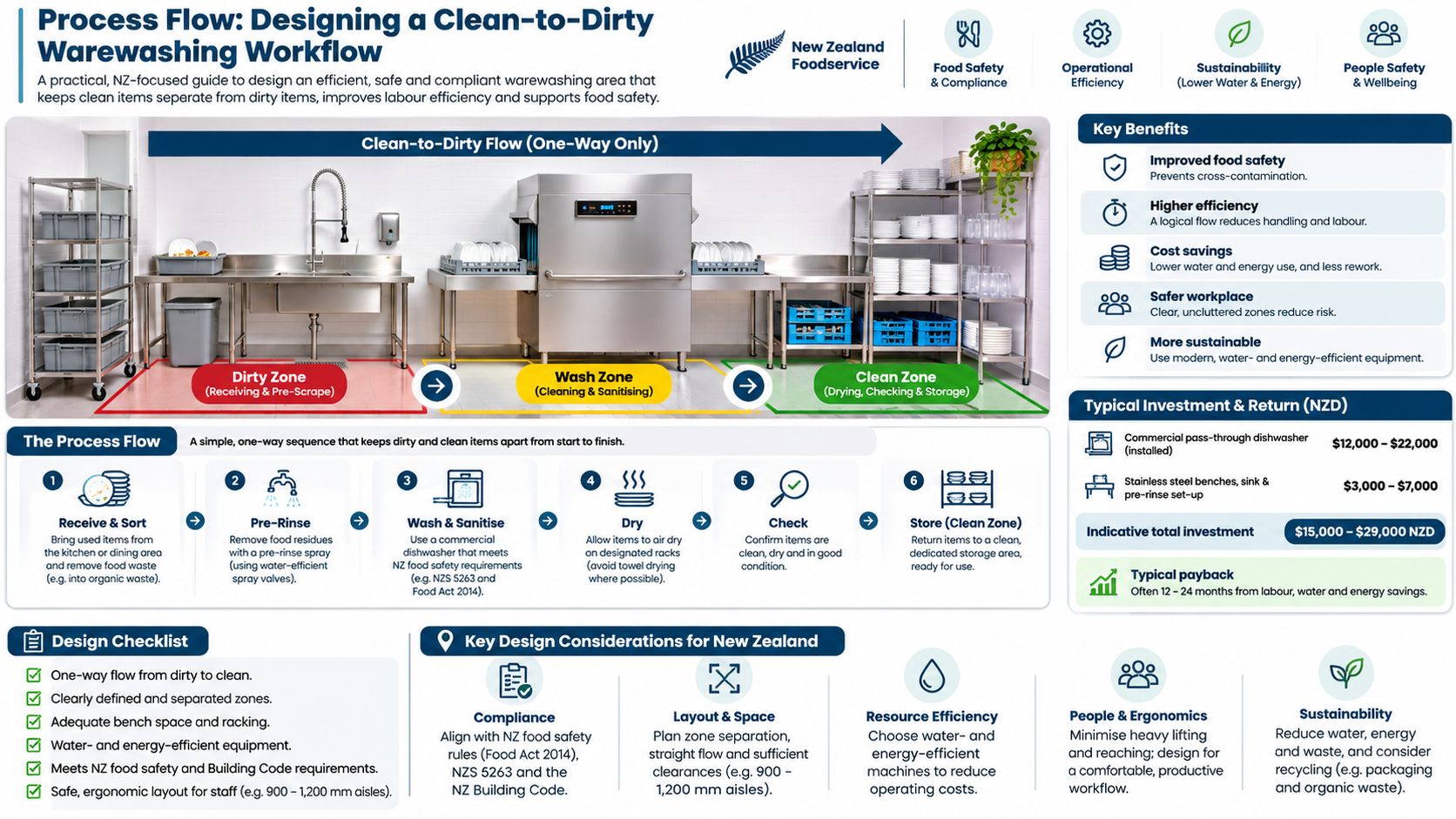
Ergonomics belong in the layout conversation, not after it. Bench height, reach distance for rack loading and the distance a full rack has to be carried all affect injury risk, and a machine position that forces staff to twist at the waist is a false economy. Fixed appliances should be installed and commissioned by qualified trades, with power, water and drainage checked before the benching is fabricated. For facilities that need a specialist commercial kitchen layout or a wash area designed from first principles, SACH Design handles that work alongside the equipment specification.
Sketch the one-way route on a floor plan and mark every point where dirty and clean ware could meet. The crossover points are predictable: the loading point, where dirty racks queue beside clean bench space, and the unloading bench, where a just-washed rack lands next to whatever the last shift left there. For the wider kitchen around the wash area, the guide to planning a one-way restaurant kitchen layout applies the same thinking to the rest of the fit-out.
Water Quality, Chemistry and Checking Results
A clean-looking plate is not proof that anything was sanitised. Visible soil is easy to see; residue film, hard-water spotting and an under-dosed detergent are not. In an aged care kitchen the stakes sit higher than in a restaurant, because one dosing fault affects every tray in the service and the residents eating from them have the least margin for error. Results depend on the whole system: the machine, the water, the chemicals and the person doing the checks.
| Symptom | Likely cause | What to check |
|---|---|---|
| Cloudy film on glassware | Hard water or under-dosed rinse aid | Test water hardness and confirm rinse aid dosing |
| White scale on heating elements or spray arms | Mineral build-up from untreated water | Descale on the manufacturer's schedule and review water treatment |
| Food soil left on plates after a cycle | Under-dosed detergent or blocked spray arms | Check detergent dosing, then clear filters and spray arms |
| Spotting after drying | Poor rinse or slow drying | Check rinse aid dosing and the drying method |
Water hardness is the quiet culprit in most of these. Minerals in the supply leave film on glassware, scale on elements and spray arms, and a machine working harder for the same result. Softening or filtration protects the machine and the wash result, and the right answer depends on a water test rather than a guess about what the town supply is doing.
Detergents and rinse aids have to suit both the machine and the water. Detergent strength and dose do the soil removal, rinse aid shifts the water off the surface so it dries without spotting, and dosing systems keep both consistent between shifts. Follow the manufacturer's instructions for the machine and use compatible chemicals, because mismatched products can damage seals and pumps or leave residue on food contact surfaces. Dishwasher chemicals and cleaning consumables sit in Simply Hospitality's Cleaning & Chemicals range, so consumables can be matched to the machine at the same time.
Routine cleaning and descaling sit on the manufacturer's schedule for a reason. Filters, spray arms, curtains and wash chamber surfaces collect soil that no cycle will remove, and a partially blocked spray arm produces the exact symptom in the table above. A spray arm is quick to pull and rinse; skipping it turns into rewashing racks mid-service.
Where a water test shows hardness, chlorine or sediment coming in with the supply, treatment hardware belongs between the supply and the machine. Winterhalter water-treatment accessories cover the common cases for the machines the brand supplies, and the guide to how water quality affects dishwasher performance goes deeper on matching treatment to a measured problem. Treatment is a small line item next to the machine, and omitting it undermines the reliability of the whole setup.
Film and spotting on glassware are usually the first visible sign that something has drifted. Hold a rack of glasses up to the light after a cycle. It takes a moment and catches a dosing or rinse problem before a full meal service runs through it.
Test the water, set a dosing check schedule and log the results. Keep the log beside the machine and assign the check to a named role on each shift. A logged check is the difference between a process and an assumption.
Keeping Service Running When a Dishwasher Fails
Breakfast trays are loaded on the trolley at 7.40am and the machine is showing a fault code. Residents are waiting, the dining room opens on schedule, and a care assistant has already started filling the sink. That is what dishwasher downtime looks like in aged care. Meals cannot pause while a repair is booked, so the consequences land as delayed service, shortages of clean tableware, extra workload on clinical staff and improvised washing arrangements.
Temporary procedures still have to meet the hygiene controls the facility works to. The same manual wash sequence and hot-water sanitising apply on a breakdown day as on a normal one, and someone has to own the call. The written plan should name who signs off a temporary method, and that sign-off should be logged with the method used, when it started and when the machine returned to service.
Preventive maintenance is cheaper than any of that. Scheduled servicing keeps the machine inside its validated parameters and catches worn parts before they stop a meal service.
Parts availability deserves its own line in the plan. Replacement parts can look interchangeable but differ in lugs, clearances and airflow, so the appliance model, version and product code should be verified before ordering. A part that arrives wrong on a Friday afternoon is a weekend of hand washing.
For larger facilities, three contingencies are worth agreeing in advance. Hold a par level of clean ware in reserve. Identify a backup machine or an alternative washing arrangement, whether that is a second kitchen or a neighbouring site. And name who makes the call when the machine fails, so nobody waits for approval while trays stack up. The commercial dishwasher maintenance guidance sets out the servicing rhythm, and in a care setting the knock-on effects of a stoppage run well past the kitchen.
Write the downtime plan on one page: temporary method and who approves it, clean stock on hand, the service contact and the decision maker. When the fault code appears, nobody should be working it out for the first time.
How to Choose Warewashing Equipment for an Aged Care Facility
The shortlist test is simple: if a machine cannot clear the peak load at its rated rack capacity, on the normal chemical programme, with the staff roster on shift, it does not stay on the list.
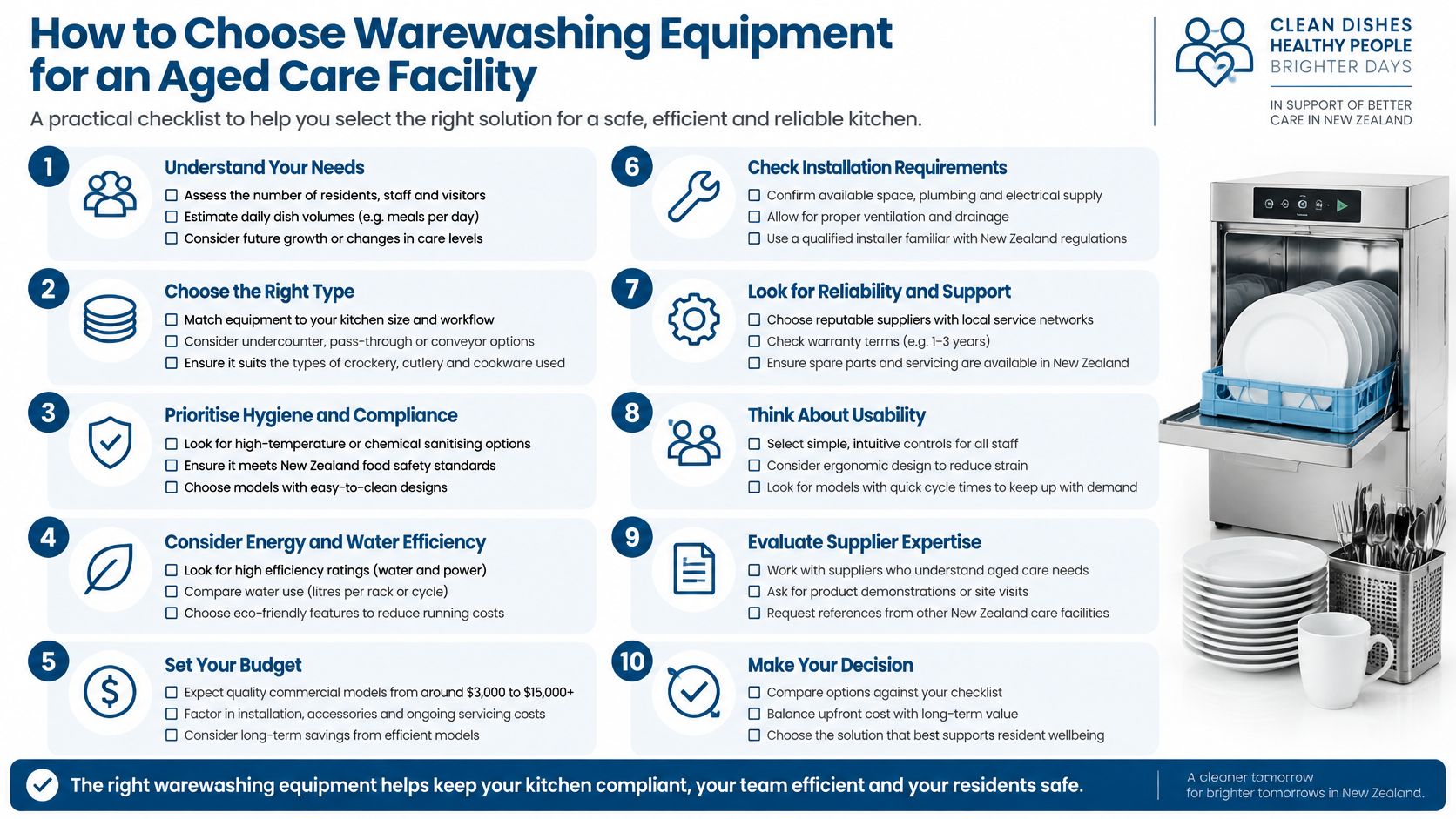
| Shortlist check | What to confirm before signing |
|---|---|
| Staff ergonomics | Loading height, rack weight and unloading direction stay manageable through a full service |
| Installation and infrastructure | Power, water, drainage, ventilation and clearances match the model document before cabinetry is ordered |
| Commissioning | Fixed appliances are installed and commissioned by qualified trades, with the validated programme set up front |
| Consumables and support | Detergents, rinse aid and cleaning chemicals are supplied for the machine and the local water |
| Scope boundary | The job is foodservice warewashing, not clinical decontamination or sterilisation |
Whole-of-life cost is what makes those checks comparable. Take two pass-through units with the same nominal throughput. The lower-priced machine needs a second wash when trays come back heavily soiled, runs without heat recovery, and keeps one staff member at the machine longer during dinner. The dearer unit clears the same peak on the standard programme. Across a service week, the gap in labour time, chemical use and energy demand can matter more than the invoice.
Heat recovery belongs in that comparison, not as a brochure extra. Where the model supports an economy or heat-recovery option, a machine sized for the actual peak usually runs better than an oversized unit left half empty between services.
We supply dishwashing ranges from Classeq, Rhima and Winterhalter, along with cleaning chemicals and consumables for daily warewashing. Check the final electrical or gas supply, cut-out, ventilation and clearances against the model document before ordering cabinetry, because a machine that cannot fit the space or the supply becomes a problem at install. For a specialist wash-area layout, SACH can plan the room around the clean-to-dirty flow.
Scope is worth stating plainly. We supply equipment, consumables and design support. Infection prevention consultancy, clinical sterilisation equipment and guaranteed emergency servicing sit outside foodservice warewashing.
If you're specifying warewashing for a rest home, hospital wing or retirement village kitchen, bring your peak-period load sheet and the checks above. We can help match machine type, rack handling, chemicals and layout to the meal rhythm and the team running it. Visit Simply Hospitality to see the dishwasher ranges and consumables, or get in touch for a quote built around your facility.