


Why Airex Display Refrigeration Continues to Stand Out
A customer reaches the café counter, scans the drinks, notices the chilled sandwiches and asks for something cold to take away. Behind the glass, the display refrigerator is doing more than holding stock. It's protecting product, guiding attention, supporting the queue and occupying valuable commercial space. That's why Why Airex Display Refrigeration Continues to Stand Out is best answered through a merchandising and operating lens, not by comparing appliance features in isolation.
For New Zealand cafés, bakeries, convenience stores and takeaway businesses, the right cabinet has to keep refrigerated food in suitable conditions while making it easy to see, choose and buy. Airex display refrigeration stands out when its format, visibility, temperature performance, energy use and service workflow are matched to the venue rather than selected on appearance alone.
What Display Refrigeration Is Really For in a Hospitality Venue
A display refrigerator has two jobs. It must maintain appropriate refrigerated conditions, and it must present products clearly enough for customers to make a quick decision. A storage fridge can succeed at the first job while contributing nothing to the second. A display cabinet sits at the intersection of refrigeration, merchandising, customer access, floor space and staff workflow.
Consider a countertop cabinet beside a café till. A barista can reach for a bottled drink while customers are waiting, while the cabinet presents the remaining range without another sales conversation. That same unit also needs to fit the counter line, avoid obstructing service, allow practical replenishment and keep its internal conditions stable through repeated access.
Practical rule: A display refrigerator should make the product easier to buy without compromising the refrigeration job happening behind the glass.
The commercial case is especially relevant in New Zealand. EECA identifies refrigeration as the country's third-largest electricity user, with refrigeration systems using 16,194 TJ of electricity in 2023. Commercial display cabinets commonly operate continuously, so cabinet choice affects ongoing electricity use, operating cost and emissions rather than only the initial fit-out budget.
A New Zealand cabinet policy paper from MBIE describes refrigerated commercial cabinets as equipment used to display and store food in retail and commercial premises. Businesses own about 157,000 refrigerated commercial cabinets, which shows the scale of the equipment category across cafés, bakeries, supermarkets, hotels and food-service outlets.
A better display cabinet can support sales without acting like a salesperson. The glass, lighting, shelving and cabinet position all influence what customers notice first, while the refrigeration system protects the product behind that presentation. Operators assessing a possible merchandising benefit can also consider how a better display cabinet may influence food sales, without assuming that any cabinet automatically creates an uplift.
Introducing Airex as a Display Refrigeration Brand in NZ
Airex is a commercial refrigeration and display brand available in the New Zealand hospitality market through Simply Hospitality. The relevant question isn't whether the cabinet looks polished on a showroom floor. It's whether the construction, controls and presentation details remain useful when the counter is busy and staff need to replenish stock quickly.
A typical commercial evaluation starts with the cabinet structure. A sturdy steel or stainless construction provides a practical base for repeated service, cleaning and movement during a fit-out. Double-glazed heated doors can help maintain a clear viewing area in humid conditions by resisting condensation. That matters in a New Zealand café or bakery where a fogged door hides the very products the cabinet is meant to present.
Lighting also needs to serve a purpose. Bright, low-heat LED lighting can help staff see stock levels and customers read the range without relying on harsh overhead lighting. Adjustable chrome or glass shelving gives operators more control over product grouping, although shelf positions and loading limits must always be checked against the current model specification.
Features should earn their space
A digital controller gives staff a clear point for checking and adjusting cabinet operation. It doesn't replace temperature verification, but it supports day-to-day control and makes abnormal readings easier to identify. Refrigerant selection also belongs in the technical review, particularly as New Zealand operators increasingly consider the environmental profile of refrigeration systems alongside their operating performance.
Airex's value is therefore best understood as a merchandising-first design approach. The cabinet needs to cool reliably, but its glass area, lighting, shelf arrangement, controls and service access should also help the venue present products consistently.
The Airex freestanding refrigerated food display range provides a useful starting point for reviewing the available format and specification. The final choice still depends on product type, ambient conditions, installation space and how staff will use the cabinet during service.
Why Visibility and Presentation Sit at the Heart of the Cabinet

A customer waiting in a café queue has only a brief moment to notice an extra drink, dessert or prepared meal. What the cabinet shows during that pause is merchandising, not decoration. Airex should therefore be assessed as a merchandising system that connects product visibility with ordering behaviour, staff workflow and the cabinet's operating demands.
At eye level, LED shelf or canopy lighting should make packaging, labels and colours easy to distinguish without creating unnecessary heat. Full-length double glazing can maintain a broad sightline, while clean glass prevents fingerprints and condensation from becoming a barrier. In New Zealand cafés, bakeries and convenience stores, those details matter because bright ambient light, busy counters and frequent door opening can quickly weaken presentation.
Shelf layout directs attention
Shelf spacing must match the products on sale rather than merely fill the cabinet. Bottles, cans, filled rolls, desserts and packaged meals need different heights and presentation angles. Adjustable shelves help operators create clear groups, while tilted merchandising plates can face products towards customers instead of hiding them behind the front shelf edge.
Give each category a defined position. Keep frequently selected items easy to reach, and use prominent shelf space for products that benefit from immediate visibility. A crowded cabinet can hold more stock while selling less effectively, particularly when labels face sideways or smaller products disappear behind taller ones.
Cabinet placement and door configuration shape the customer's view. A unit beside a queue should face the direction customers naturally look. Door swing, sliding access and cabinet handedness also affect whether customers can pause comfortably and whether staff must reach across the service path.
Presentation must remain operational
A cabinet that looks excellent when fully stocked still has to work during a rush. Staff should spot low stock quickly, remove products without disturbing the shelf and clean the interior without dismantling an unnecessarily complicated arrangement. Layout, access and visibility must support service speed as well as sales.
The commercial display fridge guidance supports this practical view. Visibility depends on cabinet dimensions, lighting, shelf geometry, glass, access and placement. Treat those choices as part of the refrigeration specification, because presentation loses value when the cabinet is difficult to clean, load or operate efficiently.
Matching Airex Cabinet Styles to What You Are Selling
Different products require different display behaviours. A drinks cabinet for self-service has a different job from a cake cabinet at a bakery counter, and an open-front multideck has a different operating trade-off from a closed-door merchandiser.
| Cabinet Style | Best Suited To | Key Consideration |
|---|---|---|
| Upright glass-door merchandiser | Chilled drinks, dairy, packaged meals and grab-and-go products | Offers clear presentation and controlled access, but requires customers or staff to open doors |
| Countertop or counter-height display | Cakes, desserts, chilled snacks and point-of-sale products | Makes the product part of the ordering conversation, but usable capacity is limited by counter space |
| Open-front multideck | High-turnover drinks, convenience food and self-service areas | Access is fast, but ambient conditions, loading and energy performance require close attention |
| Food display cabinet | Assisted-service counters, bakeries and prepared-food presentation | The cabinet must suit the product format, service side and required temperature range |
| Curved-glass display | Front-of-house food presentation where a broad viewing angle matters | Strong visual presentation can come with more demanding cleaning and access considerations |
An upright glass-door merchandiser earns floor space when the venue needs visible chilled stock with a defined product range. It suits grab-and-go drinks, dairy and packaged meals behind or near a service counter. It's less suitable when customers need constant access and the doors would create a bottleneck.
Countertop and counter-height displays work well in bakeries and cafés where desserts, cakes or prepared food form part of the ordering decision. Their advantage is proximity to the customer. Their limitation is equally clear, the counter footprint and internal layout restrict how much reserve stock can sit in the unit.
Open access has a price
Open-front units can suit convenience areas and high-turnover self-service lines where speed matters. Customers can take products without opening a door, and staff can replenish from the service side when the layout allows. The trade-off is greater exposure to room air and air movement, so the unit's stated operating conditions, installation environment and loading instructions become critical.
Food displays and curved-glass cabinets suit assisted-service lines where staff control access and customers select from a visible range. They're often the right tool for a bakery or servery, but not automatically the right tool for bulk chilled storage.
Capacity should be assessed through the merchandising chain:
Product dimensions → number of facings → shelf configuration → replenishment frequency → peak stock requirement
Nominal litres matter, but they don't tell the whole story. A smaller cabinet with useful shelf spacing and a sensible replenishment routine can outperform a larger cabinet that leaves products hidden or awkward to reach.
Temperature Performance, Ambient Conditions and the Open vs Closed Trade-Off
Presentation cannot come at the expense of food safety. A controller reading is only one part of the picture. Operators need to distinguish between the cabinet set point, displayed air temperature, actual product temperature and the ambient conditions surrounding the unit.
New Zealand food businesses remain responsible for monitoring chilled food and following their applicable food-control requirements. Cabinet selection should therefore begin with the product's required temperature, then confirm that the specific Airex model can provide suitable performance under its stated operating range and climate rating.
The room changes the refrigeration job
A display cabinet beside an oven, in direct sun or near a doorway faces a harder operating environment than the same model in a cool, stable retail area. Kitchen heat, air-conditioning cycles, draughts and nearby equipment can all influence cabinet performance. Open-front equipment is particularly sensitive because its designed air curtain depends on the surrounding air and correct installation.
Operators should check:
- Ambient rating: Compare the model's stated climate rating with the actual venue conditions.
- Clearances: Allow the ventilation space specified by the manufacturer around the refrigeration system.
- Heat sources: Keep the cabinet away from ovens, grills, hot pass areas and direct sunlight.
- Air movement: Review air-conditioning outlets, doorway draughts and strong extraction flows.
- Loading: Keep products within the shelf limits and airflow boundaries stated for the model.
Closed-door cabinets generally create a stronger barrier between the refrigerated space and the room. That can support temperature retention and reduce warm-air infiltration, but customers must open the door and staff need to manage handles, seals and access.
Open-front cabinets provide easier customer access and can suit fast-moving stock. The thermal compromise is real. A field retrofit of doors on open refrigerated dairy cabinets reported an immediate 42% reduction in electricity use, while the analysis estimated that enclosing all such dairy cabinets in New Zealand supermarkets could make at least 33 GWh per year available in savings. The published field study supports the basic engineering lesson, limiting warm-air ingress can reduce refrigeration load.
Compliance is the starting line
New Zealand's regulated threshold for refrigerated display cabinets is EEI < 130, as set out in EECA's commercial product regulations report. Compliance doesn't prove that a cabinet is the best fit for every site. It establishes a minimum requirement, while the operator still needs to compare design, loading, placement, access and expected use.
The closed-versus-open decision should be blunt. An open merchandiser earns its running cost when rapid access and high turnover are central to the sales model. A closed-door Airex unit is usually the smarter long-term choice when the range turns more slowly, temperature retention matters more and the business can accept a small access step.
Choosing the Right Airex Display Refrigerator for Your Operation
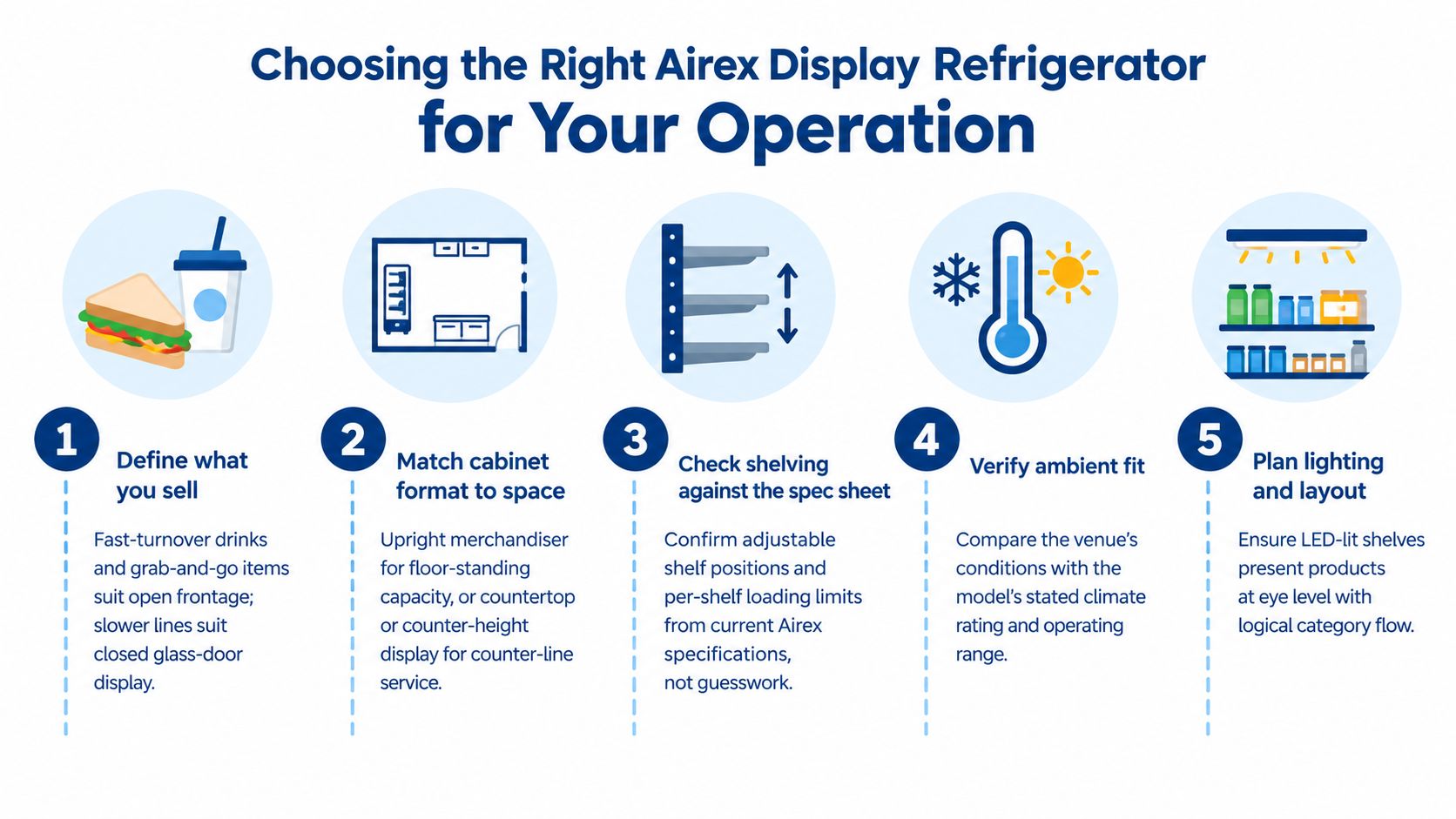
The selection process should begin with the product, not the cabinet. A drinks-led convenience offer, a bakery dessert range and a café grab-and-go cabinet can occupy similar floor space while requiring different shelf layouts, access patterns and replenishment routines.
Use the trading pattern to size the cabinet
Start by listing the products that will be displayed and how quickly they turn. Then calculate the stock required during the busiest trading period, not the average quiet period. The cabinet needs enough visible facings to look organised and full, but it shouldn't become a reserve store that staff struggle to rotate.
The practical sequence is:
- Define what will be displayed. Record product heights, packaging shapes, temperature needs and expected turnover.
- Determine the required product temperature. Confirm the food category and review the model's stated range rather than relying on a generic controller setting.
- Calculate peak display stock. Allow for the busiest service window, then separate display stock from reserve refrigerated storage.
- Check shelf layout. Confirm adjustable positions, shelf dimensions and per-shelf loading limits from current Airex specifications.
- Decide how customers access products. Choose open, sliding-door or hinged-door access according to the service model.
- Measure the footprint. Include door swing, customer clearance, staff access and cleaning space.
- Confirm electrical and ventilation requirements. Check the installation instructions and ensure the site can support the cabinet's requirements.
- Plan replenishment. Identify where replacement stock is held and how staff can refill the cabinet without obstructing customers.
- Compare appropriate Airex models. Compare like-for-like formats, not a countertop cabinet against an upright merchandiser just because both have glass.
Common mistakes are predictable. Operators undersize for peak trade, place signage across the air path, install open-front cabinets in direct sunlight, or forget to plan condensate drainage. These decisions can undermine a good cabinet before the first customer sees it.
Quoting checklist: Product type, required temperature, peak stock, shelf layout, access style, footprint, clearances, power, ventilation, drainage and replenishment route.
Temperature monitoring deserves its own line in the fit-out plan. Commercial refrigeration monitoring guidance can help operators consider how cabinet performance will be checked rather than assuming that a digital display alone proves safe product storage.
Cleaning, Maintenance and the Whole-of-Life View of Airex Ownership
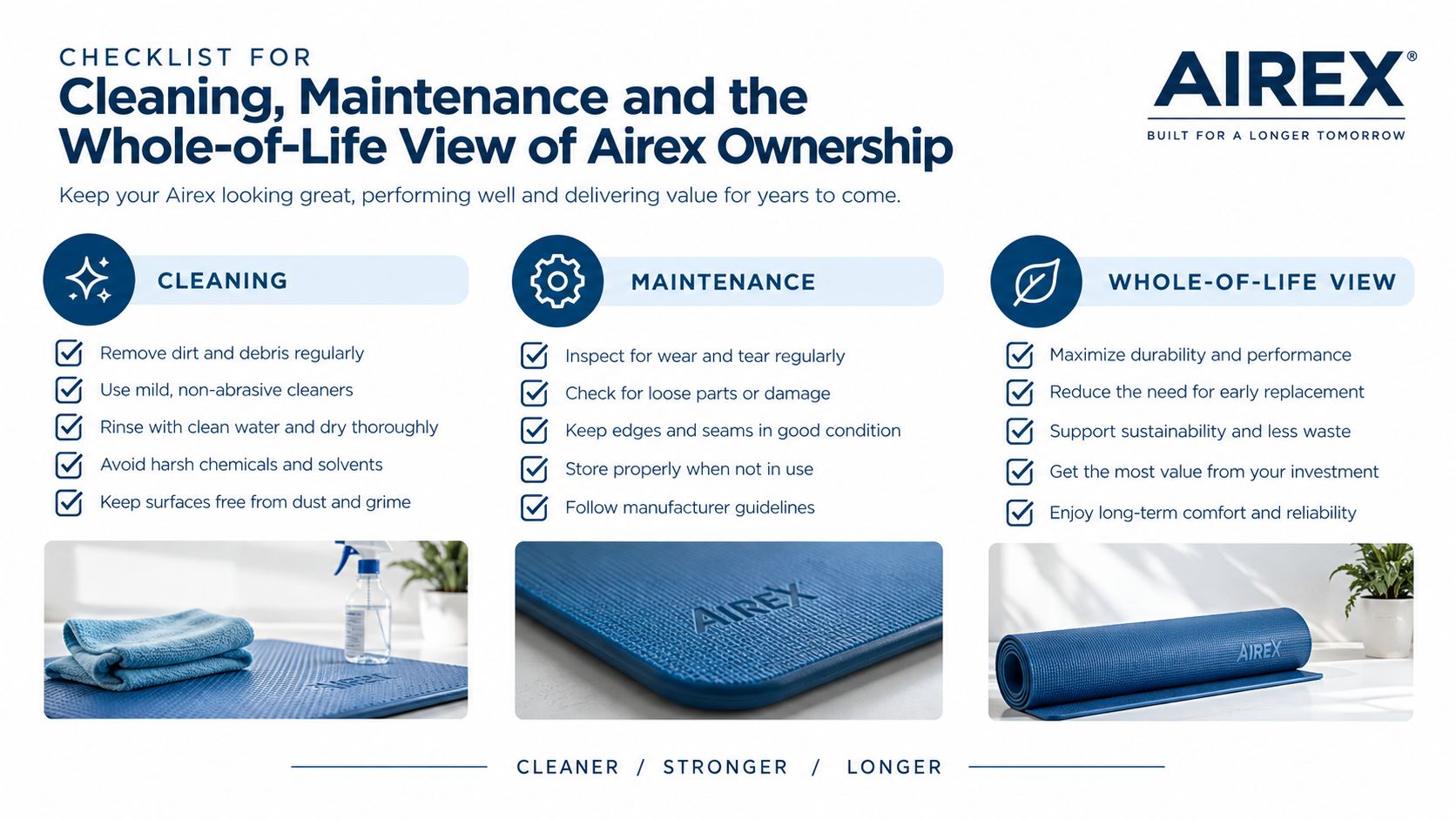
A display refrigerator has two visible responsibilities. It must keep product cold, and it must look clean enough for customers to trust what they're buying. A cabinet with streaked glass, crumbs under the shelves or damaged seals fails as a merchandising surface even if the compressor is still operating.
Daily cleaning should focus on the customer-facing parts. Staff can wipe glass and shelves, remove spills and crumbs, rotate stock and check for products sitting outside the intended arrangement. Door tracks and handles need attention where applicable because they collect debris through normal service.
Maintenance needs a written owner
The maintenance routine should follow the current Airex instructions rather than an invented universal interval. Useful checks include:
- Glass and shelving: Clean without leaving streaks, and remove shelves according to the manufacturer's instructions.
- Door seals and tracks: Look for food debris, split gaskets, poor closure or resistance during opening.
- Condenser area: Keep the coil and surrounding ventilation clear, using the manufacturer's cleaning method.
- Controller and probes: Investigate unusual readings and arrange qualified checking if calibration or sensor accuracy is in doubt.
- Drainage: Check condensate trays and drains as part of routine maintenance, especially where spills or blockages are possible.
EECA explains that condenser piping needs to allow condensed refrigerant to drain easily to the receiver. Poor drainage can leave refrigerant in the condenser and reduce the heat-transfer area available for vapour to condense, as described in its industrial refrigeration good-practice guide. NZQA's commercial refrigeration maintenance unit standard also identifies condensate trays and drains as items to check, clean and sanitise.
Whole-of-life cost is more than the invoice
The ownership decision combines purchase price, electricity consumption, maintenance, usable merchandising capacity and operational suitability. A cabinet that holds more product but forces difficult replenishment may not be the efficient choice. A cabinet that looks inexpensive but operates in a poor ambient environment can create avoidable service and energy problems.
New Zealand's regulatory context makes this worth serious attention. MBIE noted that refrigerated display cabinets still had scope for improvement even as minimum standards developed, so buyers should assess future compliance and retrofit risk rather than selecting purely on the lowest purchase price. The regulatory impact analysis provides that wider context.
Display refrigeration also shouldn't replace back-of-house storage. If customers never need to see the product, a storage cabinet from brands such as SKOPE or Atosa may be more appropriate. Airex display refrigeration earns its place where visibility, access and merchandising contribute directly to the service environment.
The practical ownership mindset is simple. Choose the cabinet for the products and service model, install it within the manufacturer's conditions, load it as specified and give cleaning and monitoring clear responsibility. Operators can also review commercial refrigeration maintenance practices when building the care routine.
Simply Hospitality supplies commercial display refrigeration and can help hospitality operators compare Airex formats against product dimensions, temperature requirements, counter layouts and replenishment needs. Visit Simply Hospitality to review the available range and request practical advice for the next café, bakery, convenience store or food-service fit-out.