
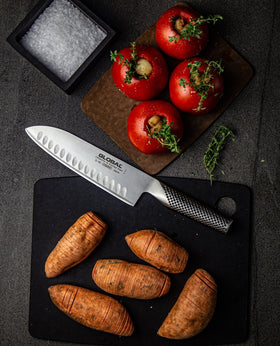

Why Global Knives Continue to Be a Chef Favourite in NZ
A busy kitchen doesn't need a knife that looks impressive in the block. It needs one a chef can use for hours without constantly adjusting grip, balance or technique. That practical familiarity explains why Global knives continue to be a chef favourite worldwide, including in New Zealand kitchens where knife handling, cleaning and maintenance form part of everyday professional practice.
Global's appeal isn't based on one universal claim that every chef should use the same knife. It comes from a combination of Japanese heritage, stainless construction, lightweight balance, distinctive dimpled handles and broad blade selection. Those features suit operators who need dependable tools for preparation, service and repeated hygienic cleaning, while still leaving room for personal preference.
The Knife a Chef Reaches for Without Thinking
Friday night service is moving quickly. Tickets are building, a chef is switching between protein preparation and garnish, and the same knife keeps returning to the hand because it already feels right. There's no pause to assess the handle or compensate for a heavy blade. Familiarity takes over.
That's the central reason Global knives remain popular. A chef's main knife becomes a personal working tool, not just another item of equipment. During long preparation periods, weight, balance, handle shape and control matter alongside sharpness. A blade that demands constant correction can create friction, even if it has an impressive specification.

Global's recognisable design takes a different approach from traditional knives with substantial bolsters and heavier handles. Its all-stainless appearance, hollow handle and dimpled grip give the range a distinctive feel, while the balance is intended to make the knife predictable in use. The result is a tool that can become almost invisible once a chef has used it regularly.
New Zealand's hospitality training framework treats knife handling and maintenance as formal competencies. NZQA unit standard 13285 is a Level 2 competency for commercial kitchens, while unit standard 21059 covers knife care, use, storage and carrying in hospitality. That context matters because knives affect more than cutting performance. They influence training, workflow, cleaning routines and how confidently staff work at a preparation bench.
Many operators also compare Global with other options before standardising a kitchen. The practical questions in this New Zealand chef knife guide are the right ones: how the knife feels in the hand, what the menu demands and how the team will maintain it. Even equipment outside knife storage deserves the same fit-for-purpose thinking. Operators protecting a pizza station, for example, can also review how to protect your baking stone before choosing cutting practices that damage expensive surfaces.
Global's worldwide following is therefore less about prestige than repeatable familiarity. A chef who barely thinks about the knife while concentrating on food has already found the quality that matters most.
Engineering Behind the Global Feel
Global's feel comes from several design decisions working together rather than from a single feature. The brand uses CROMOVA 18 stainless steel, a proprietary Yoshikin steel produced in Japan. A detailed steel reference describes Global blades as hardened to 56 to 58 Rockwell and identifies CROMOVA 18 as the material used throughout the blade and handle construction. The technical overview of Global knives also describes the blade as welded seamlessly into the handle.
CROMOVA 18 and practical edge control
The name refers to the steel's chromium, molybdenum and vanadium content. In practical terms, that combination supports a stainless blade designed for corrosion resistance, usable edge stability and straightforward maintenance. The hardness range gives the blade enough structure for professional preparation while remaining approachable to sharpen compared with harder, more brittle knife steels.
That doesn't mean a Global edge is immune to damage. Contact with hard surfaces, poor technique, unsuitable boards and careless storage can still deform or damage the edge. A professional knife's useful sharpness depends on the whole operating routine, not just the alloy.
Seamless construction
The blade and handle form a continuous stainless design without the conventional handle scales and exposed rivets found on many knives. The bolster-less profile also changes how the chef holds the knife, particularly for a pinch grip near the blade heel.
The hygiene benefit is straightforward. Fewer joints and recesses leave fewer places for food residue and moisture to collect, making the surface easier to wash and inspect. That feature is particularly relevant in commercial kitchens where knives are repeatedly cleaned during working days.

The handle and centre of balance
Global's handle is hollow stainless steel with a dimpled grip. A source describing the brand's design notes that the hollow handle is sand-filled for balance, while New Zealand guidance describes the handle as ergonomic, hygienic, bolster-less, comfortable and slip-resistant. The balance is not a guarantee of comfort for every cook, because hand size, grip and preparation style vary, but it explains why many chefs notice the range's light, controlled handling.
The same principle applies to other kitchen equipment. A freezer such as the SKOPE ActiveCore 3 Door Storage Freezer, Stainless, SKFT1500NS-A also makes its value through practical operating details, including a removable refrigeration platform, solid swing doors and a cabinet configured for demanding frozen storage. In both cases, the useful design is the part that reduces friction during routine work.
Practical rule: A knife's engineering should be judged by how consistently it supports the team's actual preparation routine, not by appearance alone.
Matching Blade Shapes to Kitchen Tasks
A chef's knife is usually the starting point, but it isn't the answer to every preparation task. Global offers profiles for broad chopping, precise vegetable work, detailed garnish, cooked-meat slicing and specialist fish or meat preparation. The right choice depends on what a station does repeatedly.
The G-2 20 cm Chef's Knife is the general-purpose option for vegetable mise en place, chopping, dicing and portioning boneless proteins. Its curved profile supports rocking cuts, although chefs who favour a push-cutting technique may prefer a flatter blade.
The G-5 18 cm Santoku suits precise vegetable preparation, herbs and compact board work. Its shorter, broad profile gives the hand control close to the cutting surface, making it useful where accuracy matters more than a long slicing stroke.
A G-7 18 cm Carving Knife is intended for cooked meats and controlled slicing. It's a specialist choice for kitchens where roast service, plated meat or portioning cooked joints forms a regular part of the workflow. The G-21 15 cm Petty Knife handles smaller work such as shallot brunoise, citrus supremes, trimming and garnish preparation, particularly when a full-size chef's knife feels cumbersome.
For fish butchery and poultry fabrication, the G-30 16 cm Boning Knife provides a narrower profile for navigating joints and separating meat from bone. It shouldn't be treated as a substitute for every fish preparation knife, but it can be a useful specialist addition where staff regularly carry out detailed breakdown work.
| Global Model | Blade Length | Primary Tasks | Cutting Style |
|---|---|---|---|
| G-2 Chef's Knife | 20 cm | Chopping, dicing, vegetables and boneless proteins | Rocking and general push cuts |
| G-5 Santoku | 18 cm | Vegetables, herbs and compact mise en place | Controlled push cutting |
| G-7 Carving Knife | 18 cm | Cooked meats and portioning | Long, controlled slicing |
| G-21 Petty Knife | 15 cm | Garnish, trimming and detailed preparation | Short, precise cuts |
| G-30 Boning Knife | 16 cm | Fish and poultry preparation | Narrow, joint-following cuts |
Most chefs don't need every blade in the range at one station. A carefully selected rotation of two or three knives often covers the majority of a menu, while specialist blades can remain assigned to the preparation area that needs them. A Knife Set NZ comparison can help operators think through whether a boxed set or individual selection makes more sense.
Global also isn't the automatic choice for tasks such as bread slicing. The Wüsthof Gourmet Super Slicer Knife 26 cm uses a long serrated edge for crusty loaves, soft bread and filled sandwiches, so it suits a station where clean bread cuts matter more than an all-purpose chef's knife profile.
Why Stainless Construction Matters in Commercial Kitchens
In a commercial kitchen, stainless construction is a working advantage because knives are exposed to food residue, water, cleaning chemicals and repeated handling. New Zealand's Food Hygiene Regulations 1974 require knives used on food premises to be thoroughly washed and rendered hygienic at least once each working day. The regulations covering food hygiene make cleaning a routine operational responsibility, not an optional finishing task.
Global's smooth, one-piece stainless form supports that routine. Without wooden scales, exposed rivets or a pronounced bolster, there are fewer transitions for staff to scrub around. A continuous surface is easier to rinse, dry and visually check, particularly when several knives must be processed at the end of a shift.
Cleaning is part of knife selection
A knife that performs well on the board but creates awkward cleaning work may not be a good commercial fit. Staff need to wash the blade and handle thoroughly, remove food residue and dry the knife before storage. The handle should feel secure enough to control during washing, but no handle design can replace correct technique and staff training.
The stainless surface also suits kitchens where acidic ingredients, saltwater and humidity are common. Stainless doesn't mean rust-proof under every condition. Moisture left on the knife, harsh detergents, poor storage and dishwasher exposure can still cause staining or corrosion.

Hygiene and total ownership
The operational benefit is not only cosmetic. Easier cleaning can reduce the number of awkward surfaces staff need to inspect, while durable stainless construction can support longer ownership when the knife receives proper care. That still depends on how the kitchen uses and stores the knife, so operators shouldn't interpret construction as permission for careless handling.
The same fit-for-purpose principle applies when businesses assess other hospitality tools. An explanation of why Chef Inox has become a hospitality essential reflects the broader value of equipment that is durable, cleanable and suited to repeated commercial use.
Global's construction is especially relevant where operators want a serious professional knife without the maintenance demands often associated with high-carbon blades. The choice won't remove the need for hand-washing and immediate drying, but it can make the daily routine simpler.
Maintaining the Edge Through Daily Service
A Global knife won't stay sharp because it's expensive. Edge longevity depends on frequency of use, ingredients, cutting-board material, technique, storage, honing and sharpening practice. Any claim that a professional knife will remain sharp for a universal period should be treated cautiously.
The first control point is the cutting board. Wood and quality plastic boards are generally more forgiving than glass, stone or other hard surfaces. A board should sit securely on the bench, remain in good condition and be appropriate for the preparation task. A damaged, unstable or unsuitable board can affect both edge condition and knife control.

Sharpen according to condition
Honing and sharpening aren't the same task. Honing helps realign an edge that has moved during use, while sharpening removes material to create a new edge. A ceramic rod, suitable honing tool, whetstone or professional sharpening service may all have a place, depending on the kitchen's skills and equipment.
Staff should watch the knife rather than follow a rigid calendar. If the blade drags through tomato skin, crushes herbs instead of slicing them or needs excessive pressure, the edge needs attention. The knife sharpening stone guide provides useful background for teams considering whetstone maintenance.
A sharp knife is easier to control, but only when the edge is maintained with the right method for the steel and the user's technique.
Wash, dry and store correctly
New Zealand buying guidance for quality kitchen knives recommends hand-washing, immediate drying, suitable wood or plastic boards and protective storage such as a block, saya, edge guard or knife roll. Water, harsh detergents and loose storage with other utensils can damage the edge and increase corrosion risk.
A magnetic strip keeps blades visible and accessible, but it must be installed securely and positioned away from busy collision points. A knife roll supports personal tools moving between stations, while an edge guard protects an individual knife in a drawer or storage tub. Loose storage is the poor option because blades strike one another and staff can reach into a container without seeing the edge.
Dishwashers create avoidable stress through heat, detergent and movement. Global's stainless construction is practical, but it still deserves hand-washing and immediate drying. That routine protects the edge and helps preserve the clean, consistent handling that made the knife useful in the first place.
Building a Global Selection That Fits Your Kitchen
A full boxed set can look organised, but it may include blades that a kitchen rarely uses. Operators usually get better workflow value by starting with the menu and assigning each knife to a clear preparation role. A restaurant focused on vegetables, sauces and boneless proteins may prioritise a chef's knife, santoku and petty knife. A bakery, steakhouse or seafood operation will need a different mix.
| Knife Type | Primary Use | Priority Level | Best Suited For |
|---|---|---|---|
| Chef's knife | General preparation and portioning | Essential | Most commercial kitchens |
| Petty knife | Garnish, trimming and detail work | High | Plating, prep and smaller ingredients |
| Bread knife | Bread, crusts and soft interiors | Menu dependent | Cafés, bakeries and sandwich stations |
| Santoku | Vegetables, herbs and compact prep | Menu dependent | Produce-led and detail-focused kitchens |
| Boning knife | Fish, poultry and joint work | Specialist | Kitchens handling whole or portioned proteins |
| Fish filleting knife | Filleting and delicate fish work | Specialist | Seafood preparation stations |
A curated selection also allows chefs to test personal preferences before committing across several stations. One chef may prefer Global's lighter Classic feel, while another may want a different handle profile or a heavier specialist knife. Ergonomics aren't universal, and a handle that suits one hand may feel uncomfortable to another.
Standardising a brand can simplify replacement, staff training and storage. It can also create unnecessary compromise if the menu includes tasks better served by specialist tools from another manufacturer. The sensible middle ground is often a consistent core range with carefully chosen exceptions.
Multi-site operators should document which knife performs each role, where it is stored and how staff maintain it. That creates consistency without forcing every location into an identical blade list. Businesses can also build the range progressively, starting with high-use knives and adding specialist profiles when the preparation volume justifies them.
A comparison of why Furi knives remain a favourite among professional chefs is useful for teams weighing Global against other practical professional options. The question isn't which brand wins in the abstract. It's which knife gives each station the right control, comfort and maintenance routine.
Choosing the Right Knife for Your Operation
The best knife in a commercial kitchen is often the one that disappears in the chef's hand. It doesn't create hot spots, demand awkward wrist adjustments or make the user think about balance during every cut.
Global remains compelling because its design addresses several daily pressures at once. The stainless construction supports straightforward hygiene routines, the lightweight balance can suit long preparation periods, and CROMOVA 18 provides a practical stainless platform that can be maintained over time. None of those features removes the need for training, a stable board, correct sharpening or careful storage.
Personal preference still decides the final choice. A mixed knife block combining Global with specialist tools from other brands may be more useful than a complete single-brand set, particularly for menus covering vegetables, bread, meat, fish and detailed garnish work.
Operators should involve the kitchen team before standardising knives. Staff should ask:
- Hand comfort: Does the knife feel comfortable during the grip used most often?
- Weight: Does its weight suit the way the team prepares food?
- Blade profile: Which shape matches the station's most common tasks?
- Maintenance: Can the team maintain the edge correctly?
- Storage: Where will the knife be cleaned, dried and stored?
- Quantity: Does the kitchen need a full set, or several carefully selected Global knives?
Even a broader resource such as a HYDAWAY camping cutlery guide reinforces a useful selection principle: tools should match their environment and intended use. Commercial kitchens need that same discipline, only with greater attention to repetition, hygiene and staff control.
Hospitality helps New Zealand hospitality businesses select chef knives, sharpening equipment, storage solutions and wider commercial kitchen essentials around menu, service volume and team requirements. Visit Simply Hospitality to review the available options or contact the team for practical advice before committing to a full Global selection.