


Why Rhima Is Often Considered for Aged Care and Healthcare Applications
A post-breakfast rush in an aged-care kitchen can turn into a bottleneck fast. Trays come back together, cutlery needs sorting, cups pile up, and the staff member on warewashing is trying to keep the next service moving while staying ahead of hygiene expectations. That is the environment where why Rhima is often considered for aged care and healthcare applications becomes a real buying question, not a branding exercise.
The short answer is that healthcare warewashing is judged on more than speed. Facilities need repeatable wash results, sensible workflow, and equipment that fits the room, the staff, and the service pattern. Rhima's New Zealand materials position its systems around those pressures, including hot-water cleaning for dishes and utensils, healthcare-oriented washer-disinfectors, and compliance-focused machine builds for regulated environments (Rhima New Zealand aged-care dishwashers, Rhima about and healthcare positioning).
The Unique Pressures of Healthcare Warewashing
A standard hospitality kitchen can often smooth demand across a service period. Aged care and healthcare rarely get that luxury. Breakfast, lunch, and dinner create concentrated return waves, and those waves usually include more than plates and bowls.
The load is mixed, not neat
The return side can include cups, glasses, cutlery, trays, GN pans, and prep items from kitchens that also support wards, nurse stations, or satellite servery areas. That mixed load means operators need to think in terms of items per meal, resident or patient count, and the length of the wash window, not just whether a machine is “fast”.
Practical rule: if the return bench fills faster than staff can sort and rack items, the machine rating alone won't save the workflow.
In aged care, meal-tray systems can create an even sharper spike. One tray run can dump a full mix of ware into the dishroom at once, so the wash area has to handle clearing, scraping, pre-rinsing, loading, washing, unloading, and clean storage without creating cross-traffic. Room layout, bench space, and staff movement matter as much as the machine itself.
For operators weighing reliability against feature lists, the practical test is whether the system holds up during peak return periods without adding extra handling steps. That is the point raised in this Simply Hospitality discussion on reliability versus features in aged-care warewashing.
Rhima's New Zealand site frames its medical and aged-care washing systems for facilities where hygiene, throughput, and compliance matter, and the broader aged-care context helps explain why. The Ministry of Health projects the population aged 75 and over will grow by about 42% over the decade to 2034/35, while demand for residential care is projected to increase by about 11,600 bed years, or 33%, over the same period and by 45% from 2025/26 to 2037/38 (Rhima NZ hospitals and aged-care context). The same source says New Zealand has about 418,000 people aged 75+, around 8% of the population, and about 105,000 people aged 85+, around 2% of the population (Rhima NZ hospitals and aged-care context).
That does not mean every facility needs a bigger machine. It means the wash system has to match the service peaks that hit the room.
Why generic hospitality thinking falls short
In a café or restaurant, the pressure is usually volume across a few busy windows. In healthcare, the pressure is volume, consistency, and hygiene discipline every day, with staff who may rotate across shifts. A machine that looks suitable on paper can still fall short if it cannot keep up with the way trays and ware return in real time.
Hygiene Control and Thermal Disinfection
Hygiene is the required part of healthcare warewashing, but the right answer isn't “the hottest machine wins”. The question is whether the machine produces a consistent, repeatable process that fits the facility's hygiene program and documentation needs.
What Rhima is actually positioning
Rhima's New Zealand healthcare materials describe washer-disinfectors for reusable dental, medical, and veterinary instruments, and its Med Sparkle washer is presented as suitable for aged-care facilities and hospitals with a Hygiene Plus program that reaches a final rinse at 87°C (Rhima about and healthcare positioning, Med Sparkle brochure). The brochure says the machine runs for 10 minutes after the tank reaches 65°C and finishes with that 87°C rinse (Med Sparkle brochure).
That matters because healthcare operators don't just want “clean-looking” ware. They need a wash profile that is controlled enough to support a hygiene-sensitive environment. Rhima's aged-care material also says its commercial and aged-care dishwashers use hot water to kill germs and bacteria and are designed to wash dishes and utensils safely, effectively, and efficiently (Rhima aged-care dishwashers).
Temperature visibility and process discipline
Where a machine shows temperature, cycle progress, or program selection clearly, that can help a busy kitchen team stay consistent. It doesn't replace the facility's own procedures, and it doesn't automatically satisfy compliance obligations, but it does make day-to-day control easier.
A visible cycle is useful only if the room is organised enough to act on it.
That point matters in healthcare because the dishwasher is one part of the hygiene chain, not the whole chain. Scraping, pre-rinsing where required, chemical handling, loading patterns, drying, and clean storage all affect the final result. For broader water-quality considerations, it also helps to understand how incoming water influences warewashing performance and scaling, as outlined in Simply Hospitality's water quality and dishwasher performance guidance.
Some operators also find it useful to think beyond the wash room. For example, the same kind of process discipline that matters in laundry and rehang workflows, as covered in takedown and rehang service, applies to healthcare dishrooms too. Items need a clear route in, a clear route out, and no unnecessary crossing of clean and dirty paths.
Matching Machine Type to Facility Workflow
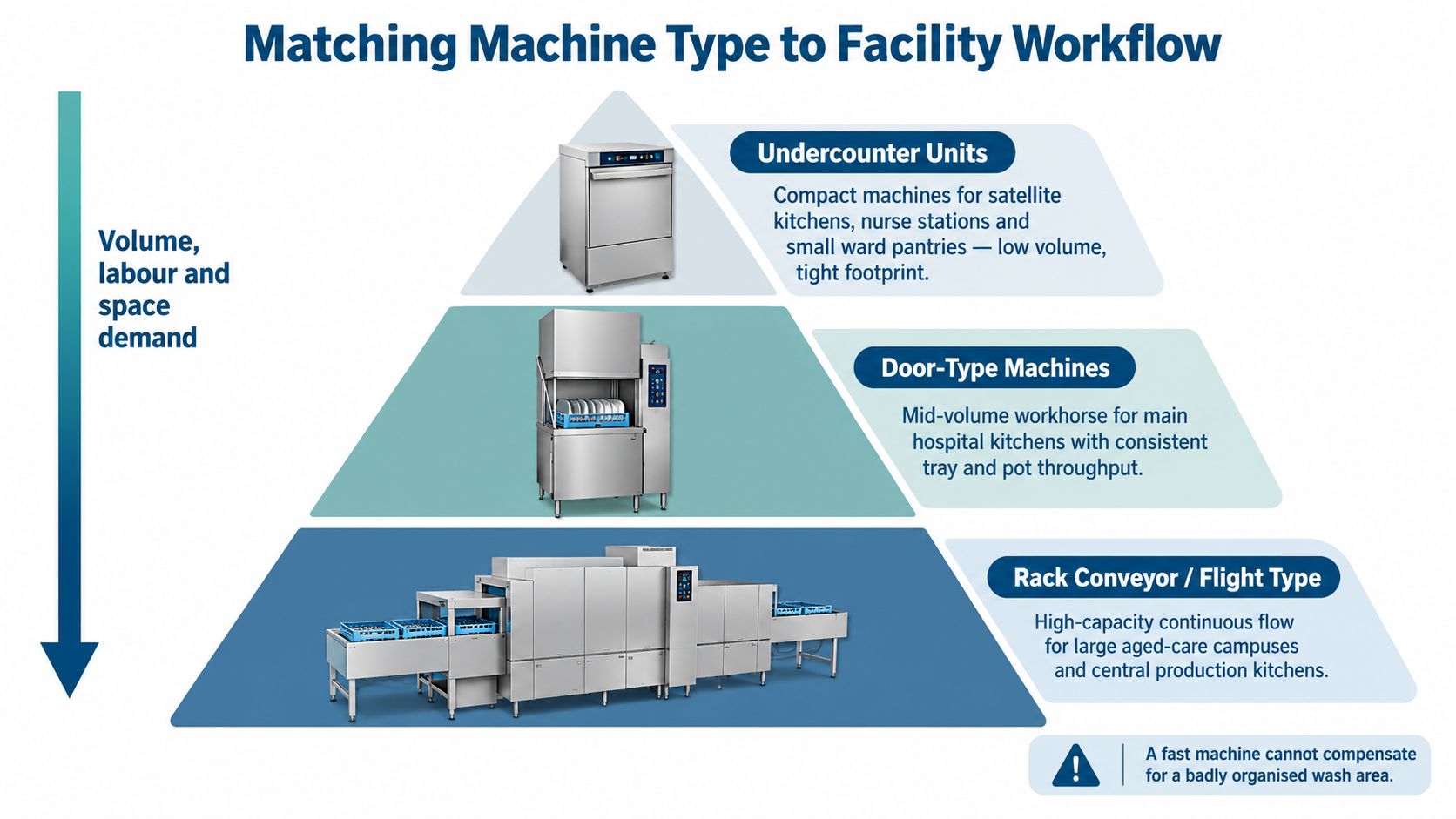
The right machine type follows the way the room operates. Start with the dirty return, not the brochure. If the pathway is awkward, even a capable dishwasher can become a daily frustration.
From satellite areas to central kitchens
Rhima's New Zealand materials show that its Twin Star disinfector cabinet-style dishwasher is suitable for healthcare facilities with up to 30 beds, and it is also positioned for small hospitals and clinics (Rhima fromagerie). That makes it the sort of unit a smaller care home or ward pantry might consider when the footprint is tight and the ware volume is modest.
At the other end of the scale, larger facilities usually need a door-type or pass-through machine, or eventually a conveyor or rack system, because the issue becomes rack movement and clearing speed rather than just one wash cycle. The machine has to match the room, the staffing pattern, and the clean-side layout.
A practical way to size the job
A simple selection logic looks like this:
- Peak dirty-item arrival. How many plates, cups, bowls, cutlery sets, trays, and utensils come back at once?
- Available wash window. How long do staff have before the next meal service starts?
- Racks required. How many racks must move through the machine in that window?
- Clean-item requirement. How many clean sets need to be ready before the next run?
- Machine type. Undercounter for small satellite areas, pass-through for steady main-kitchen flow, rack or conveyor systems for high-volume facilities.
That logic is more reliable than trying to buy the biggest machine available.
Why layout beats raw output
A fast dishwasher cannot compensate for a badly organised wash area. Dirty ware should travel in one direction, from return to scraping or sorting, then pre-rinse if needed, loading, washing, unloading, drying or inspection, and clean storage. In a pass-through setup, dirty and clean sides need to support that direction cleanly, or staff end up backtracking through the same space and slowing the whole room down.
If clean ware has to cross back through the dirty zone, the room design needs fixing before the purchase order is signed.
For operators comparing options, Simply Hospitality's commercial dishwasher guidance is a useful place to sanity-check the fit between throughput, footprint, and staffing reality.
Staff Usability and Daily Operational Realities
Healthcare kitchens often run across shifts, and the warewashing area gets used by different people with different habits. That's where usability becomes a serious purchasing factor. The most advanced machine can still be the wrong choice if staff find it fiddly, confusing, or difficult to clean.
What teams need to work smoothly
Simple controls matter because they reduce operator error during peak periods. Clear cycle status information helps staff know when a rack is ready to move, and ergonomic working height matters when trays and racks are being handled all day. Easy access to filters and cleaning points also makes daily maintenance more realistic for busy teams.
Aged-care and healthcare operators should be cautious about over-specifying features that sound impressive but add unnecessary steps. If the daily users need a laminated instruction sheet just to keep the machine running correctly, the process is too complicated.
Meal-tray systems add another layer. A tray return usually creates a concentrated workload, because one return can include crockery, cutlery, drinks ware, and other items all at once. The machine then has to sit inside a wider clearing system that includes waste removal, tray sorting, rack loading, and clean storage before the next meal service starts.
Why maintenance access matters
Cleaning access is not a minor detail. Staff won't strip a machine down every day if the filters are awkward, the panels are hard to reach, or the routine interrupts meal service. Over time, that creates a gap between how the machine is meant to run and how it really gets used.
Rhima's New Zealand materials describe equipment built for regulated, heavy-use settings and note specialised or custom-built washing equipment built to TGA, FDA, GMP, and TST standards. That compliance orientation is one reason the brand often comes up in procurement conversations where repeatability and controlled operation matter.
For smaller facilities, the takeaway is straightforward. A compact machine that is easy for multiple staff to operate well is often more practical than a larger unit with more capability than the room can support. Usability isn't a nice extra, it's part of long-term reliability.
Evaluating Total Cost of Ownership in Healthcare
Upfront price is only one piece of the decision, and in healthcare it can be the least useful piece if it crowds out everything else. Purchase, installation, water, energy, chemicals, labour, servicing, and downtime exposure all belong in the same conversation.
Capital pressure is part of the brief
The NZ Ministry of Health's aged-care review says building 10,000 additional beds would cost about $2.6 billion at roughly $260,000 per bed (NZ aged-care review). That figure is about beds, not dishwashers, but it shows the scale of capital pressure in the sector. Providers are buying equipment while working inside a tightly funded operating environment.
The same review also warns that aged-care demand could lift costs by almost 90% over 20 years (NZ aged-care review). That makes total ownership cost more important, not less.
Hygiene and cost sit together
Independent New Zealand design guidance says healthcare-associated infections are the most common complication affecting NZ patients, rising at about 7.7 infections per 100 patients in 2021 with an estimated annual cost of $226 million (infection prevention and control guidance). That figure doesn't turn a dishwasher into an infection-control guarantee, but it does explain why buyers focus on whole-system hygiene burdens rather than machine price alone.
The same guidance also notes that the NZ aged-care sector has faced significant additional infection-prevention costs from PPE, fit testing, isolation, and staffing disruption (infection prevention and control guidance). In practice, that means the warewasher has to be judged against labour pressure, compliance effort, and how much disruption the room can tolerate.
The buying mistake to avoid
A cheap machine that slows the room down, is awkward to clean, or creates avoidable rework can cost more over time than a better-suited unit. That doesn't mean every site should buy the biggest or most complex model. It means the purchase should be tied to the actual service pattern, room layout, and staff capability.
For a broader buying lens, Simply Hospitality's buying cheap vs buying once article is a useful reminder that the cheapest spec sheet rarely tells the full story.
Current Rhima Configurations for Care Facilities
The practical question is usually which Rhima configuration fits the room, the workflow, and the level of hygiene control the site needs. In aged care and healthcare, that choice affects staffing pressure, cleaning consistency, and how much disruption the kitchen can absorb.
Med Sparkle for hygiene-focused workloads
The Med Sparkle washer-disinfector suits sites where thermal-disinfection-style programming matters. Rhima presents it as suitable for aged-care facilities and hospitals, with a Hygiene Plus program, a final rinse at 87°C, and a cycle that continues for 10 minutes after the tank reaches 65°C.
That profile matters when the facility wants a more controlled process for reusable items and a clearer hygiene pathway for staff to follow. It is not the right fit for every dishroom. Some sites need faster turnover and tighter footprint use more than they need detailed thermal programme control.
Twin Star for smaller, lower-dependency settings
The Twin Star disinfector cabinet-style dishwasher is positioned for healthcare facilities with up to 30 beds, as well as small hospitals and clinics. That makes it a practical option for smaller aged-care homes, satellite prep areas, or clinic-style operations where space is tight and the load is more predictable.
The decision point is whether the return pattern, room layout, and staffing model suit the unit. A machine can be compact and still be a poor fit if the facility's dirty-to-clean flow is awkward.
Choosing between them
A compact machine often suits sites that need straightforward operation and limited footprint. A thermal-disinfection-oriented unit becomes more relevant when the workflow calls for a more explicit hygiene profile and the kitchen can support that process properly.
For operators comparing options, it also helps to review Rhima's practical notes on what hospitality operators should know about Rhima dishwashers alongside the facility's actual warewashing workload. For broader care-related operational planning, resources on managing incontinence with advice can be useful too, since linen, sanitation, and dishroom routines often overlap in the same timetable.
A Practical Selection Framework for Healthcare Operators
The best buying decisions start with the room, not the machine brochure.
- How many meals are served? Count the service pattern, not just the bed count.
- What items return after each meal? Include trays, cups, bowls, cutlery, GN pans, and prep items.
- How concentrated is the return period? Breakfast, lunch, and dinner can be very different.
- How many racks must be processed during that window? Size for the peak, not the average.
- What hygiene processes does the facility require? Match the machine to the actual hygiene program.
- Is an undercounter, pass-through, or larger system appropriate? Let throughput and space decide.
- How will dirty and clean ware move through the room? Keep the workflow logical and one-way.
- What water, drainage, and electrical services are available? Check the services before you choose the model.
- How easy is the system for staff to operate and clean? Daily usability matters every shift.
- What happens if the machine is unavailable? Plan the contingency before service is at risk.
That checklist is useful for Rhima, but it's just as useful for any warewashing brand under consideration. The point is to buy for the actual facility, not the idealised one.
If you're planning a care-room upgrade or trying to work out whether a compact, pass-through, or hygiene-focused washer makes sense, Simply Hospitality can help with practical equipment selection and site-fit advice. Visit Simply Hospitality to discuss the right warewashing option for your aged-care or healthcare operation.