

Why Solis Continues to Innovate in Coffee and Food Preparation
A small New Zealand café can have two baristas working flat out, a queue at the door and breakfast tickets building beside every coffee order. In that setting, innovation isn't about adding technology for its own sake. It means making grinding, extraction, milk preparation, blending, portioning and cleaning more predictable, so staff can work with fewer interruptions and customers receive a consistent result.
That practical focus matters across the local hospitality sector. For the year ended March 2024, New Zealand hospitality sales reached NZ$15.7 billion, with restaurants and cafés contributing NZ$7.8 billion, while the wider industry employed approximately 145,000 people (Restaurant Association hospitality report). Operators are working in a large industry under real cost pressure, so equipment needs to justify its bench space, training time and maintenance requirements.
The Practical Case for Solis in a Busy Kiwi Kitchen
A breakfast service rarely fails because one appliance lacks a clever feature. It slows down when the grinder needs constant adjustment, the milk wand is awkward to clean, the blender occupies too much bench space or a new staff member can't understand the controls quickly.
Solis equipment is useful when it removes those friction points. A machine with adjustable grinding and dosing can give staff more control over the coffee process. A compact automatic espresso model can suit a motel breakfast room or workplace counter where space is limited. A blender or food-preparation appliance can make smoothies, sauces or purées without requiring a separate appliance for every small task.
The distinction between practical convenience and commercial capacity matters. Solis products sold into New Zealand can suit home users, offices, accommodation, staff kitchens and lower-demand hospitality applications, depending on the model and its intended duty. They shouldn't automatically be treated as replacements for a high-volume commercial espresso system or heavy-duty food processor.
Practical rule: The right Solis appliance is the one that removes a genuine workflow problem without creating a larger servicing, capacity or cleaning problem.
New Zealand operators also need to consider how service patterns are changing. In the second quarter of 2024, restaurants and cafés represented 49.0% of hospitality sales, while takeaway food services generated NZ$1.06 billion and catering generated NZ$312.9 million. Takeaway and catering sales grew year over year, even as total quarterly sales moved unevenly (Restaurant Association quarterly snapshot). That mix rewards equipment that can handle different batch sizes and service formats, but it doesn't mean every venue needs the largest available machine.
Solis innovation matters most when it helps a buyer choose a sensible level of control, capacity and simplicity. The brand's value isn't that one appliance suits every kitchen. It's that several everyday preparation problems are addressed in equipment that can be matched to lighter workloads and more compact operating environments.
The Solis Story From Swiss Origins to Today
Solis is a Swiss appliance brand with origins in Zurich and a history extending back to 1908, according to the brand material supplied for its product range. Its early identity developed around household appliances, and the business later expanded across coffee, kitchen preparation, beauty and air-conditioning categories.
That history gives buyers useful context, but it shouldn't be turned into a guarantee about every product. A Swiss brand isn't automatically the same as a product manufactured in Switzerland, and Swiss heritage alone doesn't confirm commercial-duty suitability. The relevant question is how Solis has applied its appliance experience to the product being considered.
The current range commonly encountered by New Zealand buyers spans several practical categories:
- Coffee preparation, including espresso machines, automatic espresso machines, grinders and related accessories.
- Food preparation, including blenders, hand blenders and food processors where those models are available through the local range.
- Kitchen appliances, such as kettles and vacuum-sealing equipment in broader Solis collections.
- Small-appliance functions, designed for home, workplace, accommodation and lighter preparation environments rather than automatically for continuous commercial production.
The brand's development is therefore less about a single breakthrough product and more about applying appliance design to recurring preparation tasks. Coffee users need control over grind, dose, temperature and milk. Kitchen users need manageable capacity, useful programmes, accessible cleaning and a footprint that fits the available bench.
Longevity matters because it shows that the brand has continued to develop across changing appliance categories. It isn't enough on its own to prove that a particular model is suitable for a café, hotel or institutional kitchen. That decision still depends on the product's specifications, warranty terms, workload and support pathway.
What Innovation Actually Means for Solis
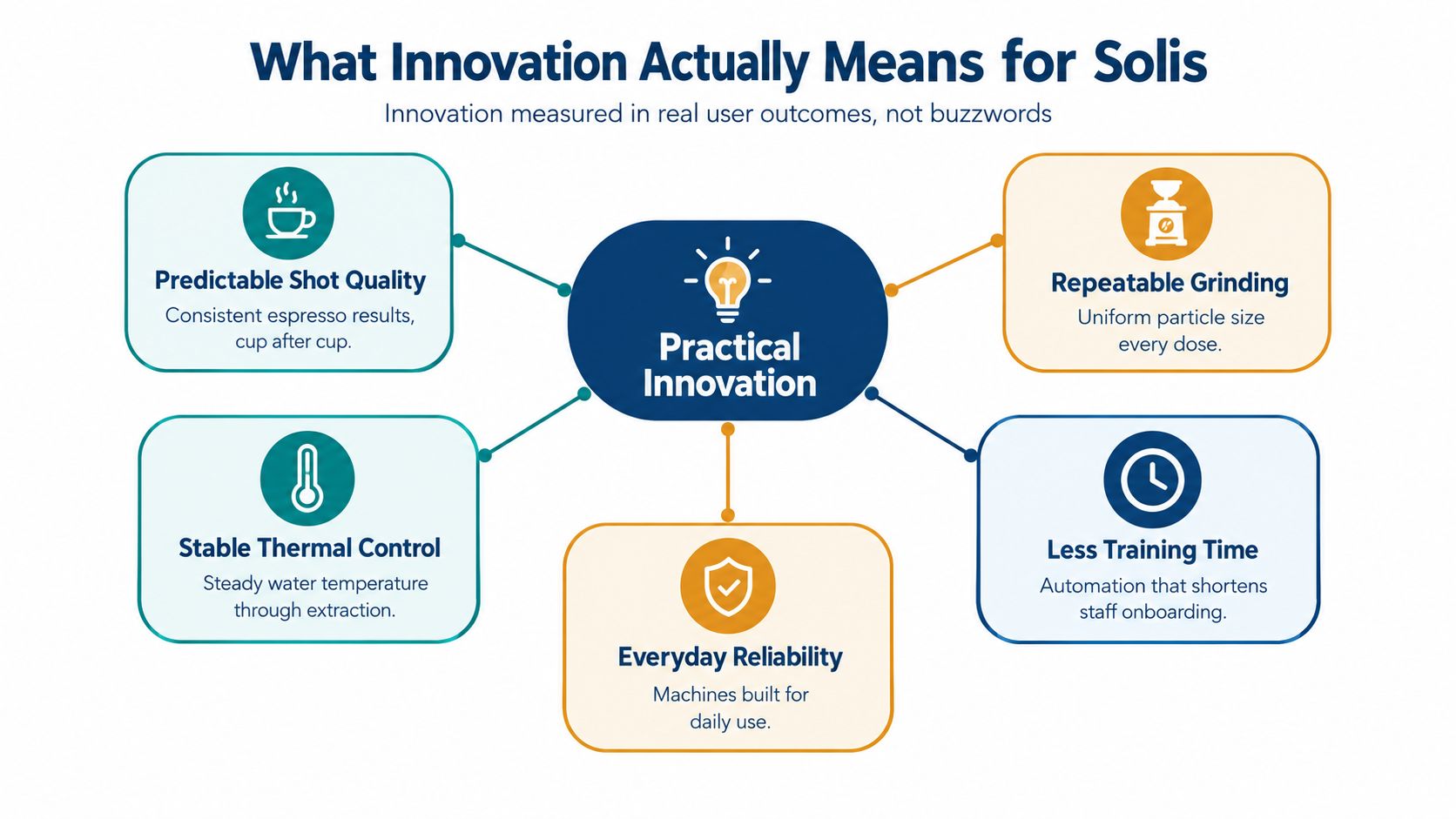
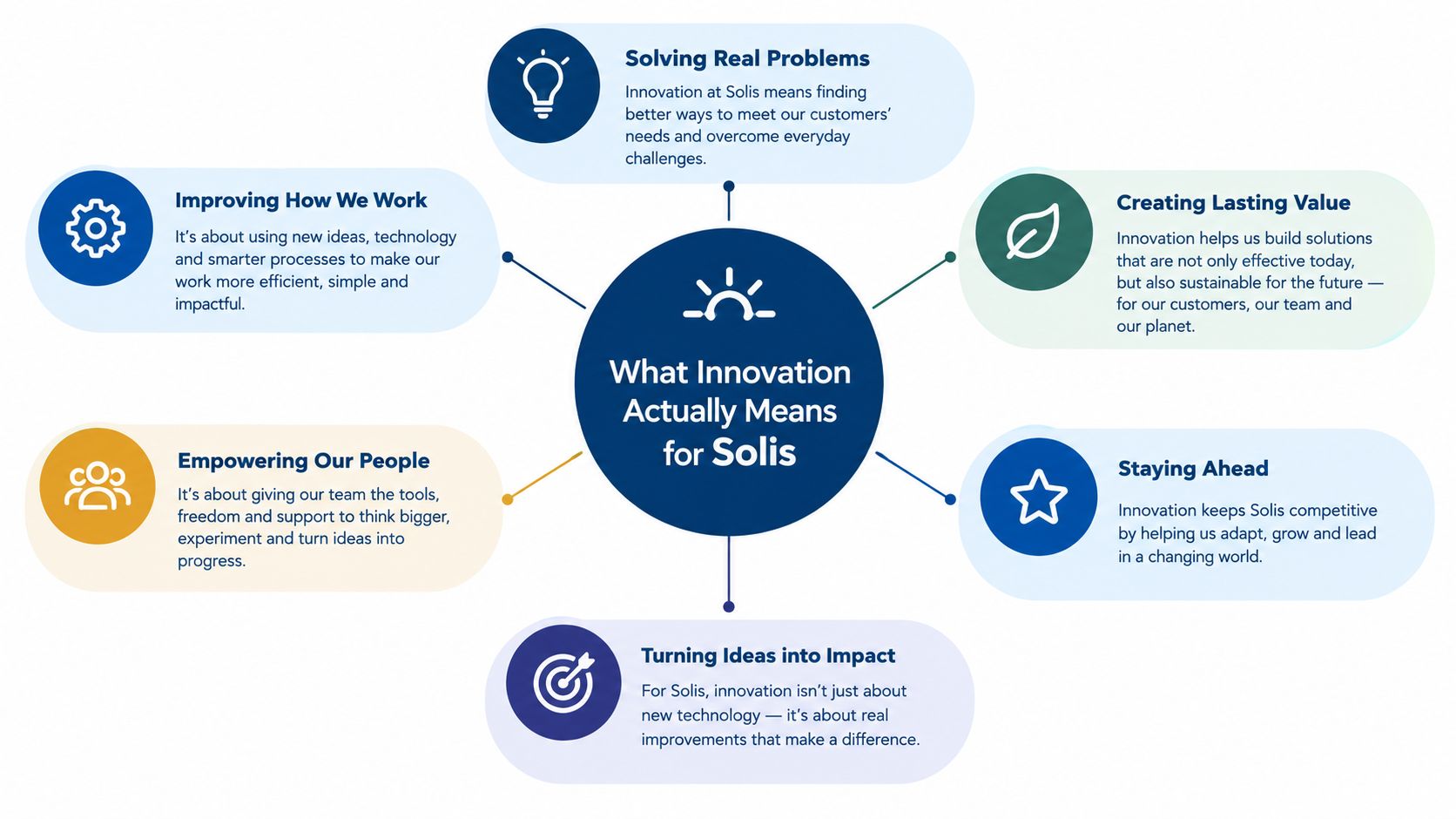
For Solis, innovation is most useful when an operator can feel the improvement during an ordinary preparation task. A control that helps staff repeat a dose, a temperature system that reduces fluctuation or a removable component that makes cleaning easier has more operational value than a feature that looks impressive but isn't used.
The strongest examples fall into six practical areas:
-
Control
Adjustable grind settings, dose timing and extraction controls let users respond to different beans and recipes rather than accepting one fixed result. -
Consistency
Repeatable settings can reduce variation between operators. They don't remove the need for training, but they can make the process easier to teach. -
Thermal management
The Grind & Infuse Perfetta uses an adaptive PID controller that monitors and stabilises water temperature. That gives the operator a clearer control point during espresso preparation. -
Compact design
A narrow machine can fit a workplace, accommodation counter or small service station, provided there is still adequate access for refilling, ventilation and cleaning. -
Multifunction preparation
A single appliance can be useful when the venue performs several related tasks. It isn't automatically better value if the extra functions are rarely used. -
Maintainability
Water filtration, descaling programmes, removable parts and accessible cleaning routines matter because a feature that staff avoid maintaining won't protect performance for long.
The New Zealand coffee environment makes these details relevant. A nationwide survey found that 70% of coffee-drinking New Zealanders who buy coffee away from home rank location and convenience as the most important purchase factor, while the flat white represented 31% of reported coffee orders (BP New Zealand coffee survey). Fast service and repeatable milk-based drinks therefore matter, but the machine still needs to match the venue's actual demand.
The same logic applies to food preparation. Waste research covering cafés and restaurants estimated approximately 24,375 tonnes of annual sector waste, with 61% classified as avoidable, and average venue waste of about 7.9 kg per day (WasteMINZ café and restaurant food-waste research). Equipment won't solve waste by itself, but accurate portions, repeatable batches and easier storage can support better control.
Inside the Solis Coffee Range Operators Should Know
Two models illustrate different approaches to coffee preparation. The Barista Perfetta Plus is a manual espresso machine with operational settings that support controlled preparation, while the Grind & Infuse Perfetta combines grinding and espresso functions in one unit.
The Grind & Infuse Perfetta uses a ZERO STATIC grinder with 25 grind settings and a micro-timer that doses coffee to one-tenth of a second, according to its product specification (Grind & Infuse Perfetta specifications). Those controls matter because grind size and dose affect how water moves through the coffee. The unit also uses soft pre-infusion and adaptive PID temperature control, while its pressure gauge indicates the brewing pressure. The stated target extraction range is 8 to 12 bar.
The removable 2.6-litre water tank includes a BRITA INTENZA filter. That doesn't remove the need to understand local water quality or follow the cleaning instructions, but it gives operators a defined part of the water-management routine.
The Barista Perfetta Plus has a different operational emphasis. It is specified to heat in about 40 seconds and produce the first cup within approximately one minute. Its standby function activates after 10 minutes, with an adjustable interval of 30 or 120 minutes, followed by automatic shutdown after 20 minutes in standby (Barista Perfetta Plus specifications). Those settings can suit intermittent service, although staff should check that standby behaviour doesn't interrupt a busy period.
| Feature | Barista Perfetta Plus | Grind & Infuse Perfetta |
|---|---|---|
| Preparation style | Manual espresso workflow | Integrated grinding and espresso workflow |
| Grinding | Requires a separate grinder | ZERO STATIC grinder with 25 settings |
| Dosing | Set through the chosen grinder and operator workflow | Micro-timer doses to one-tenth of a second |
| Temperature control | Product-specific operating controls | Adaptive PID temperature stabilisation |
| Extraction feedback | Operator manages the espresso process | Pressure gauge indicates brewing pressure |
| Water management | Follow the model's filtration and cleaning routine | 2.6-litre tank with BRITA INTENZA filter |
| Best fit | Users wanting separate grinder and machine control | Users wanting an integrated, compact coffee setup |
Milk preparation still depends heavily on technique. A steam wand can support textured milk, but staff need to purge, position the wand correctly and clean it immediately after use. Neither model should be presented as equivalent to a multi-group commercial machine for sustained café volume.
Operators comparing equipment can also use the commercial coffee machine guidance from Simply Hospitality alongside broader coffee education, such as this guide to coffee spots by Stay Norwich Apartments, which helps illustrate how different service environments shape the customer experience.
Why the Grinder and Machine Work as a System
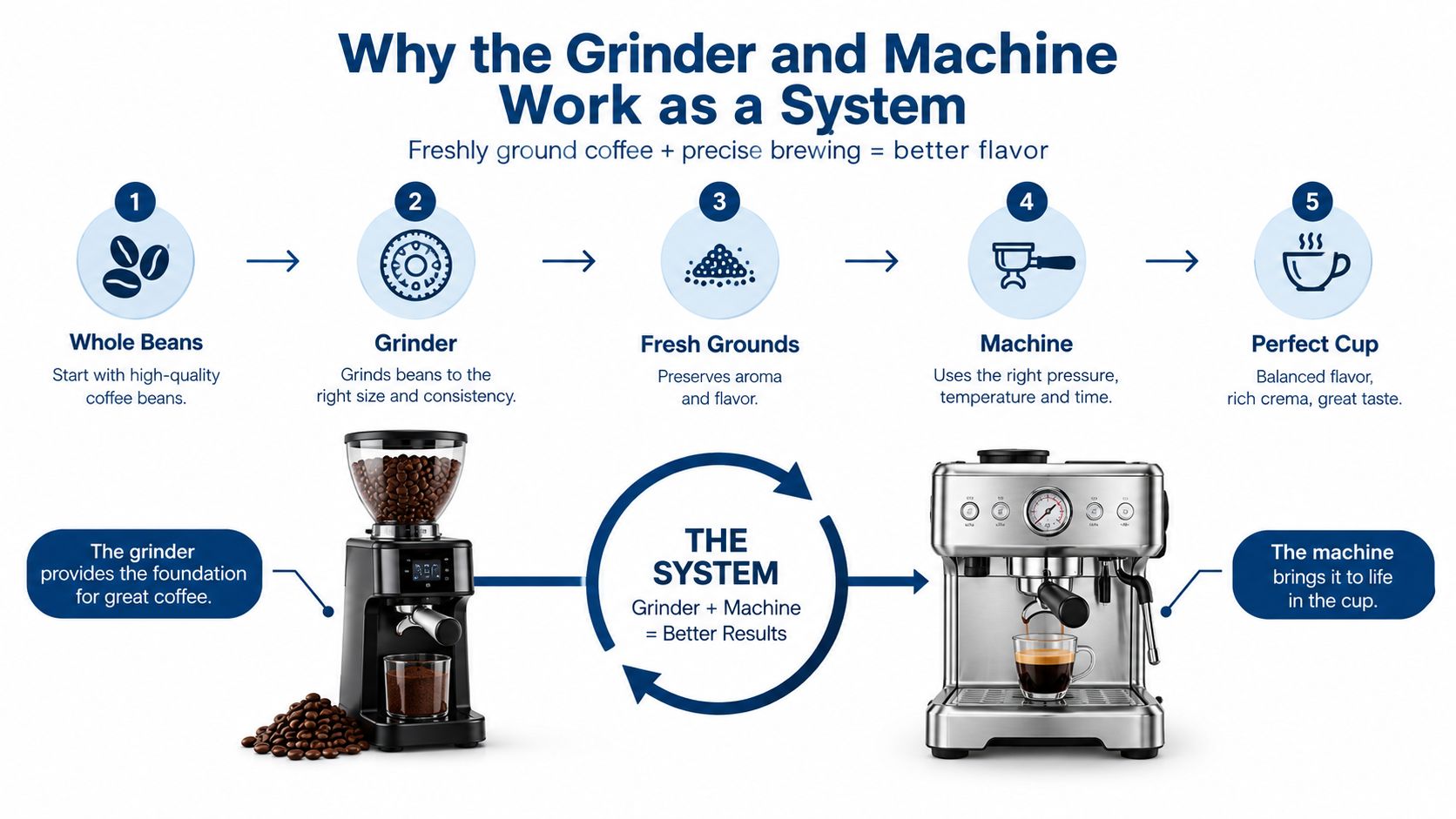
Coffee quality follows a chain:
Beans → grind → dose → extraction → milk preparation → cleaning
A capable espresso machine can't correct every weakness earlier in that chain. Stale beans, an unsuitable grind, inconsistent dosing or a poorly prepared portafilter can produce an uneven drink even when the machine's temperature and pressure controls are working correctly.
The Grind & Infuse Perfetta brings grinding and brewing together, which can simplify a smaller setup. Its adjustable grinder and micro-timer allow the operator to change the preparation as beans or recipes change. The benefit is reduced equipment separation, not a guarantee that every coffee will be correct without adjustment.
A Barista Perfetta Plus requires a separate grinder. That can be a strength when the operator wants to replace or adjust the grinder independently, but it adds another purchase, another cleaning routine and another piece of bench equipment. Buyers should assess both units as one workflow rather than choosing the espresso machine first and treating the grinder as an afterthought.
The daily controls that matter
- Beans: Choose beans suited to the intended drink profile and keep storage organised.
- Grind: Adjust the grinder when extraction changes. Finer and coarser settings alter flow, so staff need a consistent method rather than random changes.
- Dose: Use the machine's timing or the grinder's dosing method consistently.
- Extraction: Monitor the result, not just the display. Taste, flow and appearance still matter.
- Milk: Purge and wipe the wand after every use, then complete the deeper cleaning routine required by the model.
- Cleaning: Keep the portafilter, group area, drip tray, water tank and grinder free from residue.
The coffee machine and grinder buying guidance is useful for buyers deciding whether an integrated system or separate setup better matches the venue.
A machine is only as consistent as the routine around it. The grinder, water, accessories and cleaning process deserve the same attention as the espresso boiler.
Solis Food Preparation Beyond Coffee
Food preparation equipment should be selected by task rather than by the length of its specification sheet. A blender may be appropriate for smoothies, dressings and sauces, while a hand blender can work directly in a pot or container. A food processor may suit chopping, mixing or slicing, but it can be unnecessary if the venue only blends occasional drinks.
Solis's broader appliance range includes food-preparation categories such as blenders, hand blenders and food processors where those products are available through the relevant New Zealand catalogue. The practical questions are straightforward:
- Can the vessel hold the normal batch without overfilling?
- Is the motor and blade system intended for the ingredients being processed?
- Are programmes useful for the actual menu?
- Can staff remove, wash and dry the working parts safely?
- Does the appliance fit the bench without obstructing other equipment?
| Category | Capacity | Motor / Power | Programmes | Footprint | Best For |
|---|---|---|---|---|---|
| Blender | Select for the normal drink or sauce batch | Match power and blade design to ingredients | Useful where repeatable cycles are needed | Needs clearance around the jug and controls | Smoothies, sauces, dressings and purées |
| Hand blender | Depends on the working container | Match the motor to the density and duration of use | Usually relies more on operator control | Compact storage and direct vessel use | Soups, sauces, small batches and finishing |
| Food processor | Select for bowl size and ingredient volume | Consider cutting, mixing and chopping demands | Programmes matter only if they support regular tasks | Requires workspace for the bowl and accessories | Chopping, slicing, mixing and prep batches |
| Multi-function appliance | Combined capacity may vary by attachment | One motor may support several functions | More programmes can increase flexibility | Fewer base units, more accessory storage | Venues performing several light-duty tasks |
Wattage alone doesn't determine blending performance. Blade geometry, vessel shape, speed control, ingredient volume and operator technique all affect the result. A unit that handles a soft smoothie mix may not be suitable for prolonged dense preparation, and a domestic or light-duty appliance may need rest periods that don't fit a busy production schedule.
Cleaning is equally important. Staff need access to the jug, blade area, seals and lid, and the venue needs a clear process for food-safe washing and drying. A complex appliance that stays dirty between tasks creates a hygiene risk and undermines the reason for buying it.
For demanding blending work, operators should compare the intended duty and service support against a dedicated commercial option. The Vitamix commercial range overview provides a useful comparison point without assuming that every kitchen needs that level of equipment.
Matching Solis Equipment to the Right Venue
The same appliance can be sensible in one venue and a poor purchase in another. A workplace pantry may need a compact coffee solution for intermittent use, while a café needs equipment that can withstand repeated preparation through service peaks.
The assessment should cover number of users, peak demand, consecutive use, required functionality and manufacturer-intended duty. Arbitrary user thresholds are less useful than observing when the appliance is used, how quickly orders arrive and whether staff can complete the cleaning routine between tasks.
| Venue Type | Recommended Solis Category | Throughput Note | When to Step Up |
|---|---|---|---|
| Home kitchen | Integrated espresso, grinder or blender | Suitable when preparation is spread through the day | Move up when repeated service becomes continuous |
| Office or staff kitchen | Compact automatic coffee appliance or blender | Intermittent demand usually favours simple operation | Consider a more robust system when queues form or use becomes sustained |
| Motel or B&B | Coffee machine, drip appliance or hand blender | Breakfast use may be concentrated into a short service window | Step up when multiple guests require simultaneous drinks |
| Lower-demand café | Manual espresso machine with a suitable grinder | Works only with disciplined dosing, cleaning and realistic volume | Choose fully commercial equipment when the machine becomes the service bottleneck |
| Catering setup | Portable or compact preparation equipment | Batch size and transport affect the decision | Use dedicated commercial equipment for repeated event production |
| Institutional kitchen | Food-preparation appliance matched to the recipe | Operator skill and sanitation procedures are central | Step up when duty cycle, batch size or compliance requirements exceed the appliance |
An automatic Solis espresso model described for compact installation is 18 centimetres wide, with a 19-bar pump, five grinder settings, a 1.2-litre water reservoir and a 150-gram bean container (Solis automatic espresso specifications). That width can be valuable on a small counter, but buyers still need to check ventilation, refill access and space around the machine.
A lower-demand café may find a Barista Perfetta Plus appropriate if staff understand grinding, dosing, tamping, steaming and cleaning. If the venue needs sustained output, rapid recovery and several drinks being prepared simultaneously, a fully commercial group-head system is more honest procurement.
The equipment also sits within a wider operating system. A venue that wants to optimise its restaurant Google profile may attract more local discovery, but that attention only helps if the team can deliver the advertised service consistently. The café kitchen equipment planning guidance can help buyers consider coffee, food preparation, refrigeration and workflow together.
The sensible upgrade point is reached when demand exceeds the appliance's intended duty, not when a neighbouring venue buys a larger machine.
Buying, Owning and Getting the Best From Solis
Purchase price is only one part of ownership. Labour pressure, food waste and service interruptions can make a simple, well-matched appliance more practical than a complex model that staff struggle to maintain.
Hospitality wage costs reached approximately 40% of hospitality revenue in 2025, while food costs commonly added 28 to 35%, leaving operators with as much as 75% of revenue committed before rent, utilities and other overheads (Restaurant Association wage-cost analysis). Those figures don't prove a particular Solis machine will generate a specific return. They do explain why buyers should examine training time, cleaning effort, throughput and waste control alongside the purchase price.
Food waste also deserves a measured approach. A national assessment estimated approximately 1 million tonnes of food loss and waste across New Zealand, equivalent to about 237 kg per person annually (Aotearoa New Zealand food-loss baseline). Equipment may help with portioning, batch consistency or storage, but operators need their own baseline if they want to verify any improvement.
Questions to answer before ordering
- Workload: How many drinks, batches or preparation cycles will the appliance handle during the busiest period?
- Duty: Is the model intended for home, workplace, accommodation, light hospitality or continuous commercial use?
- Water: Does the venue need filtration, and can staff follow the required cleaning and descaling routine?
- Service: What warranty applies, who handles repairs and are replacement components available?
- Workflow: Does the grinder match the espresso machine, and can staff reach every component needed for cleaning?
- Space: Are there enough clearances for ventilation, refilling, jug handling and safe storage?
- Waste: Which ingredients, failed batches, milk portions or packaging elements will the equipment help the venue monitor?
Solis's New Zealand support information identifies an in-house service team for warranty, repairs and customer issues. Its returns policy states that damaged merchandise or goods supplied because of a picking error can be replaced when requested, but that shouldn't be read as a blanket guarantee covering every fault or change-of-mind return.
Ownership routines still determine results. Espresso equipment needs regular backflushing and descaling according to the manufacturer's instructions. Grinders need residue management and inspection of their working parts. Blender vessels, seals and blade areas need prompt cleaning, while staff should replace worn components according to the relevant product guidance rather than waiting for a failure.
For buyers weighing capital purchase against other options, the lease versus buy equipment discussion can help frame the decision around cash flow and operational suitability. The central test remains simple: the appliance must perform the required work, within its intended duty, with a maintenance routine the team will actually follow.
Simply Hospitality can help New Zealand cafés, accommodation providers, workplaces and institutional kitchens compare Solis coffee and food-preparation equipment against the required workload, bench space and cleaning routine. Visit Simply Hospitality to discuss the right combination of machine, grinder or preparation appliance before committing to a purchase.