

Why Yaxell Knives Have Become a Premium Choice for Serious Chefs
The popular advice is to buy the sharpest knife a kitchen can afford. That's incomplete. Why Yaxell knives have become a premium choice for serious chefs comes down to what sits behind the sharpness, including Japanese manufacture, carefully selected core steels, layered construction, heat treatment, balance and the discipline required to keep a fine edge working. The right Yaxell isn't a universal upgrade for every station. It's a precision tool for cooks whose technique, workload and maintenance standards justify it.
In a New Zealand commercial kitchen, that distinction matters. Yaxell is already available through specialist hospitality and kitchenware channels, and local listings show models with 69-layer Damascus and VG10 cores, alongside 193-layer Super Gou Ypsilon construction and a Ran PLUS Santoku listed at in New Zealand. That puts the brand firmly above basic commercial cutlery, but price alone doesn't make a knife operationally sensible.
What Premium Actually Means at the Top of the Knife Market
At the premium end, a chef isn't buying sharpness alone. A sharp edge can be produced on many knives. The premium proposition is the combination of steel quality, blade construction, heat treatment, geometry and handling, which determines how precisely that edge behaves during repetitive preparation.
Four factors deserve attention:
- Core steel: The hardened centre carries the working edge. VG10 and SG2 offer different balances of hardness, wear resistance, corrosion resistance and sharpening response.
- Layer architecture: Damascus cladding can protect and support a harder core while creating the distinctive surface pattern associated with Japanese cutlery.
- Heat treatment: The maker's treatment determines whether the chosen steel behaves as intended. A steel name on its own doesn't guarantee a reliable blade.
- Balance and ergonomics: A handle, spine, choil and blade profile must suit the person using the knife. A technically impressive blade that causes discomfort is a poor commercial purchase.
Hardness affects edge stability. A harder blade can support a thinner, more acute edge that cuts cleanly through vegetables, fish and proteins, but it also demands better technique. Independent knife-steel guidance places 58 to 61 HRC in a broadly useful all-round range and notes that blades at 62 HRC and above can retain a crisp edge for longer while becoming more sensitive to lateral force and poor technique (knife steel guidance from MesserWisser).
That's why premium shouldn't mean “buy the most expensive line for everyone”. A thin, hard knife isn't the correct tool for bones, frozen products or aggressive twisting through dense food. It belongs at stations where controlled slicing and accurate preparation matter.
Practical rule: Match the knife to the station before matching it to the budget.
A head chef weighing purchase cost against service life can also use the broader principle in buying once versus buying cheaply. A premium knife earns its place only when staff use it properly, sharpen it correctly and store it safely.
Yaxell's Japanese Blade-Making Heritage and Seki City Roots
Yaxell's Japanese identity matters only when it translates into reliable work at the bench. The brand is associated with Seki, Japan, a city known for Japanese blade-making, while a New Zealand retailer describes Yaxell as established since 1932 and made in Seki. That provenance gives hospitality buyers useful context, but it is not a substitute for checking the knife's steel, geometry, maintenance requirements and intended station.
Seki's importance comes from its specialised knife-making ecosystem. Traditional skills, grinding expertise, suitable water sources and modern manufacturing have developed together. That combination helps explain the precise geometry and refined edge work associated with Japanese knives. It does not remove the need for consistent heat treatment, grinding and quality control.
Yaxell's layered construction follows that design approach. A harder central core forms the blade, while softer stainless layers support it. Depending on the range, the outer layers can contribute corrosion resistance, structural support and the Damascus pattern. Layer count is therefore both a construction detail and a visual feature. It is not a simple quality ranking. More layers do not make a knife the right choice for every prep task, especially where heavy contact, twisting or rough handling is expected.
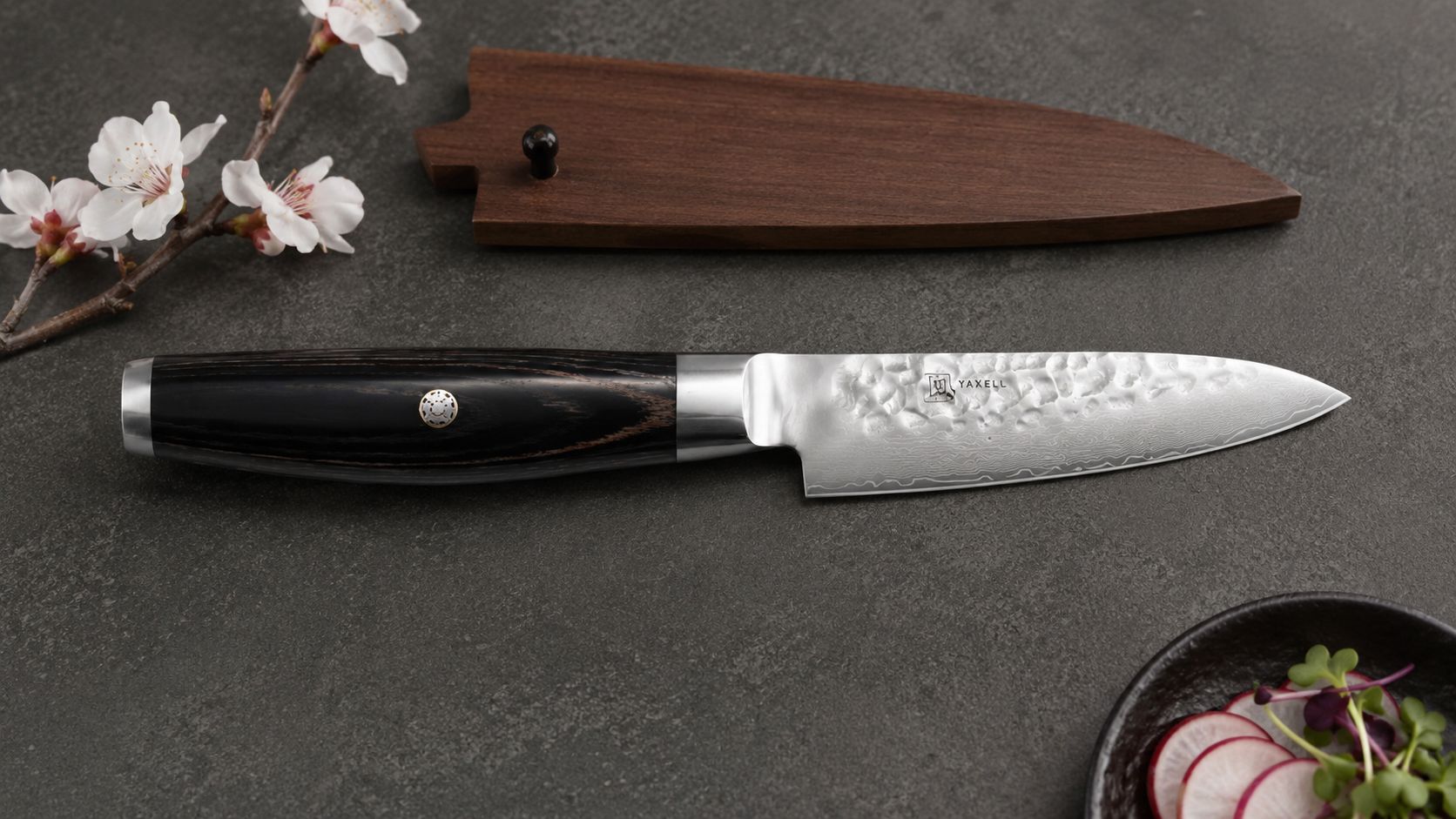
The Yaxell Ketu Japanese Damascus Utility Knife 100mm shows how those specifications affect station choice. It uses a 193-layer Damascus construction, an SG2 micro-carbide powdered-steel core hardened to 63 HRC, a black canvas Micarta handle and a wooden sheath. Its 100 mm straight edge sits between a paring knife and a chef's knife, making it suited to detailed produce, sandwiches, small proteins and bench-side work.
For a hospitality buyer, Japanese origin should be one part of the purchase assessment. Confirm that the construction suits the station, staff can maintain the edge, and supply and after-sales support are adequate. Craftsmanship matters, but it has to survive the demands of a working kitchen. Buy precision where it improves prep, and choose tougher tools for heavy-duty work.
VG10 and SG2 Steels, Layer Counts and Hardness Explained
Yaxell shouldn't be judged as one uniform product line. Its ranges use different steels and constructions, so the specification needs to be read model by model.
VG10 is the more broadly practical premium core. Yaxell states that its Ran series uses a VG10 stainless steel core hardened to HRC61, while its Tsuchimon series also uses a VG10 core at 61 Rockwell (Yaxell Ran specifications, Yaxell Tsuchimon specifications). That hardness sits toward the harder end of the kitchen-knife range and supports a refined edge for everyday chef's work, vegetable preparation, fish and controlled protein slicing.
Local descriptions also associate VG10 with alloying elements including cobalt, molybdenum, vanadium and carbon, alongside specialised heat treatment and, on some lines, ice-hardening. Those details help explain why VG10 is often chosen as a balance between edge stability, corrosion resistance and manageable sharpening.
SG2 moves further towards fine edge performance. Yaxell's Super Gou Ypsilon series uses an SG2 micro-carbide powder stainless steel core hardened to HRC63 and states that the blade contains 193 layers of stainless steel in total (Yaxell Super Gou Ypsilon specifications). Powder-steel construction and micro-carbide distribution support a hard, precise apex, but the edge is less forgiving when staff twist the knife, strike hard materials or use unsuitable boards.
| Range | Core Steel | Typical Hardness (HRC) | Damascus Layers | Best Suited To |
|---|---|---|---|---|
| Ran | VG10 | 61 | Layer count varies by model, including 69-layer local listings | General chef's work, vegetables, fish and controlled slicing |
| Tsuchimon | VG10 | 61 | Range construction varies | Everyday precision preparation |
| Super Gou Ypsilon | SG2 powder stainless | 63 | 193 | Fine slicing, detailed preparation and presentation-focused work |
Layer counts affect construction and appearance, but they don't replace proper evaluation of grind, edge geometry and heat treatment. A 69-layer VG10 model and a 193-layer SG2 model occupy different parts of the premium market because their cores and intended use differ.
A detailed chef knife buying guide for New Zealand kitchens should therefore be read alongside the individual product specification. The sensible choice is the knife that matches the station, not the one with the biggest number printed on the box.
How Hardness and Blade Geometry Affect Real Kitchen Work
Hardness becomes meaningful at the cutting board. A harder, thinner edge can enter food cleanly rather than forcing the blade through with excessive pressure. That's valuable for fine vegetable work, raw fish, garnish preparation, detailed slicing and accurate protein portioning.
The benefit is control, not guaranteed speed. A chef using a precise knife may achieve cleaner cuts through soft produce, reduce crushing during delicate preparation and work with more predictable blade feedback. The knife gives experienced hands a better instrument, but it doesn't replace a stable grip, correct cutting motion or sound prep technique.
Geometry matters just as much as the steel. A blade that is thin behind the edge creates less drag, while the spine and choil influence pinch-grip comfort. A slim profile can feel nimble during brunoise, herb work and fish preparation, but the same profile can be vulnerable when a user applies sideways force or tries to lever through dense ingredients.
Stations that reward precision
Yaxell is most defensible where cutting accuracy affects presentation or yield:
- Fish preparation: Controlled slicing benefits from a clean, stable edge and careful tip work.
- Garde manger: Fine vegetable cuts, garnish and composed presentation reward precision.
- Protein portioning: A refined blade can support consistent slicing when the operator uses the correct motion.
- Chef and sous chef stations: Experienced users are more likely to protect the edge and maintain the knife properly.
- Bench-side preparation: Smaller utility formats can offer better control when a full chef's knife is excessive.
Tasks that need a tougher tool
A premium Japanese chef's knife shouldn't be used on bones, frozen products or hard impacts. Twisting in dense squash, striking through joints or forcing the edge into a board can damage a hard blade, even when the steel and construction are excellent.
The same principle applies to sharpening. A proper sharpening stone gives the operator control over the edge, whereas rushed sharpening can remove material unevenly or create an inconsistent bevel.
A premium knife performs best when the kitchen treats it as a precision tool, not a substitute for every specialist blade.
Where Yaxell Sits Alongside Victorinox, Global and Wüsthof
Yaxell should not replace every knife in a professional kitchen. It earns its place at stations where controlled cutting, edge retention and presentation justify stricter handling. Victorinox, Global and Wüsthof address different working demands, so the right comparison is operational fit, not brand ranking.
Victorinox remains the practical professional workhorse. Its familiar commercial role suits high-turnover preparation, shared stations and kitchens where straightforward replacement matters. Global offers a lightweight Japanese design and smooth handling for cooks who prefer agile everyday work. Wüsthof combines German precision with traditional craftsmanship, with a substantial feel suited to cooks who favour a Western profile and rocking cuts. This comparison of Wüsthof's precision and craftsmanship helps clarify why its role differs from Yaxell's.
Yaxell is the specialised option among these reference points. Its harder Japanese cores and layered constructions suit chefs who prioritise controlled slicing, refined edge geometry and visible craftsmanship over impact tolerance. That advantage carries a cost in handling discipline and sharpening control.
| Brand / Range | Core Steel | Hardness (HRC) | Edge Profile | Best Fit |
|---|---|---|---|---|
| Yaxell Ran and related VG10 lines | VG10 stainless | 61 | Thin, precise Japanese profile | Precision chef's work, fish and vegetables |
| Yaxell Super Gou Ypsilon | SG2 powder stainless | 63 | Fine, hard-edged profile | Detailed slicing and presentation work |
| Victorinox Fibrox | Stainless workhorse steel | Not stated here | Practical commercial geometry | Shared, high-turnover preparation |
| Global | Stainless monosteel | Not stated here | Lightweight Japanese profile | Nimble everyday preparation |
| Wüsthof Classic | German stainless construction | Not stated here | Substantial Western profile | Traditional chef's work and rocking cuts |
Assign each knife by station. Use Victorinox for general preparation and shared work, Global for cooks who prefer a light Japanese feel, Wüsthof for heavier Western-style tasks, and Yaxell where edge control affects yield or presentation.
That setup also controls total ownership cost. A Yaxell may deliver better precision at the right station, but using it for heavy impacts creates avoidable repair or replacement costs. Premium cutlery pays when its strengths match the work and staff follow the required handling discipline.
Cutting Boards, Sharpening, Storage and Intended Use
A hard edge can't compensate for poor contact with the board. Hospitality businesses often find that careless storage and unsuitable surfaces shorten the useful life of premium knives faster than normal preparation does.
For board selection, operators should prioritise:
- End-grain timber: A forgiving surface can reduce harsh impact on the edge.
- High-density polyethylene: A practical commercial option when hygiene, cleaning and replacement are central concerns.
- Stable, non-slip construction: Movement encourages lateral pressure and unsafe cutting.
Glass and marble boards are poor choices for fine edges. Bamboo can also feel harsh because of its density and construction. The board should support the knife's geometry rather than punish it.
Sharpening needs control
A whetstone remains the most controlled option for maintaining a hard Japanese blade. A coarse stone can restore a damaged or badly worn edge, while finer stones refine the finish. The correct grit sequence depends on the condition of the blade and the operator's skill, so sharpening should be assigned to trained staff rather than treated as an informal shared task.
Pull-through electric sharpeners are a poor fit for layered premium knives. They can remove material aggressively, alter the intended geometry and leave an uneven edge. A professional sharpening service may be more sensible for venues without a trained in-house operator.
Storage deserves equal attention. A magnetic strip can keep blades separated and visible, an in-drawer insert can protect the edge from contact, and a saya or sheath can suit individual knives moved between stations. Knives shouldn't be dropped loosely into a drawer or left in a sink, where staff can damage the blade or create a safety hazard.
The butcher's block guidance for New Zealand kitchens is relevant because board material, hygiene and workflow all affect long-term knife care. The strongest operating rule is simple: assign each knife to its intended work, keep it dry, store it separately and sharpen it before the edge becomes difficult to recover.
Cost Justification and Total Cost of Ownership for Venues
Premium knives earn their place selectively. Issue a Yaxell to a fish, garnish, tasting-menu or senior chef station where precise cutting affects the result. Do not equip every prep bench with one and call that an upgrade. A precision blade is a poor substitute for a durable workhorse on a high-volume station.
Total ownership cost includes more than the invoice:
- Useful service life: A well-maintained blade can remain operational for a long period, provided staff use suitable technique and follow a sharpening and storage routine.
- Sharpening requirements: Harder steels require operators who understand whetstone work, or a reliable professional sharpening service.
- Downtime: A blunt or chipped edge slows preparation and makes accurate trimming harder.
- Replacement risk: Shared issue, dishwash recovery and unsuitable tasks increase the chance of chips, damage or loss.
- Station fit: A knife designed for controlled slicing adds little value to repetitive bulk chopping.
A harder edge can stay crisp through more controlled preparation, which may reduce sharpening frequency in the right station. Clean geometry can also disturb delicate products less during fine slicing and support consistent portioning. These are operational benefits, not guaranteed savings. Track actual sharpening, repairs, replacement and labour patterns before claiming a financial return.
Where the premium maths breaks down
The business case weakens quickly when sharpening discipline is poor or staff misuse the knife. A high-hardness SG2 blade is difficult to justify on shared prep involving hard root vegetables, frozen food, lateral force or unsuitable boards. Its layered construction and refined edge then increase the cost of a mistake rather than improving output.
Market conditions also support selective purchasing. Analysts reported a negative CAGR of -20.58% from 2020 to 2024 in the New Zealand kitchen knives market report. The same report recorded 5.08% growth from 2023 to 2024. Read separately, those figures describe a broader contraction followed by a recent rebound, not one uninterrupted growth trend. For an import-led category, procurement continuity and access to sharpening or service support matter alongside blade performance.
| Cost Factor | Yaxell SG2 Gyuto | Victorinox Fibrox 8" Chef's Knife |
|---|---|---|
| Upfront purchase | Premium purchase tier | More accessible workhorse tier |
| Edge maintenance | Requires disciplined sharpening and careful technique | Generally more forgiving in shared use |
| Station suitability | Precision-focused chef, fish or finishing station | High-turnover general preparation |
| Misuse tolerance | Lower when exposed to impact and lateral force | Better suited to broad commercial handling |
| Replacement planning | Protect through controlled issue and storage | Easier to standardise across larger teams |
| Ownership conclusion | Rational when precision and care are present | Rational when durability and simplicity dominate |
Set a clear allocation policy. Buy fewer premium knives, assign them to trained users, record their condition and keep practical workhorses on general prep. Yaxell earns its cost where precision, sharpening discipline and controlled handling are built into the station. Elsewhere, a simpler knife usually produces the better ownership result.
Matching the Right Yaxell Range to Your Kitchen Role
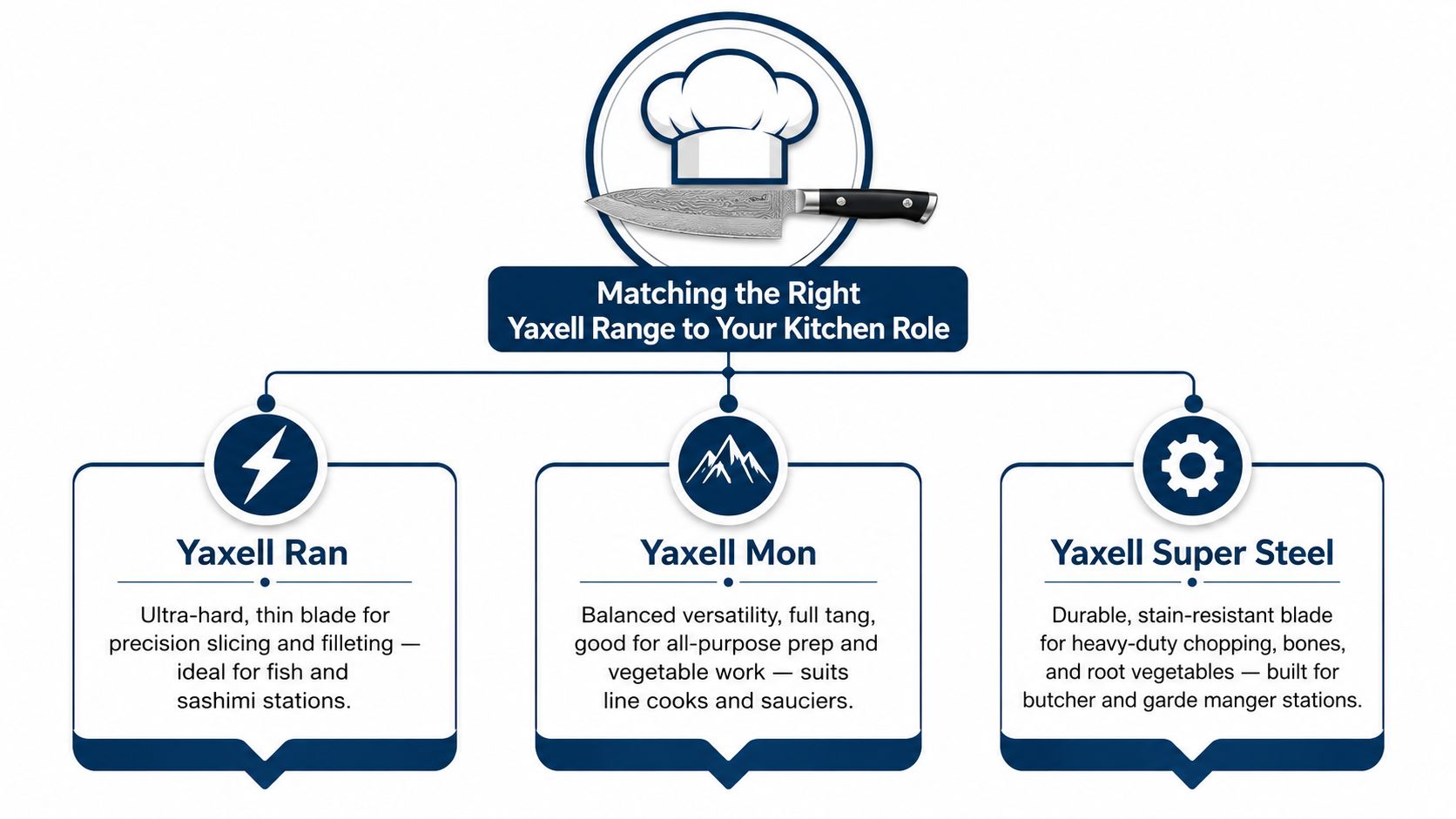
Yaxell is not a universal upgrade. Choose the range through a purchasing workflow that tests the knife against the station, the user and the maintenance plan. The Damascus pattern comes last.
Start with a short trial of the proposed model on its intended board and ingredients. Record cutting feel, edge stability, balance and user feedback during service. Ran's VG10 construction suits chef and sous chef stations that need controlled everyday precision. Mon's VG10 format is a practical option for varied preparation and line work. The harder SG2 and Super Gou Ypsilon models merit consideration only where operators can protect a fine edge and use it for accuracy rather than impact.
Use this buying checklist before placing an order:
- Workload: confirm that the knife will handle slicing, produce, fish or fine finishing, not bones, frozen products or heavy root vegetables.
- User: assign it to a chef who understands sharpening, storage and lateral-force limits.
- Maintenance: confirm the sharpening method, frequency and person responsible before purchase.
- Control: provide protected storage and prevent communal drawer use or dishwash recovery.
- Ownership: compare the purchase cost with expected service life, sharpening time and replacement risk.
The range should follow the venue's process. A premium edge pays for itself through controlled, accurate cutting only when the team protects it. For broader preparation, a simpler workhorse may deliver the better total cost of ownership. Materials, craftsmanship, balance and precision determine how sharpness is delivered, so evaluate those qualities at the station rather than selecting by appearance alone.
Operators can contact Simply Hospitality for practical product guidance, sharpening and storage advice, and hospitality supply support. Visit Simply Hospitality to discuss the fit between Yaxell options, staff capability and the venue's maintenance routine.