

Food Truck Kitchen Setup NZ: Planning Your Fit-Out
A food truck kitchen setup in NZ starts long before the first appliance is bolted in. The key job is to build a small, safe production system that can hold up when orders hit the window at once, while still meeting New Zealand food-business and trading requirements for a mobile operation under the Food Act 2014 and local council rules MPI guidance on mobile food businesses. If the menu, workflow, utilities, and compliance pieces don't fit together, the truck becomes cramped, slow, and expensive to fix.
Designing the Kitchen Around Peak Demand
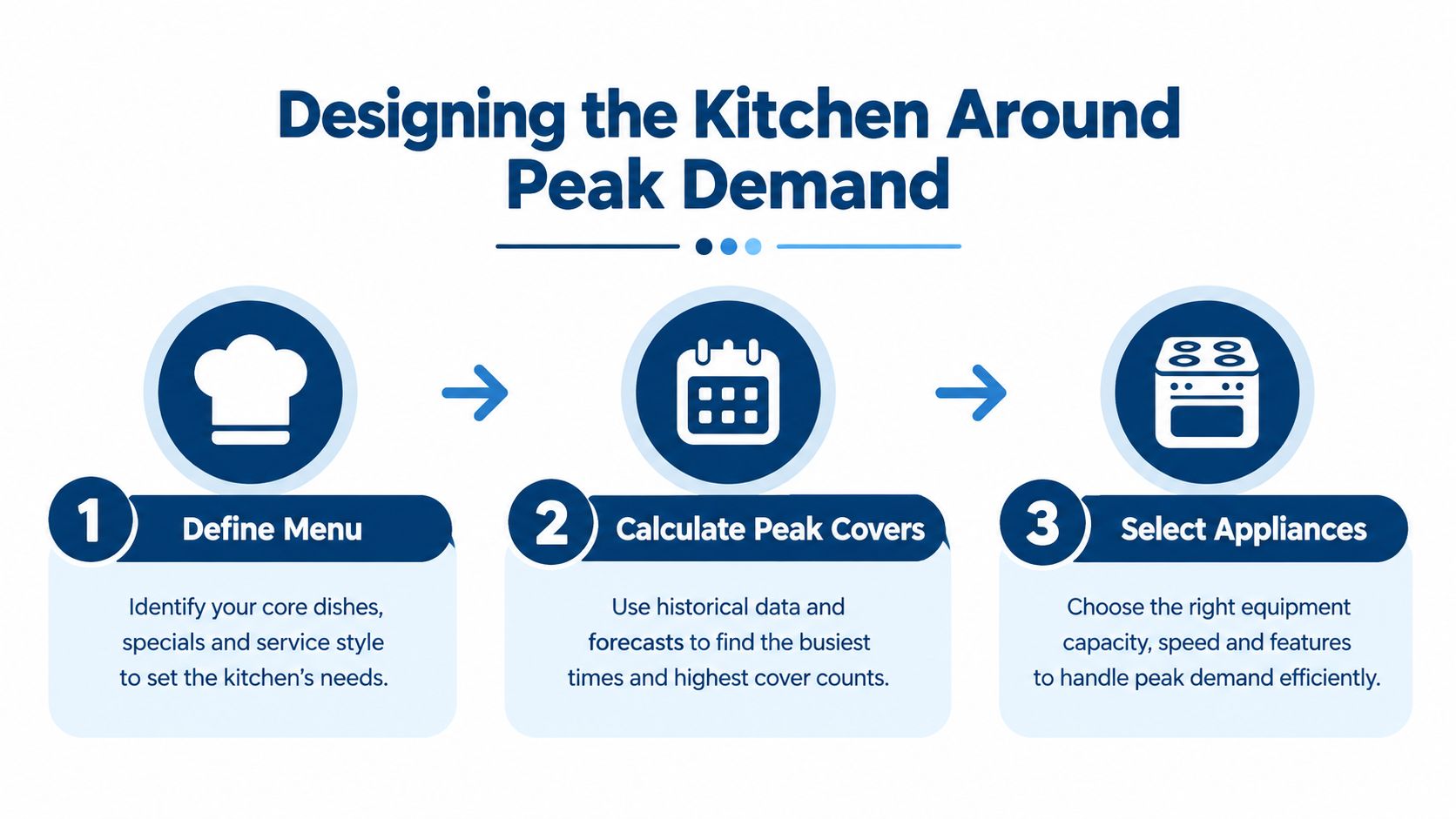
A food truck is a commercial kitchen compressed into a very small footprint, so the menu has to lead every equipment decision. A burger truck, coffee cart, pizza truck, and mobile catering setup all place different demands on cooking speed, bench space, refrigeration, and cleanup. The smartest first move is usually to simplify the menu until the production line is tight enough to survive peak service without constant cross-traffic.
Start with the menu, then work backwards
The clean sequence is menu → portions at peak → cooking processes → equipment → refrigeration → workflow → utilities. That order matters because every extra cooking step adds heat, handling, storage pressure, and cleaning load inside the truck. A menu that looks attractive on paper can become unworkable once the truck is full of equipment and two staff are trying to move at the same time.
Practical rule: design for the busiest 15 to 30 minutes, not for the average day.
Daily covers alone don't tell you where the bottleneck sits. The limiting factor might be fryer recovery, grill space, assembly space, pass space, or the single person who has to both plate and hand over orders. If you're mapping out a new launch, a broader planning resource like start a mobile food business can help frame the commercial steps around the build.
Simplify before you buy
Fewer cooking processes usually mean fewer appliances, less refrigeration, less dry storage, and less chance of staff blocking each other during service. That's why many operators choose a narrow menu with repeatable builds rather than a broad offer that needs extra prep items and more holding space. A compact menu also makes cleaning and shutdown easier, which matters when the truck has to be secured and moved often.
A useful internal reference for tightening service flow is kitchen efficiency during peak service. Keep that same discipline in the truck. If one station, one pan, or one landing area becomes the bottleneck, the rest of the setup won't save you.
Mapping Workflow in a Confined Space
Space that looks generous on a sketch disappears the moment refrigeration doors, sink clearance, and cooking gear are installed. The truck has to be mapped as a sequence of actions, not as a list of fittings. Cold and dry storage, prep, cooking, assembly, service, and clearing all need a logical path that keeps people from doubling back through each other.
Draw the movement, not just the furniture
The easiest way to test a layout is to trace the journey of one menu item from the fridge to the customer window. If the route crosses itself or forces a staff member to turn back repeatedly, the layout will feel clumsy in service. Hot and cold tasks should sit apart where possible, and frequently used ingredients need to live close to the point of use.
A good layout protects small pockets of landing space beside cooking equipment. Without those surfaces, pans get parked in unsafe spots, lids end up on clean prep areas, and staff start improvising with whatever is near by. That usually becomes a hygiene issue as well as a workflow issue.
Build in storage that survives transport
Trucks need secure homes for utensils, packaging, cleaning supplies, and waste bins while moving between sites. Loose items become a mess in transit and a hazard once the vehicle stops. Custom stainless fabrication is often worth discussing when standard bench modules waste odd dimensions or leave dead corners that can't be used properly.
Keep the line short, keep the tools close, and avoid any layout where one person has to pass through another person's task zone just to plate a meal.
For broader layout thinking, the internal article on restaurant kitchen layout ideas is useful because many of the same spatial principles still apply, only in a far tighter envelope. The difference is that a truck punishes bad layout much faster than a fixed kitchen does.
Selecting Mobile-Suitable Equipment
Compact equipment is not automatically suitable for a mobile commercial kitchen. The right choice depends on the menu, the duty cycle, the available power, and how much floor and bench area each unit consumes. In practice, the best mobile gear is the equipment that does its job without creating a second problem in heat, power demand, or cleaning.
Match the appliance to the menu
A grill-focused truck and a fryer-led truck need different line layouts, different extraction thinking, and different bench placement. Griddles, fryers, chargrills, cooktops, compact ovens, and panini or contact grills all solve different menu problems, but none of them should be chosen just because they look compact. If a product can't tolerate repeated peak use or fit the mobile installation properly, it's the wrong product for the truck.
Refrigeration deserves special attention because it carries both food-safety and workflow pressure. Underbench or preparation refrigeration often works well in food trucks because it combines chilled storage with usable bench space. That's a major advantage when every square centimetre has to do more than one job.
Think about how the fridge will be used
Door-opening frequency matters in a truck because ingredients are often accessed rapidly and repeatedly during service. Ambient conditions inside a hot working box also matter, because refrigeration has to cope with the heat load created by cooking equipment and people. Electrical demand matters too, especially if multiple compressors are running in a small system with limited capacity.
The internal guide on the portable induction cooktop is a good reminder that compact doesn't equal compromise-free. Portable gear can work well in some mobile setups, but only when it fits the actual service model and power arrangement. For a more integrated fit-out, food prep and cold storage from brands such as SKOPE, Atosa, Blue Seal, Cobra, Turbofan, Fimar, and Robot Coupe can be relevant depending on the menu and install, but each item still has to earn its place.
Consider equipment as a working system
A common mistake is buying individual appliances first and then trying to make the truck work around them. The better approach is to size the line around service flow, then confirm that the selected units fit the space, power, and ventilation reality. In other words, the truck should be designed around the production system, not just filled with standalone machines.
One extra resource that helps compare compact cooking choices in a mobile context is RV cooking recipes at Motor Sportsland. The cooking style is different, but the space discipline is familiar.
Managing Utilities and Compliance Requirements
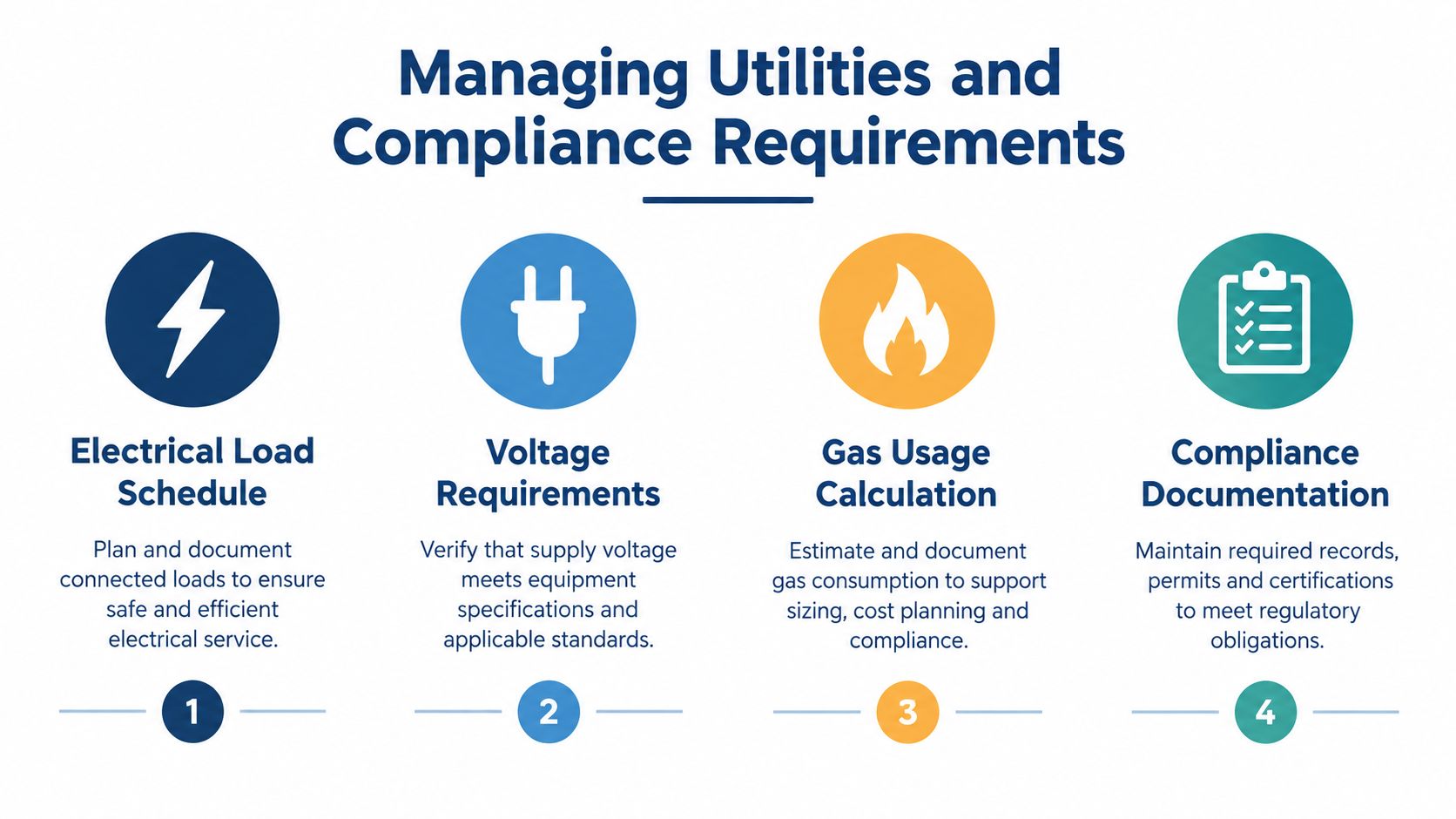
A food truck fit-out turns fragile fast when utilities are treated as an afterthought. The equipment schedule needs to show each appliance's electrical load, voltage or phase, gas use where relevant, water demand, drainage need, and ventilation requirement. Without that map, the truck can look complete and still fail once the actual service load is switched on.
Treat power, gas, and water as one planning job
Electrical work, LPG, water, wastewater, and extraction all influence where the appliances can go. For a closer look at extraction planning, see choosing a kitchen exhaust hood. The layout should be checked with vehicle, electrical, gas, and regulatory professionals before final sign-off, because equipment chosen in isolation can create problems with total load, airflow, or service access.
For LPG and ventilation controls, use qualified advice and current New Zealand requirements rather than guesses. WorkSafe New Zealand notes that LPG appliances consume substantial fresh air, cylinders need to be upright and protected, and cylinders larger than 2.25 kg must be in a compliant LPG locker or enclosure WorkSafe food trucks guidance. The same WorkSafe guidance also sets signage thresholds above 50 kg indoors or 250 kg outdoors, and requires a 2 kg dry-chemical extinguisher where more than 50 kg of LPG is present.
Build the fit-out to council and food-safety rules
New Zealand council guidance says food-truck food-contact areas should be smooth, waterproof, and easy to clean, with ventilation, hand-washing facilities, enough hot water, and a wastewater holding system sized to the operation South Waikato District Council guidance. MPI guidance also notes that registered food businesses are commonly verified every 3 to 18 months, depending on the operation and compliance history MPI food-premises guidance. The truck is a compliance system as much as a kitchen.
Practical rule: if a proposed appliance creates a power, water, or extraction problem on paper, it will be harder in a real truck than it looks in a drawing.
Local trading permissions sit on top of that. Invercargill City Council states that public-place trading requires a Mobile Trading Licence, private land must comply with District Plan rules, and road trading needs council roading approval as well as landowner permission where relevant Invercargill City Council mobile traders. Site rules and lead times vary, so the route and trading locations need to be settled early, not left until the truck is finished.
Budgeting for the Complete Integrated System
A food truck fit-out gets expensive in the places that are easiest to ignore at the start. The appliances are only one part of the build. Fabrication, refrigeration, extraction, electrical and gas fitting, plumbing, installation, and compliance sign-off all have to be budgeted together if the truck is going to trade properly.
Budget the whole production system
Buying a cheap unit that can't handle peak service often creates a second round of spending later. The same is true for equipment that technically fits the footprint but overloads the ventilation, drains the power system, or creates awkward cleaning gaps. Correcting those mistakes after the vehicle has been built usually means downtime, extra trades, and more disruption than the original saving was worth.
The stronger approach is to budget for the full integrated system from the start:
- Cooking equipment: selected for the actual menu and peak load.
- Refrigeration: sized for service flow, not just storage.
- Fabrication: benches, supports, splashbacks, and secure mounting.
- Extraction and ventilation: matched to the cooking line.
- Electrical and gas fitting: checked against the full appliance schedule.
- Plumbing and wastewater: planned to suit the truck's layout.
- Compliance and sign-off: built into the project from day one.
Use the layout to protect long-term costs
A properly integrated system usually costs less to live with than a truck assembled from standalone parts after the fact. That's because each part supports the next one, so cleaning, access, and shutdown are easier. It also reduces the chance that a well-made appliance is later replaced only because it was put in the wrong place.
Hospitality also supplies stainless benches, commercial cooking equipment, underbench refrigeration, and smallwares, which is useful when a fit-out needs compatible pieces rather than isolated purchases. In a truck, compatibility matters more than showroom appeal.
For more complex projects, professional kitchen planning through SACH can be relevant where the menu, service method, and compliance layers need to be mapped before fabrication starts. That kind of planning is often what stops a mobile kitchen from becoming a patchwork of fixes.
Commissioning and Testing Before Launch
A food truck is not ready when the last panel goes in. It is ready when the full system works under load, with the cooking line, ventilation, power, refrigeration, water, and shutdown steps all behaving as planned. That testing needs to happen before the first paying customer arrives.
Test the truck as a live system
Start with the basics. Check that every appliance has the right certification, that gas-line routing and connections are correct, and that each unit sits where it can be used and cleaned without awkward reaches. Then leak-test every gas connection, confirm the cylinders are secured against movement, and verify ventilation and exhaust performance with the full cooking load running. The truck should be tested the way it will trade, not in a quiet half-loaded condition.
A practical launch test is a full simulated rush. Run a 20-order service with the extractor, fryers, refrigeration, pass space, and gas shutdown procedures all live before day one. That kind of rehearsal shows where heat builds up, where staff bottlenecks form, and whether the power draw holds when the truck is under real pressure.
Fire equipment has to sit where staff can reach it quickly, and every operator needs to know how to isolate the gas and make the system safe in an emergency. The same applies to handover procedures at the end of service, because the truck has to be made safe before it moves. The commissioning approach used in commercial kitchen installation is still relevant here, even if the footprint is smaller.
Keep the compliance file current
Verification is not a one-off milestone. MPI food-premises guidance sets out that checks under a template Food Control Plan commonly happen every 3 to 18 months, depending on the business and its risk profile MPI food-premises guidance. That is why the operating file should record gas checks, pre-start inspections, cylinder condition, ventilation checks, and staff training so the truck stays auditable between sites.
A mobile operation also has to account for trading locations, not just the kitchen itself. A fit-out that passes in one place may still need different local permission elsewhere, especially if the truck moves across territorial-authority districts. Commissioning should cover the machinery, the paperwork, the site permissions, and the shutdown process that keeps the operation orderly on the road.