

What Thousands of Product Enquiries Have Taught Us
Most equipment buying advice starts with the product. After thousands of product enquiries, the more useful starting point has proved to be the problem behind the request. A model number, brand preference, price or capacity figure can all be relevant, but none of them explains whether a machine will cope with a café's busiest service, a school staffroom's short breaks, a youth camp's concentrated meal preparation or a hotel's changing workflow.
That distinction matters across New Zealand hospitality. The sector generated $15.7 billion in annual sales in the year ended March 2024, with restaurants and cafés contributing $7.8 billion, according to Restaurant Association industry reporting. Equipment decisions therefore cover far more than isolated appliance purchases. They affect food safety, staffing, service speed, energy use, cleaning, fit-out planning and the reliability of everyday operations.
Customers Often Ask for a Product Before Explaining the Problem
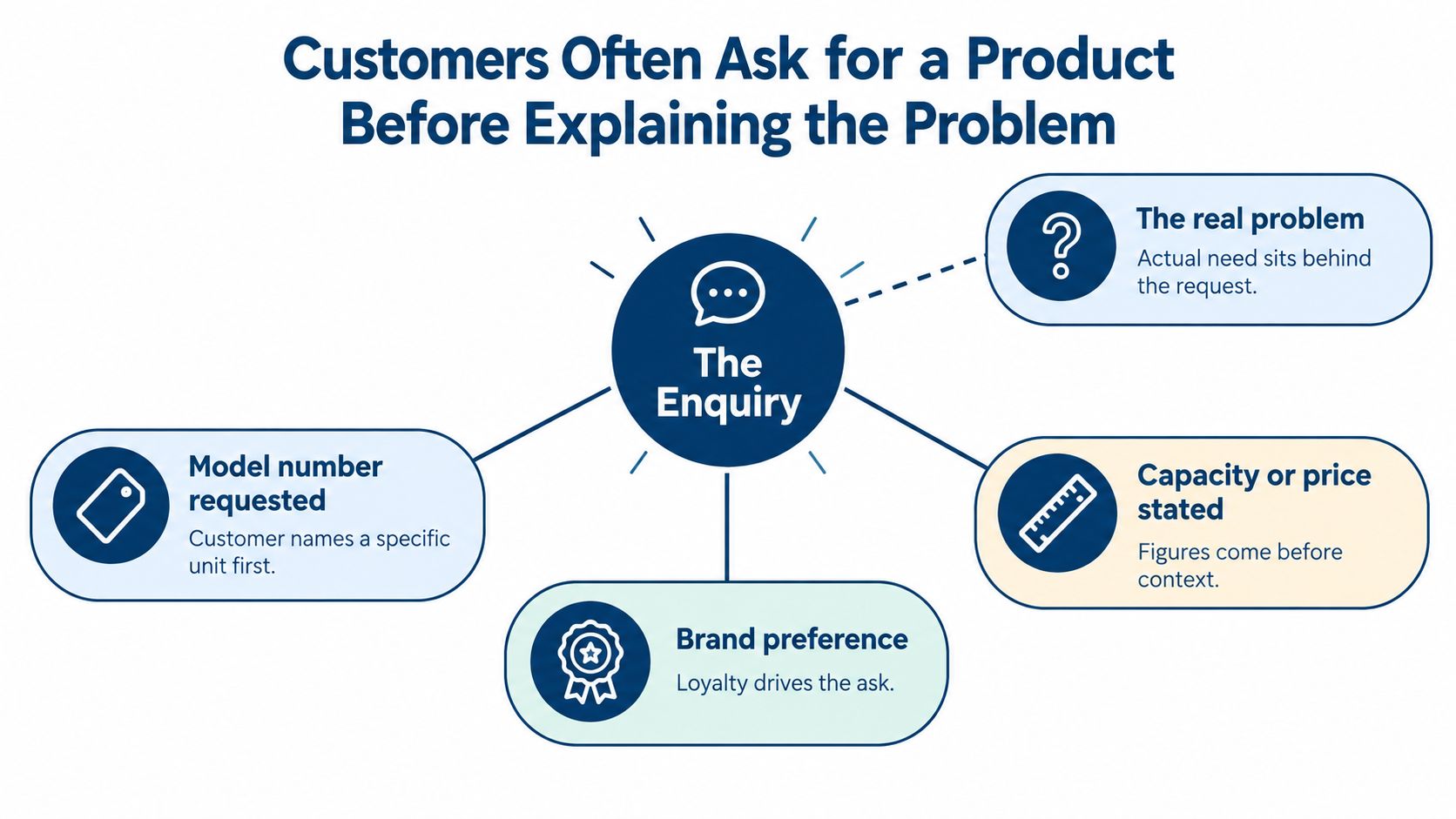
A café owner may begin with a request for a particular underbench dishwasher. A school may ask for a domestic microwave. A bar manager may provide a preferred brand and a maximum width before explaining what the unit needs to handle. The request sounds specific, but the operational brief is still missing.
That's where a useful enquiry starts to change direction. The important questions concern what the equipment must accomplish, how frequently it will run, what happens during the busiest period, what's already installed and what isn't working with the current setup.
Context changes the recommendation
The same product category can mean very different things in different venues. A marae may need durable equipment for intermittent, high-volume community events. An accommodation provider may prioritise quiet operation, storage and housekeeping workflow. A café may need fast recovery between services, while a school kitchen may need straightforward controls that different staff can use confidently.
The product requested at the start may not be the solution once those details are clear. A larger unit could be unnecessary if the core problem is poor layout. A higher-capacity machine may still fail if the available power or drainage can't support it. A preferred brand may offer a suitable option, but the specific model still needs to match the workload.
Practical rule: Ask what the equipment needs to do before deciding what the equipment should be.
This approach also applies beyond kitchen equipment. Businesses choosing branded merchandise often benefit from defining the purpose, audience and practical use before selecting an item, which is the thinking behind this resource on choosing the right promotional products. The principle is similar. A specification becomes useful only after the intended outcome is clear.
The Cheapest Option Isn't Always the Least Expensive
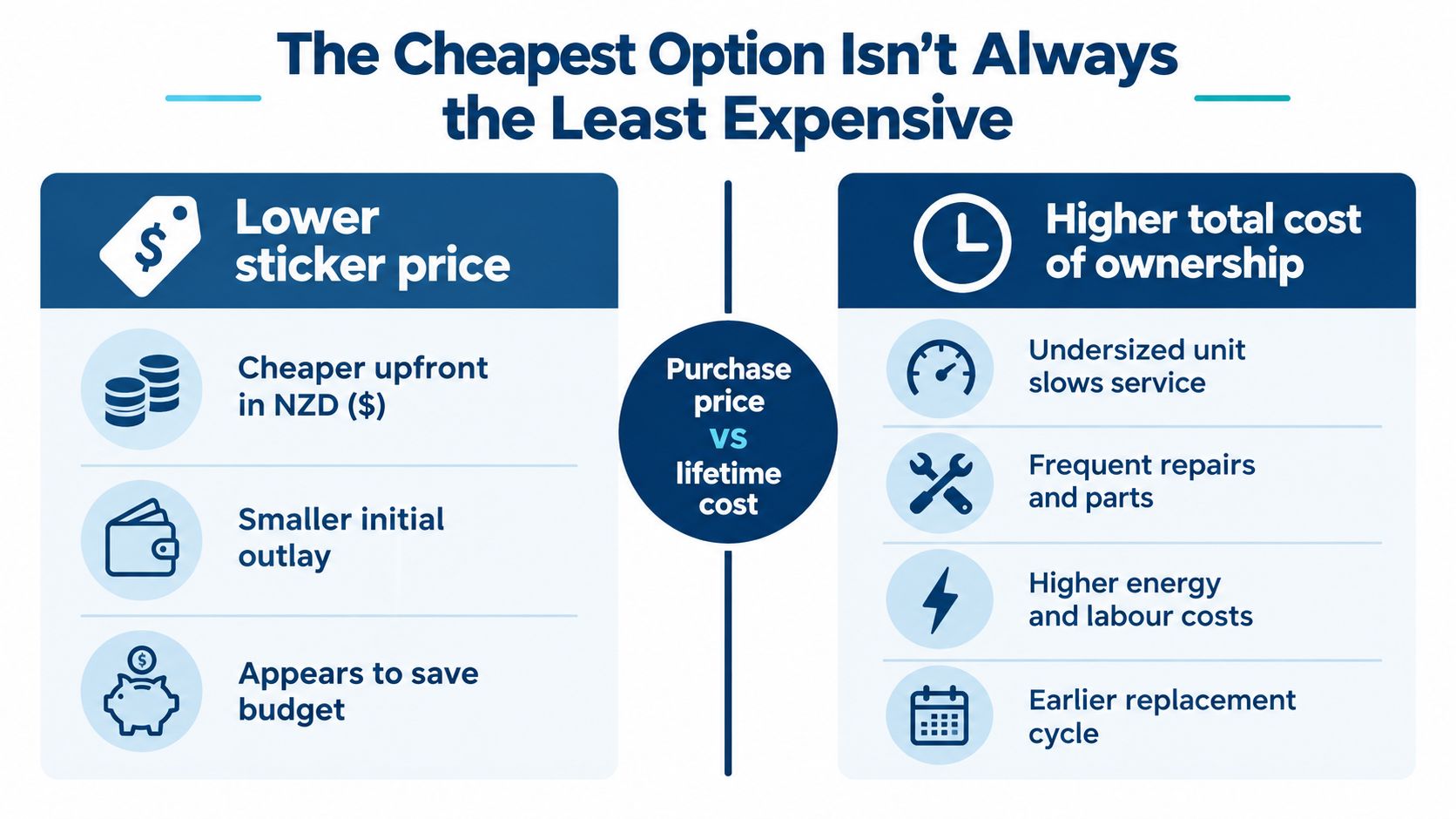
A lower purchase price can look sensible when a budget is tight. The trouble begins when the appliance is too small for the workload. An undersized dishwasher may require repeated cycles during service, leaving staff waiting for clean items and creating extra handling. A cheaper refrigerator may suit a quiet opening period but struggle once stock levels, door openings and ambient kitchen temperatures increase.
Those costs rarely appear on the original quote. They show up as slower service, additional manual work, repairs, replacement decisions and disruption when the equipment fails at the wrong time. New Zealand operators are already managing significant pressure. Labour costs reached an average 40% of hospitality revenue in 2025, while food-price inflation reached 4.6% in the year to June 2025, compared with general inflation of 2.7%, as reported by the Restaurant Association's 2025 hospitality report.
The other expensive mistake
Overspending can be just as unhelpful. A venue with modest production may not benefit from a large, highly featured oven if staff won't use its capabilities and the installation creates unnecessary demands on space, power or ventilation. Expensive equipment isn't automatically appropriate equipment.
The useful comparison is between the venue's actual workload and the machine's whole-life demands:
- Capacity: Can it handle peak production without becoming a bottleneck?
- Labour: Does it remove work, or create more loading, cleaning and handling?
- Reliability: Can staff access service points and carry out routine maintenance?
- Downtime: What happens to the menu if the unit is unavailable?
- Fit: Will the appliance work with the site's utilities and workflow?
The aim isn't to sell the most expensive machine. It's to recommend equipment appropriate to the workload and budget. Operators weighing that choice may also find this discussion of buying cheaply versus buying once useful, particularly when comparing a low upfront price with the practical cost of repeated disruption. Even decisions outside hospitality benefit from the same whole-life thinking, such as this Pestless pricing guide for Miami, which separates an initial quote from the wider service being purchased.
Commercial Versus Domestic Is the Most Common Equipment Mix-Up
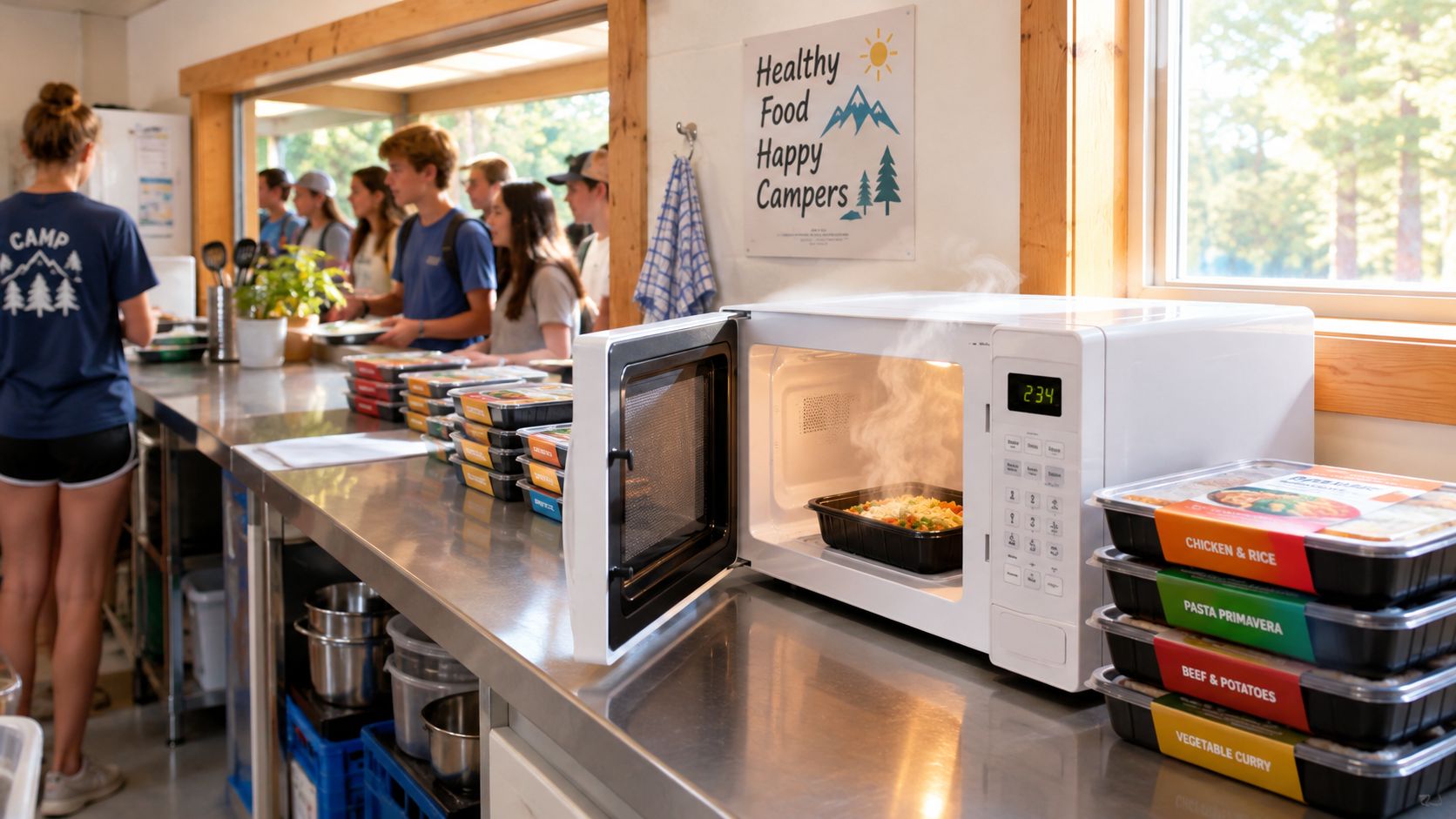
One example still captures the issue clearly. A youth camp was using a domestic microwave to prepare meals for large groups. The unit could perform the task in isolation, but concentrated demand turned it into a bottleneck. When several meals needed attention in a short window, occasional household design wasn't suited to the operating pattern, and a properly specified commercial microwave became the more sensible solution.
The lesson isn't that every shared kitchen needs fully commercial equipment. It's that domestic suitability and commercial suitability answer different questions. A domestic appliance is generally designed around intermittent household use. A commercial appliance is selected around repeated use, concentrated demand, staff workflow and the consequences of interruption.
The label isn't the whole decision
Some workplaces, community organisations and lower-demand venues can be well served by a selected semi-commercial appliance. That depends on the specific product, the operating pattern, the environment and the warranty conditions. A semi-commercial unit may be a practical middle ground where the venue doesn't face continuous service pressure but still needs more durability or capacity than a household product provides.
The decision should consider:
- Demand pattern: Is use spread across the day or concentrated into a short service?
- Users: Will trained kitchen staff operate it, or will many people use it casually?
- Failure impact: Can the venue pause the task if the appliance stops?
- Cleaning and care: Who will maintain the unit and how often?
- Warranty fit: Does the intended use match the manufacturer's conditions?
The distinction is covered in more detail in understanding domestic, semi-commercial and commercial equipment. The practical point is straightforward. Commercial-grade shouldn't be treated as a magic label, and domestic shouldn't be judged only by whether the appliance works once. The workload profile behind the request matters more.
Speed Often Matters More Than Customers Realise
Customers commonly compare price, external dimensions and advertised capacity. Turnaround time receives less attention, even though it often determines whether the operation functions during its busiest window.
School staffrooms provide a useful example. Staff may have limited breaks and need cups, plates and cutlery washed and returned quickly. A domestic dishwasher might manage the total daily volume, yet still fail the practical requirement because it can't complete enough useful cycles within the available break periods. A commercial undercounter dishwasher can be more suitable when the timing of demand matters as much as the total quantity.
The same distinction applies to ovens, ice machines and food preparation equipment. An oven may fit the daily menu but struggle when several batches converge before service. An ice machine may produce enough across a full day but fail during the busiest drinks period. A food processor may have adequate bowl capacity but take too long to reset, clean or reload between tasks.
Match the machine to the pressure point
| Question to Ask | Why It Matters | What to Look For |
|---|---|---|
| When is equipment needed most urgently? | Average demand can hide a short, intense workload. | Cycle time, recovery time and output during the peak window. |
| What must be ready before service? | Delays during preparation can move pressure into the service period. | Batch capacity, loading speed and ease of cleaning between batches. |
| How quickly must items return to use? | Total daily capacity doesn't guarantee useful availability. | Turnaround time, cycle length and the number of simultaneous users. |
| What happens if the machine falls behind? | A small delay can create manual work elsewhere. | Backup process, staff requirements and workflow resilience. |
The capacity of a machine over a whole day isn't the same as its capacity when everything is needed at once.
For fast-paced food service, Merrychef speed ovens show why turnaround deserves its own conversation. The right choice still depends on the menu and workflow, but speed should be measured against the moment when the venue is under pressure, not only against a daily total.
The Smallest Specification Can Decide Whether Equipment Works
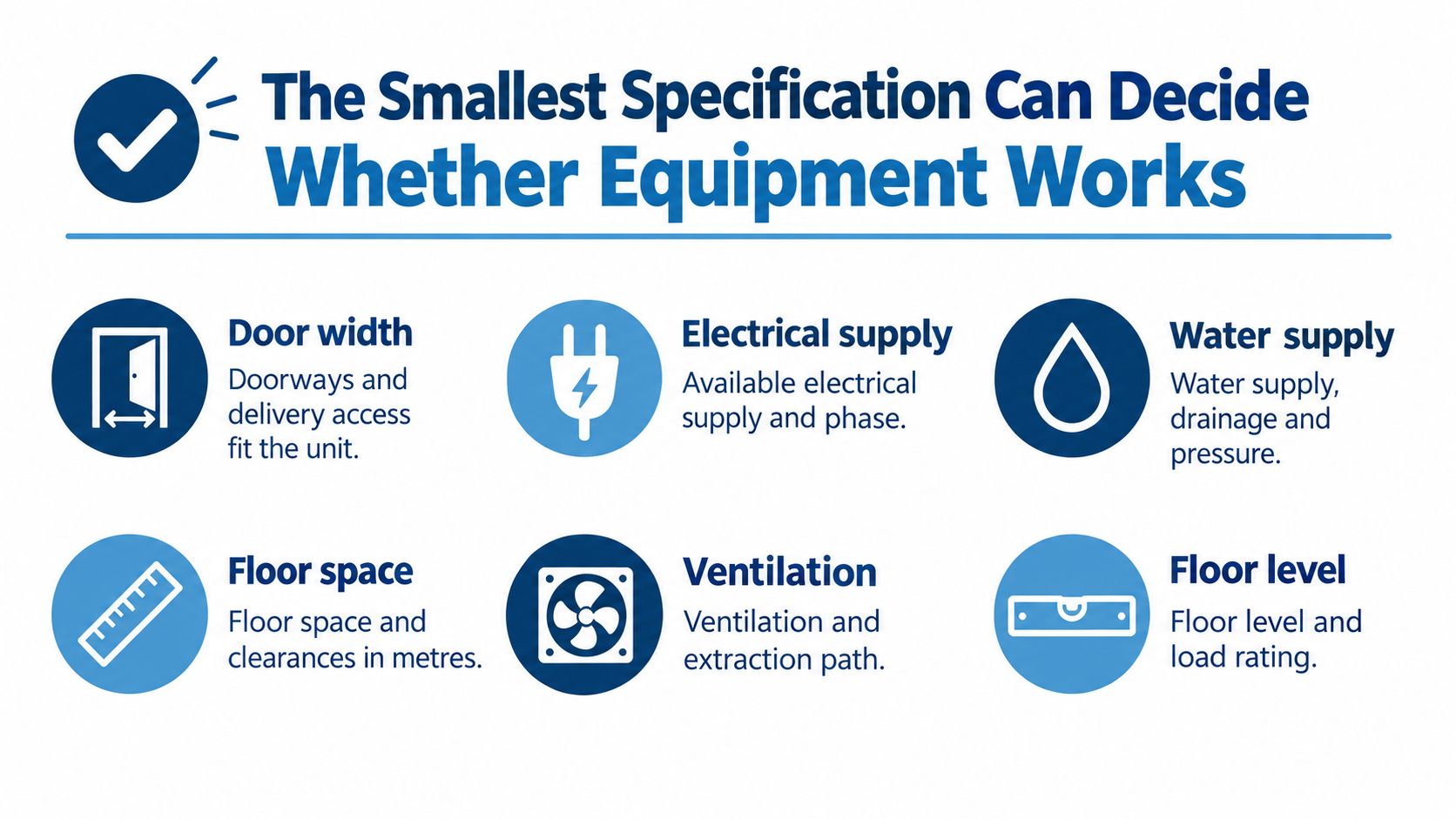
A machine can look perfect on a product page and still be unsuitable for the site. The decisive detail may be a doorway, a power supply, a drain position or the space required to open a door fully.
Before confirming suitability, the site needs a practical check rather than a quick glance at the product dimensions.
Questions that prevent expensive surprises
- Access: Can the unit pass through doors, corridors, lifts and turning points? Delivery dimensions may matter more than the final footprint.
- Electrical supply: Is the required power available, and does the site have the correct phase, socket and protection?
- Water and drainage: Does the equipment require a supply, waste connection, pressure or air gap that the site can provide?
- Ventilation: Will heat, steam, odour or combustion products need extraction? A commercial appliance may change the ventilation brief.
- Clearances: Is there enough room for doors, staff movement, cleaning and future servicing?
- Compatibility: Do trays, racks, gastronorm pans and existing accessories fit the new equipment?
- Usable capacity: How much product can staff load while maintaining airflow and safe handling? Advertised volume isn't always practical working volume.
- Ambient conditions: Can the unit operate reliably in a hot kitchen, uninsulated storeroom or other demanding environment?
A food truck, domestic kitchen converted for commercial use, school, marae or shared facility may also face different council and installation requirements. South Waikato District Council guidance notes that food premises must meet the Food Regulations 2015 and Building Code, domestic kitchens may need alteration before commercial use, and food trucks need an up-to-date electrical Warrant of Fitness with electrical appliances carrying a current safety test tag. The same guidance also points to further requirements from amended electricity safety regulations taking effect on 13 November 2025, so site-specific confirmation matters.
The practical guidance on kitchen exhaust hoods reinforces the wider point. A specification sheet is a starting point. The installation environment decides whether the equipment can operate safely and effectively.
Customers Routinely Underestimate the Cost of Manual Work
Manual work rarely arrives as one large, obvious expense. It accumulates through small tasks repeated throughout preparation and service. Staff handwash dishes, chop ingredients, transfer food between appliances, clean cookware by hand and search for products in crowded storage areas.
Each task may seem manageable. Together, they can occupy the same people needed to keep service moving.
New Zealand hospitality businesses have to take that pressure seriously. MBIE workforce research reports that 41–45% of hospitality and tourism employees intend to leave their organisation, and 57% earn below the 2025/26 Living Wage. Those figures don't mean every equipment purchase will reduce labour demand, but they do make training time, task simplicity and staff availability important parts of the buying decision.
Remove the recurring task
A Robot Coupe food processor may be more valuable than a new cooking function if staff spend repeated preparation periods chopping, slicing or processing ingredients by hand. A commercial dishwasher can change the allocation of a staff member who would otherwise stand at a sink. A combi oven may reduce repeated transfers between separate cooking and holding equipment, depending on the menu and workflow.
The right comparison isn't always “Which machine has the most features?” It may be:
- Which task happens every day?
- Which task interrupts service?
- Which task requires scarce skill?
- Which task creates the most cleaning or handling?
- Which task causes delays when one person is absent?
Operators can map those tasks with labour-planning resources such as AnchOps tools for labour planning, then compare the result with equipment options and workflow changes. A more detailed discussion of the cost of manual food preparation helps frame the decision around repeated work rather than headline capability.
The best upgrade may be modest. It may not add a new menu item or impress visitors, but it can return time to the people who need it most during service.
Brand Reputation Matters, but Suitability Matters More
A preferred brand often gives a buyer a useful starting point. Familiar controls, previous experience and confidence in support all matter. But a brand name can't answer whether the specific model suits the venue.
Two products from the same manufacturer may have different capacities, electrical requirements, controls, cleaning routines and intended workloads. A recognised name doesn't remove the need to check the operating details.
Compare the actual model
The relevant questions are practical:
- Workload: Can the model cope with the venue's peak use?
- Capacity: Is the usable internal space suitable for the pans, trays or containers already in use?
- Features: Will staff use the functions, or do they add cost and training without solving a real problem?
- Installation: Does the model suit the available power, water, drainage, ventilation and clearances?
- Support: Are warranty, parts, servicing and maintenance arrangements appropriate?
- Budget: Does the purchase leave enough room for installation and related site work?
This is why a brand preference shouldn't be dismissed, but it shouldn't control the entire decision either. Blue Seal, Unox, Merrychef, SKOPE, Vitamix, Wusthof and other recognised manufacturers all offer different product families for different applications. The useful recommendation depends on the model and the venue, not on claiming that one brand is universally superior.
Many Customers Are Solving Yesterday's Problem
Replacing equipment with an identical model feels safe. It reduces research and avoids changing familiar routines. But a like-for-like replacement can preserve a limitation that the business has already outgrown.
A café may now serve more customers, run a larger menu, employ more staff or trade for longer hours than when the original dishwasher, oven or refrigerator was installed. The old machine may still look familiar, but the operating brief has changed.
Reassess before copying the old order
Before matching the previous specification, operators should review:
- Current covers and peak production
- Menu complexity and batch sizes
- Staffing levels and skill mix
- Service times and turnaround requirements
- Storage, cleaning and maintenance workload
- Available power, water, drainage and ventilation
- Likely changes to the venue's operation
The opposite problem exists too. A business may have reduced its menu, changed its service model or moved toward smaller production, making the previous machine more than it needs. Replacing it with an equivalent high-capacity unit could waste space and budget.
Replacement is an opportunity to right-size. The useful question isn't “What did the old machine do?” It's “What does the operation need the next machine to do now?”
Sometimes the Best Advice Is Not to Buy Anything Yet
Not every bottleneck needs new equipment. Sometimes the machine is capable, but the workflow around it isn't. Staff may be loading it incorrectly, using the wrong setting, skipping a cleaning step or storing ingredients far from the preparation area.
A responsible supplier should be willing to consider those possibilities before recommending another purchase. A new appliance can't fix a badly sequenced process, an unsuitable accessory or a maintenance issue that has reduced the performance of equipment already on site.
Look for the existing solution first
Several changes can solve an operational problem without adding a major item of equipment:
- Change the workflow: Move preparation, washing or storage so staff take fewer unnecessary steps.
- Use the correct accessory: A suitable rack, tray, blade, basket or pan can change how effectively an existing machine is used.
- Review settings: Temperature, cycle, fan, speed and holding settings may not match the actual task.
- Improve cleaning and maintenance: Dirty filters, blocked condensers, worn seals and neglected probes can affect reliability and food safety.
- Rearrange the workspace: Put high-use ingredients, utensils and containers where staff need them during service.
- Diagnose the bottleneck: Confirm whether the delay starts with preparation, cooking, washing, storage, staff movement or handover.
Food safety makes that diagnosis particularly important. MPI guidance requires potentially hazardous food to cool from 60°C to 21°C within two hours, then from 21°C to 5°C or below within a further four hours, with a maximum total cooling time of six hours. Hot-held food generally needs to remain at 60°C or hotter, and food held below that threshold for more than two hours must be discarded. These limits are set out in MPI cooling guidance and MPI hot-food guidance.
Buying a blast chiller or hot-holding cabinet may be appropriate in some workflows, but the recommendation should follow an understanding of batch size, container depth, cooling method, holding practice and thermometer checks. MPI also states that reheated potentially hazardous food must reach 75°C in all parts before service or hot holding, and that warming cabinets must not be used for reheating because they don't heat food quickly enough. Those requirements are covered in MPI reheating guidance.
Ask five questions in order
The most useful enquiry framework is simple:
-
What problem are you actually trying to solve?
This separates the operational need from the product initially requested. -
What does your busiest period look like?
Peak demand reveals whether speed, recovery and simultaneous capacity matter more than a daily total. -
What limitations does your existing equipment have?
The answer might be size, cycle time, cleaning, access, reliability, settings or staff handling. -
What space, power, water or ventilation is available?
Site reality can rule out a model before price or brand becomes relevant. -
What matters most, initial cost, speed, capacity, labour reduction or long-term value?
Every purchase involves trade-offs. Naming the priority makes those trade-offs visible.
Cleaning also belongs in this decision. MPI distinguishes cleaning from sanitising and requires food-contact surfaces and equipment to be cleaned at least every day they're used, with cleaning as work progresses described as best practice. Equipment that is difficult to access, strip down or keep clean may create more operational trouble than its product description suggests. The MPI cleaning and sanitising guidance provides the relevant framework.
These questions move from the problem to the pressure point, then to the existing limitation, site conditions and final priority. Answering them in that order usually produces a more appropriate recommendation than starting with a catalogue page.
The central lesson from what thousands of product enquiries have taught us is that a product recommendation is only useful when it solves a genuine problem, suits the way the venue operates and remains practical after installation. Sometimes that means buying better equipment. Sometimes it means changing the process first.
Simply Hospitality helps New Zealand hospitality businesses compare commercial kitchen equipment and supplies against menu, workload, site services and budget. For a second opinion before replacing or adding equipment, visit Simply Hospitality and share the operational problem, not just the product name.