

Is Your Dough Production the Real Bottleneck?
Most dough bottlenecks don't start at the mixer. They start where product waits, where trays pile up, where proofing space runs out, or where the oven is starved because the line behind it can't keep pace. In New Zealand kitchens, that matters more than many operators realise, because a dough line is only as fast as its slowest stage, and a bigger machine at one point in the flow often just shifts the constraint somewhere else.
That's why Is Your Dough Production the Real Bottleneck? is the right question to ask before replacing equipment. A bakery, café, or pizzeria can buy more capacity and still see little improvement if the core issue is batch sizing, transfer loss, bench space, proving, or cooling. The practical job is to find the stage where waiting begins, then fix that stage first.
Why Bigger Equipment Rarely Fixes a Dough Bottleneck
A bigger mixer feels like the obvious answer when dough feels slow, but the obvious answer is often the wrong one. If the oven is idle because there's no prepared dough to load, the problem isn't oven capacity. If dough is sitting in tubs because the next stage can't take it, the mixer isn't the limiter.
That logic matters in New Zealand because the bakery product manufacturing sector is spread across many small operators, with 1,242 businesses and an estimated $1.2 billion scale in 2026, while the business count declined at a 0.5% CAGR between 2021 and 2026 and the market itself grew at 1.1% CAGR over the same period, according to IBISWorld's bakery product manufacturing profile. In a mature market like that, the weak point is usually not demand. It's process balance.
Practical rule: the stage that makes the next stage wait is the real bottleneck.
That's why many kitchens need to think more like a process engineer than a shopper. People looking at FindMeJobs job listings for process engineers usually aren't hunting for more horsepower, they're looking for flow, handoff, and constraint removal. Dough production is the same problem in stainless-steel clothing.
A spiral mixer upgrade can be useful, but only if the whole line can absorb the extra output. More batch size without more proving room, more trays, or more oven availability just creates a new queue. The right question is not, “How big can the mixer be?” It's, “Where does the dough stop moving?”
When does a spiral mixer become cheaper than mixing by hand is a useful read for venues that are still comparing hand labour with mechanised production, but even that decision only makes sense once the full production chain is visible.
Mapping Your Dough Production Chain
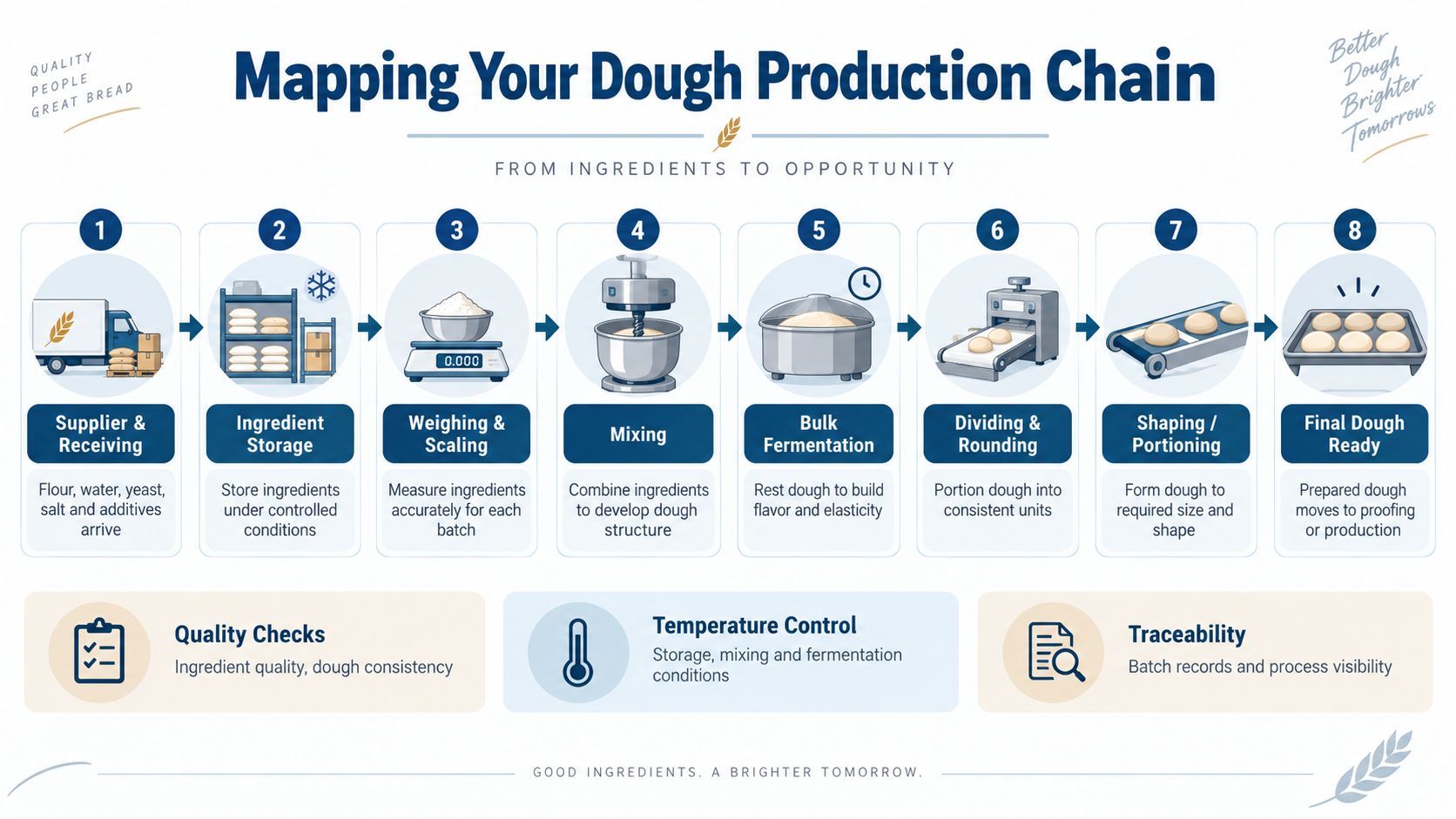
The cleanest way to diagnose a bottleneck is to walk the line in order, not by assumption. The chain is simple enough on paper, ingredient storage → weighing → mixing → resting → dividing → forming → proving → baking → cooling, but the delays usually hide in the handoffs between those steps.
Start With Time, Not Opinion
Record how long product spends at each stage, then note where trays, tubs, or dough pieces begin to queue. The point is not to build a formal audit. It's to see which stage produces faster than the next one can accept it.
A venue can do that with a clipboard and a stopwatch. A basic scale such as the Soehnle Bathroom Scales Style Sense Compact 300 Slate is a reminder that even a simple weighing tool matters when consistency starts with accurate loading. In dough work, small measurement errors can ripple through batch balance, especially when staff are trying to compare one batch against the next.
Watch the Physical Handoffs
The best clue is often visible. Ingredient tubs wait beside the mixer, dough waits at the bench, trays wait for proving space, or racks wait for oven access. That's where throughput is being lost, even if the machines themselves look busy.
A practical checklist helps:
- Storage and weighing: ingredients should be close enough that staff aren't walking unnecessary laps.
- Mixing and resting: note whether dough is being held because no bench is free.
- Dividing and forming: look for manual handling that slows the feed into the next step.
- Proving and baking: count how many trays can sit ready without being reshuffled.
- Cooling: check whether finished product is clearing fast enough for the next batch.
If the previous stage finishes early but the next stage can't receive product, that stage is the bottleneck, not the machine upstream.
A bakery fit-out also needs to respect that flow visually and physically. The layout ideas in bakery equipment setup in NZ are useful because they reinforce the same principle, one-way movement beats cross-traffic every time.
Understanding Mixer Capacity Beyond the Spec Sheet
Mixer capacity on a spec sheet can mislead operators because bowl size isn't the same as usable dough output. Commercial spiral mixers are often specified by both dough and flour capacity, and that difference matters when planning production.
Capacity Means More Than Bowl Volume
Common spiral mixer listings in the New Zealand market show 25 kg dough / 12.5 kg flour, 50 kg dough / 25 kg flour, 80 kg dough / 50 kg flour, and 120 kg dough / 75 kg flour capacities. Another commercial listing shows 38 kg kneading capacity with 25 kg flour capacity, and a separate model lists 60 kg dough with 36 kg flour. Those figures show that ingredient-to-finished-dough ratios are already built into the machine spec, so the ceiling is not just the bowl, it's the batch design.
| Common Commercial Spiral Mixer Capacities | ||
|---|---|---|
| Dough Capacity | Flour Capacity | Typical Application |
| 25 kg | 12.5 kg | Small café, light dough run |
| 38 kg | 25 kg | Medium kitchen volume |
| 50 kg | 25 kg | Busy bakery prep |
| 60 kg | 36 kg | Higher-demand mixed production |
| 80 kg | 50 kg | Larger batch workflow |
| 120 kg | 75 kg | High-volume production |
Batch Count Can Matter More Than Batch Size
If a kitchen needs several small batches every morning, the labour cost isn't just mixing time. Staff also keep loading ingredients, unloading dough, resetting the machine, and cleaning around the process where applicable. A correctly sized mixer can reduce that repetition, but oversized batches can push the problem downstream if the team can't divide, form, or prove the dough fast enough.
That's why spiral mixers are usually the first place operators look, but not always the right place to spend money first. Planetary mixers can still have a role for lighter dough work, occasional mixing, or mixed prep benches, but they're not automatically the answer when the actual demand is dough throughput. Equipment choice has to match the shape of the work, not just the label on the front.
For operators comparing models, commercial dough mixer options are worth reviewing alongside the production window, not in isolation. The same principle applies to a cross-checked recipe system, and even a resource like dumpling wrapper thickness tips from Just Cook reminds operators that dough handling is about consistency at the right stage, not just raw motor power.
Where Downstream Stages Create Hidden Constraints
The bottleneck often moves after mixing, and that's where many upgrades disappoint. A kitchen can install a larger mixer and still fail to lift output because dividing, forming, proving, baking, or cooling is already saturated.
Proofing and Baking Set the Pace
In one bakery process study, the dough rising step was the bottleneck because the dough needed at least 30 minutes to rise after mixing, and that waiting time caused delays and stockouts when demand increased, according to the ECCE dough mixer study. That is a simple but powerful lesson, proofing time can outrun mixing capacity very quickly.
New Zealand commercial baking guidance from EECA also flags real-world pinch points such as long changeovers, excessive oven warm-up time, mixer downtime, and the value of linear factory flow, preventative maintenance, adjustable-speed drives on mixers, and longer production runs to reduce interruption and wasted heat, as outlined in the commercial baking technology scan. The message is clear, the oven only helps if product is ready when the oven is ready.
Layout and Loading Matter as Much as Equipment
Manual dough handling can cap throughput long before the machine specs do. Bench space, tray movement, rack availability, and cooling space all become part of the production ceiling once batch size increases.
A venue like a bakery café sometimes gets distracted by display equipment when what it needs is cleaner flow behind the counter. The Festive Baker Ambient Floor Standing Cabinet is a front-of-house merchandising solution, but its tray race, sliding doors, and shelving layout are a reminder of the same operational truth, the path product takes matters as much as the product itself.
A larger oven achieves very little if the kitchen can't feed it fast enough.
That is why the test is not whether the oven is impressive. It's whether dough arrives at the right pace, in the right state, without staff constantly shuffling trays to create room. If proofing racks are full, the oven cannot solve that. If cooling space is blocked, the whole line backs up.
How Labour and Layout Compound Equipment Limits
Labour is part of the bottleneck calculation, but not always in the simple way operators expect. A busy dough line can look understaffed when the issue is repeated handling, awkward movement, or poor sequencing between equipment.
Hospitality is a major employer in New Zealand, with 193,000 people working in the sector in the year ended March 2025, or 6.7% of all jobs, according to Hospitality New Zealand's State of the Nation July 2025 report. The same source says hospitality productivity had grown 1.6% per year over the prior decade, around three times the national average, while the year ended March 2025 sat just above or below the national average in the last three years. That combination suggests small workflow changes can matter a lot, because the sector carries a large workforce but doesn't have endless slack.
When More Staff Stops Solving It
Adding another baker helps only while the line can absorb the extra hands. Once setup time, proofing space, or oven access becomes the limit, more labour just means more people waiting around the same choke point. That's why better kitchen design versus better equipment is such a relevant comparison for production kitchens, because layout often decides whether labour turns into output or congestion.
Dough tipping and transfer can also be a material loss point. A New Zealand government efficiency review notes that UNEP's Country Bake study found significant dough loss during tipping, and the Ministry for the Environment cited fixing the inclined plate between mixers and metal bins as an improvement in the quantification of benefits report. That's a strong signal that the problem isn't always the mixer itself, it's the handoff.
Contingency Can Matter More Than Peak Speed
Recent New Zealand reporting on baker shortages and bread disruption shows the operational risk is very real, with strike-related disruption leaving shelves empty and in-store bakeries scrambling to make extra bread, while earlier coverage noted it was taking employers about a month longer than normal to fill roles, according to Neighbourly's local reporting thread. In those situations, the winning question is not just “How fast can the line run?” It's “How quickly can the kitchen recover?”
That's where labour, layout, and equipment all meet. A strong dough line is one that keeps moving even when one person is absent, one rack is delayed, or one batch has to be reworked. Recovery speed is often more valuable than peak speed.
Practical Steps to Rebalance Your Dough Production
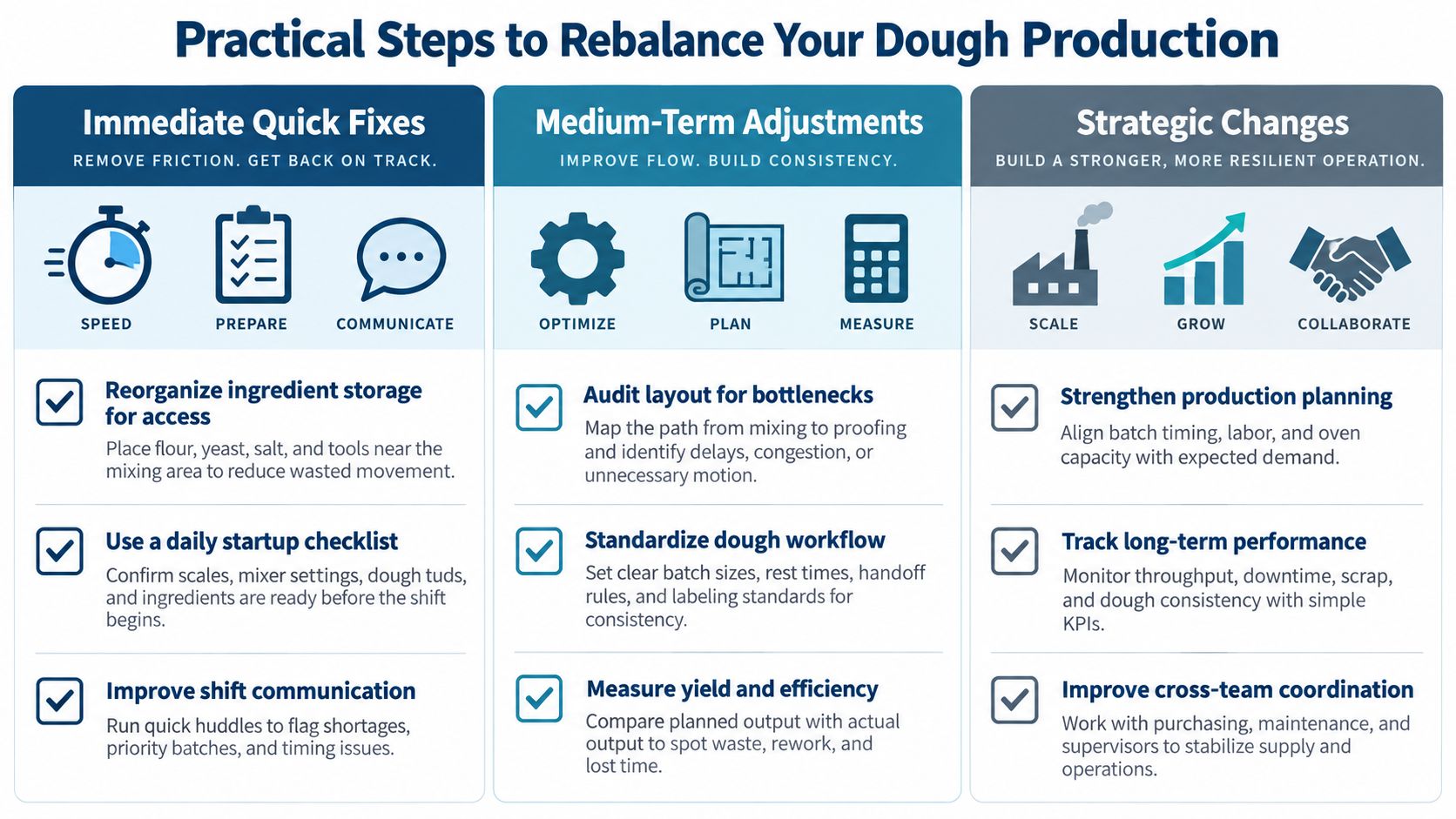
Start with the line you already have. Remove unnecessary walking, keep ingredients close to the weighing point, and reduce tray shuffling between mixing, proving, and baking. Those are simple fixes, but they often expose the actual constraint fast.
Rebuild the production line from the output backwards
Work from the amount of finished dough needed in the busiest service window, then calculate batch size, number of batches, mixing time, resting and proving time, and oven loading. That approach stops a kitchen from buying equipment in the wrong order.
For operators planning a more consistent service pattern, planning equipment for consistent meal service is a useful reminder that demand planning and equipment planning need to match. Dough production works the same way, if the busiest hour can't be fed, the rest of the day won't save it.
Match batch size to the full line
A larger batch only helps if the rest of the line can carry it. If staff can't divide and form fast enough, or if proofing capacity is limited, the batch size has moved ahead of the kitchen's real rhythm.
The right fit might be a different mixer, extra proving racks, better bench organisation, or a revised product mix that reduces changeovers. In some cases, a spiral mixer with the right dough capacity is the answer. In others, the better investment is more stable flow between stages, not more metal.
Think about recovery, not just peak output
Service continuity matters as much as speed. A dough line that can recover after a delay, staff absence, or ingredient disruption is often more valuable than one that only performs well when everything is perfect.
If the process is waiting at one point and piling up at another, the bottleneck has already identified itself. Fix that stage first, then measure again.
Hospitality helps New Zealand hospitality operators compare dough mixers, ovens, proving equipment, and layout options with the full production flow in mind. If the line is waiting in one place and piling up in another, visit Simply Hospitality for practical help choosing equipment that matches your venue's real dough production needs.