


Should You Buy Another Pizza Oven or Hire Another Staff Member?
Seven o'clock on a Friday, the docket rail is full and the pass has stopped moving. Two topped pizzas sit on the peel waiting for deck space, a delivery driver is leaning on the counter, and the phone rings with an order nobody has time to take. The question sitting in the owner's head is the one this article answers. Should you buy another pizza oven or hire another staff member?
Both options add capacity on paper. Neither fixes the wrong constraint. A second oven does nothing for a kitchen whose dough is balled too late, and another pair of hands does nothing for a deck that already runs flat out from open to close. The choice only becomes simple once you know which stage of the pizza line is holding the whole operation back.
What follows is a working sequence: find the constraint, test the cheap fixes, measure what the peak costs in lost orders, then compare an installed oven cost against a realistic wage bill. Run it in that order, because the cheapest fix often sits at the front of it.
Why Busy Pizza Services Stall Before You Spend
Every busy pizza kitchen has a version of the same Friday. Quoted wait times stretch from 20 minutes to 40, takeaway orders slip past their promised collection time, the deck runs continuously, and the team stops looking up. The owner reads that as a capacity problem and reaches straight for a solution. Another oven, or another person.
The warning signs are familiar, and none of them names a cause by itself.
- Rising wait times can come from the oven, or from dough that wasn't balled and proved early enough.
- Late takeaway and delivery orders often reflect packaging and handover, not cooking.
- Staff struggling at peak may mean too few hands, or a layout that sends people walking to the coolroom for cheese mid-service.
- An oven running continuously may be at its limit, or be fed in irregular bursts because toppings weren't set out.
- Uneven pizza quality usually tracks rushed stretching and inconsistent loading rather than a lack of heat.
- Declined orders happen when nobody can answer the phone, which is a front-of-house constraint, not a cooking one.
Each symptom narrows where to look. None of them tells you what to buy.
Adding labour isn't a guaranteed fix at a national level either. Stats NZ productivity statistics show that in the year ended March 2024, New Zealand accommodation and food-services output fell 3.8% while labour inputs rose 5.8%, and labour productivity declined 9.1%. More hours, less output. That combination puts pressure on both margin and consistency, and it's the reason a headcount decision deserves the same scrutiny as a capital one.
The rule for the rest of this decision: a symptom tells you where to look, not what to buy.
Find the Stage That Limits Your Pizza Output
A pizza line is a chain, and output equals the speed of its slowest stage. Six stages sit between an order and a customer: dough preparation, portioning and stretching, topping, cooking, cutting and packaging, and service. Improving any stage that isn't the constraint changes nothing you can see. Improving the one that is, speeds up the whole line within a service.
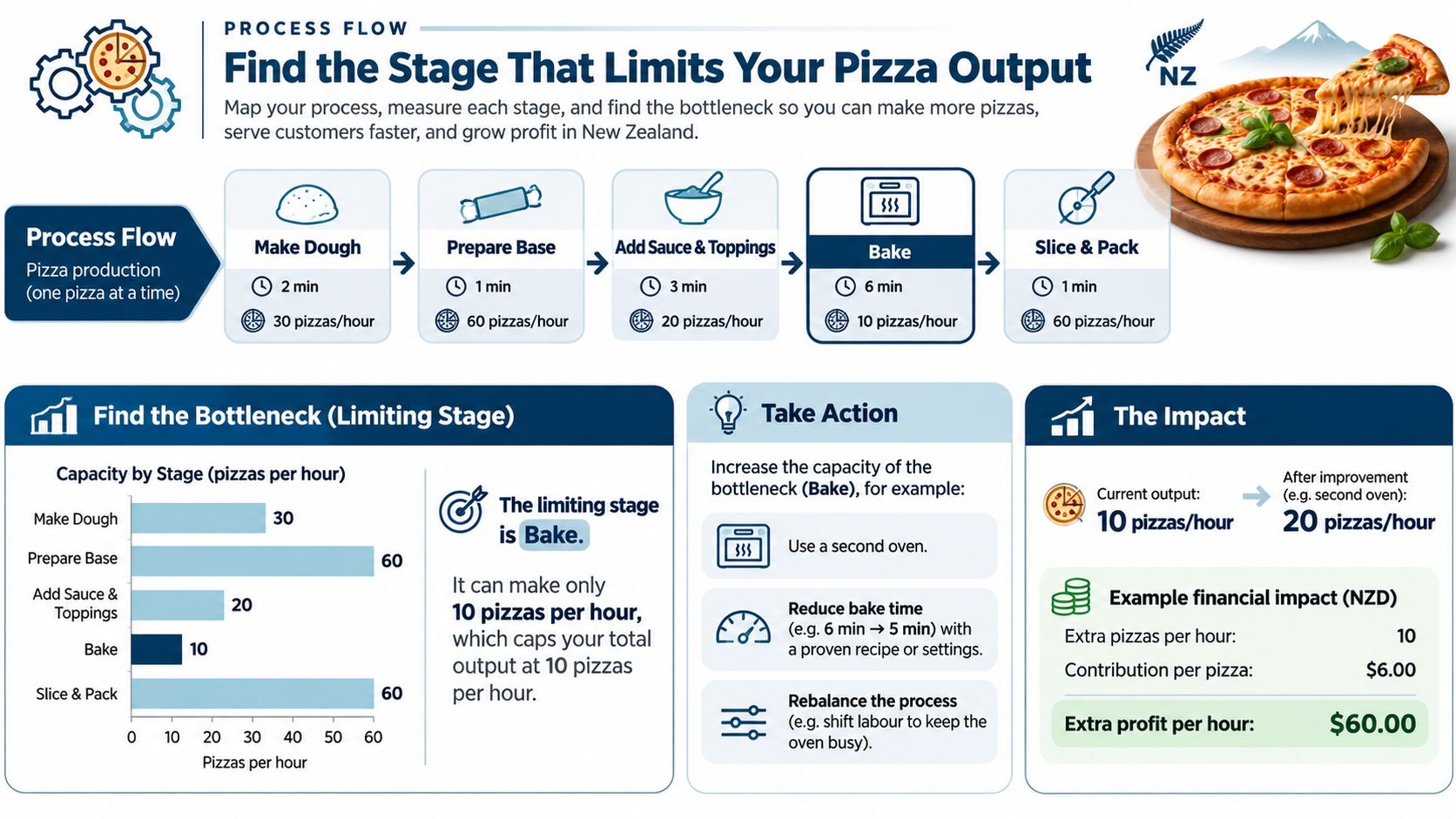
The slip at each stage is predictable enough that most operators can recognise their own kitchen in the table below.
| Production stage | Common bottleneck | Potential solution |
|---|---|---|
| Dough preparation | Dough mixed too late or in batches too small for the rush | Batch dough ahead of service, or use a suitable dough mixer |
| Portioning and stretching | Dough balls waiting for hands | Pre-portion before service and set up a dedicated stretching station |
| Topping | Toppings not set out, so staff walk to the fridge | Set up mise en place at the topping station and restock it during quiet periods |
| Cooking | Prepared pizzas waiting for oven space | Add cooking capacity, or rework the loading sequence before buying |
| Cutting and packaging | Pizzas stacking up at the packing station | Assign a dedicated packer and pre-stage boxes |
| Service | Collection and delivery handover running late | Timed collection windows and a clear order board |
The two readings that settle it
Two observations during a live peak do most of the diagnostic work. If the oven sits partly empty while orders back up, the constraint is preparation or staffing, and buying cooking capacity would add a fixed cost to a line that still can't feed it. If prepared, topped pizzas wait on the peel for oven space, the constraint is cooking capacity.
To see it plainly, walk the line during a peak and note two things at each station: how many pizzas are waiting and for how long. Not how busy people look. Where the product physically queues.
When the stall turns out to be order handling rather than cooking, the fix is usually scheduling. A useful read on that side of the line is this guide to speed up kitchen ticket flow, which covers how tickets should be sequenced between the pass and the counter.
It also helps to keep the scale of the sector in view. The Hospitality New Zealand State of the Nation report puts hospitality employment at approximately 193,000 people in the year ended March 2025, or 6.7% of all jobs, and records sector productivity rising 1.6% a year over the decade to 2024 against 0.5% nationally. Output per hour, not bodies on the roster, is what moves that number.
Two weeks of tally marks at the pass will tell you more than a year of guessing.
Gains You Can Make Before Spending
Some capacity is usually tied up in layout and routine rather than equipment. Releasing it costs far less than an oven or a wage bill, and the changes below take a weekend to trial rather than a delivery lead time.
- Bring the stations within reach. Topping, packing and the oven should sit within a few steps of each other. A layout that forces a walk to the coolroom for every second pizza adds minutes to every order.
- Prepare before the doors open. Dough balled and proved, sauces portioned, cheese shredded, toppings in containers at the station. Prep done at 5pm is prep done twice.
- Fix batch sizes. Mixing dough in amounts that run out at 7.30pm creates a second rush nobody planned for.
- Set an oven loading routine. A deck that idles while someone hunts for a peel loses slots that can never be recovered in that service.
- Simplify the menu. Fewer topping lines competing for the same hands means faster assembly and fewer remakes.
- Take the hardest task off the line. A dough mixer or a refrigerated preparation counter can hold dough at temperature while keeping the bench clear, which shortens the longest stage instead of adding to it.
- Schedule collections into timed windows. Turning a queue into a timetable flattens the peak without adding capacity.
Measure for two weeks before you spend
Pick two representative weeks and record the same six numbers: orders per 15 minutes, average ticket-to-collection time, oven occupancy by interval, remake rate, labour minutes per pizza, and sales lost when the quoted wait exceeded what a customer would accept. A tally sheet at the pass and a kitchen timer will start it. Nothing more elaborate is needed to prove whether a workflow change earned anything.
Hospitality stocks refrigerated preparation counters and stainless steel benches that support a tighter layout, and where a change needs specialist production workflow planning, Hospitality works with SACH Design on kitchen design and layout. The related article on Designing a Kitchen Around Service Requirements covers how service patterns should shape bench positions in the first place. For further practical ideas on peak service, see five ways to improve kitchen efficiency during peak service.
When a Second Oven Earns Its Place
A second oven earns its place when cooking capacity, rather than preparation or staffing, is the constraint through most of the peak. If the oven is busy only at the start of service, or prepared pizzas are not waiting to be loaded, another unit may sit underused.
Check for these conditions before committing:
- Existing ovens run at practical capacity for most of the peak.
- Prepared pizzas queue for oven space while staff are ready to load them.
- Demand arrives in concentrated peaks the kitchen cannot fully serve.
- Orders are turned away because the oven cannot take more.
- Adding takeaway or delivery is expected to raise order volume without adding seats.
A second oven adds cooking capacity at peak times, provides cover if one unit is out of service, and reduces reliance on a single appliance. The commercial case also depends on labour costs and the sales the added capacity can serve. The Restaurant Association 2025 hospitality report records labour costs reaching an average of 40% of revenue, the highest level in its remuneration survey, while total hospitality sales grew only 1.4% to NZ$15.99 billion for the year ended June 2025. Model whether additional output can contribute enough to justify the equipment, rather than assuming that avoiding another wage makes the purchase pay.
What a second oven does not fix
A second oven does not automatically double output. Loading, topping and packing can still set the pace, and the additional unit needs its own loading routine, cleaning schedule and food-safety checks. Running two ovens through a peak also adds heat to the kitchen, which can affect staff comfort and extraction performance.
| Requirement | What to check | Why it matters |
|---|---|---|
| Floor space | Footprint, clearance and access for the oven and its stand or bench | Confirms the unit can fit without displacing other equipment |
| Power supply | Single-phase or three-phase supply, circuit capacity, or gas supply and connection | The oven must operate alongside existing equipment on the available supply |
| Ventilation and extraction | Hood capacity and make-up air for heat and steam | Two ovens increase the kitchen's heat load during a peak |
| Installation cost | Electrical, gas, plumbing and any hood work | Include installation in the total cost and request a quote early |
| Lead time and freight | Stock or made-to-order timing, and freight for bulky units | Custom-built equipment needs plenty of lead time during peak season, and freight may be confirmed before dispatch |
| Staff training | Who loads, rotates, cleans and checks the second oven | Extra capacity needs a clear operating routine |
Plan custom-built equipment well ahead of peak season. Freight for larger, bulky or commercial equipment is calculated separately, and Hospitality may contact customers to confirm or adjust freight costs before dispatch.
For a twin-deck option, the Fimar MINI Twin-Deck Electric Pizza Oven - 2 x 500mm Decks is listed in the catalogue. Check the product page for dimensions and chamber details, then compare the oven with your available space, supply and menu before ordering. The article on whether a faster pizza oven can increase your restaurant's revenue explains why cycle time alone may not determine whether added oven capacity pays. Before committing, assess whether demand is being limited by oven space and whether the extra orders can be handled through the rest of the service.
When Another Pair of Hands Is the Better Buy
Labour removes a different constraint. The tasks that matter are dough preparation, ingredient replenishment, pizza assembly, oven loading, packaging, order taking and customer handover, and the value of a hire depends entirely on which of those sits at the bottleneck.
Picture a kitchen where the oven sits partly empty while one person stretches, tops, packs and answers the phone. Add a second person on dough and toppings and the existing oven runs closer to its practical capacity without any capital outlay. That's labour solving a preparation problem, not a cooking one.
Flexibility is the other argument. A part-time or peak-only role follows demand more closely than a fixed asset ever can, though productive hours are capped by minimum shift lengths and by quiet periods where there's little to do. Many operators find a defined peak role easier to justify than a full-time position.
Then there are the costs that don't appear in the advertised rate. Recruitment, training time before the person is productive, rostering, leave, KiwiSaver and payroll administration all land on top of the wage.
Wage categories catch people out
New Zealand has three statutory minimum-wage categories, and eligibility is narrower than many operators assume. The business.govt.nz minimum wage and fair pay guidance sets the starting-out and training rates at $19.16 per hour from 1 April 2026, against $23.95 for adults, but starting-out rates apply only to certain 16- and 17-year-olds, some 18- and 19-year-olds receiving specified benefits, and workers required to complete industry training. The training rate is limited to employees aged 20 or over in recognised industry training of at least 60 credits a year. You can't pay every young worker the lower rate.
Retention deserves the same attention as the hourly figure. The Ministry of Business, Innovation and Employment's 2025 hospitality and tourism employment report found only 48% of surveyed workers felt fairly paid in 2025, down from 57% in 2024, and 57% earned below the Living Wage. A hire that leaves inside a season costs more than an oven that runs for a decade.
Two mistakes show up repeatedly: hiring to fix a shortage that's really oven capacity, and assuming the junior rate applies to every young worker. The article Is Bigger Catering Equipment Always Better? is a useful counterweight to both, and the breakdown of the cost of manual food preparation in a commercial kitchen shows where labour minutes go before you add more of them.
Before you advertise, name the one task the new person takes off the constraint, and the number of hours a week it actually fills.
Comparing Oven and Labour Costs Side by Side
Compare the full cost of each option over the same period. A purchase price beside an hourly wage is not a useful comparison on its own. The figures below are illustrative, not product quotations or New Zealand wage benchmarks. Use them to check the arithmetic, then replace them with quotes, roster assumptions and operating costs for your kitchen.
Additional pizza oven (illustrative). Equipment and installation cost $20,000. Add operating, energy and maintenance costs once you have assessed them for the specific model.
Additional employee (illustrative). At 25 hours per week and a fully loaded cost of $32 per hour, the employee costs $800 per week, or $41,600 over 52 weeks.
For wage context, the Restaurant Association remuneration survey reports an average hospitality wage of NZ$27.84 per hour. At 40 hours a week over 52 weeks, that is approximately NZ$57,907 in gross wages before leave, KiwiSaver, recruitment and training. The Employment New Zealand's minimum wage rates list the adult rate as $23.95 per hour from 1 April 2026. That equals $958 for a 40-hour week, or $49,816 over 52 weeks, before employment overheads.
| Cost element | Additional oven | Additional employee |
|---|---|---|
| Upfront cost | Illustrative $20,000 for equipment and installation | Recruitment and onboarding, to be assessed |
| Recurring cost | Operating, energy and maintenance costs, to be assessed | Illustrative $800 per week, or $41,600 over 52 weeks |
| Weekly equivalent | Assess against installed cost and expected equipment life | Illustrative $800 per week |
| Availability | Available whenever the kitchen operates | Limited by rostered hours and minimum shift requirements |
| Financing | Finance may spread the upfront cost; count repayments in the comparison | Wages are paid as they are incurred |
Revenue, contribution and profit are three different numbers
Revenue is the money taken across the counter. Contribution margin is what each extra pizza leaves after ingredients, packaging and other variable costs. Profit is what remains after fixed and operating costs are covered. Only contribution pays for either option. Pizza revenue also covers costs that continue whether or not the investment succeeds.
Installation depends on the specific oven model, so confirm power, extraction and other site requirements against its current specifications. The Fimar FYL/4 Electric Pizza Oven - 4 x 350mm Pizzas is one model to assess when comparing equipment options.
Break-even in pizzas
At an illustrative $10 contribution per pizza, a $20,000 oven requires 2,000 additional pizzas to recover its initial cost, before operating expenses. An employee costing $800 a week requires 80 additional pizzas every week to cover that wage. Count only demand you have measured, not output the equipment might theoretically produce.
Minimum-wage rates are reviewed annually, so allow for increases in a multi-year budget. Employment New Zealand minimum wage guidance provides the relevant guidance. If the oven is financed, include repayments in the comparison. Equipment finance through SilverChef Finance changes the timing of cash outflow, not the total cost. The guide to lease versus buy for commercial kitchen equipment in NZ explains how each option affects the books. To convert an hourly rate into an annual figure, check hourly-to-annual pay conversions before entering it in your spreadsheet.
Only contribution pays for either option.
Confirm the Right Investment Before You Buy
The measured constraint converts into a verdict fairly quickly. Prepared pizzas waiting for oven space points to cooking capacity. An underused oven points to preparation or staffing. Demand squeezed into short peaks suits flexible staffing or workflow change, while sustained demand above capacity justifies equipment expansion. Where several stages stall at once, coordinated investment in both areas usually beats a single large purchase.
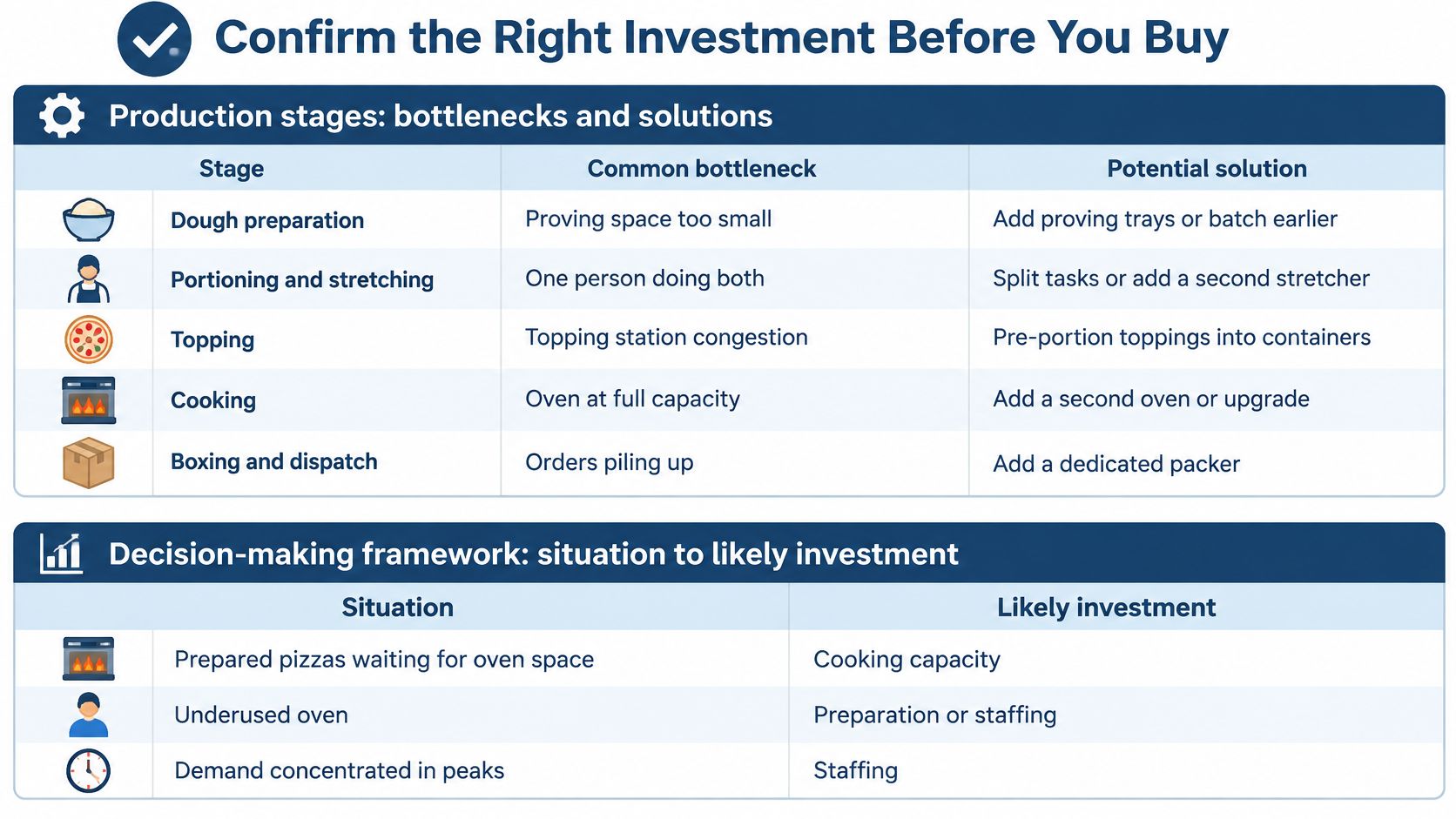
| Situation | Likely investment to investigate |
|---|---|
| Prepared pizzas waiting for oven space | Additional cooking capacity |
| Oven frequently underutilised | Preparation or staffing improvements |
| Demand concentrated into short peaks | Flexible staffing or workflow changes |
| Sustained demand exceeding production capacity | Equipment expansion |
| Multiple production bottlenecks | Coordinated equipment and staffing investment |
The sequence matters more than the conclusion. Remove the cheapest constraint first. Test temporary peak support with a part-time role over a defined period, then compare lost orders and ticket times with and without it. If a constraint remains and demand is proven, model the oven on installed cost, finance, maintenance, energy and expected life against incremental pizza volume.
Volatility is the reason to test rather than assume. The USDA Foreign Agricultural Service report on New Zealand food service notes international visitor arrivals recovering to roughly 87 to 92% of pre-COVID levels, with stronger effects in tourism centres such as Queenstown, Rotorua and Christchurch. A seasonal dip leaves a fixed asset underused in a way a rostered shift doesn't.
The checklist before any commitment
- Confirm the constraint from recorded peak data rather than impressions.
- Confirm contribution margin per pizza, not average ticket value.
- Confirm floor space, power and ventilation for any oven under consideration.
- Confirm each worker's lawful wage category and realistic rostered hours.
- Confirm total cost of ownership across the expected life.
When the constraint is cooking capacity, Simply Hospitality can help size the right deck for your menu and volume, from compact twin-deck units through to wider commercial pizza ovens, along with the dough preparation equipment, refrigerated counters and stainless benches that keep the rest of the line moving. Bring your peak-hour numbers, your space and your power supply, and the team can work through the comparison with you, including finance options through SilverChef. Visit Simply Hospitality to see the range or get in touch to talk through your kitchen.