

Which Piece of Commercial Kitchen Equipment Makes the Most Money?
The usual advice points to a coffee machine, pizza oven or combi oven as the kitchen's biggest money-maker. That skips the question that matters: which machine adds the most financial benefit after its operating costs are paid? For a New Zealand hospitality business, the answer might be equipment that sells more food, but it could just as easily be a dishwasher that clears a bottleneck or refrigeration that prevents stock losses.
Choosing which piece of commercial kitchen equipment makes the most money starts with the venue's own menu, sales and invoices. A machine's theoretical capacity means little if customers don't want its output, staff can't feed it quickly enough, or cleaning and servicing consume the expected benefit.
How Equipment Earns Its Keep Beyond Sales
Equipment doesn't need to produce a saleable item to justify its place in a kitchen. The strongest investment delivers the greatest financial benefit relative to its total cost, whether that benefit comes through sales, recovered staff time or avoided losses.
The distinction matters because operators can mistake a busy machine for a profitable one. A fryer might produce orders throughout service while leaving little contribution after food, oil and labour costs. A refrigerator produces no menu item, yet protects the ingredients needed to fulfil every order.
Separate the financial measures
- Revenue is sales income, not the amount available to repay equipment.
- Contribution margin is what remains after the relevant variable costs, including ingredients, packaging and attributable direct labour.
- Profit is what remains after the business also covers its overheads.
- Payback measures how long incremental financial benefit takes to recover the equipment investment.
These differences apply across a substantial hospitality sector. Stats NZ's business performance benchmarker recorded NZ$8,290 million in income for New Zealand cafés and restaurants in 2024, an aggregate industry figure, not an equipment return or a ranking of machines.
Equipment serving cooking, chilled storage and preparation therefore supports a broad range of hospitality operations. However, sector income can't establish whether a particular oven or cabinet belongs in a particular venue.
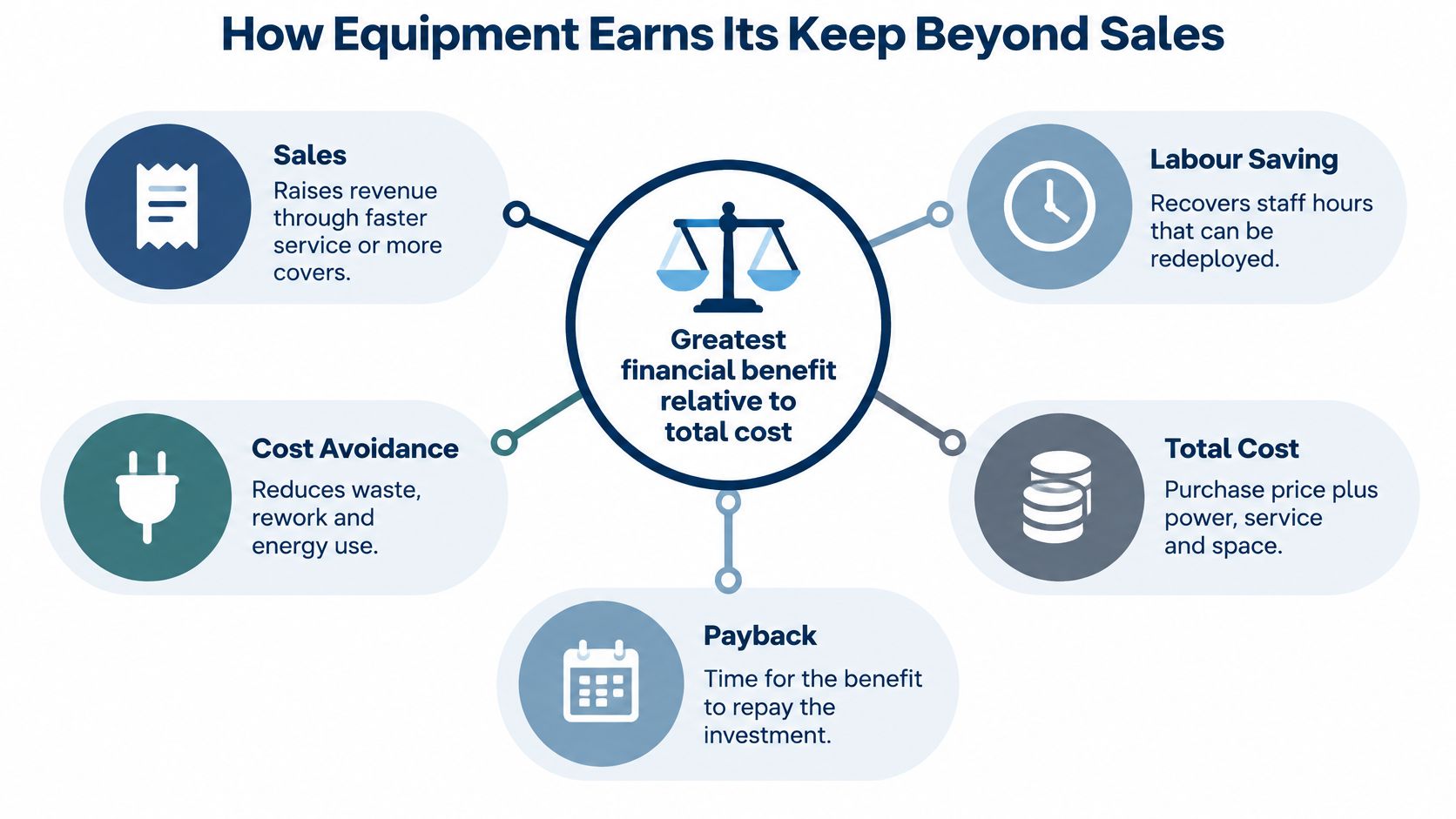
Test the financial mechanism
Equipment can contribute by generating additional revenue, enabling higher-margin products, increasing production capacity, reducing preparation time, minimising waste and improving consistency. Each mechanism needs a practical explanation, not just a feature on a specification sheet.
A programmable oven might reduce remakes. A processor might make batch preparation manageable before lunch. Suitable storage might prevent delicate ingredients being damaged or forgotten.
Purchasing test: What does the machine add, what does it remove, and what does it cost to run?
A credible purchasing case answers all those questions. A proposal that answers only the first is usually a sales forecast rather than an investment assessment.
Equipment That Directly Generates Revenue
| Equipment | Revenue opportunity | Key profitability consideration |
|---|---|---|
| Coffee machines | Espresso and milk drinks, takeaway cups, sales across the day | Daily volume, milk and bean cost per cup, and staffing at peak |
| Pizza ovens | Dedicated pizza and flatbread menu line, batch sales | Demand for the category, bake time per pizza, and dough and topping cost |
| Soft serve machines | Dessert and cone sales, add-on sales to other orders | Cone and topping costs, cleaning time, and whether customers buy dessert |
| Commercial fryers | Chips, fried sides and crumbed items | Oil cost and change frequency, portion control, and fryer capacity at peak |
| Commercial grills | Grilled mains, burgers and toasted items | Protein cost, cooking speed, and effect on menu-item margin |
| Beverage equipment | Draught beer, cocktail and juice service | Keg or stock cost, wastage when lines are idle, and line cleaning and maintenance |
None of these categories deserves an automatic first-place ranking. A fryer supporting a busy takeaway menu has a different commercial role from the same fryer handling occasional side orders in a café.
Customer demand determines whether productive capacity becomes income. Adding equipment to introduce a new category also adds purchasing, storage, training and cleaning obligations. Those obligations remain even when orders are quiet.
Cost the product before choosing the machine
Every row needs the same commercial checks:
- Selling price: Use the price customers will realistically pay, allowing for discounts and promotions.
- Ingredient cost: Work from a weighed recipe rather than an approximate food-cost percentage.
- Peak capacity: Check output during the busiest ordering period, not just across the whole day.
- Operating expenses: Include power, gas, oil, cleaning products, packaging and routine consumables.
- Staffing: Identify who prepares, serves, replenishes and cleans the equipment.
For soft serve, cleaning labour can matter as much as ingredient yield when demand is intermittent. For grills, a profitable burger recipe still needs sufficient extraction, bench space and staff to assemble orders. Beverage equipment needs convenient drainage and a cleaning routine that staff can complete.
Match the opportunity to the menu
A Faema coffee machine deserves consideration where beverage demand supports it, not just because coffee is a familiar revenue stream. The same discipline applies to a dessert machine positioned as an easy add-on sale.
Operators should identify which table row matches an established customer need, then isolate the financial driver they can't yet quantify. If dessert demand is unknown, a forecast shouldn't assume every main-course customer buys dessert. If oil usage isn't recorded, fryer profitability remains partly untested.
A strong equipment shortlist begins with menu economics. Brand and model selection follow once the required job is clear.
Coffee Machines and the Value of Frequent Small Sales
Hypothetical café example: selling 100 coffees daily at an average contribution of $3 per coffee produces $300 in daily contribution before fixed overheads. Across an illustrative 300 trading days, that becomes $90,000. These are assumed figures showing the arithmetic, not a sales forecast or an industry margin.
The assumed contribution must already allow for beans, milk, cups, lids and attributable drink-making labour. If those costs haven't been deducted, the figure isn't contribution. It's an incomplete sales calculation.
Check the actual drink mix
A long black and a large milk-based drink don't carry the same ingredient costs. Alternative milks, extra shots and takeaway packaging also change the amount retained from each transaction.
A useful operating tally includes:
- Daily cups: Separate drink types rather than treating every coffee as identical.
- Contribution per drink: Cost the recipe and packaging against the actual selling price.
- Peak queue: Record when customers wait, leave or abandon an additional purchase.
- Staff deployment: Check whether the constraint is brewing, steaming, payment or collection.
Buy for the rush, not the badge
Location, nearby competition and office or school routines influence achievable volume. A larger espresso machine won't create passing trade, and extra groups won't help when the delay is milk preparation or payment.
Faema and Casadio machines can be compared against the required peak workflow. The Faema E61 Jubile Commercial Espresso Machine, for example, combines volumetric dosing with the E61 pre-infusion platform in different group configurations.
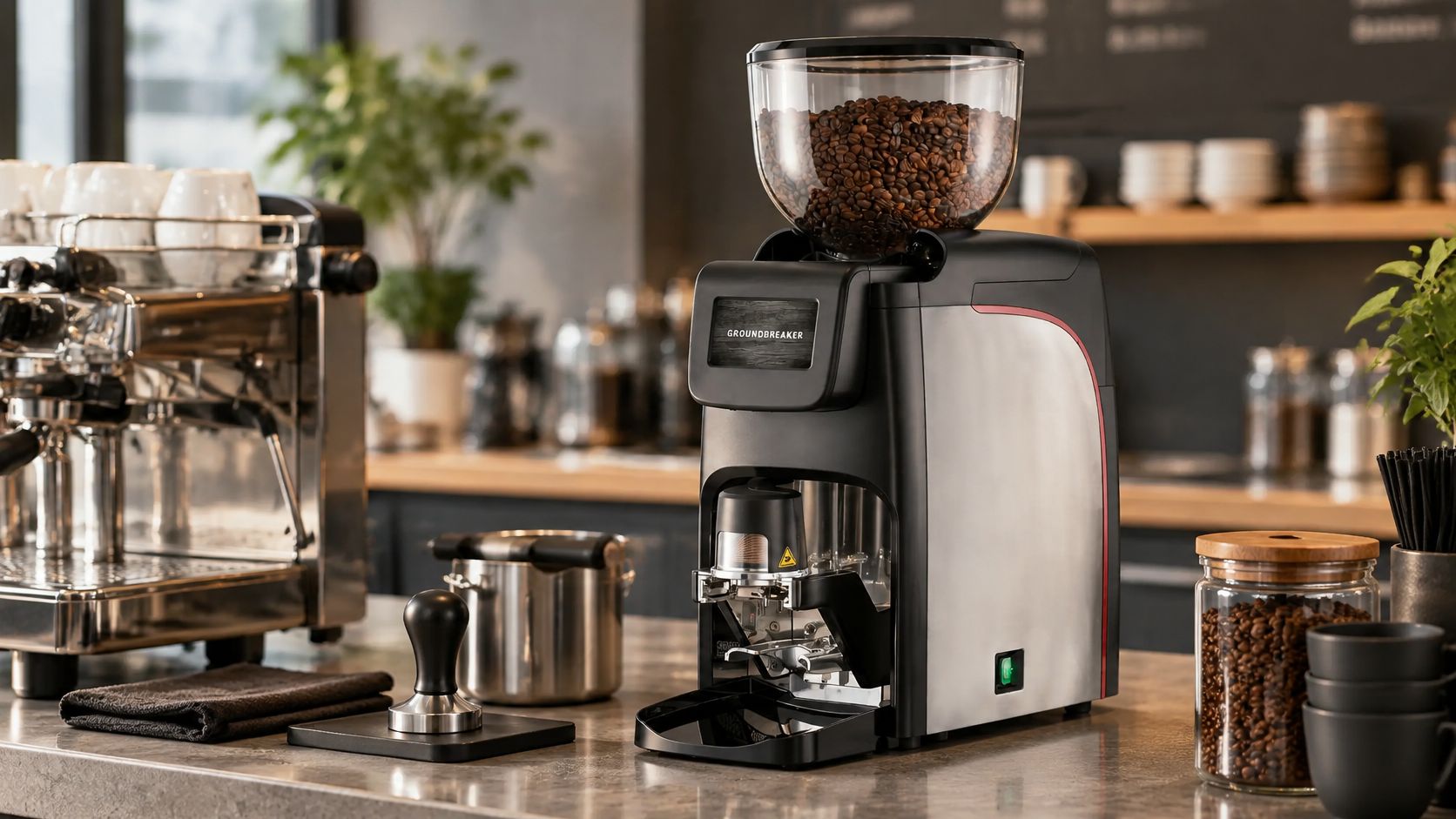
The grinder belongs in that assessment too. The Faema Groundbreaker Commercial Coffee Grinder doses freshly ground coffee directly into the portafilter, with Barista Drive System configurations and optional automatic tamper integration.
For the ownership decision, Your Coffee Machine or the Roaster's, Which Actually Costs Less? provides a relevant comparison. Is Bigger Catering Equipment Always Better? is also a useful question before extra capacity becomes an unnecessary fixed cost.
Pizza Ovens, Fryers and Combi Ovens Compared
Additional cooking capacity creates value only when customers want the output and the kitchen can deliver it. An oven can finish food faster without increasing completed orders if dough preparation, plating or delivery collection remains the limiting step.
A dedicated cooking appliance and a multifunction oven solve different problems. Compare them by what each adds to the menu, what it removes from the workload and what it costs to run, then test the payback against your own order counts rather than the number of functions on the brochure.
Dedicated output versus shared production
A pizza-led café with concentrated lunch demand is the clearest case for a dedicated oven. It supports a defined product, but its useful output still relies on dough readiness, topping organisation, loading technique and space for finished orders.
Bake time alone doesn't establish service capacity. Staff must load and unload the oven, manage the baking surface and assemble orders without blocking the next batch.
A hotel or institutional kitchen has the opposite profile: roasted proteins, banquet trays, vegetables and reheated dishes across the day. A combi oven can cover steaming, roasting, baking and reheating for that schedule, provided the menu uses those modes and staff can plan loading around each process.
| Kitchen requirement | Dedicated pizza oven | Combi oven |
|---|---|---|
| Pizza-led service | Focuses production around a specific menu category | Requires testing against the required crust and finish |
| Mixed batch cooking | Limited fit outside its intended cooking style | Supports varied production methods |
| Simultaneous tasks | Keeps pizza separate from other oven work | Requires scheduling around temperature, humidity and loading needs |
| Main purchasing risk | Insufficient pizza demand | Paying for functions or capacity the menu won't use |
Test a combi oven against your three most common recipes before buying. Unox and Convotherm combi oven ranges can be assessed against actual recipes, loading patterns and staff capability rather than claimed versatility.
Fryer recovery and convection capacity
For fryers, assess recovery between batches ahead of basket size. Loading too much cold product drops oil temperature and compromises the finish. Filtration, oil changes and access for safe cleaning belong in the running-cost calculation.
Convection ovens suit menus needing circulated dry heat, and humidity-equipped models add further control. A convection oven is a different purchase from a full combi oven, so match the specification to the cooking methods the menu calls for.
The Unox CHEFLUX Manual Manual GN Convection Oven with Humidity, 12-Tray GN 1/1, Electric uses manual controls for time, temperature, humidity and fan speed. Its 12-tray capacity pays back only where the kitchen can load it productively across the service.
A faster oven won't fix a preparation queue.
Before increasing cooking capacity, record where orders stop moving. Can a Faster Pizza Oven Increase Your Restaurant's Revenue? addresses the connection between oven speed and saleable output. Installation checks must also cover electrical supply, gas where applicable, extraction, water, drainage and service access.
Equipment That Earns by Saving Labour
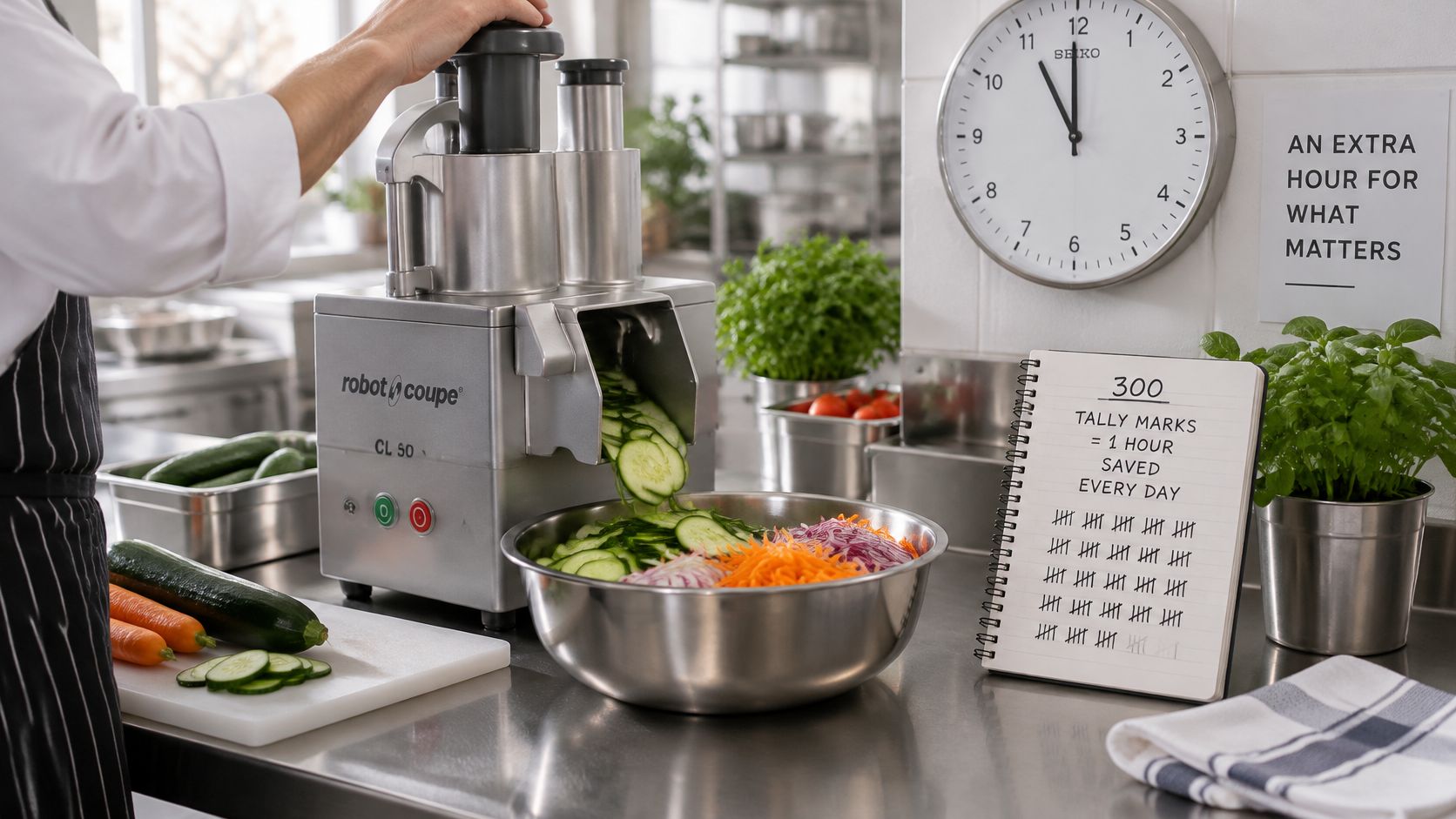
A vegetable-preparation task that ties up 60 minutes of paid time every day is the place to start. Across 300 trading days, a machine that removes that hour frees 300 hours; at an illustrative labour cost of $30 per hour, that is $9,000 of staff time a year. Treat those figures as assumptions to replace with your own roster and payroll numbers.
The freed hour earns back in three ways: paid hours or overtime fall, staff produce more saleable food on the same roster, or the time is absorbed into cleaning, training and preparation. Only the first two belong in a payback calculation.
Measure the complete task
Timing only the cutting stage overstates a processor's benefit. The comparison must include fetching ingredients, setting up discs or attachments, loading, emptying, washing and reassembly. Test each machine by what it adds to output, what it removes from the task list and what extra work it creates.
Run the same before-and-after timing across the main labour-saving categories:
- Commercial dishwashers: assess scraping, loading, wash throughput, unloading and clean-item storage. A faster cycle does not help when staff have nowhere to stack racks.
- Food processors and vegetable preparation machines: compare the required cut quality, batch size and cleaning effort with manual preparation.
- Dough mixers: match bowl capacity to actual dough batches and allow for lifting, portioning and cleaning.
- Combi ovens: test whether programmed processes reduce active supervision without creating difficult loading or cleaning routines.
Identify where the released time goes
Robot Coupe food preparation equipment is worth comparing where repetitive cutting occupies a meaningful part of the prep shift. Winterhalter and Classeq warewashing deserve assessment where dirty crockery interrupts service or pulls staff away from food production.
Neither purchase should rest on a general promise of efficiency. You need a before-and-after task measurement, a staffing plan for the freed minutes and a payback figure built from your own invoices and sales.
For a task-by-task comparison, which piece of commercial kitchen equipment saves the most labour is a useful starting point. The common purchasing mistake is mechanising work that leaves output unchanged while the service bottleneck stays untouched.
Equipment That Protects Profit Before It Sells
Refrigeration, freezers, blast chillers and storage equipment earn their place by keeping purchased ingredients and prepared food usable. Their financial contribution is easier to understand when operators record what happens during a failure: discarded stock, replacement preparation, interrupted service and emergency repair costs.
For chilled storage, Ministry for Primary Industries temperature-control guidance identifies 5°C or below, or above 60°C for hot food, as temperature-control conditions. Cabinet performance therefore needs checking under normal loading and door-opening conditions, not only when the kitchen is quiet.
Protect the production already paid for
Freezers support stock held for later use, but poor labelling and inaccessible shelving can still leave food forgotten. Suitable containers, clear dates and a practical stock-rotation layout matter alongside the refrigeration system.
Blast chilling supports batch preparation when the cooling process is controlled. MPI's further-processing guidance requires potentially hazardous cooked food to cool from 60°C to 21°C within two hours, then to 5°C within a further four hours, a maximum total of six hours.
For sauces, soups, cooked meats and other batch-prepared food, that makes cooling capacity part of the production plan. A standard storage refrigerator shouldn't be assumed capable of cooling a large hot batch safely.
Hot holding needs equal attention. MPI's hot-food guidance requires thermometer checks every two hours when food is held hot for more than two hours, and disposal when food has been between 21°C and 60°C for more than two hours.
Check capacity, control and support
Before purchasing protective equipment, complete these checks:
- Loaded performance: Confirm temperature control with the usual product load and service activity.
- Usable capacity: Allow airflow and workable shelf spacing rather than filling every available gap.
- Local service: Establish access to technicians and parts before a breakdown occurs.
SKOPE and Atosa refrigeration and Irinox blast chillers are ranges to compare against those requirements. Cleaning condenser areas, inspecting seals and keeping air paths clear should form part of routine maintenance.
Food preservation also depends on process. How Much Food Waste Can Vacuum Packing Eliminate? is relevant when reviewing portioning and storage, without treating packaging as a replacement for temperature control.
Water-dependent equipment needs suitable treatment too. Ring Hot Water's resource on sizing water filters for busy offices provides related context, although hospitality equipment must be matched to its own water-quality and demand requirements.
How to Calculate Payback for Each Equipment Type
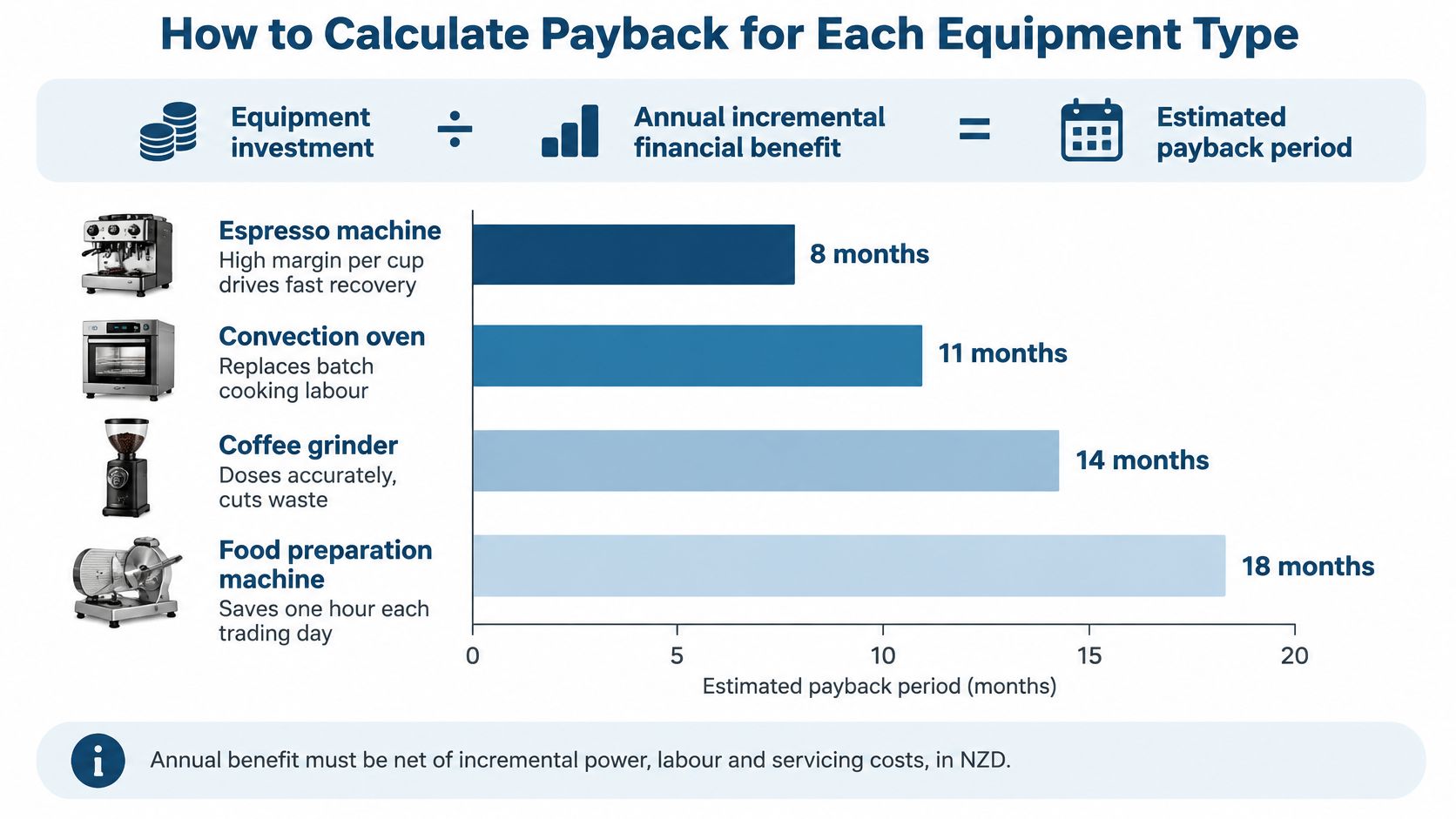
Equipment investment ÷ Annual incremental financial benefit = Estimated payback period
Use the installed investment, including delivery, commissioning and necessary site work. The annual benefit must be net of incremental power, ingredients, consumables, cleaning, servicing and added labour. Otherwise, the calculation makes the investment look better than it is.
Illustrative simple payback comparison
The following NZ dollar figures are hypothetical calculations only. They aren't actual equipment prices, quotations or typical returns.
| Equipment | Installed cost | Annual incremental benefit | Simple payback |
|---|---|---|---|
| Coffee machine | $12,000 | $18,000 | 8 months |
| Pizza oven | $20,000 | $15,000 | 16 months |
| Food processor | $4,000 | $6,000 | 8 months |
In the hypothetical coffee example, $12,000 ÷ $18,000 gives approximately 0.67 years, or eight months. The pizza oven calculation gives approximately 1.33 years, or sixteen months, while the processor recovers its assumed investment in approximately eight months.
These results show the method, not which category deserves priority. The processor's benefit might rely on roster changes, while the coffee machine's benefit might rely on additional customers. Those assumptions need different evidence.
The following graphic illustrates separate payback scenarios. Its figures are illustrative, not equipment benchmarks, and don't represent the table's assumptions.
Build the annual benefit from records
Use sales reports and recipe costs to estimate additional contribution. Use measured tasks and a staffing plan for labour benefits. Use disposal records and purchase invoices for avoidable stock losses.
For replacement refrigeration, compare equivalent usable capacity and operating conditions. EECA's food and beverage service sector pathway reports that refrigeration accounted for 22% of energy consumption in New Zealand's accommodation and food services sector in 2022, compared with 15% for commercial ovens and cooking elements.
Those sector shares don't establish a particular cabinet's electricity bill. Obtain comparable consumption information and apply the site's tariff, allowing for ambient conditions, door opening, defrost and maintenance.
- Avoid double counting: Don't claim both payroll savings and extra output from the same released labour unless both occur.
- Test lower utilisation: Recalculate with quieter demand or a slower sales ramp-up.
- Allow for disruption: Include installation downtime and a realistic service contingency.
- Check the selling requirement: How Many Ice Creams Does a Soft Serve Machine Need to Sell to Pay for Itself? applies this discipline to a new product category.
Look beyond the payback date
Useful life, maintenance, local support and eventual residual value affect the longer-term decision. What Is the Hidden Cost of Buying Cheap Hospitality Equipment? is a relevant question when a low purchase price conceals difficult servicing or expensive consumables.
Financing changes cash-flow timing, not the underlying unfinanced equipment payback. Interest, fees and ownership terms still belong in a separate financed cash-flow assessment.
Confirm Your Investment Priority Before You Buy
| Business objective | Equipment to investigate |
|---|---|
| Increase beverage sales | Commercial coffee equipment |
| Expand pizza production | Commercial pizza ovens |
| Introduce additional dessert sales | Soft serve machines |
| Reduce preparation time | Food processors and mixers |
| Improve kitchen versatility | Combi ovens |
| Reduce warewashing bottlenecks | Commercial dishwashers |
| Protect stock and reduce losses | Commercial refrigeration |
The priority should follow the constraint in the operation. A venue losing covers to a slow pass-through gains more from clearing the warewashing queue than from another oven, and a kitchen discarding spoiled stock needs reliable chilled storage before any expansion of production.
Complete the purchasing checks
- Measure demand: Record orders and unmet demand during the busiest service.
- Confirm contribution: Cost the actual menu mix after ingredients, packaging and attributable labour.
- Time the work: Identify the tasks consuming staff hours.
- Locate the stoppage: Establish where production pauses before selecting equipment.
Should You Buy Another Pizza Oven or Hire Another Staff Member? captures the practical choice: extra capacity and extra labour solve different problems. Neither is useful when the other part of the operation remains the constraint.
Hospitality Finance offers SilverChef Finance and SKOPE Funding. SilverChef lets customers own top-tier commercial kitchen equipment without paying the full upfront cost. Finance proposals should still be compared against the same operating assumptions, with repayments and fees assessed separately.
For most established venues, improving an existing constraint beats adding a new product line. Buy only when the projected monthly gain from the machine, whether extra sales or hours saved, clears the monthly cost of owning and running it within the payback period you have set.
The team supplies commercial kitchen equipment and helps New Zealand hospitality businesses assess capacity, workflow and ownership considerations. Visit Simply Hospitality and contact the team with the proposed menu, peak production requirements and site details to discuss equipment that addresses the business's actual constraint.