


What Is the Cost of Equipment Downtime During Friday Night Service?
The Friday reservation book is full, prep is ready, and an appliance stops just as orders reach the pass. The cost of equipment downtime during Friday night service is the contribution lost on orders the venue can't fulfil, plus additional breakdown expenses and any continuing disruption. The repair invoice is only part of that total. A useful calculation separates those costs without counting lost turnover and lost contribution twice.
A Worked Friday Night Loss
Hypothetical example, all amounts in NZ dollars: a restaurant normally generates $6,000 in Friday night sales. An equipment failure reduces the orders it can fulfil by 25%, leaving $1,500 in potential lost revenue.
At an illustrative 60% contribution margin, the estimated lost contribution is $900. The restaurant avoids $600 of variable costs associated with orders never prepared, such as ingredients and packaging. Those avoided costs aren't another loss.
Friday night downtime cost calculation
| Line | Value | Where the number comes from |
|---|---|---|
| Friday night sales | $6,000 | Hypothetical baseline; in practice, use the venue's own 30- or 60-minute Friday takings, not a daily average |
| Share of orders the kitchen could not serve | 25% | Hypothetical covers turned away, tickets not taken and tables not reseated |
| Potential lost revenue | $1,500 | $6,000 × 25% |
| Illustrative contribution margin | 60% | Hypothetical; use the venue's own food, packaging and other variable costs |
| Variable cost avoided | $600 | $1,500 × 40%, for orders never made |
| Estimated lost contribution | $900 | $1,500 less $600 |
| Sales recovered on a shortened menu | Deduct | Alternative dishes still sold reduce lost revenue before the appropriate margin is applied |
| Extra cash costs and repair invoice | Add separately | Incremental call-out charges, parts, extra staff hours, waste and customer remedies, without duplicate entries |
Lost revenue isn't lost profit. Contribution is what remains after relevant variable costs, before fixed operating costs. Losing that contribution leaves less money available for rent, rostered wages and other commitments.
The repair invoice hasn't entered this calculation yet.
Rules that keep the calculation honest
- Use the actual service window. Friday sales records should reflect the period affected, rather than spreading weekly revenue evenly across opening hours.
- Credit recovered sales. If guests choose grill dishes instead of unavailable fried meals, count the contribution retained.
- Separate refunds from avoided costs. A refunded meal that has already been prepared still consumed ingredients. Record the refund once and account for the actual food cost, rather than assuming that cost disappeared.
For scale, a New Zealand café and restaurant business-interruption analysis places small café annual revenue at approximately NZ$200,000 to NZ$600,000, and established full-service restaurants at NZ$500,000 to NZ$2 million or more. Those broad ranges aren't a forecast for an individual venue; they reinforce why the value of the interrupted service matters more than a generic daily average.
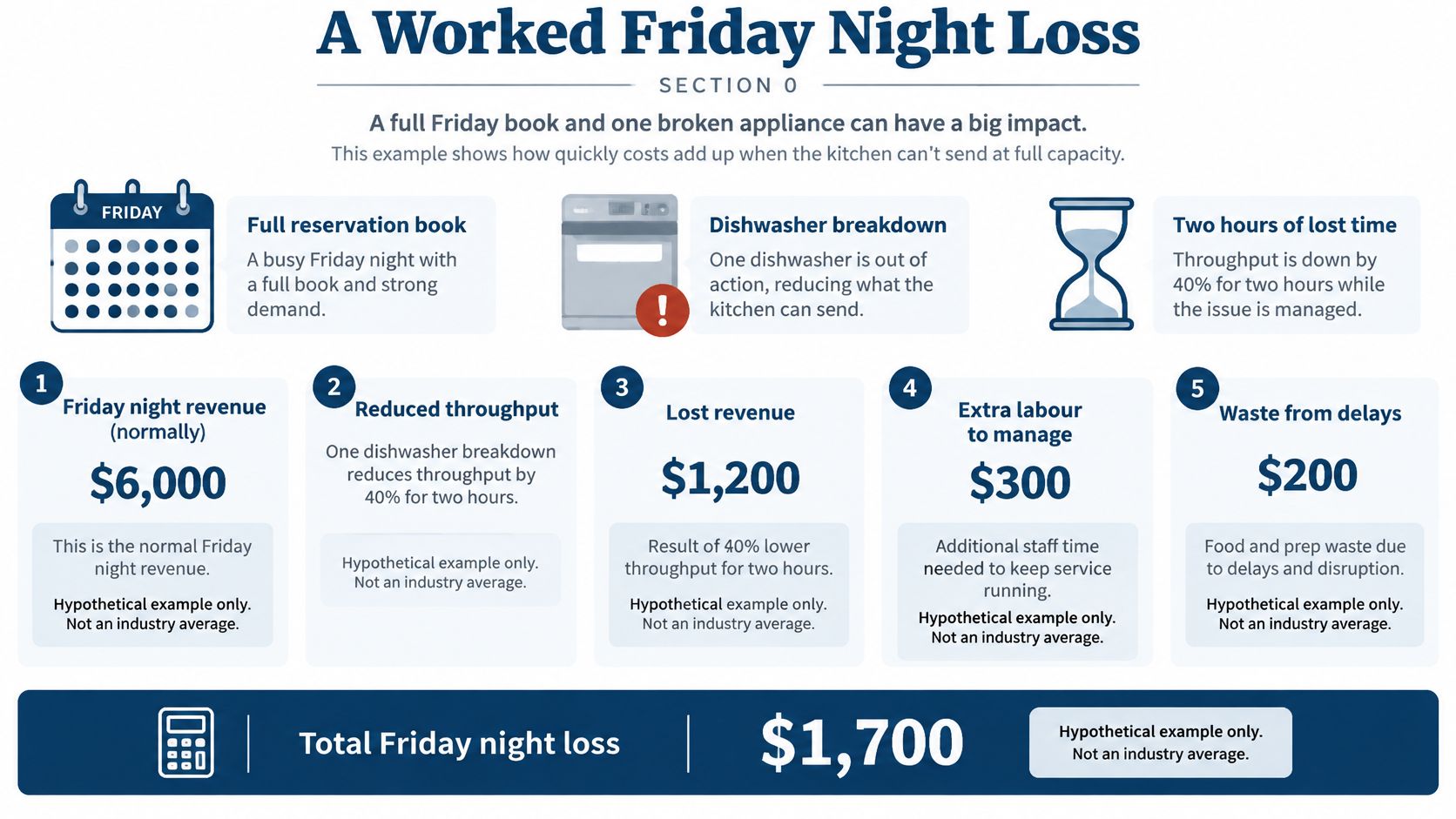
The following graphic presents a separate hypothetical gross-exposure example, not the contribution calculation above. Its turnover-based total shouldn't be treated as a net profit loss without adjusting for avoided variable costs.
Why Friday Night Is a Different Cost
An oven fault during a quiet weekday might mean pausing a special and moving the remaining orders to another appliance. During a fully booked Friday, that alternative oven may already be occupied, the dining room may already be seated, and every ticket may carry a time-sensitive promise.
The appliance hasn't changed. The available recovery options have. Chefs have less spare production capacity, while floor staff must explain delays, manage unavailable dishes and prevent new orders from exceeding what the kitchen can deliver.
Demand already committed
Friday disruption affects work already underway: prepared ingredients, rostered staff, seated guests and bookings still to arrive. A delayed order can also prevent the next table from being seated, so the commercial exposure isn't limited to tickets currently on the rail.
During one Friday technology disruption, hospitality spending across the Auckland, Wellington and Christchurch city centres was 5.6% above the average of the previous four Fridays, according to RNZ's reporting on transaction data. That specific event isn't a universal Friday uplift, but it illustrates why operators should assess the actual trading window rather than assume an average hour.
Practical rule: A missed peak-service order often can't be sold again after the room has emptied.
Access to help isn't the same as access to parts
Hospitality's office hours are Monday to Friday, 9am to 5pm. Those hours aren't an emergency repair commitment, and operators shouldn't assume an evening fault can be resolved through a normal trade desk.
A service contact may answer without having the required part or a technician available. Planning around that distinction is central to protecting the busiest trading days with reliable equipment.
Equipment Failures That Stop Service
The most disruptive appliance isn't necessarily the largest or most expensive. It's the one the venue's menu and service model can't work around.
A fryer failure can remove the core offer from a takeaway operation. In a restaurant with a substantial grill menu, the same fault might require a controlled menu reduction rather than stopping service.
How Friday night failures hit different equipment
| Equipment | Immediate impact | Potential commercial consequences |
|---|---|---|
| Commercial ovens | Mains, roasting and batch work stop or slow | Lost covers, a shortened menu and pressure on any remaining appliance |
| Fryers | Fried items become unavailable or queue badly | Severe disruption for takeaway and pub menus built around fried volume |
| Refrigeration | Safe chilled or frozen stock is at risk | Discard decisions, a shrinking menu and a possible stop to service |
| Commercial dishwashers | Clean plates and glasses stop circulating | A full-service bottleneck even while cooking continues |
| Pizza ovens | Pizza production stops or slows sharply | High impact where pizza is the core Friday offer |
| Ice machines | Bar, post-mix and cold service lose their ice supply | Slower drinks, difficulties with chilled displays and emergency purchasing |
| Coffee machines | Espresso and milk drinks stop | Lost café orders and interrupted restaurant finishes |
Refrigeration deserves particular attention because it supports ingredients across multiple stations. A cooking fault may remove selected dishes; a refrigeration fault can make the ingredients for otherwise functioning stations unavailable.
Dishwashing has a different dependency. A takeaway using suitable disposable packaging may retain much of its output, while a full-service restaurant can run out of clean crockery even with every burner operating.
Match capacity to the actual menu
Relevant equipment ranges include SKOPE and Atosa refrigeration, Waldorf and Blue Seal cooking equipment, Unox, Convotherm and Turbofan ovens, and Winterhalter and Classeq warewashing. The badge alone doesn't establish suitability. Peak batch sizes, recovery between loads, cleaning requirements and installation conditions all matter.
For example, the Convotherm CXGBT10.20D - 22 Tray Gas Combi-Steamer Oven - Boiler System - Disappearing Door uses boiler-generated steam and accommodates 22 × 1/1 GN or 11 × 2/1 GN trays, according to its catalogue specification. Its disappearing door retracts alongside the oven, reducing aisle obstruction during loading.
That configuration warrants consideration where sustained steaming, batch production and aisle access match the kitchen's needs. It doesn't establish that concentrating all production in that appliance is the right resilience decision.
- For batch-led kitchens: Assess whether another appliance can finish essential production if the main oven stops.
- For takeaway operations: Check whether separate cooking capacity can preserve the best-selling items.
- For full-service restaurants: Consider crockery reserves and wash capacity alongside cooking output.
No brand or specification makes equipment immune to breakdown.
How One Breakdown Slows the Whole Kitchen
Hypothetical scenario: a commercial dishwasher fails midway through a fully booked restaurant service. The ovens, refrigeration and cookline still work, but the restaurant washes its crockery and glassware on site.
Initially, staff continue serving from clean reserves. Dirty plates then accumulate, the next wash rack can't be processed, and the bar starts running short of glassware.
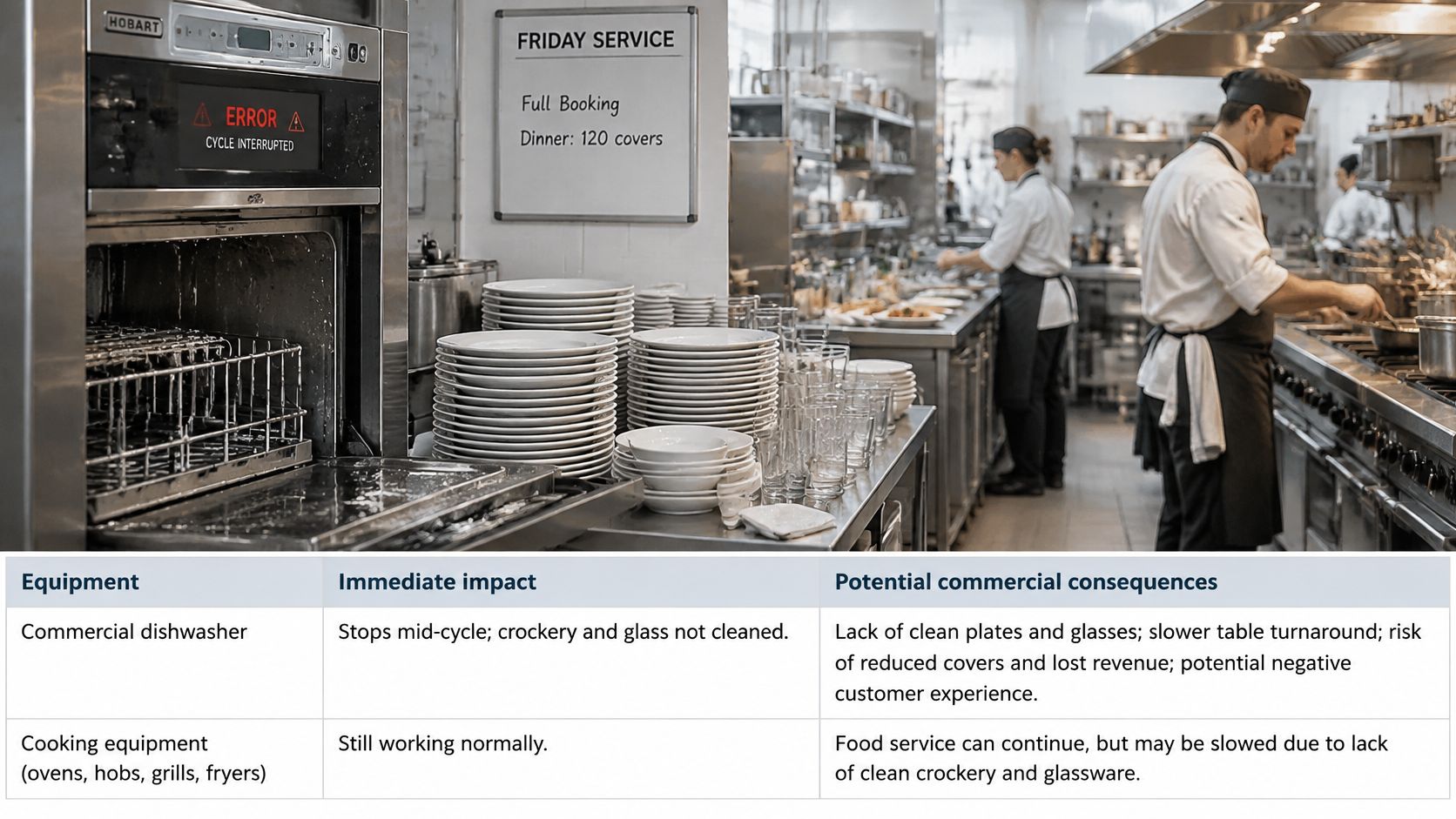
Follow the queue through the operation
The pass starts waiting for plates rather than food. Floor staff wait for finished dishes, drinks take longer to leave the bar, and tables remain occupied while guests wait for their next course.
A kitchen hand moves from preparation to washing. If a cook joins that effort, the kitchen loses production capacity at another station, even though its cooking equipment remains operational.
- Plate availability: Dishes that need particular bowls or platters become harder to send.
- Glassware turnaround: The bar may need to simplify drinks service around available clean stock.
- Staff allocation: Washing, drying and moving crockery compete with clearing tables and preparing food.
- Table service: Slower clearing and course delivery can delay the next sitting.
This is why waiting during peak service has a commercial cost beyond the broken machine. Each handover can leave another employee unable to complete the next task.
A workaround needs its own capacity check
Manual washing is only a bridge if the venue can maintain its food-control-plan requirements for cleaning and sanitising, including suitable water conditions, chemical use, contact time and separation of dirty and clean items. Staff shouldn't improvise a process that produces visibly clean but inadequately sanitised crockery.
Protecting a reserve of plates for best-selling mains may be more practical than attempting the full menu. The decision should reflect remaining bookings, spare crockery, suitable wash facilities and any independent second machine.
A workaround isn't free capacity. Its labour, hygiene requirements and effect on neighbouring stations must be counted.
The useful question isn't whether staff can wash by hand. It's whether they can do so safely while preserving enough capacity to serve the remaining room.
Hidden Costs Beside the Lost Sales
The breakdown record should separate lost contribution from additional expenditure. Combining lost turnover, lost contribution and every wage paid during the interruption produces an inflated total that won't support a sound replacement decision.
Rostered staff may remain on payroll while output falls. Those wages remain commercially important, but wages that would have been paid anyway aren't automatically an additional breakdown expense.
Record costs that actually change
- Repair charges: Record the call-out, diagnostic work, parts and subsequent visits against the incident.
- Additional labour: Include genuine overtime, extended shifts or extra staff called in, rather than counting the normal roster again.
- Stock loss: Identify ingredients discarded because of unsafe temperatures, delayed production or meals that couldn't be served.
- Customer remedies: Record refunds, replacement meals and complimentary items once, using their actual accounting treatment.
- Temporary arrangements: Capture transport, purchased ice, suitable temporary equipment and additional delivery expenses.
- Recovery work: Include extra cleaning, stock replacement and management time where these create an identifiable additional cost.
A refund requires care. If the sales record already shows it as reversed revenue, adding the refund again as a separate loss counts the same money twice.
Food safety can require a stock write-off
The Far North District Council food-safety newsletter advises keeping chiller and freezer doors closed during power outages, maintaining chillers at 5°C or below and freezers at −18°C or below, and discarding perishable food held above 5°C for more than two hours. Its door-closed guidance describes refrigerated food remaining safe for up to four hours and freezer contents for up to 48 hours, subject to temperature checks.
These aren't guarantees for a busy kitchen repeatedly opening a failing cabinet. Staff need actual food temperatures, elapsed times and the venue's food-control-plan procedures, not an assumption based on how cold the cabinet feels.
The Ministry for Primary Industries food-control guidance identifies 5°C to 60°C as the temperature danger zone and requires hot holding at 60°C or above; hot food held between 21°C and 60°C for more than two hours must be discarded. Equipment repair or replacement and a review of maintenance controls also form part of the corrective response.
Commercial Kitchen Equipment Troubleshooting is a useful related reading topic for recognising warning signs, but it isn't permission for staff to undertake electrical, gas or refrigeration repairs. The incident record should preserve alarm messages, probe readings, stock identification and the corrective action taken.
The Cost That Shows Up After the Night
Guests experience a delayed meal, an unavailable dish or a cancelled booking, not the failed component behind it. An uneven service can affect confidence, repeat visits and online reviews, although it would be misleading to assign every disappointed guest a permanent financial loss.
The immediate priority is a service promise the kitchen can still fulfil. Honest, specific communication is more useful than repeatedly extending an optimistic waiting time.
Recovery can outlast the interruption
Reporting on the 2024 Northland power cut provides an infrastructure example rather than a typical appliance-repair benchmark: RNZ reported a caterer's estimated direct cost of NZ$15,000 to NZ$20,000 after refrigerated and frozen stock losses disrupted three back-to-back functions, while many small businesses lost two to three days of income.
A single-machine failure has a narrower scope, but the practical question remains: what prevents normal service from resuming? A repaired refrigerator doesn't replenish discarded ingredients, and a functioning oven doesn't restore cancelled function preparation automatically.
Protect the service that remains
- Explain the constraint early: Guests should know which dishes are unavailable before ordering.
- Offer a controlled alternative: A smaller menu executed properly is preferable to accepting orders the kitchen can't deliver consistently.
- Assign a communication lead: The duty manager should give the floor a consistent explanation and realistic service expectations.
- Confirm reopening readiness: Safe stock, completed preparation and available staff matter alongside the repaired appliance.
The related article on commercial kitchen equipment service near the venue can support planning around service access. Availability still needs confirmation for the specific equipment and operating period.
Protecting the customer experience can remain worthwhile even when lost covers can't be recovered. It gives guests a fair explanation and a clear choice, rather than leaving them to discover the problem through repeated delays.
Reliability Against the Purchase Price
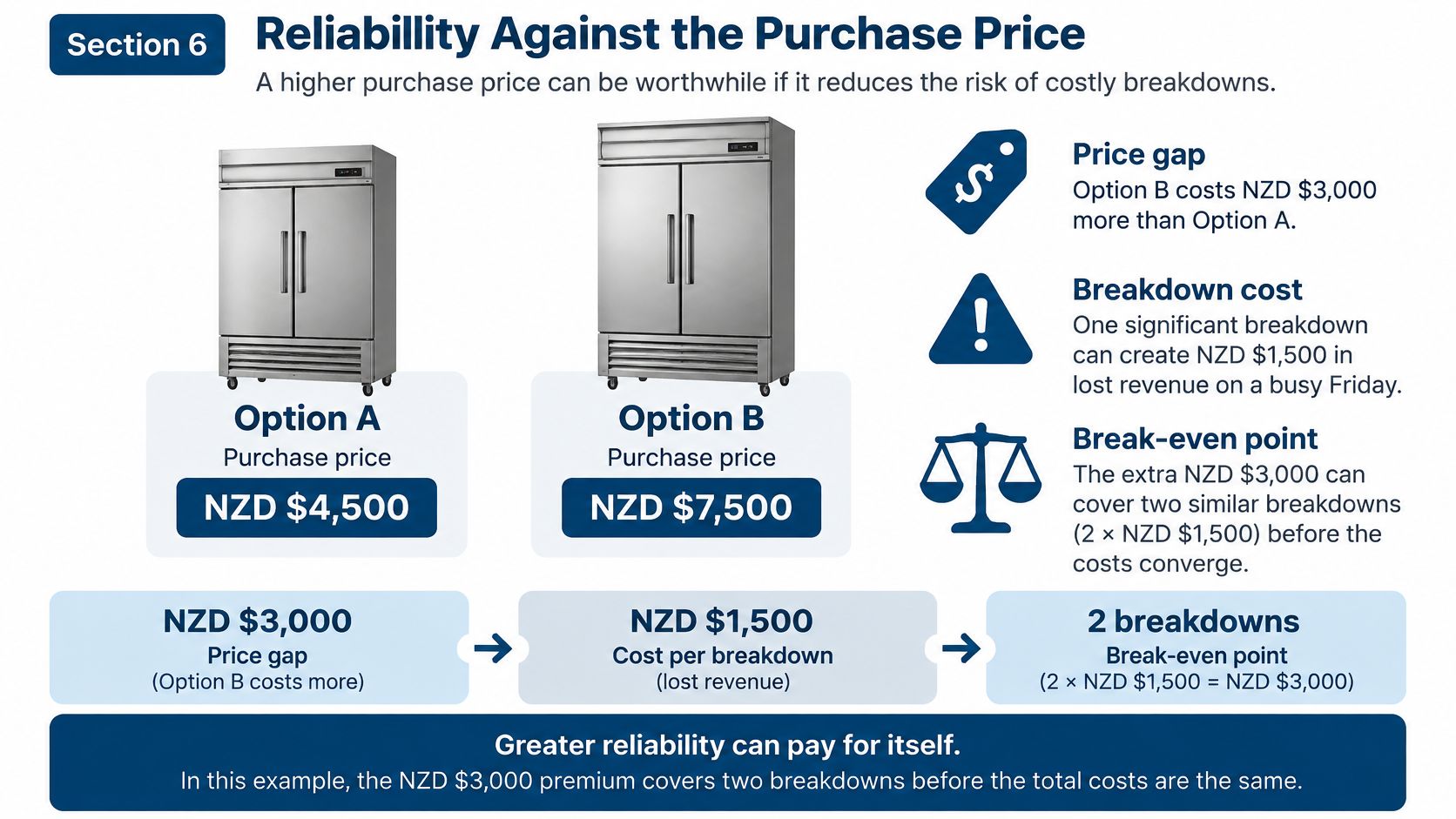
Separate hypothetical comparison, in NZ dollars: a higher-specification appliance costs $3,000 more than an alternative. If a significant breakdown creates $1,500 in combined lost contribution and additional expenses, the price difference equals the financial impact of two such incidents.
That arithmetic doesn't prove the dearer appliance will prevent either incident. Premium equipment still breaks, and a lower-priced unit may be entirely suitable for a lighter workload.
The graphic below uses a simplified turnover-based comparison. Its visual convergence point isn't a forecast of failure frequency or a demonstrated financial return; a purchasing decision needs the contribution-based incident cost described above.
Evidence worth comparing
| Buying consideration | Practical question |
|---|---|
| Construction and duty suitability | Can the appliance handle the menu's sustained peak workload, not just an occasional full load? |
| Warranty coverage | What is covered, what is excluded, and what maintenance evidence is required? |
| Spare parts | Which critical parts can realistically be obtained locally? |
| Servicing support | Are qualified technicians familiar with the model and available in the region? |
| Installation | Do access, ventilation, drainage and site services suit the equipment? |
| Cleaning access | Can staff complete the required cleaning without an impractical interruption? |
A café, pizza-led restaurant and aged-care kitchen won't give each criterion the same weight. Their menus, service commitments and consequences of interruption differ.
What Is the Hidden Cost of Buying Cheap Hospitality Equipment? is a useful purchasing question, while assessing whether ageing equipment costs more than expected helps distinguish a repairable issue from an unacceptable operational dependency.
Ownership includes delivery and support planning
Hospitality offers equipment finance through SilverChef Finance. Finance changes payment arrangements, not reliability; bulky-equipment freight is calculated separately, some special-order items are non-returnable, and custom-built equipment requires plenty of lead time during peak season.
Insurance also deserves a practical check:
- Cover: Confirm whether accidental breakdown, stock spoilage and business interruption are included.
- Excess and exclusions: Establish what the business would retain itself.
- Evidence: Keep service records, temperature logs, photographs and a written fault report.
Buying judgement: Reliability should be evaluated beside purchase price, not inferred from it.
How to Reduce Friday Night Downtime Risk
A useful plan identifies what staff will do when an appliance stops, not merely when its next service is due. Preventative maintenance and contingency planning reduce risk, but they can't eliminate equipment failures.
The operational checklist should be part of the pre-service routine rather than an emergency document nobody has opened.
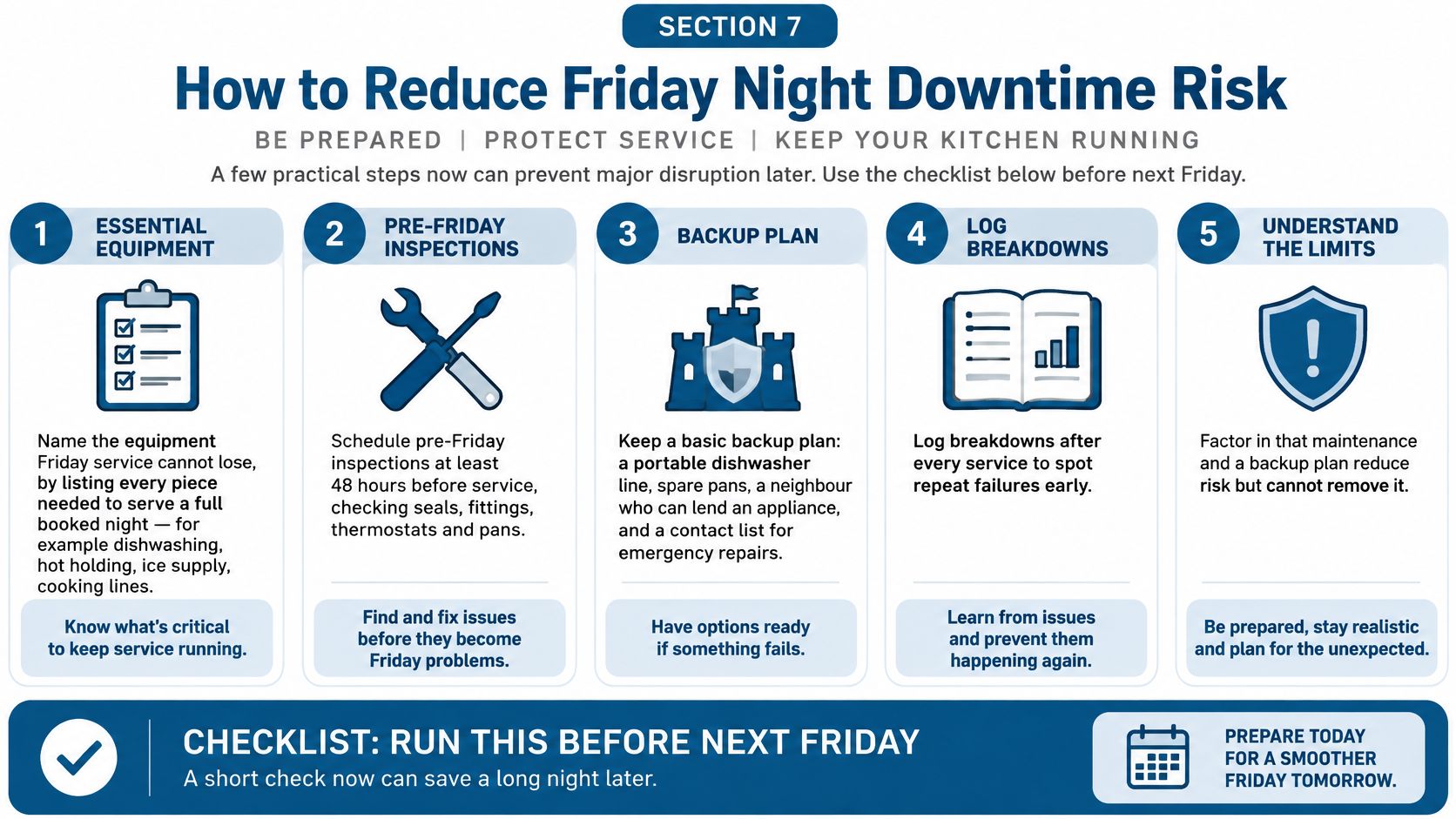
Eight actions before the next peak service
- Identify critical equipment. Map the booked menu against the appliances needed to produce, hold and serve it. Rank the consequences of losing each machine.
- Complete routine cleaning and maintenance. Follow the manufacturer's schedule and use qualified technicians where required. The related guidance on preventative equipment cleaning supports this planning.
- Act on early warning signs. Record unusual noises, temperature drift, longer cycles, poor recovery and recurring error messages. Repeated resets aren't a diagnosis.
- Confirm service access. Keep model details, serial numbers and qualified service contacts accessible. Confirm after-hours arrangements instead of assuming they exist.
- Assess independent spare capacity. Multiple appropriately sized appliances may preserve part of production when one stops. They also require space, cleaning and maintenance, and shared power, water or gas supplies can still leave both unavailable.
- Write alternative service arrangements. Prepare a reduced menu, safe stock-transfer options and any approved manual processes. Is Your Commercial Kitchen Designed for Growth? is a relevant planning question when assessing room for backup capacity.
- Train the team on safe breakdown procedures. Assign responsibility for stopping the station, isolating equipment safely, communicating with guests and logging times and temperatures.
- Plan replacement before reliability becomes unacceptable. Consider recurring faults, peak-load suitability, parts support and installation lead times. Commercial Kitchen Equipment Maintenance belongs alongside that replacement assessment.
Use outage guidance in its proper context
MPI's power-outage guidance distinguishes unopened refrigerators without power for less than 24 hours, whose contents require checking and may be safe, from outages exceeding 24 hours or refrigerators opened beyond briefly adding ice, when readily perishable food should be discarded; it also sets freezer exclusions including more than four days without power, opening, incomplete filling or evident thawing.
Those conditions aren't a blanket holding allowance for an operating kitchen. Food-control-plan procedures and measured time-temperature history should govern the decision, not appearance or smell.
Hospitality accepts Service Requests and Warranty Claims through its website. These submission routes aren't an emergency call-out commitment.
Hospitality suppliers provide commercial refrigeration, cooking and warewashing equipment for New Zealand hospitality businesses. Visit Simply Hospitality to discuss equipment matched to the venue's Friday menu, peak workload and available backup capacity, with long-term ownership costs considered alongside purchase price.