

Best Professional Cooking Utensils for NZ Kitchens
The best professional cooking utensils aren't necessarily the most expensive tools or the largest set on the shelf. They're the utensils that match the menu, cookware, cleaning system and people using them shift after shift. For New Zealand restaurants, cafés, caterers, bakeries and institutional kitchens, that means judging each tool by fit, construction, hygiene, comfort and whole-of-life value, not by the number of pieces in a box.
Why the Right Utensil Matters More Than the Biggest Set
A large utensil set can look like good value until half of it sits untouched in a drawer. Meanwhile, the tongs used at every service loosen, the favourite turner disappears into another section, and the one ladle that delivers the correct portion needs replacing. In a compact commercial kitchen, unused tools also consume storage space and make the tools that matter harder to find.
The right professional utensil earns its place through repeated use. A café with a short menu may need several dependable pairs of tongs, a few turners, a whisk, a portioning ladle and compact storage. A restaurant with sauces, grilled proteins, pastry work and high-volume plating will need a broader selection, but it still benefits from buying around actual tasks rather than purchasing every possible tool.
What professional grade should mean
“Professional grade” isn't a universal technical certification. Buyers should assess the product specification and construction instead of relying on the wording printed on packaging.
A commercial utensil should be considered against:
- Frequency of use: Domestic tools may cope with occasional cooking but fail sooner when repeatedly heated, washed and handled across several shifts.
- Construction: One-piece bodies, sealed joints, rounded transitions and fully bonded handles generally leave fewer places for food residue to collect.
- Heat exposure: The tool must suit the temperatures and equipment where it will be used.
- Ergonomics: Grip, balance and handle length affect comfort when staff repeat the same movement throughout service.
- Cleanability: Smooth, impervious surfaces are easier to wash, sanitise and inspect.
- Replacement availability: Operators should be able to reorder a familiar tool individually instead of replacing an entire proprietary set.
The MPI food-safety culture research found that 95 percent of New Zealand businesses had formal food-safety policies and rules, while only 69 percent had specific food-safety goals or key performance indicators. Those figures make utensil construction more than a durability issue. A utensil that is difficult to clean or inspect can undermine the gap between written policy and monitored practice. (MPI food-safety culture research)
Practical rule: If a utensil has a hollow handle, loose rivets, deep seams or a damaged surface, its apparent low price may not reflect its operating cost.
The same logic applies to purchasing decisions generally. The discussion of buying cheap versus buying once is relevant to smallwares because replacement, cleaning and service disruption matter alongside the initial invoice.
Essential Professional Cooking Utensils for Commercial Kitchens
The core collection should follow the menu. Not every kitchen needs every utensil below, and a bakery shouldn't be equipped as though it runs a grill station and a soup pass.
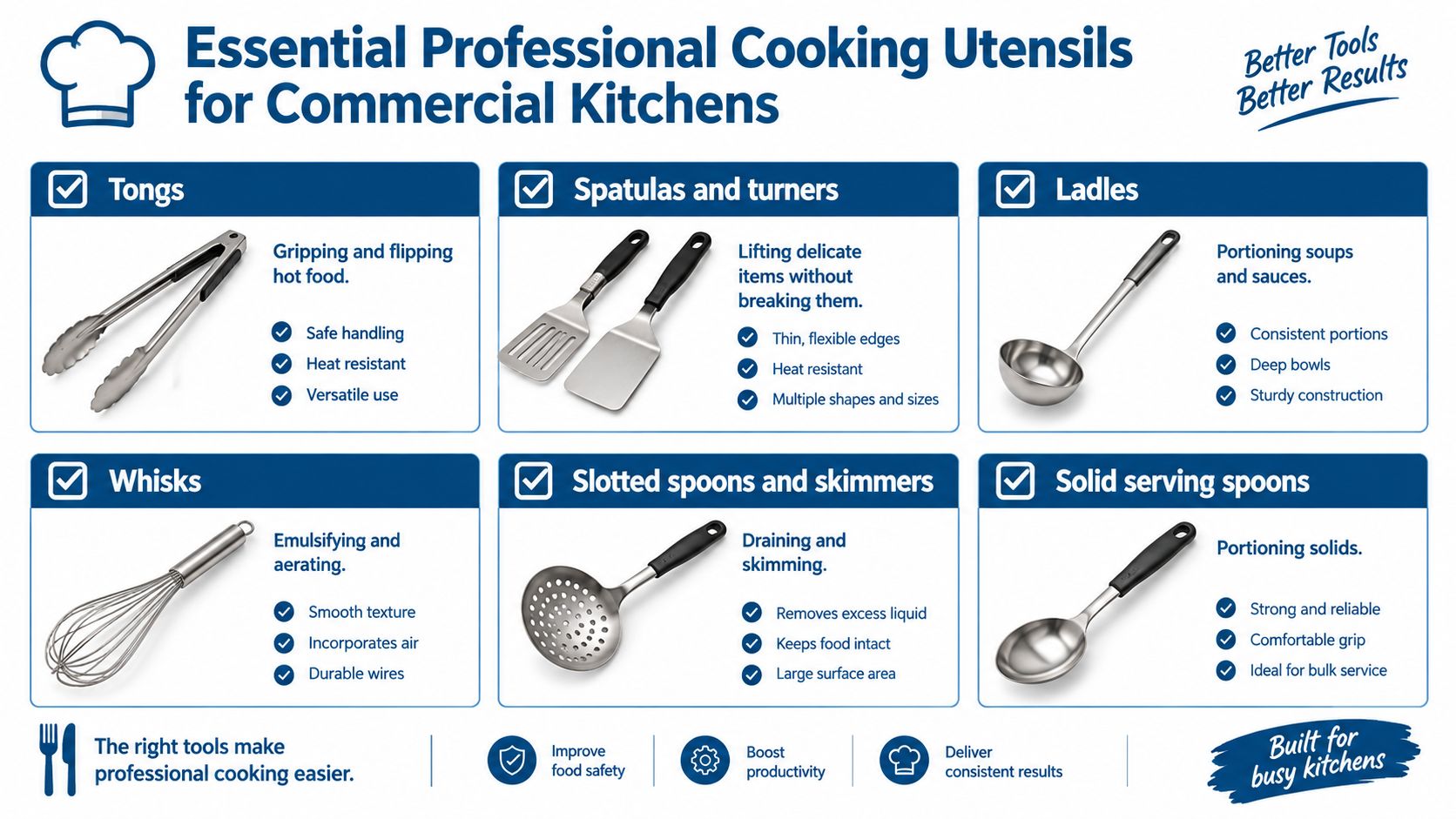
- Tongs: Useful for turning, gripping, plating and serving. Look for a spring that feels controlled, a secure locking mechanism where required and a handle that stays comfortable during repeated use. Longer tongs help with heat exposure, while shorter versions offer better control at the pass.
- Spatulas and turners: A rigid metal turner suits griddles and heavy-duty cookware, while a thinner or coated-compatible turner is more appropriate for delicate food and suitable non-stick surfaces. Edge shape matters because it determines whether staff can slide beneath food cleanly.
- Ladles: Choose the bowl size and handle length around the portion and vessel. A ladle for a stockpot needs reach and heat protection, while a smaller sauce ladle supports controlled plating.
- Whisks: Balloon, piano and sauce whisks behave differently in bowls, pots and pans. The wires should be securely fixed, and the handle should remain comfortable when emulsifying or aerating for an extended period.
- Slotted spoons and skimmers: These remove food from liquid while allowing drainage. A skimmer with an open, easily cleaned structure is useful for stocks and frying applications, provided its size suits the equipment.
- Solid serving spoons: These support stirring, portioning and service. Bowl shape affects how accurately staff can move solids, grains, vegetables and sauces.
- Silicone spatulas: These are useful for scraping bowls, folding mixtures and working with compatible cookware. The manufacturer's heat rating must match the task.
- Kitchen forks: A sturdy kitchen fork can turn or handle foods where tongs or a turner isn't the best fit. It should be selected for the food and cookware, not treated as a universal replacement.
- Bench scrapers: These help portion dough, lift chopped ingredients and clear a workstation. A smooth, seam-free construction is easier to wipe and inspect.
Chef Inox, Force and other stocked commercial ranges can provide useful starting points, but the product specification still needs checking. The same attention given to commercial chef knives should be applied to smallwares, particularly where grip, balance and repeated cleaning affect daily work.
Stainless Steel, Silicone, Nylon or Wood
No single material is right for every station. Stainless steel is often the practical choice for demanding commercial work because it offers durability and a smooth, cleanable surface when the utensil is well constructed. For acidic or saline foods, operators should ask for the grade rather than accepting “stainless” as a complete specification.
MPI identifies 300-series stainless steel or better as preferred for seafood-contact equipment and notes that 316 gains corrosion resistance from molybdenum. In general service, food-grade 304 or 304L is commonly suitable for tools such as ladles, whisks and tongs. Where brines, seafood, acidic sauces or aggressive cleaning create greater corrosion risk, 316 or 316L may be more appropriate. (MPI guidance on stainless steel for food-contact equipment)
How the materials differ
| Material | Strengths | Limitations |
|---|---|---|
| Stainless steel | Durable, smooth and generally easy to inspect and clean | Can damage unsuitable cookware surfaces and may corrode where grade or construction is poor |
| Silicone | Useful for scraping and compatible with suitable non-stick cookware | Heat tolerance and dishwasher suitability depend on the manufacturer |
| Nylon | Lightweight and often gentle on delicate cookware | Heat limitations must be respected, particularly near griddles, burners and fryer oil |
| Wood | Useful for selected preparation and cooking tasks, with a familiar feel | Condition, cleaning, moisture exposure and food-operation suitability require closer attention |
Silicone works well when a bowl or pan needs to be scraped clean without unnecessary abrasion. Nylon can be practical for delicate cookware, but it shouldn't be treated as a high-heat material just because it feels sturdy. Wood may suit selected tasks, although porous or damaged surfaces require careful assessment in a wet commercial environment.
Material decisions should reflect the task, temperature, cookware surface and cleaning regime. A useful overview of material selection from PureHQ Inc. provides additional context for comparing material properties, but product-specific declarations remain the deciding factor.
Dishwasher suitability isn't universal. The manufacturer's instructions should be checked, especially for bonded handles, coated surfaces, silicone components and wooden tools. Any utensil that arrives visibly pitted, cracked, porous or damaged should be rejected or removed from service because defects are harder to clean and can retain food residue. Further practical context is available in the discussion of wooden utensils in New Zealand kitchens.
Matching Utensils to Cooking Equipment
A utensil that performs well at the plating bench may be the wrong tool over a fryer or stockpot. Selection should begin with the equipment the utensil will touch, the operator's reach and the heat exposure involved.
Match the tool to the station
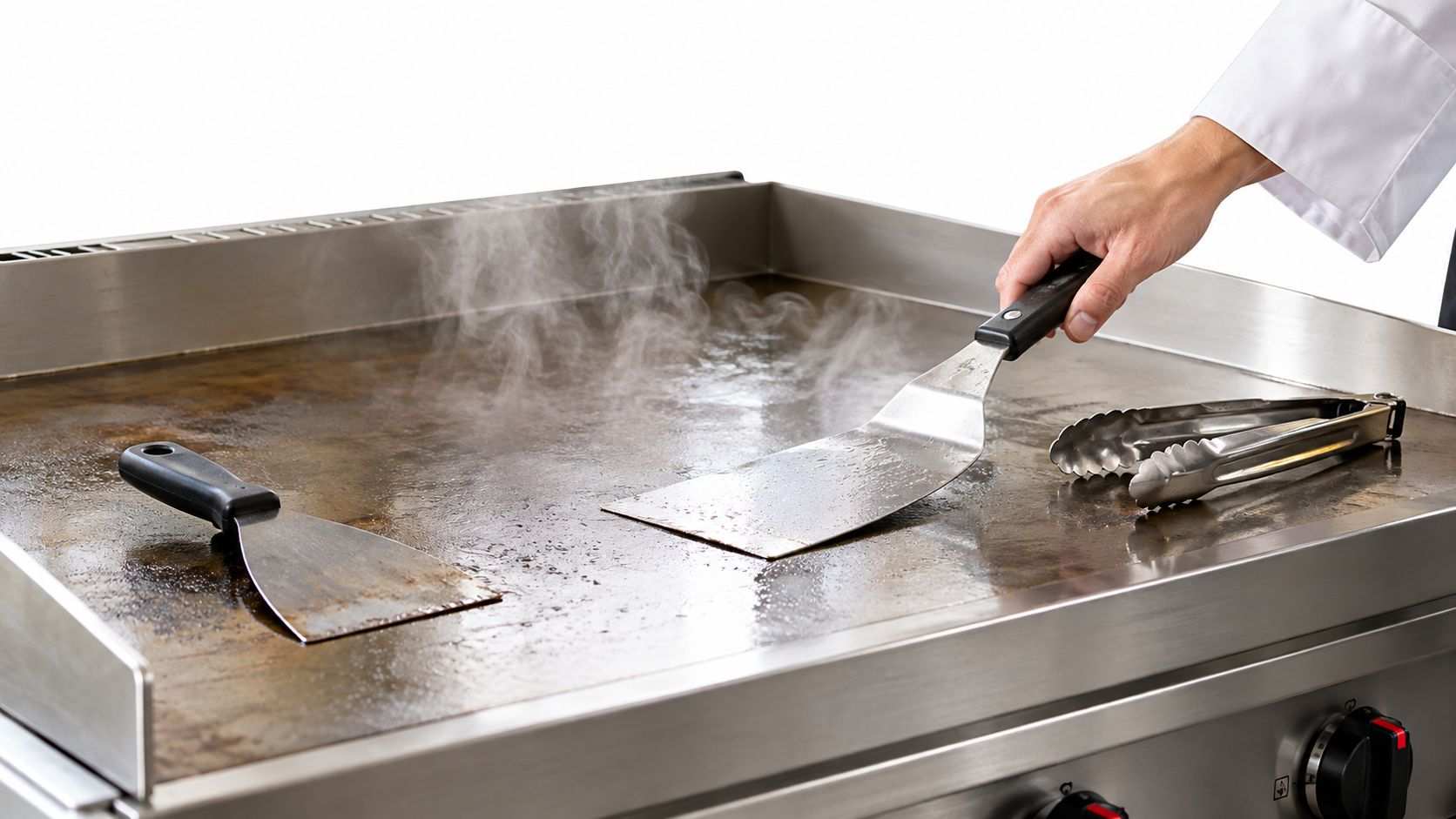
- Commercial griddles: Use turners, scrapers and tongs designed for direct work around hot steel. A flexible plating turner may lack the stiffness needed to lift food from a busy flat top.
- Fryers: Skimmers, baskets and heat-resistant tools should be sized to the fryer tank and the food being removed. Long handles can reduce unnecessary exposure to hot oil.
- Saucepans and stockpots: Ladles and spoons need sufficient length to reach the bottom without forcing the operator to lean over steam or liquid. A short-handled tool may be excellent for plating but awkward and unsafe at a large stockpot.
- Non-stick cookware: Choose compatible silicone or nylon tools where appropriate. A metal edge may work brilliantly on a griddle but unnecessarily damage a coating.
- Combi ovens: Tray-handling and food-handling tools are often overlooked during specification. Handles, reach and heat exposure should be considered alongside the oven workflow.
- Bakeries: Whisks, silicone spatulas, dough scrapers and portioning tools should suit mixing bowls, dough consistency and bench layout.
The operator's hand position matters as much as the material. A long handle can provide reach but become cumbersome in a tight plating area. A shorter handle offers control but may expose hands to heat. Equipment choices also interact with utensil choices, as shown by the practical considerations around an induction cooktop, where pan movement and heat response influence the tools staff use.
Ergonomics, Speed and Kitchen Workflow
At a busy pass, a cook may be turning food in a pan, adjusting a portion, lifting a garnish and reaching for a clean tool within the same minute. Small differences in balance and access become noticeable when that sequence repeats through an entire service.
A ladle that matches the portion reduces guesswork and makes plates more consistent. Tongs with the right length and spring help staff grip food without over-squeezing, while a turner with a suitable edge can lift food cleanly instead of forcing repeated attempts.
What operators should test
- Grip: The handle should remain secure with wet or gloved hands.
- Balance: A tool that feels front-heavy can create unnecessary wrist strain.
- Length: Reach should protect the operator without making precise work awkward.
- Weight: Heavy construction can feel reassuring but may become tiring during repetition.
- Storage: Frequently used tools need a clear, hygienic home near the station.
- Switching tasks: Similar handles and predictable shapes can make it easier to move between tools without searching.
Historical information from Te Ara records that Auckland restaurants and cafés increased from 4,322 in 2000 to 6,633 in 2011, an increase of approximately 53.5 percent. The historical growth underlines why professional utensils need to tolerate higher throughput, repeated sanitising and standardised preparation across shifts. (Te Ara history of restaurants and food outlets)
Professional utensils should make frequent tasks easier, not simply look impressive on a kitchen wall.
Food Safety, Cleaning and Storage
A utensil can look clean and still be unsuitable for service. MPI distinguishes between cleaning, which removes dirt and grease, and sanitising, which kills harmful microorganisms on surfaces. Food-contact equipment needs both processes, followed by suitable storage and handling. (MPI cleaning and sanitising guidance)
Construction affects whether staff can complete those steps properly. One-piece tools, sealed handles, rounded transitions and fewer dirt-trapping joints are generally easier to scrub, rinse, sanitise and inspect. Operators should confirm that the dimensions and construction suit the site's commercial dishwasher cycle rather than assuming every stainless or silicone tool is dishwasher-safe.
Separate the workflow, not just the drawer
MPI advises using separate equipment for raw foods and cooked or ready-to-eat foods, or thoroughly cleaning and sanitising between activities. Its guidance specifically recommends different tongs for raw food and cooked or ready-to-eat food. The same principle applies to allergen-free preparation, where separate equipment or carefully controlled preparation times can reduce cross-contact. (MPI food allergy guidance)
Colour-coded or dedicated utensil sets can make the system easier to follow under pressure. MPI also advises that wiping and rinsing alone aren't effective methods for removing allergens, and its food control plan requires clean utensils for each type of food. Reusable utensils that become dirty must be replaced or cleaned and sanitised regularly during service. (MPI Food Control Plan requirements)
Commercial utensil washing requirements specify wash water of at least 60°C, followed by a clean-water rinse of at least 77°C for at least 10 seconds. (New Zealand commercial utensil washing requirements)
A practical daily inspection
- Check handles and joints: Remove tools with looseness, cracks or exposed components.
- Check working edges: Look for chips, deformation, broken scraper edges or coating damage.
- Check surfaces: Reject pitting, porosity and deep scratches that are difficult to clean.
- Check storage: Keep cleaned tools protected from splash, dust and contact with dirty equipment.
- Check separation: Confirm raw, ready-to-eat and allergen-control tools remain in their designated locations.
A utensil that could shed a fragment or retain food residue shouldn't stay in service because it still appears usable.
For further operational detail, the guidance on preventing cross-contamination can help connect utensil selection with broader kitchen procedures.
Are Expensive Professional Utensils Worth the Higher Price
Price matters, but it shouldn't lead the decision. The more useful calculation is:
Purchase cost + durability + replacement frequency + cleaning practicality + suitability for the task.
A well-made stainless steel utensil may justify a higher initial price in a busy kitchen if its construction suits repeated washing and daily handling. An inexpensive specialist tool can also be perfectly sensible when it performs an occasional task and staff can inspect and replace it easily.
Spend where the hand goes most often
The best professional cooking utensils are usually the tools staff reach for repeatedly:
- Tongs used throughout service.
- Turners working over a hotplate.
- Ladles controlling portions.
- Whisks used for sauces, batters or emulsions.
- Scrapers used across a bakery or prep bench.
Large sets often include tools that rarely leave the drawer. That isn't value if the kitchen still needs to buy extra versions of the two or three utensils that wear out first. A smaller core collection, backed by a few task-specific additions, usually gives operators clearer control over storage, training and reordering.
A higher price is easier to justify when the tool solves a repeated problem. It isn't justified by a premium label alone.
Choosing Utensils for Different Hospitality Businesses
Venue type provides a useful starting point, but the menu and service pattern matter more than the floor area. A small restaurant with several specialist cooking methods may need more varied utensils than a larger café with a compact menu.
Restaurants
Restaurants generally need durable everyday tools supported by specialist equipment for the menu. A grill-focused operation may prioritise strong turners, tongs, scrapers and skimmers, while a sauce-led kitchen may need a carefully selected range of ladles, whisks and silicone spatulas.
Plating tools should be chosen for control rather than appearance. Staff need utensils that sit comfortably at the pass, clean easily between tasks and can be replaced individually when a favourite tool is damaged.
Cafés
Cafés often benefit from versatile utensils that move between breakfast, lunch, baking and service tasks. Tongs, turners, whisks, portioning spoons and silicone spatulas should fit the available bench and storage space.
Compact storage has practical value where several stations share one smallwares area. A café doesn't necessarily need every size of ladle or whisk. It needs the sizes that match its pans, bowls, recipes and service rhythm.
Bakeries
Bakeries place greater emphasis on dough scrapers, whisks, silicone spatulas, mixing tools and portioning equipment. Bench scrapers should be comfortable to hold and easy to clean around the working edge.
The right tool also depends on dough consistency and batch work. A utensil chosen for light batter may be unsuitable for a dense mixture, while a flexible scraper can be useful for bowl recovery but not for every bench-cutting task.
Caterers
Caterers need reliable serving utensils, ladles, tongs and equipment that can move safely between preparation, transport and service. Handles should remain practical when food is served from deep containers, and storage should prevent clean tools from contacting unsuitable surfaces.
Quantity planning matters because separate tools may be required for different foods, stations or allergen-control workflows. A catering operation shouldn't assume one serving spoon can move safely between dishes throughout an event.
Hotels and institutional kitchens
Hotels, schools, hospitals, aged-care kitchens and marae often benefit from consistent specifications across teams. A standard handle style, clear colour coding and straightforward cleaning process can help staff work consistently despite shift changes and varied experience.
Centralised procurement should also consider replacement. If a utensil is familiar, cleanable and available as an individual item, replacing one damaged tool is simpler than retraining staff around an entirely different set.
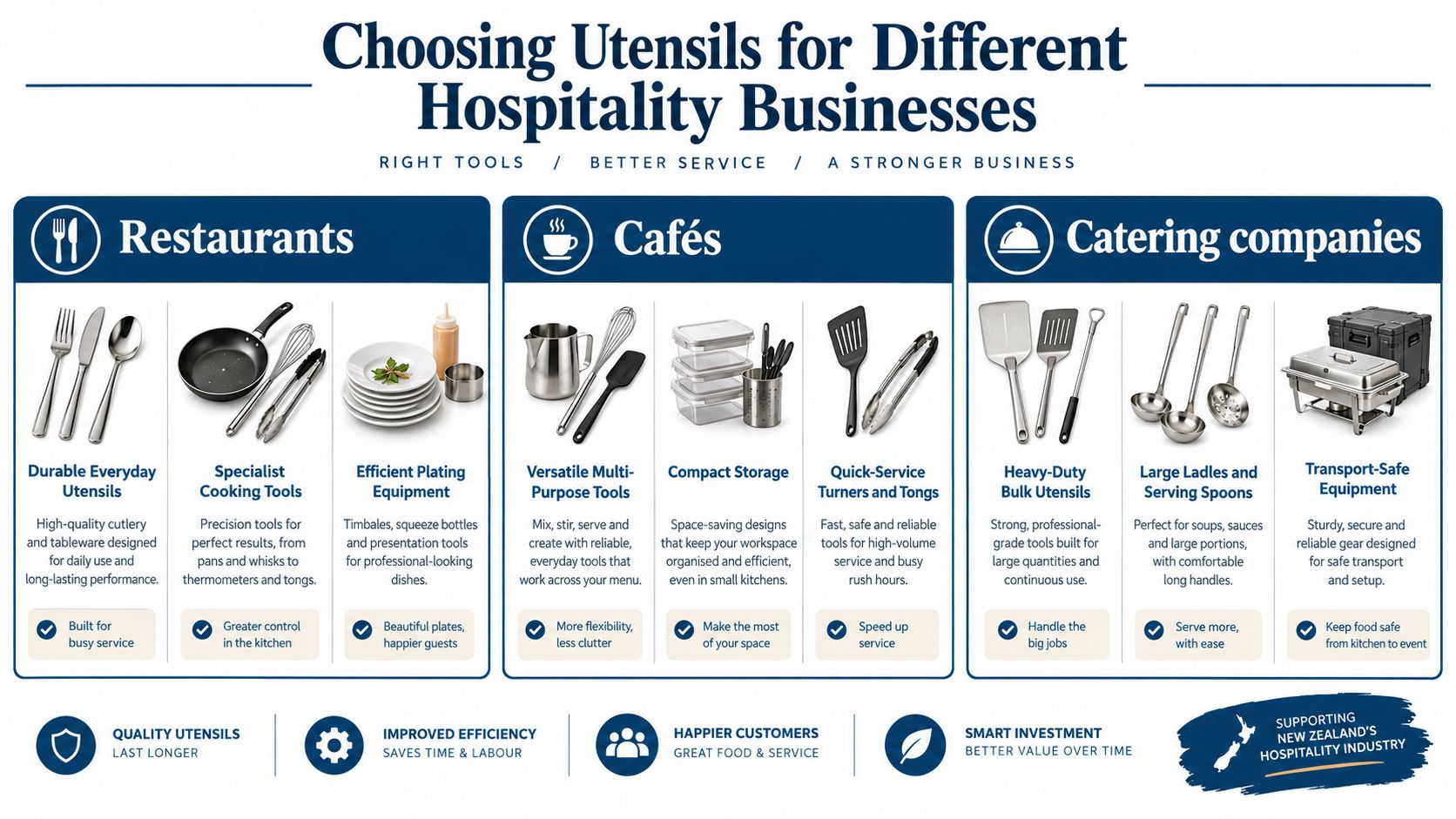
A practical baseline for many operations could include tongs, a turner, a ladle, a whisk, a slotted spoon, a solid spoon, a silicone spatula and a bench scraper. That list should be adjusted to the menu, equipment and service volume, then expanded only when staff identify a real workflow gap.
Operators can compare current options across Simply Hospitality's commercial kitchen utensils, tongs, spatulas, ladles, whisks, skimmers, cookware and kitchen smallwares. Chef Inox, Force and other stocked commercial ranges should be assessed by material, dimensions, handle length, construction and the manufacturer's cleaning instructions.
| Utensil type | Best application | Recommended material or features | What to check before buying |
|---|---|---|---|
| Tongs | Turning, gripping, plating and serving | Stainless construction, controlled spring and suitable length | Grip, locking action, joint construction and cleaning access |
| Turners | Griddles, frying and delicate foods | Rigid stainless steel for suitable cookware, or compatible silicone or nylon | Edge profile, flexibility, heat exposure and cookware compatibility |
| Ladles | Soups, sauces, stocks and portioning | Smooth bowl, secure handle and size matched to service | Bowl capacity, handle reach, balance and storage |
| Whisks | Sauces, batters and emulsions | Securely fixed wires and comfortable handle | Wire shape, bowl compatibility, joins and cleaning |
| Skimmers | Stocks, frying and draining | Open, smooth construction with appropriate reach | Mesh or perforation design, handle length and fryer suitability |
| Solid spoons | Stirring, portioning and serving | Smooth stainless, suitable wood or other task-appropriate material | Bowl shape, surface condition and cleaning instructions |
| Silicone spatulas | Scraping, mixing and compatible cookware | Food-grade silicone with manufacturer-stated heat rating | Heat rating, handle bonding, flexibility and dishwasher guidance |
| Bench scrapers | Dough handling, portioning and bench cleaning | Smooth stainless steel or another suitable, easy-clean construction | Edge condition, grip, rigidity and storage |
Hospitality supplies commercial kitchen equipment and smallwares for hospitality operators, so its team can help compare utensil specifications against a menu, equipment list and cleaning process. Visit Simply Hospitality to review the relevant collections and contact the team when a kitchen needs help building a fit-for-purpose utensil selection rather than an oversized set.